
Bite-sized threads showing stuff working, sometimes not working too. We can learn from both. Check out my site for my latest projects.
Joined October 2025
- Tweets 2,878
- Following 574
- Followers 1,281
- Likes 2,504
1,163 Photos and videos







Pinned Tweet

Me watching my Senior Engineer perform black magic (he fixed something)
1
9
1,207
Stuff Working Good retweeted

New month- New sheets😏
6/3 HR/Bases Looks👀
Going to be making these more stat filled as time goes on. I’m just trying it out for my first time today!
Inspired by @ArcherTargets thanks


1
6
727
Stuff Working Good retweeted
Learn how 1 million pound planes actually fly
1
2
46
Blue Origin's New Glenn just blew up at LC-36 while attempting to Static Fire ahead of NG-4.
The explosion occurred around 9 PM EDT tonight during an attempt to ignite the rocket’s seven BE-4 first-stage engines ahead of NG-4, which was slated to carry 48 Amazon Project Kuiper satellites. No injuries were reported.
The explosion destroyed the rocket, its launch equipment, and a lightning protection tower.
NG-3 had already lost its payload due to a second stage anomaly, so NG-4 was supposed to be the recovery mission - and the first of 24 Amazon-contracted launches.
Bezos posted on X: “It’s too early to know the root cause but we’re already working to find it. Very rough day, but we’ll rebuild whatever needs rebuilding and get back to flying.”
1
1
198
A CNC (Computer Numerical Control) machine starts with a digital design file – typically a CAD model – that gets translated into G-code, a language of coordinates and motion commands. The machine’s controller reads this code and converts it into precise electrical signals sent to stepper or servo motors, which drive movement along multiple axes (X, Y, Z, and sometimes rotational axes). Every cut, pass, and position change is executed by following this pre-programmed sequence with no manual input required during the run.
The cutting itself depends on the machine type. A milling machine spins a cutting tool against stationary material, removing it in layers. A lathe spins the material while a stationary tool removes it. A router, plasma cutter, or laser each use different energy delivery mechanisms, but the motion control logic is the same across all of them. The tool path – the exact trajectory the cutting head follows – is generated by CAM software, which optimizes for things like cut depth, feed rate, and tool wear.
Feedback is what separates a good CNC machine from a great one. Closed-loop systems use encoders on the motors to continuously report actual position back to the controller, correcting for any drift or error in real time. Open-loop systems (cheaper, more common in hobbyist machines) just trust that the motor moved where it was told – which works fine until it doesn’t, like when a stepper skips steps under load.
A well-tuned CNC machine can hit tolerances in the range of ±0.001 inches, run the same program a thousand times, and produce the same part each time. That consistency is what makes it foundational to modern manufacturing.
3
212
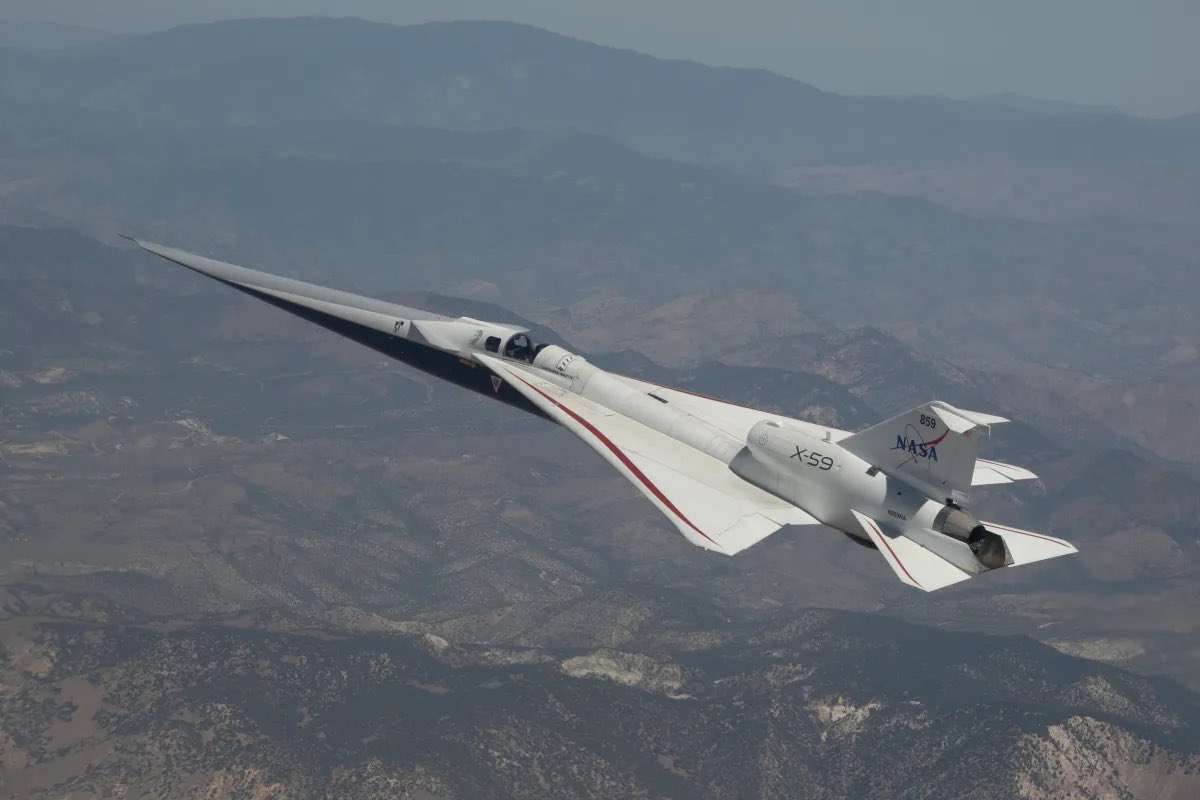
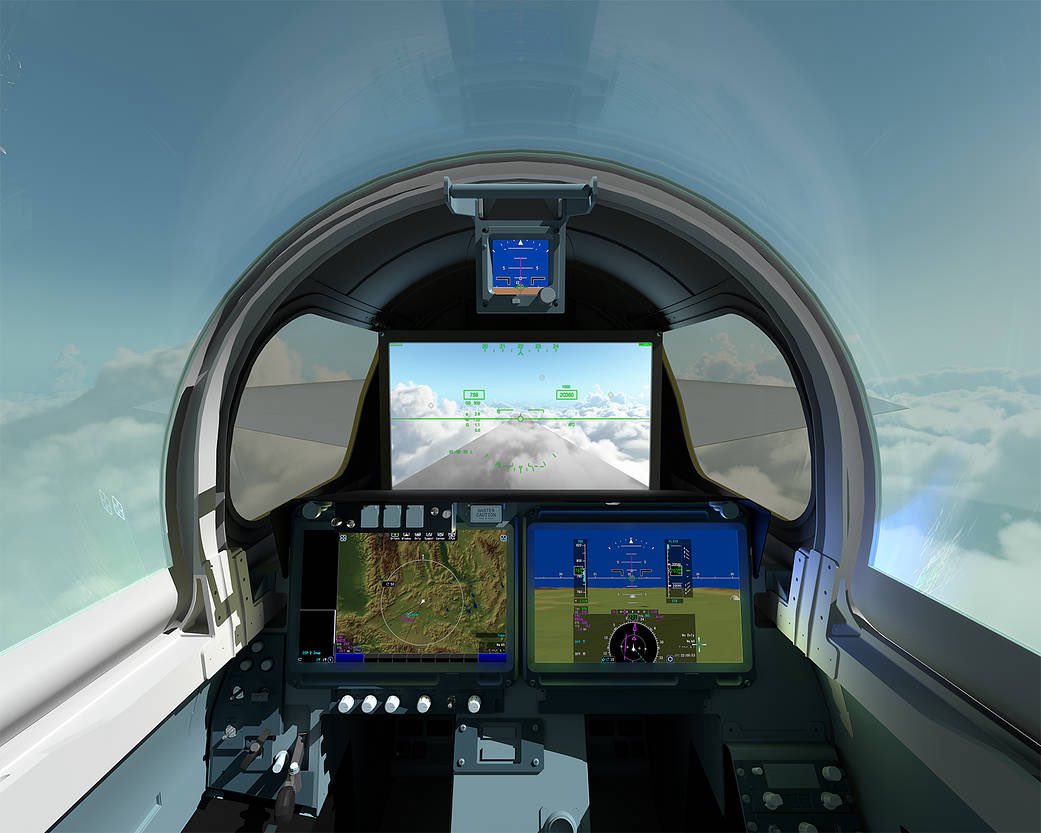
NASA’s X-59 Prepares for First Supersonic Flight
The X-59 made its first flight in October 2025, went through scheduled maintenance, then returned in March 2026. It has since completed 14 additional flights , working through envelope expansion at lower altitudes and subsonic speeds.
It’s about to begin a new block of test flights that will include its first time flying faster than the speed of sound. The target is Mach 1.4 (925 mph) at a “mission conditions” flight altitude.
NASA’s Quesst mission will then survey how people respond when the X-59 flies overhead, sharing reactions to the quieter sonic “thumps” with national and international regulators to inform new data-driven noise thresholds for supersonic commercial flight over land.
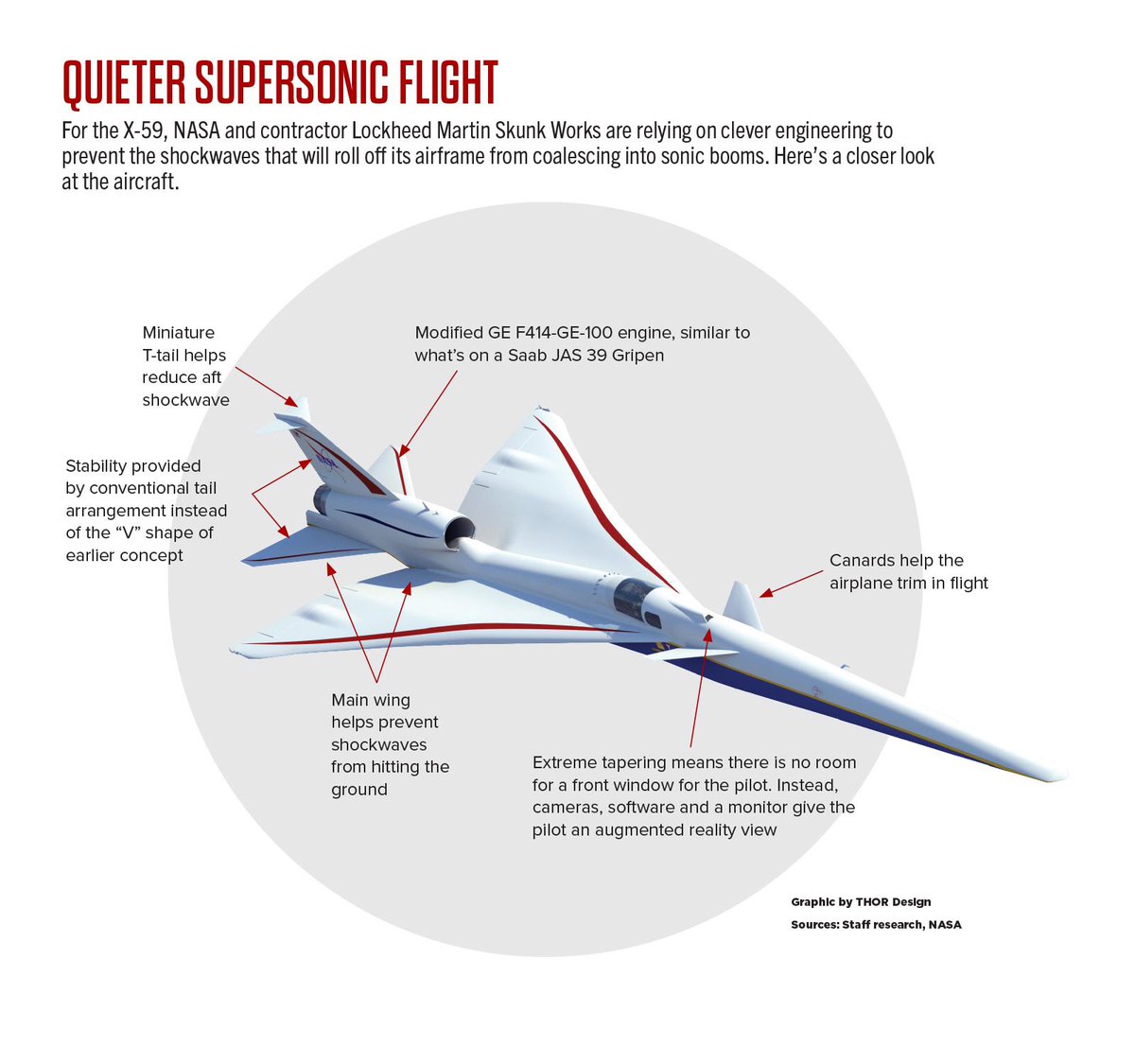
The core engineering trick – shaping the airframe so shockwaves don’t coalesce into a single N-wave boom – is the real story. If the community noise data holds up, it’s the regulatory unlock that Boom Supersonic and others need to operate over land without the Concorde-era restrictions.
1
1
85
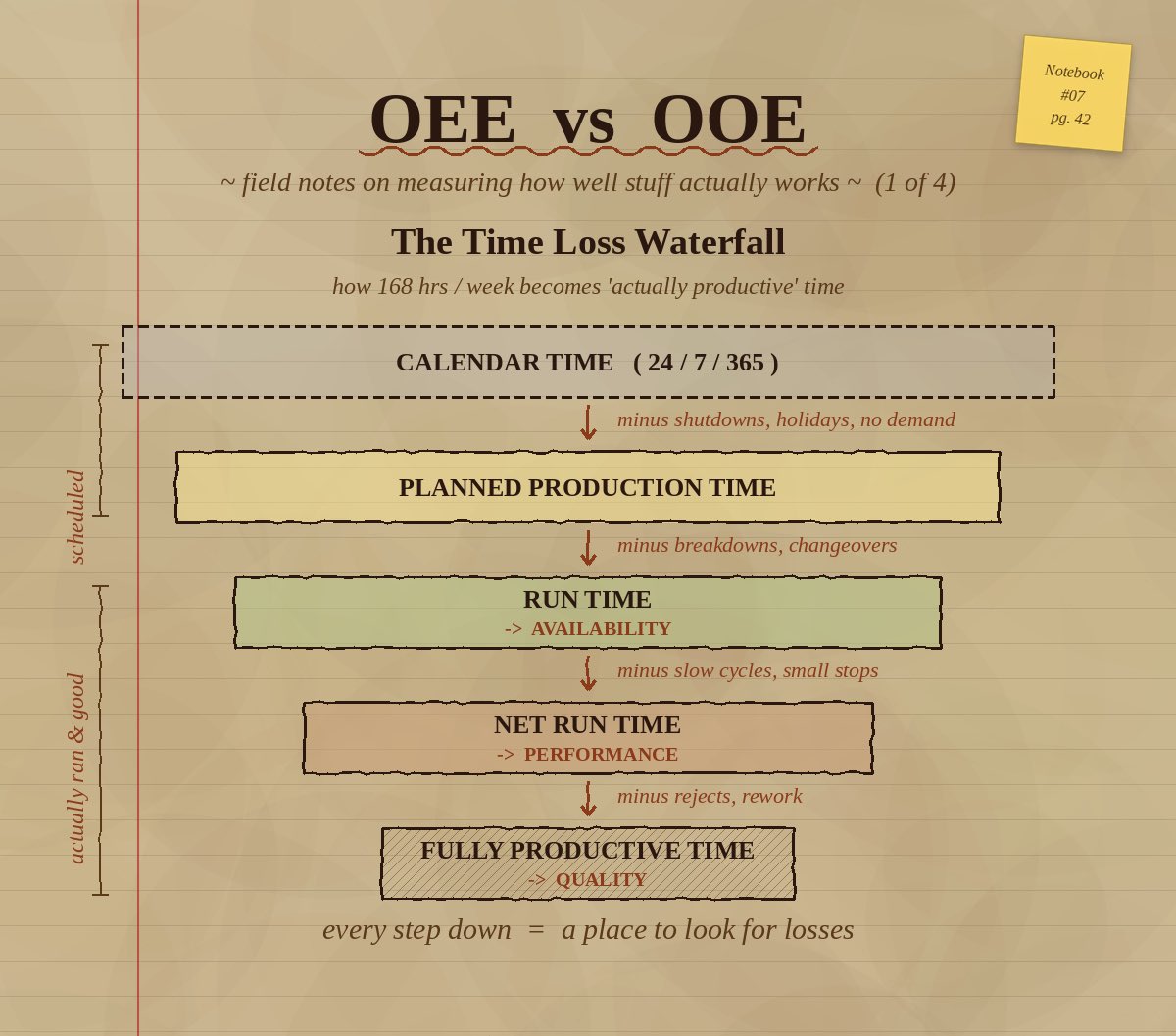
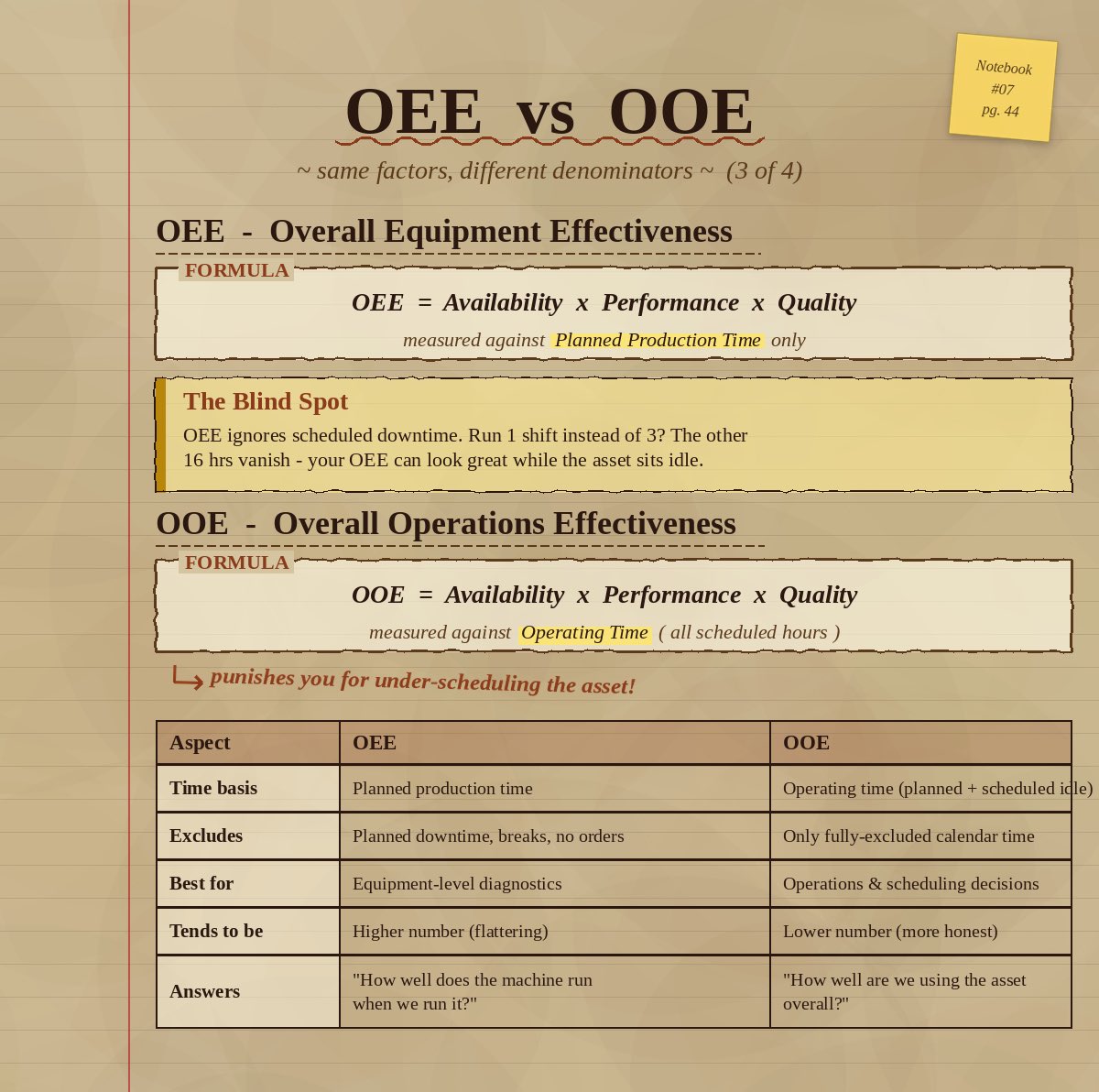
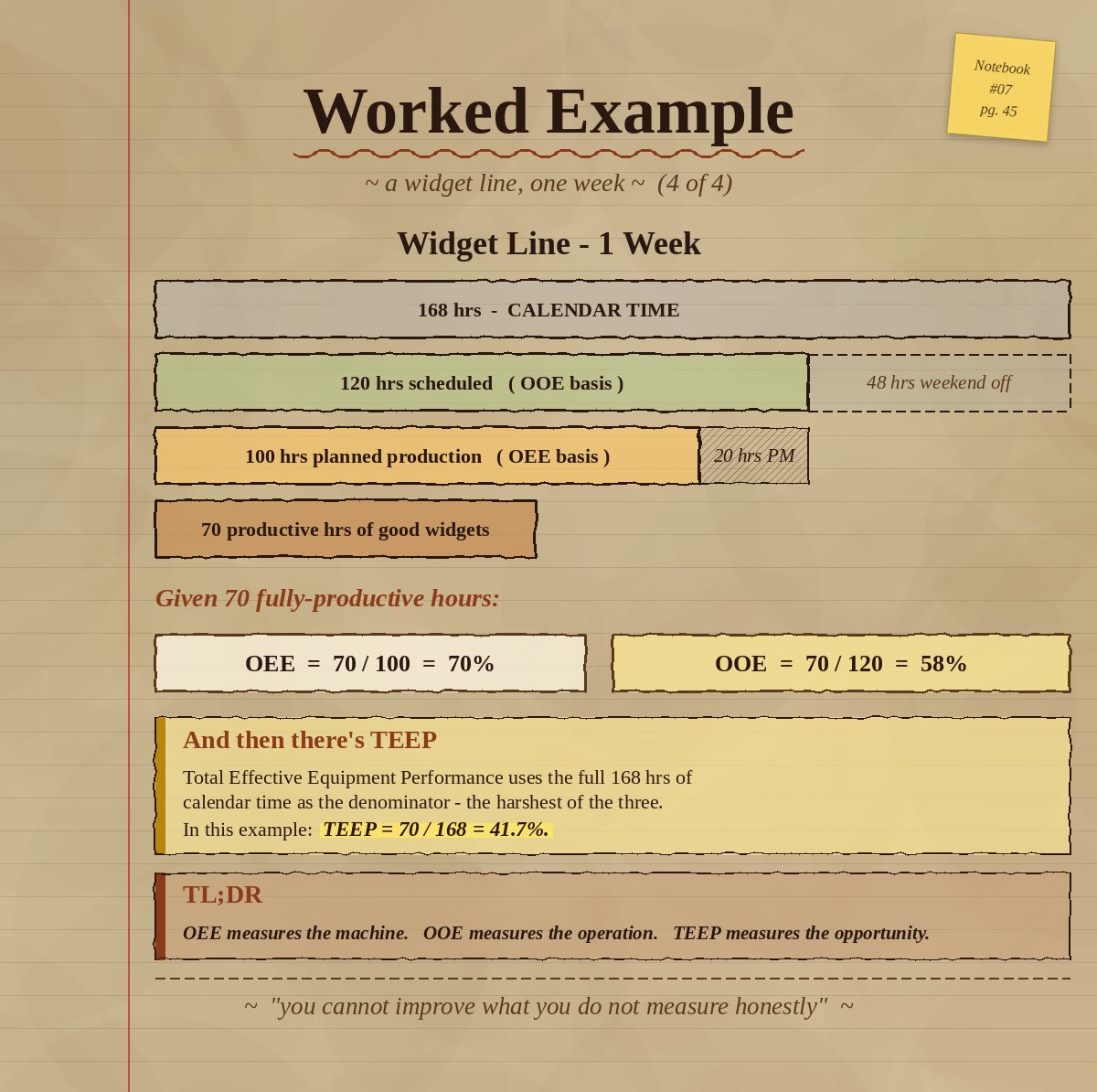
OEE and OOE measure the same three things - Availability, Performance, and Quality - but against different denominators. OEE only counts the hours you planned to run, so it tells you how the machine performs when you actually use it. OOE counts all the hours the asset could’ve been scheduled, which exposes the shifts you never staffed. Same week, same equipment, two different numbers.
The example in the deck shows it: 70 productive hours out of a 100-hour plan is 70% OEE, but against the 120 hours that were actually available it drops to 58% OOE. Neither number is wrong. They just answer different questions: one’s about the machine, the other’s about how you’re using it. TEEP takes it further and uses the full 168-hour week, which is useful when you’re deciding whether to buy more capacity or just add a shift.

35
Stuff Working Good retweeted

May 25
I logged in today and found that my follower base has doubled overnight....why is that - because I am posting things that I do, things that I enjoy, and my story. It resonated with people, X is teeming with engineers, developers, techs, and everything in between. This kind of content is necessary. X isn't just a debate stage for politics, it's full of very interesting and capable people, which is obvious. I honestly never knew it. I have thousands of people to follow back, and I will - its going to take a bit since there are follow back limits, but I'll work tough it. For now - here's a massive robotic welding cell we were building that had an 8000# welding fixture, 2x Fanuc M710iC/20L welding robots, Lincoln welding equipment, a Gudel servo RTU track. This fixture is mounted on a custom designed headstock system that has dual-sync servo drives from both ends - for both rotation and lift. We had to lower the entire fixture down so it could be loaded, then raise it back up so that it can rotate about its horizontal axis... so dual sync rotary and dual sync raise/lower. We built it all in-house with CNC mills, CNC lathe, CNC waterjet, powder coated in-house, I had to send out the yellow structure for stress relief and machining on a large format horizontal. This one pushed the boundary for my company, but we did it anyway.
33
32
897
26,779
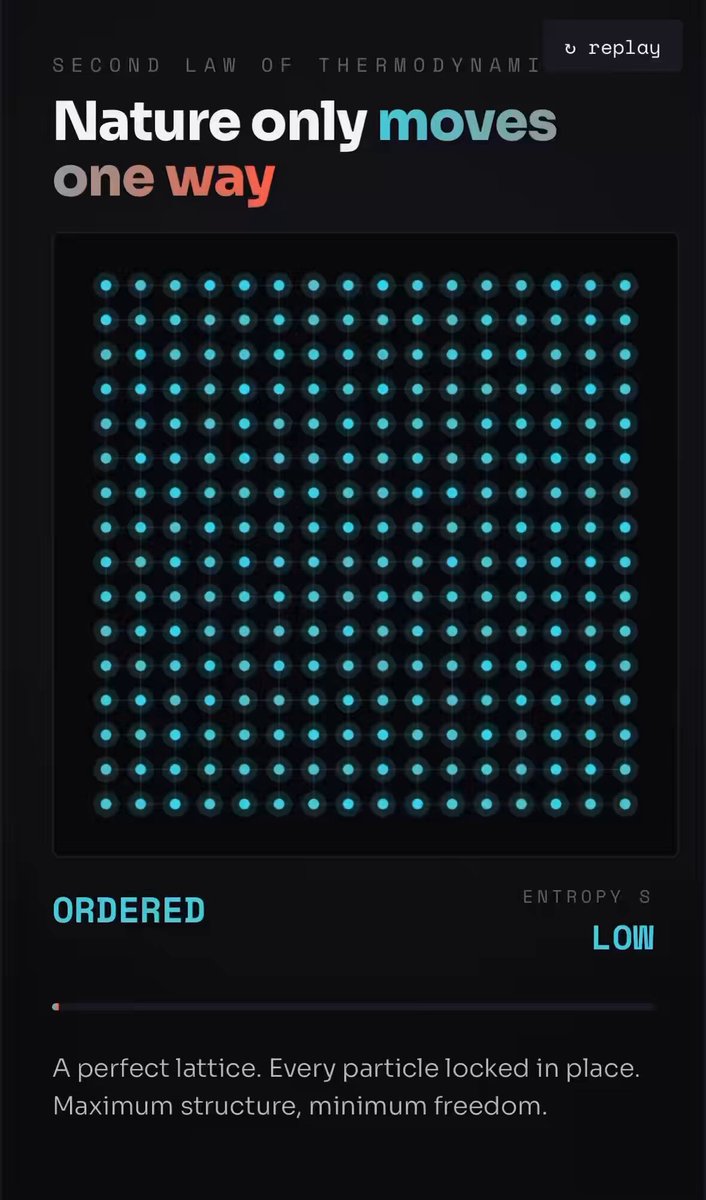
Entropy is the universe’s most reliable tendency. Every system - a gas, a room, a star - has vastly more ways to be disordered than ordered, so disorder is simply what happens when nothing forces order to persist. A shuffled deck has 52 factorial possible arrangements. Only one of them is perfectly sorted.
The particles in the simulation start locked in a lattice because that takes energy to maintain. Add heat, and that energy spreads out. Bonds loosen, positions drift, and the tight grid dissolves into a random scatter. No single particle is doing anything unusual. The chaos is just the outcome of many small freedoms stacking up.
What makes entropy strange is the direction. Nothing in the laws governing individual particles prevents the reverse. A scrambled system could spontaneously re-order itself, and physics would not object. It just never happens, because the number of disordered states so overwhelmingly outnumbers the ordered ones that the probability of going backwards is effectively zero. That asymmetry is why time feels like it moves in one direction.
46
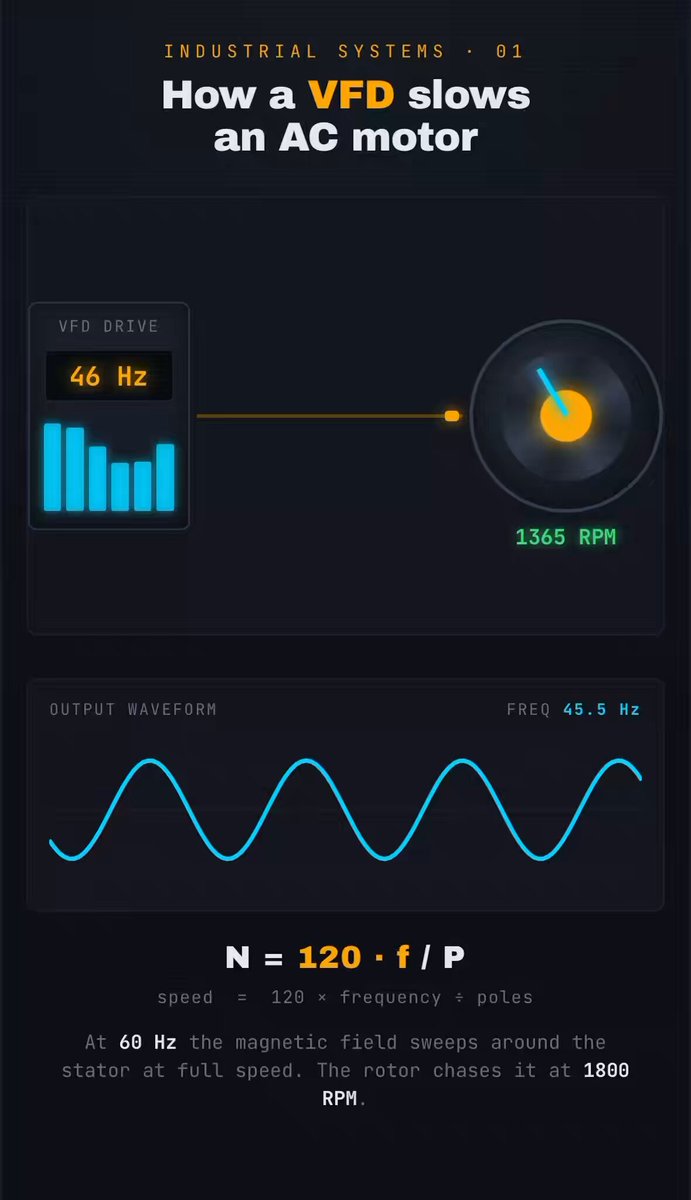
An AC induction motor spins because of a rotating magnetic field produced by alternating current in the stator windings. The speed of that rotating field is set entirely by the frequency of the AC supply and the number of poles built into the motor. For a standard 4-pole motor on 60 Hz power, that works out to 1800 RPM. The rotor just chases the field, so whatever speed the field rotates at, the rotor follows close behind.
A VFD controls motor speed by rebuilding the AC waveform from scratch. It first rectifies the incoming AC to DC, then uses transistors switching on and off at high speed (PWM) to synthesize a new AC output at whatever frequency you dial in. Lower the output frequency and the rotating field slows down. The rotor has no choice but to slow with it. There are no mechanical brakes involved, no throttling of power like a valve restricting flow. You are literally changing the fundamental electrical quantity that determines speed.
One thing the VFD has to manage alongside frequency is voltage. The torque a motor produces depends on the ratio of voltage to frequency staying roughly constant. If you drop frequency without dropping voltage, the motor core saturates and overheats. So a VFD tracks both together on what is called a V/Hz curve, keeping the motor in a healthy operating region across the entire speed range. That is what separates a VFD from simply putting a resistor or a transformer in the circuit.
48
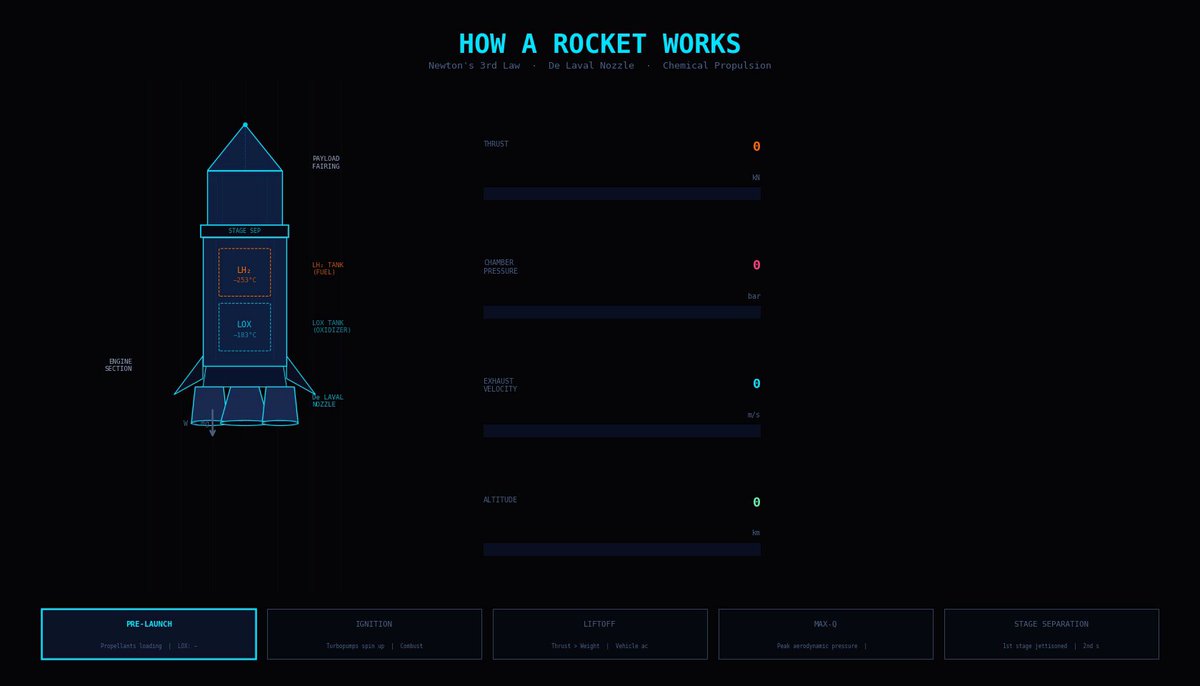
A rocket operates on one of the most elegant principles in physics: Newton’s Third Law of Motion. For every action, there is an equal and opposite reaction. Inside the rocket’s engine, liquid oxygen and liquid hydrogen are pumped into a combustion chamber at extreme pressure, where they combust at roughly 3,300°C. The resulting hot gas expands violently and is directed downward through a precisely shaped nozzle. That downward exhaust is the “action” - and the rocket shooting upward is the “reaction.”
The nozzle itself is a marvel of engineering called a De Laval nozzle. Its converging-diverging shape accelerates exhaust gas from subsonic to supersonic speeds - up to 4,500 meters per second - converting thermal energy into pure kinetic thrust. The faster and heavier the exhaust, the greater the thrust force pushing the vehicle upward. This relationship is captured in the rocket equation: thrust equals mass flow rate multiplied by exhaust velocity. Getting that exhaust velocity as high as possible is why engineers choose cryogenic propellants over simpler fuels.
Once liftoff occurs, the rocket faces its next challenge: the atmosphere. As it accelerates through thickening air, aerodynamic pressure on the vehicle builds to a peak called Max-Q - the moment of maximum structural stress. Engineers throttle the engines back slightly at this point to keep forces within safe limits. Once through it, the first stage burns out and separates, dramatically reducing the vehicle’s mass. A lighter rocket needs far less thrust to keep accelerating - and that staged design is ultimately what makes reaching orbit physically possible.
2
43
Stuff Working Good retweeted
Someone made a recreation of the in-ship map in Project Hail Mary
valhovey.github.io/gaia-mary…
1
3
260
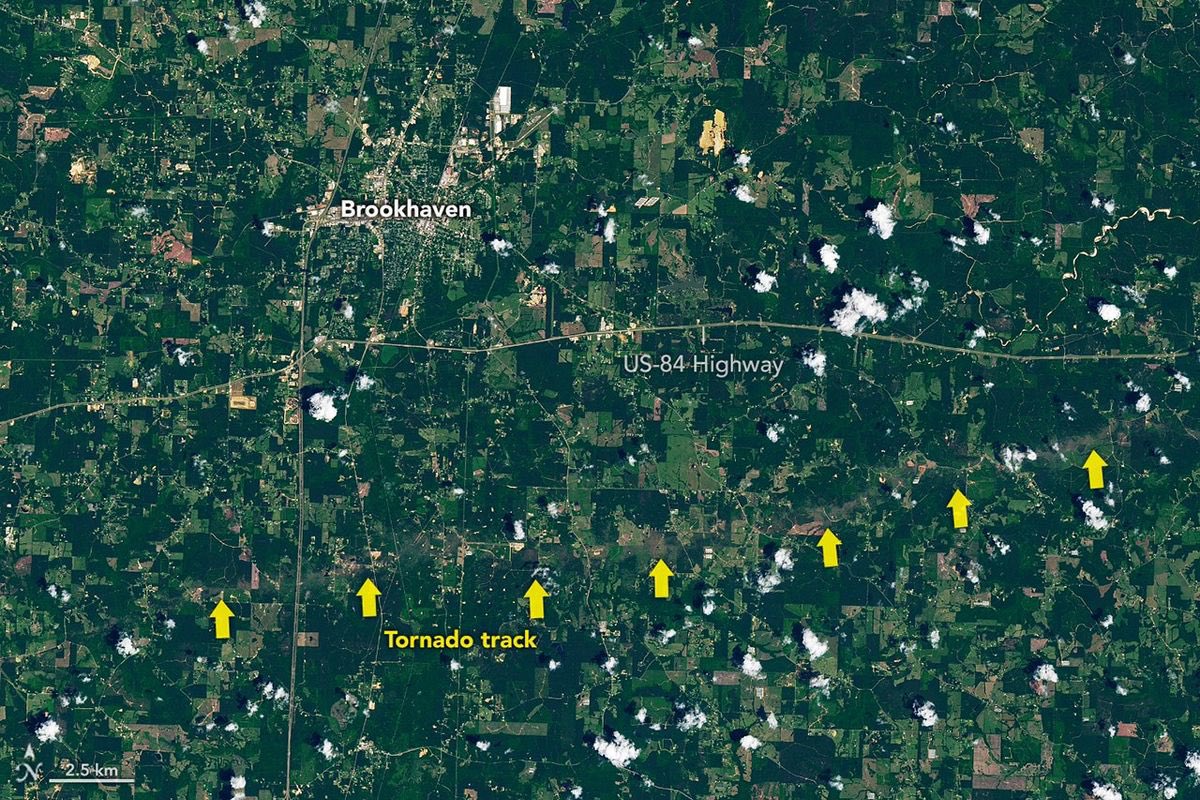
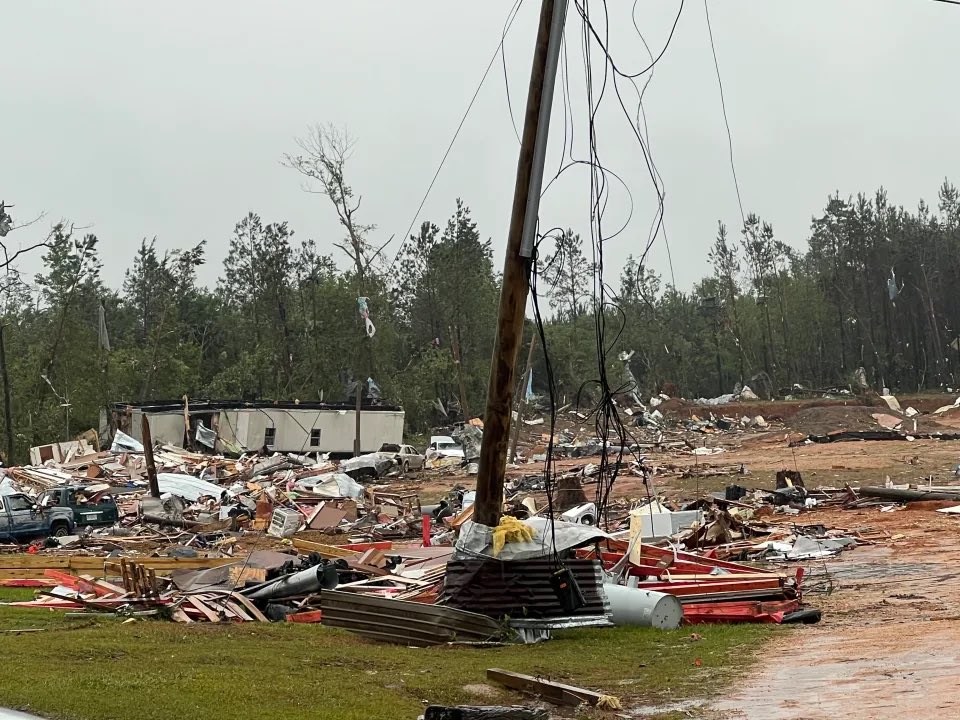
May 6th - an EF-3 tornado in southern Mississippi left a long visible scar across forests and vegetation that could be seen from space in a Landsat 8 satellite image.
The tornado struck on May 6, 2026, during a broader severe weather outbreak that produced seven tornadoes across Mississippi. The tornado’s damage path stretched about 82 miles (132 km), making it one of the longer tornado tracks recorded in the state. It began near the Mississippi River in the St. Catherine Creek National Wildlife Refuge and moved eastward for over two hours.
In the satellite image, the tornado path appears as a jagged tan line cutting through green forested areas. The lighter color comes from vegetation being stripped, uprooted, or damaged by the tornado’s winds. NASA notes that the visible track only shows part of the overall destruction.
The storms caused widespread damage statewide. According to Mississippi emergency officials, more than 400 homes plus many businesses and farm buildings were damaged, especially in Lincoln County.

72
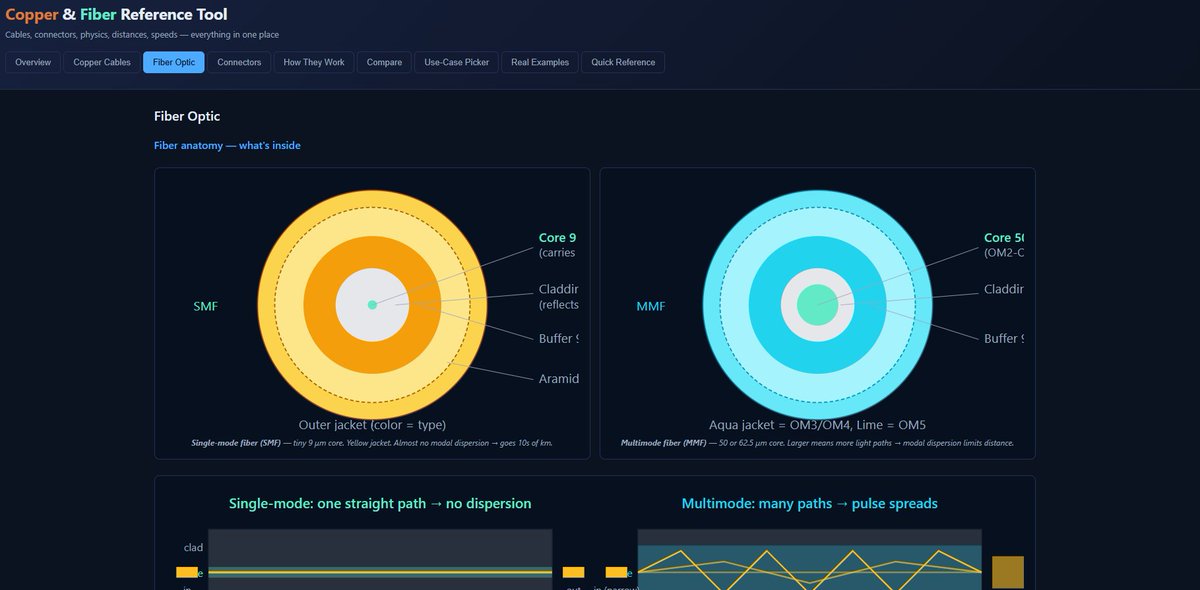
Will be adding to this for anyone who is interested in network cabling as we enter this new world:
stuffworkinggood.github.io/n…
39
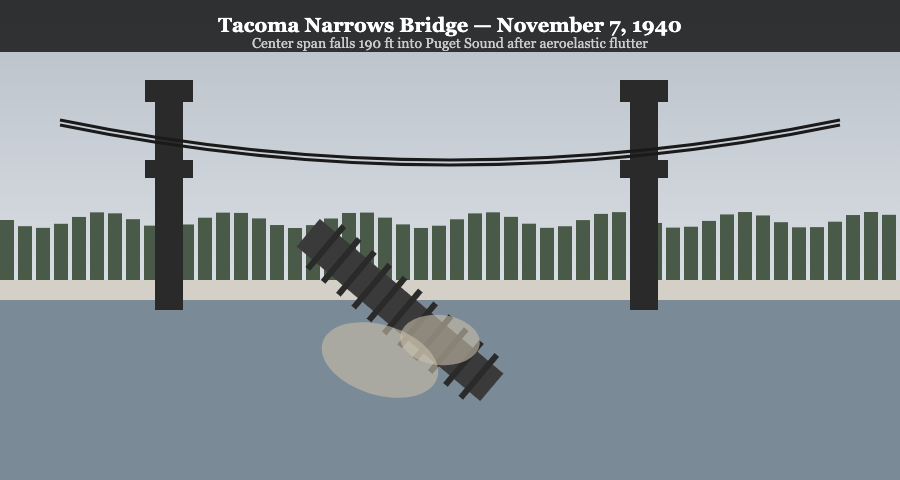
Thought it was cool so I made this:
stuffworkinggood.github.io/S…

Someone made a recreation of the in-ship map in Project Hail Mary
valhovey.github.io/gaia-mary…
1
1
75
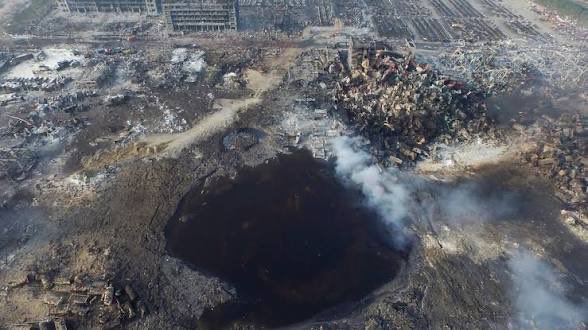
In 2015, firefighters in Tianjin, China sprayed water on a chemical warehouse fire. The explosion that followed killed 173 people.
1
2
650
The warehouse stored calcium carbide. Contact with water produces acetylene gas. It also stored sodium cyanide, ammonium nitrate, and dozens of other incompatible materials ~ 40 times the legally permitted quantity.
The first responders had no manifest. No one told them what was inside.
The initial blasts registered as a 2.9 and 3.0 magnitude seismic events. The crater left behind was 6 meters deep. Shipping containers were thrown hundreds of meters. A shockwave shattered windows miles away.
The site was a port warehouse in a dense urban area, 600 meters from residential buildings. Permitted minimum distance was 1000 meters. Permits were obtained anyway through connections with local regulators.
Every safeguard in the system - material limits, separation distances, emergency response information - was either bypassed or ignored. The firefighters did exactly what they were trained to do.


1
144