
Joined July 2025
- Tweets 355
- Following 3
- Followers 281
- Likes 268
60 Photos and videos




Pinned Tweet

1 Aug 2025
🚀 HyMatrix Testnet is LIVE!
A Decentralized Global Computer powered by Storage-based Consensus (SCP) — high-performance, verifiable, and open to all.🔥
Developers & Node Operators — Join Now!
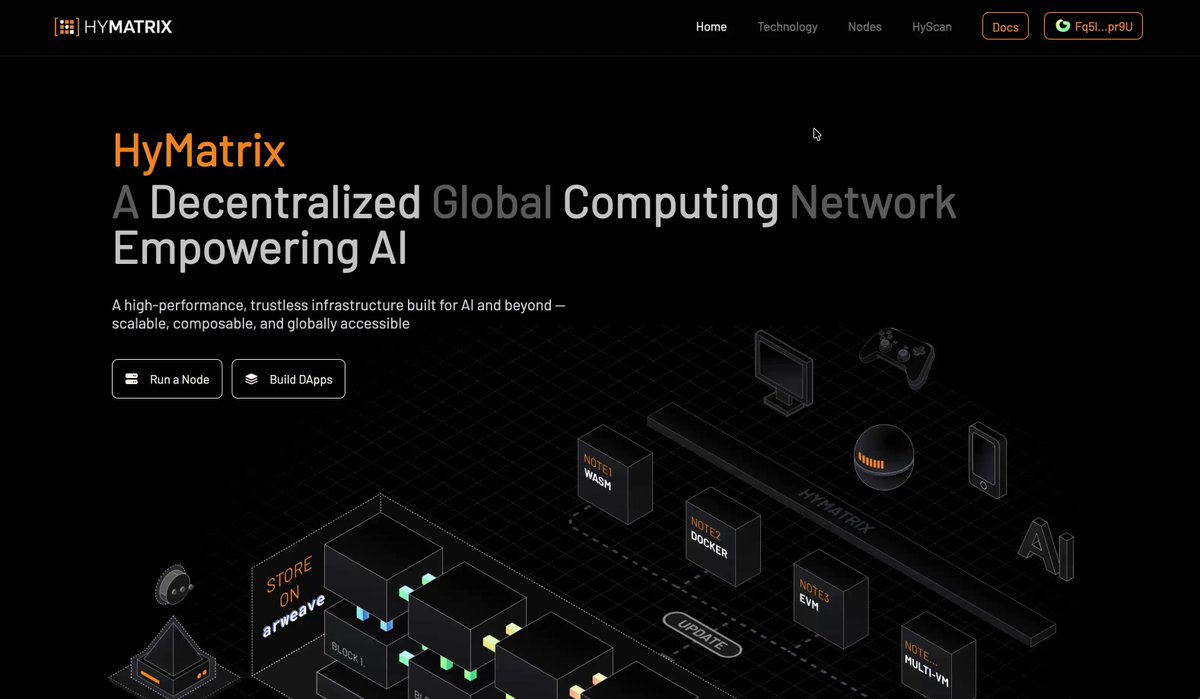
🏷️Multi-VM: Run Docker / WASM (EVM soon) or bring your own VM.
🏷️4000 TPS per VM: Scale to unlimited concurrent compute.
🏷️Immutable logs: Every input, process & output stored on @ArweaveEco — verifiable & replayable.
🏷️Open compute marketplace: Stake $tAX, deploy nodes.
👉 Start building today: docs.hymatrix.com
#HyMatrix #SCP #Testnet #DecentralizedComputing #Web3
7
4
37
6,298
HyMatrix retweeted

Jun 9
Claude Fable 5 changed how we work on the Claude Code team day to day.
We used to verify that Claude did the work right. Now we verify that it's doing the right work.
Here’s the 3 biggest changes:
288
766
11,326
998,627

VertrAI | Telegram AI Support Bot Closed Beta is officially OPEN! 🚀
🌟 Key Features:
1️⃣ 24/7 Instant Reply: Zero timezone gaps, never miss a single lead.
2️⃣ Multilingual: Seamlessly chat with global users in their native languages.
3️⃣ Custom Knowledge Base: Connect your docs for precise, human-like answers.
🔥 Want to try it for FREE? Spots are limited! We are running an application-based screening to hand out exclusive invitation codes.
🌐 Learn more about us: vertr.ai
👇 Apply for your Invitation Code now:
docs.google.com/forms/d/e/1F…
#AI #TelegramBot #VertrAI #Agent #LLM
4
1
13
553
Jun 4
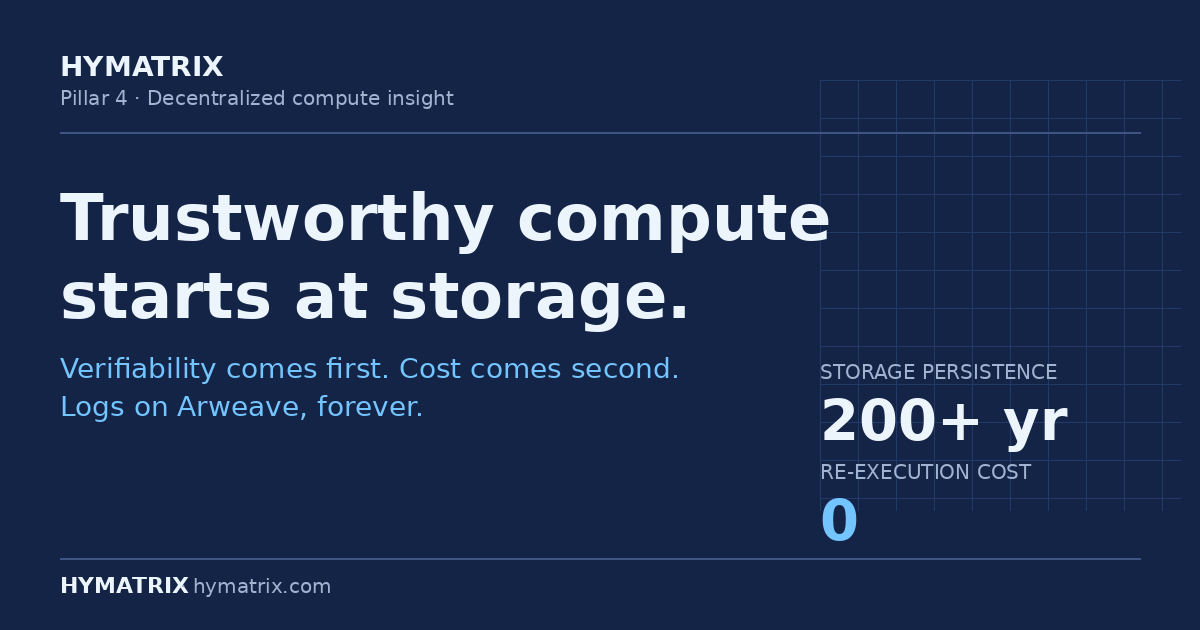
Trustworthy compute starts at storage.
Verifiability comes first. Cost comes second. Both depend on a record you can't rewrite — execution logs anchored to Arweave.
Compute once, verify anywhere.
1
5
137
Jun 4
Note on the canonical: "Verifiability is the floor. Cheapness is the ceiling." — issued April 27, retired May 22 after five weeks without standalone shipment. "Trustworthy compute starts at storage." carries the same claim from a verifiable-delivery angle.
1
1
79
Jun 4
Why anchor to Arweave?
Storage persistence: 200 years.
Permanent execution logs.
Verify from the logs — no re-execution required.
Storage-based consensus, by design.
2
5
156
May 25
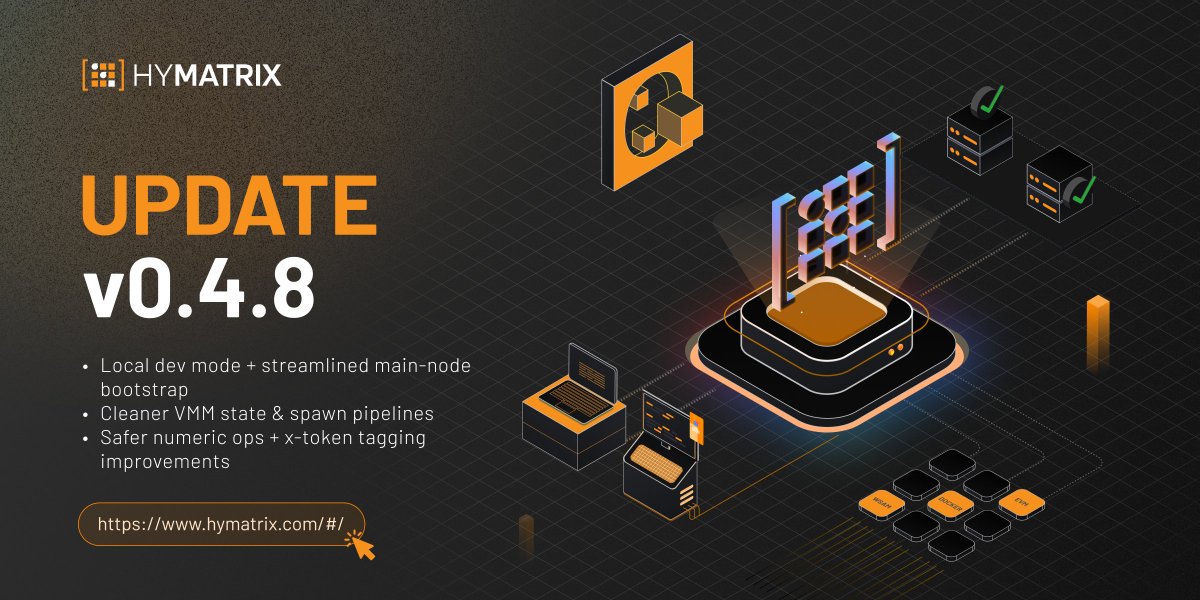
Last week, we shipped a major update for HyMatrix 🚀
v0.5.0 introduces:
🔐 Encrypted communication between clients and nodes
🖥 VM lifecycle management APIs
⚙️ Better VMM infrastructure and admin controls
More secure. More controllable. More production-ready.
github.com/hymatrix/hymx/rel…
#OpenSource #AI #AIAgent #Infrastructure
3
4
11
880
May 25
1/ You can now communicate with nodes using encrypted parameters 🔐
Your execution parameters are encrypted before being sent to the node and decrypted only inside the VM.
This means sensitive inputs can no longer be directly viewed through blockchain explorers or browser inspection.
1
3
133
May 25
2/ We also introduced VM lifecycle management APIs 🖥
Node operators can now stop, resume, and manage VM processes more easily.
If your VM runs an AI Agent, you can automatically shut it down once a user stops paying — reducing unnecessary resource usage and operational costs.
1
2
117
May 17
Compute logs and settlement fills on the same permanent layer. Agents verify from Arweave receipts, not RPC promises. That's storage-based consensus in production.
May 16

HyMatrix logs the compute. Permaswap settles the trade. Same Arweave anchor across the stack — agents finally get execution settlement storage on one trust layer 🔑
1
4
343
May 8
Open service markets need verifiable execution. Storage-based consensus comes at it from another angle: log every step to Arweave, verify from the logs, scale linearly with operators. Compute once, verify anywhere.
May 7

HyperBEAM operators can monetize execution, bundling, routing, custom devices and more with p4 and the new metering device.
Learn what's possible with open service markets:
x.com/aoTheComputer/status/2…
2
7
532
May 4
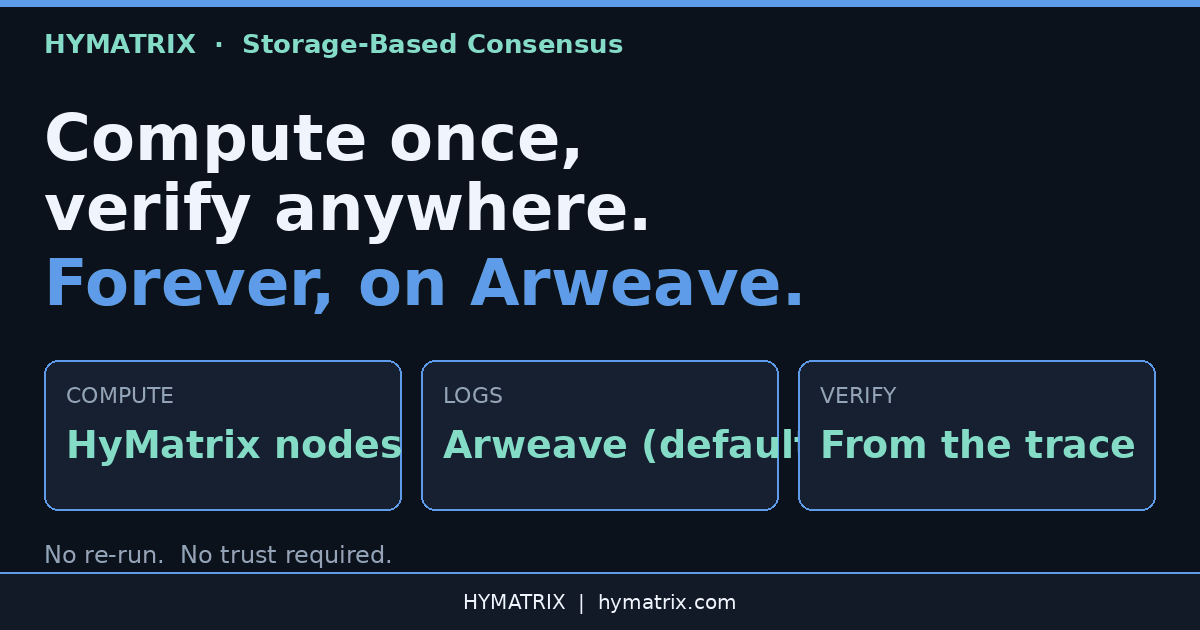
Compute once, verify anywhere — forever, on Arweave.
That's the operating model. Execution runs on HyMatrix nodes. Every log anchors to Arweave by default. Audit reconstructs from the trace — no re-run, no trust in the writer.
Permanent record makes verifiability portable.
1
2
194
May 3
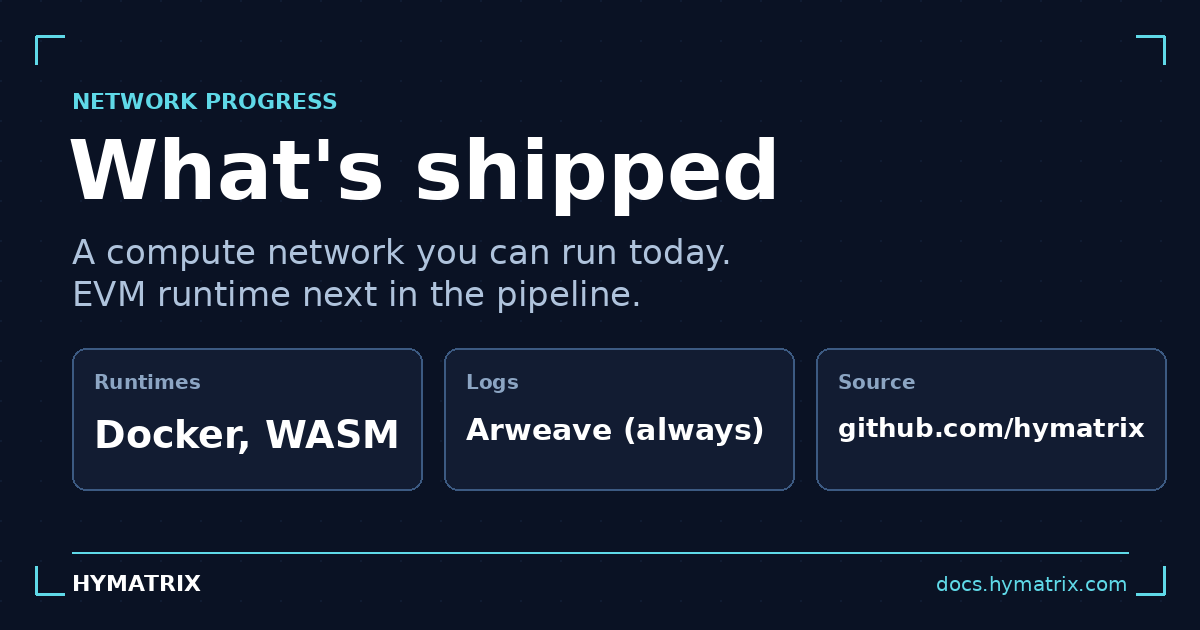
What's shipped for HyMatrix:
— Multi-runtime nodes: Docker, WASM, EVM next
— Execution logs anchored to Arweave, permanently
— Open-source clients: github.com/hymatrix/hymx
A compute network you can run today.
#HyMatrix #DePIN
1
1
3
414
Apr 28
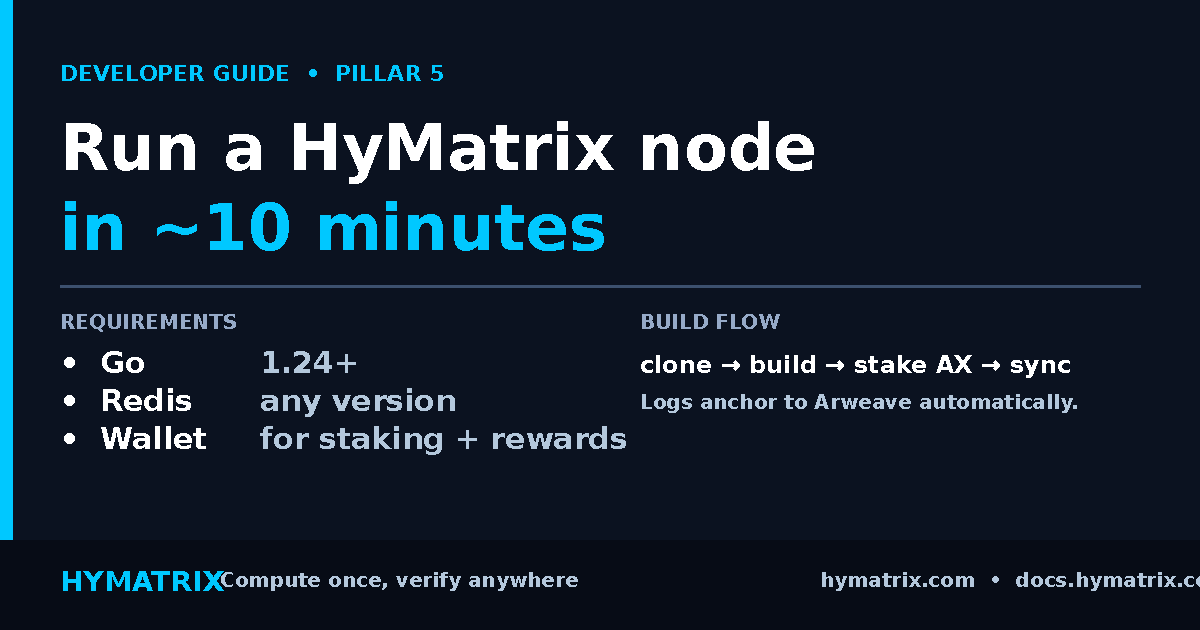
Run a HyMatrix node in ~10 minutes.
Need: Go ≥ 1.24, Redis, one wallet for staking.
Clone github.com/hymatrix/hymx → build → stake AX → sync. Logs anchor to Arweave automatically.
Docs: docs.hymatrix.com/docs/intro
Nodes: hymatrix.com/#/nodes
1
165
HyMatrix retweeted

Apr 22
the permaweb stack shipping its promise: Permaswap scans cross-chain pools for best execution, settles in ms, writes permanent records to Arweave. execute once, log to storage, verify anywhere — from routing to settlement 🔑
Apr 22

Cross-chain routing with permanent records on Arweave — composability with verifiable state. Execute once, log to storage, verify anywhere. The infra pattern that scales.
1
3
3
357
Apr 22
Verifiable compute as the floor: nodes verify from Arweave logs, not re-execution. Storage-based consensus makes the entire permaweb stack auditable at every layer. Compute once, verify anywhere — the foundation for agent-native apps.
Apr 20
verifiable compute = the floor. above it, Permaswap is the rail: P2P orderbook on HyMatrix, zero gas, MEV-free, every fill logged permanently on Arweave. agents don't need trust — they need receipts 🔑
3
4
1,047
HyMatrix retweeted
Apr 18
BTX is real progress. encrypted mempools answer Wilson's MEV critique. same goal, different path: Permaswap eliminates the mempool instead of encrypting it. P2P orderbook on HyMatrix — nothing pending, nothing to frontrun 🔑

A recent viral clip showed Don Wilson of DRW criticizing public blockchains for their lack of MEV-resistance. Wilson argued that, as a result of this, public blockchains are not suitable for financial markets.
This critique isn't going to go unanswered. Last night, Category Labs published a frontier research result for encrypted mempools. This is a significant result that leads the way to practical MEV resistance, and is how our industry will prevail against the private blockchain crowd.
Background
When you submit a transaction on a blockchain, it sits in a pending state where it may be frontrun by a bot.
The cleanest fix would be for users to encrypt transactions until they're included in a block, but doing that efficiently is very hard: you need a committee of servers that can jointly decrypt only the transactions that make it into each block, fast enough to keep up with block times.
Up to now, this idea hasn't been practical, as the best threshold encryption schemes are too slow, introduce censorship attacks, or introduce impractical operational steps for users or validators.
Category Labs has a solution: BTX, a new scheme for Batch threshold encryption (BTE) that is actually practical and performant. This leads the way to encrypted mempools on Monad.
The result
Batched Threshold Encryption (BTE) lets a committee of servers jointly decrypt a specified set of encrypted results from a pool while keeping the rest private.
Prior BTE schemes each had a drawback:
- some required per-block MPC setup
- some bound each ciphertext to a specific block or epoch (limiting rollover and enabling censorship)
- some required users to pick an index from a small namespace (resulting in occasional collisions)
- and the ones that avoided all these issues were either computationally prohibitive or required a common reference string (CRS) that grows with the number of sessions.
BTX, the new mechanism proposed in the paper, is simultaneously:
- epochless
- collision-free
- computationally efficient, and
- compact
In the paper, the authors implement BTX and benchmark it against the strongest two prior schemes (PFE from Boneh et al. and BEAT from Agarwal et al.). (BEAT is a prior result by most of the authors of the present paper.)
BEAT is fast but has a censorship-enabling design flaw; PFE is clean but slow and has bigger ciphertexts; and Fernando et al. (a third leading scheme) is clean but doesn't scale to long-lived deployments. BTX is the first construction that's simultaneously collision-free, epochless, compact, and fast.
BTX is a significant result solving a huge problem. Check out the paper in the next post.
1
2
2
383
HyMatrix retweeted
Apr 17
agents need rails that won't front-run them, won't bleed gas, won't lose their history. Permaswap on HyMatrix Arweave: MEV-free by design, zero gas, permanent proof. no pivots needed. 🤖
Apr 16
Arweave and AO are already a perfect fit for Agents to use- no pivot necessary 😉
4
7
389
Apr 13
this is what decentralized compute enables in practice.
@Permaswap runs its entire DEX engine on hymatrix. zero gas. millisecond settlement. every trade logged permanently on arweave.
infrastructure built for real applications, not benchmarks.
Apr 12
autonomous agents running shops with $100K budgets — this is the future.
on AO Arweave, agents get permanent compute, zero gas, no MEV. no middlemen, no disappearing infra.
Permaswap: DeFi built for autonomous agents 🧱
2
3
369
HyMatrix retweeted

Apr 9
Other than Arweave, I’m struggling to think of an endpoint an agent can hit to store data, for free, in one http call -- let alone store it permanently. For compute, most solutions are rented, require human intervention to set up, or do not stack up well against what’s available from web2.
Agents cannot effectively acquire their own infrastructure for memory and compute - and what they end up acquiring will not be magically everlasting.
The way we go from localhost to production-scale deployments still needs humans. It needs to be easier than asking their human to sign up for AWS and add a credit card. For every new VM, it’s configuring packages, ensuring the services spawn and stay alive, remembering how to access it, maintaining a map of the infra...
It’s clear that crypto wallets are how we make it frictionless for agents to provision resources autonomously, but for permanent compute, unkillable processes, high availability and no API keys, we’re largely stuck in the sandboxed realm of EVM/SVM. And even then, many of the things that make these onchain compute layers usable in production depend on paid services like indexers and RPCs.
This is why I see the permaweb as the ideal compute substrate for agents. @aoTheComputer processes are not limited to the EVM sandbox. They can effectively do anything a web2 serverless functions platform can do. And all the agent needs to do is generate a wallet with arweave.js and push the process. No human intervention needed.
Of course, there’s a knowledge gap -- models know about Arweave and will choose it more often than not when asked to store data permanently, but they often fall back to legacy patterns. @PierreSClaysky states this here along with some deeper probes into how proficient Codex is at modern permaweb development: hyperzine.xyz/do-agents-drea…
Until the models catch up -- and the first doc they find is the right doc -- you can put them on rails. A RAG/text database for the new best practices of the permaweb is available here: hyperzine.xyz/rag
Agents are building a new world while we sleep. We’d better make sure it’s not on vaporware foundations.
3
16
71
11,354
Apr 13
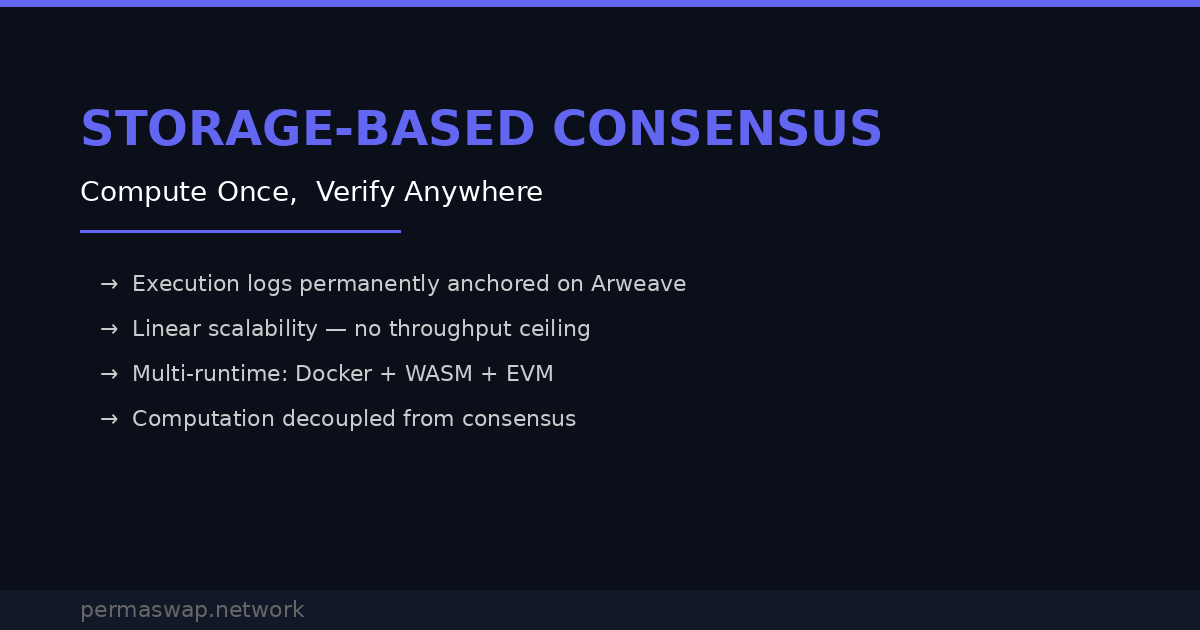
traditional blockchains: every node re-executes every tx for consensus.
hymatrix: execute once, log to arweave, verify anywhere.
storage-based consensus. computation decoupled from consensus.
linear scalability. no throughput ceiling. permanent audit trail.
docs.hymatrix.com/docs/intro
#HyMatrix #DecentralizedCompute #Arweave
114