
📊 We're the halal money & investment guys. 🏃♂️Follow for all things Islamic Finance and building generational wealth.
Joined August 2015
- Tweets 1,904
- Following 983
- Followers 11,276
- Likes 958
623 Photos and videos

7 Dec 2025
In 7th century Makkah, a woman ran one of the most successful trading operations in Arabia. She sent caravans across the desert while men twice her age struggled to turn a profit.
When she hired a young merchant named Muhammad to lead one of her expeditions, he returned with double the expected profit.
She later proposed to him for marriage, impressed by his trustworthiness.
Her name was Khadija. And her business strategies built the foundation that would later sustain an entire religious movement.
Here's what made her different 👇
Khadija understood something most traders didn't: in a world before contracts and legal systems, reputation was the most valuable currency a business could possess.
She didn't just engage in trade. She built trust with her partners, clients, and the broader community. Every deal she made reinforced her name.
That reputation would later prove invaluable.
When the Quraysh imposed an economic blockade against the Prophet ﷺ and his supporters - banning all trade, marriage, and social contact - it was Khadija's wealth and network that helped the community survive.
She had invested in relationships for decades. In the crisis, those relationships paid dividends.
But she wasn't reckless with her resources.
Khadija managed risk through systematic diversification. She didn't place all her trust in a single trade route or product. She sent caravans to Syria, Yemen, and other profitable markets.
If one route failed, others continued.
And she invested in people, not just goods.
Her decision to hire Muhammad wasn't random. She investigated his character thoroughly before entrusting him with her capital. She bet on integrity.
That single hiring decision changed history.
Building a business that lasts requires more than profit margins.
It requires reputation. Diversification. And the wisdom to invest in people whose character you trust.
Khadija mastered all three.
3
7
26
4,802
4 Dec 2025
In 622 CE, two men hid in a cave while search parties combed the desert for them.
One was the Prophet Muhammad ﷺ. The other was a wealthy merchant who had just abandoned everything, his home, his business, his entire fortune - to make this journey.
He had brought 5,000 dirhams with him. Every coin he had left.
His name was Abu Bakr. And what he did with the money would change the course of history.
Here's what most people miss about his wealth strategy 👇
Abu Bakr didn't see wealth as something to accumulate. He saw it as something to deploy.
When he accepted Islam, he was one of the richest merchants in Makkah. By the time he became Caliph, he had given away nearly everything.
But this wasn't careless charity. It was a strategic investment.
He bought and freed Bilal ibn Rabah when Bilal was being tortured for his faith. He freed other enslaved Muslims who would later become pillars of the community. He funded the migration to Madinah. He spent on the cause when no one else could.
Every dirham deployed for maximum impact.
His business philosophy was equally sharp.
He invested in profitable sectors at the right time. He understood that business must align with market demands. In Makkah, he traded textiles. He read the market and moved with it.
He also built networks deliberately.
Abu Bakr cultivated relationships not just for trade, but for da'wah. His closest friends - Uthman, Talha, Zubayr, Abdurrahman ibn Awf - all became Muslim through him. All became wealthy. All became leaders.
His network multiplied his influence.
And underneath it all: complete trust in Allah's provision.
He gave away his entire wealth before the Battle of Tabuk. When asked what he left for his family, he said: "Allah and His Messenger."
That's not recklessness. That's conviction.
True wealth isn't what you keep.
It's what you deploy for impact that outlasts you.
4
2
14
3,011
2 Dec 2025
In 622 CE, a refugee arrived in Madinah with nothing.
His resident host offered him half of everything he had - wealth and property:
The refugee declined it all.
He said five words: "Just show me the market."
He went on to become the richest merchant in Arabian history: 🧵
2
2
9
1,815
2 Dec 2025
His name was Abdurrahman ibn Awf. Within years, he became the wealthiest of all the Prophet's companions.
Here's how he did it 👇
That refusal wasn't just humility. It was a commitment to earning halal.
He could have taken the shortcut. Started with someone else's capital. But he understood that the source of wealth matters as much as the wealth itself.
He chose to build from zero, with his own hands.
And build he did.
Abdurrahman didn't rely on luck. He hustled in the marketplace daily, forging fair deals and building trust. He practised ihsan, excellence in everything. No cutting corners. No questionable transactions.
The Prophet ﷺ prayed for barakah in his wealth. Abdurrahman honoured that prayer by never compromising on ethics.
His approach combined pure intention with relentless action.
He attributed every success to Allah's help. But that trust didn't make him passive. It made him more diligent. If Allah would open doors, Abdurrahman would make sure he was worthy of walking through them.
Tawakkul plus hustle.
Despite his fortune, he lived with humility.
Once, when served a lavish meal, he wept. He remembered Mus'ab ibn 'Umayr, a companion who died with so little they couldn't find enough cloth to cover his body. Wealth never made Abdurrahman forget where he came from.
And he avoided pomp. Even with immense riches, he dressed simply. He ate simply. He remembered that everything was a trust.
This is the part most wealth advice misses.
Seek halal income. Work with excellence. Trust Allah but act diligently. Stay humble, no matter how much you earn.
The richest companion built his fortune on principles, not just profits.
2
2
4
1,175
30 Nov 2025
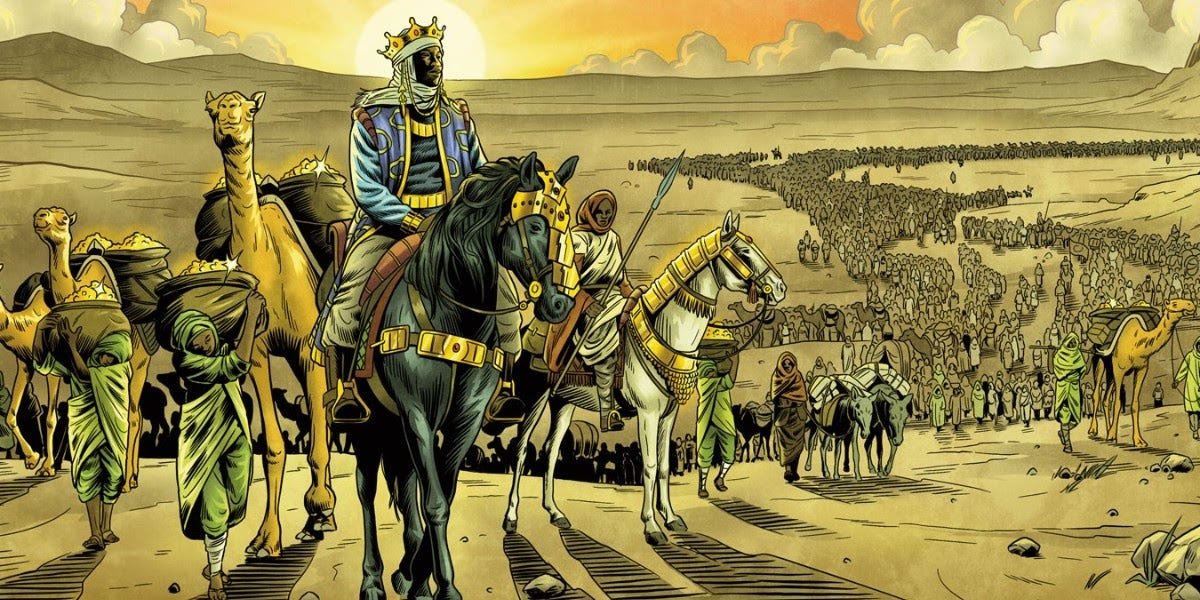
In 1324 CE, a caravan so large it stretched beyond the horizon crossed the Sahara Desert.
60,000 people. 12,000 servants. 80 camels carrying 300 pounds of gold each.
When they reached Cairo, the man leading them gave away so much gold that he crashed Egypt's economy for a decade.
His name was Mansa Musa. And historians estimate his net worth at over $400 billion in today's money.
Here's what nobody talks about 👇
His wealth wasn't just from sitting on gold mines.
Yes, he controlled Mali's monopoly over gold and salt, the two most valuable resources of the medieval world. But what he did with that advantage is what separates him from forgotten kings.
First: strategic generosity as investment.
Mansa Musa didn't just give gold away. His donations created network effects that opened new trade routes back to Mali. Every mosque he built along his pilgrimage route became a node in his commercial empire.
Charity with compounding returns.
Second: he invested in knowledge, not just castles.
While European rulers were building fortresses, Mansa Musa was building universities. Under his reign, Timbuktu became the Oxford of Africa. The Harvard of the Islamic world. Scholars travelled from across the globe to study there.
Human capital outlasts stone walls.
Third: he built for the long term.
The Djinguereber Mosque he commissioned in 1326 is still standing today. Still being used. Nearly 700 years later.
That's what building with intention looks like.
Fourth: he made diversity his competitive advantage.
His empire included Muslims, Christians, and followers of traditional African religions. He didn't just tolerate this diversity. He leveraged it. Different perspectives. Different trade connections. Different innovations.
Community as a competitive moat.
Most people remember Mansa Musa for the gold.
The real lesson is what he built with it.
5
20
1,972
27 Nov 2025
In 625 CE, arrows rained down on a battlefield near Madinah.
One man used his own body as a shield, taking wound after wound, protecting the Prophet ﷺ.
His hand was permanently paralysed that day.
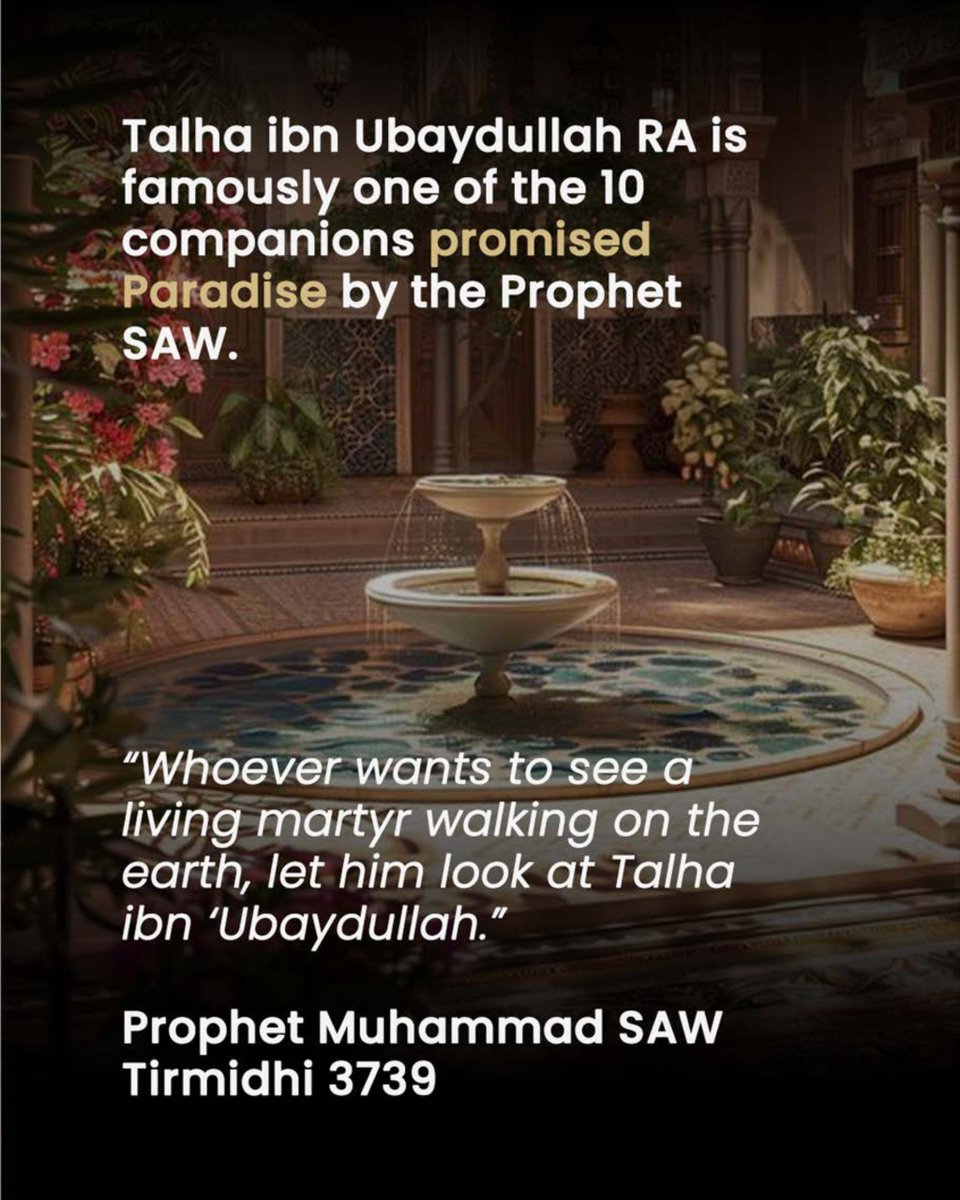
The Prophet ﷺ looked at him and said: "Whoever wants to see a living martyr walking on the earth, let him look at Talha ibn Ubaydullah."
But here's what most people don't know: Talha was also one of the wealthiest men in Arabia.
Here's how he built his wealth 👇
Talha didn't separate his character from his capital. They were the same thing.
He became known as "Talha al-Fayyad", a name tied to overflowing generosity. That reputation didn't come from clever pricing. It came from who he was.
When a crisis hit during the raid at Dhu Qarad and people faced hunger and thirst, Talha didn't wait for a committee. He slaughtered a camel, bought a well, and fed everyone himself.
But he wasn't just generous. He was also strategic.
He built income-producing assets across multiple regions. Properties in Iraq generating 400,000 a year. Land in al-Sarat yielding 10,000 dinars. Holdings near Madinah. Reports say his daily cashflow could hit thousands of dirhams.
Multiple streams. Different locations. Systematic risk management.
And his generosity? Targeted.
He focused on real problems he could see: food, water, and especially debt relief. Biographical reports say he would not leave anyone from Banu Taym in hardship.
He didn't scatter his giving. He concentrated it where impact was measurable.
That's the model most people miss.
Build multiple income streams. Let your character drive your reputation. And when you give, give where you can see the change.
Wealth built on character compounds differently.
2
6
1,277
26 Nov 2025
We're going live to give our instant reaction to the Autumn Budget.
We'll be be joined by Salman Anwar, leading tax specialist and Director of ADL TAX, for a real-time breakdown of all the announcements and their impact.
Join us and ask your questions: youtube.com/live/JcNdp_j46-g…
2
2
1,763
25 Nov 2025
In 622 CE, a wealthy merchant lost everything fleeing persecution.
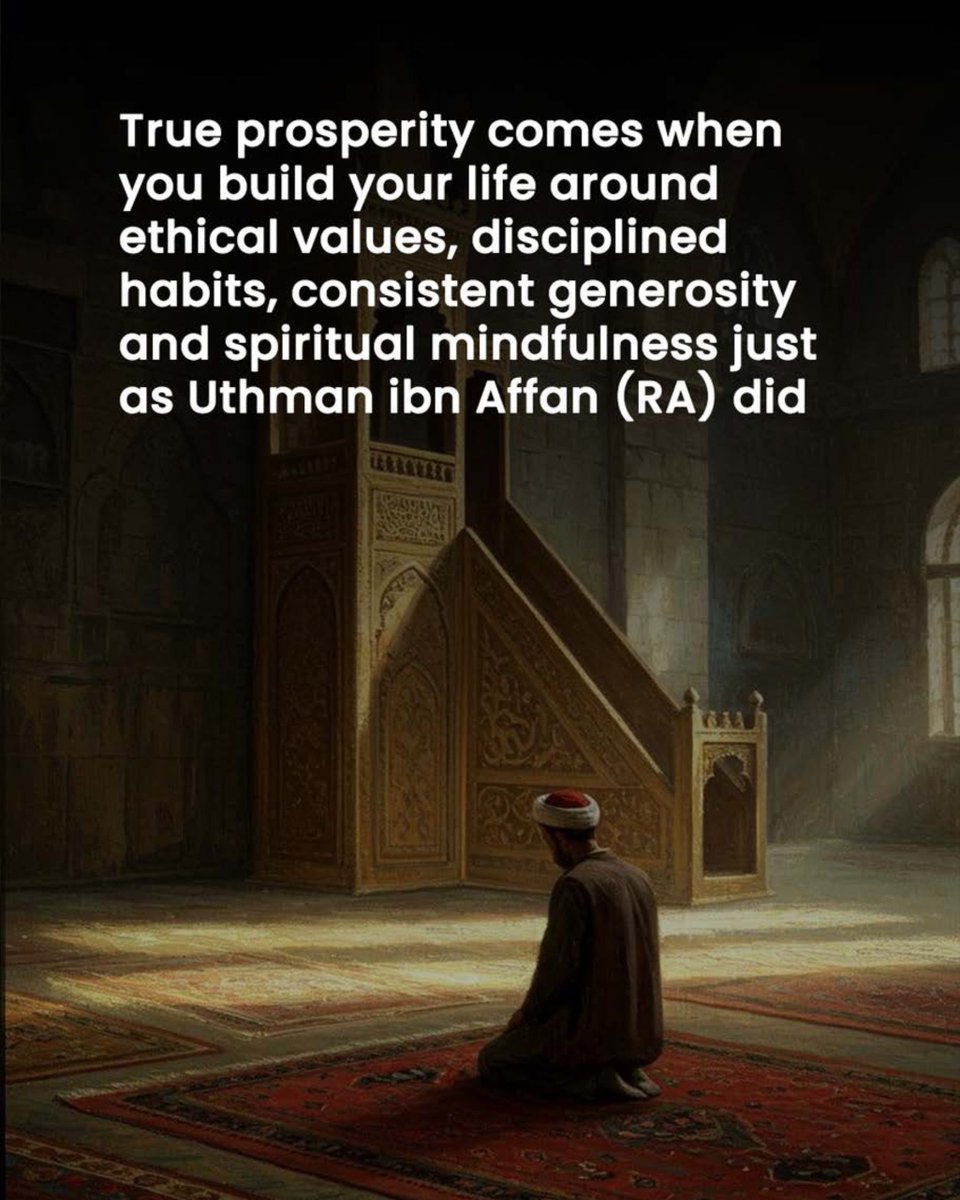
He arrived in a new city called Madinah with nothing but his name, Uthman:
Within years, he became the richest man in Arabia.
How Uthman ibn Affan rebuilt his fortune reveals something most business books miss.
Here's what happened:
Uthman was already successful in Makkah. Textiles. Trade routes. Serious wealth.
Then he accepted Islam.
His own family turned on him. Boycotts. Beatings. Eventually exile.
He left everything behind and migrated to Madinah with the other Muslims.
Most would've spent years recovering.
Uthman started rebuilding immediately.
And this is the fascinating part 👇
He didn't chase quick wins. He played long games.
First move: reputation. In a new market where nobody knew him, he established trust before transactions. The Prophet ﷺ himself called him "the most modest of the companions... the one most trusted by the Muslims."
Second move: diversification. He didn't just trade. He bought the well of Ruma when Madinah had water shortages. Invested in land across the Arabian Peninsula. Spread risk across multiple ventures.
Third move: strategic generosity. During the Battle of Tabuk, he funded nearly a third of the entire army. People called it charity. It was actually investment in the community that made his business possible.
His wealth compounded because his values did.
That's the part we forget.
Uthman understood something most entrepreneurs miss: your network is your net worth, but only if trust is the currency.
He built an empire not despite his ethics, but because of them.
Struggling to rebuild something you lost?
Start with trust. Diversify early. Give strategically.
The comeback is always bigger than the setback.
3
9
1,114
21 Nov 2025
Modern society loves the "girl boss" narrative.
But Muslim women have had their own role models for 1,400 years. And they were building legacies.
Here are three of them:
- Khadija (RA) - She ran a trade empire when most women couldn't own property. She employed the Prophet Muhammad ﷺ as her business agent, recognised his character and integrity, and later proposed marriage to him. Smart, independent, commercially savvy - and a devoted mother who supported the early mission of Islam with her wealth and wisdom.
- Asma bint Abu Bakr (RA) - During the Prophet's migration to Medina, while he was hiding in the Cave of Thawr, she risked her life carrying food and water up a treacherous mountain route. And she did this while heavily pregnant. The Prophet ﷺ honoured her sacrifice and called her "the one with two belts" - referring to how she tore her belt in half to tie provisions for the journey.
- Nusayba bint Ka'ab (RA) - A fierce warrior who defended the Prophet ﷺ in battle despite sustaining serious injuries herself. Her courage broke every stereotype about what women could or couldn't do. She was a leader, a defender, and an example of Muslim female strength in its truest form.
The Qur'an celebrates strong, purposeful women throughout its pages:
"Indeed, the Muslim men and Muslim women, the believing men and believing women...for them God has prepared forgiveness and a great reward."
(Surah Al-Ahzab, 33:35)
These women weren't trying to fit into someone else's definition of success.
They were building businesses, protecting communities, and shaping history - all while staying true to their faith.
Their legacy was built on power, resilience, and strong iman. Not on corporate buzzwords or Instagram aesthetics.
That's real leadership.
Who are the Muslim women leaders who inspire you today?
1
5
16
1,665
18 Nov 2025
Uthman ibn Affan was the wealthiest of the Khalifas.
When you study how Uthman built and maintained his wealth, you find lessons that are just as relevant for investors today.
The Qur'an reminds us:
"But as for him who is stingy and self-satisfied, and denies the good, We will pave his way to difficulty."
(Surah Al-Layl, 92:8-11)
Uthman understood this instinctively. Here are three principles he lived by:
• Visionary investing - Uthman didn't just donate money. He bought the Well of Rumah, the first well Muslims drew water from. This addressed a real community need, created trust, and earned him blessing in both this life and the next. When people see you solving real problems rather than chasing quick profits, they want to do business with you.
• Playing the long game - It would have been easy for Uthman to start selling the water from the Well of Rumah. But he made it free for everyone. He was playing for the Akhirah. And in this life too, when people see you're not trying to squeeze every short-term profit, they trust you more. They know you won't swindle them.
• Diversification - Uthman didn't put all his eggs in one basket. He owned trade, land, real estate, different types of commerce. This helped him keep making profit regardless of where the economy was heading.
The Prophet Muhammad ﷺ taught:
"The truthful, trustworthy merchant will be with the Prophets, the truthful and the martyrs."
(Ibn Majah, Hadith 2187)
Character wasn't separate from Uthman's business success. It was the foundation of it.
When you combine integrity with prudent economic strategy, something remarkable happens: barakah (blessing).
Modern Muslims building wealth can learn from this: invest in things that solve real problems, resist the temptation to extract every short-term profit, and diversify your holdings.
That's how you build sustainable wealth that benefits you in both worlds.
What other business lessons have you learned from the Sahaba?
1
5
13
1,576
16 Nov 2025
The wealthiest Muslims don't drive Lamborghinis.
You'd be surprised how they actually live:
We work with high-net-worth Muslims regularly at Cur8 Capital and Islamic Finance Guru. And there's a pattern that keeps showing up.
The truly wealthy ones don't look the part.
No designer wear dripping off them. No entourage. Often driving ordinary cars and eating pretty average food.
Instead, their conversations revolve around ideas, experiences, and legacies. Not the next handbag or supercar.
This isn't new.
The Prophet Muhammad ﷺ himself taught:
"Wealth is not from having many possessions, but true wealth is contentment of the soul."
(Sahih Muslim 1015, Book 12, Hadith 83)
The really wealthy Muslims understand this instinctively. Here's what sets them apart:
• They value experiences over things - because the physical world is temporary. Ideas, legacies, and experiences last. In conversations, they're far more likely to discuss politics, philosophy, or memorable trips than their next purchase.
• They live modestly - true wealth doesn't need a spotlight. They've already made the money. They're comfortable in their own skin. And they know that being ostentatious just brings headaches and pressure they don't want.
• When they do spend, it's on things that aren't obvious - rare hobbies, domestic help, a personal chef, a driver. Things that make their life run more smoothly rather than showing off.
The lesson?
Real wealth is internal, not external.
It's about what serves your life, not what broadcasts your status.
That's what Islam has always taught.
What are other signs you've noticed that someone has real wealth?
3
23
2,222
13 Nov 2025
Western finance promised the Learjet. Islam offers something better: peace of mind.
If there's anything that unites contemporary Islamic thought, it's this: Islam offers an alternative to toxic modernity.
The Qur'an redirects us to what actually sustains human wellbeing:
"Indeed, in the creation of the heavens and the earth and the alternation of the night and day are signs for those of understanding."
(Surah Al-Imran, 3:190)
Virgin nature. The Earth. The sky. The mountains.
And equally central: family life. Conception. Childbirth. Respect for parents. Raising children.
These themes appear throughout the Qur'an, which are not abstract spiritual concepts - they're the fundamental sources of human happiness.
The Prophet Muhammad ﷺ taught us:
"Wealth is not from having many possessions, but true wealth is contentment of the soul."
(Sahih Muslim 1015, Book 12, Hadith 83)
This reframes everything.
Three principles for Muslims building wealth today:
• Wealth serves life, not consumes it - Your family should remember your presence, not just your portfolio
• Success requires inner alignment - External achievement means nothing if your heart is anxious and your relationships are broken
• Nature and family ground us - These aren't luxuries to enjoy after you "make it" - they're non-negotiables throughout the journey
Modern capitalism tells us that more is always better.
Islam quietly asks: better for what?
Your net worth matters less than your character. Your exit matters less than your intention. Your status matters less than your peace.
That's the therapeutic alternative Islam offers.
And it's one that more Muslims are waking up to.
1
5
13
1,138
30 Oct 2025
Ibn Khaldun, a 14th-century scholar, emphasised that true wealth is not just material.
Khaldun’s concept of Asabiya, of how societies succeed when they invest in their people, values and systems, was central to his vision of sustainable economic growth.
Here’s how his insights apply today:
1. Education as the Foundation of Prosperity
Ibn Khaldun viewed education as a primary pillar for the advancement of society. In his work, he argued that the intellectual growth of individuals and groups forms the bedrock for economic and social development. He believed that knowledge, whether practical or theoretical, was integral to building strong and prosperous communities.
He saw education not only as a means to transmit skills but as a force that could shape the moral and intellectual foundation of society.
2. The Role of Skilled Individuals in Society
In Ibn Khaldun’s model, the division of labour was a key concept. He understood that each individual’s skills contributed to the wider fabric of society. The specialisation of work, ensuring that individuals are trained and equipped with specific skills for their roles, was essential for economic growth.
He knew that economic success depends on the cultivation of skilled professionals who contribute to society in meaningful ways.
3. Knowledge as Power and Cohesion
Ibn Khaldun believed that societies with a strong intellectual foundation were more likely to develop social cohesion and economic power. By investing in education and cultivating a shared intellectual heritage, people could strengthen their collective identity, which in turn facilitated more efficient governance and economic prosperity.
His concept of Asabiya (social cohesion) was partly built on the intellectual unity and the common purpose that education can foster.
Follow Islamic Finance Guru for more insights like the above. Thanks for reading!
1
2
9
910
28 Oct 2025
The Prophet Muhammad ﷺ gave us this practical financial wisdom:
“No one ever ate a meal better than that which he earned with his own hands. And the Prophet of God, David, used to eat from what he earned with his own hands.” (Bukhari)
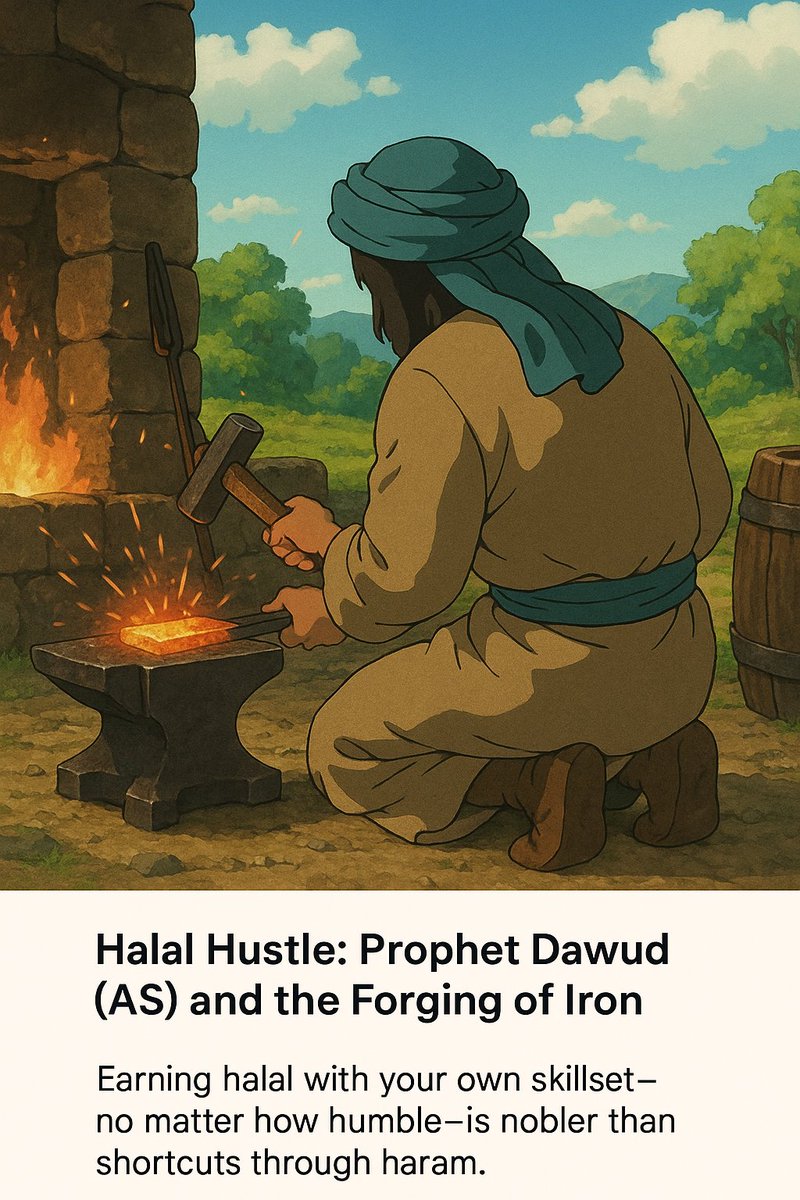
Prophet Dawud (AS) wasn’t just a king and messenger.
He was a blacksmith.
A craftsman.
A man who earned his living with his own hands, forging armour from molten iron.
In Surah Saba, God says:
“We softened iron for him, [saying], 'Make full coats of mail, and measure the links well, and work righteousness. Indeed, I am All-Seeing of what you do.’” (34:10-11)
Despite having access to power, wealth, and status, Dawud (AS) chose to earn his income the halal way – through his own skillset, without depending on others or taking from the public treasury.
And that wasn’t just incidental.
It was intentional.
In a world that often glamorises passive income, rapid exits, or crypto overnight gains, this story reminds us that long-term halal hustle isn’t a failure – it’s prophetic.
Not every believer will be a king.
But every believer can be a craftsman in their own way – whether you code, consult, design, deliver, teach, or trade.
Sometimes the most powerful form of worship is not in the masjid, but in the place of work.
Not with a hammer like Prophet David, but using a keyboard, a mic or a mouse.
Not in a lofty dream, but in a 10,000-hour craft.
There is nothing weak about working hard.
There is nothing backwards about earning something slowly, carefully, and ethically.
And there is nothing noble about haram shortcuts – even if they’re dressed up with success and scale.
So whatever your field is, own it. Master it. And do it with ihsan.
Because halal hustle is not just a career strategy.
It’s dignity.
It’s sunnah.
PS. If reflections like this resonate with you, sign up to our newsletter - where Ibrahim Khan and Mohsin Patel share more timeless lessons from Qur’anic stories, history, and wealth-building, all through an investment and wealth building lens: islamicfinanceguru.com/newsl…
3
15
1,330
26 Oct 2025
Money is one of the biggest issues in marriages breaking.
Especially in Muslim marriages, where religion meets culture meets personal expectations.
So we wrote a monster of an article breaking it all down: who pays for what, how joint investments should work, commuting costs, childcare, in-laws, shared bank accounts… the lot.
But here’s the tl;dr if you're pressed for time (or married):
Husbands: You're financially responsible. Period. That includes basic food, clothing, bills.
Wives: You're not obliged to chip in, but if you do, there's massive reward in it. Just don’t let it feel expected.
Joint accounts? Great if you're saving for something together. Terrible if you're filing taxes or want to buy a surprise Eid gift.
In-laws: Tricky. Supporting your parents is noble. Neglecting your spouse and kids to do so? Not so noble.
The conclusion? The fiqh is clear. But real life is messy. The best marriages aren’t based on contracts. They're built on fairness, respect, and a bit of good-natured muddling through.
💡 Money conversations don’t ruin marriages. Not having them does.
PS. Building that stability in your marriage doesn’t just come from saving - it also comes from learning how to invest wisely and in line with your values.
Not sure where to start?
Sign up to our newsletter and get access to our free email course: The 5 Money Mistakes Keeping Muslims Poor (and How to Fix Them). It’s packed with practical tips to help you build better financial habits and grow your income the halal way.
islamicfinanceguru.com/newsl…
2
1
14
1,618
23 Oct 2025
There are stay-at-home mums earning six figures from the living room.
Here are the three roles that are making it happen:
1. Freelance content creation
If you can write, edit, or design, the demand is insane right now. Blog posts, YouTube scripts, social media content - the possibilities are endless.
The top creators aren't just freelancing anymore. They're building teams underneath them, turning it into a proper business.
2. Virtual assistance
Bookkeeping, admin, emails - the boring stuff that executives desperately need handled. The best VAs are worth their weight in gold because reliability is everything at that level.
Again, once you've got too much volume, you can build a team and scale it.
3. Customer service (but make it clever)
The smartest ones are leveraging AI to handle multiple clients simultaneously. Phone, chat, email - if you're efficient, you could manage 3-4 clients at once.
That's how you hit six figures from your living room.
Look, I know what some of you are thinking. "Six figures? Really?"
Yes, really. But let's be clear - these aren't get-rich-quick schemes. The mums hitting these numbers are treating it like a proper business. They're professional, they're reliable, and they're constantly upskilling.
The opportunity is there. The question is whether you're ready to grab it.
Which of these fits your skillset? Or are you already doing something similar?
1
4
10
1,969
IslamicFinanceGuru retweeted

22 Oct 2025
📢 Hiring for a new content growth associate at @IFguru to help create engaging YouTube videos, social media content, and articles that empower millions of Muslims to make smarter financial decisions.
Perfect for a creative storyteller who loves writing. 1/2
1
3
3
1,212
21 Oct 2025
Jeremy Corbyn and Zahra Sultana set up a new political party. Its name is... no one knows. But if we were in Jeremy's shoes, here's how we'd transform our economy using Islamic economic principles:
1. Create a National Infrastructure Bank
Take money creation out of the hands of banks who just pump up house prices and the stock market. Instead, invest it in infrastructure that's crumbling across the country.
We're living in a 1970s country. Our pension funds prop up the US economy while our own infrastructure falls apart. That money needs to be invested here, not there.
2. Match funding with charities
Government doesn't have money. Charities do, and they're happy to contribute to local communities. Plus, charities have local knowledge that Westminster doesn't. More efficient capital allocation, better outcomes.
3. Actually fund small businesses
Look at economies that have grown rapidly - China, South Korea, post-war Germany. What did they have in common? They provided SME finance.
Small businesses are the heartbeat of any economy. But our banks aren't lending to them. We need policies that change that.
These aren't radical ideas. They're practical applications of Islamic finance principles - real asset backing, community involvement, and productive investment over speculation.
The reality is our current system isn't working. House prices through the roof, infrastructure falling apart, small businesses can't get loans while banks make record profits.
What economic policy would you implement tomorrow if you had the power?
2
1
15
2,256
19 Oct 2025
My brother got married in Britain for just £3,000.
The average UK wedding costs £50,000. He managed it for less than the price of a used car.
Here's how he pulled it off (with 100 guests, no less):
1. Invite only your nearest and dearest
Sounds obvious, but how many weddings have you been to where half the room are people you've never met? My brother kept it to 100 people who actually matter. Quality over quantity.
2. Focus on what actually matters
It's not the chocolate fountain. It's not the guy with the drum. It's the food. Get the food right, people are happy. Everything else is just expensive noise.
3. Lean on your community
There's so much goodwill in our communities that we don't tap into. Someone's cousin is a photographer. Someone's uncle has a nice car. People want to help - let them.
But here's the real secret (and it's not comfortable to hear):
None of this works if both families aren't on the same page. You need buy-in from both sides that a simple wedding is the goal. Otherwise, you're fighting a losing battle against "what will people say?"
Look, I get it. Weddings are emotional. Cultural expectations are real. But starting married life without debt? That's a gift to your future self.
My brother's guests still talk about his wedding two years later. Not because of the decorations or the venue. But because the food was good, the company was genuine, and the joy was real.
What actually made your wedding memorable - the budget or the barakah?
1
6
37
6,392