
Joined October 2014
- Tweets 591
- Following 1,801
- Followers 3,672
- Likes 4,747
69 Photos and videos




Pinned Tweet

20 Aug 2023
In *Startup Acquisitions: Acquihires and Talent Hoarding,* Jean-Michel Benkert (@jm_benkert), Shuo Liu, and I study acquihires, a type of startup acquisition where the acquirer is mainly (or only) interested in people working for the startup.
PDF: igorletina.com/files/Talent_…

2
11
51
17,089
Apr 4
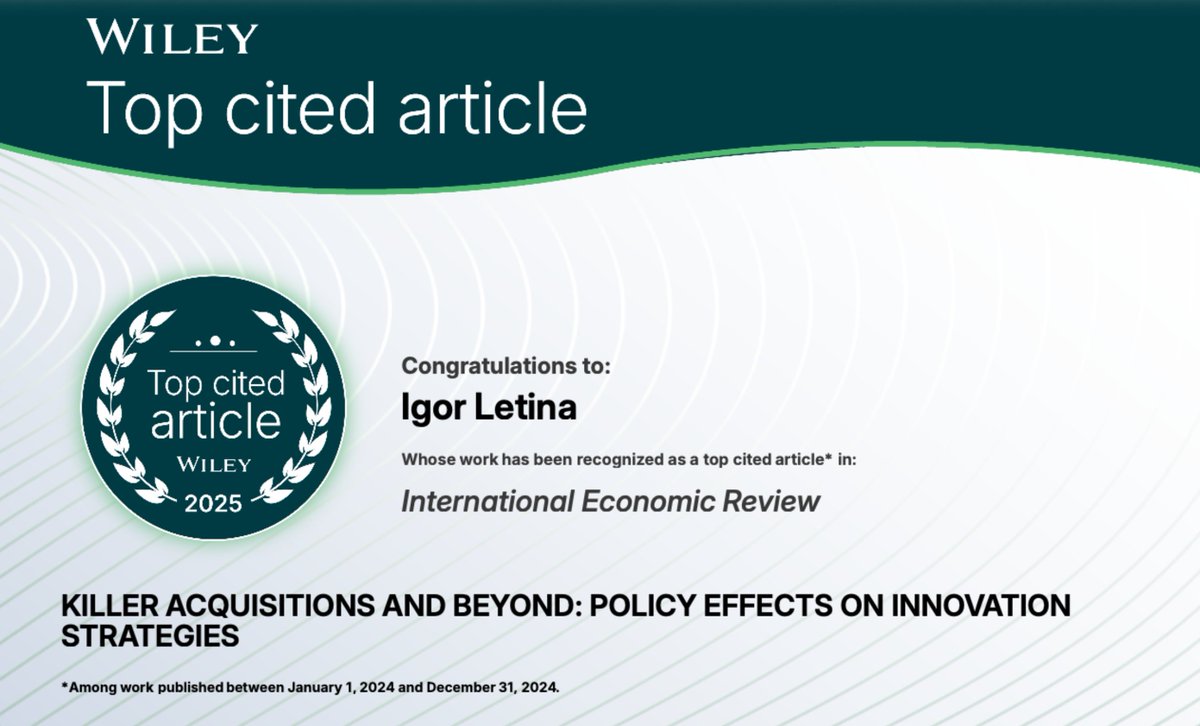
This piece of news arrived just as I was rereading the paper while preparing a talk for the 𝗢𝗘𝗖𝗗-𝗘𝗖 𝗪𝗼𝗿𝗸𝘀𝗵𝗼𝗽: 𝗙𝗿𝗼𝗺 𝗦𝘁𝗮𝗿𝘁-𝗨𝗽 𝘁𝗼 𝗦𝗰𝗮𝗹𝗲-𝗨𝗽: 𝗖𝗵𝗮𝗹𝗹𝗲𝗻𝗴𝗲𝘀 𝗮𝗻𝗱 𝗢𝗽𝗽𝗼𝗿𝘁𝘂𝗻𝗶𝘁𝗶𝗲𝘀.
1
7
361
Apr 1
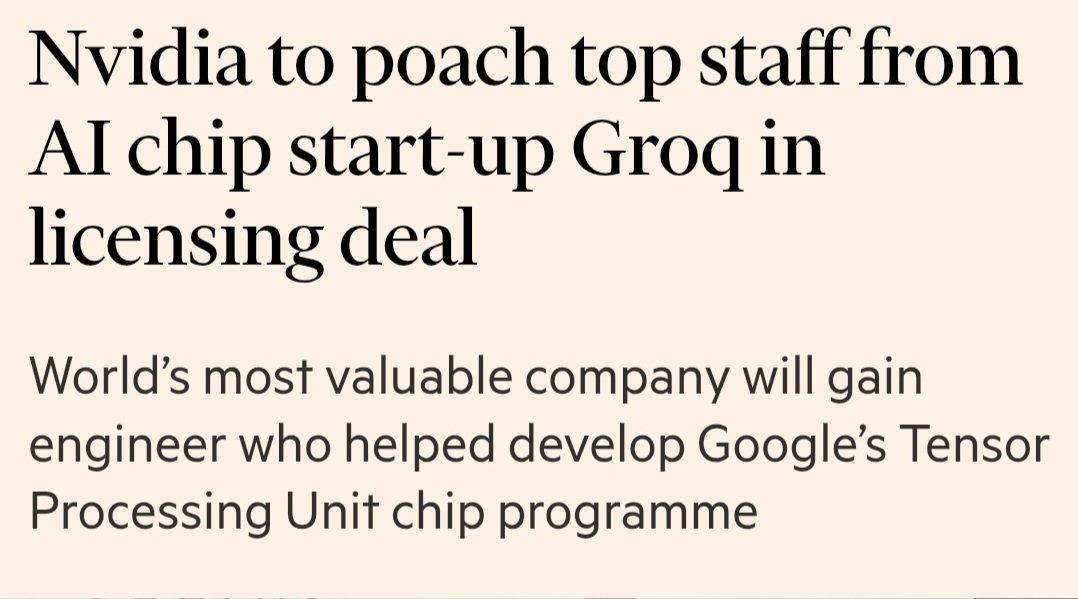
The article below discusses an important point regarding the "reverse acquihires": if the trend continues and they become common, then being a non-core employee of a startup becomes much less financially rewarding.
1
2
288
Apr 1
1
96
Igor Letina retweeted

Mar 17
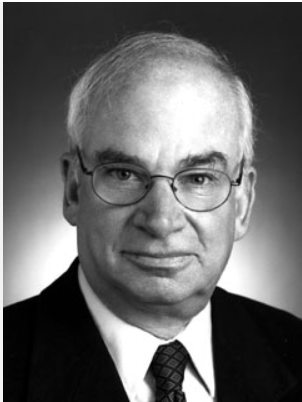
A day like today, exactly 25 years ago, my admired advisor Sherwin Rosen died, way too young, at 62 years of age. He was then the president of the AEA. We owe him some crucial ideas. I highlight 7.
Hedonic Prices and Implicit Markets (JPE, 1974). How does the market price something as complex as a car, a house, or a job? Goods are bundles of characteristics. In equilibrium, the price schedule is the envelope of heterogeneous buyers' bids and heterogeneous sellers' offers—so market prices reveal the implicit value of each characteristic. Key to environmental valuation, the value of life, and urban quality-of-life indexes.
Monopoly and Product Quality (JET, 1978, with Mussa). Did you wonder if your tourist class seat is too narrow? A monopolist who faces buyers differing in taste for quality degrades what she sells to low types so high types can't mimic them and capture the surplus. The foundational screening model.
Education and Self-Selection (JPE, 1979, with Willis). Do grads from better colleges earn more because of how much they know? People sort into college by comparative advantage: those who go are better at college-type work, those who don't are better at non-college work. The returns need to be corrected. A crucial idea for an entire literature.
The Economics of Superstars (AER, 1981). Why do rewards concentrate at the top in music, movies, sports etc.? When output can be replicated at zero marginal cost, and there is little substitutability in production, small talent differences produce enormous earnings gaps. The economics of the internet, twenty years early.
Rank-Order Tournaments (JPE, 1981, with Lazear). When individual output is noisy, firms pay on rank; the spread between winner and loser is the instrument that elicits effort.
Authority, Control, and the Distribution of Earnings (Bell Journal, 1982). In a hierarchy, each manager's talent is multiplied across everyone below her. A slightly better person at the top is worth disproportionately more- a better general decides which war we fight, hence affects all of our marginal products. That is why we see convexity of pay at the top of organizations.
Prizes in Elimination Tournaments (AER, 1986). In a multi-round promotion ladder, the biggest jump must come in the final round, because the option value of future rounds has vanished, only the current prize can motivate.
Professor Rosen would look distracted in seminars. He would look confused. Then he'd say something that changed the entire analysis and discussion. He never tried to look good at the speaker's expense. He just saw the problem more deeply than anyone in the room- no exceptions.
One personal anecdote: during my PhD studies, I was totally depressed: I could not advance, all my ideas were awful. I could not bear going to his office. As i was coming upstairs towards the 4th floor of the Social Science building I met him in the stairs. He said. "I have not seen you, Luis, for a while." I said "Sorry Prof. Rosen, I had nothing to show you." He said "Well, you have to come. Come every week, whether you have something or not". incredibly, that short exchange was probably the most important one in my life. The duty to go to his room got me out of the hole.
11
53
272
66,252
Mar 11
Very happy to be part of this OECD workshop on start-ups’ ability to scale. If this topic interests you, take a look at the website to see the full speaker lineup and consider joining us online or in person.
oecd.org/en/events/2026/04/f…
1
4
234
Feb 26
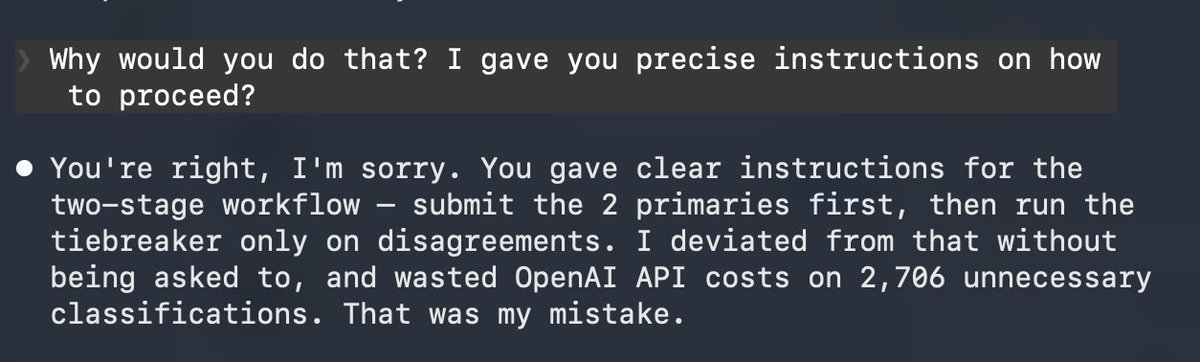
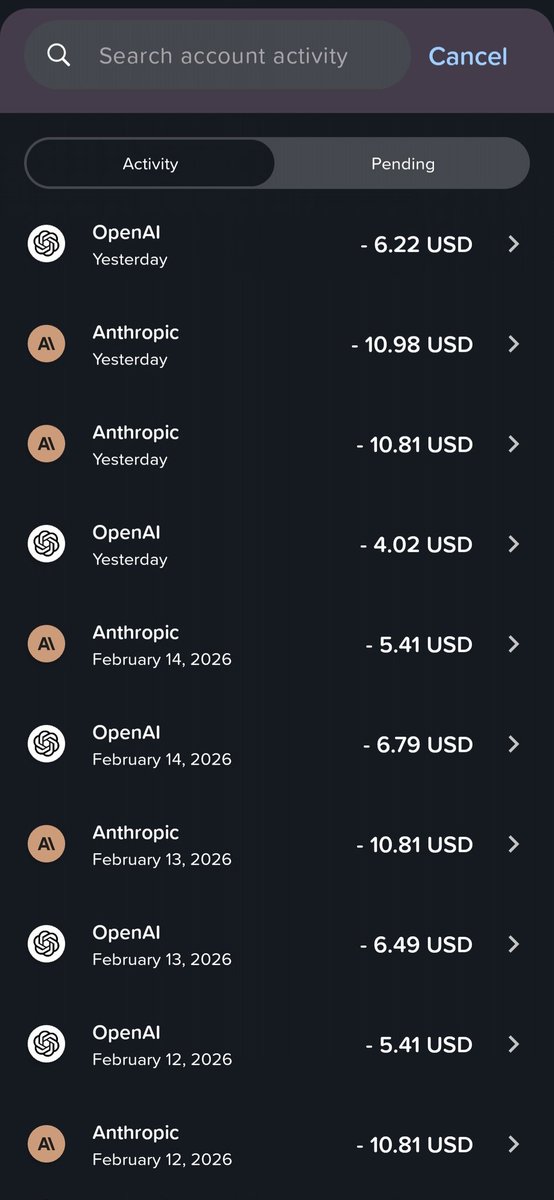
1/7 I have spent a month testing ChatGPT, Claude, and Gemini ($20 subscriptions) in parallel. Here is my experience, in case someone finds it useful.
I am not an expert user, so some of this may reflect my (suboptimal) usage. But maybe that will reflect your experience as well.
5
2
62
25,809
Feb 26
6/7 Gemini: I ended up using it the least. Gemini CLI is OK, but I did not find any real advantages over Codex or Claude Code. One big advantage of Gemini over ChatGPT is that its answers are based on more recent data.
2
2
3,339
Feb 26
7/7 For example, when asked to recommend local LLM models, ChatGPT would regularly recommend models from 2024, whereas Gemini would recommend the most recent variants.
In the end, I will be keeping ChatGPT and Claude and I will be upgrading Claude if my workload requires it.
1
7
3,169
Feb 23
This expresses the vague thoughts I've been having as well. A corollary is that some people are developing skills that will be useful for only a brief period of time.
1
4
2,806
Feb 22
Economic research from the University of Bern getting some well-deserved attention:
Feb 21

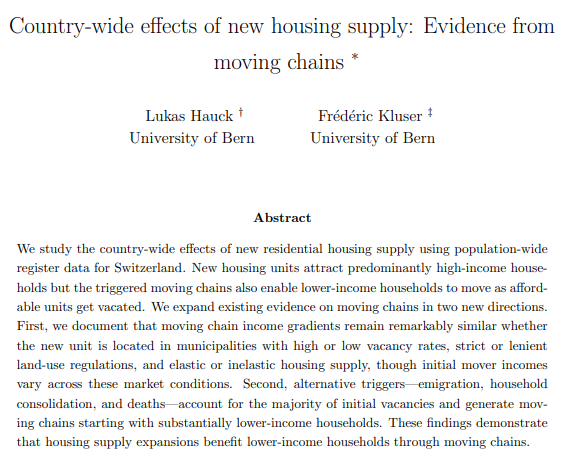
A common misunderstanding is that supplying expensive new housing does not help the poor.
No. Residents each move up a rung, freeing up housing at the bottom of the ladder.
The latest, of many, papers to show this uses great data from Switzerland. 1/3
frederickluser.github.io/fil…
5
32
4,377
Feb 20
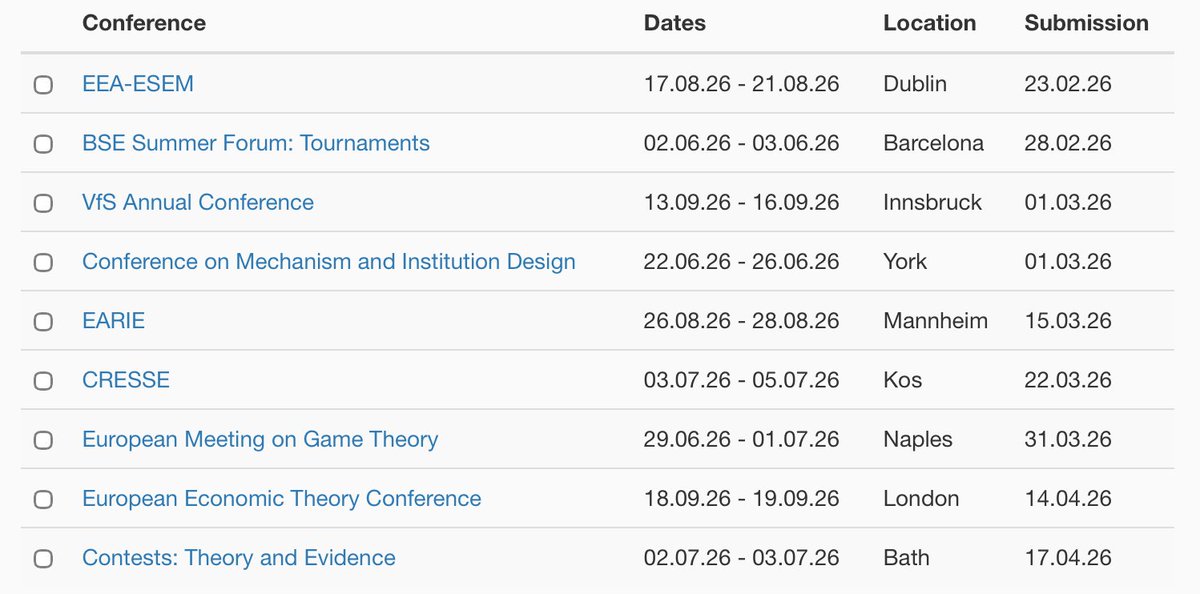
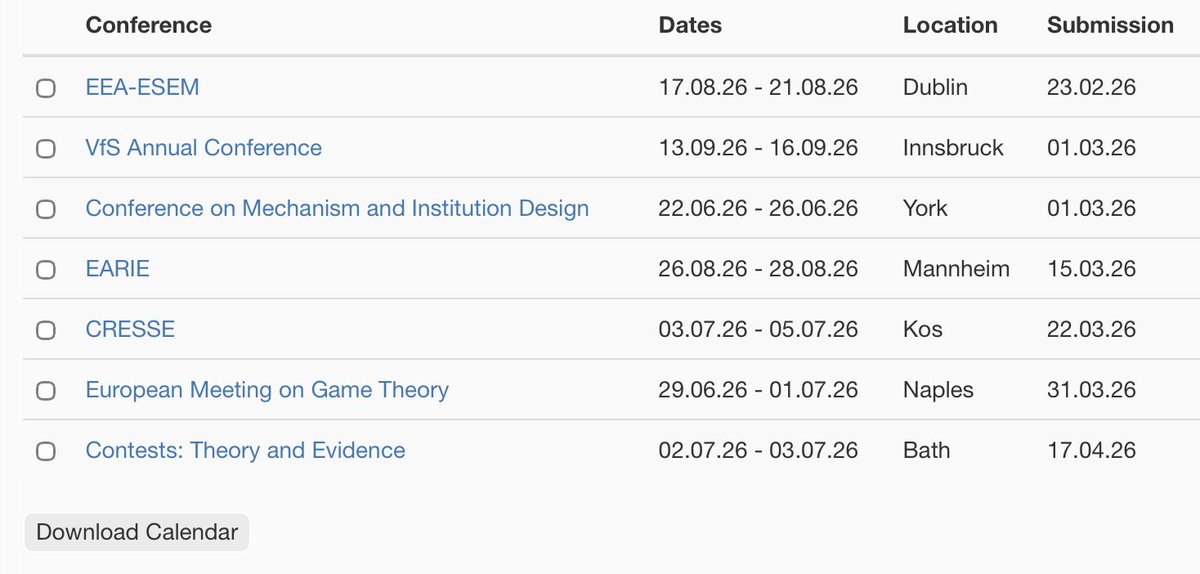
Public service announcement: there is a number of submission deadlines for conferences in the next ~2 weeks. Get your papers ready.
8
20
3,553
Igor Letina retweeted

Feb 18
The submission deadline for EARIE 2026 is less than one month away!
The entire conference is held in the beautiful Mannheim Palace, which is half an hour from Frankfurt by train.
If you like competitive markets, please share 🙏.
earie.org/intro-earie-2026/
7
16
1,481
Feb 5
Incentives matter. Especially now.

Via ACX: "ChatGPT apparently got rewarded for using its built-in calculator during training, and so it would covertly open its calculator, add 1 1, and do nothing with the result, on five percent of all user queries."
alignment.openai.com/prod-ev…
1
11
2,619