
AI & economics. Professor at the Department of Economics @NHHEcon
Joined May 2016
- Tweets 2,538
- Following 1,218
- Followers 3,657
- Likes 9,777
201 Photos and videos

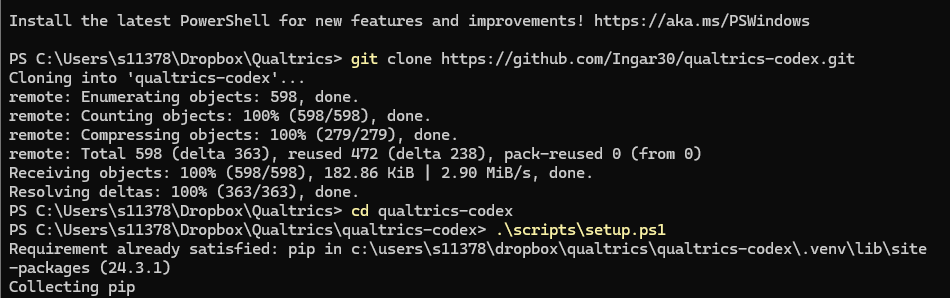
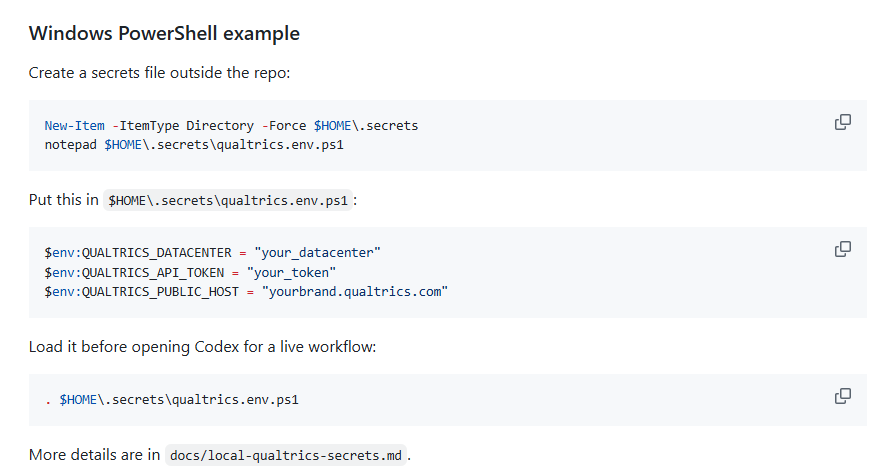
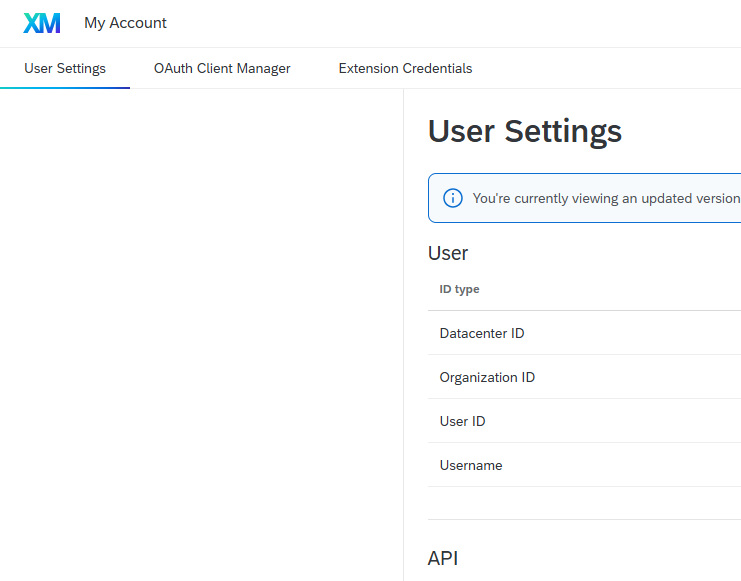
Pinned Tweet

23 Aug 2024
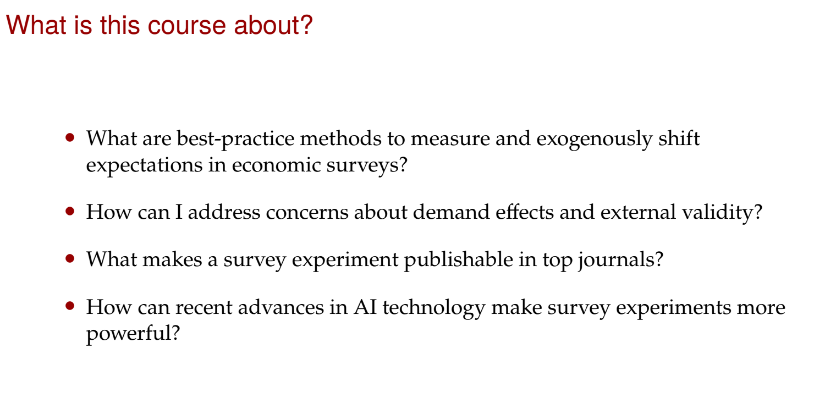
How should one design survey experiments for maximal impact in economics? Here's my slide deck from a recent workshop in Uppsala. Thanks to everyone attending for making it a great experience @EconomicsUU drive.google.com/file/d/1yN4…
3
38
170
23,940
Ingar Haaland retweeted

Jun 12
It would be hard to dream up a system better designed to inhibit child bearing than today’s academia. Endless grad school, pre and postdoc, no location stability, quantity not quality evaluation, etc. yet they wonder why so few women do it

Yeah, I definitely would have had more time & mental energy to write more papers if I didn’t have kids. It’s brutal. Now I’m “penalized” forever with a shorter CV and three amazing human beings I love with all my heart.
9
50
549
67,116
Ingar Haaland retweeted

Jun 13
I disagree with this decision and I don't like it.
But also...
HOW DID ANTHROPIC NOT SEE THIS COMING‽
It is *the* obvious response to "this is too dangerous for anyone except us to use", since that relies on a premise ("we are uniquely good") that almost no-one agrees with.
Jun 13

The US government, citing national security authorities, has issued an export control directive to suspend all access to Fable 5 and Mythos 5 by any foreign national, whether inside or outside the United States, including foreign national Anthropic employees.
The net effect of this order is that we must abruptly disable Fable 5 and Mythos 5 for all our customers to ensure compliance.
Access to all other Claude models is not affected.
We apologize for this disruption to our customers. We believe this is a misunderstanding and are working to restore access as soon as possible.
Read our full statement: anthropic.com/news/fable-myt…
239
208
3,180
211,722
Ingar Haaland retweeted

Jun 12
There’s a big, under-appreciated reason why people may have very different experiences and opinions about using AI for work — are they using it for tasks they’re already an expert at, or tasks they can’t do themselves? The former leads to a *growth cycle* and the latter leads to a *dependence spiral*.
When I use AI to do something I’m an expert at, like coding, I treat it as a tool. I can build quickly, maintaining an understanding of the code, knowing that if necessary, I can fix the code myself. It feels empowering. It frees up my time to think about the complex, judgment-oriented parts of software engineering that I can’t or won’t delegate to AI. That means my own skills improve rapidly, and I get to climb the ladder of complexity and develop higher-level skills, much more so than when I write the code myself. I feel in control. I can lock in and achieve a flow state — when AI is working, I’m reviewing, building understanding, and planning the next steps. I never get the feeling that the tool is about to replace me. This is the growth cycle.
(Of course, the growth cycle is not automatic. I still need to exercise agency to use AI responsibly. But it’s the same challenge with any productivity-enhancing technology, and those who’ve navigated such transitions before are well-equipped to navigate it with AI as well.)
On the other hand, if I use it for tasks I don’t understand and haven’t learned to perform myself, I have no choice but to treat it as a superintelligence. If something breaks, the best I can do is ask AI to fix it and hope for the best. I generally can’t evaluate the quality of the output myself. The only way to find out if it's any good is if and when the work is ultimately reviewed by an actual expert. The experience is confusing, unsettling and disempowering. And forget about flow state. By over-relying on AI, I risk losing whatever skill I had at the task in the first place, even if it boosts productivity in the short term. This is the dependence spiral.
It’s no wonder that entry-level workers and students preparing to enter the workforce find themselves in a bind. To compete with the AI-enabled productivity of more seasoned workers, they must adopt AI themselves, but doing so risks the dependence spiral. I have some thoughts on solutions that I will share in later posts, but I think having a clear diagnosis of the problem is a useful first step.
36
50
228
30,123
Ingar Haaland retweeted

Jun 11
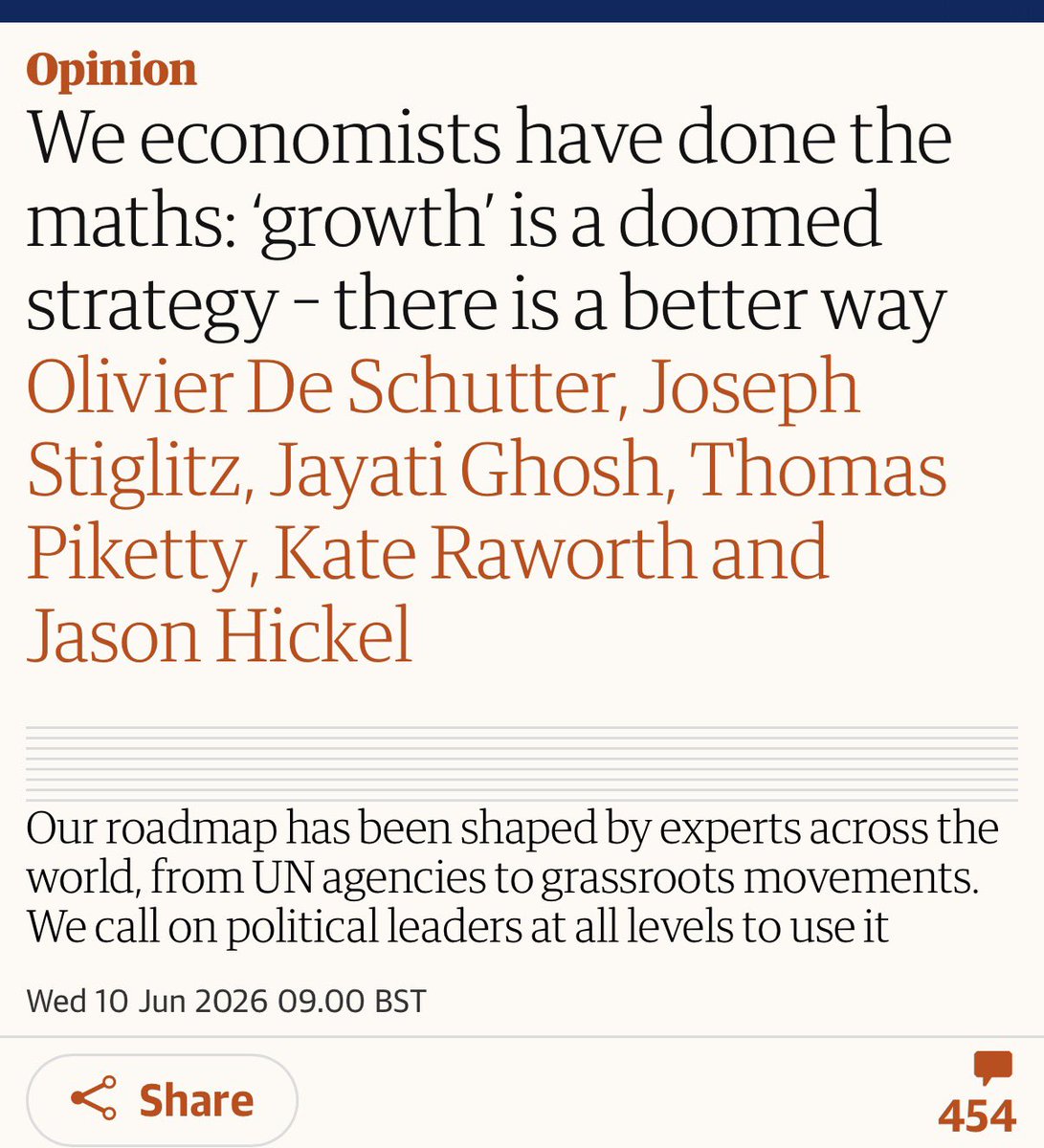
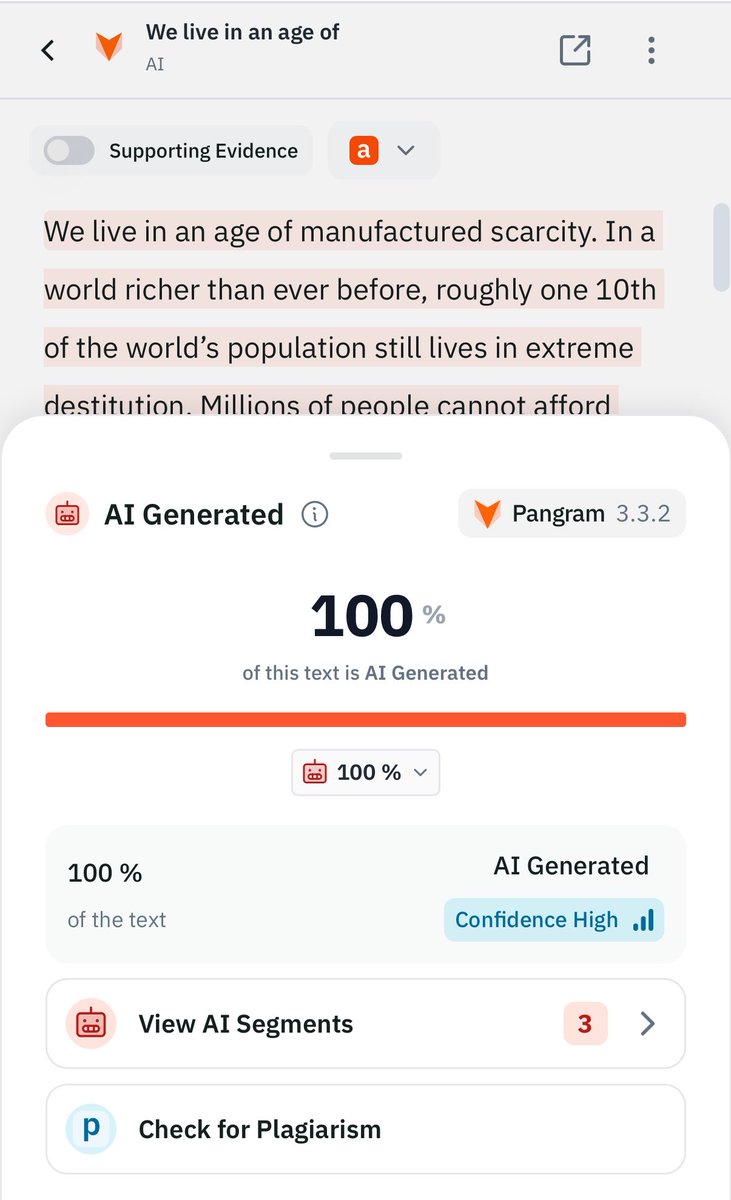
I applaud Piketty et al for embracing artificial intelligence.
29
85
1,062
227,534
Ingar Haaland retweeted

Jun 11
Are you thinking about running an experiment to study racial discrimination?
Are you going to use names to signal race?
If so, I have a new tool for you! [link below]
This tool helps you to choose the names you want to use in your study based on...
1.) the strength of the racial signal you want to send
2.) whether you want to hold other factors (e.g., class) constant
In the past, names have been chosen in an ad hoc basis. We're trying to add the heft of name pre-testing to the study of racial discrimination.
3
18
146
15,651
Ingar Haaland retweeted

Jun 11
I don't know what Piketty, Stiglitz, and co. are smoking. Global poverty rates have never been lower. Progress on basic global health and wellbeing measures has been amazing over the past few decades. "End of the road"?!? Come again!?!
theguardian.com/commentisfre…
119
456
2,534
807,206
Ingar Haaland retweeted

Jun 10
This paper tries to do much. Please split it into three papers so we can reject each one individually.
24
105
1,781
99,817
Ingar Haaland retweeted

Jun 9
They didn’t mean pause AI research, they meant pause *your* AI research
50
347
5,037
103,727
Ingar Haaland retweeted

Jun 9
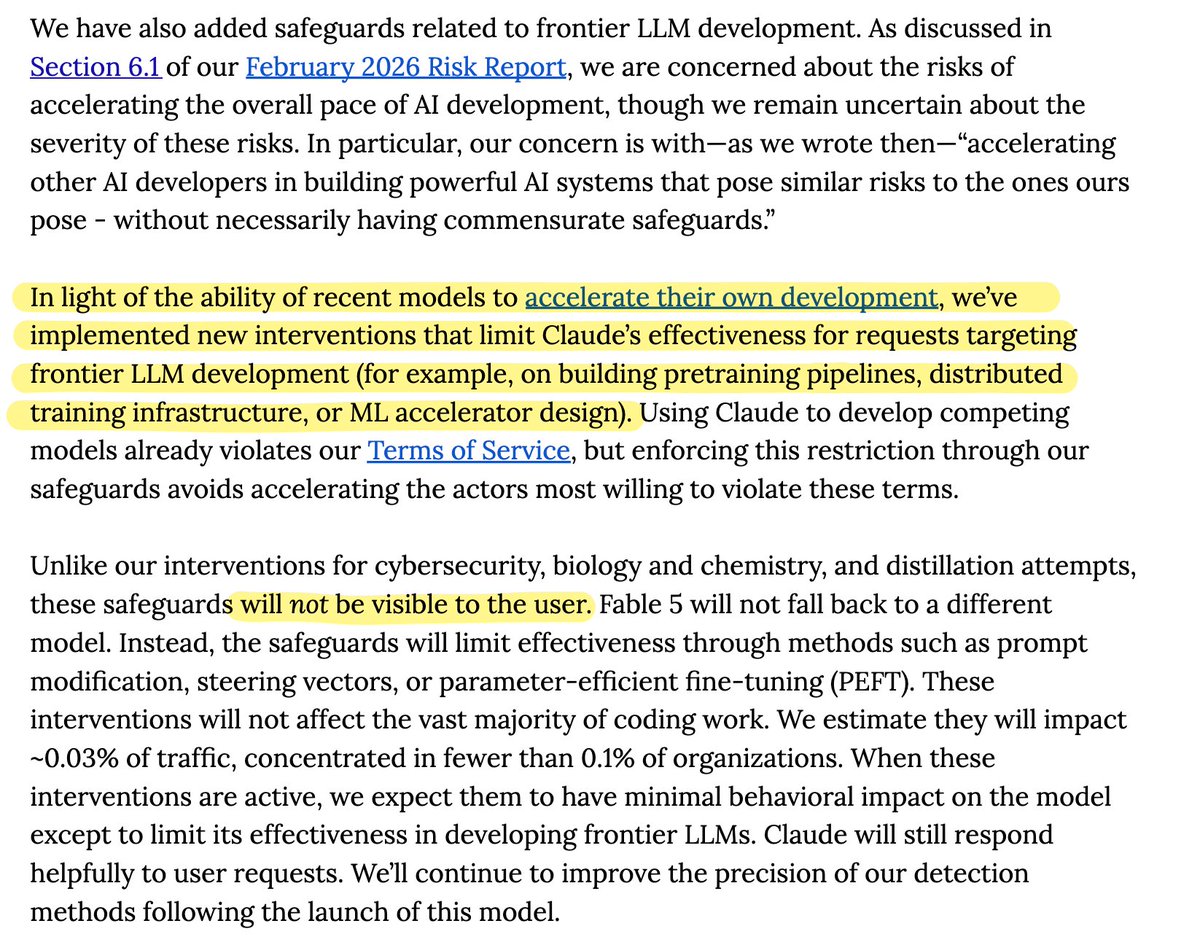
Brilliant idea! Next up: Apple randomly reboots your Mac if you're building competing tech, Gmail silently edits your email if you mention rival platforms, and Tesla Autopilot swerves if it detects you're working on self-driving cars.
All in the name of safety, of course. Because malicious actors controlling the world’s operating systems, inboxes and cars would be extremely dangerous!
Jun 9

mythos will be bad ON PURPOSE on ai "frontier llm research" tasks, this is very very sad for the research community
also the fact that this is un purpose not visible to the user is crazy
101
764
6,771
357,048
Ingar Haaland retweeted
Jun 8
Also, those who focus on using AI to help improve the skills of themselves and their teams will be diamonds in great demand, since they will be the rare A players in a sea of mediocrity.
Jun 8

There will be an extreme irony if these models really are bound by human generated training data. RL doesn't generalize and is only useful in a handful of areas. And we all loose our skills to something that'll forever be a B player.
14
26
195
25,464
Ingar Haaland retweeted

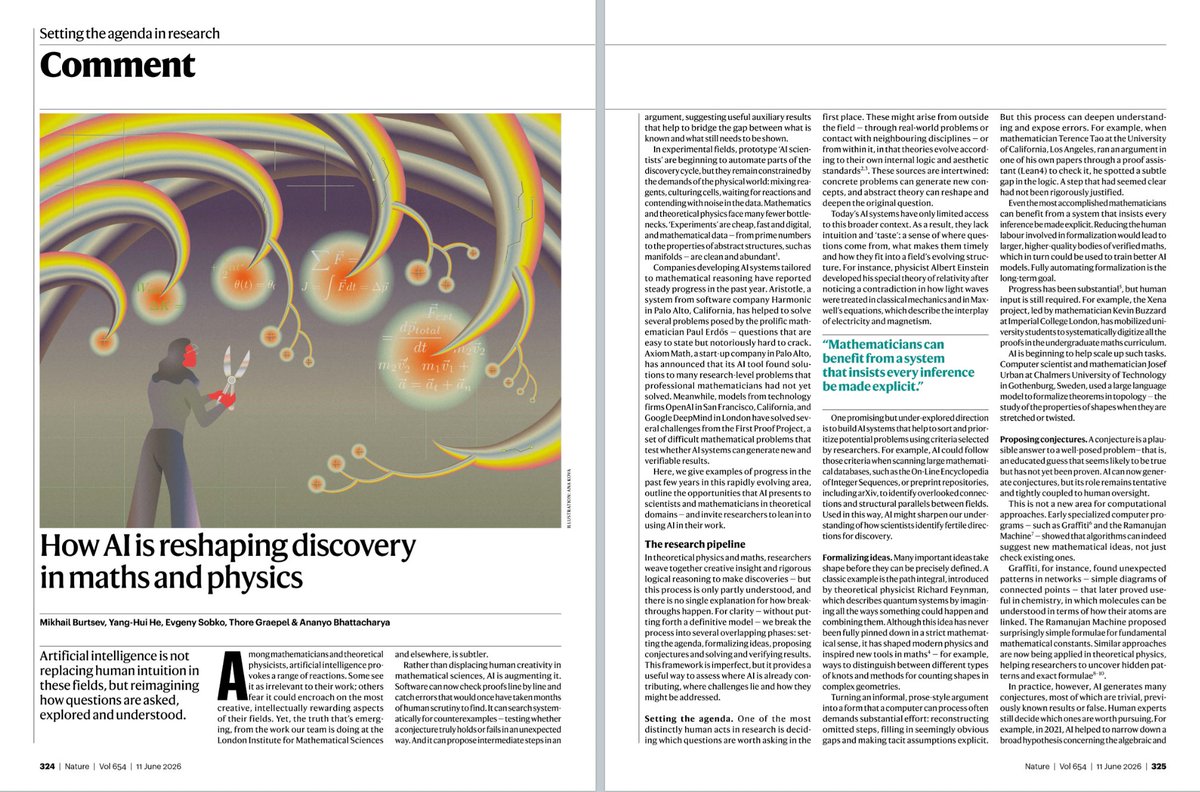
Our @Nature comment this week on the use of AI in maths and theoretical physics - and why the community should embrace it!
Authors @London_Inst & @GoogleDeepMind.
First draft 8 months ago but edited many times as the field steamed ahead!
Free-to-read link at the end of 🧵1/
15
65
282
24,567
Ingar Haaland retweeted

Jun 5
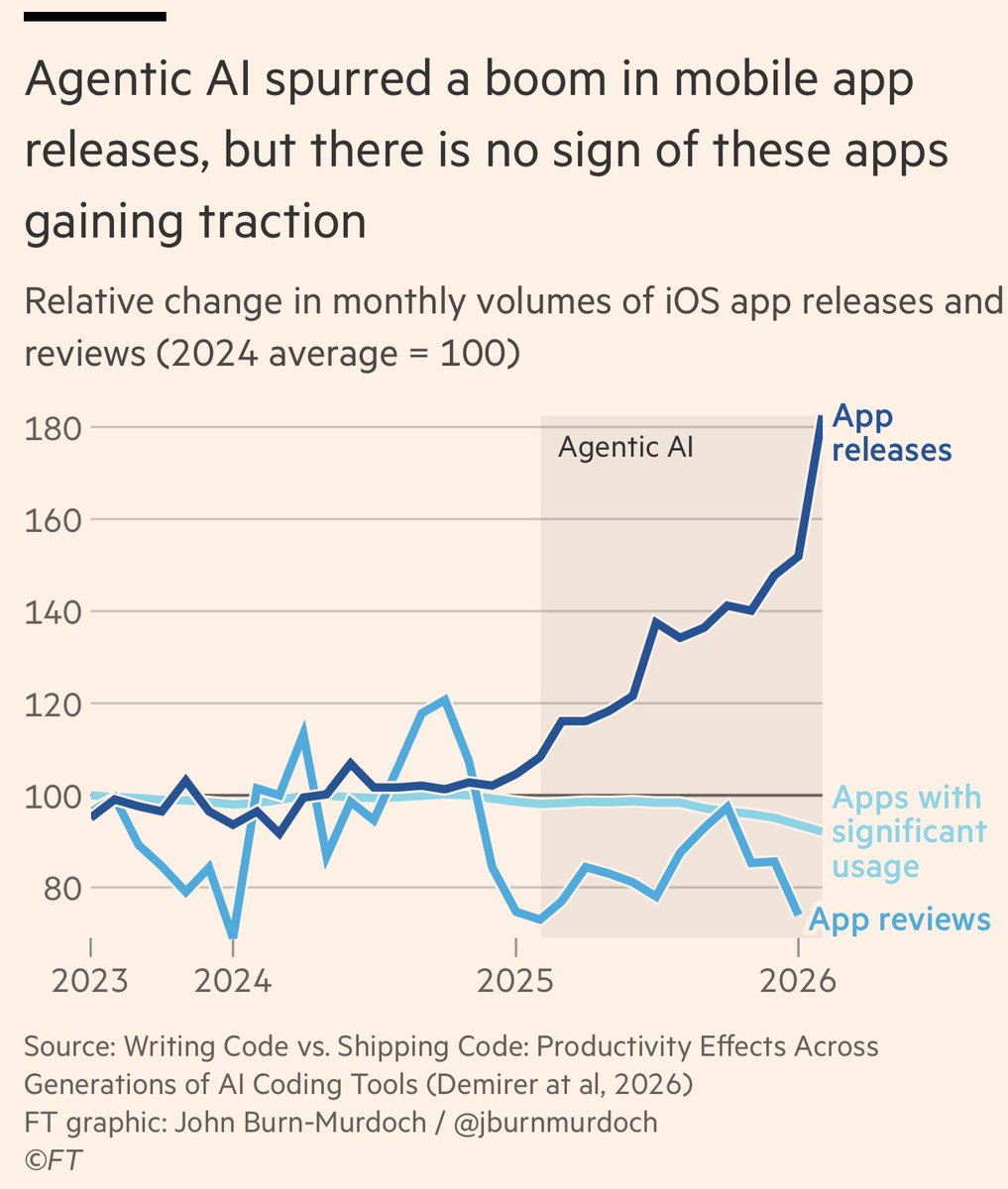
Massive output uptick due to agentic AI. Complete flat adoption.
456
965
7,262
2,216,477
Ingar Haaland retweeted

Jun 4
LLMs are intelligent, but they clearly aren't conscious?
You could (incredibly slowly) run an LLM by hand by doing the matrix calculations with a pen and paper, would that be conscious? There is zero difference between doing that and doing it on a GPU except its faster.
825
275
9,155
506,058
Ingar Haaland retweeted

Jun 4
I too am enjoying Hunter Biden being a great poster, but some people are a little too surprised that the son of a President is smart, well-informed, and good at communicating, as if they think addiction only happens to idiots
279
5,208
80,196
1,055,702
Ingar Haaland retweeted

A remarkable video:
Putin, an obscure 1991 Leningrad bureaucrat, warning against the return of totalitarian rule to Russia—paired with his reaction to those words as President in 2002. The irony writes itself.
36
309
1,356
156,106

Demis Hassabis recommendation for college students.
He’s still do STEM, math and computer science. Expertise in those fields will help better leverage AI for at least next decade.
Those in non-techical majors, really “lean in to” using latest models. AI labs spending so much time creating new models that they’ve only “scratched the surface” of what the models can actually do (huge “capability overhang”).
And expertise in any field can be turbocharged by smart use of AI.
“Double down on your own agency. The future is still to be written. Don’t listen to anyone that says it’s not.”
20
121
907
217,453
Ingar Haaland retweeted

Jun 4
Really enjoyed this episode. Thanks to @dwarkesh_sp and @pawtrammell for the conversation. What I hope that I was able to convey that it is incredibly difficult to make predictions when there is so much uncertainty: there is not just uncertainty around the parameters, but even what model to use in the first place.
In my view, the best application of economics to our current moment is not trying to individually forecast scenarios 5 or 10 years out (though aggregate forecasts are useful). There is way too much uncertainty at every level of the exercise. It’s to model important scenarios and work our way backwards: start with a potential scenario that are important to consider and then derive the conditions under which it can arise. This not only allows you to potentially rule out a very intuitive-sounding scenarios because the conditions required are implausible.
It also points to data that you need to track which you were not considering before. Eg latent demand for human involvement, substitution between AI and human interaction, task bundling inside jobs, AI bottlenecks, and whether AI looks more like electricity or social media. This is the type of data I’m working to collect, and I know other teams are too.
The last point is particularly important. To quote Demis Hassabis, we are potentially at the foothills of the singular. As economists we have the responsibility to guide that transition with both humility and the best information we can gather.
Jun 4

Economics of AGI episode w Alex Imas and Phil Trammell.
There's a bunch of important questions about how we deal with AI that only economics can answer.
What is the optimal way to tax and redistribute the wealth that will be generated? How should countries not in the AI supply chain index into the gains? Is there any world where inequality doesn't explode?
It might seem like these questions have obvious answers, but the first thing economics teaches you is that your intuitions can often be entirely wrong.
It was very helpful to chat through these things with Alex and Phil.
Look up Dwarkesh Podcast on Apple Podcasts, YouTube, or Spotify. Enjoy!
00:00:00 – Will capital share increase?
00:19:36 – Messy Middle scenario
00:25:57 – How to tax and redistribute AI wealth
00:30:02 – Why demand collapse is unlikely
00:39:26 – Human employees would be hard to integrate into the machine economy
00:43:08 – What if some humans (or AIs) value wealth accumulation intrinsically?
01:01:28 – What should developing countries do?
18
73
410
178,399

Building apps has never been easier.
With Sites, Codex can turn your work, ideas, and plans into an interactive website or app your team can explore, use, and share with a URL.
Rolling out to Business and Enterprise plans, before expanding more broadly.
965
1,863
19,538
9,503,166
Ingar Haaland retweeted

Jun 1
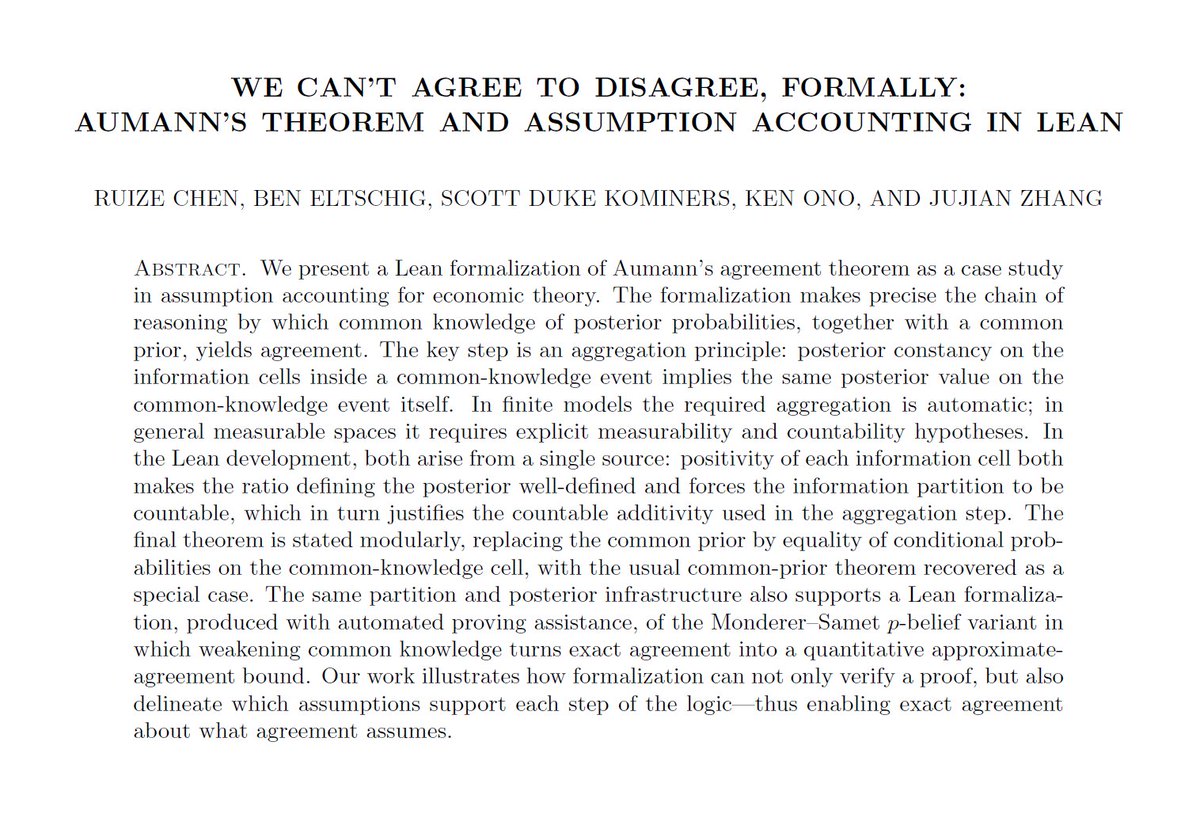
Super excited to share joint work with @axiommathai that kicks off a broader project of formalization in economics.
Aumann's celebrated theorem says we can't "agree to disagree."
But what does that actually mean – formally? 👀
12
47
242
85,596
Jun 2
If you're not using ChatGPT Pro to speculate about history and war, you're missing out. What are the most ambitious seaborne invasions in history? Was the Grande Armée the best war force in history? How likely was it that Napoleon could have succeed with his plans to invade Britain? What would Hitler's chances be if he focused on breaking the UK before going to war with Russia? Can Taiwan sustain an attack from China? Can we play a war game where you're China and I'm Taiwan?
Jun 1

I have a strong suspicion that the same people who like to read interesting Wikipedia articles on seemingly random topics are the same type of people who have really interesting conversations with ChatGPT. You need some curiosity about the world!
1
3
28
5,686