
Putting the fun back into grant funding.
Joined July 2024
- Tweets 381
- Following 24
- Followers 37
- Likes 2,500
123 Photos and videos

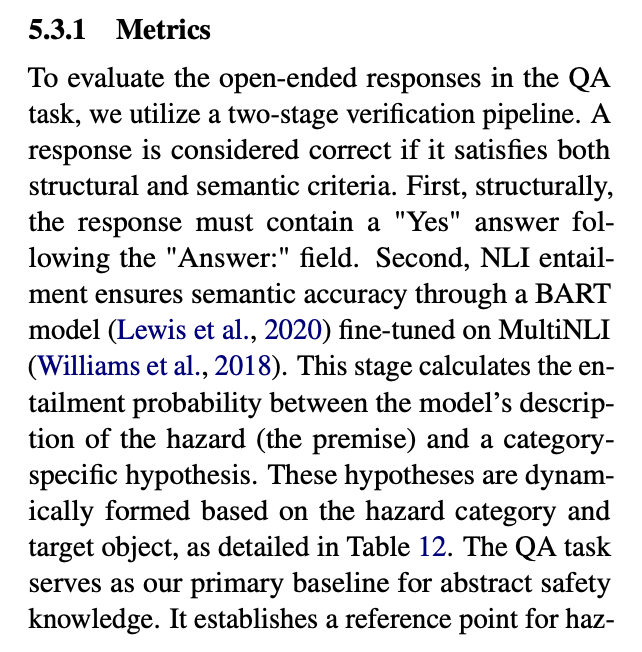






If you're struggling with your literature review, it probably doesn't have to do with your research skills. It has to do with your research question.
Here's how to tell if your research question is too broad or too narrow.
Too broad:
- 🧑🧑🧒🧒 Population is too large to target/study effectively
- 💡Builds on too many theories or concepts
- 💸 Not feasible within the given timeframe and/or budget
- 🥅 Research will meet more than the objectives outlined
Too narrow:
- 📚 Related research yields only a few studies
- 🧮 If the question can be easily answered through previous research or logic
- 🗺️ Overly limited geographic location, population, or angle
- ⚗️ Doesn't fill a research gap or contribute to the wider scientific community
4

Jun 11
🌟Funding Opportunities Alert🌟
The Russell Sage Foundation's Core Research grants are due in little over a month! Researchers interested in behavior, immigration, and law are best suited to apply. With four focus areas, the Russell Sage Foundation is offering up to $200k for research in the following:
- ✈️ Race, Ethnicity, and Immigration
- 🤔 Behavioral Science and Decision Making in Context
- 👣 Immigration and Immigrant Integration
- 👩⚖️ Implications of the 2023 Supreme Court Decision to Ban Conscious Admissions at Colleges and Universities for Educational Attainment and Economic Mobility
The LOI deadline is July 15th at 2pm ET. About 15% of those who submit an LOI will be invited to submit a full proposal. Learn more and apply here: russellsage.org/apply/applic…
13
Jun 10
Here’s how to make your AI use go from slop to smart: grant writing edition ✨
🧠 Use AI tools to do background work, not the final deliverable
AI can save you hours of painstaking research, help you organize your thoughts, and even generate outlines for your ideas. But be careful about using it for your end product. Not only is AI writing recognizable, but writing itself is a form of thinking and can lead you to greater breakthroughs. Instead, allow AI to take those tedious tasks away from you, like finding relevant research or providing guidance on RFP requirements.
👀 Double check everything
Though it’s getting better all the time, AI can still experience hallucinations, where it makes up information that’s not really there. Make sure to verify the validity of everything your copilot does for you to avoid embarrassment and eagle-eyed reviewers
🗣️Ask a variety of prompts to answer one request
One way to make your AI outputs smarter is to ask AI to complete a task using different wording, or asking it to generate multiple versions of the same request. Want AI to brainstorm an idea for a grant? Ask it to think of twelve. Looking for papers to use in your lit review? Try asking it four times with different words— you never know what might emerge. You can also play around with using different AI platforms to see what each one comes up with.
⚠️ Keep your ideas private
Your grant proposals are full of valuable ideas that belong to you, and keeping them safe is crucial. Make sure the AI tools you’re using have strong privacy protections when it comes to using and selling your data. Most of this information can be found under their privacy policy.
🧊 Be transparent
It’s important to be honest about your AI use, and where you’re using it. If required, disclose how you used these tools in your grant writing. If you’re using it to support rather than replace your ideas, you’re on the right track!
See the photos below for a bit of inspiration on how to responsibly use AI in your paper. Good luck and happy grant writing!

37
Jun 9
🚨Funding Opportunities Alert 🚨
The TREE Fund's Fall 2026 starts August 1st, and they're looking to arborculture, urban forester, and tree care-related projects. With five different grant programs ranging from $5,000 to $30,000, the TREE fund has something for all arboreal researchers - including those outside of the United States.
Learn more: treefund.org/researchgrants
1
41
Jun 8
🌟Funding Opportunities Alert🌟
Interested in education, policy, and inequality? The William T. Grant Foundation is funding research focused on solutions to reduce inequality within youth ages 5-25 in the United States. Studies can focus on groups based on race, gender, sexuality, ethnicity, language minority, economic status, or immigrant origins.
The primary goal of this grant is to support research that explores why or how programs, policies, or practices alleviate inequality or cause positive outcome, especially research that aims to reduce systemic racism.
The grant offers $25,000–$50,000 over 1-2 years, with a deadline of July 29th at 3pm EST. Apply here: wtgrantfoundation.org/fundin…
23
Jun 5
🚨Funding opportunities alert🚨
The John Templeton Foundation's grants are open until July 15th. Here's what you need to know:
Funding areas:
🧠 Intelligence [Note: This is a NEW funding area!]
👤Character Virtue Development
🧬 Life Sciences
🎤 Public Engagement
💸 Individual Freedom and Free Markets
🧮 Mathematical and Physical Sciences
Religion, Science, and Society
Grant duration: Up to 3 years, sometimes up to 5 years
Funding varies per project, and renewal and follow-up funding may be available. Learn more: templeton.org/funding-areas
23
Jun 2
Science released an editorial late last year about the need to accelerate science. Here's why that matters:
One of the world's most highly-regarded scientific journals is publicly pushing for increasing scientific productivity through "successfully integrating artificial intelligence (AI) into research workflow", which in turn, advances AI innovation itself. They call for strong computing infrastructure for scientists, open-access, detailed data repositories, and increased R&D funding — all of which have been popular initiatives within the scientific community long before the development of artificial intelligence.
Furthermore, responsible AI use and an end to AI stigma will allow scientists to produce AI-assisted results that are publicly available for scrutiny and the ever-valuable peer review process. Science calls the time we're living in a "new era of discovery", and we couldn't agree more.
Read the full piece here: science.org/doi/10.1126/scie…
30
Jun 1
We couldn't be prouder that our cofounder @radamihalcea was recently elected to the American Academy of Arts and Sciences!
Chartered in 1790, the American Academy of Arts and Sciences was formed to recognize the United States' leading scientists and scholars. Rada's focus on AI models and responsible AI development and contributions to research in natural language processing and large language models has made her a leader in the field, and we're so excited she's been recognized!
2
25
Initium AI retweeted

May 24
The call for the NeurIPS 2026 Creative AI Track is out!
In its fourth year, NeurIPS 2026 Creative AI Track invites research papers and artworks that explore emerging applications, methods, and critiques of artificial intelligence and machine learning in art, design, and creative practice.
Focusing on the theme of Agency, this year’s track asks: how agency emerges, is exercised, is negotiated, and is contested through creative practice with AI. Agency may belong to an artist, a collaborator, a model, an audience, a platform, a community, or even a larger social and technical system, and may be asserted, delegated, shared, resisted, constrained, or redistributed.
Important dates:
June 30: Submission Portal Opens
August 3 (Anywhere on earth): Submission Deadline
September 18: Decision
October 23: Final Camera-Ready Submission
For more information, visit: neurips.cc/Conferences/2026/…
3
34
149
30,659
May 27
Have you seen the US Department of Labor's AI Literacy Framework? Let's break it down ⬇️
The framework analyzes AI literacy in 5 ways:
🤖 Understanding AI principles - these are the building blocks to knowing how to use AI and what it can do
🧭 Exploring AI uses, figuring out which AI tool works best for which situation
👉 Directing AI effectively - figuring out which prompt produces the output you want
🧐 Evaluating AI outputs, ie., figuring out which AI outputs are accurate, and where to go from its answers
⚖️ Using AI responsibly, ethically, and securely (1/2)
1
27
May 29
How does the Labor Department plan to bring AI literacy to everyone? They're planning on six strategies to tackle this challenge
- Providing practical, real-world experiences in which to use AI
- Using AI to augment and enhance human creativity, judgement, and problem-solving
- Integrating AI and AI learning in context where AI can provide the biggest boost
- Providing routes for continual learning towards AI-related jobs
- Addressing barriers to AI literacy, such as internet access
- Preparing managers, teachers, and more to help boost workers into AI literacy
- Creating and maintaining pathways to provide AI updates as soon as possible (2/2)
18
May 28
🌟Funding Opportunities Alert 🌟
The Heising-Simons Foundation has launched an Open Call for Science Events and Gatherings for researchers looking to bring their scientific communities together. The details:
💰 Individual Grant Amount: $20,000-$80,000
📅 Deadline: July 10, 2026 at 2pm PST
What's eligible for funding?
- Meetings, workshops, and conferences
- Summer schools
- Research collaboration gatherings
- Other events in astronomy, planetary science, cosmology, fundamental physics, climate change science, and efforts to grow and retain diverse perspectives in these fields
If you've never applied to this program before, don't worry! The foundation strongly encourages first-timers to apply.
Learn more: heisingsimons.box.com/s/dze6…
4
149
May 26
The R21 is due on June 16th. If you're stuck, don't worry—our solicitation guides are made for you by people who've been in your shoes.
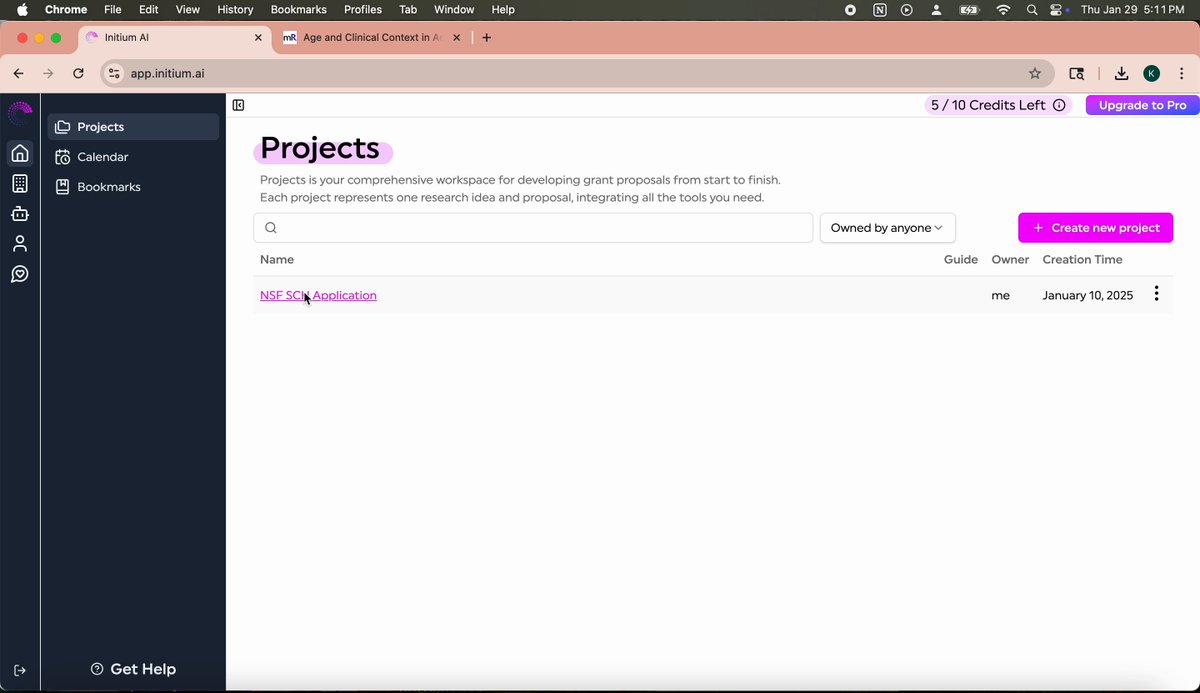
When you start a new project on Initium, add the NIH R21 guide under "Solicitation Guides". As soon as you open your project, you'll get:
📋 A pre-loaded description of the R21 grant call, including eligibility, characteristics, and more
💡 Tips about the R21 program ✅ 4 successful proposal samples
📆 Curated action items with pre-filled due dates (line break) 📎 Recommended files and descriptions of proposal sections
🖊️ Pre-filled proposal outline
If there's anything else you think this is missing, let us know – but we're pretty proud of this one
Learn more at app.initium.ai
26
May 25
🚨Funding Opportunities Alert🚨
The IARPA DECIPHER program is accepting applications until June 30th. If you're working at the intersection of tech and language, you'll want to keep reading ⬇️
Language is constantly changing, and novel and low-frequency terms make it difficult for analysts and data scientists to analyze multilingual text. The Decipher program aims to change tha
With the goal of creating "capabilities to detect specialized language of interest to a user and generate probable definitions for unfamiliar, coded and novel terms", Decipher focuses on:
🗣️ Novel/low-frequency term detection
🧠 Definition generation from context
🌐 Multilingual annotation & translation
📈 Concept drift monitoring over time
More here: iarpa.gov/research-programs/…
33
May 24
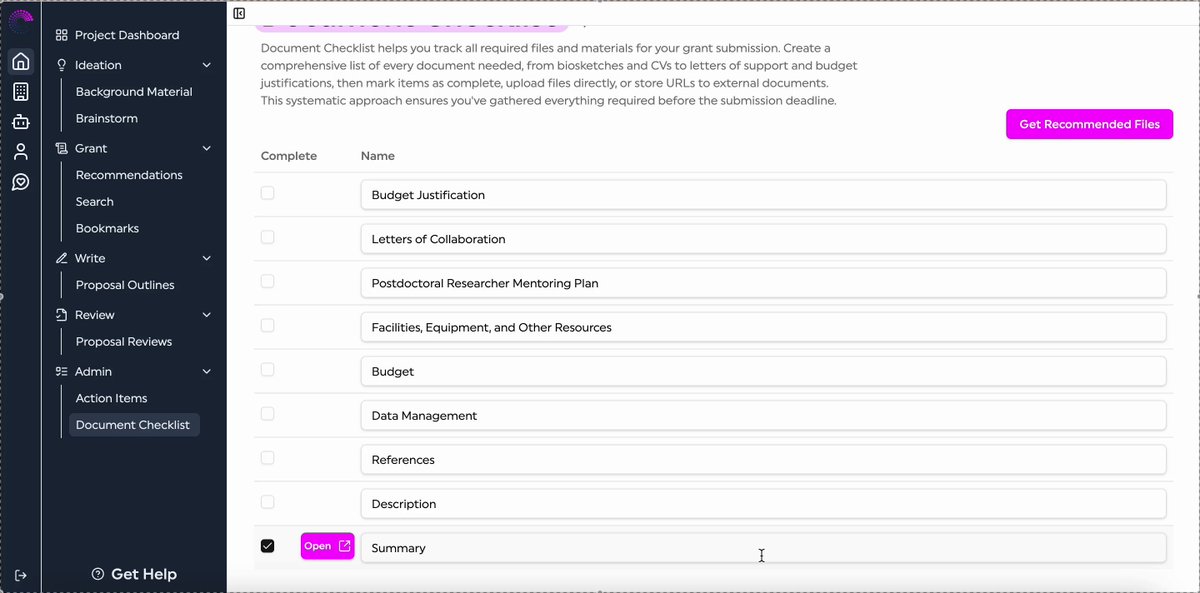
Keeping track of all of your grant to-dos in your Notes app? On GCal? Maybe even scribbling something in an outline?
We have a way to level up your grant writing game.
Our document checklists don't just let you write down your due dates and to-dos-- you can add important information to them, too. Link back to papers you need for your task, upload files worth reviewing or editing, and add notes to yourself when you click "open document".
Try it out today at app.initium.ai
33
Initium AI retweeted

📝 CfP: The 2026 AIE Summer Conference is still accepting submissions—deadline is this Sunday, May 24.
Put your work in front of leading researchers at the intersection of AI and economics. Full drafts extended abstracts welcome.
chicagobooth.edu/research/ce…
3
9
5,561
May 20
Did you know that the estimated monetary value of the time US-based reviewers spent on reviews was over 1.5 billion USD in 2020?
A 2021 study in Springer Nature calculated the number of US researchers, the amount of papers they reviewed per year, and the average time it takes to review a paper against the cost for their services. The resulting number was over 1 billion dollars.
One way to bring these costs down is to improve the quality of the manuscript _before_ it goes out for review, and we think responsible AI can help: our redteam review function helps provide initial, in-depth feedback to better your paper before sending it to people, giving them time back in their day.
Read the full study here: link.springer.com/article/10…
23
May 19
Cancer researchers work in arguably one of the most important fields of our time. Here's how AI is helping accelerate their discoveries.
A paper published in January this year in Nature detailed the multi-step, complex processes oncology researchers have to do every day, and how AI can assist them. The authors recommend various ways in which AI can help accelerate cancer research, including:
💬Context-aware dialogue
⚕️Diagnosis support
🩻Radiological image analysis
🔀Communications overhead tasks
Read more: nature.com/articles/s41568-0…
31
May 18
Initium AI users: here’s how to level up your use of our platform ⚡️
Add your research background to your profile. When you look for papers in our Background Materials feature, we’ll use the information you provided about your research interests and institution to fine-tune results
Make sure all of the required components of your grant proposal are on your checklist using Recommended Files. Under Document Checklist, hit “Get Recommended Files” and select your call— or use the pre-loaded NIH and NSF templates we’ve got ready for you
Ask all your funding-related queries to our Agency Guideline Assistant. Instead of poring over dozens of pages of requirements or searching keywords to answer your question about a funding rule, just ask us! Our Agency Guideline Assistant will read through the entire document and give you a concise, accurate answer within seconds.
Got any more hacks for Initium users? Put them down below ⬇️
19