
$ETH Telegram: t.me/intersteLLarx2
Joined February 2018
- Tweets 2,480
- Following 891
- Followers 1,663
- Likes 5,426
335 Photos and videos









Pinned Tweet

Jan 2
7
6
19
2,244
Interstellar retweeted

May 12
solana:7HgfXftRBBqsYtAEYcqjGLQrNJLL6Tww9ek4rE3Apump thank you
1
1
7
404
Feb 25
Web2 & Web3 integrations $ENX got it all
Feb 25

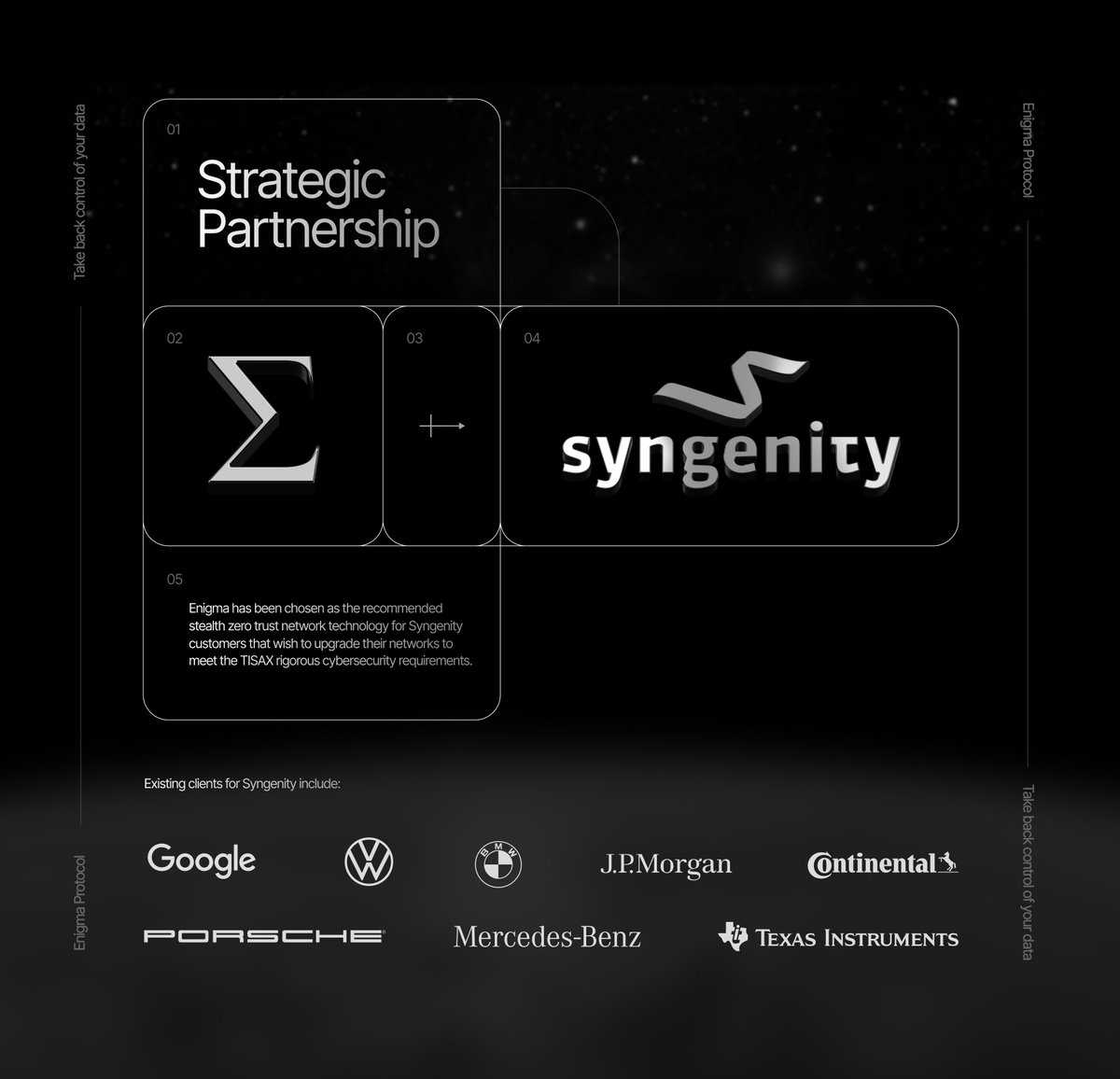
We are proud to announce that Enigma has partnered with Syngenity, a global leader in TISAX consulting, an elite cybersecurity standard for the global automotive industry.
Enigma will work with customers that wish to upgrade their networks to meet the rigorous TISAX cybersecurity requirements related to zero trust network access.
Existing clients for Syngenity include:
Google
J.P. Morgan
Mercedes-Benz
BMW
Volkswagen
Texas Instruments
Continental
$ENX
3
1
8
245
Interstellar retweeted

Feb 24
The Enigma Private Network beta testing application is now live!
enx.typeform.com/epnbeta
We will randomly grant 25 applicants with the opportunity to activate the Enigma Private Network. Holders are encouraged to participate in integration, environment, yield testing, and provide feedback as we continue to upgrade our data tunnel traffic servers and capabilities.
For Enigma, this marks the beginning of substantial opportunities across enterprise, retail, and institutional integration, as we progress towards the public release of EPN.
$ENX
39
52
203
17,297
Feb 16
guess it's time $ENX
Feb 16
EPN Dev Update
February 16, 2026
⸻
The Network
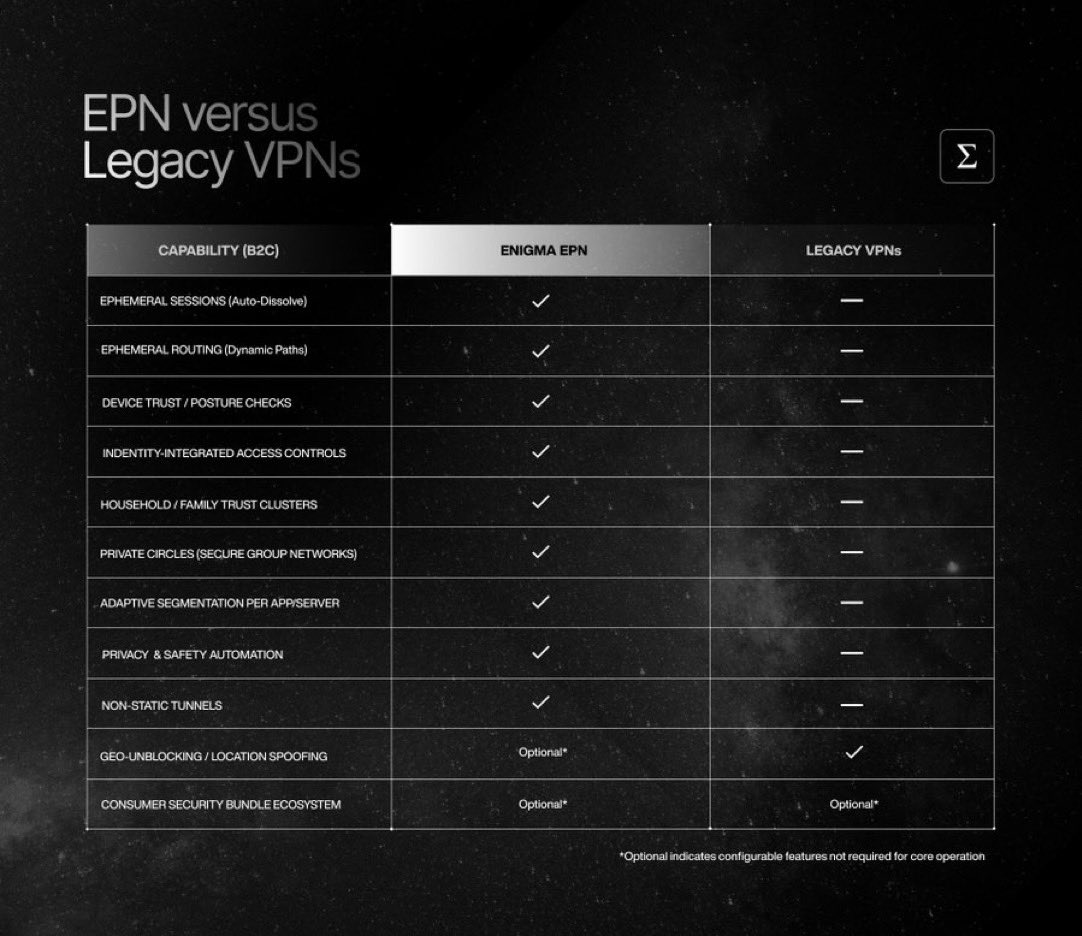
Zero-trust overlay architecture in place. Devices authenticate before connection.
End-to-end encrypted traffic routed through distributed edge mesh. Path selection based on latency and node health. Session handoff supported under normal network conditions.
14 exit nodes
(8 U.S. based, 6 international)
Provisioned for testing purposes.
Design target:
• <50ms latency for most US users
• <20ms in select metro areas (proximity dependent)
Smart routing, IP rotation, and geographic exit selection implemented.
⸻
Backend & Billing
Backend API deployed and live.
Handles:
• User accounts
• Authentication
• Stripe subscriptions
• Device enrollment
• Entitlement enforcement
Access provisioned on subscription. Revoked upon lapse (near real time).
Device controls:
• Enrollment
• Revocation
• Per-user device limits
⸻
Windows
Version 1.0.0.2 released.
Includes:
• Connect / disconnect
• Real-time network stats
• Identity management
• MFA
• Tunnel configuration
Production distribution:
• Code-signed installers
• Stable beta update channels
• Crash diagnostics reporting
In-app device enrollment active.
Status: Released. Preparing for beta expansion.
⸻
macOS
Client rebuilt with new dark HUD design system.
Implemented screens:
• Login
• Registration
• Password recovery
• Subscription (in-app Stripe)
• Device enrollment
• Dashboard
• Device sharing (QR)
• Account management
• Settings
End-to-end auth flow connected to live backend.
Keyboard navigation and structured error handling in place.
Status: Core experience complete. Finalizing for public beta.
⸻
iOS
Functional client:
• Tunnel management
• Identity enrollment (QR)
• MFA
• Diagnostics
SwiftUI interface prototype developed. Converging with production client.
Status: Functional. UI modernization ongoing.
⸻
What’s Next
Desktop beta this week.
Final integration testing on full in-app flow:
sign up → subscribe → enroll → connect.
iOS follows after desktop stabilization.

1
5
238
Interstellar retweeted
Feb 13
The EPN beta testing application will be live soon.
We will randomly grant 25 applicants the opportunity to activate the Enigma Private Network. Holders are encouraged to participate in integration, environment, yield testing, and provide feedback as we continue to upgrade our data tunnel traffic servers and capabilities.
For Enigma, this marks the beginning of substantial opportunities across enterprise, retail, and institutional integration, as we progress towards the public release of EPN.
$ENX
13
19
49
3,134
Interstellar retweeted
Feb 10
Automated Moving Target Defense (AMTD) invalidates reconnaissance before it can be exploited.
$ENX
Feb 10

Founder’s Notes (04) - Movement Is Life: The Radio Revolution
By the mid-20th century, the rules of the spectrum were changing. Intercepting a steady, predictable signal had once been straightforward: find the frequency, tune in, and listen.
But then came a breakthrough, frequency hopping and spread spectrum. Suddenly, the signal wouldn’t sit still. Instead of transmitting on one channel, radios leapt across many, changing frequencies in rapid succession. To the casual observer, the signal disappeared, flashing in and out unpredictably. To an operator with the right synchronization, it was perfectly clear. For the interceptor, it was a nightmare.
Manual tracking became impossible. Machines were required just to follow the jumps and reconstruct the stream. Movement became protection. Agility became survival.
The Modern Parallel: Cyber hopping networks today faces the same reality. Static endpoints (fixed, visible IP addresses), always-on VPN tunnels, unchanging DNS records that behave like those old, stationary radio transmissions.
They can be found, monitored, and eventually attacked.
Movement changes the equation. Ephemeral IPs that rotate, gateways that shift, multiple simultaneous pathways, applications that rebuild and relocate inside containers; these are the modern equivalents of spread spectrum.
Just as frequency hopping denied the enemy a stable target, Automated Moving Target Defense (AMTD) invalidates reconnaissance before it can be exploited. It’s not about hiding forever. It’s about moving fast enough that the attacker’s map is out of date before they can use it.
The Lesson That Endures, The fourth great truth of SIGINT and EW: survival depends on speed and unpredictability.
Strength alone won’t hold. Static defenses invite patient enemies. Motion forces adversaries to chase shadows, never quite catching up.
Why It Still Matters: Today’s adversaries automate reconnaissance, scanning vast swaths of the internet in seconds. Static defenses give them all the time in the world to probe, wait, and strike. But when the terrain itself changes, when addresses shift, services move, and containers rebuild, the adversary’s timing is broken.
What they found yesterday is gone today. Just as spread spectrum kept radio operators one step ahead, modern cyber defenders must think in terms of motion. Every system left standing still is already halfway compromised.
Next in the Series “The Fusion of SIGINT and Electronic Warfare”. How listening evolved into active disruption, and why blending sensing with effects became the foundation of dominance.
8
13
33
1,626
Jan 28

5
3
15
308
Interstellar retweeted

Jan 28
Enigma is being presented at Cybertech Global Tel Aviv: one of the world’s premier cybersecurity conferences. This is where CISOs from govs, military, intel agencies, and top global cyber startups talk shop.
Not retail “privacy", but institutional infra. $ENX is early.
Jan 26

I am excited to announce my upcoming trip to Tel-Aviv, where I have been personally invited to join the Global CISO panel as a speaker representing Enigma at the 2026 Cybertech Global Conference. The discussion will primarily revolve around Al governance, national cyber resilience, and the deployment/expansion of Enigma.
cybertechisrael.com/speakers
$ENX
13
5
41
11,973
Interstellar retweeted
Jan 27
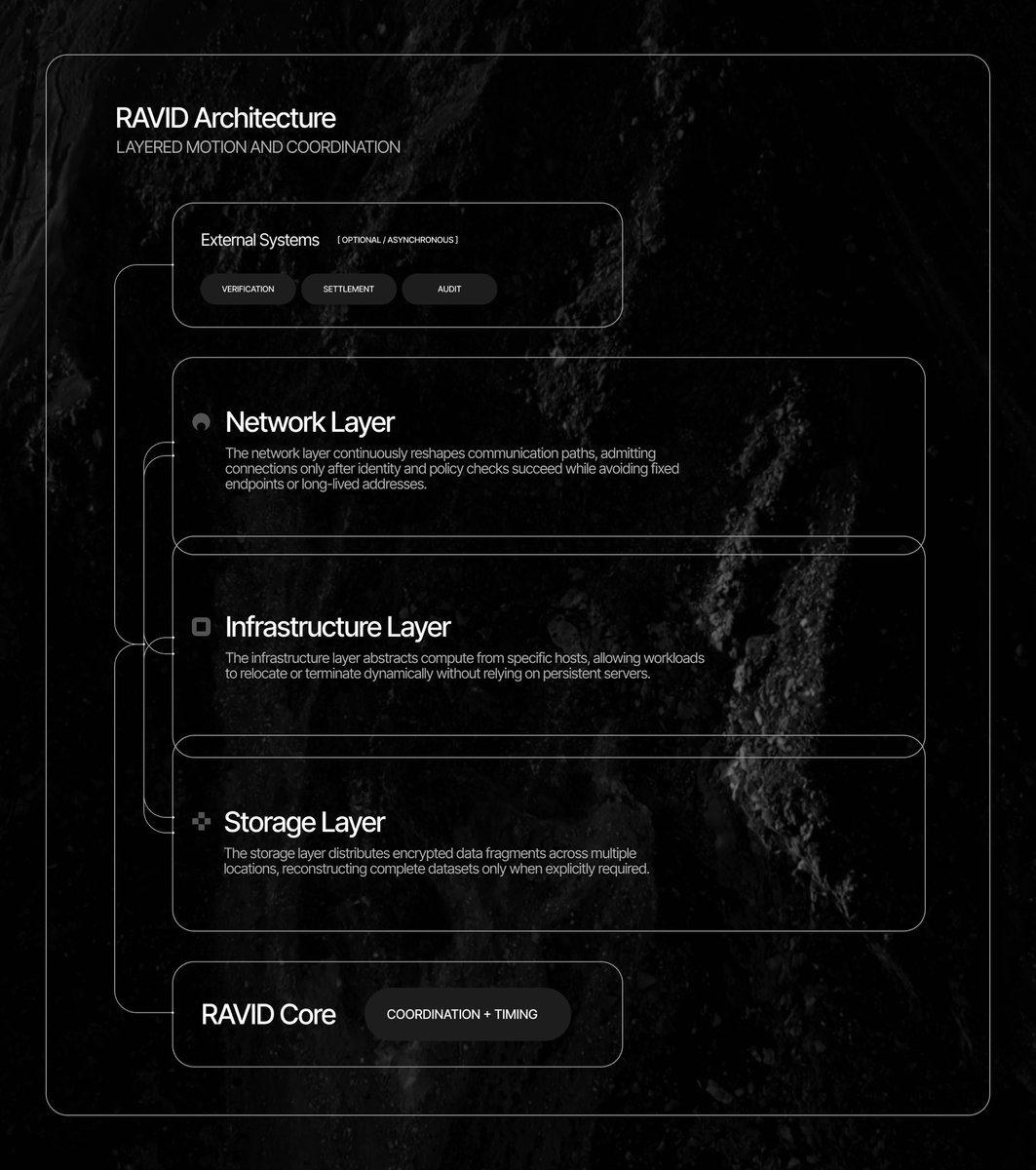
RAVID Architecture: Layered Motion & Coordination
Infrastructure that remains static over time accumulates observable structure.
RAVID’s architecture is designed to limit this accumulation by ensuring that network, compute, and storage components remain in controlled motion while preserving coordination and operational stability.
RAVID’s architecture is a layered system organized around continuous motion and coordination rather than fixed infrastructure. The design separates responsibilities among network, infrastructure, and storage layers, orchestrated by a central RAVID Core.
The network layer operates as a zero-trust overlay where communication paths are dynamically established. Routes are not bound to fixed endpoints or long-lived addresses. Connectivity is created only after identity and policy checks succeed, reducing exposure of the underlay.
The infrastructure layer abstracts compute resources away from specific hosts. Workloads are deployed across available substrate without assuming persistent servers, allowing instances to be created, relocated, or terminated based on system conditions.
The storage layer distributes encrypted data fragments across multiple locations. Complete datasets are not persistently stored in a single place; reconstruction occurs only when explicitly required.
The RAVID Core coordinates timing, lifecycle boundaries, and state synchronization across layers, ensuring that independent adaptations do not introduce instability. External systems, including blockchain-based components, may be used for verification or settlement but are not relied upon for real-time operation.
Relevant documentation:
docs.engma.io/ravid/architec…
$ENX
10
20
36
4,081
Interstellar retweeted
Jan 26
Thrilled to have our CISO and Chief Digital Privacy Officer, @JenniferEnigmaX in Tel-Aviv for the 2026 Cybertech Global Conference.
Enigma on track to scale globally.
cybertechisrael.com/speakers
$ENX
Jan 26
I am excited to announce my upcoming trip to Tel-Aviv, where I have been personally invited to join the Global CISO panel as a speaker representing Enigma at the 2026 Cybertech Global Conference. The discussion will primarily revolve around Al governance, national cyber resilience, and the deployment/expansion of Enigma.
cybertechisrael.com/speakers
$ENX
18
25
55
9,100
Interstellar retweeted

Jan 26
I am excited to announce my upcoming trip to Tel-Aviv, where I have been personally invited to join the Global CISO panel as a speaker representing Enigma at the 2026 Cybertech Global Conference. The discussion will primarily revolve around Al governance, national cyber resilience, and the deployment/expansion of Enigma.
cybertechisrael.com/speakers
$ENX
10
12
26
20,600
Interstellar retweeted
Jan 24
Quantum resistance at Ethereum's protocol level will be a necessity in the future as some data will always we be exposed due to the nature of blockchains.
But we believe that encryption is only one part of the equation. The other part is data exposure.
That's why we've built zero metadata infrastructure with RAVID, adding a critical privacy layer for the whole ecosystem that reduces the risk of data decryption by quantum attacks to a minimum.
docs.engma.io/ravid/overview
$ENX
19
19
56
8,675
Jan 23

Your ISP can see you. A VPN isn’t enough anymore. Use EPN
Your ISP can see you. A VPN isn’t enough anymore. Use EPN
Your ISP can see you. A VPN isn’t enough anymore. Use EPN
Your ISP can see you. A VPN isn’t enough anymore. Use EPN
Your ISP can see you. A VPN isn’t enough anymore. Use EPN
Your ISP can see you. A VPN isn’t enough anymore. Use EPN
$ENX 💎
8
10
20
3,012

Your ISP can see you. A VPN isn’t enough anymore. Use EPN
Your ISP can see you. A VPN isn’t enough anymore. Use EPN
Your ISP can see you. A VPN isn’t enough anymore. Use EPN
Your ISP can see you. A VPN isn’t enough anymore. Use EPN
Your ISP can see you. A VPN isn’t enough anymore. Use EPN
Your ISP can see you. A VPN isn’t enough anymore. Use EPN
$ENX 💎
8
9
34
4,132
Interstellar retweeted
Jan 20
RAVID is at the very core of the Enigma Protocol.
Contrary to traditional network infrastructures, RAVID provides a fluid network infrastructure. It continuously randomizes routes, nodes and session characteristics by distributing traffic across adaptive tunnels that change over time based on network conditions and risk models. There is no permanent topology to observe and no single point that exposes the whole network when discovered by attackers.
The RAVID framework allows for creating customized and future-proof privacy applications with zero metadata leakage.
$ENX
14
24
52
10,868

Jan 12
Jan 12

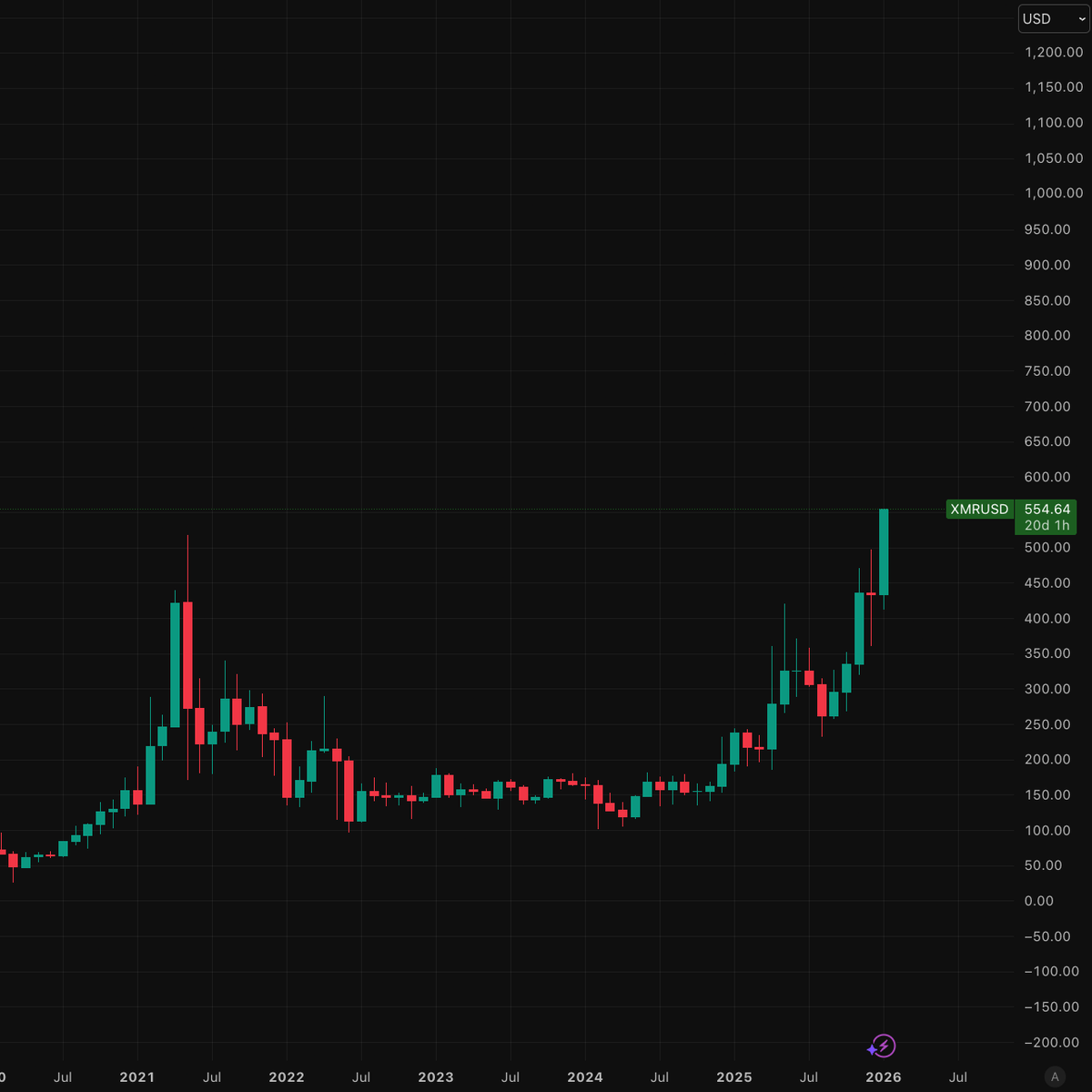
🔥 UPDATE: Monero hits a new all-time high at $554, breaking past its previous peak of $517 set in May 2021.

8
6
16
646