
Joined October 2009
- Tweets 42,109
- Following 18,581
- Followers 25,678
- Likes 107,622
2,535 Photos and videos









16h
I just voted ABSTAIN with 71.37 million ADA, on the treasury withdrawal: Scalus: Cardano’s Application Platform for Building, Launching, and Scaling.
On behalf of my loyal delegates and ADA holders.
Rationale
I am formally registering an ABSTAIN vote on the standalone Scalus treasury request.
I commend Lantr Engineering for their comprehensive, unbundled proposal and their strategic focus on opening our blockchain to the massive JVM developer ecosystem. Their technical track record and commitment to the application layer are undeniable. I previously voted abstain on high-cost infrastructure proposals, and I am standing by this position in the current market.
Whilst I recognise the immense technical advantages of a unified application platform and the value it brings to our ecosystem, an 8.5 million ADA request for a 12-month delivery window is an extraordinary draw on the treasury. I cannot allocate funds for this as a priority at this moment in time given the market and my current planned focus on strict fiscal prudence.
Transaction
adastat.net/transactions/94e…
16h

I just voted NO with 71.37 million ADA, on the treasury withdrawal: Cardano dOSPO and OMF Program
On behalf of my loyal delegates and ADA holders.
Rationale
I am formally registering a NO vote on the d(OSPO) treasury withdrawal request.
While I agree that sustaining our core open-source infrastructure is absolutely critical to the blockchain's survival, a 12 million ADA commitment over 36 months is an unjustifiable draw on the treasury in the current market. Specifically, allocating 2 million ADA purely for operational overhead, administration, legal setup, and advisory stipends before a single line of code is funded runs directly counter to the modernized, lean engineering approach we desperately need right now.
Creating a brand new, heavily-funded administrative entity to distribute funds is not a capital-efficient way to achieve ecosystem resilience. My fiduciary duty to my delegators requires me to prioritize treasury replenishment and strict, code-driven ROI over funding multi-year bureaucratic overhead. We must find more streamlined, direct ways to compensate our maintainers.
Transaction
adastat.net/transactions/aad…
4
2
42
2,128
16h
I just voted NO with 71.37 million ADA, on the treasury withdrawal: Cardano dOSPO and OMF Program
On behalf of my loyal delegates and ADA holders.
Rationale
I am formally registering a NO vote on the d(OSPO) treasury withdrawal request.
While I agree that sustaining our core open-source infrastructure is absolutely critical to the blockchain's survival, a 12 million ADA commitment over 36 months is an unjustifiable draw on the treasury in the current market. Specifically, allocating 2 million ADA purely for operational overhead, administration, legal setup, and advisory stipends before a single line of code is funded runs directly counter to the modernized, lean engineering approach we desperately need right now.
Creating a brand new, heavily-funded administrative entity to distribute funds is not a capital-efficient way to achieve ecosystem resilience. My fiduciary duty to my delegators requires me to prioritize treasury replenishment and strict, code-driven ROI over funding multi-year bureaucratic overhead. We must find more streamlined, direct ways to compensate our maintainers.
Transaction
adastat.net/transactions/aad…
1
4
71
3,970
23h
A significant shift is happening in Cardano.
ADA holders are no longer passive participants in someone else’s roadmap. They now have direct influence over the direction, funding priorities, and future of the protocol.
The holders have spoken clearly in the recent budget cycle.
They want progress. They want accountability. They want delivery tied to discipline. When capital comes from the treasury, it is entirely reasonable for ADA holders to ask hard questions, challenge poor execution, and expect spending to translate into measurable value for Cardano.
That changes the incentive structure.
As a result, we have already seen treasury spend fall. In my opinion, the value of that spend has increased. Less capital is being treated as automatic entitlement, and more attention is being placed on delivery, relevance, risk, and return to the ecosystem.
I believe this will continue.
As global competition around value output increases, proposals will need to become sharper. They will need to justify cost more clearly, explain the mechanism of value creation, and show why the treasury should fund them.
The personal attacks, emotional outbursts, and increasingly strange behaviour we are seeing from some corners are a confirmation of that shift. When informal control starts to weaken, the reaction often becomes louder, less rational, and more personal.
Until people accept that power and control is moving back towards ADA holders, those social outbursts will likely continue.
That is what happens when influence moves away from closed circles and towards the people who carry the economic risk.
I think this is extremely beneficial to Cardano.
Healthy governance should apply pressure. It should force clarity. It should make capital allocation more difficult, more accountable, and more closely linked to outcomes. That is how a decentralized ecosystem matures beyond personalities, relationships, and legacy influence.
The powerful thing is that absolutely anybody can contribute to that change.
A holder, builder, stake pool operator, developer, researcher, business owner, or ordinary user can bring information into the system. They can question assumptions, expose weaknesses, improve proposals, challenge poor incentives, and help force positive change.
That is where collective global intelligence starts to create real value.
Different people bring different experiences. Some understand infrastructure. Some understand markets. Some understand governance, risk, compliance, enterprise adoption, product delivery, or community behaviour. When those perspectives are allowed to surface, the system becomes harder to control, but much stronger over time.
Disappointment is not a weakness in governance. It is often the first sign that the system is beginning to correct itself.
What matters is that frustration is being converted into action. Holders are voting, questioning, organising, analysing proposals, and pushing for a more serious and accountable ecosystem.
The old model of quiet influence, unclear control, and decisions shaped away from the people who bear the economic risk is weakening every day.
This is where Cardano becomes different.
Its strength is the ownership structure, the incentives, the treasury system, and the fact that every ADA holder has the same fundamental rights within the system.
No special class. No permission gate. No hidden entitlement.
Cardano’s future will be shaped by the people who hold it, use it, build on it, and are prepared to defend its long term value.
Exciting times.
18
42
383
7,274
Jun 12
I think there is a broad misconception around productive funding and the long term sustainability of Cardano.
Businesses should choose Cardano because its underlying properties create genuine commercial value. Determinism makes systems easier to build, test and operate with predictable outcomes. That becomes increasingly important for privacy preserving applications, agentic interactions, regulated financial products, compliance driven workflows and enterprise level settlement, where execution needs to be reliable, auditable and consistent.
Censorship resistance and immutability allow consumers and institutions to independently verify what has occurred. Decentralisation provides a credible settlement layer with strong reliability, reducing dependency on individual operators and increasing confidence among businesses, stakeholders and users.
Treasury funding should therefore be assessed around the delivery of specific capabilities that create measurable value for Cardano. Where several companies are capable of delivering the same functionality, they should compete on technical quality, cost, execution risk and their demonstrated record of delivery. When I think about this I see added competition starting to reduce spend, but increase our quality.
Building a company on Cardano, however, cannot itself become the core revenue driver of a business. Treasury funding may support development, reduce early execution risk or accelerate strategically valuable infrastructure, but the underlying business must ultimately generate sustainable demand from customers, users or commercial activity.
Otherwise, the ecosystem risks financing companies whose revenues depend primarily on continued treasury access rather than the value of the products they deliver.
This should also be viewed through the lens of capital allocation. Where public treasury funding helps create a viable commercial opportunity, there should be a clear mechanism for Cardano to participate in the value created. Revenue sharing and treasury replenishment can align the interests of ADA holders, businesses and the wider ecosystem, provided the structure reflects the level of risk taken and offers a fair, proportionate return.
Historically, the distinction between ecosystem investment and corporate subsidy has sometimes been unclear. I expect that distinction to become sharper as governance matures, although some early friction is inevitable.
Cardano will succeed when businesses use it because its architecture gives them a durable advantage over competing systems. Its reliability, predictability, verifiability and decentralisation are the foundations of that advantage.
The treasury should fund capability, not dependency, and I strongly believe that capability is exactly what will eventually drive the future of Cardano's ecosystem.
12
10
114
2,755
Jun 12
I voted on all 69 proposals in the Cardano Budget 2026 process.
You can see all of my votes below.
My goal was to ensure essential infrastructure and tooling retained support, including projects such as Mithril and Pallas, without directing too much of the available budget towards tooling alone. I also wanted to preserve room for proposals focused on ecosystem growth, increased on chain activity and treasury replenishment.
I supported Encrypted Programmable Tokens because I believe the functionality is genuinely interesting and could enable several strong use cases across Cardano.
Hardware wallet maintenance was also an important priority for me. As technology advances and attacks become more sophisticated, maintaining secure and reliable hardware wallet support is something the ecosystem cannot afford to fall behind on.
The Indigo Innovation Proposal covering V2030RS, tokenized real world assets, Bitcoin DeFi and privacy was particularly interesting. In my view, the potential value outweighed the cost. The revenue sharing arrangement with the treasury also aligned with my objective of supporting proposals that could contribute towards long term treasury growth and replenishment.
I was initially on the fence about the High Performance Partner Chain Factory using Ouroboros Tachýs. I ultimately decided to support it because a reusable toolkit that reduces partner chain deployment from a complex process to something achievable within hours could create significantly more opportunities for Cardano. More partner chains could also create additional revenue opportunities for stake pool operators and delegators.
The Dano Finance proposal for a DeFi Kernel, American Options and an Orderbook SDK could establish a strong technical foundation for the future of Cardano DeFi, while also contributing to meaningful on chain activity. I have been very impressed by what the team has built so far, as well as the organisation, structure and accountability presented within the proposal.
Across all 69 decisions, I tried to balance essential infrastructure, practical ecosystem growth, financial discipline and opportunities that could return value to the Cardano treasury. I abstained from some of the proposals I couldn't make my mind up on and didn't feel strongly enough to give a no vote.
intersect.ekklesia.vote/vote…
Huge credit to everyone involved in improving Ekklesia. The voting experience was significantly better this time. It was smooth, reliable and made an intense workload far more manageable.
5
7
128
2,573
Jun 10
I just wanted to say a huge thank you to everyone who has trusted me with their voting power as a DRep.
I take this responsibility extremely seriously and spend a significant amount of time weighing up every decision. I am deeply involved across Cardano, connecting with people throughout the ecosystem, building, running a stake pool, and speaking with people outside the ecosystem too.
I am serious about helping Cardano grow and, looking back, I genuinely feel that some of my votes have helped shape its future.
Seeing my voting power continue to increase, especially while market conditions have become more difficult, irrational, and unpredictable, genuinely means the world to me.
This evening I submitted 69 votes as part of the Cardano Budget Process 2026. It took a significant amount of time, but I also want to credit everyone who contributed to the voting platform. The experience was seamless, straightforward, and a significant improvement.
People are working hard to make governance more manageable and effective. I will continue doing my best to push Cardano forward through strategic investment, responsible spending, and proper accountability, ensuring the treasury receives what was promised and that ADA holders get genuine value for what they fund.
Thank you to everyone who has supported me and trusted me with their voting power.
19
15
370
4,624
Jun 10
Behind the scenes, as many will confirm, I have consistently pushed for what I believe Cardano needs to achieve sustainable growth.
I stand by my principles. Treasury expenditure must be accompanied by clear milestones, measurable progress, transparent reporting, and accountability for what was promised. Capital should be allocated strategically, with a clear understanding of risk, expected value, and the long term return to the ecosystem.
Although delegates have entrusted me with their voting power, I consider the wider interests of all ADA holders when making decisions.
Together, we can drive the standards Cardano needs, improve capital discipline, and retain the confidence of professional and long term investors in both ADA and the wider Cardano ecosystem.
1
14
615
Jun 10
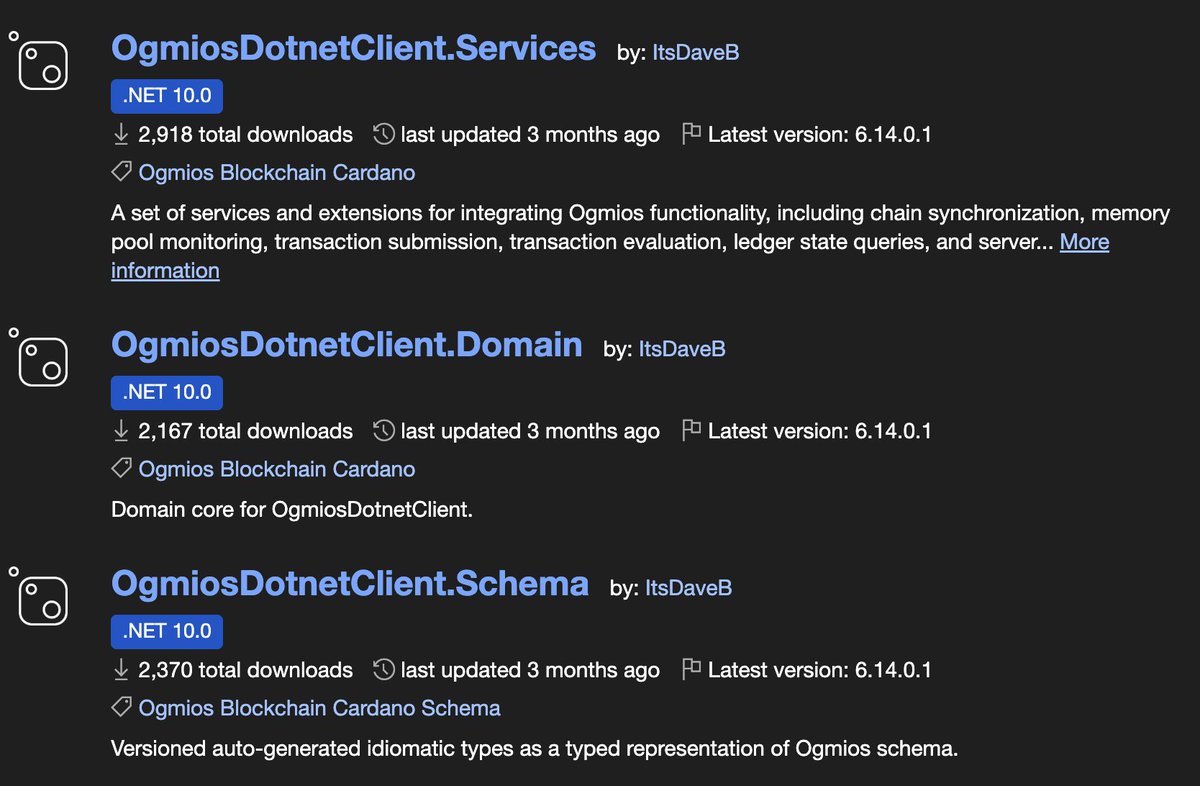
The Ogmios .NET packages I created for Cardano, have now passed 7,450 combined downloads, making it easier for the .NET developer community to build on Cardano through a familiar, plug and play integration.
The packages provide typed access to chain synchronisation, mempool monitoring, ledger queries, transaction evaluation and submission, removing much of the integration work developers would otherwise need to build themselves.
I continue to maintain and upgrade these packages in my own free time, helping keep them reliable and aligned with changes across Cardano and Ogmios, where possible.
5
17
153
2,930
Jun 10
Don’t get me wrong, compared with Solana, where many packages have hundreds of thousands of downloads, it is still relatively small.
But equally, it is just me building and maintaining this in my own time, while they have entire teams working on developer tooling as a full time role.
So I am genuinely proud of the progress and grateful to everyone using what I have built.
19
563
Jun 10
I own a stake in one of the most reliable, resilient and decentralised blockchains in the world.
It's called, Cardano.
20
45
630
7,193
Jun 9
Cardano DEX volume is up 217.77% over the last 7 days, with weekly volume now sitting at $35.4m.
Cardano perps volume is also up 29.66% over the same period, reaching $11.62m in 7 day volume.
Real usage. Real settlement. Real liquidity, and increasing activity, all happening on Cardano.
17
49
398
6,784
Jun 8
ADA holders, through Cardano’s on chain governance, are voting YES to fund Cardano Vision 2026 Research.
The proposal is currently winning by a large majority, sitting around 7% above the approval threshold with just over an hour left.
This supports research into post quantum security, Leios and Peras integration, ZK enabled scaling, Babel fees, SPO incentives, identity, governance, developer experience, and further scalability work across L1 and L2.
At a high level, this is about strengthening the foundations Cardano will need over the next decade.
The proposal includes papers and technical reports, Cardano Problem Statements, prototypes, and Cardano Improvement Proposals, designed to move research closer to real protocol capability.
Funding work that improves Cardano’s security, scalability, resilience, and long term architecture is exactly the kind of decision that can compound over time.
It is also the kind of decision that helps set Cardano apart from other blockchains.
Right now, ADA holders are speaking clearly.
They are saying yes.
9
33
331
5,344
Jun 8
I just voted ABSTAIN with 70.69 million ADA on the Treasury Withdrawal Proposal: The first node in the browser; a Cardano USP
On behalf of my loyal delegates
Rationale
I am formally registering an ABSTAIN vote on the standalone Gerolamo treasury request.
I commend the HLabs team for taking prior feedback on board by unbundling their initiatives. I previously voted abstain, additionally I have since supported their Pebble proposal with a yes vote. I am standing by this position in the current market. Whilst I recognise the unique technical advantages of this proposal and the value it brings to our blockchain, I cannot allocate treasury funds for this as a priority at this moment in time in the current market and with my current planned focus.
However, out of profound respect for the team's exceptional track record, I will not use my voting weight to actively block it. I will not stand by if the community were to decide this is required, and I am stepping aside to let the collective voice of the ecosystem determine the outcome.
Transaction
adastat.net/transactions/ff3…
Apr 19
With 68.26 million ADA voting power, I just voted ABSTAIN on the governance action: Pebble Gerolamo - HLabs 2026 Budget on behalf of my loyal delegates.
Rationale
I am voting ABSTAIN on the Harmonic Laboratories Treasury Withdrawal. I want to explicitly commend the HLabs team for their ongoing contributions to Cardano. I am a tremendous advocate for their passion, their undeniable technical talent, and their proven track record of executing for our ecosystem.
While I see immense strategic value in this proposal, particularly the Pebble programming language which I would have strongly considered supporting in isolation at an appropriate valuation, the bundled nature of this request presents an insurmountable hurdle. In our current financial climate, I cannot justify a combined expenditure exceeding eight million ADA for this specific functionality. Furthermore, funding these expansive and parallel infrastructure projects today inevitably guarantees ongoing Treasury obligations for future maintenance costs. If this proposal were to fail, I would strongly encourage the team to consider unbundling this initiative in the future, as a standalone proposal focused purely on bringing Pebble to market would find a highly receptive audience.
Despite these strict fiscal reservations, my profound respect for this team dictates that I will not use my voting weight to actively block their initiative. I firmly believe HLabs brings exceptional value to our blockchain, and as a mark of that respect, I am formally stepping aside to allow the broader community to determine the ultimate fate of this governance action.
Transaction
adastat.net/transactions/6e5…
5
2
68
3,446
Jun 8
I just voted YES with 70.68 million ADA on the Treasury Withdrawal Proposal: Cardano Vision 2026: Human Centred, Scalable, Post Quantum Secure - IO Research
On behalf of my loyal delegates.
Rationale
I am formally registering a YES vote on the Cardano Vision 2026 treasury withdrawal request.
I have always deeply valued the research-led engineering approach that defines Cardano. It is a foundational characteristic that personally interested me in this blockchain, and I am confident it did the same for many of my delegators. I am highly supportive of this scientific foundation and believe it is an avenue we must continue to fund, provided the blockchain's financial cost permits. I deliberately chose to wait to vote on this proposal until I could thoroughly evaluate its scope and make an informed decision in an extremely challenging market.
Going forward, however, I would like to see the programmatic direction pivot slightly into a more streamlined, coordinated effort. We need a tighter pipeline where foundational research rapidly drives functional proof of concepts, allowing the ecosystem to evaluate whether a theory is genuinely feasible from an operational perspective. This approach will allow us to iterate faster and explore the practical realities of what is being researched. In a governance-led funding model, we cannot afford to deliver pure research and then wait years for its practical engineering execution, as this impacts our ability to compete.
Given the fierce competition in the broader layer-1 landscape, I would love to see the ways of working improved and adapted to a more modernized, agile engineering approach. This would not only allow the community to see tangible value from our research investments sooner, but it would also improve the final technical outputs by accounting for real-life operational scenarios that formal mathematical models might overlook. Furthermore, I believe a great improvement for future iterations would be giving the community a voice or a structured set of options to help dictate the directional focus of the research. I have also provided this feedback prior to this vote, and I believe it was well received.
Ultimately, I want to credit all of the incredible academic and technical contributions made to Cardano's research over the years. This scientific rigor is what sets us apart, and I am excited to support its continuation through this proposal.
Transaction
adastat.net/transactions/7b9…
18
15
228
3,651
Jun 8
Additionally, I am excited to contribute towards this proposal passing.
1
20
935