
Joined January 2024
- Tweets 79,223
- Following 3,400
- Followers 3,107
- Likes 142,753
3,364 Photos and videos



11h
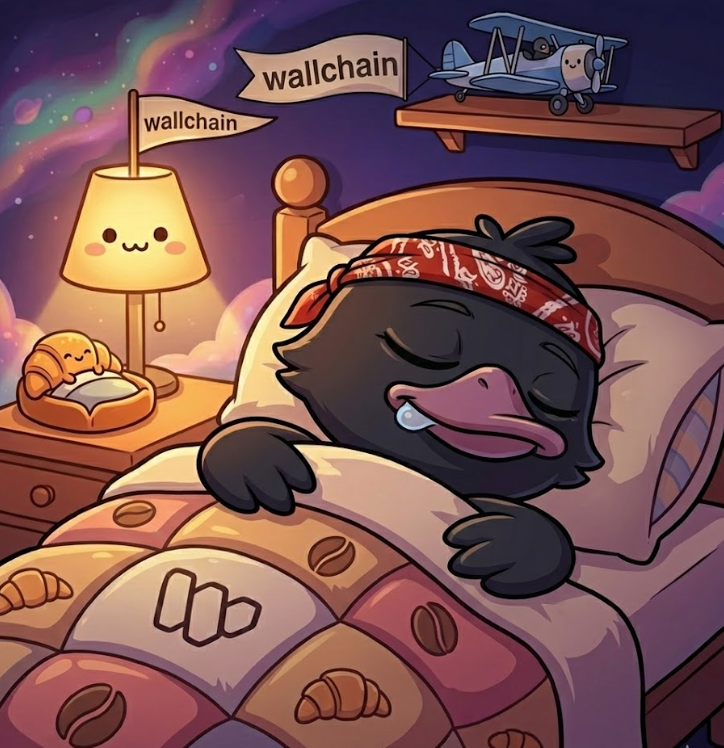
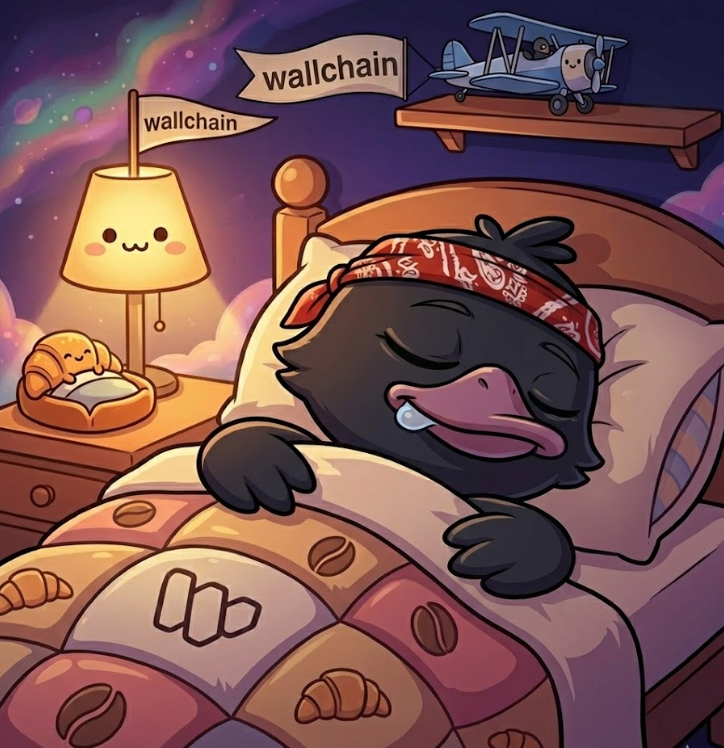
Goodnight CT 🌙
It's time to disconnect, leave the noise of the day behind, and enter rest mode.
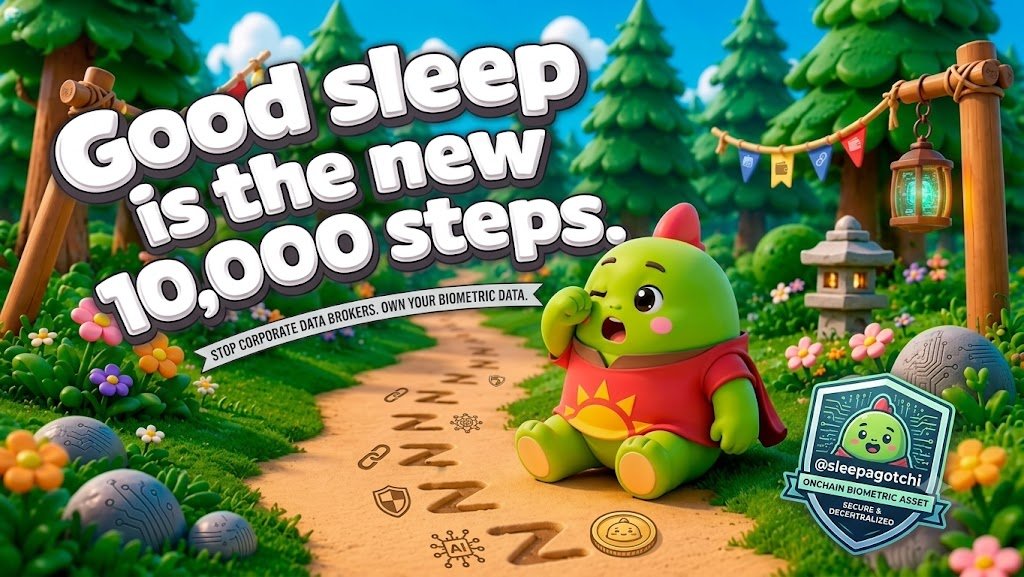
At @sleepagotchi, rest is part of progress, not a pause.
And at @wallchain, every interaction leaves a trace, even when you're not active; the signal continues to grow.
So tonight, it's about slowing down, getting a good night's sleep, and letting everything unfold as you slumber 💤
By the way, Trump has banned Fable and Mythos; it's no longer active since Claude. 😵
46
45
365
13h
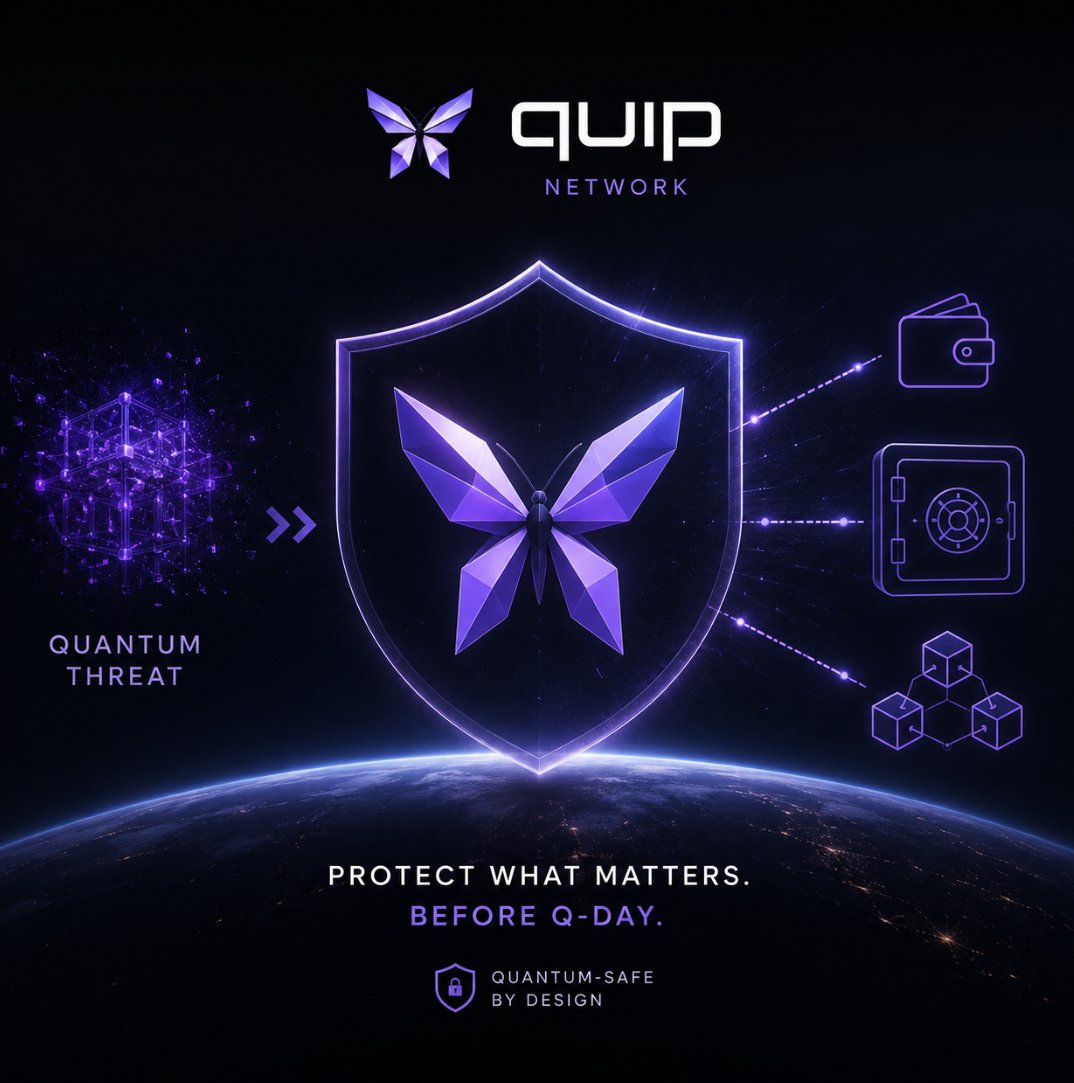
Protecting assets in the quantum era isn’t a future problem anymore, it’s happening now.
Most wallets, custody systems and chains still rely on elliptic-curve cryptography, which could become vulnerable once large-scale quantum computing arrives.
What @quipnetwork is building takes a different approach:
Instead of forcing a full migration, it adds a post-quantum protection layer on top of what already exists.
🔹 Hybrid wrappers around existing wallets and networks
🔹 Cosigned transactions with post-quantum signatures
🔹 Standards-based cryptography (WOTS , SPHINCS , XMSS, ML-DSA, FN-DSA)
🔹 No need to change wallets, keys or infrastructure
The idea is simple but powerful; don’t rebuild the system, wrap it and secure it before Q-Day arrives.
From individual wallets to institutional custody, the goal is the same, make critical assets quantum-resistant without disrupting how they’re used today.
Quietly building the security layer for what comes next.
30
1
27
274
20h
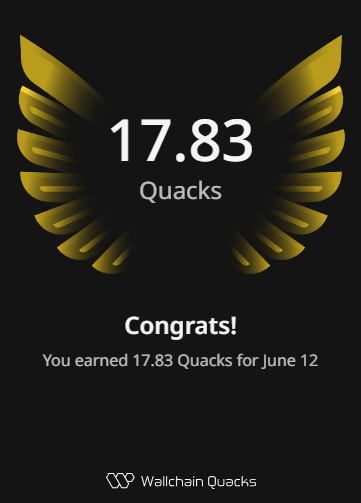
,. @wallchain update 🦆
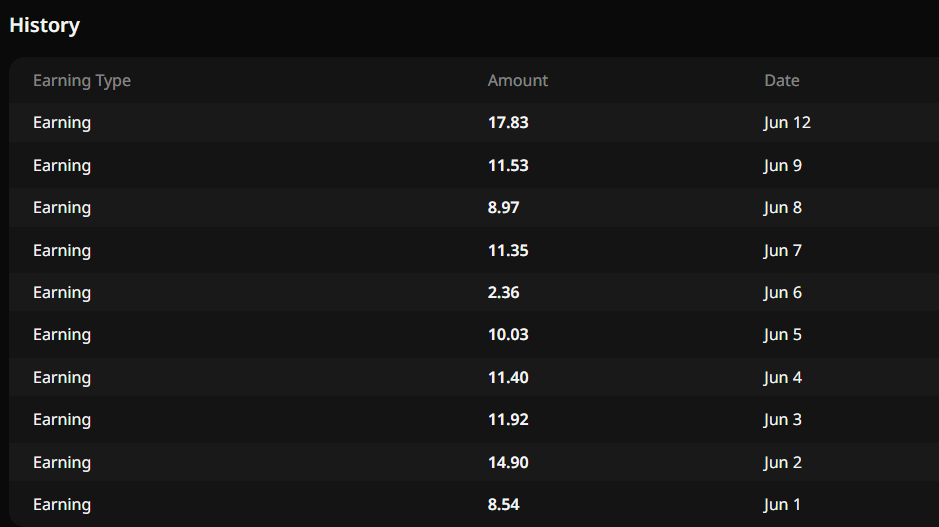
Today we finally received our Quacks: 17.83
But curiously, we went two days without receiving anything.
Has anyone else experienced the same thing?
It doesn't seem serious, but the variation in distribution is noteworthy.
We're keeping an eye on it, because these kinds of details also reveal a lot about how the system is evolving.
Whether it's an isolated incident or a general issue, we'll all keep an eye on it.
42
38
313
22h
Quick update from @quipnetwork
The @NucleusCodes and Quantum Echoes WL campaign ends today.
It's going to be tough to get in here: only the top 100 by reputation are guaranteed a WL, and for everyone else, we have a mini-giveaway of 20 spots.
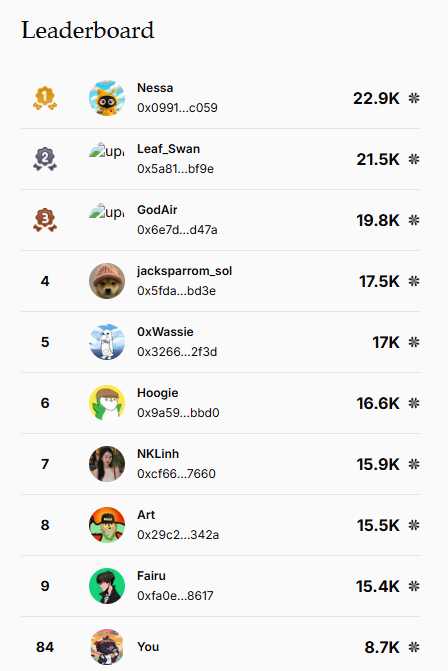
Meanwhile, we're continuing with the quests. Right now, we have 8,730 points, with a position of #84.
We're in, but there's no room for complacency.
Meanwhile, we're continuing to promote mindshare. Because here, it's not just about completing tasks; it's about showing up, contributing, and staying visible to earn extra weekly points. This is key.
Our node remains active, and we're providing support.
45
43
348
Jun 13
Good morning fam, happy weekend!
This weekend it's time to keep building, but with a different energy.
Observing, learning, and refining.
@wallchain continues to strike me as one of the most interesting approaches to giving real meaning to attention.
Less shouting into the void and more purposeful connection.
And @quipnetwork is gradually making it clear that it's not just about narrative. It's useful, verifiable computing with a vision that goes beyond the hype.
Two different layers, but with something in common:
they're trying to build infrastructure that actually works.
Have a great weekend everyone 🤝
72
2
70
542
Jun 12
Good night CT🌙
Time to slow down, log off, and let the day turn into rest.
In @sleepagotchi , sleep isn’t just rest, it’s progress.
So tonight, no pressure, just rest, reset, and let the system do its thing while you sleep 💤
55
1
59
507

Most IPO investors watch the launch. Smart investors watch the unlock schedule.
Everyones talking about the IPO price.
Almost nobody talks about when billions of dollars worth of shares become eligible to hit the market.
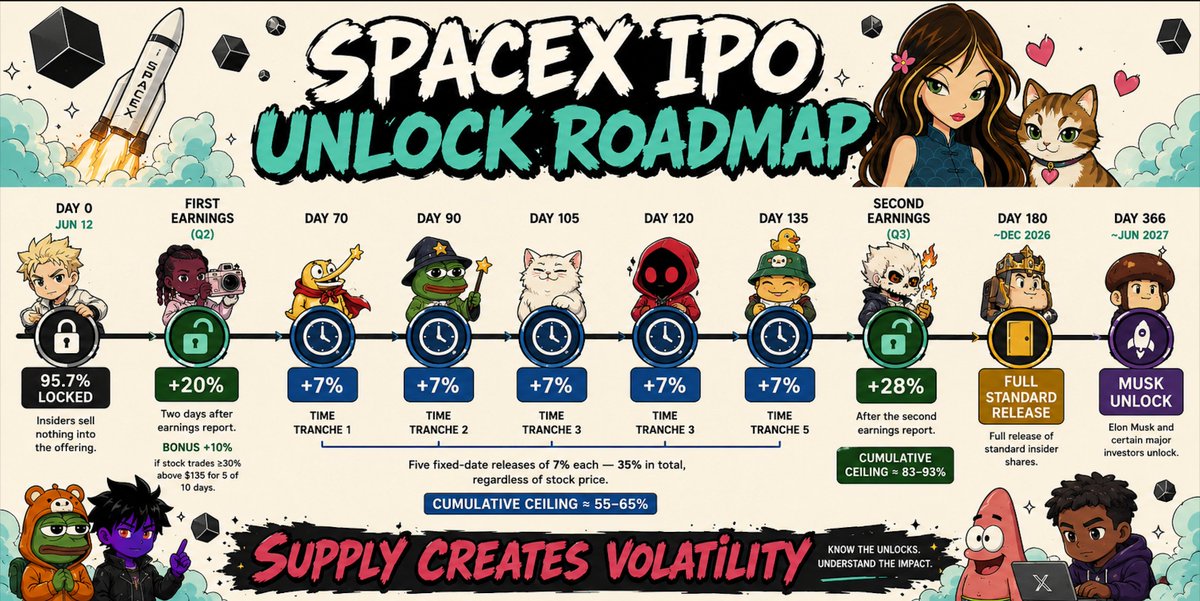
In the SpaceX IPO example, roughly 95.7% of insider and pre-IPO shares are locked on Day 1, meaning the initial float is far smaller than most people assume.
Here's what matters:
> Day 0: Insiders are largely locked up
> After first earnings: Up to 20% unlocks ( possible performance-triggered unlocks)
> Days 70–135: Additional staged releases begin
> After second earnings: Another major tranche becomes eligible
> Day 180: Traditional lockup expiration
> Day 366: Elon Musk and certain major investors finally unlock
The lesson?
Price moves are often driven by supply, not just fundamentals.
If you don't know:
Float size
> Insider ownership
> Lockup expirations
> Secondary distributions
you're only seeing half the picture.
The market doesn't just price earnings. It prices future selling pressure. Position accordingly.
51
9
145
3,132
Jun 12
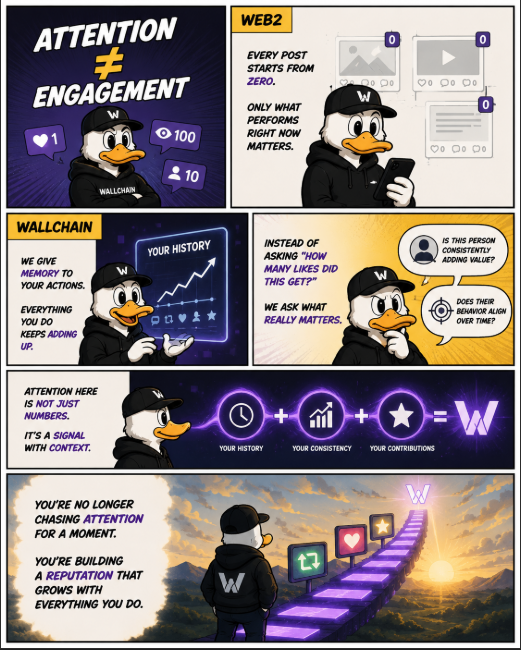
Attention ≠ Engagement
The problem is simple: in Web2, every post starts from zero, so it doesn’t matter what you did yesterday or how much you contributed before, because the system only cares about what performs right now.
@wallchain changes that by giving memory to your actions, meaning that everything you do keeps adding up and helps define your reputation over time.
Instead of asking how many likes did this get?, the system starts asking something much more meaningful, like is this person consistently adding value? and does their behavior align over time?
That’s why attention here is not just numbers, but a signal with context, where your history, your consistency, and your contributions all matter together.
You’re no longer chasing attention for a moment, you’re building a reputation that grows with everything you do.
28
24
189
Jun 12
Unlocking patterns in the chaos
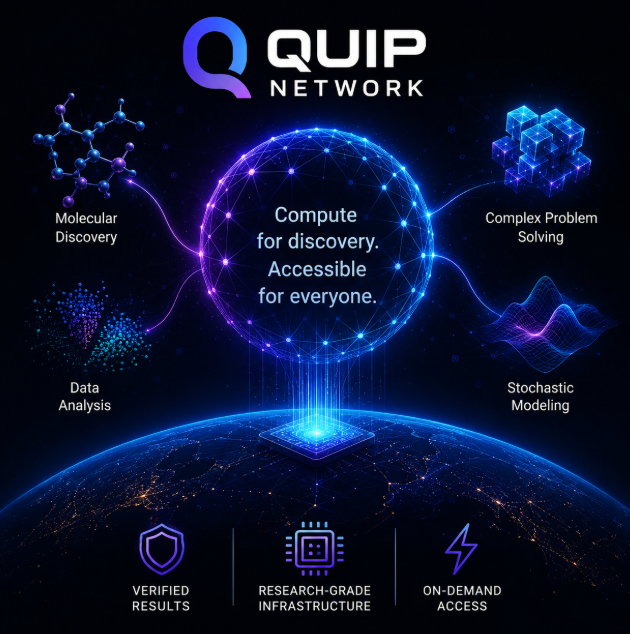
Today, conducting advanced research (such as in chemistry, physics, or complex AI) presents a challenge: it requires considerable funding and access to very expensive equipment.
With @quipnetwork , instead of only large universities or corporations being able to use advanced computing, a system is created where anyone can:
🔹 Request computing power when they need it
🔹 Pay only for what they use
🔹 Solve complex scientific problems without needing their own infrastructure
What are the practical applications of this?
🔸 Solve complex optimization problems (logistics, routing, complex decisions)
🔸 Understand chaotic systems (data that appears random but isn't)
🔸 Analyze and compress large amounts of data
🔸 Simulate molecules to discover new drugs or materials
The key lies not only in the technology, but in the change of model:
Before → limited access to scientific computing
Now → open access on demand
It's like going from having to buy a supercomputer to renting it when you need it.
That's what's changing.
21
1
21
167
Jun 12
Good morning fam, happy Friday ☀️
Markets are opening with one of those rare headline days.
SpaceX is set to debut on Nasdaq at $135 per share, targeting a $1.75T valuation, a reminder of how quickly capital, innovation, and narrative can converge when demand is strong enough.
But while everyone watches the obvious liftoffs, the deeper shifts are happening elsewhere.
@wallchain is building the layer where information becomes traceable, attributable, and economically meaningful.
@quipnetwork is focused on securing the value layer itself, preparing for a future where today’s cryptographic assumptions may not hold.
Some launches move markets.
Others change what the market is built on.
Enjoy the Friday!!
86
3
80
514
Jun 11
Good night CT 🌙
Today it’s clear that two different layers are evolving at the same time:
@quipnetwork is pushing the limits of what we can compute.
Not just securing the future with post-quantum infrastructure, but turning advanced computation into something accessible.
@wallchain is doing the opposite side of the equation.
Not compute, but coordination. Not power, but signal.
One expands capability. The other refines contribution.
And both point in the same direction:
The future won’t just be more powerful, it will be more participatory.
Sleep well. Tomorrow we keep building.
46
2
43
387
Jun 11
Your sleep is not just rest, it’s data, and right now, you don’t own it.
Every night you generate one of the most valuable biometric datasets:
🔸 Recovery patterns
🔸 Stress signals
🔸 Cognitive readiness
🔸 Long-term health indicators
Web2 platforms collect it, store it, sell insights from it.
That model is broken.
Projects like @sleepagotchi are flipping the equation:
🔹 Data stays tied to you
🔹 AI interprets it in real time
🔹 Multi-agent systems turn it into action (nutrition, recovery, performance)
🔹 Value flows back to the user, not just the platform
Sleep stops being passive. It becomes a structured, usable asset.
Just your biology, finally working for you.
1
1
46
Jun 11
After months of consistent activity, quacks didn't appear today.
No changes in routine, no changes in behavior, just silence.
The most interesting thing is that others did receive their signal.
So, the question isn't emotional, but structural:
Where are quacks located, and why didn't they appear following the same daily routine?
Attention-based systems need, above all, reliability.
Without it, even long-term participants begin to question the signal. Let's see how @wallchain sheds light on this.
Has anyone else experienced this today?
22
20
213
Jun 11
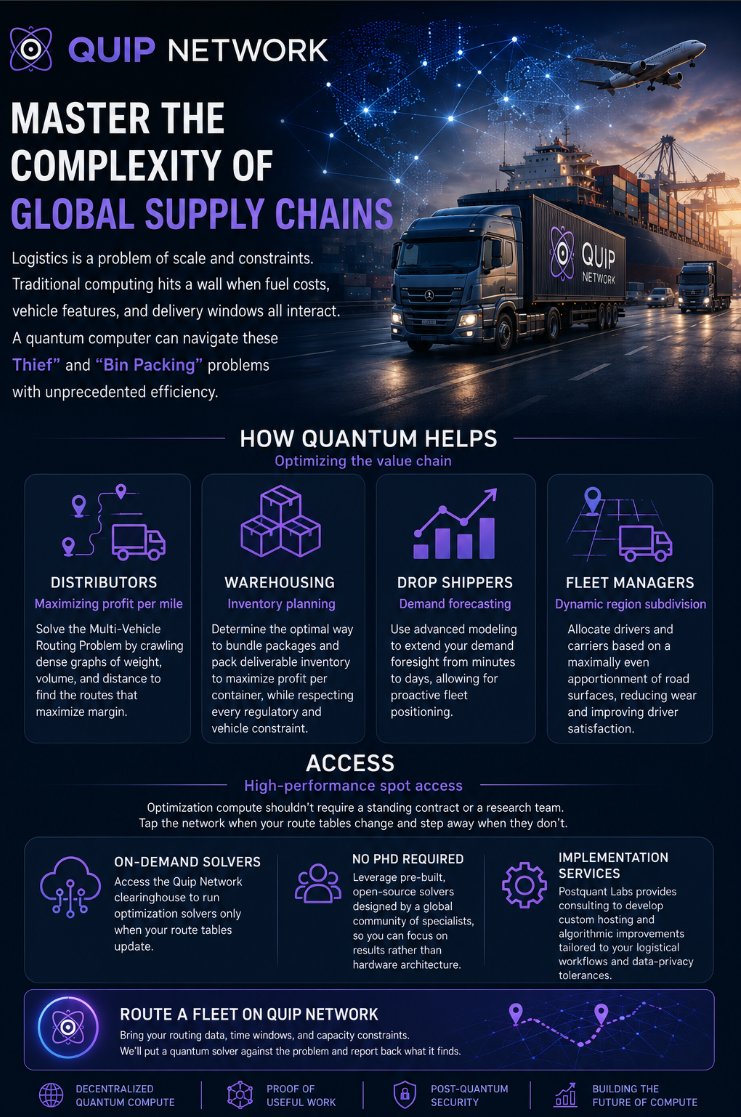
Logistics is one of the hardest problems in the real world.
It’s not just about moving packages from A to B, it’s about managing thousands of constraints at the same time: fuel costs, vehicle types, delivery windows, package sizes, and constantly changing demand.
And this is exactly where traditional computing starts to struggle.
@quipnetwork is approaching this differently by using quantum compute to handle complexity at scale, especially in problems like route optimization and supply chain planning.
Instead of trying to brute-force every possible option, quantum systems can explore massive combinations at once, helping find more efficient routes, better packing strategies, and smarter fleet allocation.
This shows up in practical use cases like multi-vehicle routing, where the goal is not just to deliver, but to maximize profit per mile by finding the most efficient paths through dense networks of constraints.
It also applies to warehousing, where the system can optimize how goods are packed and grouped inside containers, making sure every shipment maximizes space and value while still respecting real-world restrictions.
Even in demand forecasting and fleet management, the idea is the same: using better computation to make better decisions earlier, so logistics teams can react before problems even appear.
The key shift is access.
Instead of needing a research team or long-term contracts, companies can tap into the network only when they need it, run their optimization problems, and move on.
No heavy setup. No PhD required. Just results when complexity spikes.
Still early, but this is what practical quantum computing starts to look like in the real world.
24
27
441
Jun 11
Good morning fam, happy Thursday
Concentrated. Focused. Moving forward.
Today is a day to build, learn, and maintain consistency.
Let's see what we can accomplish today.
83
1
81
510
Jun 11
Picked my XI like I pick my strains - high quality only. @kushyprod World Kup kicks off 2026-06-11 kushyprod.com @solana @solanamobile
2
2
35
JOSE retweeted

Jun 10
ICYMI: new to Quip Network? start here.

325
284
587
45,250
Jun 10
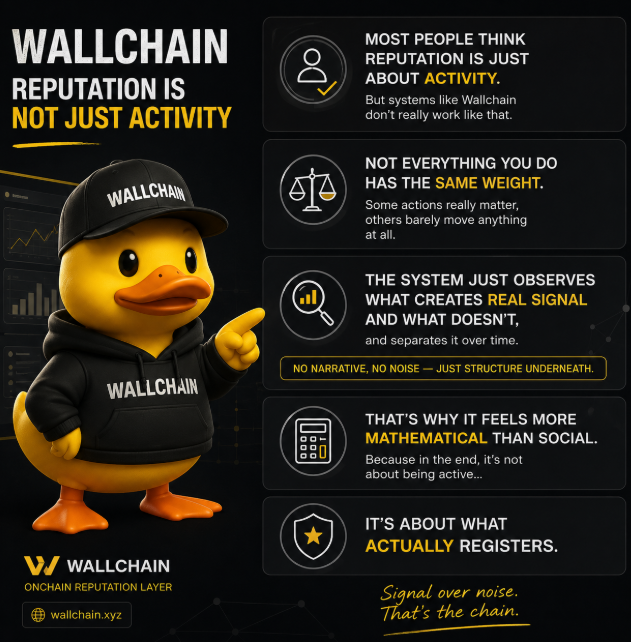
Most people think reputation is just a matter of activity.
But systems like @wallchain don't really work that way.
Not everything you do carries the same weight.
Some actions truly matter, others have little impact.
The system simply observes what generates a real signal and what doesn't, and separates them over time.
No narrative, no noise, just underlying structure.
That's why it feels more mathematical than social.
Because in the end, it's not about being active, but about what truly leaves a mark.
28
26
210
Jun 10
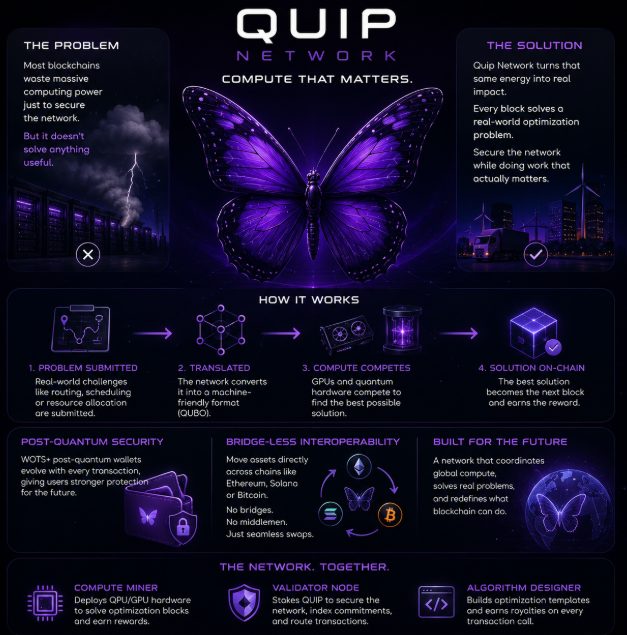
Most blockchains use massive amounts of computing power just to secure the network, but that power usually doesn’t produce anything useful in the real world.
@quipnetwork takes a different approach by turning that same energy into something meaningful, where every block that gets produced is actually solving a real-world problem.
Instead of random calculations, the network focuses on tasks like optimizing delivery routes, improving scheduling systems, or solving complex allocation problems that companies deal with every day.
The process is surprisingly simple: a problem is submitted, the network translates it into a machine-friendly format, and then different machines (from GPUs to quantum hardware) compete to find the best possible solution, which then becomes part of the chain.
In other words, the network stays secure while doing work that actually matters.
But Quip is not only about computation, it also rethinks security.
It introduces post-quantum wallets where your keys evolve with every transaction, reducing exposure and making them much more resilient in a future where traditional cryptography might not be enough.
On top of that, it removes one of the biggest pain points in crypto today: bridges.
With Quip, assets can move directly between different blockchains like Ethereum , Solana, or Bitcoin, without relying on external validators or risky intermediaries.
When you put everything together, the idea becomes clear.
Quip is not just another blockchain trying to move value faster, but a system designed to coordinate global computing power, solve real problems, and upgrade security at the same time.
And that is a very different direction for where this space can go 🦋
19
21
165
Jun 10
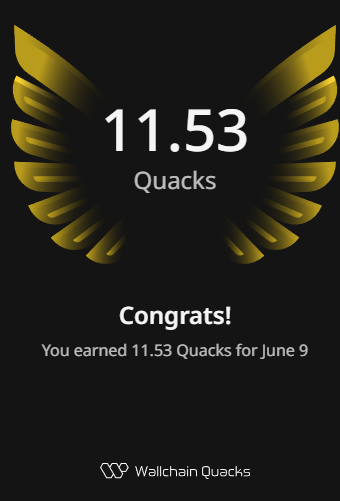
11.53 QUACKS received today from @wallchain
Another day of presence. Another day of consistency.
No campaigns, no selections. Just reputation, quietly building in the background.
At this point, one starts to wonder:
Is it about being active, or about being chosen?
Even so, I'm still here. I'm still quacking.
42
1
36
366