
Joined December 2009
- Tweets 282
- Following 1,214
- Followers 572
- Likes 462
23 Photos and videos



Jun 14
If demographic change in Northern Ireland, a tiny corner of Europe with only 1.9 million people, is viewed through a global cultural context we are met with a conundrum.
This being to whom we apply the term 'minority'.
In a national context, a person from abroad would arrive into NI with a cultural difference to the existing population. Therefore, they are viewed as a 'minority'.
However, we live in an increasingly connected world where people from cultures spanning all over the globe now view NI as a place of opportunity. Arrivals therefore often come from countries that have much larger populations and cultures.
India is a perfect example. If an Indian person arrives into NI they are placed into a 'minority' category.
However, that person comes from a country of over 1.48 billion people. In a global context, their cultural group monumentally dwarfs that of NI.
So in this connected world should we define that person as a minority? Or should we treat the existing NI population and its two distinct cultural groups as the minority?
This is a crucial question to ponder.
49
Jun 14
Nothing showed me the power enjoyed by the US advertising industry more than during the 2024 Election night when a major broadcaster had their coverage regularly interrupted by viagra adverts. I was sat in DC utterly bemused.
Altering the historic regulations of football to play some extra adverts doesn't really come as a surprise after that. Even if it warps the football experience that we love.
Jun 14

These ‘hydration breaks’ are fundamentally warping the World Cup. Curacao had just enjoyed perhaps the highlight so far with that equaliser against Germany and were on the attack again. Then three minutes to promote a laptop brand, and momentum is handed straight back. Wretched.
95
Jun 14
Immigration Absolutism has been at the centre of many attempts to analyse the violence that occurred last week in Belfast. In this, it has followed a familiar pattern.
It starts with an alleged horrific act of someone who arrived into the country through the process of immigration. That event then sparks a response from parts of an existing population, which can turn violent.
Analysis then focuses on that response, with a defensiveness towards the term ‘immigration’. This is because it is being conveyed as something that could be producing negatives for society.
When the term is key to an increasing amount of identities in Britain, this creates the problem of automatic association with that negativity. No one wants this for themselves. An emotional response is understandable.
We see this in many opinion pieces based around the sentiment of 'immigration or immigrants are not the problem'. Those writing the pieces often place blame towards another source.
In this, analysis remains fixated on the second order consequences of an event, rather than placing critical eyes towards finding its potential primary source. This process is then repeated again and again while people question why society appears to be getting worse rather than better.
It is important to state here that my own analysis isn’t claiming that all immigration and all immigrants represent a problem for society. That too would be an absolutist position that doesn’t match the changing dynamics of contemporary Britain.
However, when a theme occurs of horrific acts being conducted by those who have arrived into the country, can such an absolutist defence be made of immigration only being a positive?
This is what is conveyed when a general statement like ‘immigrants aren’t the problem’ is argued. It pulls together a vast range of people and cultural groups into one single group, bound together through one commonality. This being the process of immigration. It simplifies an extremely broad term.
In this, we see discussion that aims to analyse a potential primary source of a problem become nullified. It conveys a sense that any person who conducts the act of immigration into the country is an innocent actor. Even when time and time again we see this isn’t accurate.
This is the opposite to an absolutist position of ‘stranger danger’, which seeks to convey every person as a potential threat. This too breeds an atmosphere of tension and potential violence.
The problem with many in contemporary society is they have tilted their attitudes towards either absolutist position. When it comes to the absolutism of immigration only representing positives, society can find itself having created an atmosphere of exploitation.
In a naive belief that every arrival will be an innocent actor, it places blind trust towards a global population. This trust is then exploited and in the worse case scenarios, can transpire in the form of violent acts against existing populations.
However, despite seeing such events occur again and again, an absolutist position keeps people steadfast in their belief that everyone who arrives is innocent.
In relation to Belfast, this blocks society from simply stating that without a new form of global immigration into the city, its streets would not have seen such violence take place. This is simply following basic logic.
However, how can this point be analysed without conveying a belief that every immigrant is a problem?
This is the challenge that society must consider to avoid further friction and violence in the future. If it shuts down debate and doesn't explore potential primary sources of an issue, how does it expect to solve the problem as a whole?
Analysis of the response of an existing population to such horrific acts, even if it rightly condemns violence, simply focuses on the consequences of a primary source.
As stated, a critique of Immigration Absolutism doesn't aim to convey a belief that every immigrant represents a problem. It simply aims to achieve a consensus in society that some immigrants can cause us problems. Reality is showing this to be the case.
1
58
Jun 14
I wrote previously about how through Immigration Absolutism we are losing reasoned debate to the emotion of identity: substack.com/home/post/p-192…
21
Jun 14
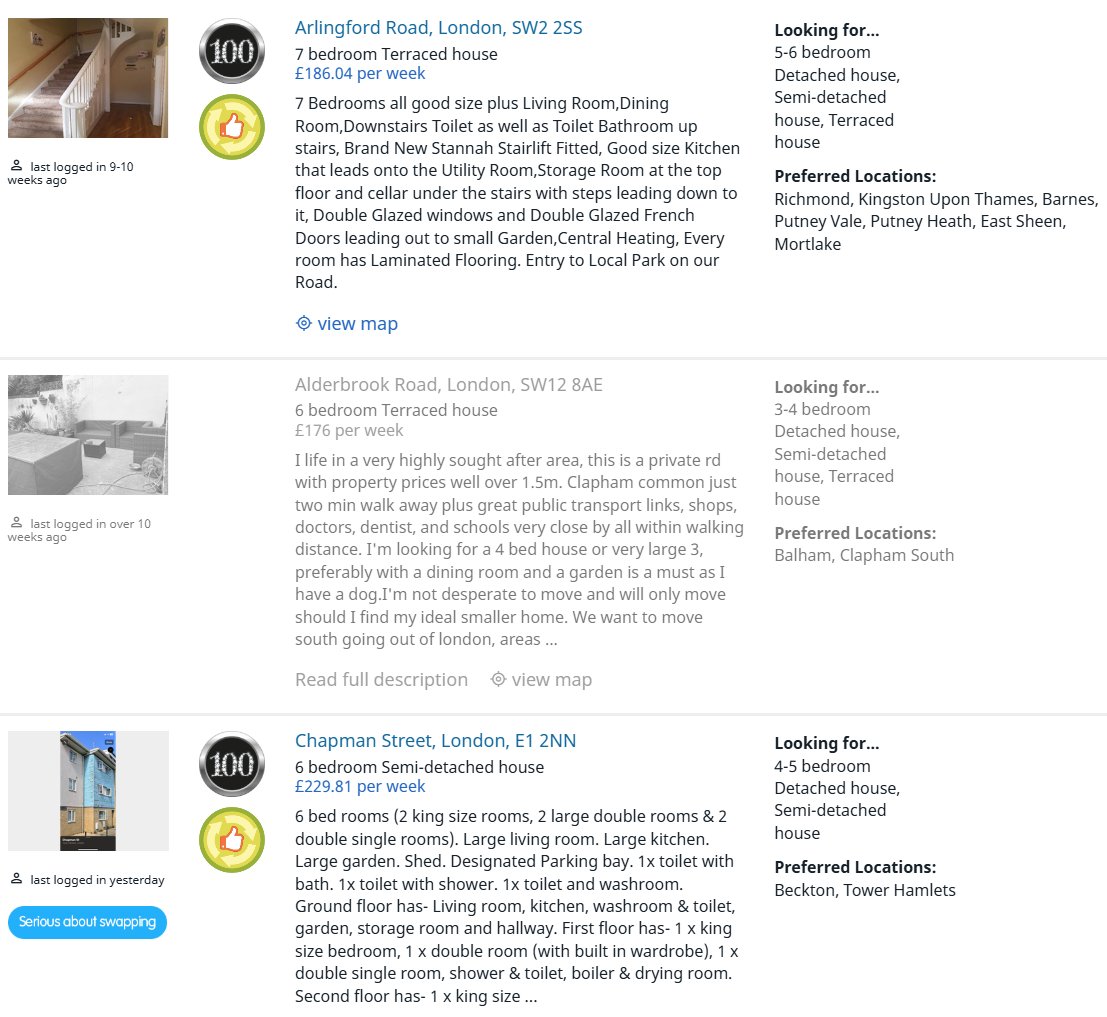
Had a look on 'HomeSwapper' in my own area. Someone is trying to swap a two bedroom flat on my street with a monthly rent of £770. A price many young professionals probably don't even think could exist in London.
If we use an average for the area, to buy that same two bed you would be looking at around £350k. To rent it privately, it would be around £1800-£2000.
If you're one of many who find themselves stuck in the 'squeezed middle', you could find yourself unable to afford that £350k price tag. However, you'll simultaneously be viewed as too wealthy to obtain a low rental rate through council housing.
Therefore your private rent could be almost 3x higher than your neighbours. Even if you had the wealth to buy the property, your mortgage could be 2-3x higher.
So many different realities can occur on the exact same street. How do you apply the concept of a 'social contract' to such a fragmented society?
Jun 14

The council house swapping Facebook groups and websites are very eye-opening. There are 6- and 7-bedroom properties on offer in Zone 2 at ~£750 a month. Private rents for similar properties would be £6,000 . Enormous subsidies are being distributed in the worst possible way.
3
143
Jun 13
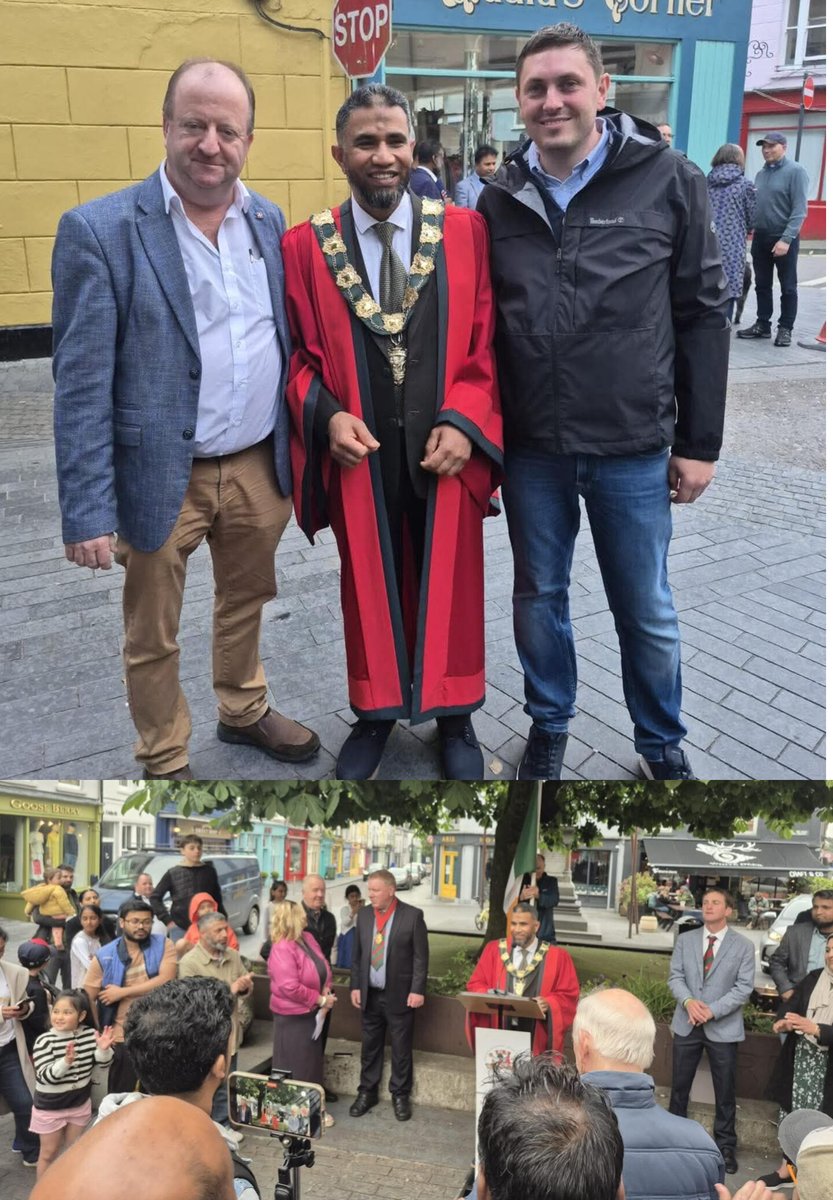
Even in the rural south west of Ireland, on the far edges of Europe, people from a global population arrive and seek political involvement.
The act of putting your name forward politically indicates a desire to influence an area's future. Even if all intentions are well meaning and the person is a pleasant individual, this is a postnational mindset.
Here we see a man who moved from Bangladesh, a country with an estimated 178 million people, to Ireland. A country that has just 5.45 million people.
He then puts himself forward for public office to 'represent' members of the native population.
The question here to consider is whether it would be realistic or possible for an Irish person to do the reverse journey?
Ireland has never experienced this phenomenon of a world population with active eyes towards its shores and political systems.
How does this small nation adapt its national frameworks to cope with these modern international conditions?
If it doesn't, especially while its youth continue to speak of a desire to leave, how rapidly will further demographic change occur?
The irony of the handover ceremony involving someone named 'Michael Collins' will probably won't go unnoticed either.
Jun 13

Clonakilty County Cork is a small Irish town with a population of less than 6,000 people.
As of yesterday, the Mayor of Clonakilty is a Bangladeshi man named Yousuf Janabali.
30
Jun 12
Growing up in East Belfast and living in London has allowed me to experience life in both a predominantly homogeneous society and a multicultural society.
I have found positives and negatives in both. However, a key point living in these two societal models has taught me is that you can't attempt to analyse events in Belfast through a mainly multicultural lens without missing key context.
I've seen that a lot this week. To grasp why violence broke out, you have to understand why many people in the city value having surroundings that reflect their cultural heritage. Even if you disagree with them.
The confusion that arises from analysis through a multicultural framework stems from an expectation that people should accept change from around the world on their doorstep. It views multiculturalism in a solely positive light.
So when a group states they don't want this, those who view multiculturalism as having no negatives are left in a state of confusion. Often their response is that those who disagree with them are bad people.
This is why such disagreement exists. One mindset wants change in society while another wants the complete opposite. They want cultural preservation.
Crucially, they don't want to take on the risk that comes with change. Continuity of their surroundings represents safety and home.
When I left East Belfast at 19, I was rejecting that safety. I viewed the sameness of my surroundings as boring. London offered an exciting opposite.
But it didn't discount how many wanted to remain in the safety of their cultural surroundings. Even if I didn't understand their mindset at a young age.
2
146
Jun 11
A key detail behind friction towards rising levels of immigration in Belfast is how evidence points to a correlation between more diverse areas and higher house prices.
It is important to note that many areas that have seen higher levels of recent immigration remain segregated on religious lines. They are also formed around traditionally working class models and many residents feel economically left behind.
A study last year found that houses in religiously mixed areas of NI sell for 'an average of 10% more than equivalent properties in more segregated areas'.
This feeds into the protective nature that many in these segregated areas have towards their immediate surroundings. A desire to preserve a cultural heritage is already core to their identity. Now add in how evidence exists that the arrival of new groups into their areas could result in rising house and rental prices. This is where concern builds from.
The research also states: 'historically, research suggested people often prefer living near others like themselves'. This is a crucial point to consider for those viewing Belfast through a liberal, multicultural framework. These people, like many throughout the world, simply prefer to live with surroundings that reflect their cultural heritage. You can disagree with this. But it is how they feel.
Growing up in Belfast, there were families of foreign heritage living amongst such communities. Not many but they did exist. However, it is the speed and scale at which areas have seen new arrivals, especially in the past five years, that has changed attitudes.
It represents a shift that many feel will permanently alter the atmosphere of the surroundings that they call home. It is their sense of belonging. This has all the ingredients to build a shared feeling of protectiveness amongst residents.
Most interestingly the research makes the point: 'In more culturally diverse areas, differences in cultural attitudes and norms can lead to lower levels of social cohesion and cooperation, or even – in rare cases competition and conflict.'
Those words were penned last year. Does it not bear resemblance to the events of the past week?
This also represents a challenge for a society that still aims to break through the remnants of sectarian division. How does it do so when there is evidence that reducing segregation in areas risks damaging the economic conditions of those who live there?
A complex scenario occurring in such a small place.
bbc.co.uk/news/articles/cp8z…
1
217
Jun 11
The idea that exterior influences were behind the mobilisation of groups that lead to violence in Belfast speaks of a real struggle in the minds of those in England to understand the cultural differences between Belfast and their own society.
Even in attempts to understand the actions of Unionists and Loyalists who share a British identity.
It's understandable. Their society hasn't been historically dominated by the framework of two stringent identity groups who demand cultural preservation.
Therefore, they often miss how strong the connections within these groups remain. When an event occurs that is seen as a risk to their shared culture, they act as one and use these connections to mobilise rapidly.
Meanwhile, the English mind often looks on and thinks external influence is required to motivate that amount of people at once. In this case, Russia and Iran are mentioned. Others mention Elon Musk. This is rather than understanding how it comes from within the identity group itself.
There will of course be some attempts to promote violence on social media. But as someone from Belfast, both historical identity groups in the city don't require such external motivation to mobilise when they feel their culture is under threat.
It is through the group mentality of defending 'their own' as to why they can react so quickly. I saw this with my own eyes growing up in the city. A few calls made and there's a group ready to go.
It could even be argued that the appearance of certain individuals from afield on social media actually stopped some groups from taking to the streets. This being to avoid association with those who would hold historical difference.
Was there social media during the Troubles? No.
But was there rapid group mobilisation from areas of stringent cultural identity? Yes.
This is something those in England are only beginning to consider as its own society fragments into multiple different identity groups and 'communities'.
Jun 11

Met Police chief Sir Mark Rowley very strong on scenes in Belfast:
"I was watching a bit of the news last night, and I can't remember what channel it was, but a journalist was talking about 'these protesters.'
"I thought, that isn't a protest. People are setting fire to cars. That's not a protest. That's violent disorder, that's criminality. I really feel for Northern Ireland colleagues who are wrestling with that. It's really, really difficult.
"We live in these volatile times and, some of what goes on online whips up, sentiment on the street.
"We know that Russian state actors, Iranian state actors, they want to sow discord on the streets of the UK. So this is a really complex issue we're wrestling with. So you've got very polarised debates in the UK, and you've got other people overseas who want to drive wedge issues to create disorder, and you've got the great men and women of Police Service Northern Ireland on the streets in the middle of that, trying to sort of protect people and stop people burning down houses and things. It's awful."
267
Jun 11
Alodid 'only had to complete a Home Office questionnaire rather than attend a face-to-face interview'.
It was that easy to remain in Britain after having entered the Republic and crossed the open border.
The fast-track scheme has now ended. However, what damage has this now had on public safety and societal cohesion?
How too does Reform aim to mend this damage when two of its senior figures were part of a Government that signed off that scheme?
Jun 11

Belfast knife attack suspect Hadi Alodid was granted asylum under a fast-track application scheme introduced by two of Nigel Farage's senior colleagues. It meant he'd only to complete a Home Office questionnaire rather than attend a face-to-face interview. belfasttelegraph.co.uk/news/…
55
Jun 10
The DUP calling for border restrictions on the island of Ireland. Political figures in the Republic calling for a border along the Irish Sea.
Historical differences being reignited from another source.
The open border wasn't designed in the context of such a globally connected world. The pressure of this is boiling over and putting strain on local populations.
Politically it's shifting discussion backwards towards debates about the ability to maintain the open border itself. An achievement of peace on the island that was the result of immense work and dedication.
If it is to remain then do current events show that policies of both nations need to adapt?
Does it also mean potentially considering that the current model of immigration and approach to asylum may be the root cause of this societal strain?

DUP leader calls for Northern Ireland and Republic’s ‘open border’ to close trib.al/L1HnLY4
45
Jun 10
The streets I grew up on have once again become the scene of violence and topic of heated debate.
But lots of that debate is coming from the exterior.
So I wrote some words in an attempt to provide better context for those commentating on events through a framework of thought that doesn't quite match the complexities of Belfast.

27