
Joined November 2016
- Tweets 1,705
- Following 79
- Followers 4,488
- Likes 1,333
115 Photos and videos






Jun 13
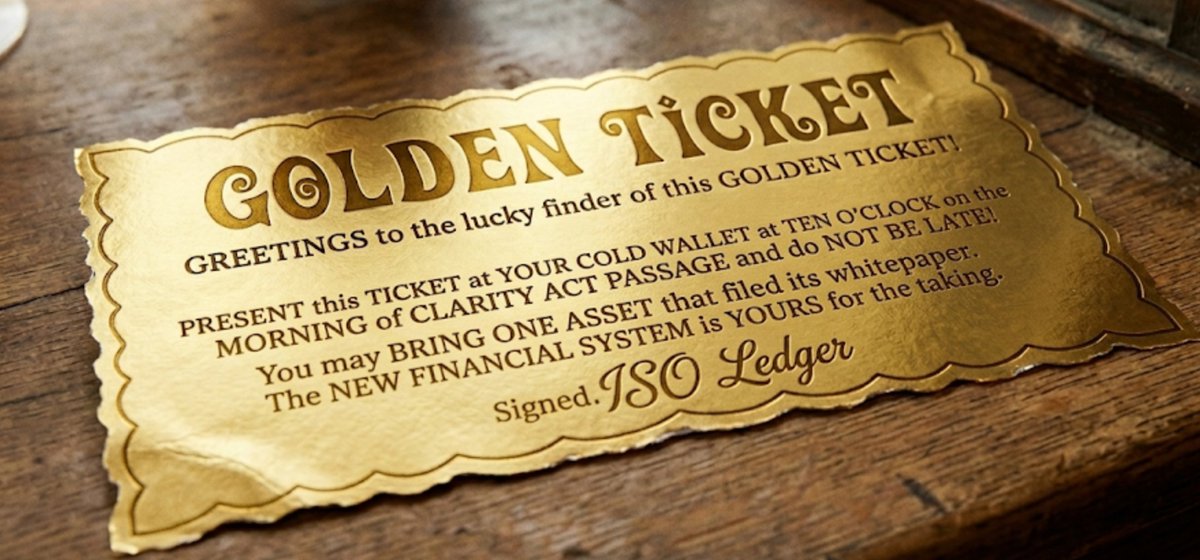
The New Monetary System.
A comprehensive deep dive, and probably one of my most important posts ever written.
Enjoy 👇 🛡
open.substack.com/pub/isoled…
5
7
21
1,005
Jun 12
Should You Be Holding LOAN Protocol?
Let's audit.
What it is:
LOAN Protocol is a decentralized lending market built on XPR Network.
Lenders deposit assets and earn variable APY. Borrowers access liquidity without selling their positions.
The LOAN token is the governance and incentive layer on top of that system.
No banks. No credit checks. No intermediaries.
That's the pitch.
Now let's look at the receipts.
What's actually been built:
Runs on XPR Network — feeless transactions, fast settlements. ✅
Metal X integration — lending and borrowing accessible through XPR's native DEX. ✅
Both lenders and borrowers earn LOAN incentives on top of variable APY. ✅
Governance voting — LOAN holders vote on protocol decisions including new token listings. ✅
Staking multiplier boosts both rewards and voting power simultaneously. ✅
The honest flags:
This is where it gets real.
72 billion LOAN initial distribution. 2 billion LOAN inflation per year at launch across reward pools. That is a high inflation model. Your rewards are real. So is the dilution pressure on everyone holding without actively participating.
No meaningful independent TVL data publicly available. DefiLlama tracks it but the numbers are not significant enough to benchmark against established lending protocols.
No named institutional partners. No ISO 20022. No central bank pilots. No DTCC connection. No JPMorgan. No Fidelity.
Aave has $57 billion TVL. Compound. Morpho. These are the protocols LOAN competes with for lending market attention. The gap is enormous.
The honest comparison:
LINK secures $75 billion in value across 16 blockchains.
ZBCN processes $500 million in annual enterprise payroll.
LOAN processes — unverified volume on a small network.
That is not an attack. That is the receipts telling the truth.
Where it could matter:
XPR Network has FedNow certification. Credit union adoption confirmed — GoWest, Mocse, Arizona Financial, St. Cloud issued the first credit union stablecoin on Metal/XPR infrastructure. ✅
If XPR Network's credit union and community banking adoption scales, LOAN becomes the lending layer for that entire ecosystem. That's the bull case.
It requires XPR Network to win first.
LOAN benefits if XPR wins. LOAN doesn't exist meaningfully without it.
The honest verdict:
LOAN Protocol is not a scam. The technology works. The governance is real. The XPR Network infrastructure underneath it has legitimate receipts.
But the receipts for LOAN specifically are thin. High inflation tokenomics. No independent TVL worth citing. No institutional adoption documented. Competing against protocols with billions in liquidity and years of battle testing.
This is a lottery ticket inside a lottery ticket.
If XPR Network becomes the community banking rail for American credit unions, LOAN captures the lending layer of that system. That's a real outcome worth a small position.
If XPR Network stays small, LOAN stays smaller.
We tell you what we see. Not what we hope.
🛡️
1
6
12
850
Jun 12
IMF
Almost nobody understands what it actually does.
The International Monetary Fund was born at Bretton Woods in 1944. 190 member countries. The institution that monitors global economies, lends to nations in crisis, and does one thing nobody talks about.
It creates international money.
They call it the Special Drawing Right.
SDR. Currency code XDR.
The SDR is not a currency. It's a potential claim on the freely usable currencies of IMF member nations. A basket of five currencies — dollar, euro, yuan, yen, pound. The IMF creates them and allocates them to member countries. When a country needs liquidity they exchange SDRs for hard currency with another member.
$943 billion allocated in its entire history. The closest thing humanity has ever created to a neutral international reserve asset.
Now here's where it gets interesting.
The criteria for inclusion in the SDR basket: freely usable, widely used in international payments, widely traded in foreign exchange markets.
It doesn't say fiat currency. It doesn't say sovereign government. It says freely usable. Widely traded. Widely used in payments.
The last addition to the basket was the Chinese yuan in 2016. A geopolitical moment — the IMF formally acknowledging China's economic weight.
Now read this carefully.
In 2017 the IMF's First Deputy Managing Director David Lipton gave a speech citing the policy implications of XRP-style cross-border settlement for financial inclusion and economic growth.
Jess Cheng — who wrote the peer-reviewed academic case for XRP as an interbank bridge asset while at Ripple — then left Ripple and went to work for the IMF Legal Department. Then went to the Fed Board overseeing FedNow.
The IMF's own payments landscape diagram lists RippleNet as active infrastructure.
Ripple's involvement with the IMF and BIS on interoperability is documented in peer-reviewed financial literature.
Is XRP going into the SDR basket?
There is no confirmed receipt for that.
Anyone saying it's happening is ahead of the evidence.
But here's the honest question.
The IMF needs a neutral bridge asset for the 80% of global payment corridors that Agorá and mBridge don't cover. The SDR was designed as a neutral reserve asset outside any single government's control. The criteria for inclusion don't require a sovereign issuer.
The IMF First Deputy Managing Director was already citing this technology favorably in 2017.
The woman who wrote the legal and academic case for it went to work for the IMF directly afterward.
No flag. No clawback. No kill switch. No central bank controlling the underlying infrastructure.
They haven't said the name.
They never do.
They didn't need to.
ISO Ledger 🛡
3
32
91
2,889
Jun 11
Free XRP?
Got an old camera sitting in a drawer?
GoPro you used twice?
Old video games?
Old cell phone or smart watch?
Video game consoles collecting dust?
Shoes still in the box you never wore?
It's spring. Time to clean house.
Jump on Facebook Marketplace. List that stuff in the shed, under the bed, in the closet you haven't opened in two years.
You're never going to use it.
Someone else will pay you for it today.
I had a broken PS5 sitting here for over a year. Just sold it for $140 cash.
Know what I'm doing with it?
...I think you can guess. 😉
ISO Ledger 🛡️
2
2
34
1,546
Jun 11
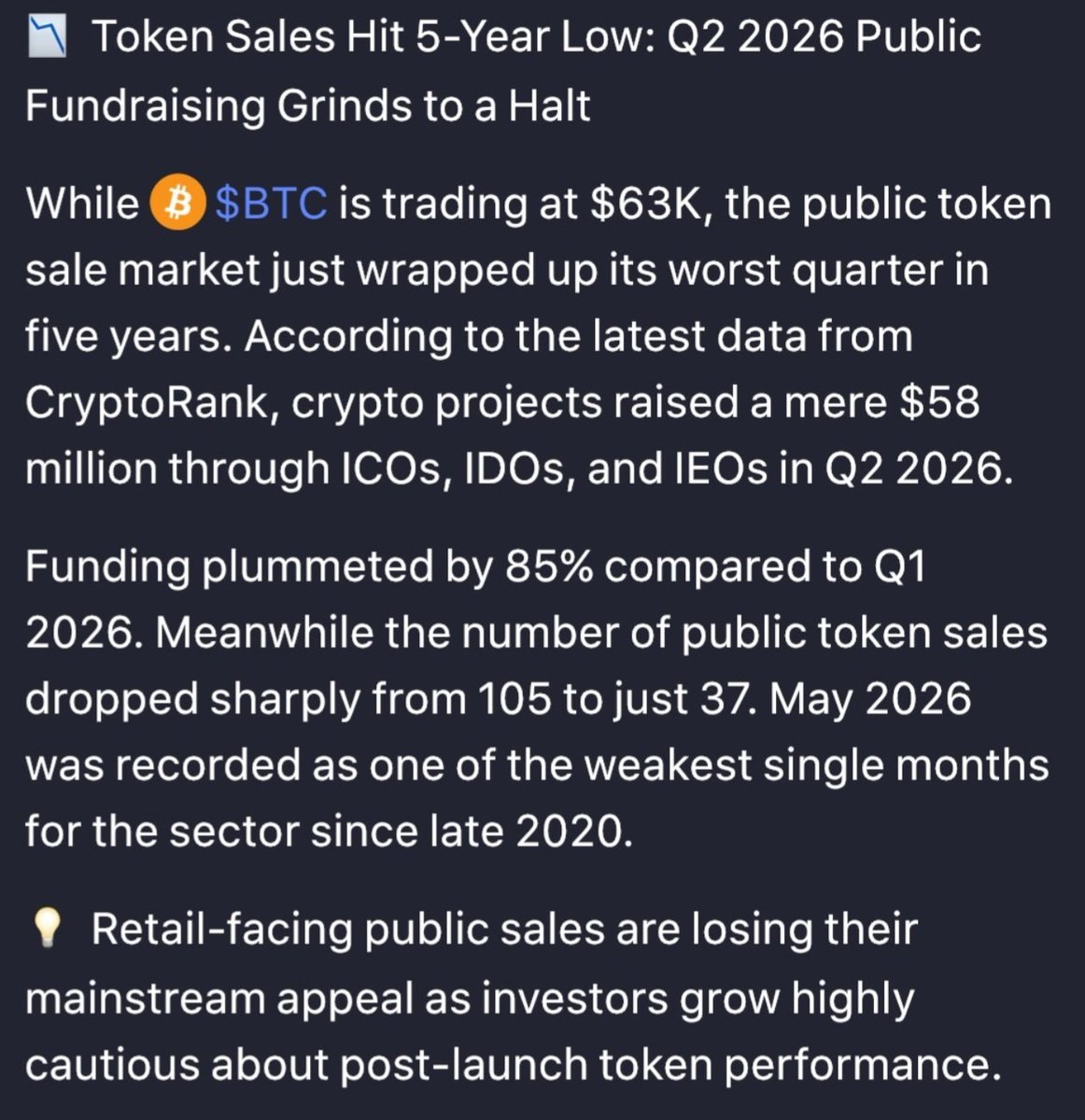
Q2 2026. Bitcoin at $62,500
Public token sales just had their worst quarter in 5 years.
$58 million raised. Down 85% from Q1.
Token launches dropped from 105 to 37 in a single quarter.
The money didn't leave crypto.
It stopped chasing new tokens.
This has happened before.
253 car companies became 3.
50 airlines became 4.
30 major US banks became 4.
Hundreds of social media platforms became 2.
50 million crypto tokens.
The top 20 take 90% of the market cap.
The pattern never changes.
Only the industry does.
The consolidation is happening right now. Most people will miss it because they're watching the noise instead of the signal.
ISO Ledger 🛡️
3
4
17
701
Jun 11
The Motley Fool published a bear case on XRP last week.
Three arguments.
Let's audit them.
Argument 1 — Stablecoins will cannibalize XRP.
There are over 200 stablecoins across 37 blockchains right now.
USDC can't talk to USDT.
USDT can't talk to RLUSD.
RLUSD can't talk to EURCV.
JPMorgan launched one.
Wells Fargo filed a trademark for one.
Western Union launched one.
Every country is getting one.
Every single one has a kill switch.
Every single one has a clawback.
Every single one has a flag.
XRP has none of those.
XRP doesn't compete with stablecoins.
XRP connects all of them.
200 stablecoins = 200 reasons XRP is needed.
Argument 2 — RLUSD will cannibalize XRP from within.
Ripple built RLUSD. It's now worth $1.7 billion.
The argument — why use XRP when RLUSD does the same job?
The answer — RLUSD has a kill switch. XRP doesn't.
Sovereign nations on opposite sides of a conflict need a bridge asset neither side can freeze.
RLUSD is Ripple's product. XRP is nobody's product.
That's not a weakness. That's the whole point.
Argument 3 — 62 billion supply limits price appreciation.
Correct that supply matters.
But the Motley Fool is valuing XRP like a speculative asset.
DTCC processes $3.7 quadrillion annually.
That's not a speculation play.
That's a velocity play.
The more value that flows through the pipe the more valuable the pipe becomes.
Supply is not the constraint. Adoption is.
The honest flag they got right:
Every catalyst arrived in 2026. Seven ETFs. Commodity classification. CLARITY Act through committee. RLUSD past $1 billion. And XRP is still down 41% year to date.
That's real. That deserves an honest answer.
Infrastructure gets priced last. Not first.
The internet existed in 1994. Amazon didn't IPO until 1997. The pipes were real. The price came later.
XLS-66d hasn't activated. DTCC goes live in July. CLARITY Act floor vote still pending.
The receipts are real.
The price hasn't caught up yet.
That's not a bear case.
That's a buying window.
We audit the plumbing. 🛡️
13
26
110
3,358
Jun 11
SPACEX IPO T-MINUS 24 HOURS. 🚨
Let's audit.
The railroad builders lost everything.
The people who laid 80 million miles of fiber optic cable in the 1990s lost everything.
The dot com investors lost everything.
But the infrastructure they left behind changed the world. The people who came AFTER made all the money.
SpaceX is a great company.
That is not what this post is about.
Here's what they're not telling you about this IPO:
The shell game.
2022 — Musk buys Twitter for $44 billion. Investor capital, his own stock, and $12 billion in debt. Advertisers flee. Revenue collapses. Fidelity marks the stake down 70%.
2025 — xAI acquires X in an all-stock deal. Twitter investors finally get something back — on paper. xAI is burning $1 billion per month. $6.4 billion in operating losses in 2025 on $3.2 billion in revenue.
The losses are ACCELERATING.
Q1 2026 alone — $4.28 billion lost in a single quarter.
2026 — SpaceX absorbs xAI. The rocket company just swallowed the money-losing AI company that already swallowed the money-losing social media company.
Then they file for the largest IPO in history.
$1.77 trillion valuation. $75 billion raise. Three businesses with completely different financial profiles sold as one number.
The valuation.
$135 per share. $18.7 billion in revenue. $4.94 billion net loss.
That's a 95x price-to-sales ratio.
Apple trades at 8x. Google at 6x. Even Nvidia at peak AI hype traded at 40x.
SpaceX is priced at 95x sales while losing nearly $5 billion a year.
The rules.
Index providers changed the rules for this IPO.
Nasdaq and Russell fast-tracked entry — SpaceX hits their indexes within DAYS of trading instead of months.
If you own an index fund in your retirement account — and most Americans do — you will be forced to own SpaceX. Not by choice. Because the fund must mirror the index.
The lockup.
Standard IPOs lock insiders out for 180 days.
Musk locked his shares for 366 days.
The other insiders? They can start selling the second trading day after the first quarterly earnings report.
That's August.
Your 401k buys in June. They sell in August.
They opened the gates.
Fidelity just cut the minimum account requirement to participate in this IPO from $500,000 to $2,000.
A 99.6% reduction.
Days before the biggest IPO in history.
That doesn't happen out of generosity.
That happens when someone needs more buyers.
The history.
Robinhood -90%. Rivian -88%. Lyft -79%. Coinbase -57%. Facebook -54%.
Median first year drawdown on major IPOs — 54%.
SpaceX has the same DNA. Enormous hype. Low float. Early investors deep in the green and waiting to sell.
We're not going to Mars tomorrow.
The technology is real. The vision is real. The timeline is 15-20 years.
I spent an hour on the phone with my father this week. We walked through all of it. He moved his 401k to the sidelines until the dust settles.
That's his choice. Might be worth asking if it's an option for you.
Check with your plan provider. Ask about money market or stable value funds.
Not financial advice. Just what we see playing out.
You are not the investor in this IPO.
You are the exit liquidity.
ISO Ledger 🛡️
4
8
40
1,937
Jun 10
What Is @t54ai
Lets audit.
AI agents are already moving money.
Unverified. Unaccountable. Nobody held responsible when something goes wrong.
That's the problem t54 Labs is solving.
Founded January 2025. San Francisco.
$5 million seed round closed February 25, 2026. Led by Anagram, PL Capital, and Franklin Templeton. Ripple came in as a strategic investor.
Here's what they actually built.
Four products. One mission.
Know Your Agent — identity verification for AI agents. The same way KYC verifies humans, t54 verifies the agent itself. Who created it. What it's authorized to do. What its limits are.
Real-time risk — flags suspicious activity before funds move. Not after. Before.
Credit — credit lines for AI agents based on verified identity, risk scores, and transaction history. An AI agent with a credit score. That's the world we're entering.
x402 Facilitator on XRPL — this is the direct XRP connection. t54 built an open-source trust layer on top of Coinbase's x402 protocol and deployed it on the XRP Ledger. Their XRPL x402 Facilitator lets AI agents pay for services using XRP and RLUSD directly. Agent calls an endpoint.
Payment request arrives in the HTTP header. Agent pays in XRP or RLUSD. Settlement in seconds. No bank account. No API key. No human in the loop.
How XRP is connected — the honest answer:
The x402 Facilitator uses XRP and RLUSD as the payment assets. When an AI agent pays for a service through t54's infrastructure on XRPL, XRP is one of the settlement options. Every transaction on XRPL burns a small amount of XRP in fees regardless of which asset settles.
The honest flag — at current volumes this is not significant XRP demand. The thesis is about scale. 42% of US consumers in a YouGov study said they'd allow an AI agent to make purchases for them if it guaranteed the lowest price. If that materializes at institutional scale the transaction volume on XRPL becomes meaningful.
The institutional stack around t54:
Evernorth — Ripple-backed digital asset treasury targeting $1 billion in institutional XRP holdings — already integrated t54's infrastructure for autonomous treasury operations on XRPL. ✅
Franklin Templeton's SVP of Digital Asset Management called t54 "the trust and verification framework institutional finance will require as AI agents become market participants." ✅
Markus Infanger of RippleX said autonomous systems are becoming economic actors not just tools — and the financial infrastructure needs to catch up. ✅
Today Mastercard named t54 as a launch partner for Agent Pay for Machines alongside Ripple, Coinbase, Stripe and Cloudflare. ✅
The sequence:
Coinbase builds x402 in May 2025. t54 builds the trust layer on top of x402 on XRPL. Ripple and Franklin Templeton fund it. Evernorth integrates it. Mastercard puts it in a global press release alongside their entire partner ecosystem.
The internet forgot HTTP 402 for 26 years. AI remembered why it was needed.
t54 is the identity layer. XRPL is the settlement layer. XRP and RLUSD are the payment assets.
The machine economy needed a trust layer before it could have a payment layer.
Now it has both.
We audit the plumbing 🛡
3
11
35
1,186
Jun 10
Japan's PPI just printed 6.3% YoY.
Expected: 5.5%.
Highest in over 3 years.
While you slept, $580 billion was wiped from Asian markets.
Nikkei -1.89%. KOSPI -4.52%. Taiwan -3.31%. Hong Kong -0.64%.
US CPI drops this morning.
BOJ decision June 16. Warsh's first FOMC June 17.
What to watch:
If CPI comes in hot — rate hike odds jump, bond yields spike, risk assets dump. BOJ has cover to hike June 16. Yen carry trade unwinds hard.
If CPI comes in soft — short relief rally, markets celebrate. Doesn't change Japan's problem. Imported inflation doesn't care what our CPI says.
Either way — Warsh inherits this on day one. 10Y already above the 4.50% intervention threshold we've been tracking since April.
The dominos are lined up.
Watch the data.
This is what a system reset looks like.
We are watching history on the making.
Don't panic. Grab a coffee and a egg mcmuffin and enjoy the show ☕️
🛡
2
5
34
1,519
Jun 10
UPDATE 8:31 AM:
It just dropped.
May CPI — 4.2%.
Highest since April 2023.
More than double the Fed's target.
The dominos are lined up.
BOJ June 16. Warsh June 17.
Watch carefully. 🛡️
1
6
459
Jun 10
XRP 🤝 The Woman In Every Room
(Real Story)
Yale University. 2006.
Economics degree.
Then Columbia Law School.
Then the most prestigious corporate law firm in America.
Wachtell Lipton.
The firm Wall Street calls when the stakes are existential.
She doesn't stay long.
She moves to the Federal Reserve Bank of New York.
Counsel and officer.
Legal advice covering funds transfer services.
International currency distribution.
Central bank account services.
The plumbing underneath the dollar system.
She was inside it.
Then something unusual happens.
She leaves the Fed.
Not for another law firm.
Not for a bank.
For a startup in San Francisco that most of the financial world hasn't heard of yet.
She becomes Deputy General Counsel.
While there she publishes in the Yale Journal on Regulation.
She writes about a digital asset that financial institutions can use as a bridging tool.
To streamline liquidity for interbank foreign exchange transactions.
Twelve global banks had already piloted it.
She documented the policy implications.
She understood exactly what was being built.
And why it mattered.
Then she leaves. 2018.
Goes to the International Monetary Fund.
Counsel in the IMF's Legal Department.
Advising on the strategic direction of the Fund's entire fintech work agenda.
Shaping how sovereign nations think about digital payments.
At the highest institutional level on earth.
The IMF publishes a diagram of the US payments landscape during her tenure.
RippleNet listed directly as a DLT platform.
Alongside FedNow.
Then she leaves the IMF.
Goes back to the Federal Reserve.
Board of Governors. Washington D.C.
Senior counsel. Monetary Affairs and Payment Systems.
Payments rulemaking.
Instant payments.
Stablecoins.
Blockchain based payment infrastructure.
And direct oversight of one specific product.
FedNow.
The Federal Reserve's instant payment system.
The rails the US government built to connect every bank in America in real time.
She oversaw it.
The European Central Bank then publishes her biography at their legal conference.
Federal Reserve New York.
IMF.
Federal Reserve Board.
European Central Bank.
Every major central bank institution on earth.
Her name attached to all of them.
The woman who spent three years inside a company building neutral payment rails —
who wrote about it in academic journals —
who documented its use cases for sovereign policymakers —
went back to the Federal Reserve.
And helped build the system that same company has since applied for a master account to connect to.
Her name is Jess Cheng.
Yale. Columbia Law. Wachtell Lipton. Federal Reserve New York. Ripple. IMF. Federal Reserve Board. FedNow. ECB.
She didn't just watch the new monetary system being built.
She moved through every room it was built in.
Personnel is policy.
ISO Ledger 🛡️🪿
2
21
101
2,525
Jun 9
ISDA.
International
Swaps &
Derivatives
Association
Most people in crypto have never heard of it.
That's a problem.
The International Swaps and Derivatives Association has existed since 1985. Headquartered in New York. Present in 79 countries. Over 1,000 member institutions.
Its members include JPMorgan. Goldman Sachs. BlackRock. BNY Mellon. Citi. CME Group. Bank of America. London Stock Exchange. Société Générale.
ISDA writes the rulebook for the global derivatives market.
Every interest rate swap. Every currency forward. Every credit default swap between two major institutions anywhere on earth — the legal framework governing that contract was written by ISDA.
Here's the number that matters.
Global OTC derivatives notional outstanding — $964 trillion as of mid 2025.
Not billion. Not trillion with a T like people throw around casually.
$964 trillion.
Interest rate derivatives alone traded $536 trillion in notional volume in 2025. That's up 46% from the year before. Credit derivatives grew 52.9% in the same period.
These are not exotic instruments sitting in a vault somewhere. These are the contracts that corporations use to hedge borrowing costs. That pension funds use to manage interest rate exposure. That banks use to balance their books every single day.
The entire global financial system floats on this market.
ISDA is the organization that keeps it from sinking.
In August 2023 Ripple joined ISDA.
Listed under the Digital Assets member category. Alongside the same institutions that sit on ISDA's board. The same firms writing the contracts that govern $964 trillion in outstanding exposure.
Ripple's description on ISDA's own website:
"Building breakthrough crypto solutions for a world without economic borders."
That's not a press release. That's how ISDA chose to describe them to 1,000 member institutions across 79 countries.
DTCC handles securities settlement. $2 quadrillion annually. They named Ripple in their patent.
ISDA handles derivatives. $964 trillion in outstanding notional. Ripple has a seat at their table.
Two separate organizations. Two separate markets. Combined they represent the backbone of every significant financial transaction on earth above the retail level.
Ripple is in both rooms.
Not announcing.
Not pitching.
Seated.
We audit the plumbing. 🛡️
4
21
64
2,271
Jun 9
$XRP 🤝 $XDC
Michael got the call on a Tuesday morning.
He was pulling wire in a commercial build in Columbus when his phone rang.
His mother was gone.
71 years old. Retired. A woman who clipped coupons her entire life so there'd be something left when she was done with it.
She left behind a paid-off house. A brokerage account. A savings account with $87,000 in it.
She left it all to Michael.
The will was clear. One page. Notarized. Filed properly.
That was seventeen months ago.
Michael is still waiting.
Across the United States probate takes an average of 16 to 20 months. Only 2% of Americans correctly guess how long it takes.
Simple estates run 9 to 12 months. The moment real estate gets involved it stretches to 18 to 24 months. Court backlogs in major metros add 2 to 6 months before anyone opens the file.
Michael cannot sell his mother's house. Cannot transfer the title. Cannot touch anything while probate sits on a judge's desk in Franklin County.
Property taxes still arrive. Insurance still bills. Gas to keep the pipes from freezing through an Ohio winter still comes every month.
Michael pays it all out of his own pocket.
The $87,000 his mother saved — dollar by dollar, coupon by coupon — is frozen inside a legal process that hasn't changed since the 1950s.
The estate attorney bills $380 an hour.
The mandatory creditor window runs four months whether a creditor exists or not.
Nobody in that building is in a hurry.
Except Michael.
Month four his truck needed brakes. Credit card.
Month nine the furnace went out. Credit card.
Month fourteen his own savings hit a number that made him uncomfortable.
His mother spent her whole life making sure he'd never feel that.
He feels it anyway.
Now run it again. Same man. Same mother. Same will.
Except the assets are tokenized.
The savings held in RLUSD on the XRP Ledger. The house — tokenized on XDC Network. Title on chain. Beneficiary coded. One heir.
The will is a smart contract.
His mother passes. Death certificate verified on chain. Contract executes.
XRP settles the liquid layer — the $87,000 — in seconds. Fractions of a penny in fees. No mandatory creditor window. No court calendar. No attorney billing by the hour.
XDC transfers the property title. Same week. No title company. No ancillary filing. No judge required. Built specifically for tokenized real world assets and property instruments.
Michael lists the house in week two.
He accesses the $87,000 in week one.
No credit cards. No frozen January nights fixing a furnace that isn't legally his yet. No seventeen months paying two households on one income.
He gets what his mother left him. The week she left it.
XDC for the property. XRP for the cash.
Not competitors. Two tools. One outcome.
Michael's mother clipped coupons for 40 years.
Her son deserved better than 17 months in probate court.
The new rails make sure he gets it.
We audit the plumbing. 🛡️
15
76
283
14,116
Jun 8
$XDC holders on PrimeStaking. 🚨
If your exchange rate hasn't moved in a week you're not alone.
The V2 → V3 migration window is active across the entire platform.
Staking is paused during the migration window for everyone.
Our best guess — the exchange rate won't move until the migration closes.
Deadline is June 30th.
After that staking resumes automatically and your psXDC starts appreciating in value.
No claim button.
No action needed.
Just wait for June 30th.
@PrimeNumbersFi — correct us if we're wrong.
🛡
1
1
20
2,454
Jun 8
XRP 🤝 The Woman Who Signed The Money
(Real Story)
Hayward, California.
Daughter of Mexican immigrants.
Her father picked tomatoes for a living.
She becomes the first in her family to go to Harvard.
She builds a career in economic development and urban revitalization. Cities. Infrastructure. Public-private partnerships. How money moves through communities that have been left behind.
She becomes Managing Director of Investments at MacFarlane Partners.
$22 billion real estate investment management firm.
San Francisco.
Then 2008 hits.
The financial system cracks.
She gets a call.
Takes a leave of absence.
Joins the Treasury/Federal Reserve Transition Team at the height of the crisis.
She never really leaves.
President Obama appoints her 43rd Treasurer of the United States.
She becomes CEO of the Bureau of Engraving and Printing and the US Mint simultaneously.
4,000 employees.
$5 billion budget.
Fort Knox.
In her first five years she saves over $1 billion through strategic efficiencies while increasing production.
Her signature goes on the money.
Not symbolically.
Literally.
Every dollar bill printed during her tenure carries her name.
$1.7 trillion worth.
A world record.
Out of approximately $2 trillion in circulation worldwide — her signature is on most of it.
She holds that office for seven years.
Longest serving Senate-confirmed Treasury official in history.
When she leaves in 2016 the Treasury gives her the Hamilton Award.
The highest honor they have.
She isn't done.
She fights to put a woman's face on US currency for the first time in over a century.
Legislation passes both houses of Congress.
Signed by the President.
Harvard commissions her portrait.
First Latina in the university's 388-year history to receive that honor.
Council on Foreign Relations.
Then President Biden calls.
He appoints her Chair of America 250.
The Congressional Commission planning the entire 250th anniversary of the United States.
July 4th 2026.
The biggest national celebration in a century.
She runs it.
Somewhere in the middle of all of this —
She joins a board.
Not a bank.
Not a real estate firm.
A company in San Francisco building neutral payment rails for cross-border transactions.
She said this publicly in her own words:
"XRP's primary purpose is facilitating cross border payments while other cryptos find their value in speculation."
"The train has left the station in terms of the Fintech space playing a key role in commerce."
"Blockchain and crypto will underpin our future global financial systems. Cryptocurrency is the what. Ripple is the how."
The woman who signed $1.7 trillion in US currency.
Who ran the institution that printed it.
Who managed Fort Knox.
Who is planning America's 250th birthday on July 4th —
The same date the White House has targeted to sign the CLARITY Act into law —
Joined the board of Ripple Labs.
Her name is @RosieRios.
She didn't just handle the old money.
She chose the new rails.
ISO Ledger 🛡
5
16
78
3,435
Jun 8
Everyone is asking what happens when DTCC puts $114 trillion on the blockchain.
Let me explain what DTCC actually is first.
-Depository.
-Trust &
-Clearing.
-Corporation.
Every time you buy a stock — Apple, Tesla, anything — DTCC is the invisible hand that settles it.
Not your broker.
Not the stock exchange.
DTCC.
$2.5 quadrillion in transactions annually.
$114 trillion in custody.
They are the plumbing underneath every stock trade in America.
Here's what nobody talking about the XLM or XRP price target understands.
DTCC doesn't move $114 trillion every day.
That $114 trillion sits in a vault.
What actually moves is settlement — the transfer of ownership.
And before settlement even happens DTCC does something called multilateral netting.
1 million people buy Apple.
800,000 people sell Apple.
Same day.
DTCC doesn't process 1.8 million transactions.
It nets them down to the difference.
98% of gross volume disappears before a single token touches it.
So when someone asks Grok what XLM is worth if it captures $114 trillion —
That's not the question.
The question is what fraction of what's left after netting needs a bridge.
And the answer to that question is split across multiple assets, multiple corridors, multiple chains.
No single token captures the entire DTCC market.
Not XLM.
Not XRP.
Not CC.
What gets captured is a role in the plumbing.
The infrastructure being built right now is deciding who plays which role.
We audit the plumbing 🛡
Oh and just a hint – DTCC already told you who they picked.
Patent US 2025/0078162 A1.
Filed in public. 🤫
17
31
214
21,113
Jun 7
The BIS has been building the new monetary system since 2021.
Ten projects. Actually the number is 57. Zero mentions of XRP. One unmistakable pattern.
Project Jura — France and Switzerland settling wholesale CBDCs on a third-party platform. The BIS Head of Innovation used this exact language:
"A safe and neutral settlement asset for international financial transactions."
Safe. Neutral. No single central bank controlling it.
Project Dunbar — Australia, Malaysia, Singapore, South Africa. Four central banks. One conclusion:
"A common platform is the most efficient model for payments connectivity but also the most challenging to achieve. Key concerns of trust and shared control can be addressed through governance mechanisms enforced by robust technological means."
Trust. Shared control. Robust governance. No single owner.
Project Mariana — France, Singapore, Switzerland. Cross-border CBDC trading using DeFi mechanics on a public blockchain. Three requirements stated:
"A common technical token standard provided by a public blockchain."
"Bridges for the seamless transfer between different networks."
"Central banks able to manage their wCBDC without operating or controlling the underlying infrastructure."
Without operating or controlling the underlying infrastructure.
That is the definition of what XRP does.
Project Mandala — Now in Phase 2. Building programmable compliance for digital assets. A compliance-by-design layer that embeds jurisdiction-specific rules directly into cross-border payment flows using zero-knowledge proofs. The exact regulatory gap between XRP and institutional adoption. BIS is building the solution from the outside.
Project Nexus — Going live 2026. Connecting instant payment systems across Malaysia, Singapore, Thailand, Philippines and India. Designed to serve countries with bilateral relationships and existing payment infrastructure. 150 countries have no node. No seat. No connection.
That gap is where XRP operates.
Project mBridge — Eastern hemisphere. China, Hong Kong, Thailand, UAE, Saudi Arabia. $55B processed. Reached minimum viable product. BIS stepped back. China runs it now.
Their MVP announcement included this:
"Private sector participants are invited to propose value-added solutions that can be connected to the mBridge platform."
The door between eastern and western rails is open. No one named what goes between them.
Project FuSSE — Fully Scalable Settlement Engine. Modular. Quantum-ready.
Project Pyxtrial — BIS and Bank of England. Monitoring stablecoin balance sheets in real time. Their conclusion:
"Pyxtrial has the potential to monitor other tokenised products backed by real-world assets."
They're watching every stablecoin. Every kill switch. Every freeze. Cataloguing what can be controlled. By exclusion — cataloguing what cannot.
Project Agorá — Published May 27, 2026. Seven central banks. 40 firms. Two years of work. One word buried in the official report:
"Gaps."
"By identifying cross-jurisdictional challenges and gaps."
Agorá covers seven central banks representing five reserve currencies. Approximately 20% of global payment corridors. The other 80% don't have a node.
Project Dunbar said it plainly in their final report: "An ideal state and the epitome of efficient cross-border payments would be a single global settlement platform that connects all central banks and commercial banks."
They don't have it. They've been trying to build it for five years across ten projects and they still don't have it.
Ten projects. Ten walls. mBridge east. Agorá west. Nexus retail. Mandala compliance. Mariana FX mechanics. FuSSE scalability. Jura neutrality. Dunbar governance. Pyxtrial surveillance. FuSSE quantum-readiness.
A gap between every single one of them.
No flag. No clawback. No kill switch. No central bank controlling the underlying infrastructure.
The BIS described the requirement across ten projects spanning five years.
They just never said the name.
We audit the plumbing. 🛡️🪿
2
11
46
3,427
Jun 7
Should You Be Holding Wormhole?
Let's audit.
What it is:
$W is not a blockchain. It's not a layer 1 or layer 2. It's the messaging layer that lets blockchains talk to each other.
When BlackRock needs their BUIDL fund to exist on Solana and Ethereum simultaneously — Wormhole moves it. When Ripple needs RLUSD to expand across 35 chains without fragmenting liquidity — Wormhole moves it. When Apollo Global tokenizes a credit fund and needs it accessible across ecosystems — Wormhole moves it.
What's actually been built:
$60 billion in all-time cross-chain volume. 1 billion cross-chain messages processed. 40 blockchains connected. ✅
BlackRock BUIDL fund multichain expansion via Wormhole — powered by Securitize. ✅
Apollo Global ACRED tokenized credit fund chose Wormhole through Securitize for multichain deployment. ✅
Ripple RLUSD adopted Wormhole NTT standard for native multichain expansion. ✅
Circle USDC, Uniswap, Lido, Pyth, and Jupiter all depend on Wormhole infrastructure. ✅
19-validator Guardian Network providing cross-chain message verification. ✅
$17.6 billion in 2025 volume alone. ✅
Token mechanics:
10 billion W total supply. 5.8 billion circulating — 58% of max. Unlock schedule runs through 2028.
April 3 2026 — 1.28 billion W tokens unlocked in a single day. 28% of circulating supply. Price dipped to $0.0117 immediately after. ✅
W 2.0 introduced September 2025 — 4% base staking yield. Bi-weekly unlocks replacing annual cliff model. Governance rights over protocol decisions.
ATH: $1.60 at launch April 2024. Current price: approximately $0.009 Drawdown from ATH: 99%.
The protocol kept signing BlackRock, Apollo, and Ripple while the token lost 99% of its value. Both things are true simultaneously.
The honest flags:
88% of circulating supply sits in whale wallets. Early investors, core contributors, and strategic participants waiting on their unlock schedule.
42% of total supply still locked through 2028. Every cliff event is potential sell pressure in a thin market with concentrated ownership.
February 2022 — $320 million exploited. A code flaw let an attacker mint 120,000 wrapped ETH on Solana without locking a single ETH on Ethereum. Jump Crypto bailed it out within 24 hours — which is not the same thing as decentralization.
Wormhole's Guardian Network of 19 validators is the entire security model. If the set is compromised the bridge is compromised.
W is a governance token. Governance tokens historically struggle to hold value unless protocol revenue flows directly back to holders. 4% staking yield on a $0.009 token against a 10 billion supply is thin math.
Where it connects:
DTCC isn't putting assets on one blockchain. BlackRock isn't limiting BUIDL to Ethereum. The multi-chain future being built requires messaging infrastructure between chains.
XRPL connects to 35 chains via Wormhole. ✅
RLUSD moves cross-chain via Wormhole NTT. ✅
The honest verdict:
The infrastructure case is real. BlackRock. Apollo. Ripple. $60 billion processed. Receipts confirmed.
The token case is harder. 99% drawdown from ATH while institutions signed on. 42% supply still unlocking through 2028. Whale concentration at 88%. Governance utility that hasn't historically translated to price appreciation in comparable infrastructure tokens.
You are betting that institutional volume eventually forces the market to reprice the token — and that it does so before the remaining 4.2 billion tokens hit circulation.
ISO Ledger 🛡️
2
2
29
2,814