
9,697 Photos and videos

















The prequels were the pinnacle of lightsaber combat.

I genuinely don't understand how the previous generation watched this in 1999 and 2005 and call it bad....
11
Jawa retweeted

MAN OF STEEL turns 13 today.
After THE DARK KNIGHT trilogy, Christopher Nolan helped shape the story and served as a producer on MAN OF STEEL. His involvement was a major reason Warner Bros. moved forward with the project after years of stalled reboots.
18
121
789
24,956
Join us tonight!

Join us in Discord at 8pm ET tonight for the White House UFC.
👉 discord.gg/doginaldogs
1
1
29
Jawa retweeted

Join us in Discord at 8pm ET tonight for the White House UFC.
👉 discord.gg/doginaldogs
34
31
126
1,553
Jawa retweeted
Toshiro Mifune turning down Obi-Wan Kenobi remains one of cinema’s great alternate-universe casting stories. The idea of Akira Kurosawa’s most iconic samurai stepping into STAR WARS feels so natural that it’s almost surprising it never happened.
Jun 12

What actor was originally cast or considered for a role that would’ve been interesting to see?
13
63
690
87,291
This show was 🔥 and far before it's time. Kevin Conroy was the best Batman.
Batman meets Catwoman in the very first episode of BATMAN: THE ANIMATED SERIES (1992).
Right from their first scene together, the show perfectly captures the chemistry, and mutual fascination that would define one of comics’ greatest relationships.
29
Jawa retweeted

This stray dog went to the vet and showed his injured paw so they could help him.
30
62
518
30,674
Jawa retweeted

16h
The most powerful AI model on earth was alive for 3 days
then the US government turned it off. for everyone. on the planet.
Anthropic launched Claude Fable 5 on june 9th. their best model ever.
june 12th: the Commerce Department issued an export control order blocking foreign nationals
Anthropic couldn’t filter foreign users in real time
so they shut it down. worldwide. in hours. including for their own employees
the irony:
Anthropic begged for regulation. sat with the Pope. donated millions for AI rules…
the government regulated them.. by killing their best product overnight
the most powerful AI in the world has an off switch??
and the company doesn’t hold it
first time in history a government force-killed a PUBLIC AI model
it won’t be the last.
91
93
907
26,477
Tune in to The Director's Cut!

1
19
Jawa retweeted

7h
People who feel rich before they’re rich tend to actually get rich.
Not because of delusion—but because mindset shapes behavior.
They think long-term.
They invest before it’s comfortable.
They act like stewards, not spenders.
Wealth starts as a mentality long before it shows up as money.
3
2
14
115

21
19
29
915
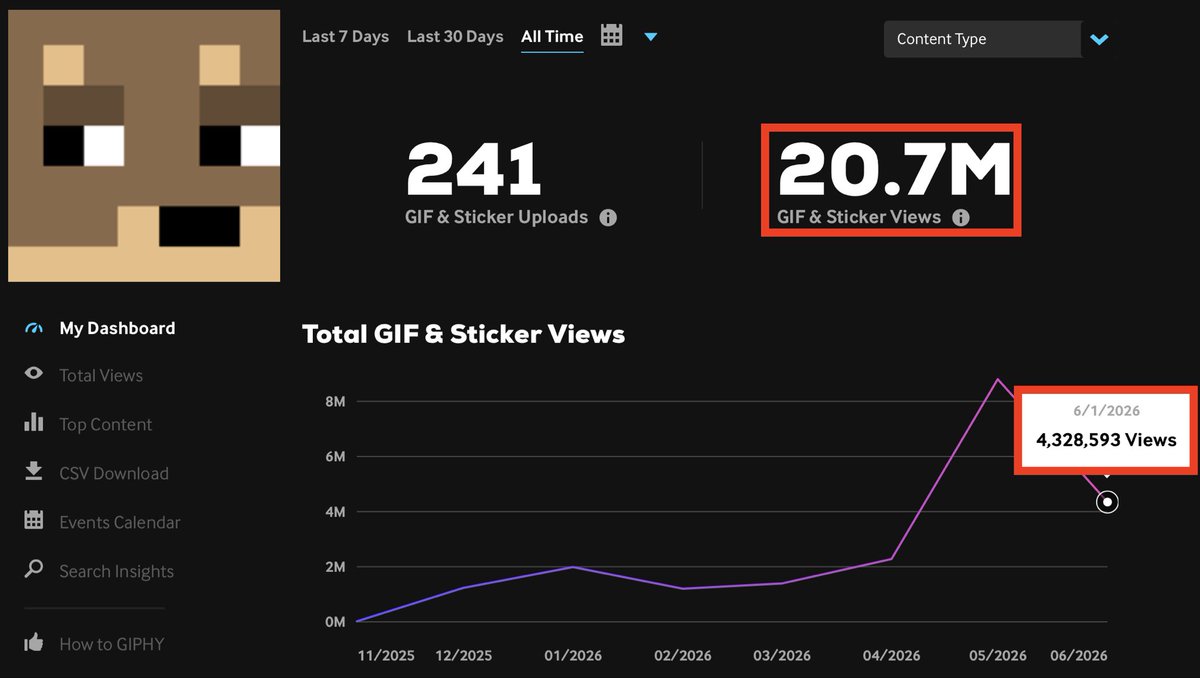
20.7M views. 20% off. Everyone.
Handcrafted frames. Zero AI.
The milestone is yours too. That’s the point.
DM me and let’s build. 💌

241 GIFs. 20.7 million views.
That’s an average of 85,000 views per upload, made by hand, for a brand inscribed on Dogecoin..
No ad spend. No algorithm hack.
Just frames placed where billions of people talk daily.
21
24
78
8,440
Jawa retweeted

250
27
110
9,722
If you follow my account you'll notice I have posted about this a few times and shared posts about it. I highly recommend keeping an eye on SpaceX.
People don't understand what they are about to do. While everyone is fighting for land, energy and compute power SpaceX is about to solve that issue by utilizing space.
Soon as I get some liquidity, I'm throwing more in.

SpaceX is moving humanity's AI compute off the planet, and construction has already begun.
AI now hits physical limits before software ones. Power plants, substations, transformers, transmission lines, cooling, land, permits, and construction time all gate it, and every ground data center competes with cities, factories, and homes for the same grid. Goldman Sachs expects US data center power demand to more than double from 31 gigawatts in 2025 to 66 gigawatts in 2027, and only 50 to 60 percent of the capacity scheduled for the next year or two to come online on time.
SpaceX is answering by building the next compute layer in space. In February, it acquired xAI, bringing launch, satellites, AI models, and the power behind them into one company, in a deal that valued SpaceX at 1 trillion dollars and xAI at 250 billion dollars. In June, it raised $75 billion in the largest IPO ever recorded, debuting at a valuation of $1.77 trillion.
The whole architecture starts with the Sun. In the right orbit, sunlight almost never stops, so solar arrays generate power, radiators shed heat into the vacuum, laser links move the data, and Starship carries the hardware up. SpaceX is taking the satellite technology it has already proved across thousands of Starlink satellites and pointing it straight at AI compute.
On June 8, Elon Musk revealed the first satellite, AI1. Each one carries 120 kilowatts of sustained compute and 150 at peak, about the draw of a single Nvidia GB300 rack, on a frame 70 meters across, wider than a Boeing 747. It cools itself with deployable liquid radiators and redundant loops, and its chip bay is interchangeable, so the best silicon on the market drops straight in. Every satellite is a full server rack running in orbit.
SpaceX has filed with the FCC to launch up to one million orbital data center satellites. In the sun-synchronous orbits it picked, they stay in sunlight more than 99 percent of the time, cooled by radiating heat into space and cut loose from every grid constraint on the ground. The filing calls the system a first step toward becoming a Kardashev II civilization, one that can harness the full power of the Sun. The launch math is 1 million tonnes of satellites a year, each tonne generating 100 kilowatts of compute, adding 100 gigawatts of AI capacity each year.
The entire US data center fleet is forecast to draw 66 gigawatts in 2027. SpaceX aims to add 100 gigawatts of new orbital compute capacity every year by 2030, so a single year of launches would exceed the projected draw of the entire American fleet.
Gigasat is the factory built to make that real, an eleven-million-square-foot complex on a thousand-acre site in Bastrop, Texas, more than ten times the size of SpaceX's largest plant today. It builds the satellite end to end, from its own solar cells and circuit boards to the finished craft, and SpaceX is targeting one gigawatt of orbital compute a year by late 2027 and scaling it by roughly ten times a year toward 100 gigawatts by 2030.
xAI's Colossus reached 200,000 H100 GPUs in a single interconnected cluster, built in 122 days and then doubled at record speed. A 100-gigawatt orbital layer gives SpaceX the power budget for whole populations of frontier systems running at once: multimodal and world models, robotics foundation models for humanoids and factories, protein and drug discovery, materials search, fusion and propulsion simulation, and scientific agents that work without sleep. More compute means more experiments and more discoveries per day, and a civilization with cheap power in orbit can chase ideas the ground would force it to ration.
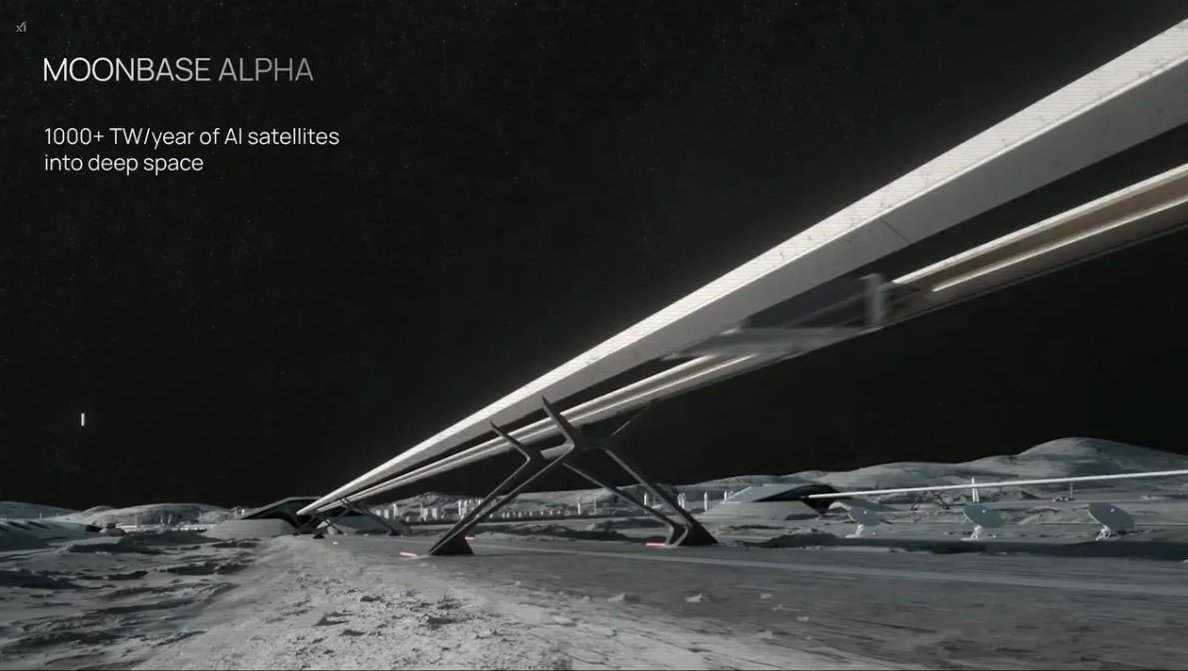
The next stage is the Moon. SpaceX is prioritizing a self-sustaining lunar city, with the first uncrewed landing targeted for March 2027. The Moon becomes a factory outside Earth's gravity well, where local material turns into satellite structures, solar arrays, and radiators, and electric mass drivers fling that hardware into deep space with no chemical fuel at all. Elon has described that path scaling to between 500 and 1,000 terawatts of new AI capacity a year, petawatt scale. Earth launches open the orbital layer, and the Moon expands it.
Starship carries all of it. Starship V3 flew for the first time on May 22 from the new Starbase pad, hit its major milestones, and deployed 20 Starlink simulators, along with two modified satellites that imaged the ship in flight. Orbital compute needs mass to orbit at industrial cadence, and Starship is the machine built for that volume.
SpaceX now holds every element pointed at one goal: the company, the public capital, the AI lab, the satellite, the factory, the FCC filing, the lunar roadmap, and the rocket, all aligned to move compute above the grid and run it on the Sun.
The internet carried human knowledge, and AI turned it into something that thinks. SpaceX is building the power and the transport for what comes next. Humanity is moving its compute to the stars, and the rocket to carry it is already flying.
5
46


26
10
31
699