
Bitcoin pleb. Spurs idiot. Poker loser. Whisky enjoyer.
Joined July 2009
- Tweets 2,497
- Following 1,908
- Followers 349
- Likes 8,672
108 Photos and videos












🌽 Agent Jim 🌽 retweeted

Feb 3
London Stock Exchange: Welcomes The Smarter Web Company to the Main Market.
londonstockexchange.com/disc…
20
35
263
9,344
🌽 Agent Jim 🌽 retweeted

7 Aug 2025
If you came across this list used to attack climate science, be warned it is from the American Enterprise Institute (AEI), a rich fossil fuel lobby group. The list is HIGHLY misleading and I will go through each and every one in this mega thread to show you why it is misleading:

32
212
464
62,593
🌽 Agent Jim 🌽 retweeted

6 Nov 2025
After our recent update, hype is building fast! 🙌
Be a part of the revolutionary $CHIPPY cult and join the fun! 🤪
THE GOOD OLD DAYS ARE RETURNING 👀🍟
👇
t.me/fishnchipssol
12
12
29
639
🌽 Agent Jim 🌽 retweeted

7 Jul 2025
* Universities never realised they were harbouring the ideology that now seeks to kill them *
A post from my blog this morning:
———————————————
There's a bitter irony at the heart of modern higher education, which too few universities, and even fewer of their leaders, seem willing to confront. This is that universities have, for decades, nurtured within their own institutions the ideology that now aims to destroy them. That ideology is neoliberalism.
Let me explain.
Firstly, neoliberalism's core is anti-thought. At its heart, neoliberalism is not just an economic project. It is a project to restrict the whole basis of debate, of imagination, of critique. This should be obvious, and yet apparently it has not been. Neoliberalism insists that there is:
•no alternative to markets,
•no alternative to private property,
•no alternative to profit maximisation as the ultimate measure of success.
Anything that dares to challenge these assumptions is dismissed as naive, dangerous, and, ironically as ideological. That argument has been used against me for a long time.
Secondly, let's not pretend otherwise, our universities eagerly imported this ideology. Beginning in the 1980s, universities across the UK, and across much of the world, embraced market models. Their leadership welcome the idea for one simple reason: they saw an opportunity for personal gain from doing so. As a result, they welcomed competition for funding, league tables that reduced education to a race for rankings, and a commercial mindset that turned students into customers. They applied “return on investment” logic to courses, to research, even to the arts and humanities. They sold off their own assets, outsourced their services, squeezed their staff, and congratulated themselves on running “efficient” businesses, and were very happy to be treated as such as they used this status to justify their excessive salaries and bloated PR functions that were engaged to maintain this myth.
Third, universities even changed what counted as knowledge. Neoliberalism infiltrated academic disciplines. Economics departments became dominated by neoclassical models that ignore power, inequality, and the environment. Business schools churned out managers trained to cut costs and maximise shareholder value, but rarely to serve society. Even humanities departments too often tied themselves to corporate partnerships and employability agendas. Intellectual autonomy was surrendered for the promise of private sponsorship, and the ability to attract that private money was seen as the true indication of academic success.
Fourth, now all of this has backfired, spectacularly. Neoliberalism never did believe in competition, or access, or diversity. All it believed in was the accumulation of power and wealth for a few. And now we see the consequences of that. Across the UK universities are cutting courses and making job cuts and desolate this they are unable to contain the financial crises in our universities. The arts, languages, and critical social sciences are especially at risk. Meanwhile in the US, where the US goes the UK usually follows, the far right is explicitly attacking universities, cutting funding, banning diversity programmes, dictating what can and cannot be taught. And they can do that because once you persuaded a whole generation that education is just a market good to be valued solely by short-term economic returns then anything that encourages people to think differently, whether that be to question power, to explore history, culture, ethics, or alternatives to the market, is just a threat.
————
See the linked tweet below to continue.
13
211
394
23,077

14 Jun 2025
Is SWC no longer on AJ Bell? Have a friend who'd like to get onboard.
Neither of us can seem to find it?
7
1
2
884
12 Jun 2025
I'm sure it's been asked before, but there's a 30p difference between US and UK prices? Why is that, and will they converge at some point?
2
5
700
3 Jun 2025
Excuse my ignorance, but does going onto the US market expose SWC to possible price manipulation by bigger aggressive US competitors?
2
3
907
🌽 Agent Jim 🌽 retweeted

16 May 2025
🚨 Avalon nano 3s GIVEAWAY🚨
We are giving away 6TH/s #Nano3s home #Bitcoin miner!
To participate:
👉Repost this post
👉Follow @mineshop_eu
👉Comment to increase your luck

971
958
918
49,338
26 Feb 2025
Finally.

2
47
🌽 Agent Jim 🌽 retweeted

2 Jan 2025
This woman claims £8,400 from the Government in Universal Credit, £1,800 in Bursary contributions.
But she doesn't want to pay £800 a year in Private School VAT to pay for these things.

48
74
302
18,512

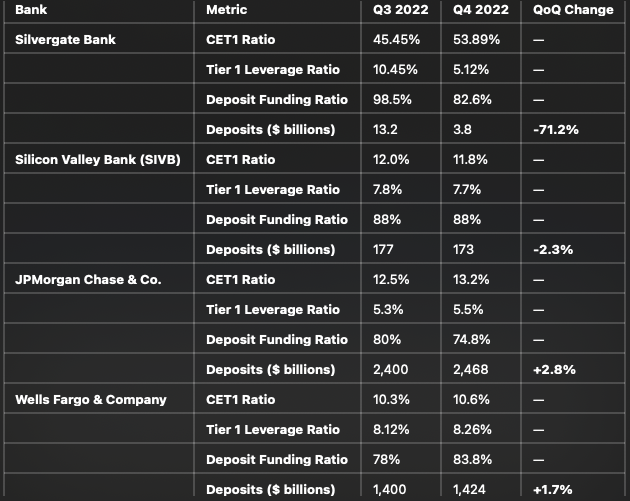
Silvergate had 5x higher CET1 & same tier 1 leverage & deposit ratios as JPM in Q4 2022 AFTER a 71% deposit drawdown. Warren pressured FHLB, auditors and FDIC to rug them. A chartered bank was vaporized overnight with no due process. No one in the banking industry said a word🧵
The Silvergate Assassination
Let's talk about how a chartered bank with perhaps the most conservative liquidity management in America got rugged by regulators because Elizabeth Warren was big mad about crypto. This is a story about what happens when political pressure trumps property rights, and the adults in the banking industry watch in silence.
The Numbers Don't Lie (But Regulators Might)
First, let's get the facts straight. In Q4 2022, AFTER surviving a 71% deposit drawdown, Silvergate had:
- 5x higher CET1 than JPMorgan Chase
- Same tier 1 leverage ratios as JPM
- Identical deposit ratios
- Best-in-class liquidity coverage
- Deposits were rounding error as a percentage of banking industry and deposit insurance fund (<$4b)
Why such conservative liquidity management? Because they understood the risks of hot money crypto depositors and specifically structured their operations to handle massive drawdowns. The regulators knew this. They approved this. Until they didn't.
How to Assassinate a Bank in One Easy Step
The kill shot was beautifully simple: Warren's crew pressured FHLB, auditors, and FDIC to straight up rug them. Silvergate repaid their FHLB advance in full (unprecedented), the FDIC forced Silvergate to reduce their crypto deposit base from 95% to 15% overnight. That's not regulation - that's a political hit job with extra steps.
The most sympathetic industry observer (respect), with years of hindsight, could only muster: "the regulators, in imposing the cap and even knowing its obvious fatal effect on Silvergate, acted within the boundaries of previously exercised authority." Translation: "Yes, they can legally assassinate any bank they want overnight if their customers are engaged in legal but politically unpopular economic activity."
The result: the bank’s "voluntary" (forced) liquidation destroyed not only shareholder and debtholder wealth but also the livelihoods and professional reputations of its employees. But the direct wealth destruction on Silvergate counterparties paled in comparison to the bank runs in Q1 2023 that were catalyzed by the attention this drew to wider and more egregious duration liability mismatches in less conservatively managed regional banks.
The Banking Industry's Profile in Courage
The response from other banks while watching a chartered institution get vaporized overnight with no due process?
*Cricket noises intensify*
Not a single word. Because when regulators become political assassins, the smart play is apparently to pretend not to notice.
These are the people in charge of administering and protecting property rights in the US economy. Just think about that for a minute.
The AML Red Herring
The same industry that watched Silvergate's assassination in silence suddenly found their voice to whisper "but what about those AML concerns?" Let's put this in perspective:
- Deutsche Bank: $258B in suspicious transactions
- HSBC: literal drug cartel money
- JPM: $135M fine for AML failures
- Wells Fargo: *gestures broadly at everything*
All still operating. None forced to liquidate overnight. Funny how that works.
When major banks violate AML rules:
- Years-long investigations
- Negotiated settlements
- Manageable fines
- Business as usual
When Silvergate faces AML allegations:
- Immediate death sentence?
- No completed investigation
- Zero due process
- Total liquidation
They didn't even wait for the investigation to finish before using it as posthumous justification. Let's be clear: AML violations have never been cause for fully liquidating a bank. Ever. Unless, apparently, you're a crypto-friendly bank and Elizabeth Warren is mad at you. Then the rules change overnight. Only Silvergate's alleged violations were serious enough to warrant immediate execution without trial.
This wasn't about AML. This was about finding a plausible-sounding excuse after the fact to justify a political hit job. And the industry's willingness to play along with this fiction tells you everything you need to know about regulatory capture.
Why This Matters
This isn't just about Silvergate. This is about:
- Property rights being subordinate to political pressure
- Nonexistent due process for a class of publicly traded companies
- Regulatory authority being wielded as a political weapon
- The banking industry being completely ossified and cucked by regulators
Of course, regulators need to consider customer concentration and hot money effects on the deposit insurance fund. That's not why Silvergate was assassinated. This was about sending a message: cross the wrong political interests, and your ratios don't matter, your management doesn't matter, your property rights don't matter. In other words, f*** them crypto kids.
The Path Forward
We need guardrails - not just for banks, but for regulators. When political pressure can vaporize a conservatively managed, well-capitalized bank overnight:
- Property rights aren't secure
- Due process doesn't exist
- Banking isn't independent
- Regulation isn't about safety
Conclusion
A bank with better capital ratios than JPMorgan Chase got politically assassinated in broad daylight, and the entire banking industry chose silence.
Because in the current system, as a bank shareholder or debtholder, your property rights are only as secure as your political protection.
If Silvergate shareholders and debtholders do not have a class action claim against arbitrary and capricious wealth destruction by the state here, what bank shareholder ever would?
20 Nov 2024

Picking up where I left off.
The controversy in the Silvergate story, as I understand it, is twofold. First, that regulators forced Silvergate into voluntary liquidation by imposing fatal restrictions on its business model — namely, a de minimis cap on Silvergate’s crypto deposits, which accounted for 95 percent of its deposits at the time. Second, that by doing so, the regulators committed an unconstitutional taking of property.
The first issue isn’t in factual dispute. Everyone stipulates to the pertinent facts as best as I can tell. The second one is in dispute and is where I will weigh in, for what it’s worth.
Whatever one thinks about cryptocurrency, one cannot argue that, in its current form, it is a stable store of value. Its price fluctuates so much that bankers are wary of it. Think about it like this, given the leverage banks use, a mere 10 percent decline in most asset prices is enough to render the typical bank insolvent.
This instability translates in the banking world into fund flows. Look at the surge in Silvergate’s deposits after the government flooded the market with liquidity in 2020-22. At the end of 2019, Silvergate reported $1.8 billion in deposits. A little over 24 months later, at the end of the second quarter 2022, that had climbed to $13.5 billion.
Then came the decline after FTX. By the end of 2022, Silvergate’s deposits stood at only $6.3 billion.
To bank regulators, volatility like this represents a threat to the Deposit Insurance Fund. Had Silvergate’s assets not been as liquid as they were, it would have failed. And had that failure caused contagion among other banks — in this case, primarily those with crypto business lines — the threat would be multiplied.
Additionally, regulators regularly impose caps of different sorts on banks — from taking more brokered deposits to making commercial real estate loans above a set multiple of capital. An extreme case is Wells Fargo, banned for years from growing its balance sheet.
Given this, it seems to me that the regulators, in imposing the cap and even knowing its obvious fatal effect on Silvergate, acted within the boundaries of previously exercised authority.
I am not, to be clear, a constitutional scholar — though, in my defense, I did get an A in Constitutional Law in law school and spent a year writing legal opinions for a federal judge. Perhaps there are novel constitutional issues at play that’ll overturn regulators’ authority, but if I were a betting man/woman then I’d bet on this story being over.
The Silvergate story is a cool story. I got to know one of the folks there and would even call him a friend. I don’t believe it was led by unscrupulous people who acted with negligence. It was led by people pioneered an idea and got shot by arrows in the back for doing so.
21
42
196
40,837
🌽 Agent Jim 🌽 retweeted

5 Dec 2024
A response to @FTAlphaville @FinancialTimes
1. "Bitcoin is a negative-sum game played on a protocol that’s very clever and hypothetically useful as a unit of account, but chronically inefficient as a means of exchange and compromised as a store of value."
This is an inane mischaracterisation.
Bitcoin's efficiency and value depend on understanding its primary function: a decentralised, trustless monetary network.
Means of exchange: Bitcoin’s "inefficiency" as a medium of exchange is often misunderstood. Its base layer isn’t meant to handle retail payments at scale; that’s the role of Layer 2 solutions like the Lightning Network, which processes transactions instantly, efficiently, and at near-zero cost.
Critiquing the base layer for not being Starbucks-ready is like dismissing gold because you can’t buy coffee with it. Bitcoin's layered approach is evolving in precisely the way its critics claim it can't.
See my videos ALL AROUND THE WORLD where i use the lightning network to buy things using bitcoin as an MoE. Including Starbucks.
"Compromised Store of value": You wot m8?
Bitcoin has outperformed every major asset class over the last decade. It is the most effective store of value in recent history. While short-term volatility remains, Bitcoin’s predictable issuance and absolute scarcity (21 million cap) are the antithesis of the inflationary currency regimes driving people to seek refuge in harder assets.
2. "The price of a bitcoin is an arbitrary hype gauge that’s disconnected from any utility... any intrinsic worth comes from sunk costs of infrastructure and intangibles like regulatory acquiescence."
Bitcoin’s price reflects more than “hype”. You don't HYPE to 2 trillion dollars.
it reflects monetary network effects, demand for censorship-resistant value transfer, and growing adoption as a hedge against fiat devaluation.
Utility: Bitcoin’s utility isn’t just theoretical—it’s real and growing. From enabling cross-border remittances to providing financial freedom to individuals in authoritarian regimes, Bitcoin is being used where traditional financial systems fail or exclude. See my videos in Cuba, Senegal and Peru for examples of this.
Also, see Bitcoin mining as a force for good.
“Intrinsic worth” and infrastructure costs: This is a fallacy rooted in misunderstanding Bitcoin’s role as a sort of digital gold.
Like gold, Bitcoin's value derives not from what it does but from what it represents: an immutable ledger / a hedge against fiat debasement. Its “sunk costs” (mining infrastructure) are part of the mechanism that secures this ledger and ensures its decentralization. This isn’t a bug; it’s the feature that sets Bitcoin apart from copycats. Muppets.
3. "It’s trivial to duplicate the utility provided by said token."
This is laughable and betrays ignorance of Bitcoin’s first-mover advantage and the importance of decentralization:
Most "Bitcoin copies" are inferior precisely because they lack Bitcoin’s immutability, security, and decentralized network effect. They all have trended to zero against Bitocin.
Decentralization isn’t trivial to replicate; it takes years of organic growth and thousands of nodes operating globally to reach Bitcoin's level of resilience.
The statement also fails to acknowledge the Lindy Effect: Bitcoin’s survival and adoption over time make it increasingly robust and irreplaceable. You cringebags.
4. "The souvenir attraction of 'being the first.'"
Dismissing Bitcoin as a "souvenir" is superficial at best. Bitcoin isn’t valuable merely for being first; it’s valuable because it’s the only truly decentralized monetary network.
Its design—immutable, neutral, censorship-resistant—has proven unmatched in the cryptocurrency ecosystem. This "souvenir" is changing lives by enabling financial sovereignty worldwide.
5. "We’re sorry if at any moment in the past 14 years you chose based on our coverage not to buy a thing whose number has gone up."
This backhander reeks of condescension.
The issue isn’t that Bitcoin's price has risen—it’s why. HOW DO YOU NOT UNDERSTAND THIS.
People have recognized its value as a hedge against inflation, a tool for financial freedom, and an alternative to a broken fiat system.
Mocking "number go up" ignores the real, human stories behind Bitcoin adoption, from hyperinflation victims in Cuba (see my videos), to empowering women in Peru (see my videos), to supercharging renewable energies (see my videos) to fighting post-colonialism (see my video... you get the point.
27
17
98
8,776
🌽 Agent Jim 🌽 retweeted

19 Nov 2024
Labour is hiking taxes on billionaires.
Don’t be distracted by the farmers protesting in Westminster. Inheritance tax on farmland means the super rich will pay their fair share.
Here’s who’s most affected:
390
1,780
11,112
1,235,089
20 Nov 2024
100k incoming

9
11 Nov 2024
Solid advice.
11 Nov 2024

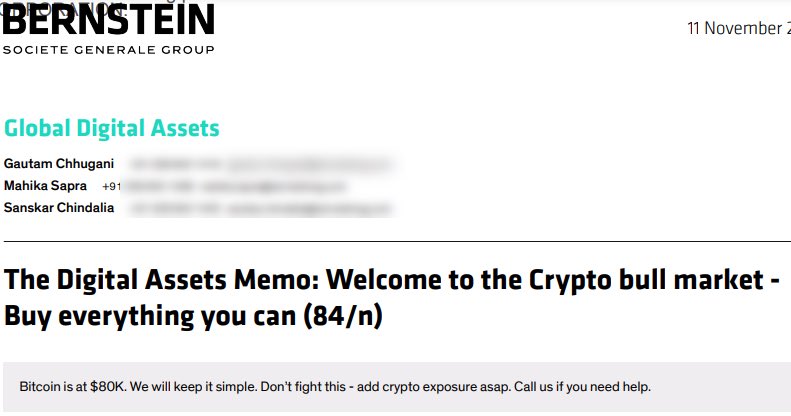
Bernstein ($800 billion AUM) just put out their Monday morning note to clients:
“Welcome to the Crypto bull market. Buy everything you can. Don’t fight this – add crypto exposure asap.”
Stage 3 really is upon us.
26
🌽 Agent Jim 🌽 retweeted

11 Nov 2024
Bernstein ($800 billion AUM) just put out their Monday morning note to clients:
“Welcome to the Crypto bull market. Buy everything you can. Don’t fight this – add crypto exposure asap.”
Stage 3 really is upon us.
114
701
4,388
613,172
🌽 Agent Jim 🌽 retweeted

6 Nov 2024
All over the rich world, people’s lives are getting worse.
It’s harder to afford the basics, keep a roof over your head, and access care when you’re sick.
People will keep voting for whoever they think will bring back prosperity. 1/
142
1,609
7,984
855,564
5 Nov 2024
Still so early.
4 Nov 2024

Everyone will have Bitcoin in their Pension by 2040...
Given its limited in supply, it's probably better to start accumulating sooner rather than later.
And cool to hear @Musqet_Bitcoin are working on providing bitcoin related products / services with Cartwright too.
1
23
🌽 Agent Jim 🌽 retweeted

24 Oct 2024
“The IMF creates a self-fulfilling prophecy of more crisis”
Ep 12 is LIVE! @adribuller & Andrés Arauz, economist & former Ecuadorian politician, discuss Yasuní, the IMF & transforming global economic institutions for a more just & sustainable world. 🔗⬇️
youtube.com/watch?v=rGdHYRgb…
3
32
67
24,903
🌽 Agent Jim 🌽 retweeted

I'm pleased to announce that signed copies - with a personalised message - of Brighton & Hove Albion On This Day are now available on eBay:
ebay.co.uk/itm/146117394212
Please RT.
@DogmaBrighton @tslr @albionroar @TheAlbionMagUTA
#BHAFC #BHAOTD #BrightonandHoveAlbion
4
6
818