Joined February 2023
- Tweets 52
- Following 435
- Followers 37
- Likes 20
21 Photos and videos







May 25
On Africa Freedom Day, we honour the generations who planted trees whose shade they knew they would never sit under. Today we stand taller, grow stronger and dream bigger because of the freedom they sacrificed for. May we too plant greater trees for the generations yet to come!!
18
11 May 2025
The present and your future needs you! Your past doesn't! Keep moving!
37
10 May 2025
A Catholic monk once wrote an angry letter to the cardinals during a 2 year papal election. Upon receiving it, they immediately chose to elect him. He tried fleeing his election but accepted under pressure. One of his only acts was to decree that Popes could resign & he did!
40
27 Apr 2025

24
6 Apr 2025
If you can keep your head when all about you are losing theirs .If you can wait and not be tired by waiting .If you can think and not make thoughts your aim . If you can trust yourself when all men doubt you ..Yours is the Earth and everything that’s in it.
31
20 Mar 2025
18 Mar 2025

Top 21 Most Beautiful Countries in the World
1. 🇬🇷 Greece
2. 🇿🇲 Zambia
3. 🇮🇹 Italy
4. 🇮🇩 Indonesia
5. 🇦🇺 Australia
6. 🇪🇸 Spain
7. 🇵🇪 Peru
8. 🇯🇵 Japan
9. 🇳🇿 New Zealand
10. 🇹🇭 Thailand
11. 🇨🇭 Switzerland
12. 🇹🇷 Turkey
13. 🇮🇸 Iceland
14. 🇲🇽 Mexico
15. 🇸🇬 Singapore
16. 🇸🇪 Sweden
17. 🇦🇹 Austria
18. 🇨🇷 Costa Rica
19. 🇺🇸 U.S.
20. 🇳🇴 Norway
21. 🇨🇱 Chile
Source: Architectural Digest
54
18 Mar 2025

UPDATE ON DEBT AND DEBT RESTRUCTURING (Delivered in Parliament By The Minister of Finance & National Planning - Dr. Situmbeko Musokotwane, MP)
Madam Speaker, allow me to now address the issue of the country’s debt. As at end of 2024, the Central Government Domestic Debt stock decreased to K229.3 billion from K232.6 billion as at the end December 2023 due to change in the issuance method of Government bonds in January 2024 from discount to par value. With regard to the Central Government External Debt stock, as at end December 2024 this stood at US $15.43 billion from US $14.6 billion as at end December 2023.
Madam Speaker, the increase was on account of continued disbursements to social sector projects largely from multilateral institutions and the various tranches of the International Monetary Fund (IMF) Extended Credit Facility (ECF). Notably, under the ECF, the IMF in June 2024 extended an additional SDR 293.46 million (about US $385.7 million) to assist Government address the severe drought that has significantly impacted agriculture and electricity generation, affecting a substantial share of the population.
Madam Speaker, the publicly guaranteed state-owned enterprise external debt at the end of December 2024 stock decreased to US$1.37 billion from US$1.41 billion as at the end December 2023. This was as a result of debt service payments by guaranteed institutions.
In terms of domestic arrears, we have made efforts to reduce them. The stock of audited and verified domestic arrears decreased to K77.5 billion as at end-September 2024 from K79.8 billion as at end-June 2024. We remain confident the downward trend will continue in the subsequent years due to our strong commitment to clear the arrears in line with the Revised Arrears Clearance Strategy.
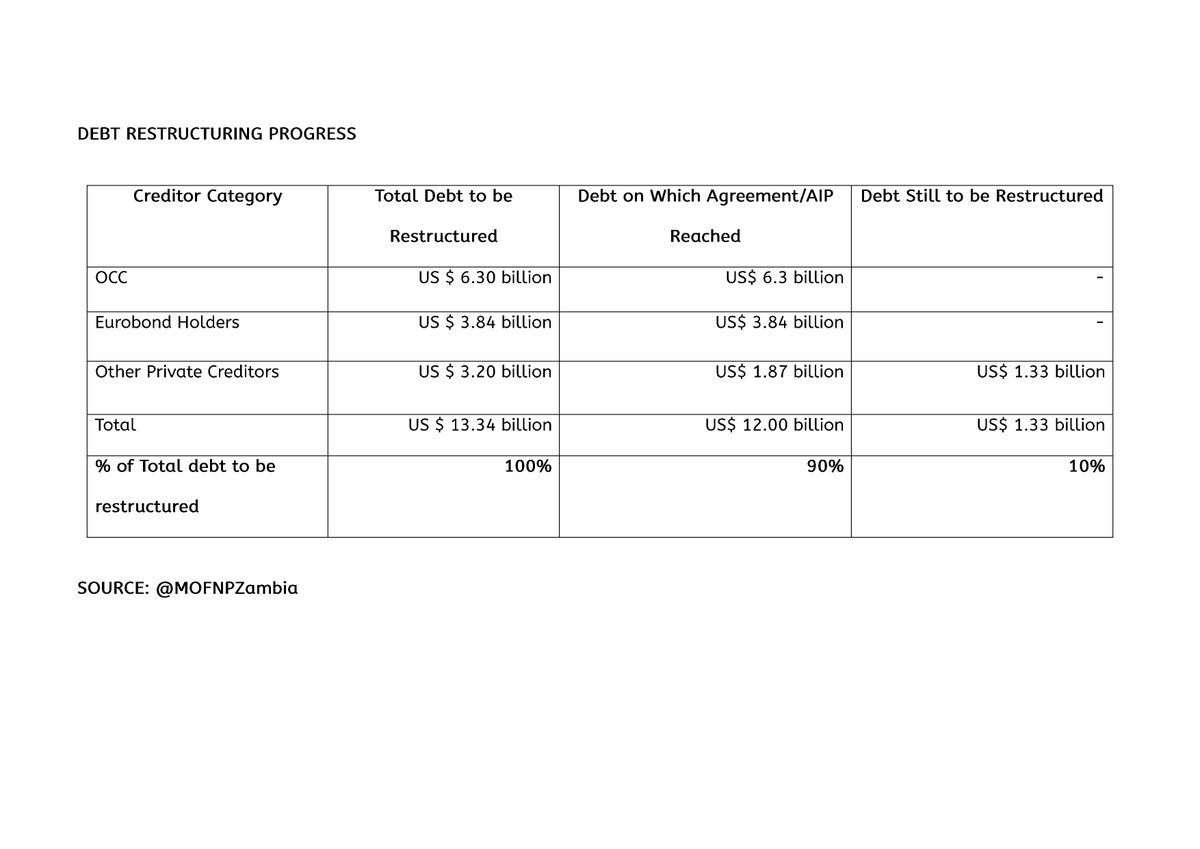
DEBT RESTRUCTURING UPDATE: Madam Speaker, Zambia has achieved a major milestone in its debt restructuring efforts. Of the US$13.34 Billion, a total of 90 percent has been reached in the Agreement in Principle (AIP) with creditors. An “agreement in principle” refers to a mutual understanding between parties on the fundamental terms and conditions of a deal, prior to finalizing the detailed legal documentation.
This significant progress reflects substantial alignment on restructuring terms and demonstrates Zambia’s commitment to resolving its debt challenges. The agreements cover bilateral, Eurobond, and commercial creditor categories, with each category achieving critical advancements toward long-term debt sustainability.
Madam Speaker, in the bilateral category, Zambia secured a restructuring agreement in June 2023 for approximately US$ 6.3 billion, which was formalized through a Memorandum of Understanding (MoU) in October 2023. This MoU established the framework for repayment terms and bilateral agreements. So far, agreements have already been signed with France and Saudi Arabia. On the Eurobond front, Zambia restructured US$ 3.8 billion in June 2024, obtaining concessions worth US$ 840 million and resuming debt service payments.
For the commercial creditor category, Zambia has concluded agreements with Paramount, Huawei Technologies, ZTE Corporation and Credit Suisse. Debt service on the aforementioned creditors has resumed. Agreements in Principle (AIPs) have also been reached with other key creditors, such as Nedbank, Investec, Industrial and Commercial Bank of China (ICBC), Bank of China, AVIC, Bank Hapoalim, StarTimes and China Development Bank (CDB).
Madam Speaker, the Government continues to engage the remaining private commercial creditors who are mainly privately-owned companies, not by nature financial institutions. However, these engagements take time because the ability of the private companies to provide huge concessions is constrained.
As required under the Public Debt Management Act No. 15 of 2022, and in line with information sharing and transparency, the Ministry of Finance and National Planning continues to publish the quarterly debt bulletin which provide details of all the debt numbers.
These restructuring achievements are expected to yield substantial benefits, including improved credit ratings, enhanced investor confidence, reduce Zambia’s debt burden, create fiscal space, and support the country’s broader economic recovery and resilience.
CONCLUSION: Madam Speaker, it is common knowledge that 2024 was a challenging year for the Zambian economy, however, the Government demonstrated exceptional resilience. In this regard, growth will most certainly be higher than the anticipated 1.2 percent we projected for 2024. As we get into the medium term, we expect the macroeconomic environment to also improve and grow the economy on an average of six (6) percent.
Madam Speaker, I thank you.
48
7 Jan 2025
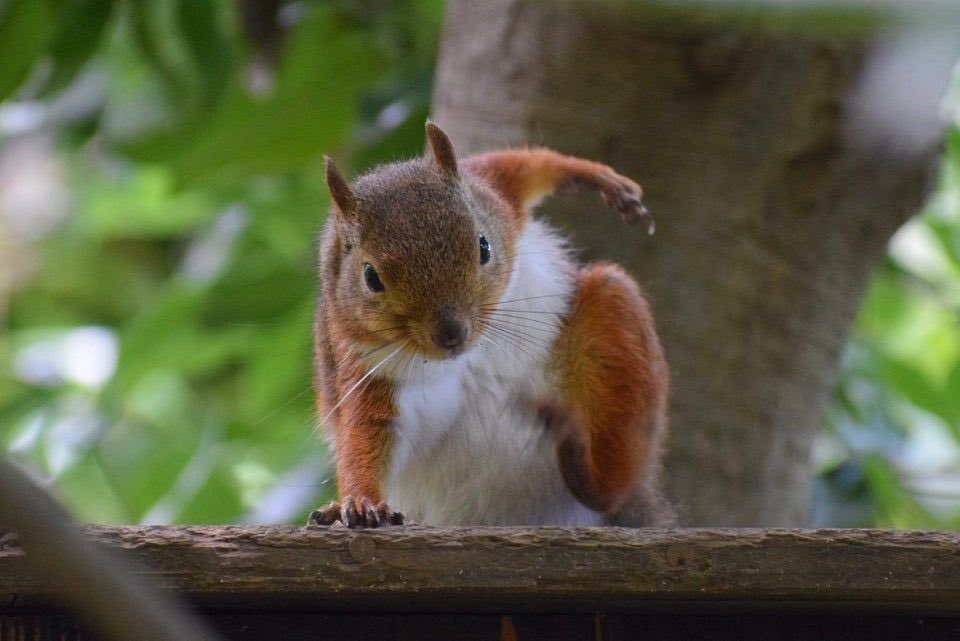
«The best thing I’ve learned this week is that when squirrels fall - they land like superheroes»
40
5 Jan 2025
🚨🇰🇵 KIM JONG UN: NO HOTDOGS FOR YOU
North Korea’s Supreme Leader has outlawed hotdogs, calling them “too Western.”
Selling or cooking the snack now counts as treason, punishable by a stint in a labor camp.
Source: Daily Mail
1
53
5 Jan 2025
Even budae-jjigae (spicy Korean-American stew) is off the menu—fusion food is officially suspicious.
Divorcing couples fare no better: both parties now face hard labor for their “anti-socialist” crime.
Previously, only one spouse got punished; now, it’s equal-opportunity .
44
2 Jan 2025
48th place seems generous for the UK?
x.com/MarioNawfal/status/187…
2 Jan 2025

🚨GREEK FOOD TAKES THE CROWN, UK FLOPS IN THE KITCHEN
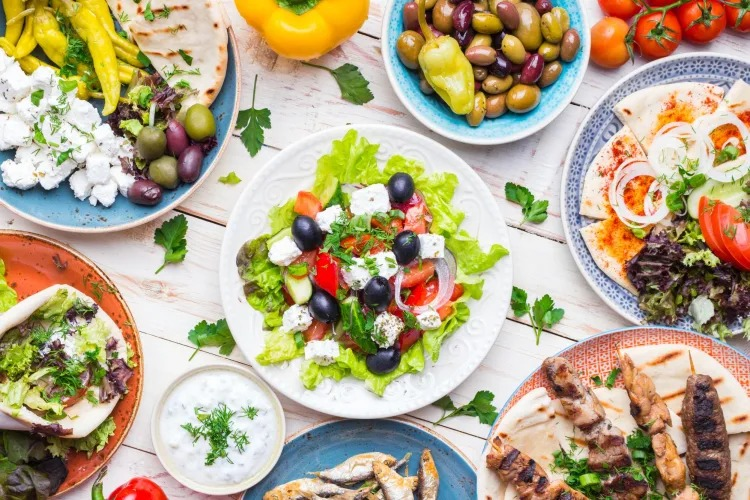
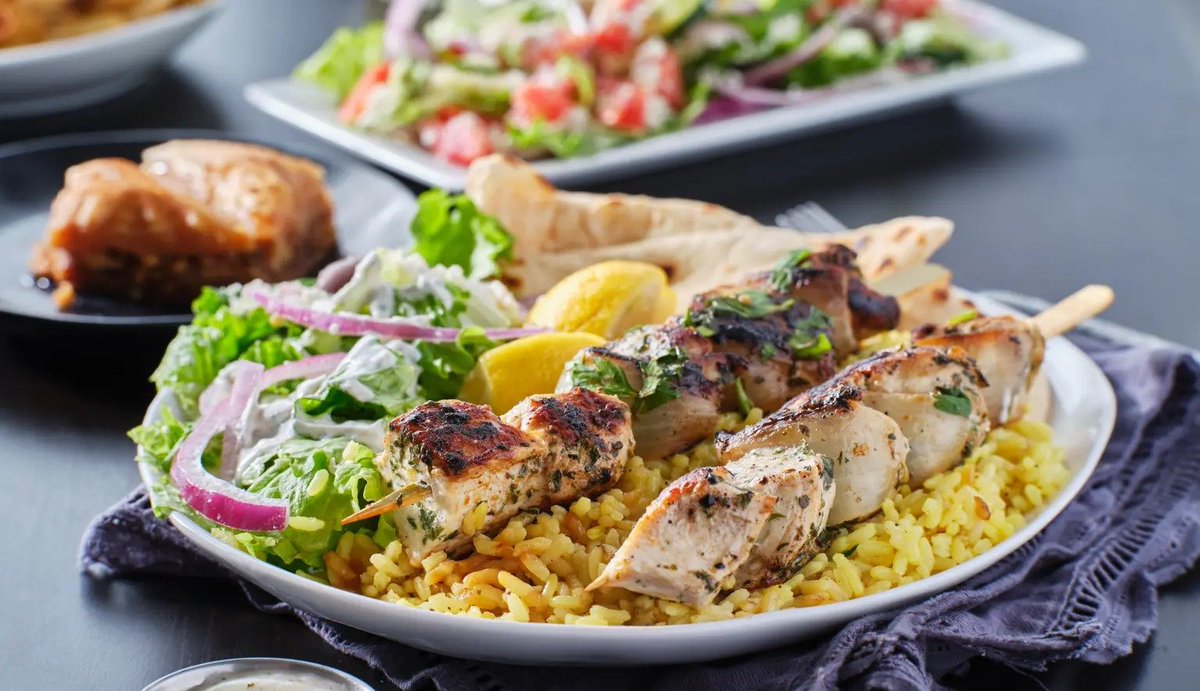
TasteAtlas has spoken: Greek cuisine is officially the world’s best, scoring a 4.6 thanks to souvlaki, pistachios, and fava beans that could bring Zeus to tears.
Italy slid into second with parmesan, Neapolitan pizza, and Nutella’s posh cousin, gianduja, while Mexico claimed third with tacos and tamales worth a fiesta.
The U.S. landed 13th, with South Texas BBQ and smoked salmon pulling their weight.
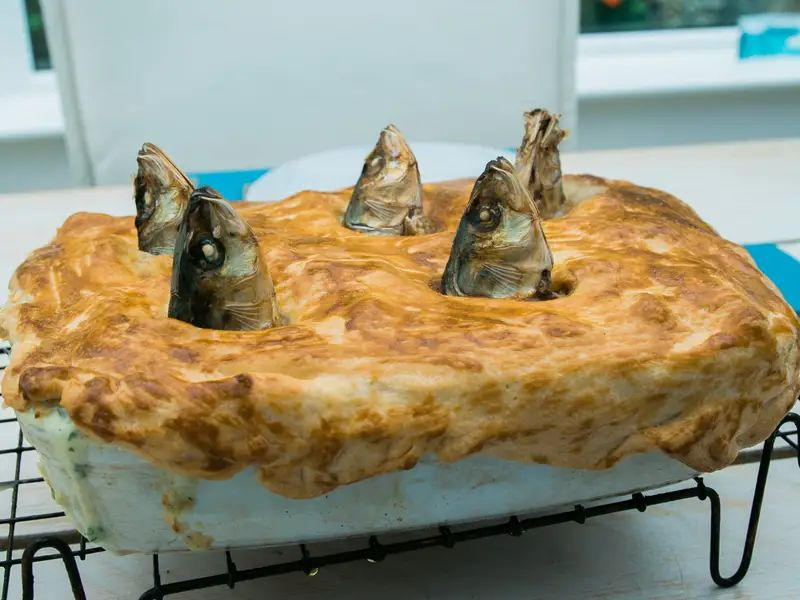
But the UK? A dire 48th.
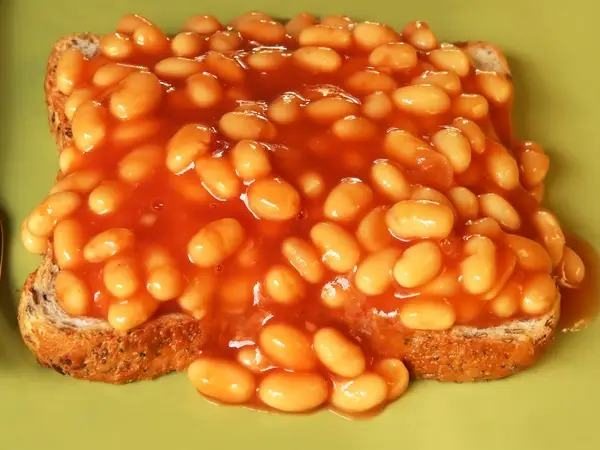
When beans on toast is your claim to fame, you’re lucky to beat out boiled cabbage.
Source: NY Post
36