
New Testament Lecturer carey.ac.nz | PhD @otago | "Some interesting explorations, but deeply flawed"-Kendall Davis | Mark 10:45, Isa 58:6, 2 Tim 2:24
- Tweets 5,249
- Following 829
- Followers 563
- Likes 11,167





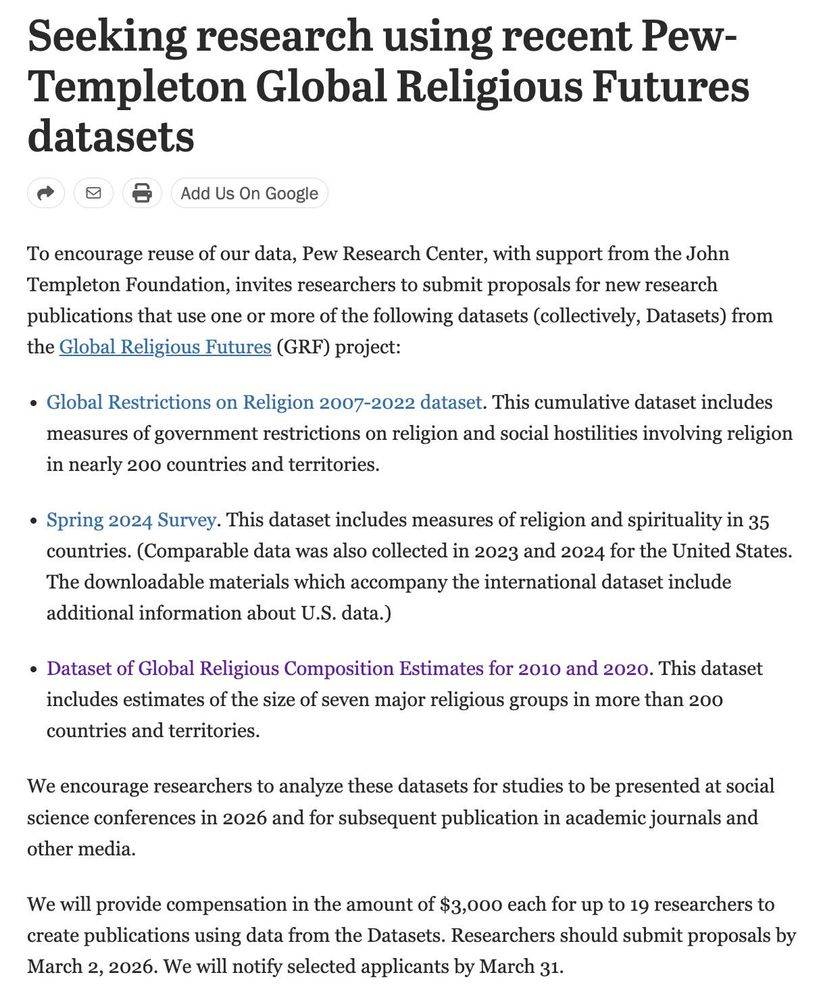
ALT To encourage reuse of our data, Pew Research Center, with support from the John Templeton Foundation, invites researchers to submit proposals for new research publications that use one or more of the following datasets (collectively, Datasets) from the Global Religious Futures (GRF) project: Global Restrictions on Religion 2007-2022 dataset. This cumulative dataset includes measures of government restrictions on religion and social hostilities involving religion in nearly 200 countries and territories. Spring 2024 Survey. This dataset includes measures of religion and spirituality in 35 countries. (Comparable data was also collected in 2023 and 2024 for the United States. The downloadable materials which accompany the international dataset include additional information about U.S. data.) Dataset of Global Religious Composition Estimates for 2010 and 2020. This dataset includes estimates of the size of seven major religious groups in more than 200 countries and territories. We encoura
