
Law Professor @WashULaw. Law & AI, Statutory Interpretation, Tax Law.
Joined December 2019
- Tweets 67
- Following 60
- Followers 546
- Likes 69
2 Photos and videos
Jon Choi retweeted

8 Nov 2023
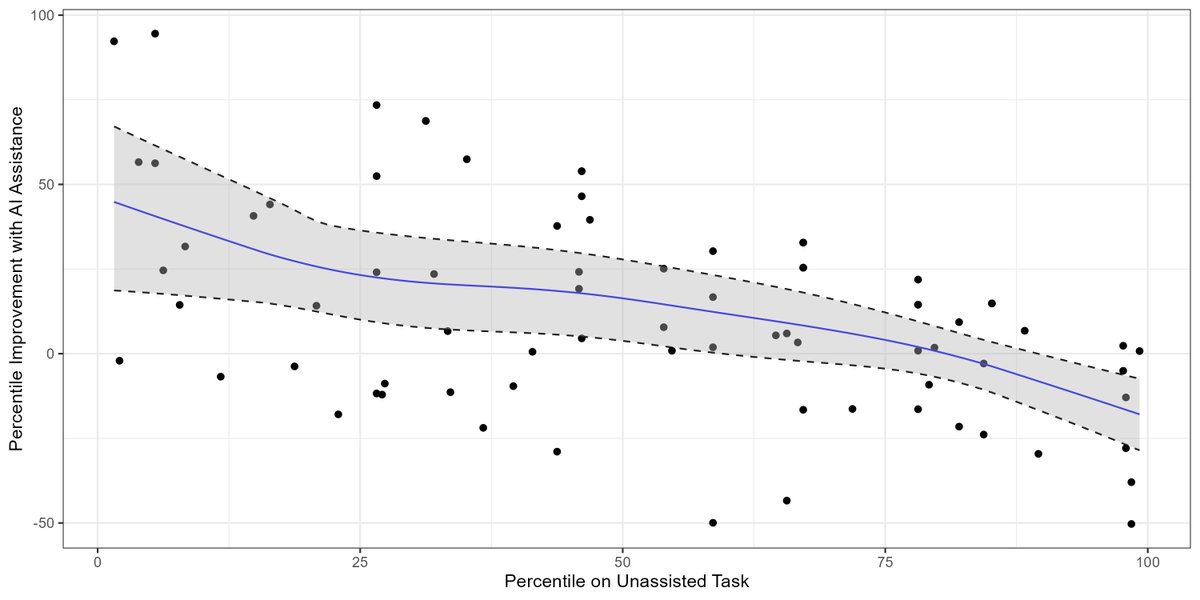
🚨New Paper 🚨 In the first randomized controlled trial of AI assistance’s effect on human legal analysis, we find it leads to large & consistent increases in speed on various legal tasks w/o harming quality. Check out Lawyering in the Age of AI now: papers.ssrn.com/sol3/papers.….
6
17
60
15,764

19 Oct 2023
Incredible news! Also big kudos to @ajurowkleiman who played a big part in the Direct File IRS feasibility report.
18 Oct 2023

Congrats to folks at @USTreasury like @jacobsgoldin who built the free Direct File tax-filing service -- great to save taxpayers money.
cnn.com/2023/10/17/politics/…
7
914
Jon Choi retweeted
30 Sep 2023
Very happy that my paper w/ @JonathanHChoi, AI Assistance in Legal Analysis: An Empirical Study, papers.ssrn.com/sol3/papers.…, is now forthcoming in the Journal of Legal Education!
3
22
1,872

We’re releasing a guide for teachers using ChatGPT in their classroom — including suggested prompts, an explanation of how ChatGPT works and its limitations, the efficacy of AI detectors, and bias. openai.com/blog/teaching-wit…
326
1,010
3,799
1,088,602
14 Aug 2023
📜New paper!📜
The big question for professors this past year: how useful is GPT-4 for university exams? @Dschwarcz and I ran a study on law school exams, finding that GPT-4 helps with simple multiple-choice but not complex essay questions. 1/4
papers.ssrn.com/sol3/papers.…
1
8
17
3,458
14 Aug 2023
Finally, we found that with good prompting (grounding with sources), GPT-4 alone outperformed on average BOTH humans alone AND humans with access to AI. Potentially bad news for legal paraprofessionals who currently do simple tasks conducive to automation. 3/4
1
1
366
10 Aug 2023
🚨📜🚨 New paper! If, like me, you're an empirical legal scholar and also a terrible manager, you might have wondered whether LLMs can replace student RAs in coding data. "How to Use Large Language Models for Empirical Legal Scholarship" reveals: Yes! ... 1/4
3
13
52
13,302
10 Aug 2023
The article is forthcoming in the Journal of Institutional and Theoretical Economics as part of a terrific symposium on Machine Learning & Law. Thanks to Christoph Engel for organizing and to @jed_stiglitz and @eredmil1 for commenting! 4/4
1
4
1,192
12 Aug 2023
Analysis code is here: jonathanhchoi.com/code-llms-…. Thanks to Nina Mendelson for providing the human-coded data for this study; the methods article is a companion to a larger doctrinal project we're working on, stay tuned!
196
Jon Choi retweeted

30 Jun 2023
It was great to return to New Haven for the Harvard/Stanford/Yale Junior Faculty Forum! Lots of engaging convos with @danepps, @Alan_Trammell, @EtienneT_Esq, @didwanias, @BrennerFissell, @HBWHBWHBW, @JonathanHChoi, @LDHerrine, and many more!

1
2
19
2,444
14 Jun 2023
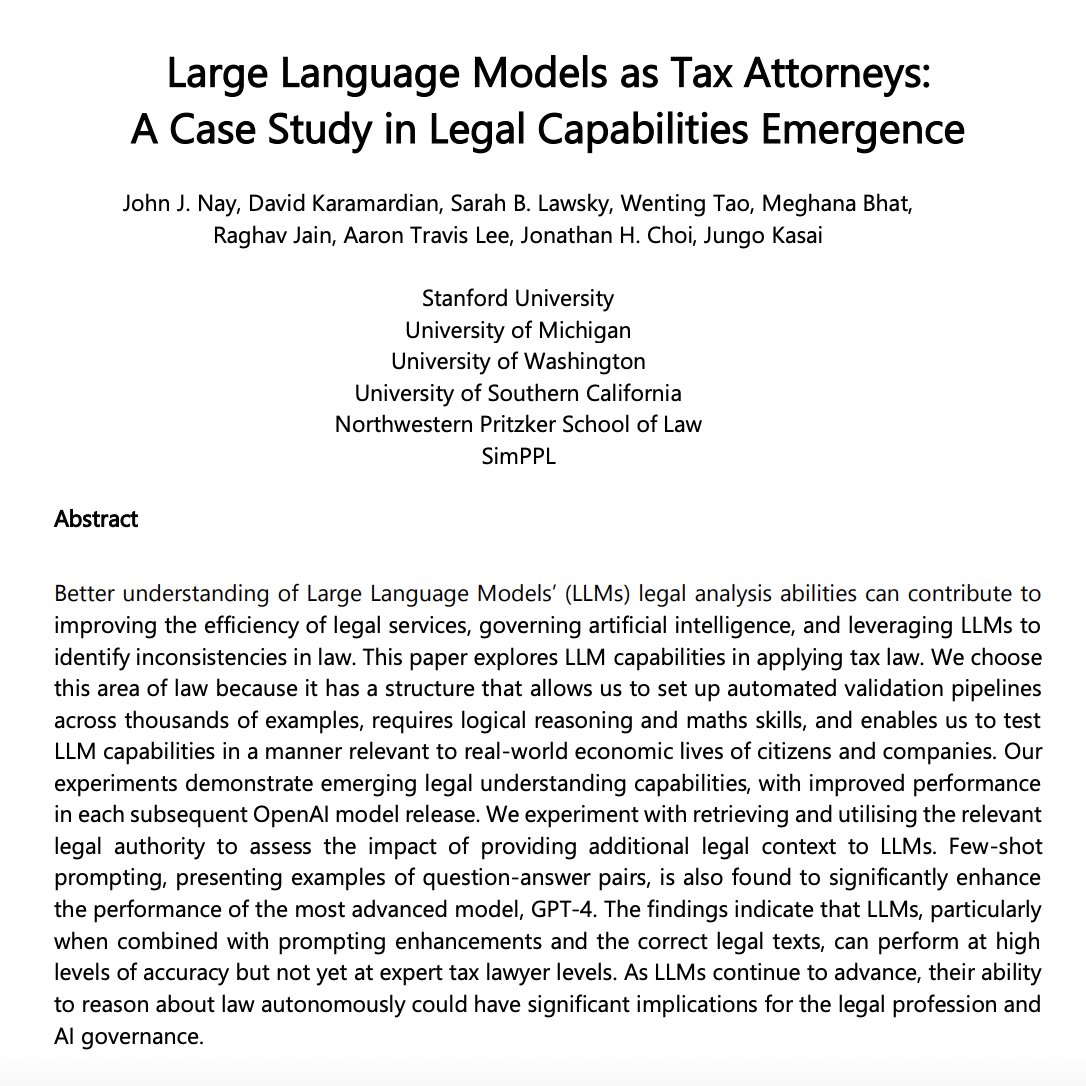
New draft paper on arXiv with @johnjnay @sarahlawsky and others! Explores GPT's capabilities at answering tough tax problems; finds that performance improves significantly with few-shot prompting and access to relevant sources.

Large Language Models as Tax Attorneys: A Case Study in Legal Capabilities Emergence
paper page: huggingface.co/papers/2306.0…
Better understanding of Large Language Models' (LLMs) legal analysis abilities can contribute to improving the efficiency of legal services, governing artificial intelligence, and leveraging LLMs to identify inconsistencies in law. This paper explores LLM capabilities in applying tax law. We choose this area of law because it has a structure that allows us to set up automated validation pipelines across thousands of examples, requires logical reasoning and maths skills, and enables us to test LLM capabilities in a manner relevant to real-world economic lives of citizens and companies. Our experiments demonstrate emerging legal understanding capabilities, with improved performance in each subsequent OpenAI model release. We experiment with retrieving and utilising the relevant legal authority to assess the impact of providing additional legal context to LLMs. Few-shot prompting, presenting examples of question-answer pairs, is also found to significantly enhance the performance of the most advanced model, GPT-4. The findings indicate that LLMs, particularly when combined with prompting enhancements and the correct legal texts, can perform at high levels of accuracy but not yet at expert tax lawyer levels. As LLMs continue to advance, their ability to reason about law autonomously could have significant implications for the legal profession and AI governance.
1
3
892
11 May 2023
Some news: Excited to say that I'm joining the faculty @USCGouldLaw this fall as a Professor of Law. Looking forward to a dynamic new group of collaborators at USC, and grateful to my colleagues and students @UofMNLawSchool, which has been a wonderful place to start my career.
16
5
160
11,709
29 Apr 2023
Thank you Leslie for a fantastic discussion!
28 Apr 2023

My chat with @JonathanHChoi @UofMNLawSchool encouraged me to embrace #ChatGPT Listen to our discussion to learn why. @WestAcademic #AI #lawschool
buzzsprout.com/2118612/12631…
5
1,292
Jon Choi retweeted

18 Apr 2023
Jon Choi, The Case for a Tilt Toward Revenue in Tax tax.jotwell.com/the-case-for… reviewing Brian D. Galle & Stephen E. Shay, Admin Law and the Crisis of Tax Administration, __ N.C. L. Rev. __ (forthcoming 2023), draft available at SSRN (Jan. 27, 2023).

1
6
2,262
29 Mar 2023
📜📜New paper with @Dschwarcz! "AI Tools for Lawyers: A Practical Guide" provides tips for lawyers to use AI models (like GPT-4 and Bing Chat) for legal research and writing. Available on SSRN now 👇
papers.ssrn.com/sol3/papers.…
2
5
833
21 Feb 2023
Pleased to say that my article, "Measuring Clarity in Legal Text", will be published in the University of Chicago Law Review @UChiLRev! The article uses natural language processing techniques to quantify textual clarity . . . 1/3
papers.ssrn.com/sol3/papers.…
9
19
131
19,998
21 Feb 2023
concluding that legal text is typically unclear in real-world cases, and moreover is fundamentally *indeterminate* in a way that can't be solved by empirical investigation. It introduces new methods to quantify textual clarity and represent legal text through word vectors. 2/3
1
1
6
1,206
21 Feb 2023
Finally, the article compares judgments of textual clarity across corpora, finding that context and setting matter a lot for textual interpretation, even among corpora that theoretically all reflect ordinary meaning. 3/3
3
873