
Joined October 2020
- Tweets 999
- Following 367
- Followers 931
- Likes 549
121 Photos and videos










Pinned Tweet

Apr 7
I'm Josh.
When I first started, I offered to work for free for a month and still couldn’t close a single client.
8 years later, I run a 75-person retention agency behind $380M in attributed revenue.
The beginning was quite a unique journey:
• I spent every dollar I had on courses, books, and food.
• Spent 4 months reaching out to brands who didn't care about email.
• Couldn't even give my work away for free.
I was in college and had no grand plan or startup vision. I just needed to make money so I could eat.
I'd been flipping random stuff on eBay, dropshipping, making a little bit of cash on the side.
But I saw an opportunity in email marketing and decided to pivot. But I had nothing:
• No network.
• No connections.
• About $1,000 to my name.
That was my entire operating budget.
And the brands I was reaching out to didn't care about email at all…
They were all-in on Facebook ads, doubling down on paid. Email was an afterthought to pretty much everyone.
So I spent four months doing cold outreach every day. Reaching out to brands on social media trying to land a single client.
And got zero results. Not a single client.
So I had a new genius offer:
"I'll do it for free. Four weeks, with no charge. We only talk about payment after I've driven results."
It felt like the offer nobody could refuse.
It turns out, free has a cost.
If you're a successful business owner, the risk of handing your email system to a random kid off the internet is real.
• What if he messes something up?
• What if you lose customers?
• What if skimping on a proper hire ends up costing more than paying for one?
The opportunity cost of free was too high. And at the time I had no clue of it.
I learned something that still shapes me today:
For people who've already built something, money isn't the scarcest resource. Time and attention are.
• Free doesn't solve for time.
• Free doesn't solve for attention.
• Free just means cheap. And cheap feels risky.
Once I understood that, I stopped competing on price and I started solving for what was actually scarce.
8 years later…
~$380M in retention-attributed revenue.
~75 people on the team.
~60 active clients.
It all started with $1,000 and four months of hearing no.
The constraint you're solving for might be the wrong one.

3
8
42
3,069
Josh Chin retweeted
I've been talking to my team about discerning the “bad fruit” of retention marketing.
So far we've talked about:
- Looking to open rates as a success metric
- Using attributed revenue alone as a gauge of impact
- Running indiscriminate promotions to the entire list when you need to make up for lagging revenue
- Set-and-forget pop-ups
- Set and forget anything, in fact
- Paying a freelancer to set up flows one time and not looking back at it for six months
- Over-indexing on aesthetics
- Over-indexing on brand building specifically with the emails
- Not understanding the broader system of retention beyond email and SMS
What else are we missing?
9
13
310
Josh Chin retweeted
Jun 13
There's a Warren Buffett saying that “the boat you choose to row on is more important than how hard you row.”
I see this manifesting in our portfolio of clients as well. We work with brands that sell only in Australia, for example, or only in Singapore. Really small, relatively smaller markets.
They work just as hard, but scale wise, they're nowhere close to what our US clients are seeing. The same is true in terms of how fast they manage to scale and break through just because of how much bigger the opportunities are.
1
10
19
601
Josh Chin retweeted
Jun 12
Fable 5 is the most capable public model right now, but it uses a lot more tokens than any other model.
It draws roughly twice as much as Opus 4.8, which is insane because we run our tokens on Opus. If you're paying for it on an API, cost wise it's super expensive.
So instead of using Fable 5 for everything, think about what Fable 5 is most powerful for and what can be done by a model like Sonnet or a cheaper model.
Haiku is for super quick answers.
Sonnet handles most of the everyday deterministic workflows, things like computing the derivative of root metrics, which is easy and ties into reporting and analysis and building reports.
The actual reasoning and thinking is where Fable 5 can shine.
That's the segmentation worth setting up before you reach for the most expensive option on every task.
Fable 5 is cool and worth checking out, but don't forget the usage is crazy, and segmenting what you use is how you actually maximize your Claude usage.

Introducing Claude Fable 5: a Mythos-class model that we’ve made safe for general use.
Its capabilities exceed those of any model we’ve ever made generally available.
8
15
729
Josh Chin retweeted
Jun 11
Me 8 years ago:
- One of the first Klaviyo agencies
- Running free audits to win brands
- A team based entirely outside the US
- Betting talent and value would beat the incumbents
Me now:
- Driven $380M in attributed revenue
- Built a team of 75 people
- Scaled to 60 active brands
- Worked with 600 clients
A lot can happen in 8 years.

6
17
57
5,238
Josh Chin retweeted
Jun 10
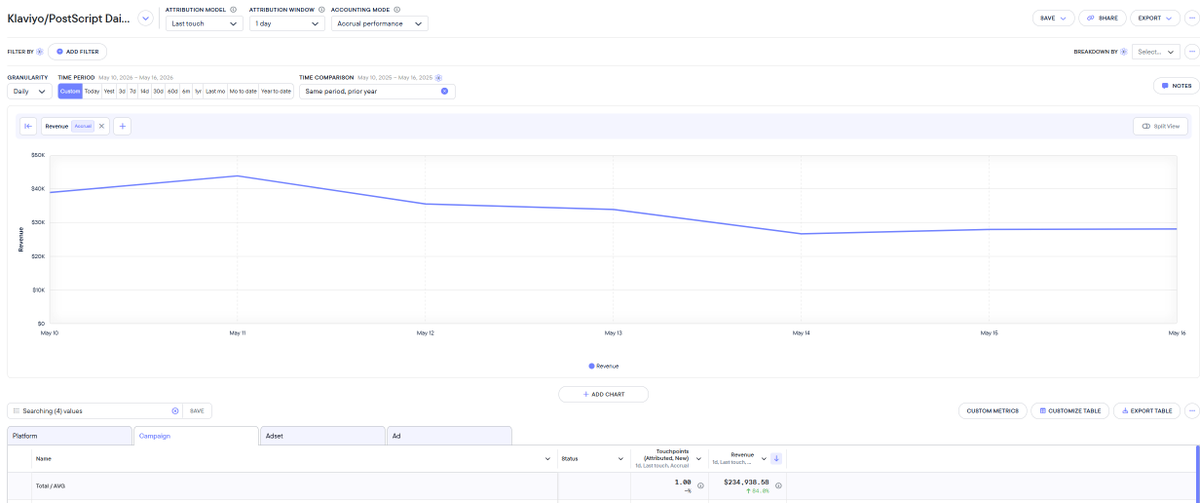
One of our clients just did $234K in revenue through retention in one week (up 84% year on year). Best email/sms performance we’ve delivered for them in 23 weeks.
1
9
16
572
Josh Chin retweeted
Jun 9
At 0-18:
- Didn't come from money
- Entrepreneurship wasn't my plan
- It was just the only exit I could see
In college:
- Had ~$1,000 to my name
- Spent it on courses, books, and food
- Cold-pitched DTC brands on email marketing
- Nobody was running email… everyone was all-in on Facebook ads
- Couldn't get a meeting, let alone a client
The offer nobody wanted:
- Learned something that changed everything: free isn't free
- Learned that people care more about time and attention than money
- The moment I started solving for that, things shifted
Year 1 of Chronos:
- $1M in revenue
- 60% margins
- Looked like a win
- It wasn't
- Every problem funneled to me and the cofounder.
- We'd built a job and were overpaying ourselves to work it
The painful fix:
- Gave up most of that margin to build a real team
- People more specialized than I could ever be
- Margins dropped
- Quality of life went up
9 years in:
- 75 people
- $400M in attributed client revenue
- Best stretch of the business to date
- Still building
1
16
35
1,655
Josh Chin retweeted
Jun 8
There are only two ways to grow an email list
Path A
- spray and pray
- batch and blast
- kills deliverability
- burns your list
- ends in declining revenue
Path B
- clean segmentation
- earned attention
- protects inbox placement
- compounds over time
- ends with a list that actually prints
There's no "in between" option.
Choose wisely.
3
2
17
486
Josh Chin retweeted
Jun 6
When you land your first retainer client
Reinvest immediately into:
- better tools
- better reporting
- one more specialist
- your own education
- a case study worth showing
Keep stacking proof.
The second client is easier when the first one got your best work.
3
2
17
557
Josh Chin retweeted
Jun 5
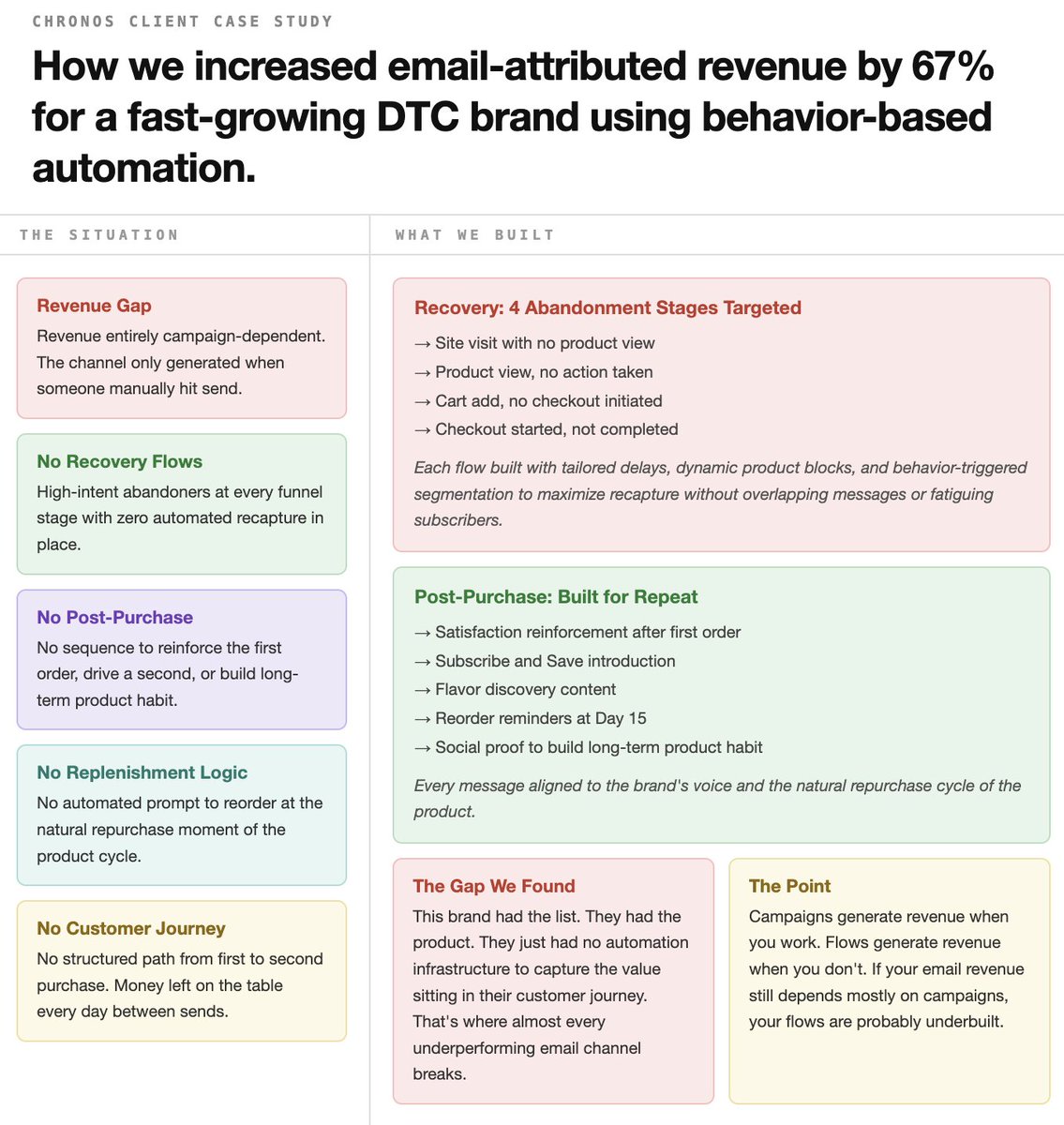
If I had to make $1,000,000 from email in the next 90 days, I’d follow this EXACT framework👇🏼
FOUNDATION PHASE:
Month 1: Flow rebuild
- Rebuild welcome, abandoned cart, browse abandonment, and post-purchase flows from scratch
- Add USPs, review-based credibility, and dynamic product blocks
- Run discounts with expiry urgency
2
2
17
800
Jun 5
If I had to make $1,000,000 from email in the next 90 days, I’d follow this EXACT framework👇🏼
FOUNDATION PHASE:
Month 1: Flow rebuild
- Rebuild welcome, abandoned cart, browse abandonment, and post-purchase flows from scratch
- Add USPs, review-based credibility, and dynamic product blocks
- Run discounts with expiry urgency
2
2
17
800
Jun 5
We used the same playbook to help an ecom brand pull $1.6M in a single quarter.
> $143K → $1.6M in email revenue
> $1.9M → $10.8M of total store revenue
> 7.3% → 15.5% email’s share of store revenue
Go ahead and steal this.
1
28