
Teacher, school development adviser, former HMI, Gàidhlig learner, church organist. Fond of dogs, cats and horses. Lifelong MCFC fan. julesmusings.blog
Joined June 2009
- Tweets 9,817
- Following 2,667
- Followers 2,897
- Likes 144,183
118 Photos and videos







Mar 17
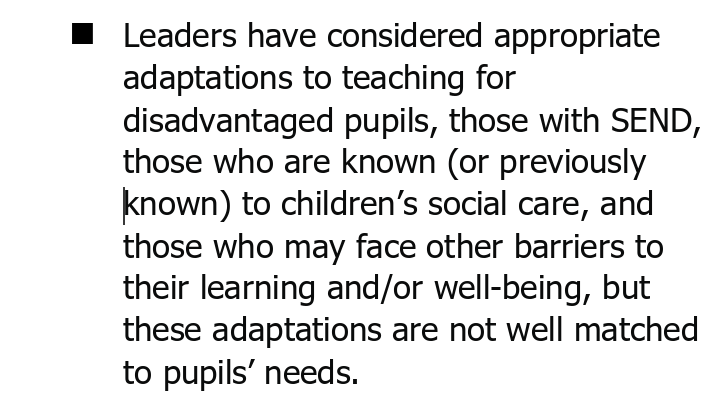
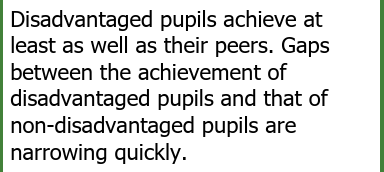
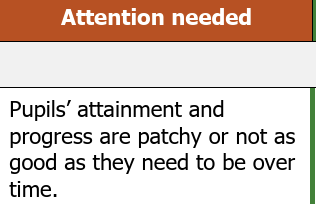
Just spoken with a HT I respect enormously. He said that Ofsted’s supposed emphasis on inclusion was just a big con. There is currently no mechanism for measuring ’average progress’ so it’s all down to attainment & those working in the toughest schools will get hit.
1
11
67
5,767
Mar 17
In 2023, none of the academies in HMCI's MAT had a positive P8 for disadvantaged pupils.
3
10
35
6,716
Mar 17
I’m concerned that some HTs will now be railroaded into becoming inspectors. Inspection remains a high-stakes process & should not be seen as a form of CPD. If we had a system based on true peer review, things would be different-but we are stuck with an awful framework.
3
10
35
3,189
Mar 17
HMCI says ‘I know there are thousands of you who want to be inspectors’. Evidence for this statement, please?
3
4
50
7,040
Mar 17
I do have evidence of massive concern about the current framework, just four months in. But Ofsted’s main concern is getting more inspectors- not listening to HTs who are incredibly concerned.
12
453
Julie Price Grimshaw retweeted

I’ve been away for a bit. We haven’t been having the best time, to be honest. I’ve noticed a few things happening with Ofsted and their supporters recently, and I’ve written about it.
Ofsted, of course, are driving on regardless.
difficultlessons.wordpress.c…
37
107
260
143,073
Mar 15
Dear Ofsted: asking school leaders, multiple times, if they are 'OK' is *not* looking after their wellbeing. As one HT said to me, 'I wanted to say no, I'm not OK, I'm finding this immensely stressful - but who's going to risk saying such a thing?'
9
28
192
19,872
Julie Price Grimshaw retweeted

Mar 4
The negative impact on school leaders who receive vexatious AI-driven letters of complaint now seems to be getting out of hand.
It’s dominating many of our calls. We seem to be at the tipping point.
What advice can we give to colleagues? How can we move forward?
Thoughts? ⤵️
8
23
46
16,817
23 Oct 2025
This week I had a discussion with an HMI who was leading a school monitoring visit. She was absolutely excellent - a skilled and compassionate inspector. A HT said 'that school was lucky - our HMI was brutal.' This lottery needs addressing as a matter of urgency.
3
2
67
3,974
Julie Price Grimshaw retweeted

29 Sep 2025
2/2 hence inspections should really focus on local authorities and academy trust. CEOs and directors are paid at the right level to take the heat of Inspection. They are also responsible for school improvement.
1
1
1
218
Julie Price Grimshaw retweeted
29 Sep 2025
1/2 I’ve said it before, and I’ll say it again: the whole framework and the approach to Inspection needs to be scrapped. We need to start again based on what the world looks like today, not what it looks like pre-Covid. We need to take the pressure of schools and Headteacher is.
1
4
191
27 Sep 2025
Last year someone posted a video of a lesson on X. Some thought it was brilliant, others thought it was poor, others thought is was in the middle. What happens in an inspection? 'Generally taught well' is so vague that it's almost meaningless.
2
2
14
1,450
26 Sep 2025
Inspection issues: a 🧵The toolkit descriptors aren't 'best fit', they are essentially checklists of statements. This means that schools who believe they have met the 'expected standard' would need to provide evidence for every single point in the list. 1/
5
7
28
11,426
26 Sep 2025
How on earth can this be done effectively within the time given? It could be argued that it might be possible if the criteria was unambiguous and didn't allow for extreme subjectivity - but as we know, it's full of 'generally/on the whole' etc etc. 4/
1
8
1,067
26 Sep 2025
What worries me most is that hard-pressed school leaders will be spending an awful lot of time on this. The toolkit states that it 'can be used..to support self-evaluation.' Think of the time spent going through the checklists! [end]
3
10
1,052
26 Sep 2025
Those of us who were around when it was promised that phonics was the answer to all our reading-related problems will be interested in the introduction of a Y8 reading test...
8
10
117
13,466
22 Sep 2025
I've spent today looking really closely at the inspection toolkit. My verdict so far is that some parts are so vague they are almost meaningless - eg, 'pupils...largely secure the necessary accuracy & fluency in word reading, spelling, handwriting and number facts' 1/
1
5
11
728
22 Sep 2025
What does Ofsted mean by 'largely'? And what is 'necessary accuracy'? What does 'generally taught well' mean? Unless we have a great deal more clarity of terms such as this, the new framework is essentially a license for inspectors to apply their own preferences. 2/
4
1
11
1,093