
Joined September 2025
- Tweets 2,442
- Following 2,530
- Followers 1,300
- Likes 5,001
102 Photos and videos

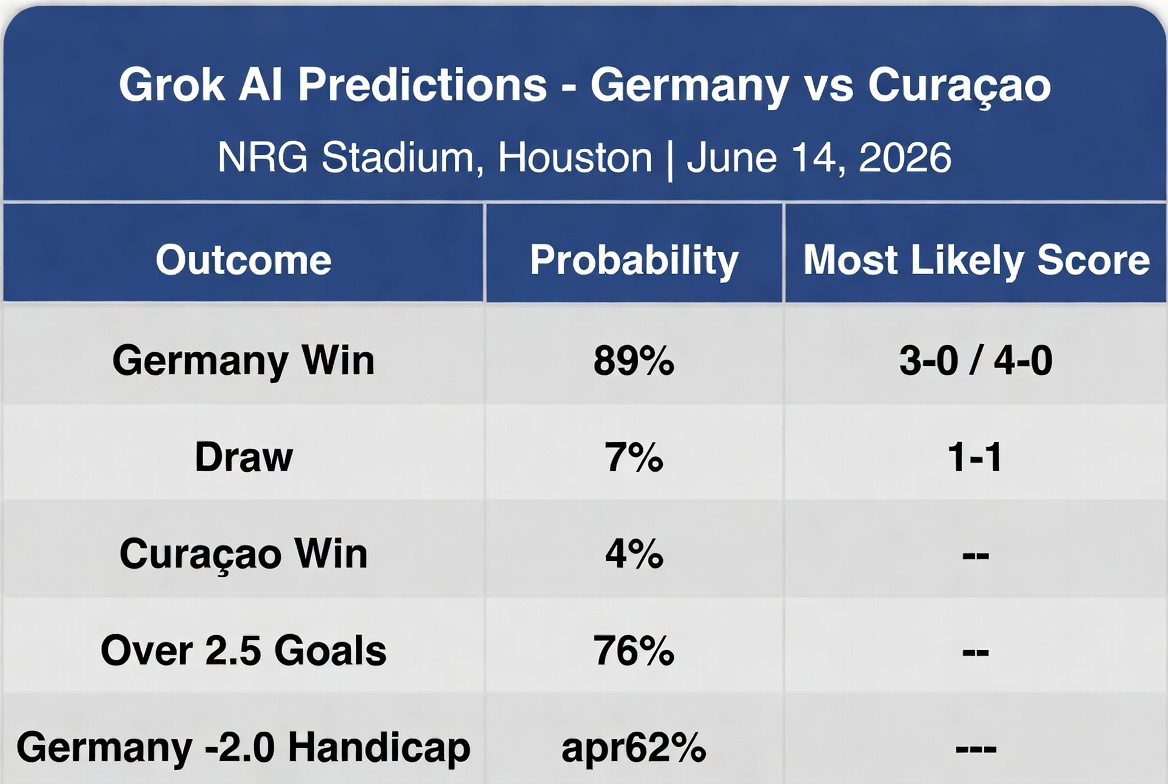










Germany vs Curaçao kicking off soon 🔥
Grok AI sees a dominant performance from the Germans.
Big win and strong goal difference expected.
Who scores first today? 👀
1
Germany vs Curaçao – Grok AI Analysis 🔥
Germany opens Group E as massive favorites against historic debutants Curaçao.
Grok AI Predictions:
Key Insights:
• Germany expected to dominate possession and create high xG
• Curaçao will defend deep and look for rare counters
• Houston heat could play a role in the 2nd half
Disclaimer: Purely AI entertainment & analysis. Not betting advice.
#WorldCup2026 #Germany #Curaçao #GroupE
5
Grok AI Match Analysis – Germany vs Curaçao
FIFA World Cup 2026 – Group E
NRG Stadium, Houston | June 14, 2026 | 13:00 ETQuick PreviewGermany opens their campaign as one of the top title favorites against debutants Curaçao — the smallest nation ever to qualify for a World Cup.
Key InsightsGermany: Elite attacking talent (Musiala, Wirtz, Havertz, etc.) and excellent squad depth. They will look to dominate possession and build a strong goal difference early.
Curaçao: Historic underdogs. They will likely park the bus and look for counter-attacks or set-pieces. Physical fatigue in the Houston heat could be an issue in the second half.
Style clash: Technical, high-pressing Germany vs. resilient, low-block Caribbean side.
Disclaimer: This is AI-generated analysis for entertainment and educational purposes only. Not betting advice — football is unpredictable.
4
@JustAIHub 🥷🏻 retweeted

Jun 13
The beauty of the World Cup! 🏆
261
1,405
10,365
278,430
World Cup 2026 AI Analysis Series – Powered by Grok
Introduction
Welcome to our objective, data-driven analysis of the 2026 FIFA World Cup — the first tournament with 48 teams, co-hosted by Canada, Mexico & USA.
This entire series is generated by Grok (built by xAI). All predictions and insights are based on real data: historical results, current form, statistics, player availability, tactics, home advantage and climate factors.
Important Disclaimer:
This is for entertainment & educational purposes only. Not betting advice. Football is unpredictable and there are no guarantees. Gamble responsibly or not at all.
Tournament Overview (14 June 2026)
• 12 groups of 4 teams
• Top 2 8 best 3rd places advance to Round of 32
• Hosts started strong: Mexico leads Group A, USA won 4-1, Canada drew
Current Favorites: Spain & France (co-favourites), England, Portugal, Argentina, Brazil, Germany.
We will post group-by-group analysis, knockout predictions, key player battles and more — all updated live.
#WorldCup2026 #FIFAWorldCup #GrokAI #FootballAnalysis #AICoverage
4

Jun 10
Claude Fable 5 is a massive leap. State-of-the-art on almost everything that actually matters (coding, research, complex tasks) while still being safe enough for general release.
The way they handled the safeguards fallback to Opus on risky topics feels mature and responsible.
Mythos 5 for trusted defenders is the right move too. Anthropic is playing the long game on both capability and safety.
This is the kind of release the industry needs right now. 🔥

Fable 5 is state-of-the-art on nearly all tested benchmarks, with exceptional performance in software engineering, knowledge work, scientific research, and vision.
The longer and more complex the task, the larger Fable 5’s lead over our other models.
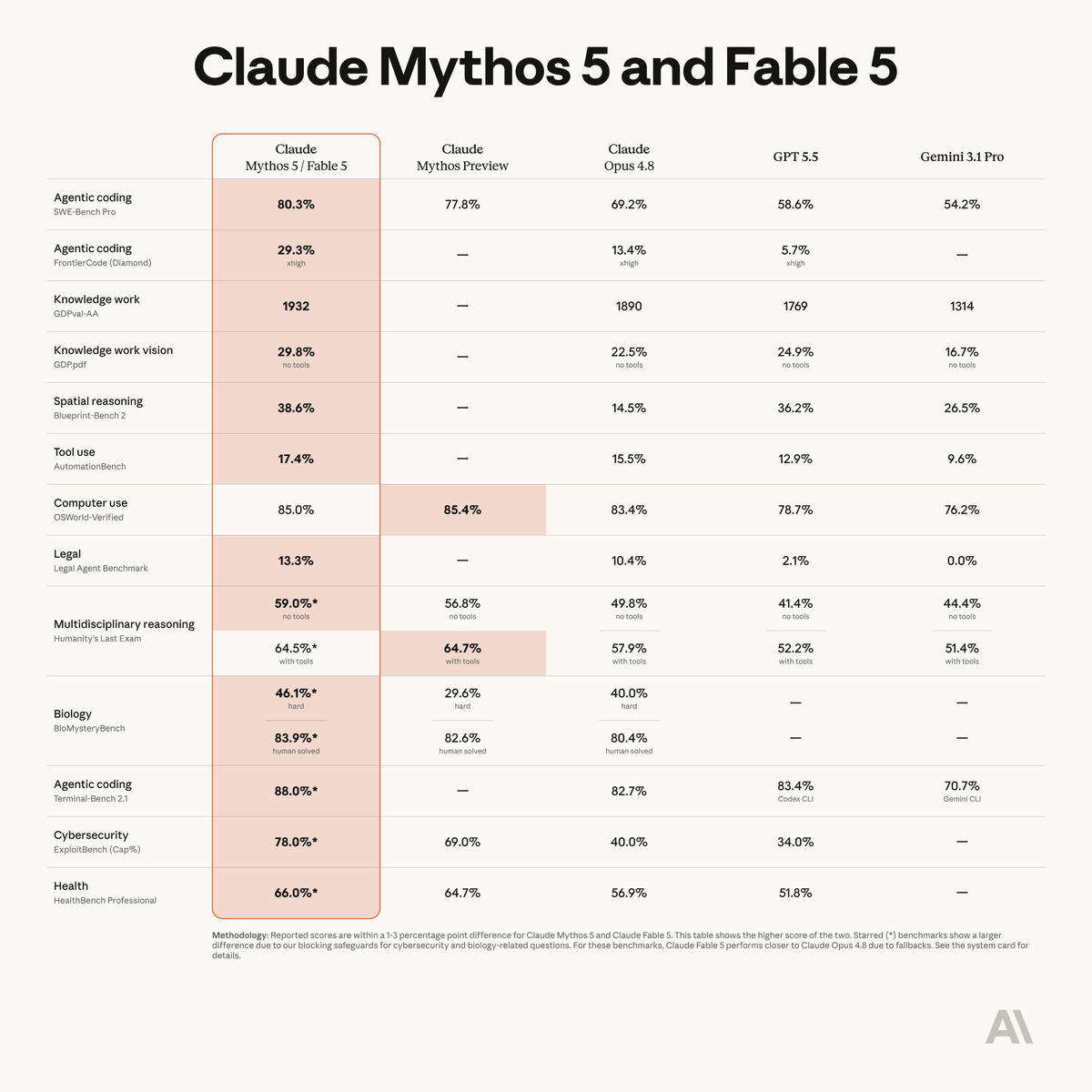
ALT Benchmark table titled Mythos 5 & Fable 5, comparing Claude Mythos 5 and Fable 5 against Claude Mythos Preview, Claude Opus 4.8, GPT 5.5, and Gemini 3.1 Pro.
9
@JustAIHub 🥷🏻 retweeted

Jun 10
You probably haven’t spotted the hidden gem 💎 behind the future of payments privacy.
Many people just saw Sui Confidential Transfers and thought ‘ok, cool feature’. Wrong.
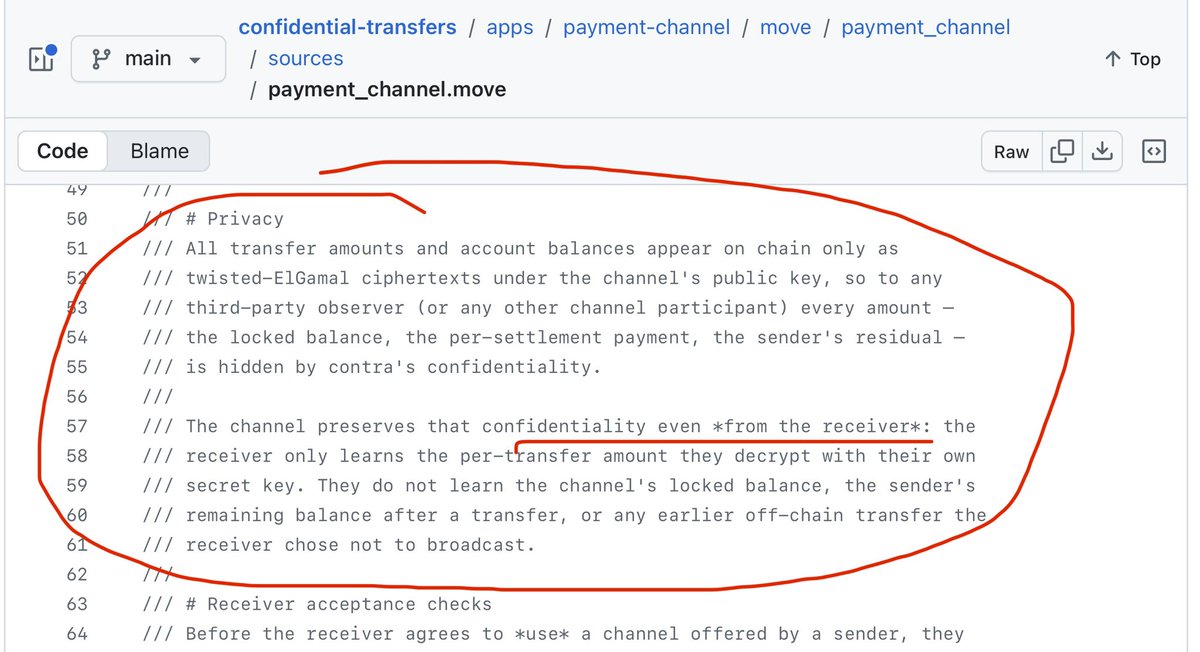
Look closely at what was open-sourced and you’ll notice a much bigger pattern: Confidential Payment Tunnels.
Remember Bitcoin’s Lightning ⚡️?
Now imagine locking undisclosed amounts and making payments completely off-chain, with privacy even against receiver, built in from the start. It’s a new paradigm.
This could unlock millions of payments per second, gasfree pay your grocery store even when offline, power entirely new startup ideas, and become the default pay-rails for both humans and AI agents who will ❤️ this option!
github.com/MystenLabs/confid…
33
65
316
27,015
Jun 9
This is gold. 2026 isn’t about writing better prompts anymore — it’s about designing better systems that run themselves.

3
@JustAIHub 🥷🏻 retweeted

Jun 9
We've reset 5-hour and weekly rate limits for all users. Enjoy Fable 5!
1,355
1,818
35,766
2,198,685
Jun 9
Fable 5 ON
Introducing Claude Fable 5: a Mythos-class model that we’ve made safe for general use.
Its capabilities exceed those of any model we’ve ever made generally available.
5
Jun 9
Anthropic is expected to release Claude Mythos tomorrow, the same model it said was too dangerous to make public. A "Mythos 1" tag was briefly spotted inside the Claude Code UI last week before being pulled, signaling a public release is imminent. In a restricted preview, Mythos found 271 vulnerabilities in Firefox alone, including a 15-year-old bug in Mozilla's HTML engine and a 20-year-old flaw in its XML processor that years of human auditing had completely missed.Mozilla went from patching 21 security issues per month to 423 in a single month.
When Mythos was first leaked in March:
CrowdStrike fell -7%
Palo Alto fell -6%
Zscaler fell -4.5%
Okta and Netskope fell -7%
Tenable crashed -9%
Cloudflare fell -13%
Thomson Reuters fell -19%
RELX fell -15%
LegalZoom crashed -20%.
The S&P 500 Software and Services Index fell 2.6% in a single session and is now down 12% since January.
4
Jun 8
SSSSUUUUUUUUIIIIIIII
Jun 8

🔥 JUST IN: Sui opened confidential transfers with private amounts and balances for public testing on Devnet.

1
8
Jun 5
AI is stronger and stronger day by day
Jun 4
🚨 LATEST: Claude maker Anthropic is calling for a global pause in AI development, warning that models are approaching the ability to self-improve without human intervention.


15

Zcash Faces Network Disruption
The Zcash network $ZEC has failed to produce a block for more than four hours, according to InfinityHedge.
The disruption comes a day after developers coordinated an emergency upgrade to patch a flaw in Orchard, Zcash’s newest shielded pool.
The team said the issue was discovered during a security review and shows no signs of exploitation so far.
41
35
125
33,158
@JustAIHub 🥷🏻 retweeted

Jun 2
Jamtis-PQ is a proposed upgrade to Monero's addressing protocol for post-quantum encryption!
'Jamtis-PQ allows for post-quantum forward secret transactions that can't be decrypted even if the address is publicly known and the elliptic curve discrete logarithm (ECDLP) is broken.'

Jamtis: Why a new address format?
When Monero was created in 2014, it inherited the CryptoNote addressing scheme. Originally, each wallet only had a single public address and payments were disambiguated with payment IDs. In 2017, subaddresses were introduced, which allowed each wallet to generate a virtually unlimited number of seemingly unlinkable addresses.
In 2019, a weakness of subaddresses was identified, which allows an attacker to link two subaddresses belonging to the same wallet. This is called the "Janus attack".
In 2026, Monero will upgrade to a new transaction protocol called Carrot, which provides mitigations for the Janus attack and offers address-conditional forward privacy (i.e. forward privacy if addresses are kept secret).
However, several issues with the legacy addressing scheme remain unresolved:
1. Wallets with publicly known addresses lose nearly all privacy against a quantum-enabled adversary.
2. Wallets that use a third party service for scanning the blockchain lose nearly all privacy.
3. Generating subaddresses requires keeping track of a global counter, which complicates implementations and may cause merchants to prefer legacy integrated addresses.
4. The detection of outputs received to subaddresses is based on a lookup table, which can sometimes cause the wallet to miss outputs.
5. Checking two addresses for equality is difficult for humans because CryptoNote addresses are long and case-sensitive.
The goal of Jamtis is to tackle the shortcomings of CryptoNote addresses that were mentioned above. Specifically:
1. Jamtis wallets with publicly known addresses retain a certain level of privacy even against a quantum-enabled adversary.
2. Jamtis wallets using a third-party scanning service retain a certain level of privacy.
3. Jamtis addresses can be safely generated without keeping track of a global counter.
4. Balance recovery for Jamtis wallets can be done reliably without the need to use a precomputed table of keys.
5. Jamtis addresses can be quickly compared thanks to a "visual prefix" consisting of 30 lowercase characters.
Jamtis focuses on post-quantum privacy because all past and present Monero transactions are vulnerable to quantum privacy-breaking attacks due to the "harvest now, decrypt later" strategy.
Additional goals are:
1. Backward compatibility with Carrot without hard forking changes.
2. Enotes sent to Jamtis addresses are indistinguishable from enotes sent to legacy addresses.
3. Jamtis addresses retain existing security properties of Carrot, especially Janus attack protection.
Jamtis also comes with a new 16-word mnemonic scheme called Polyseed that will replace the legacy 25-word seed for new wallets.
Non-goals
An explicit non-goal of Jamtis is post-quantum soundness. This includes preventing a quantum-enabled adversary from:
1. opening Pedersen commitments to arbitrary monetary values
2. forging spend authorization proofs and linking tags
3. forging membership proofs
Past and present Monero transactions are safe from soundness-breaking quantum attacks, assuming no cryptographically relevant quantum computers exist at this moment. Both Carrot and Jamtis support a migration protocol that will be used in a future fully post-quantum upgrade.
Read more: gist.github.com/tevador/639d…
11
146
340
17,404


@JustAIHub 🥷🏻 retweeted
Jun 1
The Monero Research Lab has provided an update on post-quantum encryption for Monero!
tevador presented updates to the Jamtis post-quantum (Jamtis-PQ) specification. The revisions add an identify-received public key that resolves longstanding weaknesses in the filter-assist tier, specifically preventing linkage of enotes to known addresses and detection of multiple enotes received to the same address. In the post-quantum context, this key adds only ~40 characters to an already ~400-character address, a cost the MRL participants viewed as well worth the privacy gain. The secondary view tag construction was also hardened so a quantum adversary cannot reliably determine enote ownership in many common cases. On consensus enforcement of the required CSIDH-1024 key in tx_extra, participants converged on Option 3B (no mandatory on-chain validation), citing marginal security benefit, modest CPU overhead (~10 ms), and the desire to preserve a clean soft fork while minimizing metadata leakage.
jberman: 3. Post-Quantum Encryption ( github.com/monero-project/re… ).
tevador: I updated Jamtis specs to reflect what was discussed in the past few meetings. gist.github.com/tevador/639d…
tevador: Still a lot of work left, mainly in the appendix.
jberman: tevador you mentioned Monday that the Jamtis-PQ solves the weaknesses in the filter-assist tier from Jamtis-Seraphis (specifically that the tier can't link enotes to known addresses and that it can't know if the same address received >1 enote) using an additional identify-received key. Tbc, that's an additional pub key in the address
jberman: Was my rationale above accurate in explaining the stronger justification for an additional pubkey? "With the addition of PQ protection, seems the additional key has a more marginal impact on address sizes now"
tevador: Yes, the additional pubkey only adds ~40 characters, which is small compared to the address length of 400 characters
tevador: And the benefits are definitely worth it I think
jberman: I would agree, that's a significant benefit for much lower cost than it originally was
rbrunner: But only relatively?
rbrunner: 40 of 400 is 10%, 40 of 200 is 20%
tevador: Yes, the addition of PQ encryption shifted the scale
rbrunner: Ok. I think that's a valid point of view :)
tevador: Also a notable change in the specs is that the secondary view tag is constructed differently so a quantum attacker cannot always decide if an enote belongs to the wallet with a high probability. gist.github.com/tevador/639d…
tevador: I think this is also worth the extra 3 bytes in each address.
neptunian: tevador to clarify regarding Appendix B (Interactive payments) in the Jamtis spec, I just want to know if atomic swaps will become a concern in the future.
tevador: neptunian: I don't follow. Why would an optional interactive payment protocol have any effect on atomic swaps?
neptunian: I just realised I misread it. Disregard what I said lol
jberman: Arguably an atomic swap protocol may be more included to use the interactive protocol (since atomic swaps are interactive) and would benefit
jberman: more inclined*
tevador: Yes, it might be beneficial for atomic swaps, not concerning.
neptunian: Good to know. Thanks.
tevador: The interactive protocol is there to enhance the overall PQ resistance, but it's not always possible to use it. Jamtis of course supports traditional non-interactive transactions.
tevador: I will add a clarification in Appendix B.
jberman: PQ protection on view tags is a nice added bonus. That would bring Option A closer to Option B in terms sounds like
jberman: From this table: github.com/monero-project/re…
tevador: Yes, but it works only in some cases, notably for enotes that have been received to an address the QA doesn't know and the wallet must not have received more than 1 enote to the same address.
jberman: Ha, that pesky caveat. Still a solid improvement that I agree is worth an additional 3 bytes in each address
jberman: Anything further on PQ encryption today? Thank you tevador for your continued quality work on this
neptunian: Unless someone wants to talk on the question of Jamtis enforcement, I have nothing further to add.
tevador: I think that can be left for later.
jberman: What's the question of Jamtis enforcement? As in enforcement at consensus?
neptunian: jberman: Yes. gist.github.com/tevador/639d…
tevador: Jamtis requires a special tx-extra field. The question is if nodes should enforce its presence.
tevador: Transactions lacking this field cannot be sending to a Jamtis address, which leaks information.
tevador: It's similar to the issue with the number of transaction public keys and subaddresses.
jberman: I'd lean toward Option 3B
jberman: Ideally we'd also enforce a consistent tx format for tx pubkeys and subaddresses at consensus
neptunian: jberman: My thinking as well. I was in favour of 3A or 3B
tevador: CSIDH-1024 key validation takes ~10 ms of CPU time (for options 3A vs 3B)
jberman: Part of the leaning toward deprecating tx extra was hardening protocol fields in tx format at consensus. I think enforcing consistent tx formats is a good goal
neptunian: tevador: Would it be possible for 3A to come first with 3B after as to minimise metadata leakage?
jberman: Key validation = decompressing the point? So wallets will need to do it anyway? If it was the case that if consensus doing it could save the wallet some ops during scanning, I'd be more inclined for 3A
jpk68: Is the key only put in tx_extra because that allows Jamtis to be a soft fork?
jpk68: Rather than adding a separate field
tevador: jberman: key validation is similar to checking if an EC point is on the curve. It needs to be done before acting on the public key with a private key to avoid attacks.
syntheticbird: epic matrix parsing
neptunian: syntheticbird: lol
tevador: jpk68: exactly, Jamtis is supposed to be a soft fork
vtnerd: an attacker could re-use the same key too right? meaning 3A is of marginal use compared to 3b
tevador: I was thinking it would be mostly to deter lazy wallet developers, but yeah, they can just ship a hardcoded valid CSIDH key...
tevador: Not sure if it's a real concern
jberman: or they could chuck other things into the tx that pass validation. I agree it seems doing extra crypto ops validation on the key at consensus is probably of marginal benefit here
vtnerd: I don’t think its an issue, other than de-compressing the point has somewhat low utility
jberman: presumably wallets would break if the key is invalid too, so lazy wallet devs would be deterred by having a broken wallet
neptunian: I doubt it would manifest in a significant manner if it's only in lazy-dev-wallets.
jberman: We can circle back to this convo in a future meeting, but Option 3B seems sanest to me fwiw
tevador: Agreed
neptunian: jberman: That sounds good.
libera.monerologs.net/monero…
9
112
339
23,628