
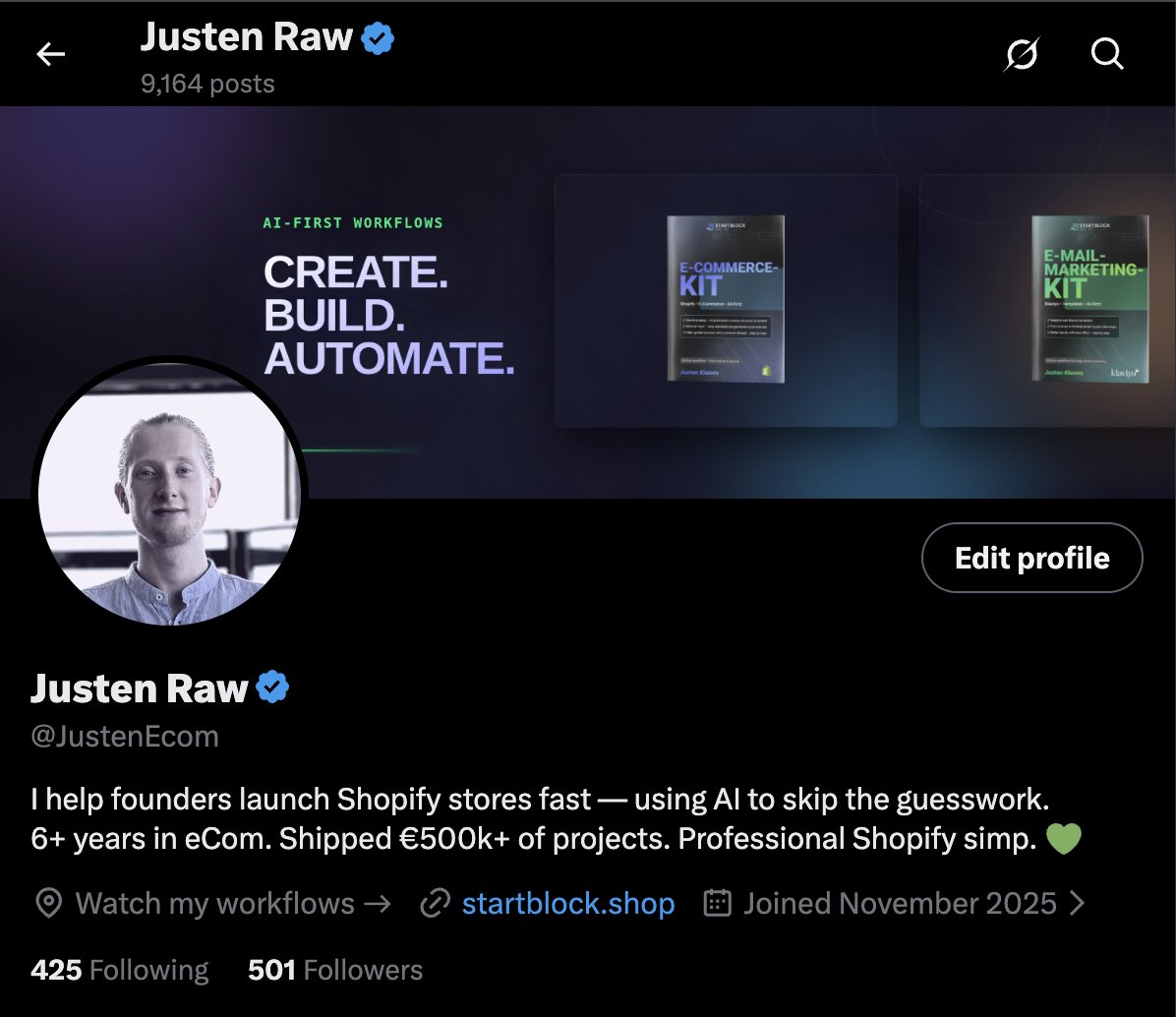
Joined November 2025
- Tweets 10,224
- Following 424
- Followers 507
- Likes 16,378
145 Photos and videos










Pinned Tweet

Jan 26
I'm Justen.
I spent 6 years building Shopify stores.
For clients. For agencies. For everyone but myself.
€500k shipped. Great at my job.
But I was playing it safe…
2026: I looked at myself and asked:
"Is this really it? Talent on rental until retirement?"
Fuck that.
Went 50% part-time. Bet on myself.
Started building MY thing.
Now I help ecommerce founders skip the months of trial-and-error I went through.
Because I remember what it felt like to be stuck.
What's different now?
AI tools that didn't exist when I started.
I'm using them to automate what I learned the slow way.
The game changed, why play it the old way?
Just me and AI systems built for 2026.
Here to build in public & help you do the same.
Follow for the journey. Repost if you're building too.❤️
Let's win together. 🚀

27
3
90
4,496
May 5
BANGGERRRR 🔥

manage your store inside ChatGPT or Claude
get insights, add products, look up orders, and more
without ever leaving the chat
1
8
112
May 4
Checkout isn't where people decide to buy.
It's where they find reasons not to.
Psychological friction points:
• "Items are not reserved" (urgency)
• "Only 3 left" (scarcity)
• "Order today, arrives tomorrow" (time pressure)
• "Free shipping over $50" (threshold motivation)
Use them sparingly. Use them honestly.
5
9
89
May 4
DOI isn't optional in email marketing.
It's legally required in most regions.
Skip it? You risk:
• Fines up to €20M (GDPR violations)
• Platform bans (Klaviyo, Mailchimp suspend accounts)
• Spam folder placement for your entire domain
The trade-off:
Single opt-in:
• Fast list growth
• 40-60% never engaged subscribers
• High spam complaints
• Deliverability tanks over time
Double opt-in:
• Slower growth (30-50% confirm)
• Engaged subscribers who actually want your emails
• 3-5x better open rates
• Protected sender reputation
What this means for revenue:
1,000 single opt-in subscribers at 15% open rate = 150 opens
500 double opt-in subscribers at 40% open rate = 200 opens
Smaller list. Better results.
2
6
108
May 3
You don't need more information.
You need less confusion.
The problem isn't lack of knowledge.
It's too many conflicting strategies pulling you in different directions.
Pick one approach. Master it. Then add more.
4
9
97
May 3
Most email welcome flows fail for one reason:
They sell too fast.
After auditing dozens of setups, this happens over and over:
Typical flow:
Email 1: Discount code
Email 2: Product catalog
Email 3: More products
Result: 15% open rate by email 3, high unsubscribes.
Better try:
Email 1 → Deliver promise (discount/freebie)
Email 2 → Build trust (story, values, why you exist)
Email 3 → Convert (social proof, testimonials, recommendations)
The difference? Trust before transaction.
Conversion rates improve when you stop rushing the sale.
2
4
69
May 2
AI for e-commerce isn't future talk. It's today's standard.
What you should automate right now:
• Product descriptions
(AI writes better copy than you in 1/10th the time)
• Customer FAQs
(AI handles 80% of support questions)
• Ad variations
(generate 20 versions, test the best 5)
• Market research
(AI analyzes trends faster than manual scrolling)
Your competition is already using this.
Every day you wait is a day behind.
The tools exist. They're cheap. Use them.
2
55
May 2
You feed one prompt into a UI tool and hope it nails the layout.
But the first output rarely matches what you had in mind.
Either it's too generic, or it misses your brand entirely.
So you tweak the prompt. Run it again.
Still not right.
The issue: treating UI generation like a one-shot task.
Reality is, you need multiple angles — a controlled version and an exploratory version.
One gives you precision.
The other gives you ideas you didn't know you needed.
Generate both, merge the best.
1
3
49
May 1
Email marketing for stores?
Start simple:
• Welcome (introduce brand first purchase discount)
• Cart abandonment (remind urgency)
• Post-purchase (thank you upsell)
These 3 emails recover 15-25% of lost sales.
Set them up once. They run forever.
2
42
May 1
Stop putting your contact form above your FAQs.
Do this instead:
Help/Contact Page Structure:
1. FAQs (TOP, fully visible)
2. Contact form (BELOW, as backup)
Why: Customers find answers before typing.
70% of tickets = questions already answered in FAQ.
Let them self-serve first.
Only real issues reach your inbox.
1
49
Apr 30
Things I regret: Not starting 2 years earlier.
Things I don't regret:
Every failed test. Every lost dollar. Every late night.
Because those failures taught me what no course could.
Even when action led to failure, it led to learning.
Hesitation led to nothing but wasted time.
If I could go back, I wouldn't change the failures.
I'd just start the failures earlier.
So if you're hesitating right now, stop.
The regret of not trying hurts more than the pain of failing.
3
5
65
Apr 30
Most “SEO” talk ignores the easiest wins.
Rename images like a human would search.
Add tight alt text (1 keyword max).
Keep file sizes reasonable.
Google reads context around the image — not your intentions.
1
2
48
Apr 29
You don't need to be first. You need to be better.
Everyone thinks they need a revolutionary product.
Some game-changing innovation nobody's seen.
That's startup thinking. Not e-commerce thinking.
Take what exists.
Make it 10% better. Market it 50% smarter.
4
7
97
Apr 29
I upload my theme ZIP to the AI project before building any sections.
Why?
The AI learns my theme structure.
Classes. Variables. Breakpoints. Schema patterns.
Every section it generates after that matches my existing theme.
No style conflicts. No rework.
The code drops in clean because the AI isn't guessing.
It's working from my actual theme conventions.
2
53
Apr 28
People ask: "Why 50% part-time, not all-in?"
Real answer:
Bills exist. Risk management exists.
I'm betting on myself, not being reckless.
50% gives me:
→ Income stability
→ Time to build
→ Room to fail without panic
All-in is romantic.
50% is realistic.
And realistic wins.
I spent 6 years building Shopify stores for agencies. €500k shipped. Never for myself.
Now I'm building MY thing while keeping the lights on.
No fake overnight success stories.
Just smart risk-taking and AI systems built for 2026.
Building in public. Sharing everything I learn.
6
10
95
Apr 28
Great products still lose when the page hides basic risk reducers.
Put trust next to the decision.
Above the fold should answer, immediately:
• Delivery time
• Shipping cost / free shipping threshold
• Returns promise
• Reviews close to title/CTA
3
5
58
Apr 27
Manual work shows dedication, right?
Wrong. It shows you don't understand leverage.
Spending 3 hours on tasks AI does in 3 minutes means you're paying yourself $10/hour.
Your customers don't care how long you worked.
They care about results.
Work smart. Let robots do robot work.
2
3
53
Apr 27
Lately I’ve been quieter on here — by design.
I’ve been deep in prep mode for my main business:
Building Shopify stores, setting up systems, and collecting leads...
I also just launched a dedicated business landing page as a proper front-facing hub — on top of my existing landing page for ebooks.
Everything is getting structured now.
Offers. Funnels. Entry points.
It’s not flashy yet — but it’s moving forward.
And that’s what matters.
We keep building. 🚀
5
7
113
Apr 26
I've worked with Shopify stores for 6 years. agency background.
The pattern I see: stores add apps randomly, then wonder why load speed tanks.
Every app adds code that can slow your store — sometimes even after uninstall.
Rule: Only install apps you truly need.
Test PageSpeed before after.
5
7
121
Apr 22
Competition is good, not bad.
No competition = no proven market = you're the guinea pig.
Lots of competition = proven demand = fight for execution.
I'd rather compete in a $10M market than own a $0 market.
Don't avoid competition.
Out-execute it.
2
5
72
Apr 22
Don't commit to one AI tool output.
Test the same landing page brief in 2 tools.
20 minutes total.
Pick the better result.
Why? Each tool interprets differently.
Same input = different outputs.
The comparison workflow matters more than which tools.
20 min upfront saves hours of revision.
3
64