
Research Analyst & Comms Lead ~ Helping brands build community & revenue via strategic communication. Contributing at @AvaxTeam1. @shefiorg S16.
Joined May 2022
- Tweets 49,284
- Following 1,069
- Followers 3,510
- Likes 85,872
1,330 Photos and videos













Pinned Tweet

May 28
“🎶 You like my hair? Gee thanks, just bought it,
I see it, I like it, I want it, I got it 🎶”
The famous words of Ariana Grande.
Sadly, we could never sing such when it comes to using a blockchain. You can't just see an NFT you like and get it.
It's more like “I see it, I like it, I want it, I check what chain, I connect wallet, I bridge funds, I try to buy, the transaction doesn't go through cause of slippage, I adjust slippage, I ignore the low estimated output because I have no other option, after 3 tries, I got it”
Catch how stressful that is?
The user experience onchain is nothing to write a song about (pun intended).
The best user experience we can get is when you say your desired outcome and get it without labour or surprises and this is what LIFI Intents is all about.
The Intent behind LI.FI Intents is simply:
- To reduce and remove user experience complications in web3.
- To prioritise user experience over technical infra and advanced money rails for once.
- To create an onchain economy where users aren't bearing all execution risks.
This solution matters even more because if we're being honest, the onchain economy cannot move forward without this crucial change.
Why is @lifiprotocol the best protocol to build an Intent Solution?
LI.FI protocol is the universal market access layer for digital assets. So, for instance, instead of a wallet integrating every single Dex that exists to access a wide variety of assets, they can simply integrate LI.FI for complete access to the digital assets ecosystem. LI.FI has partnered with 1000 partners, including: Metamask, Phantom, Binance, etc to transfer over $80 Billion in transfer volume across 100M total transfers.
LI.FI is the reason you can make swaps on some of your fav wallets basically, and after years of helping protocols access liquidity and thousands of assets to enable swaps, bridging, liquidity provision and cross-chain activity, you can tell they have had first-class seats to view how wrecked the status quo is and know the best ways to solve it, which is via LI.FI Intents.
If you still haven't caught it, LI.FI Intents is a mechanism that creates the 7 Rings by Ariana effect. Users describe their outcome and get results without following multiple steps on their own. These steps are delegated to a network of Solvers committed to doing the work for you.
How it Works
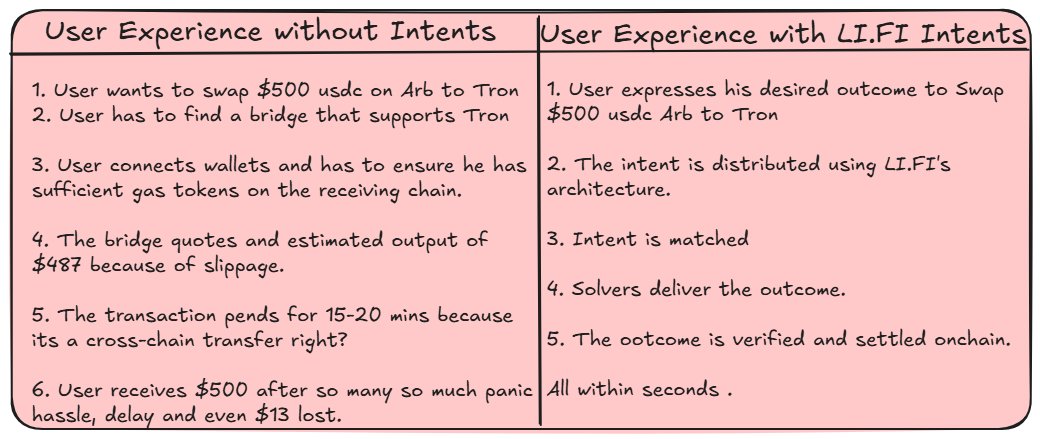
- User expresses intent e.g Swap $500 usdc Arb to Tron
- The intent is distributed
- Intent is matched
- Solvers deliver
- The outcome is verified and settled onchain.
All within seconds .
LI.FI Intents is currently supported by 15 chains and more if only you tag your fav chain to integrate LIFI Intents.
What can be achieved with LI.FI Intents?
Every enterprise bringing financial products onchain can integrate LI.FI Intents to enjoy the following use cases.
> It ensures exact output stablecoin swaps or transfers, no shortages. It also ensures zero slippage, gasless flows and covers major chains.
> Unified access to tokenised assets like RWA, gold, etc from licensed market makers.
> Access to solvers that are KYB compliant with OFAC screening built into every transaction.
The Ripple Effect
If a solo project, Dex or blockchain built an intent solution, I wouldn't be this excited, because their solution would be confined to those that use the Dex, chain, protocol, etc.
But with LI.FI building this solution, it instantly pushes this solution to 1000 protocols. This is what we call the ripple effect. Intent-based payments will become the status quo simply because a protocol gets integrated with LI.FI.
Intent will no longer be something that a blockchain offers because it's in their docs, every protocol building a solution in the onchain economy can plug in to this, creating a ripple effect that will automatically transform the user experience in crypto.
Tbh, it's the ripple effect that excites me the most.
How about you?
Do you think @lifiprotocol Intents can make the poor user experience dilemma a thing of the past?
Let me hear your thoughts in the comments.
May 26

Introducing LI.FI Intents.
Infrastructure for apps, wallets, and neobanks to:
• Enable stablecoin payments
• Access real-world assets
• Tap into compliant onchain liquidity
Built for enterprises bringing financial products onchain.
21
10
53
2,184
Keenye The Unusual retweeted
Jun 13
looking at my page, do you really know what I do or the services I offer?
or is there something I need to change?
honest answers only.
happy weekend.
25
4
60
674
Keenye The Unusual retweeted
Jun 12
I want us to have a really deep conversation via this post.
What does positioning mean to you?
People have a lot of opinions,
that it means branding, networking, bounties, etc.
But then, what does positioning mean to you?
9
1
24
225
Jun 12
I've stayed consistent now the goal is to stay consistent long enough.
So help me God 🙏
gm gm Guysss
62
1
82
592
Jun 12
Not everyone saying happy weekend when my week just started. hehehe. Today is Tuesday on my end.
1
3
69
Keenye The Unusual retweeted
Jun 12
I've stayed consistent now the goal is to stay consistent long enough.
So help me God 🙏
gm gm Guysss
62
1
82
592
Keenye The Unusual retweeted
Jun 11
I post research content.
Security checks, how to spot narratives, narrative/protocol explainers, monetisation plays, etc.
If you've been following along and something has been clicking, but you're not sure how to apply it to your specific situation, I want to hear from you.
Kindly send me a DM or drop a comment telling me one thing,
What's the biggest gap between where your writing/research skills are right now and where you need them to be?
I'm building content around real gaps and if yours is common enough, it becomes next week's post.
If it's specific enough, it might become something else entirely.
I'm looking forward to your comments and dms.
2
1
4
122
Jun 11
I intend to announce something interesting on the 15th of June, will you be there?
5
10
143
Jun 11
everyday I open this app, there's always a new update mhenn. I can't even keep up.
47
Jun 10
sometimes progress may not look like what we want it to look like.
sometimes progress simply means the ability to keep trying.
40
60
621
I think I'm finally ready to conquer June or is this just new week energy 😅
anyhooo, happy new week.
enjoy God's blessings from today and beyond.
__
also take two seconds to wish my woman @xanianthegreat happy birthday here or on her page.
40
1
75
669
the day hasn't even started, I'm already in the middle of a financial mistake.
It's too early for this 😭
You guyss won't believe what happened to me this morning 😭😂
6
8
87
Keenye The Unusual retweeted
another weekend to exist, explore, experiment and be grateful for the little things.
gm gm guyss
34
1
56
600
Keenye The Unusual retweeted

Jun 5
𝐀 𝐖𝐇𝐎𝐏𝐏𝐈𝐍𝐆 $𝟏𝟐𝟎𝟎 𝐓𝐇𝐑𝐄𝐀𝐃 𝐂𝐎𝐍𝐓𝐄𝐒𝐓
Fully sponsored by @5th_Kingdom
How to Enter:
▪︎ Follow @Bellickkruz & @5th_Kingdom
▪︎ Repost this Post
▪︎ Join Discord and Telegram
- Create a detailed X thread 5th Kingdom and its ecosystem
- Explain all about "Household" and "Hire"
- your thread should build excitement and anticipation for the upcoming NFT and Game launch
• Use the hashtag: #5thKingdomThreadContest and @Bellickkruz & @5th_Kingdom
▪︎ Facts must come from official resources.
- whitepaper: docs.google.com/document/d/1…
- you're automatically disqualified if you get info from any other whitepaper other than the one above
website: 5thkingdom.com/
▪︎ Submit your X thread link in the comments of this post
𝟗 𝐖𝐢𝐧𝐧𝐞𝐫𝐬
1st: $250
2nd: $200
3rd: $150
4th - 9th: $100
𝐂𝐨𝐧𝐭𝐞𝐬𝐭 𝐑𝐮𝐥𝐞𝐬
- Your Twitter account must be public.
- Only one entry per person is allowed.
- Entries must be in English.
𝐉𝐮𝐝𝐠𝐢𝐧𝐠 𝐂𝐫𝐢𝐭𝐞𝐫𝐢𝐚
- Creativity and Originality: Participants are encouraged not to just copy and paste the whitepaper or that of other participants, but write what you understand and also utilize other unique creativity to convey their idea
- Engagement Potential: We'll be implementing a unique formula so as to give both small and big accounts to compete fairly. The more engagement your thread gets, the better!
- Visuals and Graphics Quality: Use high quality Graphic designs, or infographics to support your written content to make your thread visually appealing.
- Utilize Captivating Hooks 🪝: Start your thread with a strong opening line to grab the reader's attention.
- Good use of memes, storytelling, and visuals will be highly considered.
- ai generated images and videos are allowed
Good luck to every participant💜

454
312
963
78,181
Keenye The Unusual retweeted

Jun 5
manifesting a full-time social media management job with a web3 project.
29
2
55
584
gm gm guysss.
It's fridayyyy, I posted a little rant so do well to check it out.
For today I have to:
> Cook
> Go for classes
> Read
I'll be taking it easy this weekend.
how about you?

90% of the people building brands in web3 have non-technical skills and maybe that’s just a sign that we are cooked.
Whenever I’m scrolling on X, 7 in 10 posts are from ghostwriters convincing busy founders to hire them, SMMs saying they deliver more than vanity metrics, content strategists telling projects their posts lack personality and content creators emphasizing how they craft explainer content that converts.
The subtle pitching, authority posts, problem-pain-solution framework posts, the offers and “your brand is your portfolio” shenanigans.
But how often do you see a dev making a post convincing a project that he needs a working product, or a software engineer emphasising the need for a solid system design or a security researcher convincing a product to invite him to conduct an audit?
I get it, their work is the proof of work. They don't need content to prove themselves the same way.
But here's what bothers me.
People with non-technical skills have to work harder, stay more visible and produce dozens of posts explaining why projects need us and some still don't get jobs.
We are consistently treated as an afterthought. It takes so much convincing before communication, marketing and product management, etc are seen as fundamental to a product's success and not decorative optional additions.
This industry is still so far behind from mainstream if skilled individuals with reliable track records still have to break their backs just to get into rooms and 8 out of 12 projects would rather run an only dev team or are just completely oblivious of the fact that non-tech skills also matter in a product’s success.
This isn't a content problem, it's an industry priority problem.
10
19
288
Keenye The Unusual retweeted
90% of the people building brands in web3 have non-technical skills and maybe that’s just a sign that we are cooked.
Whenever I’m scrolling on X, 7 in 10 posts are from ghostwriters convincing busy founders to hire them, SMMs saying they deliver more than vanity metrics, content strategists telling projects their posts lack personality and content creators emphasizing how they craft explainer content that converts.
The subtle pitching, authority posts, problem-pain-solution framework posts, the offers and “your brand is your portfolio” shenanigans.
But how often do you see a dev making a post convincing a project that he needs a working product, or a software engineer emphasising the need for a solid system design or a security researcher convincing a product to invite him to conduct an audit?
I get it, their work is the proof of work. They don't need content to prove themselves the same way.
But here's what bothers me.
People with non-technical skills have to work harder, stay more visible and produce dozens of posts explaining why projects need us and some still don't get jobs.
We are consistently treated as an afterthought. It takes so much convincing before communication, marketing and product management, etc are seen as fundamental to a product's success and not decorative optional additions.
This industry is still so far behind from mainstream if skilled individuals with reliable track records still have to break their backs just to get into rooms and 8 out of 12 projects would rather run an only dev team or are just completely oblivious of the fact that non-tech skills also matter in a product’s success.
This isn't a content problem, it's an industry priority problem.
19
1
45
1,063