
Dad | Husband| Lawyer | Sports Enthusiast | Lover of GOD | Madridista| Mourinista| Progressive| Pan Africanist...
Joined June 2009
- Tweets 84,962
- Following 4,181
- Followers 1,964
- Likes 106,722
2,063 Photos and videos















Alainironu!
What part of your brain thinks you're going to escape trying to make light of the rubbish Obi said about Kanu?
I'm on your neck till you admit it.

Lmao! You’re really insane at this point.
People are doing things.
Asked your president questions about incessant death.
But Obi is your problem. Oponu!!
5
What's the worry there? That you can't remember that this problem started under Obasanjo? Or that you're too ashamed to admit it?
You're starting to bore with pedestrian speak
Lmao! 🤣🤣🤣🤣🤣🤣let’s go 11yrs back?
Man, this is a worry. Do you raise a family with this brain?
3
How does this justify Obi saying he doesn't see anything wrong with what Kanu did?
Are you daft?
1
24
Your hero was a member of the PDP when they failed to curb terrorism at its infancy, wasn't he?
Talking about conscience when you have dozens of people kidnapped around the country by Islamist terrorist. People have done more for its people in less situation.
If them kidnap you tomorrow for that Abuja na go be that. 🤣🤣🤣
Your tweets can’t save you.
1
1
29
Have the decency to condemn what Obi said. Stop beating about the bush.
You’re pissed about one man’s comments but not upset about another man dragging the country through the mud. Yaba left is calling. You really can’t think.
Also, read on Good Friday Agreement. Then juxtapose Obi’s comments. If your brain has the capacity.
1
1
21
Time will reveal your folly.
Middle finger for emphasis? You sound like a retard, I wonder why I bother.
Time reveals all. Let’s watch.
7
RT @femiadebimpe: Obi being unintelligent doesn't need any comparison for that reality to be acknowledged.
Over the last few days, too ma…
1
2
He said he lived a life we can't fault.
More than half of his supporters were strong critics of his poor performance as Governor of Anambra.
Save small pit for your thought process.

I should spit on your thought process. Buhari a farmer and dictator is who tricked you and now a billionaire who lives a life you can’t fault is the one you’re scrutinising.
You don’t have sense.
Take it from me and everyone reading your tweets.
1
1
213
Lord have mercy

Peter Obi isn’t scared of sharing his ideas for a working Nigeria!
He is only scared of you copying it and implementing it wrongly, just like Subsidy Removal 😂
To share easy ideas, to copy ideas easy, na to implement wetin you copy be problem
1
18
Wale Kembi retweeted

This guy sent me a long defence of Peter Obi refusing to explain his plans, and honestly, it made me laugh because It proved the point I was making in the first place.
Basically, he was saying Peter Obi has good ideas, but he should hide them because Tinubu may copy and corrupt them.
His argument is basically this: Obi used to explain his ideas publicly, Tinubu copied one of them on subsidy removal, corrupted it, and made Nigerians suffer. Therefore, Obi is now right to hide his plans and ask us to judge only his character.
But that point is especially weak. Subsidy removal was not some secret Obi idea that Tinubu stole. It had been mainstream policy debate for years, and by the 2023 budget, subsidy was only funded from January to June 2023, signalling that the regime was already meant to end around mid-2023.
So to now frame subsidy removal as if Obi popularised it and Tinubu stole it from him is simply fan fiction.
The real issue was never whether subsidy should go. The real issue was how it should go, what would replace it, what would happen to transport, food prices, wages, exchange rate, production, and the poor.
That is exactly why people are asking Obi “how?”
If your whole argument is that Tinubu took a good idea and implemented it badly, then you have actually made the case for more detail, not less.
Because details are how we can separate a serious reformer from a slogan merchant.
You cannot say, “Tinubu copied my idea and destroyed it,” then turn around and say, “Therefore I will no longer explain my own idea.”
No.
The lesson from Tinubu’s subsidy removal is not that politicians should hide their plans.
The lesson is that Nigerians must interrogate every plan before power is handed over.
We need to know the sequencing, the trade-offs, the protection for ordinary people.
We need to know who pays the price.
We need to know what happens on day one, month six, year one, and year four.
The Dangote example he used is also very funny. Dangote did not say, “I will build a refinery, but I will not tell you how because someone may copy me.”
People knew the site. They knew the scale. They saw construction. They saw financing. They saw equipment. They saw progress. Whether they believed him or doubted him, there was something concrete to assess.
That is very different from saying, “I will give you 10,000 megawatts, but I will not tell you how. Just look at my character.”
Character is important, but character is not a power-sector plan.
And this is my problem with Peter Obi.
His supporters want us to treat scrutiny as betrayal.
If you ask how he will generate power, they say you don’t trust him.
If you ask how he will fight insecurity, they say he has commitment.
If you ask how he will survive Nigeria’s transactional politics, they say he is different.
If you ask what exactly in his track record proves he can transform Nigeria, they say you are attacking him.
That is not politics. That is devotion.
And I am not interested in devotion.
If Obi has a good idea and Tinubu copies it and uses it to make Nigeria better, then Nigeria wins. If Obi is truly not running for himself, that should not be a problem.
But if the fear is that another politician may take the idea and get credit for it, then we are no longer talking about saving Nigeria. We are talking about protecting political ownership.
Nobody is asking Peter Obi to release state secrets.
Nobody is asking him to publish military intelligence.
Nobody is asking him to expose negotiation strategy.
People are asking basic governance questions.
How will you fix power?
How will you fund it?
What will you do about transmission?
What will you do about DisCos?
What will you do about tariffs?
What will you do about gas?
What will you do about vandalism?
What will you do differently from the people before you?
If the answer is “trust me,” then I’m sorry, that is not enough.
Nigeria has trusted too many people already.

In In case you are still asking
x.com/i/status/2067190820281…
14
39
68
5,535
Oponu!
Point us to any meaningful thing Obi has said on policy.

Shut up you dolt.
The current sitting president said “bala bulu, bulu bala, licked a microphone on national tv, can’t make coherent sentences” yet it’s Peter Obi that’s your problem.
Eran iya
20
Berbatov
Konate
19h

- Modric
- Bale
- Kane
Some really great players have come from Spurs.
20
Wale Kembi retweeted

You guys are too daft.
- PBAT has signed the Electricity Act to allow states generate, transmit and distribute power.
- PBAT has transferred full regulatory powers to State Electricity Agencies to regulate and create their laws that fit their electricity market.
- PBAT is completing 2 major gas pipeline to pipe gas across the country for thermal plants - AKK and OB3. The last major pipeline Escravos - Lagos, was built in 1989.
- PBAT has floated a bond to pay N4trn legacy debts owed to Gencos for 13 years. This is will help restore investor confidence in the sector.
- PBAT has unbundled the TCN to create a Nigerian Independent System Operator stripping TCN of regulatory powers and allowing it to focus on physical infrastructure.
- The $2.3bn Siemens transmission expansion project is ongoing
- The Presidential Metering Initiative is ongoing.
You guys have zero ideas on how nations are built.

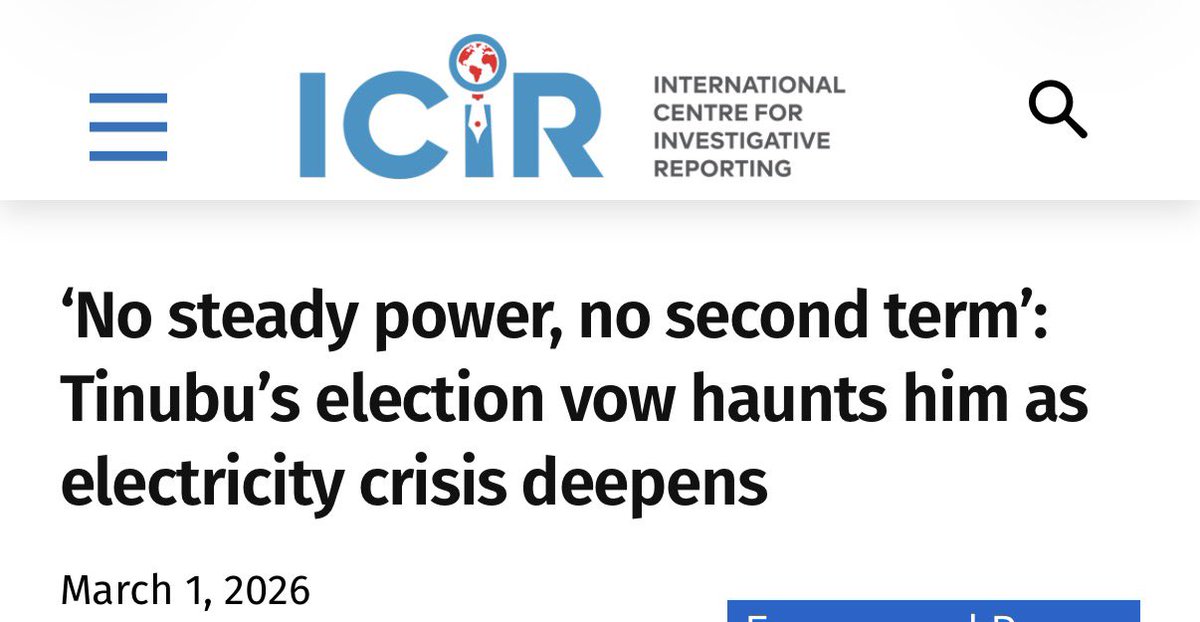
Wow, so you knew all this and never told Tinubu? That’s unfortunate, because at this rate he might lose his second term. 🤔
78
482
899
85,791

I think Obi is granting too many interviews and he needs to stop. Nigerians do not need anymore orientation about his capabilities.
Anyone that does not like him should go and vote Tinubu. Full stop!
5


Wale Kembi retweeted
Consistently delivered Colloquiums for more than 10years ooo.
Keyword "Consistently"
1
1
10
He's also not an economist but if he's going to make a bold claim about improving the economy, he has articulate such plans.
Jun 17

This country of DUMB DUMB people
You want PO to become an Electrical Engineer to show you its possible
Alex Otti is proof before your dumb eyes, that it CAN BE DONE
Hire honest people, dont steal, execute a bold modern plan and again, DONT STEAL, DONT STEAL, DO NOT FUCKING STEAL
1
34
E dey fear make Obi no talk rubbish as usual
Jun 17

Peter Obi should not subject himself to any interview or debate unless the other presidential candidates are also willing to come forward and be grilled by journalists and the media.
14

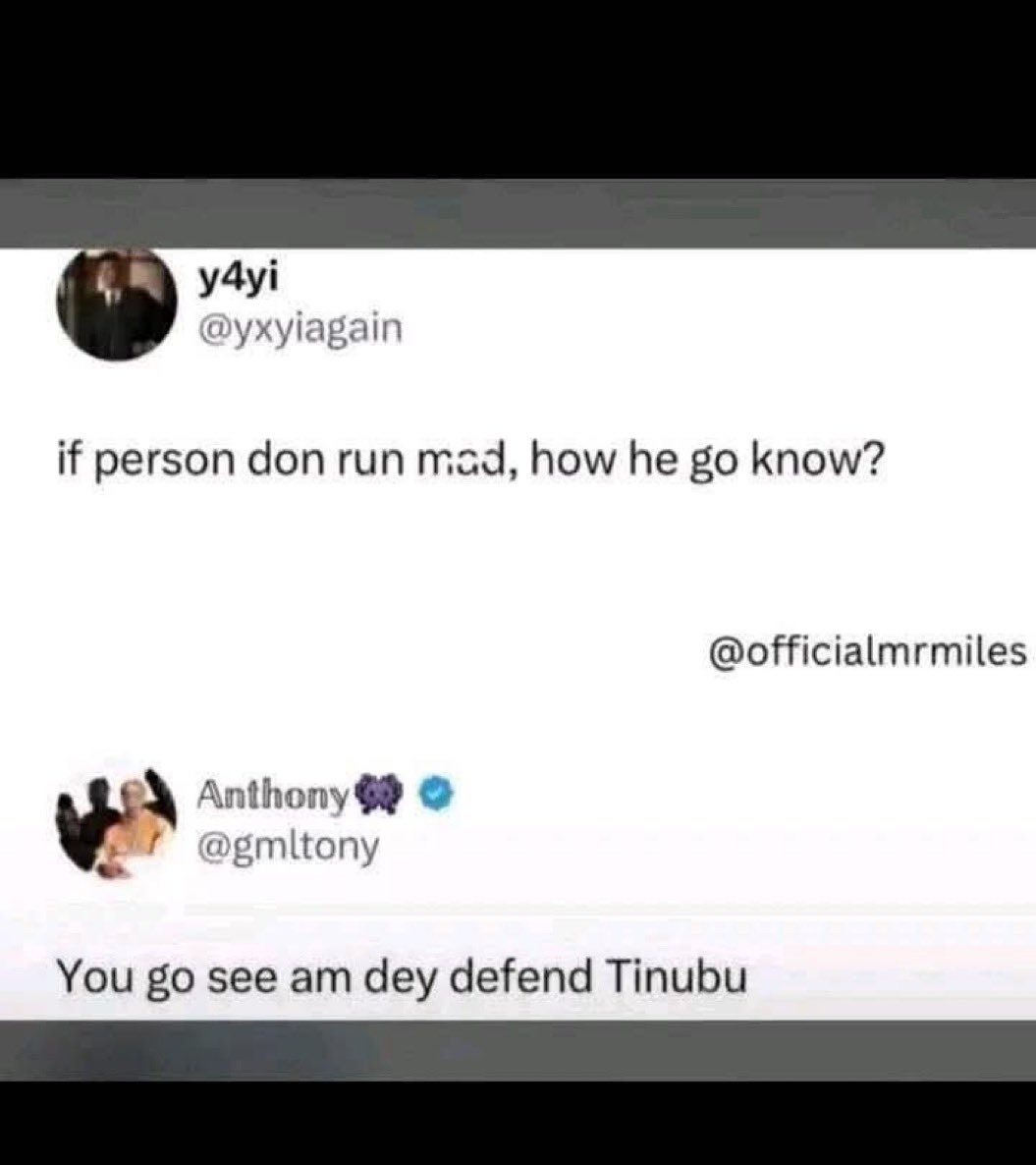
This one is basking in the lies of pre2023 election.
19h

wait .... tinubu that is barely coherent ? these guys must be in an alternate reality, this is some Dr Strange sheet, lol
80