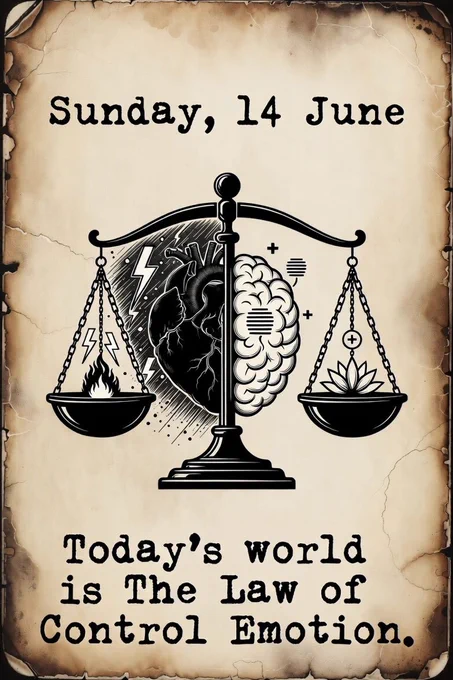
Sunday, 14 June
Today's world is
The Law of Controlled Emotion.
The Law of Control Emotion states that your mental well-being and fulfillment depend entirely on how much control you feel you have over your life and your reactions. Controlling your emotions means choosing how you respond to events rather than simply reacting on instinct.
The Law of Emotional Control (often attributed to Bob Proctor or derived from NLP) states: You cannot control external events or other people, but you can always control your internal response to them.
Stimulus (Out of your control): What happens to you (weather, traffic, criticism, delays).
· Response (In your control): The meaning you assign to it, your physiology, and your next action.
Mastering this concept is built on a few core pillars and actionable frameworks:
1. The 5 Pillars of Emotional Regulation
To gain command over your emotions, experts emphasize five essential steps:
Self-Awareness: Recognizing what you are feeling in the moment and naming the emotion without judgment.
Regulation: Using your brain's executive function to decide how to respond so it aligns with your long-term goals.
Motivation: Channeling emotional energy into productive outcomes rather than allowing it to drain your focus.
Empathy: Understanding the emotions of others, which naturally helps de-escalate conflicts and reduces interpersonal friction.
Social Skills: Communicating clearly and managing interactions effectively, even when under stress.
2. Actionable Techniques for Emotional Mastery
You can manage intense feelings in the heat of the moment by employing these practical strategies:
The Pause (Stop, Think, Act): Before making a high-stakes decision, take a deep breath to calm your nervous system.
Cognitive Reappraisal: Consciously change the narrative of a negative situation. For instance, if you feel a surge of frustration after a setback, reframe it as a learning opportunity.
Mindfulness: Ground yourself in the present moment by practicing box breathing or counting to 10 to let the initial emotional spike pass.
3. Why It Matters
When you fail to regulate your emotions, uncontrolled stress can lead to anxiety and regrettable decisions. By mastering this psychological law, you experience higher levels of achievement, better decision-making, and significantly improved relationships.
In short: The law doesn't promise you won't feel anger or fear. It promises that what you do next is always your choice.
Key Nigerian‑Specific Insights
· External chaos is guaranteed from naira devaluation to fuel price hikes to election violence. The Law of Emotional Control does not ask you to be happy about it. It asks you to own your next move.
· Collective emotion is intense Nigerians often react as a group (protests, viral anger). The law applies even then: a leader who can pause and reframe can steer a crowd from riot to constructive action.
· “No light” as a training ground Many Nigerians already practice emotional control daily (e.g., when NEPA takes light during a crucial work task). The formal law just gives that instinct a name and a structure.
Summary Lesson from Nigeria
You cannot control the removal of a fuel subsidy. You can control whether you spend that afternoon redesigning your business or burning your tyres in the street.
The Law of Emotional Control, applied in the Nigerian context, is not naive optimism it is strategic survival.
ALT Sunday, 14 June
Today's world is
The Law of Controlled Emotion.
The Law of Control Emotion states that your mental well-being and fulfillment depend entirely on how much control you feel you have over your life and your reactions. Controlling your emotions means choosing how you respond to events rather than simply reacting on instinct.
The Law of Emotional Control (often attributed to Bob Proctor or derived from NLP) states: You cannot control external events or other people, but you can always control your internal response to them.
Stimulus (Out of your control): What happens to you (weather, traffic, criticism, delays).
· Response (In your control): The meaning you assign to it, your physiology, and your next action.
Mastering this concept is built on a few core pillars and actionable frameworks:
1. The 5 Pillars of Emotional Regulation
To gain command over your emotions, experts emphasize five essential steps:
Self-Awareness: Recognizing what you are feeling in the moment