Vision, neural networks, and open brain science. RT means "This may deserve more attention". Like means "I have read this (e.g. paper) and think it's solid."
Joined June 2014
- Tweets 4,772
- Following 3,018
- Followers 10,040
- Likes 2,838
408 Photos and videos


Nikolaus Kriegeskorte retweeted

Jun 15
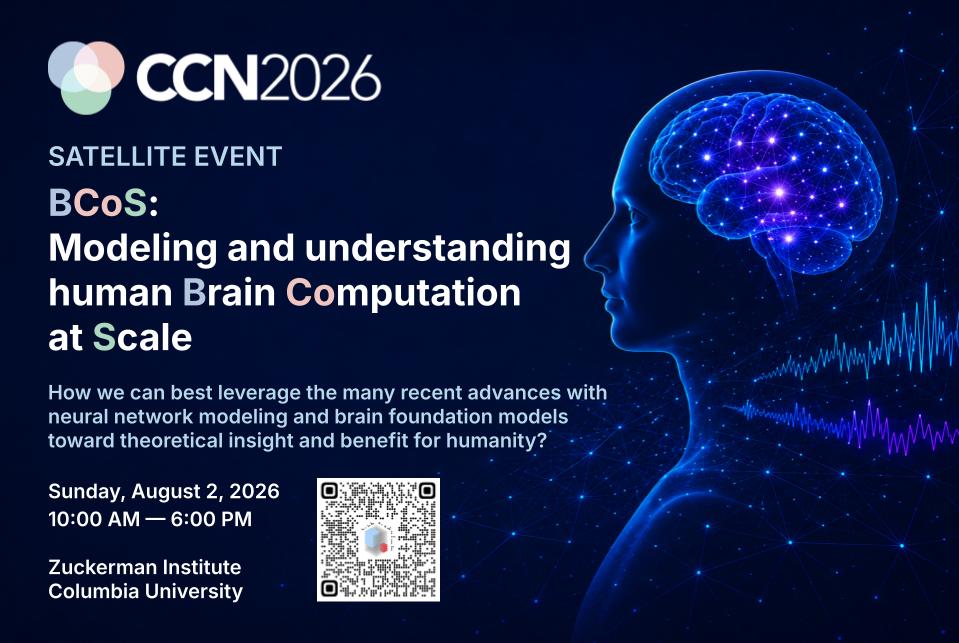
Excited to announce CCN @CogCompNeuro Satellite Event:
Modeling and Understanding Human Brain Computation at Scale
We explore how we can best leverage the many recent advances with neural network modeling and brain foundation models toward theoretical insight and benefit for humanity.
Sunday, August 2, 2026
@ZuckermanBrain
Organized with @Pinyuan3, @LibraCheng, Andrew Luo, and @KriegeskorteLab
1
9
12
933
Nikolaus Kriegeskorte retweeted

Jun 11
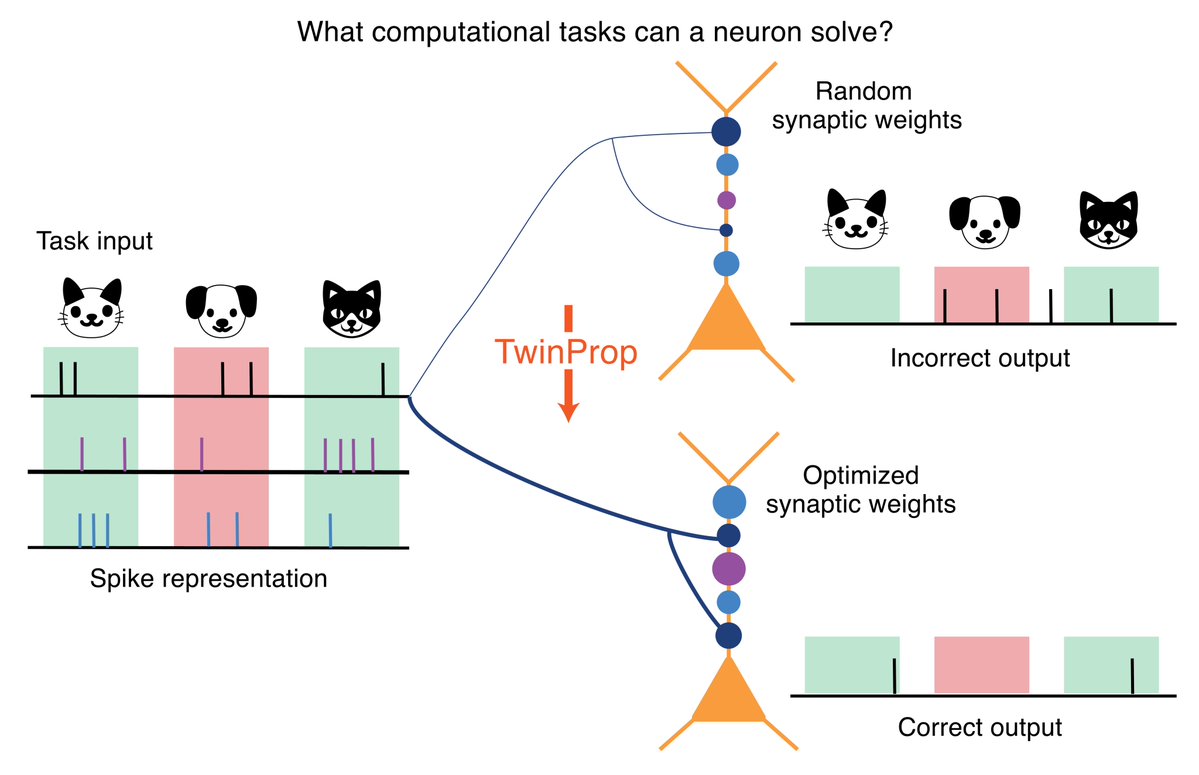
What can a neuron compute?
Real biological neurons are complex, but how capable are they?
Using a new method, we found that a single cortical neuron can classify cats vs dogs, recognize spoken words, and solve 10-bit parity, all tasks thought to require entire networks. (1/15)
51
366
1,898
295,259
Nikolaus Kriegeskorte retweeted

Jun 9
Why do humans generalize so much better than deep networks? Because they learn something deep networks can't: symmetries.
arxiv.org/abs/2412.11521
19
66
550
61,451
Nikolaus Kriegeskorte retweeted

Jun 7
gm! aunties room 01
clutter, housework, sisters.
23
44
248
10,337
Nikolaus Kriegeskorte retweeted

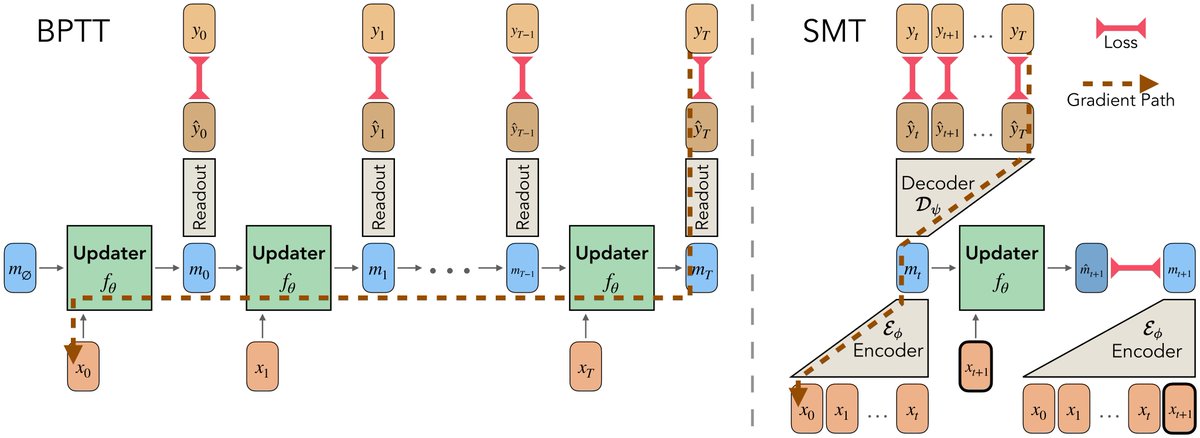
We introduce a method for training RNNs that is time-parallel and does not suffer from vanishing/exploding gradients.
Key idea is to decouple learning 1) what should be remembered (can be done without recurrence) and 2) how to update memory (can be one-step supervised by #1).
Jun 7

We never really knew how to train nonlinear RNNs well… BPTT struggled with vanishing grads (no long-range memory) and sequential rollout (hard to parallelizable).
What if instead an oracle told us the optimal memory state m_t at each step? Then the RNN could do one-step supervised learning on (m_t, x_{t 1}) → m_{t 1} labels.
We call this Supervised Memory Training (SMT): a replacement for BPTT that trains RNNs without unrolling them. SMT is time-parallelizable and solves vanishing gradients.
Website: akarshkumar.com/smt/
arXiv: arxiv.org/abs/2606.06479
2
22
227
29,069

“A call to abandon the conventional boundaries between computer vision and robot learning, and instead ponder the problems that arise when we seek to build machines that both perceive and act.”
Feb 16

In my recent blog post, I argue that "vision" is only well-defined as part of perception-action loops, and that the conventional view of computer vision - mapping imagery to intermediate representations (3D, flow, segmentation...) is about to go away.
vincentsitzmann.com/blog/bit…
1
23
3,697
Nikolaus Kriegeskorte retweeted

Jun 5
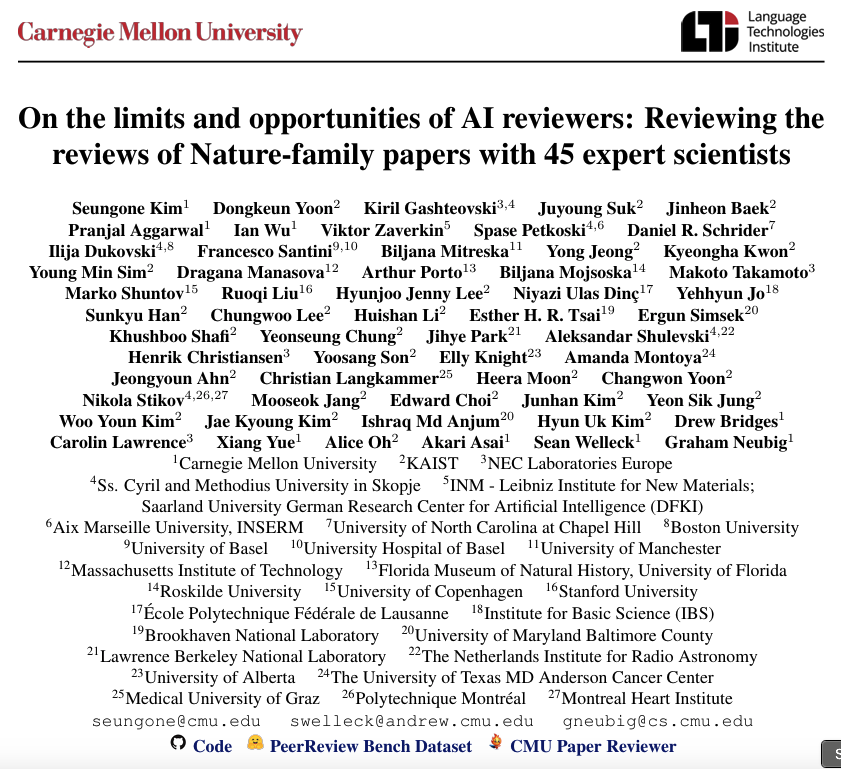
Can AI agents really peer-review Nature papers? 🔬🤖
Moving beyond simple rating consistency, we conducted a large-scale study analyzing how well AI vs. humans point out paper limitations across Nature/Nature sister journals.
We found that with a carefully designed harness, AI is supremely effective, though it lacks the diverse perspectives of humans.
Check out @seungonekim ‘s thread & our 91-page comprehensive study!
May 21

Recently, there's been complaints on low-quality AI reviews at conferences and journals. What if we put the frontier LMs into an agent harness?
With the right setup, on 82 Nature-family papers, 45 expert scientists judged that AI reviewers outperform the best human reviewer!
🤗 huggingface.co/papers/2605.2…
2
14
81
12,099
Nikolaus Kriegeskorte retweeted

Can AI "see" motion from static images like humans?
We tested 10 state-of-the-art vision models (multi-scale, recurrent, and bio-inspired) on the Rotating Snakes illusion, one of the most extensively characterized motion illusions in human and primate vision. Almost all failed — only one bio-inspired model, Dual, predicted motion most closely aligned with human perception, particularly under simulated eye movements.
Accepted to @CVPR Findings!
Paper: openaccess.thecvf.com/conten…
w/
@LibraCheng @zitangsun @KriegeskorteLab
A 🧵:
#ComputerVision #Vision
5
18
58
5,970
Nikolaus Kriegeskorte retweeted

Jun 5
You see rotation when you move your eyes, even though the image is 100% static.
Our #CVPR Findings paper uses motion illusions to (1) reveal gaps between human and AI motion processing and (2) identify architectures key for aligning vision models with human perception.
openaccess.thecvf.com/conten…
8
42
4,119
Every post on X is now an ad: visibility depends on payment (subscription tier, boosts). Twitter/X was never perfect, but has recently been moving decisively away from a conception that is compatible with the ideals of liberal democratic discourse. [Advertisement]
3
328
Rich Sutton saying that creativity requires the cycle of variation, evaluation, and selective retention as present in RL and known as instrumental conditioning in psychology. He argues that, absent this cycle, a system will never learn to create something that is both novel and good. No combination of supervised learning by backprop, prediction, world modeling can lend generative AI creativity. It's a pretty strong claim. youtu.be/K5LAFEjTlBA
1
4
809
Nikolaus Kriegeskorte retweeted

May 18
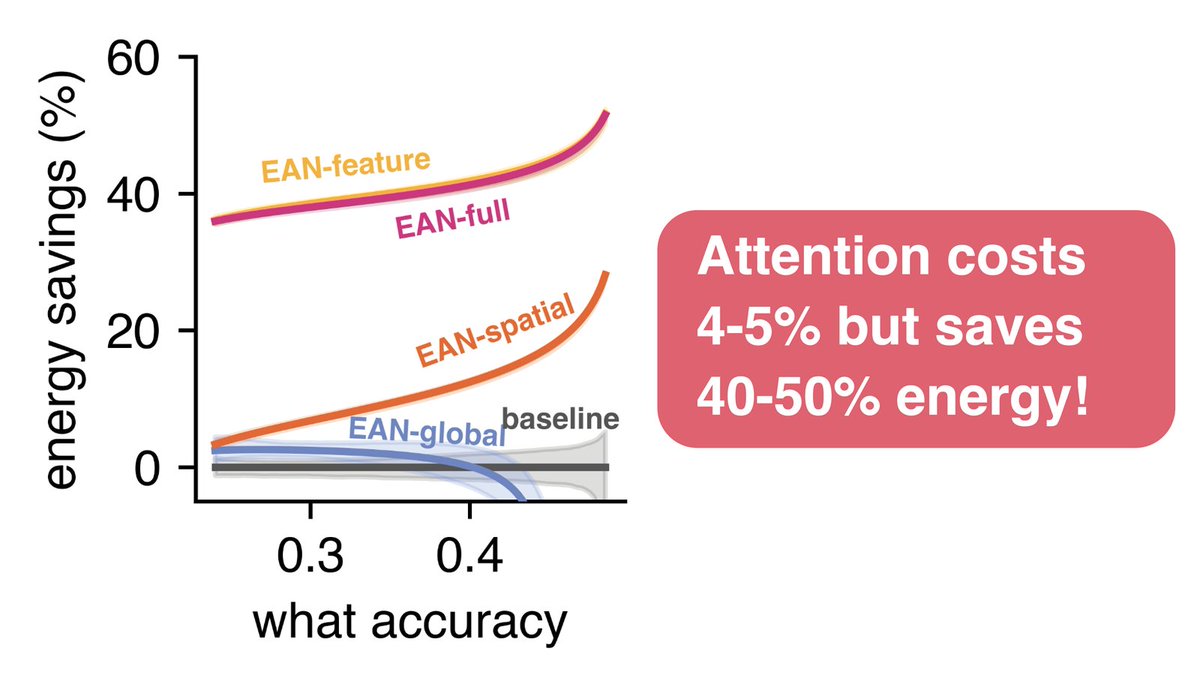
1/ New preprint VSS poster! Attention has long been thought to enable efficient vision. But does it? First demonstration that attention—consuming just 4-5% of the energy budget—can cut the energetic costs of vision in half. #VSS2026
1
10
15
1,814
Nikolaus Kriegeskorte retweeted
May 18
Look. The snakes rotate.
Hold still. They stop.
Glance away. They spin again.
We asked 10 visual-motion models to play this game with us. Only one could. 🐍
I'll present "Neural networks reveal candidate computational mechanisms underlying anomalous motion illusion" at #VSS2026
🗓️ May 19th, Tuesday 8:30–12:30
📍 Pavilion, Board 53.435
Welcome to drop by! 👋
w/ @IsabellaRosario @ZitangSun @KriegeskorteLab
1
5
11
1,127
General intelligence is generic. Domain specific intelligence is more interesting.
7
1,340
Want a digital computer to write symbolic programs for itself? Simulate on it a subsymbolic mind & brain somewhat like ours: a sea of associations continually transformed. Symbolic thought, who knew, comes more naturally to a neural network than to a symbolic architecture.
1
1
17
2,272
A service “chat” on Uber and Amazon means the customer reads through a list of issues other customers had in the past and picks one. The stupidity of this, in the age of AI chat models, boggles the mind — unless the goal is not to serve the customer.
2
650
Nikolaus Kriegeskorte retweeted

Mar 28
- Drafted a blog post
- Used an LLM to meticulously improve the argument over 4 hours.
- Wow, feeling great, it’s so convincing!
- Fun idea let’s ask it to argue the opposite.
- LLM demolishes the entire argument and convinces me that the opposite is in fact true.
- lol
The LLMs may elicit an opinion when asked but are extremely competent in arguing almost any direction. This is actually super useful as a tool for forming your own opinions, just make sure to ask different directions and be careful with the sycophancy.
1,745
2,411
31,242
3,494,405
Nikolaus Kriegeskorte retweeted

Feb 23
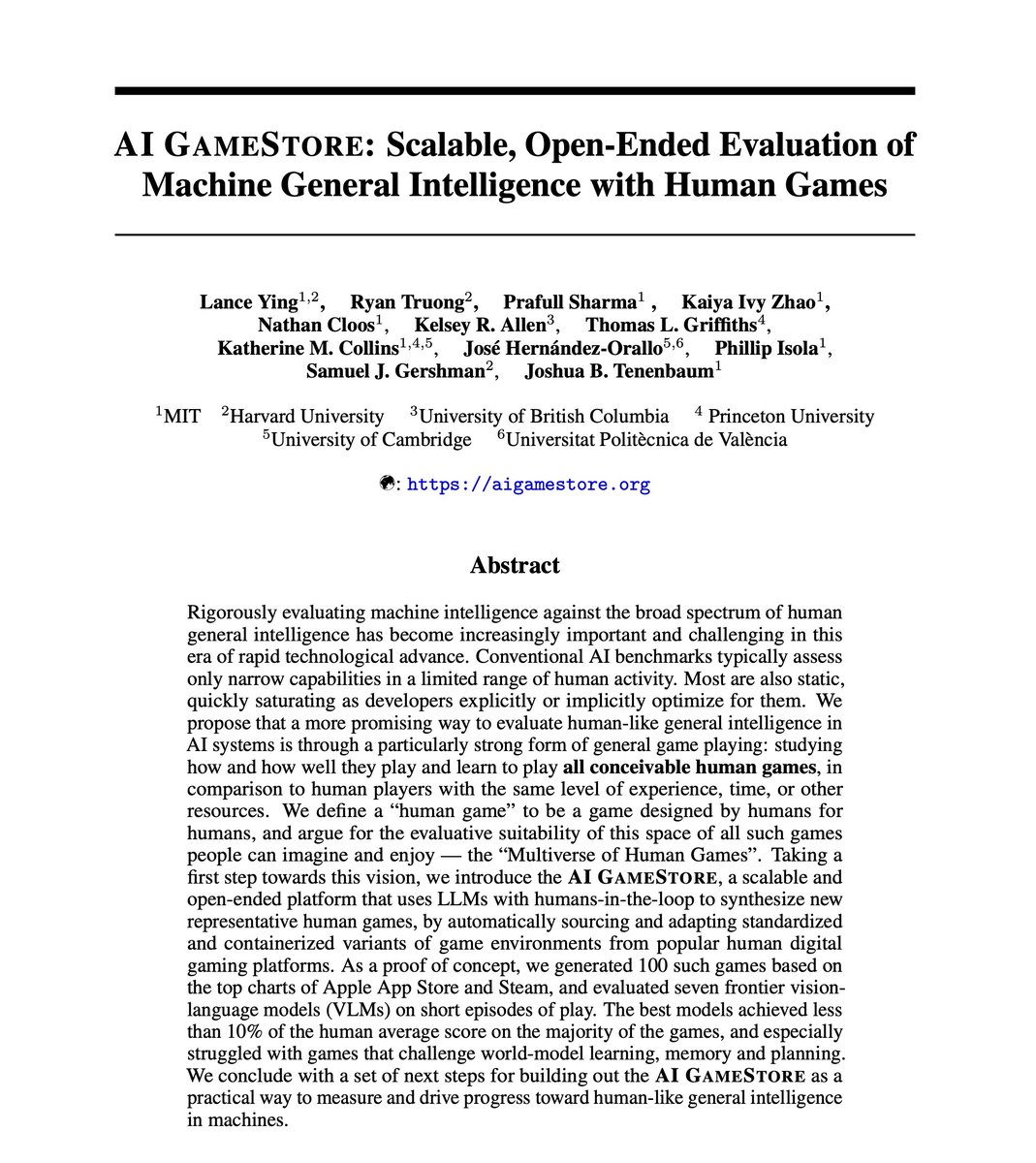
Today we present a new framework for measuring human-like general intelligence in machines (what some people call AGI).
Conventional AI benchmarks today assess only narrow capabilities in a limited range of human activities.
We propose that a more promising way to evaluate human-like general intelligence in AI systems is through a particularly strong form of general game playing: studying how and how well they play and learn to play all conceivable human games — what we call the ``Multiverse of Human Games''.
Taking a first step towards this vision, we introduce the AI GameStore, a scalable and open-ended platform that uses LLMs with humans-in-the-loop to automatically construct standardized and containerized variants of popular human games on digital gaming platforms.
As a proof of concept, we generated 100 such games based on the top charts of Apple App Store and Steam, and evaluated seven frontier vision-language models (VLMs) on short episodes of play. The best models achieved less than 10% of the human average score on the majority of the games.
Check out our website to play the games, see how agents play, and build agents to solve them!
4
28
114
20,544
Nikolaus Kriegeskorte retweeted

Mar 21
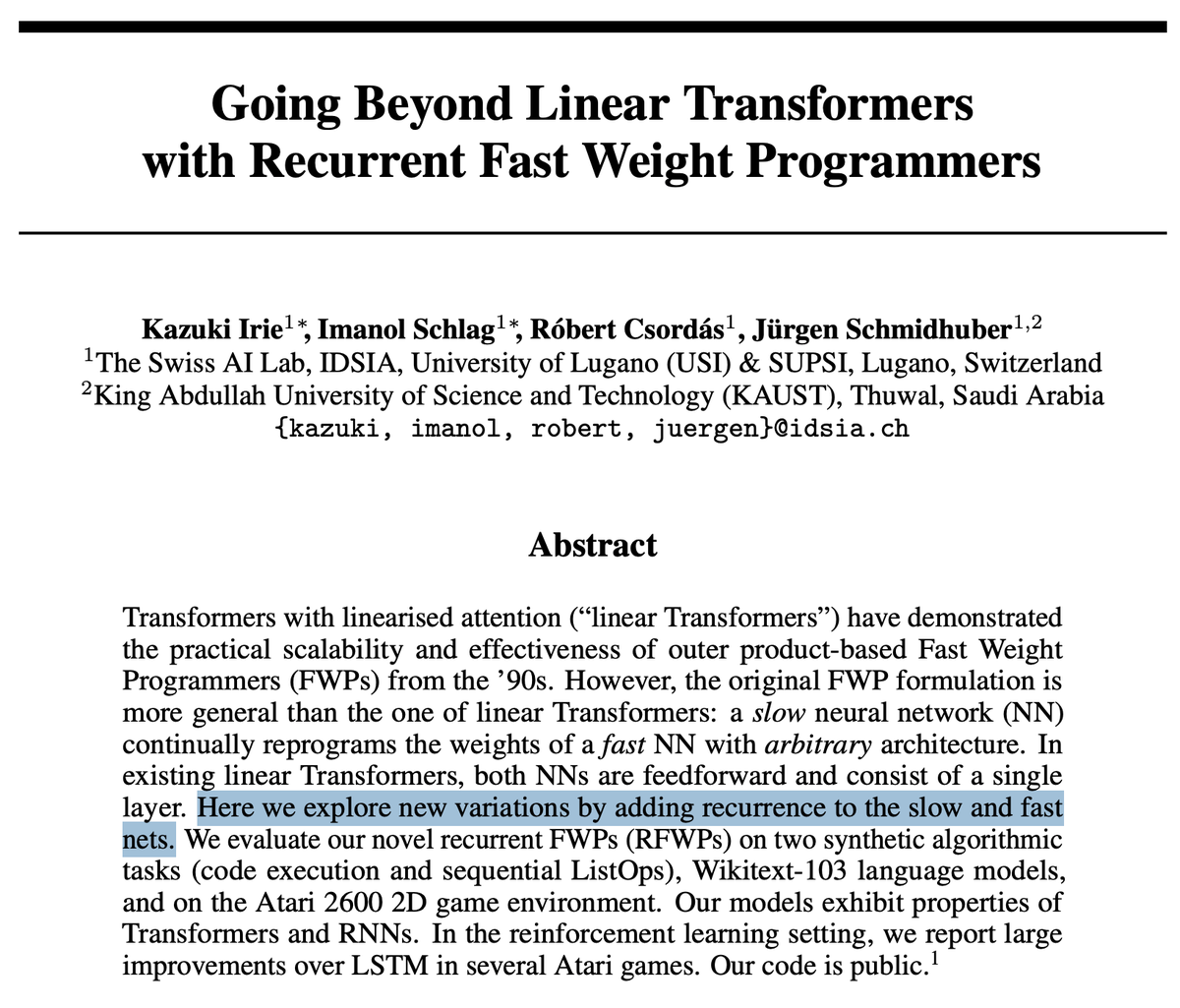
Nice to see new work exploring this direction of "going beyond linear transformers with proper recurrence"!
For context, see our related work from NeurIPS 2021: arxiv.org/abs/2106.06295, a follow-up to our ICML 2021 DeltaNet paper. w/ @ImanolSchlag @robert_csordas @SchmidhuberAI
Mar 19

Introducing M²RNN: Non-Linear RNNs with Matrix-Valued States for Scalable Language Modeling
We bring back non-linear recurrence to language modeling and show it's been held back by small state sizes, not by non-linearity itself.
📄 Paper: arxiv.org/abs/2603.14360
💻 Code: github.com/open-lm-engine/lm…
🤗 Models: huggingface.co/collections/o…
5
30
211
27,627