Focused on building an archive of academic and research-driven posts about Kurds.
Joined September 2022
- Tweets 589
- Following 55
- Followers 1,314
- Likes 9,243
144 Photos and videos
Pinned Tweet

Jun 8
Friendly reminder to all that all seven generations of my ancestry are Kurdish, and in fact I don't even have any known recent non-Kurdish ancestry. My first and last name are Kurdish. I speak Kurdish and I am proud of my heritage. I practise Kurdish culture. I wear Kurdish clothes. My patrilineal Y-DNA is Kurdish. I support Kurdish nationalism and self-determination. I support a deeply conservative, and traditionally authentic Kurdish society.
I seek to elevate the Kurdish cause by giving a truthful account of our roots. The topics I am passionate about are history, archaeology, genetics, and linguistics. The emphasis here is on truth. Everything that isn't truthful must be destroyed.
10
9
74
4,023
10h
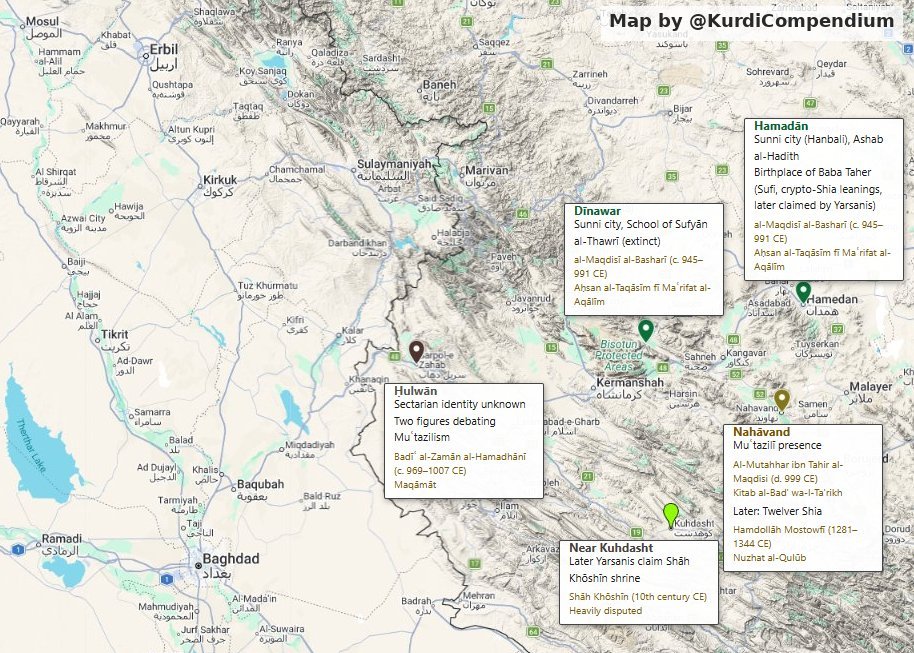
Approximate religious demographics of southern Kurdistan during the high medieval period (900AD - 1300AD).
Southern Kurdistan's traditional association with Shiism is often traced to the rise of the Kurdish Hasanwayhid dynasty, yet Sunni presence appears to have remained dominant in many cities well into later periods. The Mongol conquests shattered central authority in Iran, opening considerable space in which Shia and Shia-influenced movements gained ground, even before the Safavid dynasty's rise. Sultan Sahak, the central figure of the Yarsani faith, supposedly met Timur himself in the late 14th or 15th century and was well received.
Despite Sunni dominance in southern Kurdistan during the high medieval period, some degree of Shiite influence clearly persisted in cities like Hamadan, which was otherwise majority Sunni. Notably, Bābā Ṭāher, a Sufi with crypto-Shiite tendencies, was born into this Sunni environment and was later incorporated as a central figure in the Yarsani faith as well. The historicity of other figures, such as Shah Khoshin near Kuhdasht, remains heavily disputed, and it's unclear whether this represents a later Yarsani invention.
Mu'tazilism during the high medieval period can be traced to multiple locations in southern Kurdistan, such as Hulwan and Nahavand, though it's not entirely clear how prevalent this theological school of thought was.
Conversions to Twelver Shiism from both Yarsani and Sunni communities in southern Kurdistan occurred on a large scale, even into recent times; the Kalhor tribe, for example, underwent a major conversion during the Qajar period (1789–1925).
This map should be considered a first version of the religious demographics of southern Kurdistan. New version will be made in the future if I forgotten to add anything.
1
13
33
2,128
Jun 9
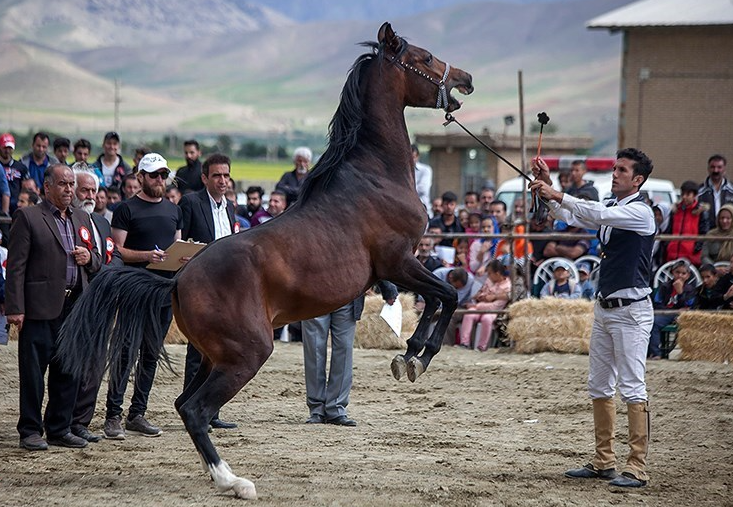
According to our limited genetic understanding of horse breeds, the modern Kurdish horse does not descend from the Nisaean horse (Median horse). What seems to be indicated in the genetic literature is that the majority of modern horse breeds globally descend from Scythian horse breeds, which replaced other horse breeds around the world, barring a few exceptions such as the Shetland pony and Norwegian Fjord, among others. Based on limited data, there also seem to be additional expansion events related to Parthian and Sassanid-era horse breeds in the past 2,000 years, which were imported into Rome and then into the rest of Europe, replacing their previous horse breeds. Pinning down where exactly Kurdish horse breeds fit into the broader picture of horse genetics is currently difficult, due to a lack of high quality genome sampling, but the following observations can be made:
The genetic affinity of 6th-century Khorasani horses with modern European horses has been noted in the literature. Finally, there is a third major proliferation of medieval Turkoman horse breeds that seemingly derives from Parthian/Sassanid-era stock rather than earlier steppe horses. Notably, this population shift observed in Europe during the 7th–9th centuries was also mirrored in Central Asia and Mongolia, suggesting a near-simultaneous replacement of older steppe lineages across Eurasia.
It is worth noting that when strict breed lineages are in place, replacement tends to happen quickly. Consider a scenario where you maintain twenty steppe ponies and eight oriental horses separately for riding and warfare, then acquire two Sassanid horses kept as a separate breeding stock. Once the earlier orientals become obsolete, they are either absorbed into the general steppe population or culled entirely, leaving the newer lineage to dominate. This helps explain the thoroughness of these successive turnovers in the archaeo-genetic record.
The success and expansion of these horse lineages can be directly attributed to their suitability for warfare, a quality most refined in the Turco-Iranian world, producing horses that were relatively muscular yet very slender with long legs. It has also been suggested that there was considerable backflow of horse breeds from Iran into Central Asia. We do have historical records of professional stud farms existed in Central Asia since at least the Achaemenid period. Over time, it seems likely that the region's own Oriental-type Iranian war horses were gradually displaced through imports and trade, while utility horses remained closer to the steppe pony type seen among Mongolian horse breeds today.
Kurdish horses are seemingly closely related to the modern Arabian and modern Persian horse breeds, rather than to Caspian and Turkoman breeds, perhaps signifying a separate Sassanid horse-breeding tradition, though this could just as easily signify an early medieval separation between these horse lineages that is still derived from a Turcoman stock. It would be interesting to see in future genetic horse papers if Kazakh and Kyrgyz horses (the breed, not their common horse) are a mixture of medieval Turkoman and Mongol horses. It should also be noted that the Mongol horse represents its own distinct tradition, separate from the main cluster of horse lineages found globally.
Given the absence of any definitive high-quality ancient horse genetics paper covering this region, everything noted here should be taken with a grain of salt until our understanding of horse genetics improves in the coming decades.
3
15
56
19,019
Jun 7
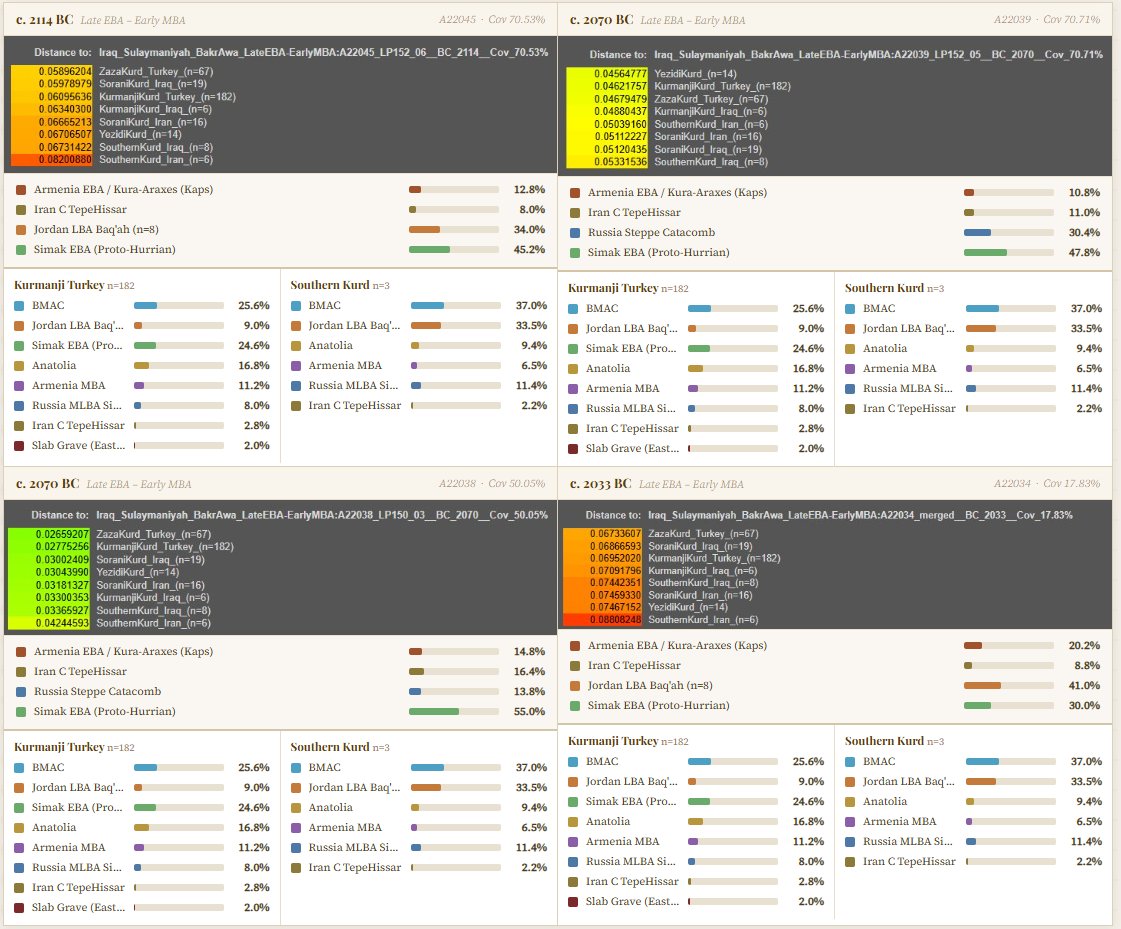
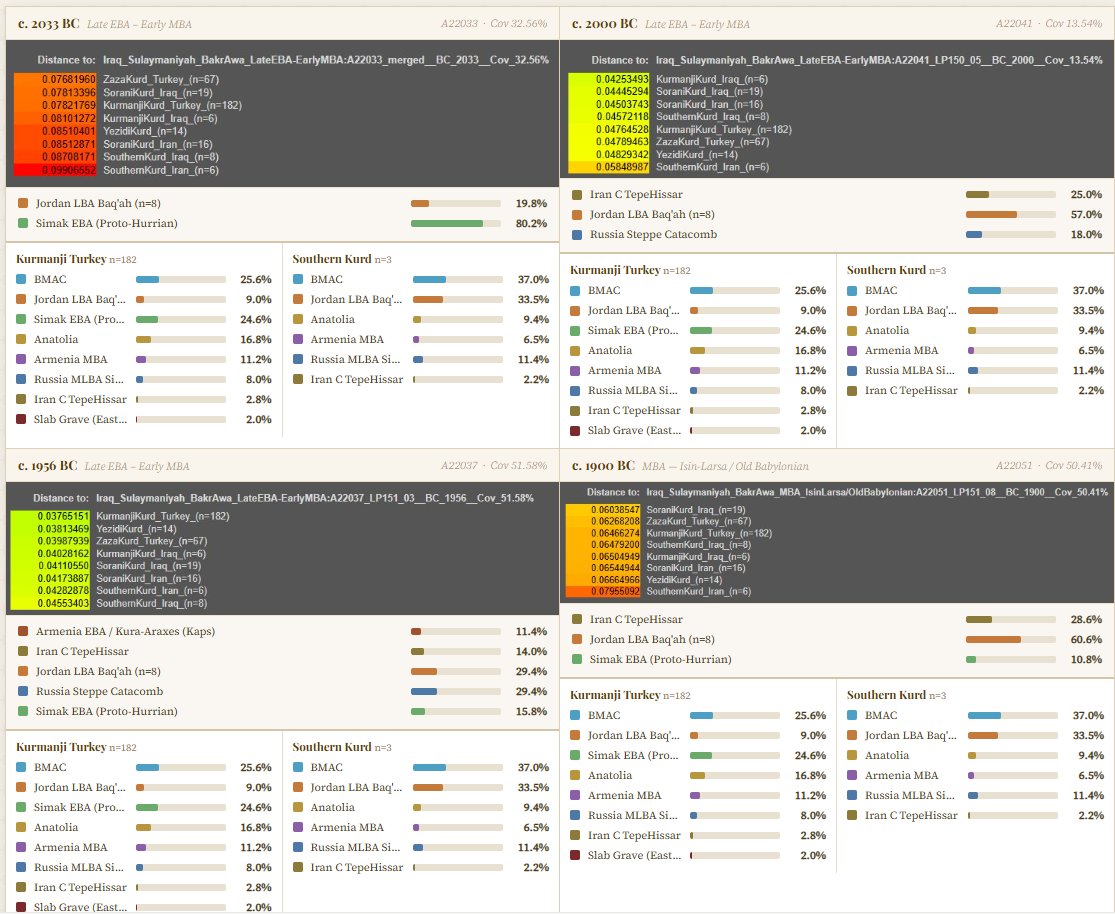
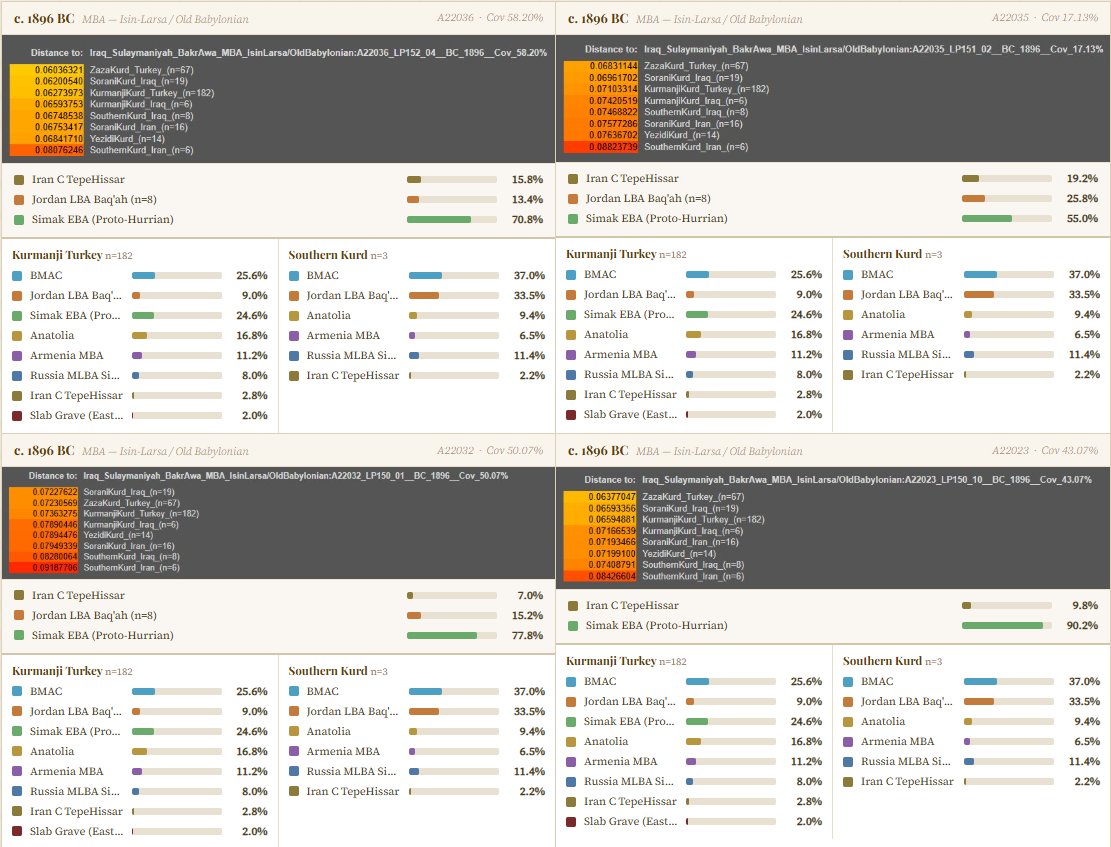
Why are the ancient Lullubi at Bakr Awa genetically close to Kurds? 15 out of 20 samples are very distant racially from Kurds. The 5 samples that artificially plot "closer" to Kurds and north-west Iranians such as Tats are in fact autosomally very distinct, proven in the screenshots below, which concretely debunks the decades-old myth that Kurds descend from the Lullubi. The Kurds who plot closest to these samples are those with extensive Armenian/Assyrian ancestry, while Kurds from the core parts of the Zagros are the most genetically distinct. The only way to sustain this narrative is to argue that having more medieval Armenian ancestry makes one more authentically ancient Kurdish or Lullubi, which is obviously absurd. Take for example sample A22025, which is supposedly the closest of all ancient Bakr Awa samples to modern Kurds: it models with 60% Proto-Hurrian-type ancestry, whereas modern Kurds score between 0 and 20% Proto-Hurrian-type ancestry, with Kurds lacking Armenian ancestry not picking up this signal AT ALL. Meaning that this population signal is not relevant ancestrally for Kurds. What people don't understand is that two distinct populations can come together, to plot closest to a third unrelated group. Take for example a Kurd who mixes with a Moroccan. The child will plot close to Palestinians on G25. This does NOT mean the child is Palestinian, as his ancestry is completely different.
Furthermore, not a single one of these 20 genetic samples carries patrilineal Y-DNA descent attributable to Kurds. Close to 50% of Kurdish Y-DNA lineages descend from Iron Age south-central Asia. It should also be noted that the presence of Bronze Age Armenian or Semitic ancestry in Kurds, as found in these Bakr Awa samples, does not mean that Kurdish ancestry derived from Bakr Awa itself. Semitic ancestry has expanded extensively across almost the entirety of the Middle East and into central Asia. The same applies to Hurrian-related profiles, which entered the Iranian plateau through later Mesopotamian migration rather than necessarily through these cis-Zagrosian groups. It is not unreasonable to suppose that cis-Zagrosian groups contributed something to the ancestry of Iranian-speaking populations, but this contribution is greatly exaggerated and obscures the straightforward reality that populations in this part of the world have been continuously subject to successive waves of new admixture.
Thinking that Kurds have 4000 years of continuity is completely absurd when we know with historical and genetic data that Kurds have mixed quite a lot in the past 1000 years. This is quite normal in the middle east. Genetic profiles are constantly shifting.
7
17
62
18,025
Jun 6
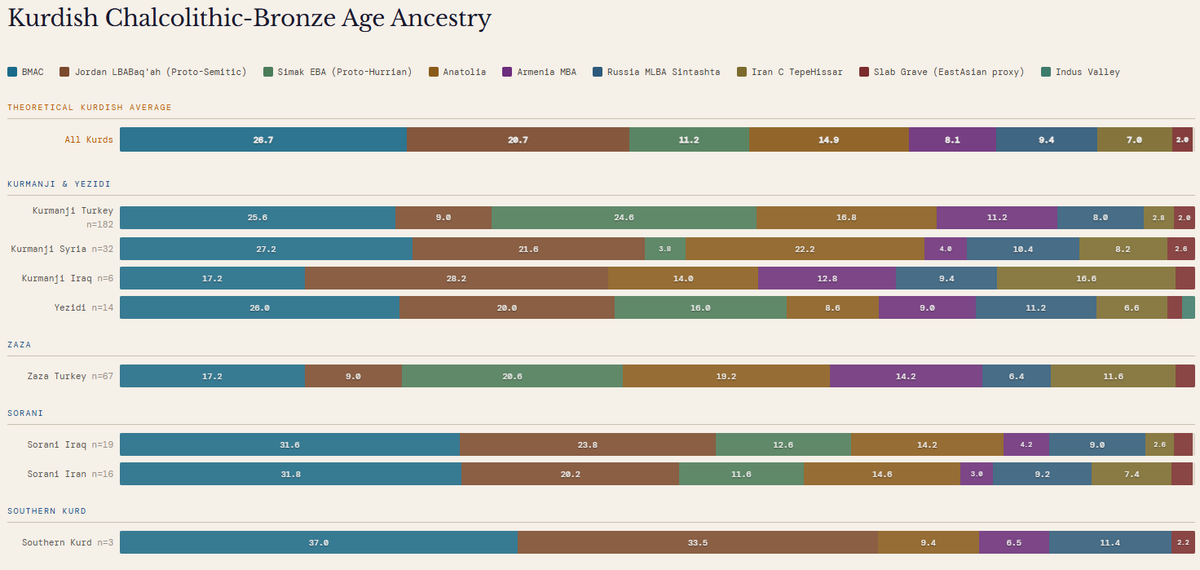
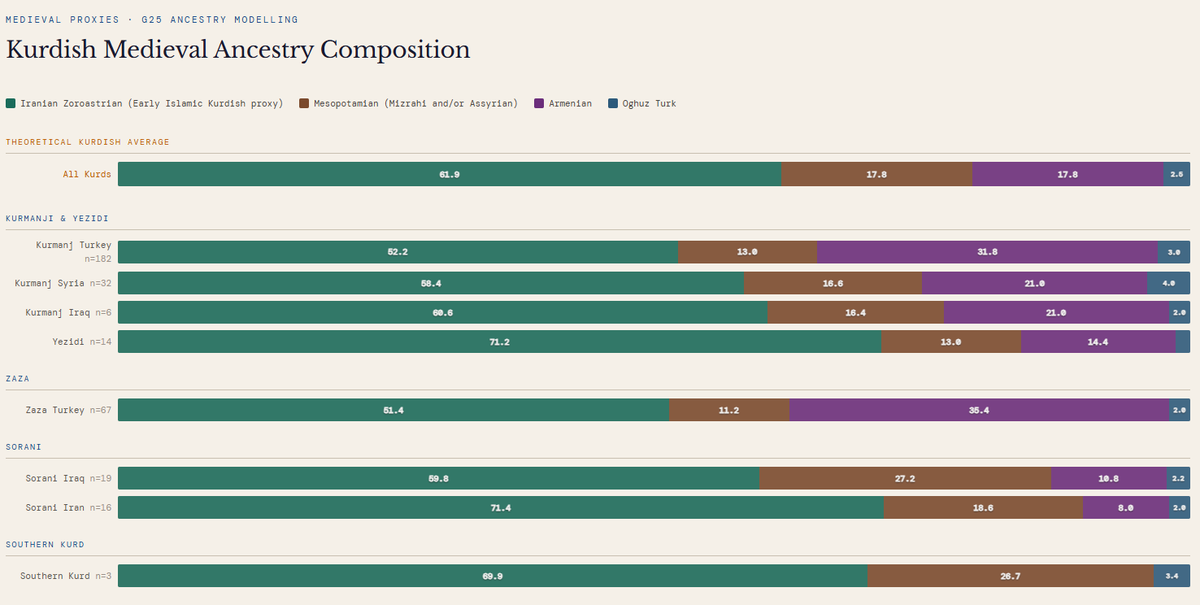
Autosomal composition of Kurds from two perspectives: a Chalcolithic to Bronze Age scale, and from the perspective of the medieval era. The former can be replicated on G25, and the latter can be replicated on G25 and qpAdm. The precise breakdown should not be taken too literally, as these admixture tool softwares are not particularly robust.
A simple breakdown of the Chalcolithic-Bronze Age component: the first Kurdish tribes appear within the Iranian plateau in the late Achaemenid to early Seleucid periods, who given their Iranian nature would be a combination of BMAC and Sintashta components. Some degree of local plateau ancestry was subsequently absorbed, which was a combination of Semitic, Hurrian, and related derived groups.
A simple breakdown of the medieval component: from the late Sasanian era onwards, large-scale expansions into what is now Kurdistan resulted in additional admixture from Adharic-speaking Iranians localised to northwest Iran and the Armenian highlands. It is difficult to gauge how impactful this admixture was, as the groups in question are genetically very similar to Kurds to begin with due to their common "West Iranian" roots. Additionally, some degree of Mizrahi, Assyrian, and Armenian admixture was gained through contact with non-Kurdish populations as Kurds expanded over their lands. Kurmanji and Zaza speakers carry very significant amounts of Armenian admixture that is considerably lower in Sorani speakers, and is often absent entirely in Xwarin speakers. It is also quite likely that Xwarin speakers proportionally carry more Adharic-type ancestry than Kurmanji speakers.
8
14
45
8,520
Jun 5
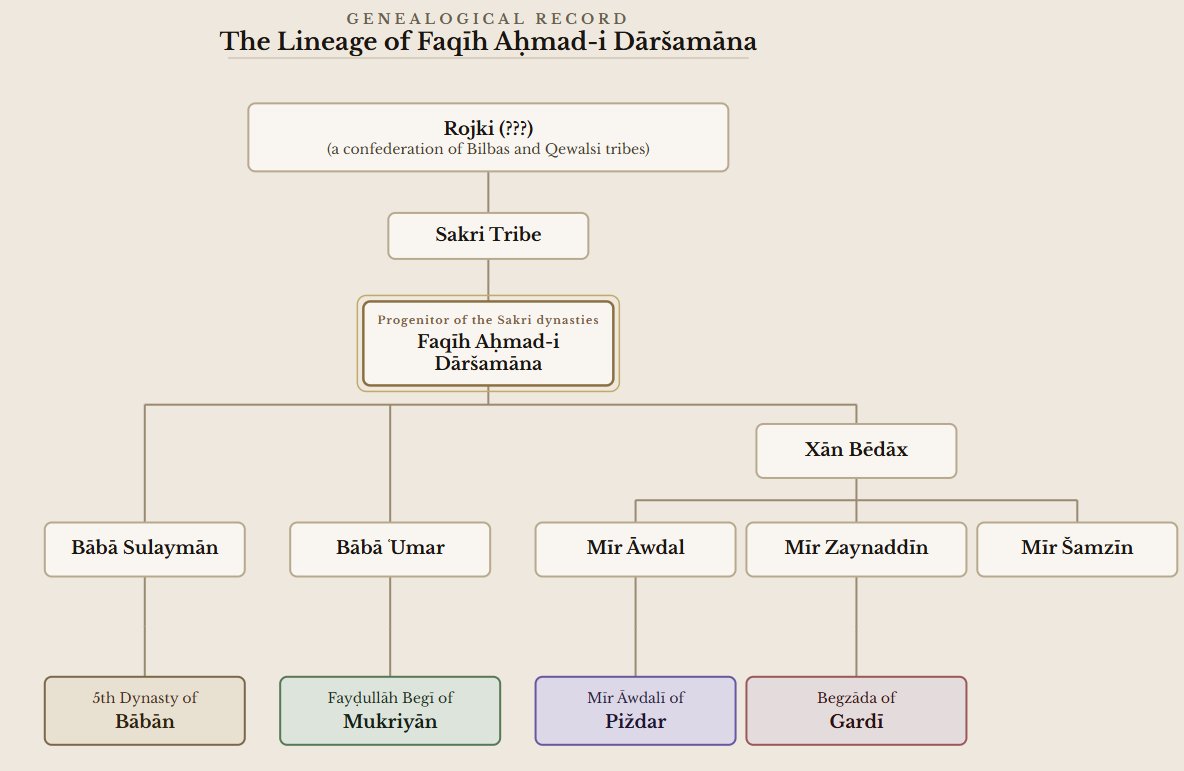
Faqih Ahmad of Darashmana, progenitor of the Sakri tribe (17th century AD), born in a village near Qaladze, is one of the most important figures of recent Kurdish history in genealogical terms, as his descendants contributed towards one of the most extensive linguistic expansions of the Sorani tongue. Not only does the 5th Dynasty of Baban descend from him, but so do the other important dynasties/figures shown in the image. Sorani is of course a modern term, and interestingly its speakers seemingly originally identified under a Kurmanj umbrella and referred to their language as Kurmanji. This is known through European traveller accounts of conversations with the Baban Kurds, who also mentioned that the Gllali (گلاڵی) and Shinki are related to them. The Gllali are notable in their own right, having been recorded by al-Umari as a major confederation in the Kermanshah area, with branches extending into Garmiyan and south of Lake Urmia.
The question of how the Sakri came to be associated with Sorani requires engagement with the Rojaki confederation of Bedlis, though the connection between the Rojaki and the Sakri dynasties that later ruled Baban must be treated with caution, as it remains uncertain. The Rojaki was composed of two tribal confederations, the Belbasi and the Qawalsi, and the Belbasi had Sakris among them. Sharafkhan Bidlisi records two competing accounts of the Rojaki's origins: one naming them after two clans of the Baban tribe, and another attributing their name to two villages in Hakkari. The coexistence of these accounts points to a southern connection, and notably Sharafkhan elsewhere records that the Mukri tribe either derived from a group of the same name living in Sharazur, itself Baban-controlled territory at a later date, or that they was Babans outright. These overlapping affiliations between the Baban, Bilbas, and Mukri suggest a tribal network with deep roots in the same zone. Sharafkhan's mention of Balakayati, the present homeland of the Balaks in southern Kurdistan, in the same context as the Balak among the Rojaki Bilbas further reinforces the interconnectedness of these tribal clusters and their ultimately southern orientation.
Two questions complicate the picture. The first concerns which Sakris are actually ancestral to the later dynasties. Separate Ottoman records from the 16th century attest to a Belbasi presence near Lake Urmia, geographically distinct from the Rojaki Belbasis of Bedlis, and the Sakris within them would therefore also be distinct. It is therefore unclear whether the Sakris who came to rule Baban descended from the Bedlis branch of the Rojaki, or from a branch that was already present in the Urmia and Pizhder area independently. The second question concerns the age of the Rojaki confederation itself. If Sharafkhan is correct that the Rojaki existed since high medieval times, then the confederation is considerably older than the period in which he was writing, which would open the possibility that all Belbasis, and by extension all Sakris, were at some point part of it before dispersing across different regions.
Two interpretations can be advanced. The first is that the Sakris of the later Baban dynasties descended directly from the Rojaki Belbasis of Bedlis, migrating southward at some point and eventually settling in the Pizhder area, from which the lineage of Faqih Ahmad emerged. Under this reading, their adoption of Sorani upon settling near Soran territory would represent either a return to earlier linguistic roots or an assimilation into a locally dominant vernacular. The second interpretation holds that the Sakris of Baban were never part of the Bedlis Rojaki at all, but rather a separate Belbasi-affiliated group already present in the Urmia and Zagros region from an earlier period, with the Bedlis and Urmia branches representing two independent offshoots of a common Belbasi origin. Under this reading, their southern genealogy still holds, but the Rojaki connection becomes a parallel rather than a direct line of descent.
Of the two, the first interpretation carries slightly more circumstantial weight, given the convergence of the genealogical record pointing to a southern Kurdish orbit, the Rojaki's own reported Baban connections, and the pattern of southward migration that the British sources describe for the Baban-Sakri group descending from Pizhder. Nevertheless, the independent attestation of Belbasis near Lake Urmia in the 16th century means the second interpretation cannot be dismissed, and certainty is not available on the current evidence.
Prior to the Sakri consolidation of power over Baban in the 18th and 19th centuries, Sorani had a very limited documentary footprint, with the scarce early attestations coming almost exclusively from the Emirate of Soran. The majority of the population across Garmiyan, Ardalan, and Sharazur spoke Gorani or languages of Lak and Kalhor affiliation, and non-tribal populations in these regions were similarly Gorani-speaking. Sorani's rise to dominance was therefore not an ancient condition but a relatively recent development driven by deliberate policy. Upon ascending to the throne of Baban, the Sakri actively promoted Sorani, referred to at the time as "Kurmanji," a term applied equally to Northern Kurdish in that period, to the detriment of Gorani, which had functioned as the lingua franca of their Ardalani rivals. This was part of a broader political project of differentiation from the Ardalan emirate and its Gorani-speaking elite, and the results were transformative: Sorani displaced Gorani across large stretches of territory between the 17th and 20th centuries.
The dialectological evidence corroborates this history. The northern dialects of Sorani, spoken across the former territories of the Soran emirate through Mukriyan and the intervening regions, show markedly less Goranic influence than those spoken further south and east, with some localities appearing to lack it altogether. The southern and eastern dialects, by contrast, bear heavy Goranic imprints and in some cases Southern Kurdish influence as well. This gradient maps closely onto the historical sequence of expansion and strongly suggests that the Soran-Mukriyan-northern Baban corridor was the original zone from which Sorani spread. When tribes of Goran or Southern Kurdish affiliation are set aside, the tribal substrate of this core zone consists of groups autochthonous to the area, such as the former Rawandi of Rawanduz, alongside tribes connected to three historically significant confederations: the early Baban, the Mukri, and the Bilbas. It is within this triangle that the conditions for Sorani's emergence and early consolidation must be sought.
Theoretically, all these branches should belong to Y-haplogroup E-V13 > BY3880, given that Faqih Ahmad of Darashmana is the progenitor. The result is based on the dynastic descendants of the 5th dynasty of Baban. Many thanks to @ZarbianHerki for pointing out this major connection between all these branches, that had previously gone unnoticed.
2
7
35
9,540
Jun 4
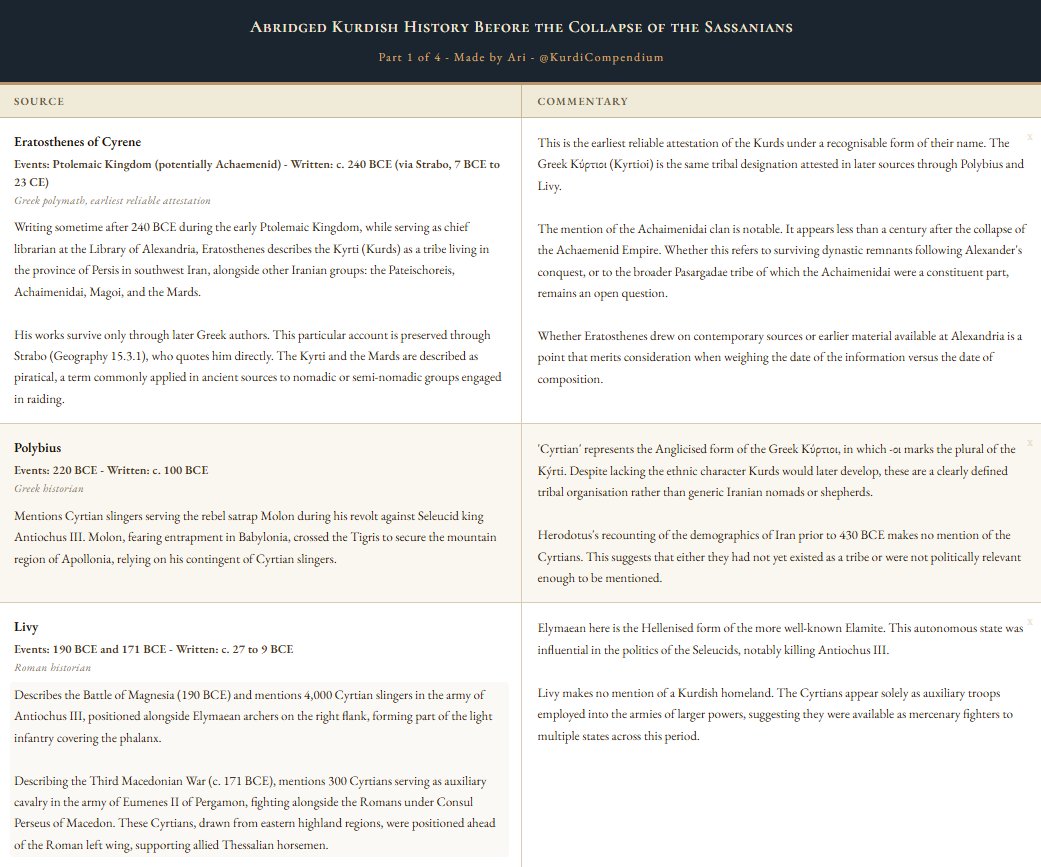
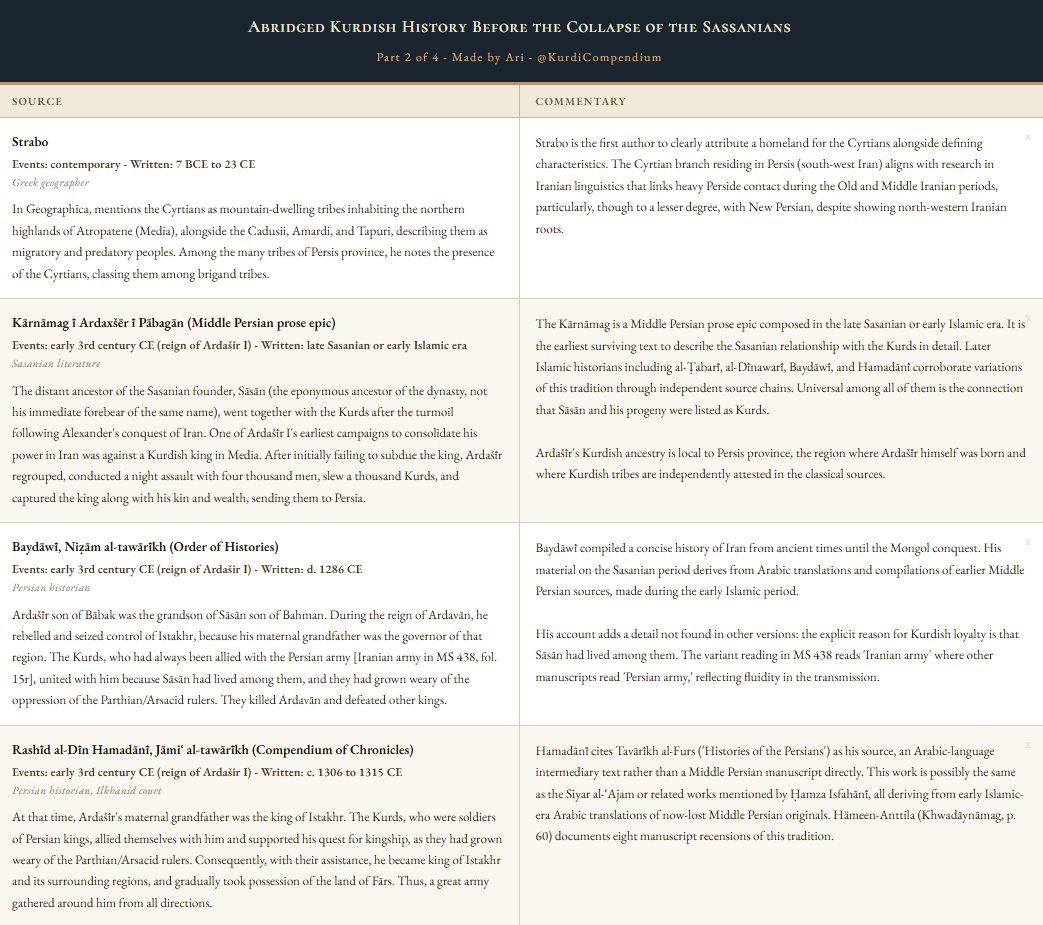
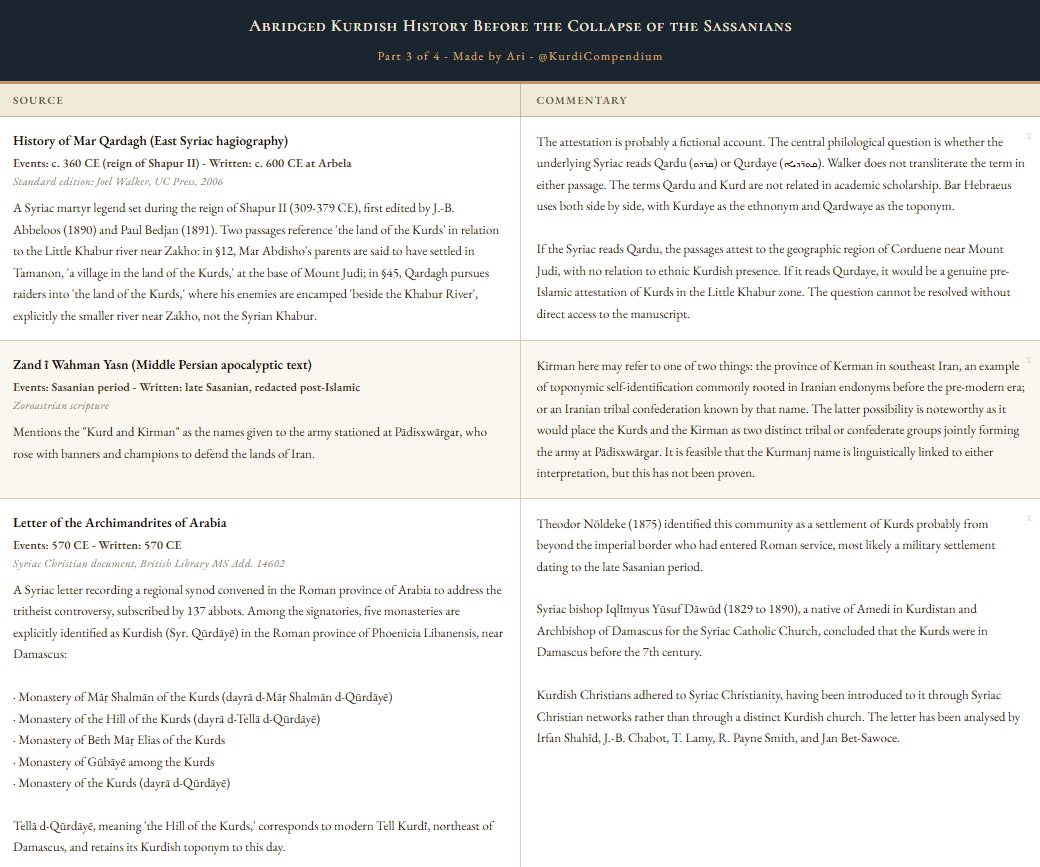
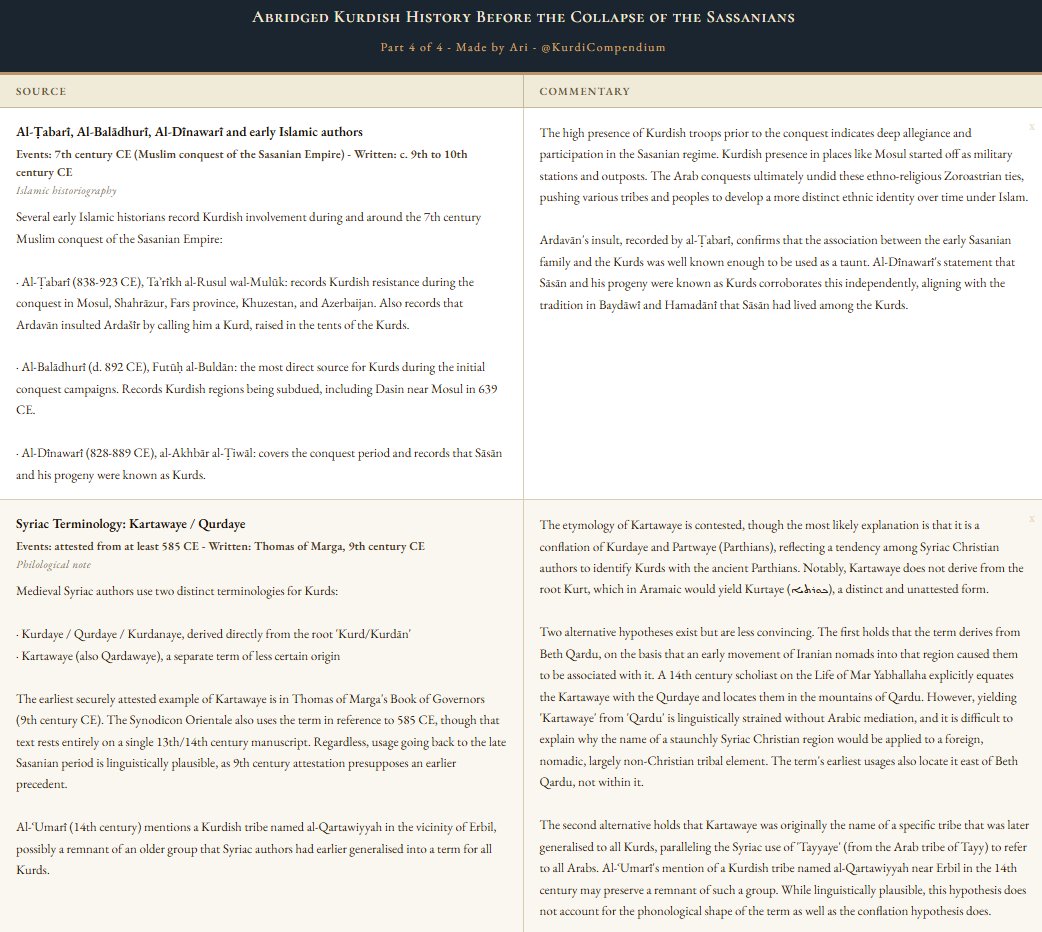
Complete Kurdish history before the Islamic age (reupload because I mistakenly didn't screenshot my commentary I had written on the Kār-Nāmag). As stated previously, any connection to Corduene/Carduchi/etc, is not listed here given that it is not only unlikely, but entirely unfeasible to be connected with Kurds, and is rejected by modern academic consensus. Furthermore, while it is true that Kurds were not defined as a distinct ethnic group within this period, it is certainly true that the Kurds were a distinct tribal confederation within the Iranian ethno-religious framework. Only direct historical attestations are included here.
7
17
70
20,047
Jun 4
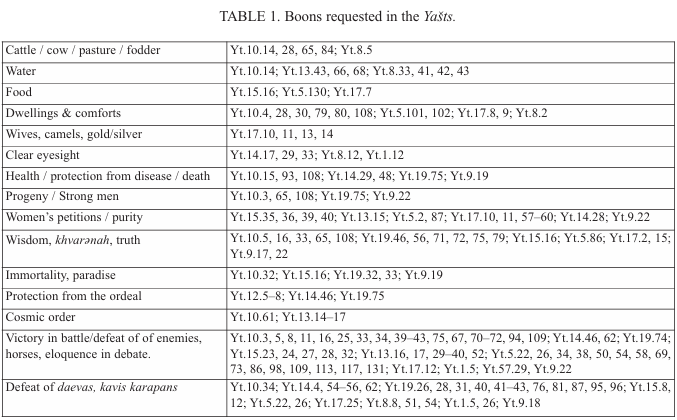
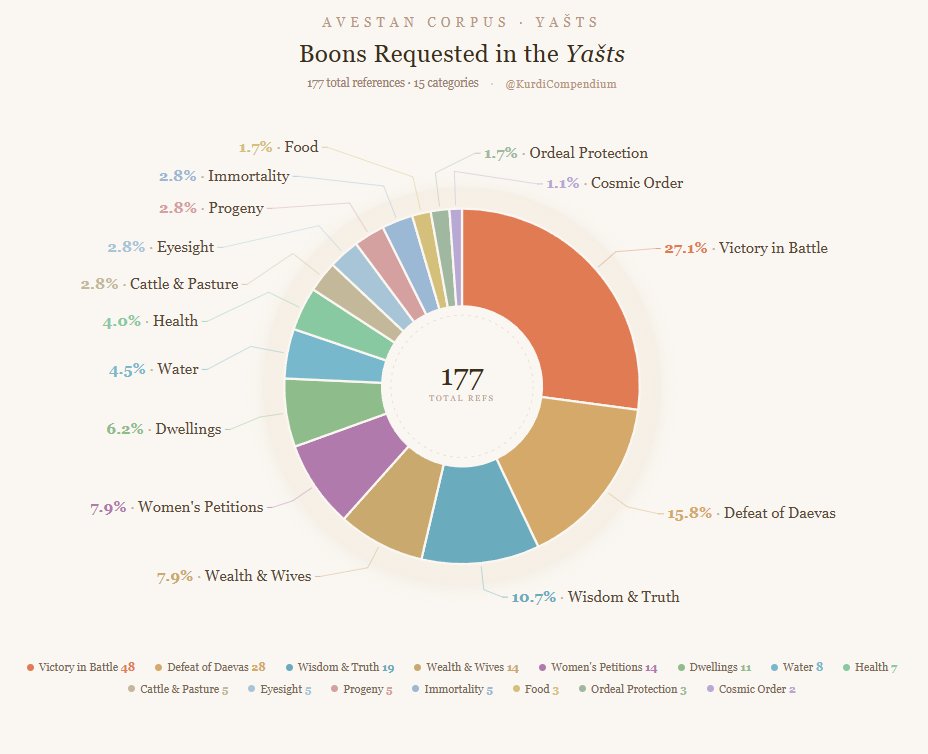
Holy war is one of the core structural features of Zoroastrianism. 27.1% of the requested boons in the Yashts are petitions for victory in battle against the worshippers of the Daevas ( those who stood outside the Zoroastrian fold). It is not only defensive in nature, but has a clear offensive dimension as well. Zoroastrianism has a clear concept of sacred violence against religious others.
This militant orientation has deep roots. The society into which Zoroaster was born was one of pastoralist tribal groups, in which violence was organised around cattle raiding, tribal feuds, grazing grounds, honour and revenge killing, among others. Priestly figures of the Aryan world, sanctified this activity through rites and rituals, lending cosmic legitimacy to what was essentially inter-tribal predation. Zoroaster's reformation did not abolish this violent impulse of his society. He redirected it in a religious prism. As the Airya identity fusing with Zoroastrian faith, produced a firm ethno-religious community that united the tribes, to conduct organised and structured violence on a much larger scale.
"Give him strength and victory! Give him welfare in cattle and bread!" thus said Zarathustra to the young king Vîstâspa. "Give him a great number of male children, praisers and chiefs in assemblies, who smite and are not smitten, who smite at one stroke their enemies, who smite at one stroke their foes, ever in joy and ready to help." ~ Drvasp Yt.9. 25–26.
2
11
41
2,684
May 31
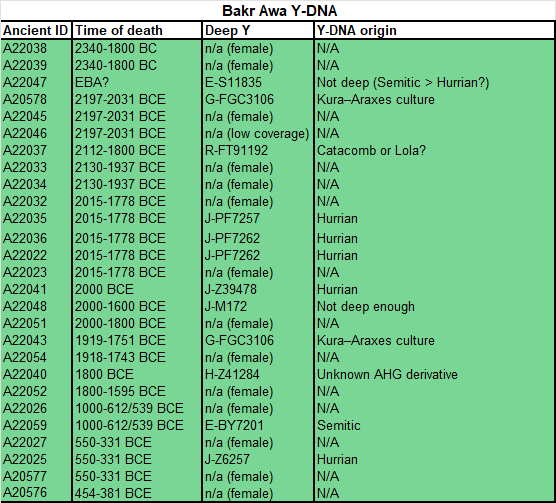
The Y-DNA samples at Bakr Awa, representing populations in Lullubum and Zamua, are just one part of a much larger phenomenon, which indicates that the Zagros Mountains were subject to extensive population settlements during the Bronze and Iron Ages from peoples further west and north of the Zagros, before any Iranians arrived on the Plateau.
Modern Kurds who reside in these same regions have far more eastern lineages, which is obviously reflective of their ancestral Iranian settlement in these lands, who were ultimately rooted in migrations from south-central Asia onto the Plateau. The modern ethnic distributions of these haplogroups have no presence among Iranians or Kurds that is not directly tied to having a modern Armenian paternal ancestor.
Prior to the bulk of these samples at Bakr Awa, there had been massive settlements from the Kura-Araxes culture, which expanded out of the Armenian Highlands into the Zagros. This is the ultimate origin of the two G2b samples that are KAC-derived, but who were absorbed into the incoming populations of the region.
One of the samples has an exceedingly rare, in modern populations, steppe-derived lineage from the Catacomb culture, or possibly even the Lola culture.
The expansion of Hurrians from upper Mesopotamia, accompanied by waves of Semites deriving from the Levant, represents the most important lineages among the samples at Bakr Awa.
10
15
72
13,205
May 29
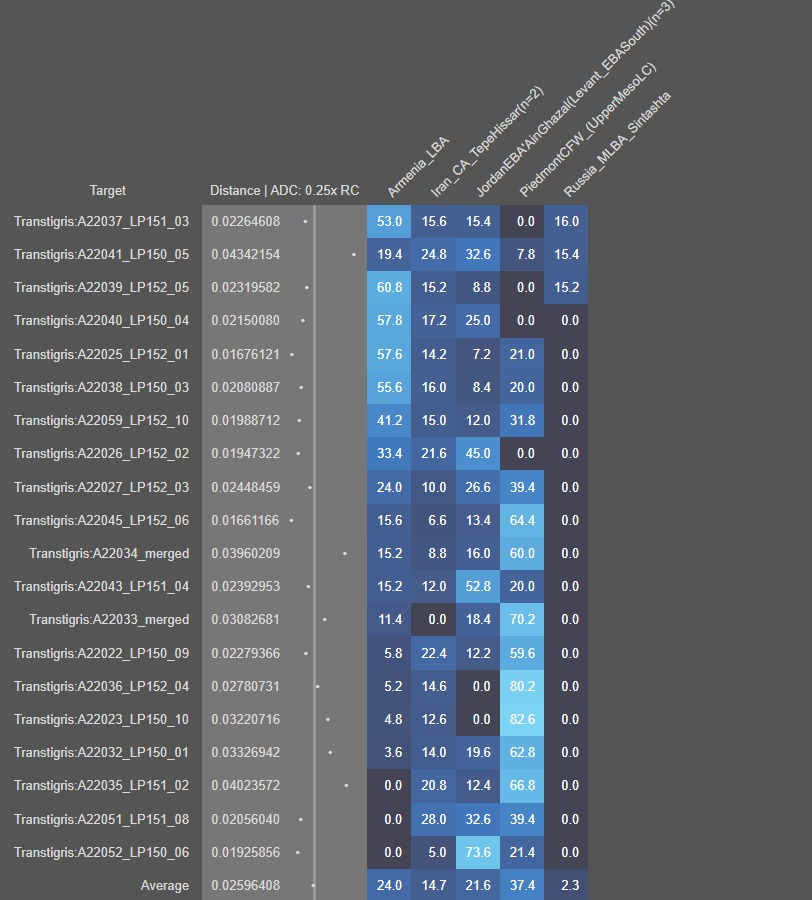
Brand new genetic samples in and around the Lullubi Kingdom from the Bronze and Iron Ages located at Bakr Awa in the Sulaymaniyah Governorate of the Kurdistan Regional Government in Iraq. The genetic samples are highly heterogeneous and can be categorised into 4 distinct genetic groups: a local Chaff-Faced Ware type profile, which likely signifies the oldest layers of ancestry in the region, and three categories that can be considered intrusive groups, namely a Semitic type profile, a Western Grey Ware type profile, and some type of high-steppe outliers.
Given the profiles below, it can be said this region experienced quite drastic demographic replacement throughout the course of the kingdom, even before the arrival of Iranians onto the Plateau. Three samples seemingly pick up Sintashta ancestry as a source, but it's not clear whether that is because they require extra steppe ancestry that is defaulting into the Sintashta category, or whether they have actual descent from Indo-Iranians. The steppe ancestry in these samples by and large comes from migrations down the Caucasus, and not from Indo-Iranians.
Unfortunately, as of now, we do not have proper genetic samples for late Chalcolithic Mesopotamia, which makes it hard to gauge just how much of this type of ancestry is present in these samples. The CFW source used here is already Semitic-admixed, which isn't ideal, but no proper alternative exists.
The genetic heritage of these samples in modern populations is not particularly relevant. What is relevant, however, is more broadly the types of migrations that were generally occurring in the Middle East around that time. Western Grey Ware samples artificially plot near Iranian speakers due to the fact that the combination of Hissar Arm BA Semitic ancestries in WGW is roughly equivalent to Sintashta BMAC Meso Arm BA, which has accumulated independently. Modern Iranians should have some level of WGW ancestry, but it isn't especially relevant.
To learn more about Western Grey Ware, check out the following two posts:
x.com/KurdiCompendium/status…
x.com/KurdiCompendium/status…
9 Dec 2025

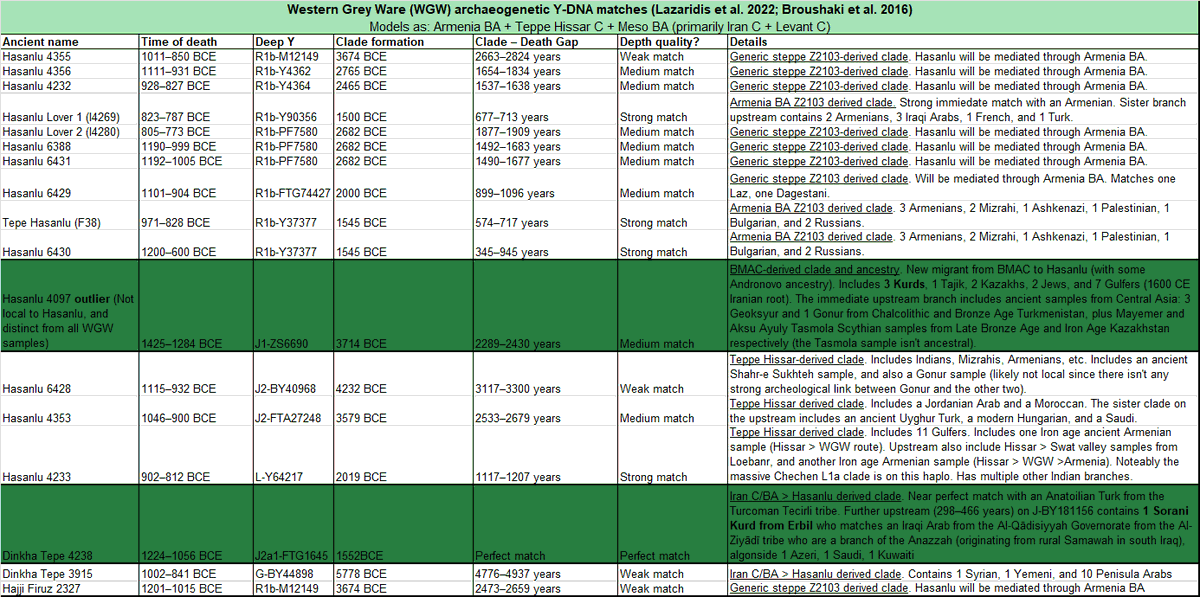
Y-DNA matches of all available Western Grey Ware (WGW) samples at Hasanlu, Dinkha Tepe, and Hajji Firuz.
Western Grey Ware (WGW) is an early Iron Age ceramic tradition found in northwest Iran that predates the arrival of Iranians onto the plateau. The primary source of the culture seems to derive from Teppe Hissar–related and derived expansions westwards into central and northwest Iran, as seen in the technological continuity and developments, with smaller degrees of technological input from Transcaucasia.
Interestingly, the Hasanlu site shows massive signs of being a genocide site, conducted by invading Urartians. Outside of the current WGW samples found in the most western regions of WGW at sites like Hasanlu, there are archaeological sites such as the Sagzabad cluster, Godin Tepe, and Nush-i-Jan Tepe. Godin Tepe and Nush-i-Jan Tepe are sometimes erroneously described as Median archaeological sites. This remains highly doubtful.
The WGW samples can be modelled as a three-way mix between Teppe Hissar, Meso BA, and Armenia BA. Perhaps the more eastern archaeological sites will contain more Teppe Hissar–enriched ancestry in the future. The genocide site at Hasanlu shows a large number of Armenia Bronze Age–derived paternal R1b-Z2103 clades, and a very high portion of the men show alleles associated with micropenis.
The WGW clades at present are generally very small among modern testers showing they are largely irrelevant paternally to modern populations. There is a repeated theme of Armenians inheriting clades close to the samples at hand. WGW clades at hand do not seem to have any significant matches with west Iranians. With over 300 Kurdish Y-700/FF samples available, only one person matches a WGW sample, and that individual is seemingly from a relatively recent assimilated background (the exact TMRCA is yet to be calculated). Check Dinkha Tepe 4238 in the Excel screenshot.
The one outlier sample from the BMAC culture, who had immigrated to Hasanlu before dying, is the only major match with modern Kurds from the current WGW list. The Kurds, Tajiks, Kazakhs, etc. do not descend from this specific BMAC migrant to Hasanlu, but from other BMAC-derived migrations (almost certainly via Iranians) out of south-central Asia. Check Hasanlu 4097 (outlier) in the Excel screenshot.
The end of the WGW horizon is marked by the massive surge in Iranian activity via new arrivals onto the plateau, first interacting with the Parsua tribes, and later the Median tribes, who would have modelled as a mix of SCA cultures like BMAC and late Andronovans.
It's difficult to believe that WGW populations went completely extinct, but progressive waves of Iranians, Mesopotamians, Armenians, etc., would have largely erased their signature. Modern west Iranian affinity to WGW is due to the accumulation of similar types of ancestry independently from WGW, not direct descent. I discuss the autosomal aspect in more detail here:
x.com/KurdiCompendium/status…
5
9
55
6,675
May 28
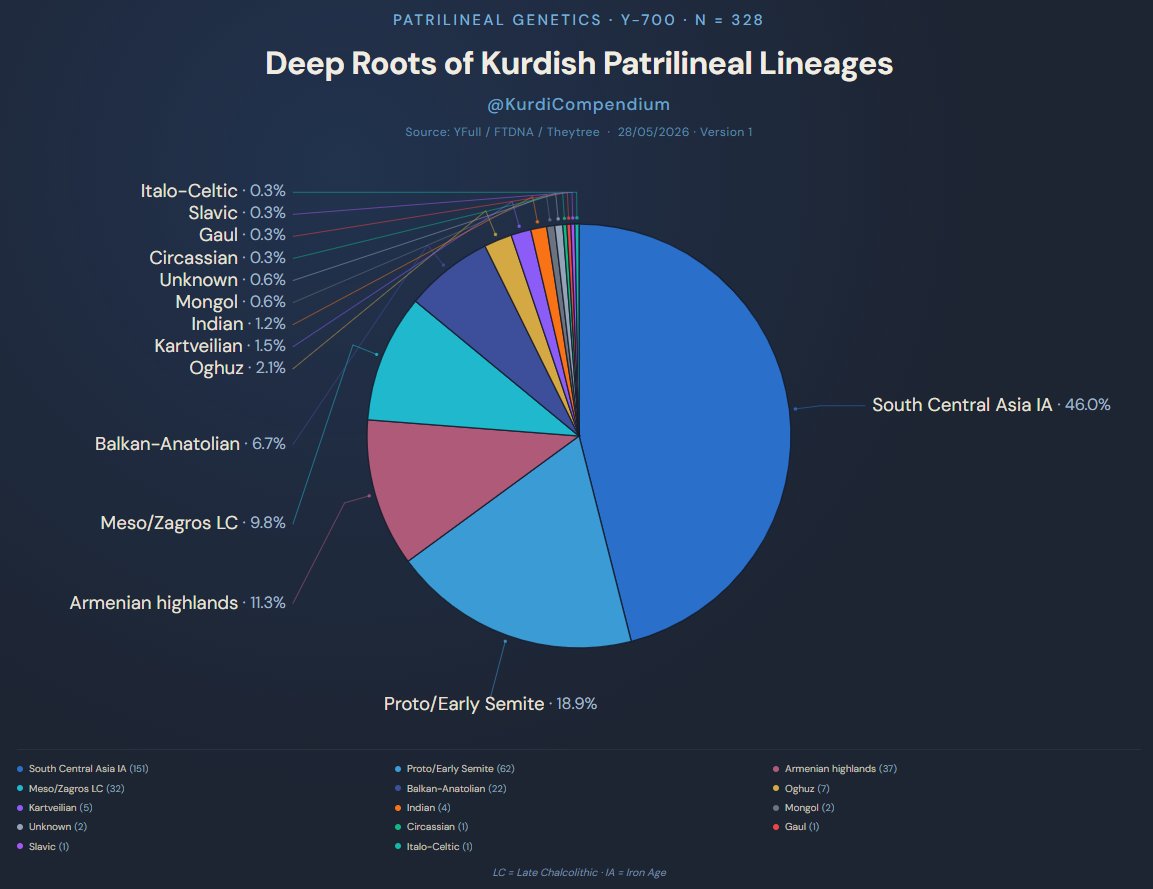
The complete deep origins of 328 Kurdish patrilineal lineages that have been sponsored or purchased through Whole Genome Sequencing (30x or higher), or through Y-700 and equivalent STR-based testing. The following also includes Kurdish samples sequenced through scientific studies to the level of 30x WGS or higher. It does not include haplogroups sequenced to anything below this high level of sequencing, therefore excluding the majority of scientific studies conducted only at Y-17 level, since we require Y-700 level testing.
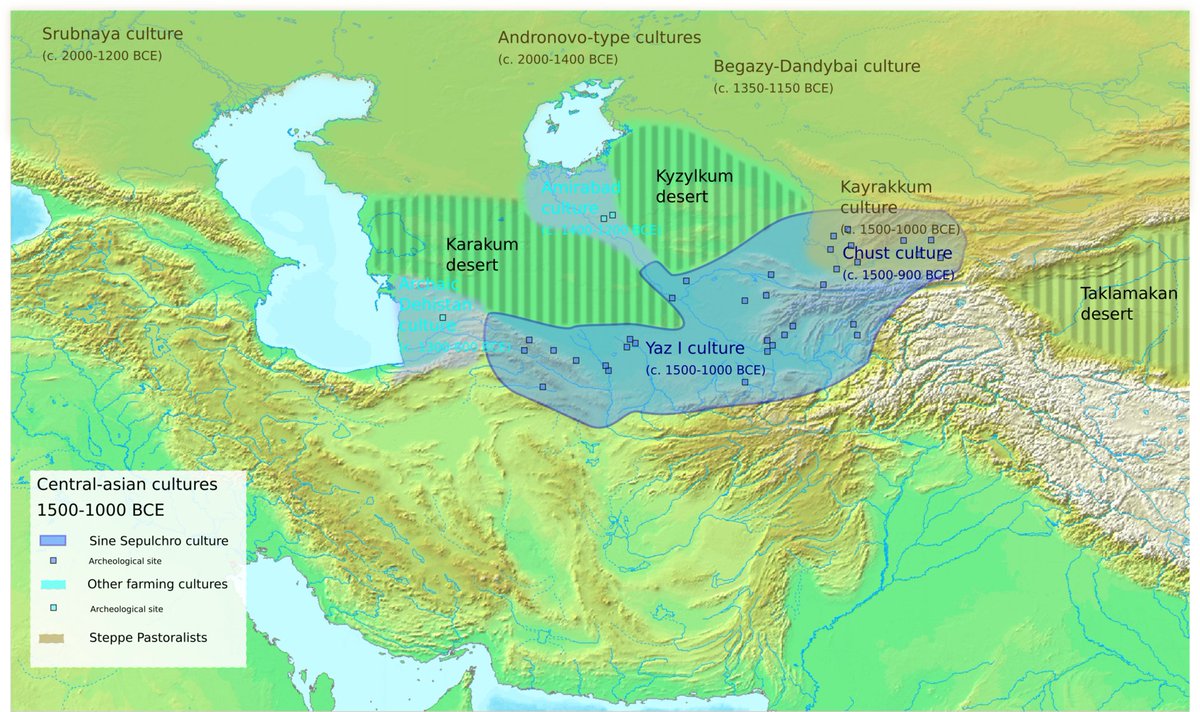
Based on the current data it can be ascertained that the clear plurality of the founding father population among the Kurds belong to Iron Age Iranians (circa 1500–1000 BCE), who were a hybridised population between Andronovans and local South Central Asian cultures like the BMAC. Most notably the Yaz culture, which scholarship and academics attribute to the rise of the Zoroastrian religion and the rapid militarisation of Iranian society, experienced a massive expansion phase. The so-called "West Iranian peoples" are a syncretised population from these early Iron Age Iranians from Central Asia who moved into the Zagros and plateau and encountered a myriad of different cultures, most notably the Elamites, including populations that were also quite freshly integrating into the Zagros, like the Semitic peoples who were already penetrating deep into the Zagros since the Middle Bronze Age (attested as far as Anshan, the Elamite capital). It is from this milieu that the first attestation of Kurds can reliably be found, dating back to Eratosthenes of Cyrene, who was born in the Ptolemaic Kingdom and was likely relying on an Achaemenid source. Kurds are first attested in the province of Persis in south-west Iran. Indeed, this is what we expect via comparative linguistic studies at the dialectal level. A North-West Iranian language living in a core Persian hub, prior to expansion out of south-west Iran into what is now Kurdistan sometime around the Sassanian era.
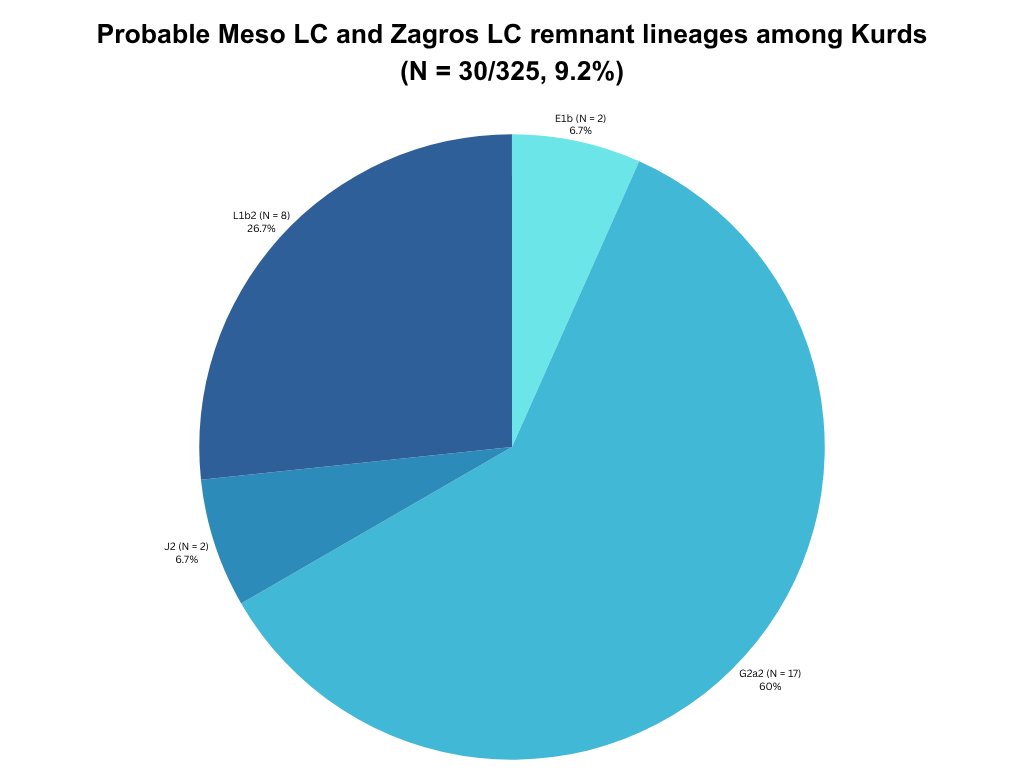
Based on the modern haplogroup distribution of Kurds it is quite apparent that the strongest and oldest layers of non-Iron Age Iranian paternal ancestry is in fact attributable to Semites, and not what most people expect, which is various indigenous Zagrosian populations. Typically the Semitic lineages among Kurds date back to around the Achaemenid era. In general there seems to be an influx of Semitic speakers into the Iranian plateau during the Achaemenid period. Based on haplogroup data there is not a single clear case of an indigenous remnant Zagrosian lineage among the Kurds that precedes the Bronze Age. Despite this, 9% is plausibly attributed to some type of local LC Meso and/or Zagrosian populations. The first Kurdish tribes would be comprised of a Semitic, an Iron Age SCA Iranian, and a localised plateau population. Interestingly there is a probable Seleucid Greek founder-effect lineage among modern Kurds that dates a few hundred years after the attestation of the first Kurdish tribes. The overwhelming majority of the remaining lineages I have not mentioned here have mutations attributable to post-Islamic assimilations, which includes the vast majority of the Armenian highland haplogroups, all Oghuz Turkic lines, among many others. Comparing Kurdish autosomal data against haplogroups, it is exceedingly clear that the Iron Age Iranian haplogroups among Kurds have huge male-biased selection. This means the Iranian lineages were the most socially dominant group among the Kurds, who reproduced more than other segments of the population. This makes sense since Kurds are an Iranian ethnic derived population, in a patrilineal based society.
Unfortunately the data disproportionately includes Zaza and Kurmanji speakers who come from Berferati (the most western parts of Kurdistan) speaking regions, since these are the regions that generate the most diaspora. Sponsoring Kurdish clades all across the Kurdistan region is of heavy priority right now. A major issue right now is that the vast majority of DNA kits that are being sponsored are not being used and are being sent back to the labs, despite the fact that these kits cost $449 for a single test. Please DO NOT ask for sponsorship if you are going to waste hard-earned money. This is just shameless and disrespectful of the highest order. If you have gotten your DNA sequenced, you must join a relevant DNA project to secure traceability of where we are sourcing this information from. We encourage you to include all relevant details like tribe, place of birth of paternal ancestors, etc.
18
41
124
27,481
May 27
9% of the Kurdish paternal Y-700 lineages that exists among the Kurds are traceable to genetic populations indigenous to late chalcolithic Mesopotamia or Zagros. The leaves 91% of the Kurdish lineages belonging to populations that had moved there from the bronze age and onwards, whether it be bronze age Semites moving out the Levant, Iron age Iranians from south central Asia, etc. This is based on the haplogroup diversity of modern and ancient genetically tested samples that have been sequenced up to a depth of 30x WGS, or an equivalent coverage.
Source: Yfull, FTDNA, and theytree.
5
8
53
10,767
May 26
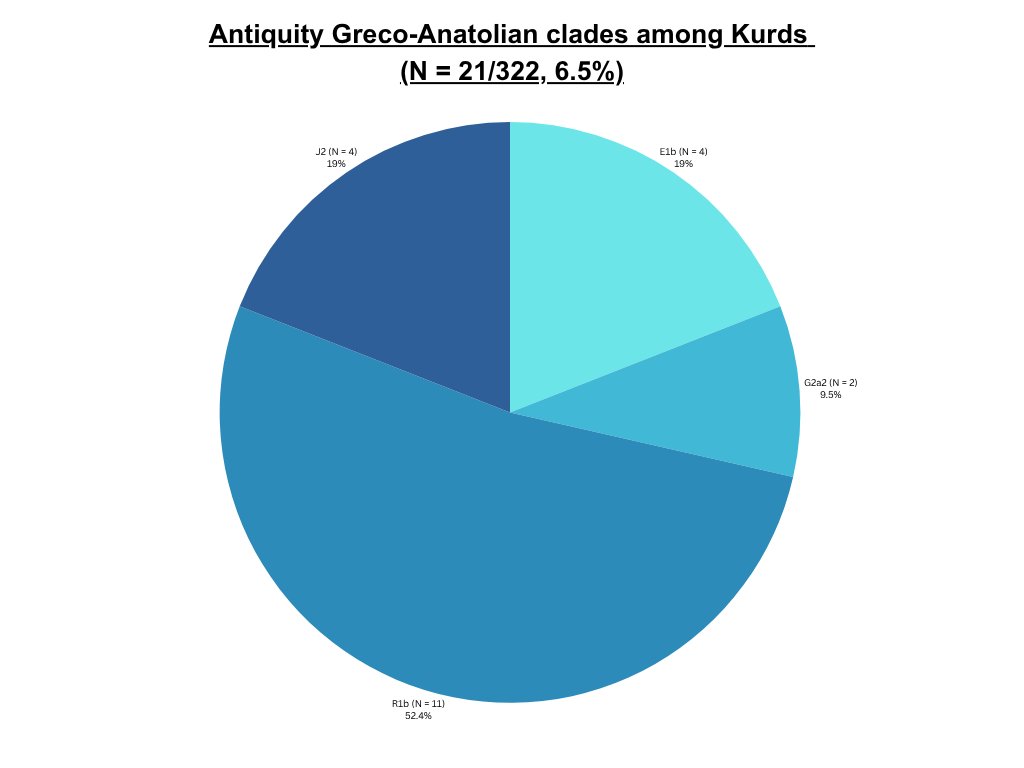
6.5% of Kurdish men belong to paternal Y-700 lineages traceable to the Greco-Anatolian world of antiquity. All the following clades have no post-Islamic matches, which strongly implies roots deep within history. Most notably, the massive Reshwan tribe have a major founder effect under R-FT186298 dating back to 87 CE (Parthian era). Most likely this individual was a descendant of a Seleucid Greeks settlers further back, carrying a Mycenaean lineage in Iran. The following historical frameworks are the most likely explanations for the origin of the various clades among the Kurds:
The first notable point of contact between the Anatolian and Greek world and the Iranian world came during the Achaemenid era, rather than the so-called Median Empire, which serious academic scholarship now largely deems to be an invention of Herodotus and not something that actually existed. Despite what is commonly believed, the Achaemenids brought in massive quantities of indentured servants and slaves from across the empire to serve the Iranian tribes. These house and palace workers were called kurtash (not to be confused with Kurd, which is separately attested as an Iranian tribe) and were often sourced from the Greco-Anatolian world. Iranian interaction with that world continued with Alexander's conquest and the succeeding Seleucid empire, which held dominion over Iran. Although not Greek, Thracian subjects were attested by Strabo as having migrated into the Zagros (possibly the root of those E-V13 Kurds). A great friction spanning 700 years between the Roman and Iranian world ignited with the collapse of the Seleucids and the rise of the Parthian empire, beginning with the delegations they sent to the great Roman dictator Sulla, whereby great disrespect was taken by the Parthian king of kings. The succeeding wars ultimately resulted in large quantities of slaves being transported to the winning side. Most famously, the Iranian annihilation of Roman armies at Edessa and Carrhae resulted in large numbers of slaves being imported into Iran, including the enslavement of the Roman emperor Valerian.
6
9
65
9,433
May 25
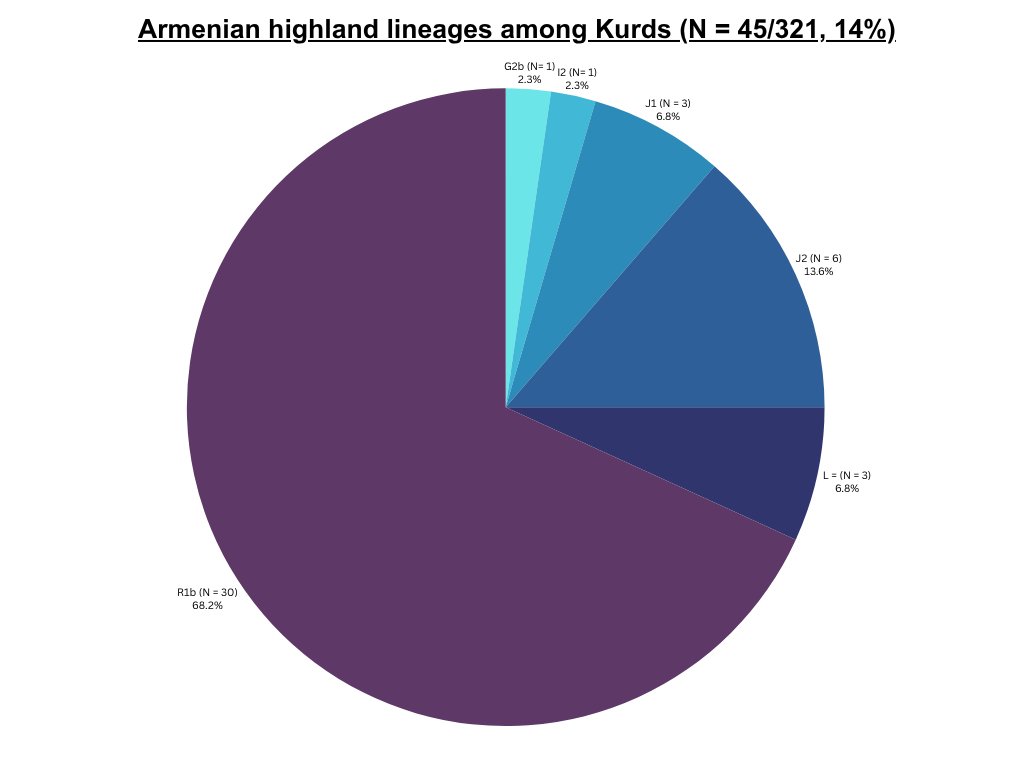
14% of the currently sequenced Y-700 Kurdish male lineages are traceable to the Chalcolithic-era Armenian highlands, encompassing cultures like the Kura-Araxes, and onwards into the Bronze Age with the Lchashen-Metsamor and Hayasa-Azzi, all the way to the Iron Age with the Urartian empire, and later in Antiquity with the rise of the Armenian kingdoms.
At a minimum, 20/45 (44%) of the post-Chalcolithic Armenian highland lineages among Kurds derive from the assimilation of Armenians within the last few hundred years, as the mutational DNA markers between individuals are shared within the Islamic age. Kurds expanded into the Armenian highlands during the tail end of the Sassanid empire, and more specifically during the Islamic age.
Given the overrepresentation of Kurds DNA-tested in regions where Armenian autosomal ancestry spikes (typically in the 40–60% range), it can be stated with certainty that there was a strong bias against non-Kurdish males who were previously native to the Armenian highland regions throughout history. Given that a great portion of Kurdish males, especially central-southern Sorani speakers and southern Kurdish/Xwarini males, do not have such high levels of Armenian ancestry, the proportion of Armenian highland lineages is realistically much lower than what is shown here for the Kurdish average.
Indeed, associated haplogroups with the Armenian highland regions are far lower among groups like Xwarin speakers or Sorans, but they lack high depth genetic sequencing.
4
4
46
10,833
May 24
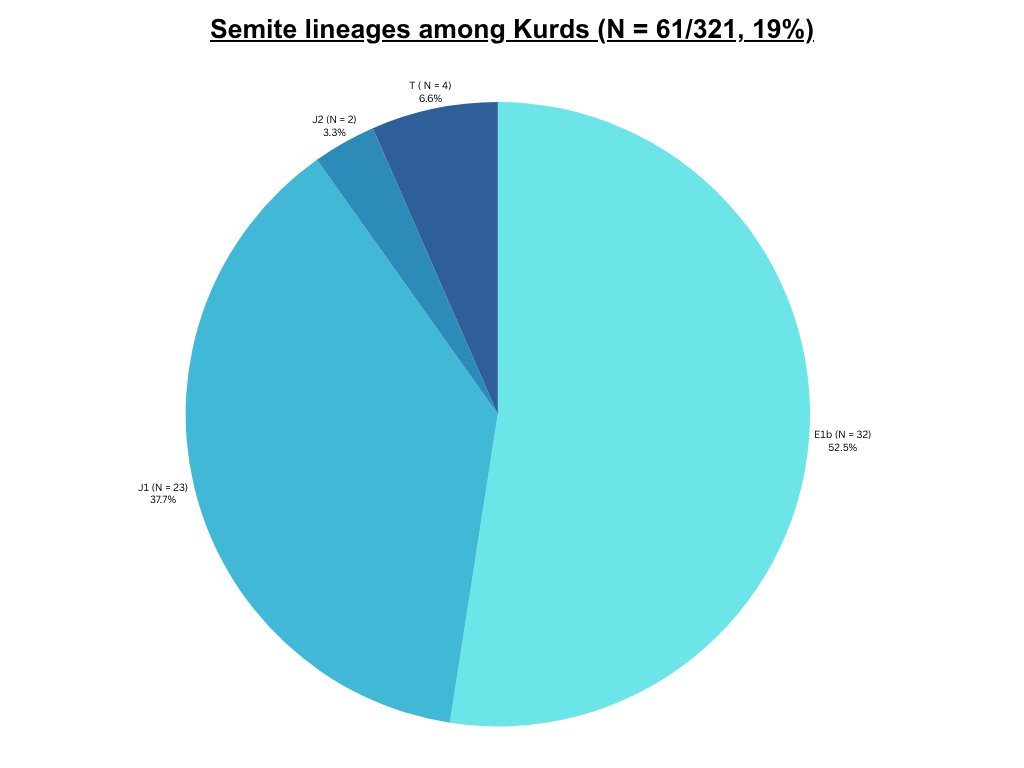
19% of the paternal lineages among Kurds are traceable to Proto-Semitic/early Semitic speakers, who originated in the Levant around 3500 BCE. The greatest bulk of the Semitic lineages among Kurds diverge from other Semites sometime just before and during the Achaemenid era. Semitic presence in the Iranian plateau dates back to the Bronze and Iron Ages, during their great expansion phase. Their presence is attested all across the Zagros during the pre-Iranian periods, as far as Anshan in Elam, among many others. Mesopotamian Semitic presence in Iran continued well into the Iranian periods, where they were known for being merchants and traders.
Out of these 61 Semitic haplogroups, 6 are of Bedouin Arab origin, and 1 is of Sabaean Yemenite origin. Therefore, 11% of the total Semitic haplogroups among Kurds are of Bedouin Arab and Sabaean origin. This roughly translates to 2% of the current total Kurdish Y-DNA. A low number of these clades can be attributed to post Islamic assimilations.
9
8
55
3,660
May 22
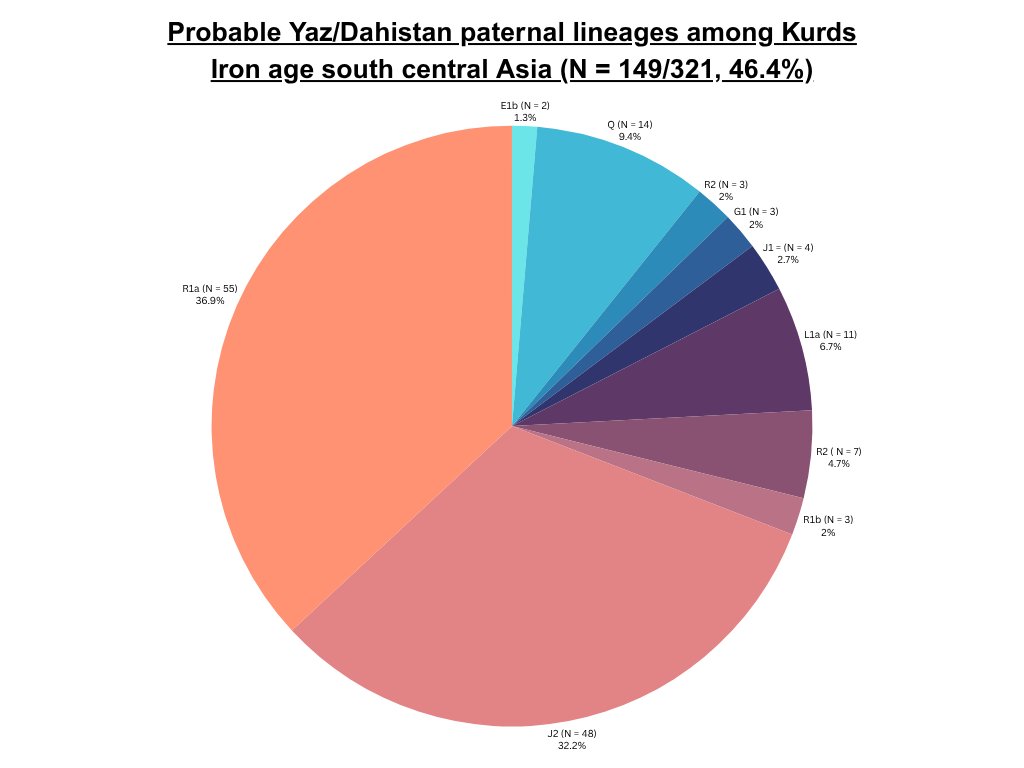
Almost half of Kurdish Y-DNA paternal lineages are traceable to Iron Age Iranians of south-central Asia, inferred through a combination of Late Neolithic–Iron Age ancient samples from central Asia and Y-haplogroup diversity data from modern populations sharing the same root lineages as Kurds that link back to an Iron age SCA root. Source: yfull/FTDNA/theytree
This should not be confused with the proportion of "proto-Kurdish" lineages among Kurds, as Kurds are first attested as a tribal organisation sometime between the Achaemenid and early Seleucid periods, and did not fully emerge as a distinct ethnicity from other Iranians until the Islamic era.
14
24
94
19,476
May 16
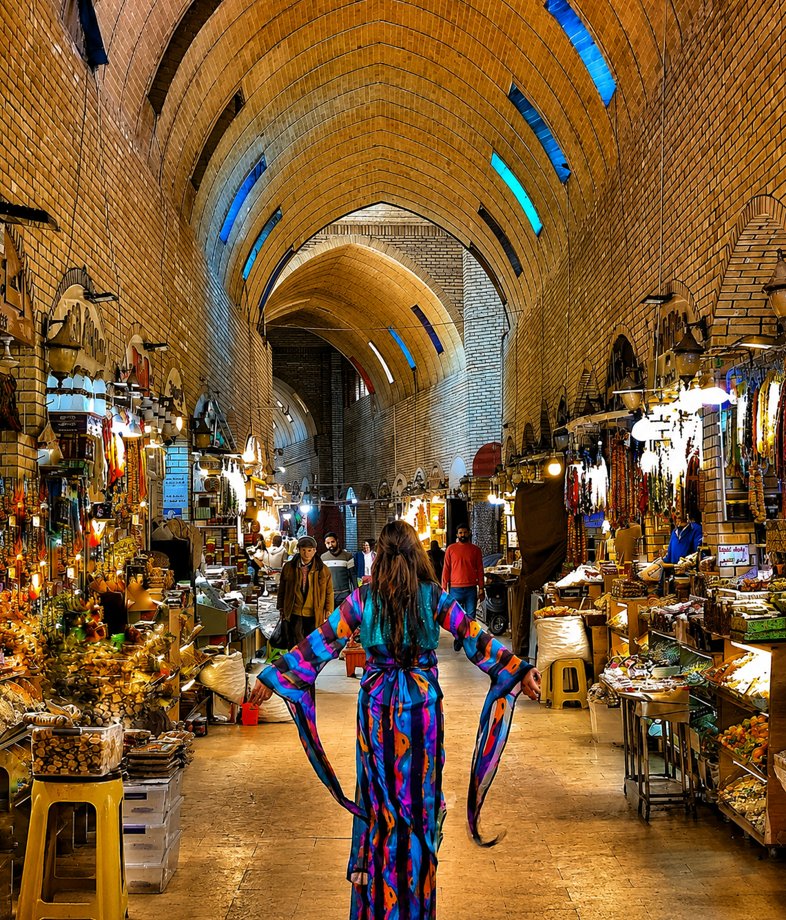
One of the great ironies surrounding the various grand bazaars becoming emblematic symbols of Kurdish cities is that their normalisation over the past several hundred years is itself a product of “Turco-Persianate” influence. The very word bazaar is a Persian loanword in Kurdish, even though Kurmanji already possessed an independent derivative root, bāzhār, meaning “city,” which itself came from an older Iranian root referring to trade spots and markets. Kurds, who were traditionally nomadic, associated the custom of markets with their urban subjects, typically seen as the domain of non-Kurds.
In pre-Islamic times, there was extreme animosity toward mercantile behaviour, stemming from the pastoral economic self-sufficiency of ancient Iranian societies and reinforced by strict Zoroastrian legal and ethical codes concerning truth, oaths, and the six graded forms of contractual customs governing trade and agreements, both verbal and non-verbal. Any breach of contract could entail severe punishments not only for the individual, but potentially for all his Nabanazdishta (nine generations of next of kin), with hellish torments including limbs being cut off, impalement, and even being forced to drink sulfur-infused potions to atone for sins committed by the tongue, sometimes extending anywhere from 300 to 1,000 years.
Most notably, the oldest example we have of ancient Iranians expressing disgust toward bazaars comes from none other than Cyrus the Great, who mocked the Greeks for permitting people to gather in the centres of their cities to barter in common marketplaces, i.e. bazaars, which he regarded as hotspots for Druj (lies and deceit), one of the gravest sins. Mercantile behaviour continued to be viewed with contempt even into the period of the Sasanian Empire, when such practices were associated with non-Iranian peoples, particularly Mesopotamians, and merchants were placed within the lowest social strata. This dehumanisation, in turn, contributed to the mercantile caste of Iranian society being disproportionately represented among the earliest converts to Islam during the formative phases of the Islamic era.
Kurds, who maintained their pastoral and herding background even after converting to Islam, largely confined the peasantry engaged in settled life and mercantile activities, such as working in the bazaars, to the status of social outcasts within the broader Kurdish clan structure throughout Kurdistan. The pastoral tribal class heavily restricted their social mobility by removing many freedoms available to these groups. This commonly included denying them the right to participate in political affairs, the right to bear arms, and similar privileges. Greater respect and dignity were often shown to rival clansmen than to the peasantry of one’s own clan. Even when the peasantry was ethnically Kurdish, their Kurdish identity was frequently not regarded as equal to that of the tribal pastoral class.
5
9
56
14,728
May 15
Are Kurds Iranian? Undoubtedly yes. For those struggling to comprehend that words can have more than one meaning, the term "Iranian" is indeed one such case where it carries various meanings. The term "Iranian" is not just a passport, nor was the term "Iran" coined in 1935. The term "Iranian" is among the oldest continuously used terms in human history. As relevant to Kurds, the term "Iranian" encompasses the linguistic, cultural, genetic, and civilisational roots and heritage tied to the Iranian plateau.
That doesn't mean that now all Kurds have to join Iran as a political movement, or to endorse pan-Iranianism. You can be a Kurdish nationalist and be committed to truth no matter what the topic is about. This is a brand new phenomena that has arisen in the past several decades where some Kurds are coping about the most basic 1 1 level fact possible. This is despite the fact historical Kurds have repeatedly asserted their Iranian nature in multiple dimensions. Any Kurd who denies being Iranian is either stupid or ignorant, and usually both.
This post is dedicated to the peanut brained copers on this platform who take issue with my posts, and like backtalking like little girls.
7
15
69
14,257
May 14
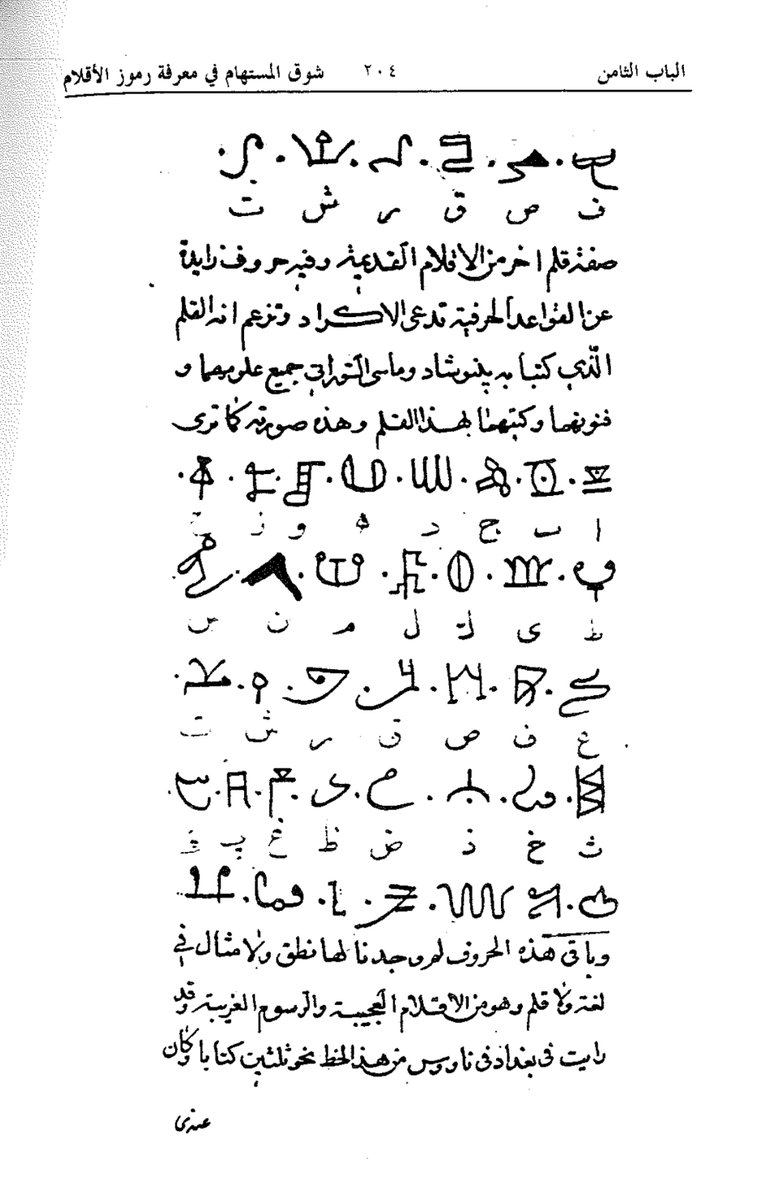
This supposed ancient Kurdish script described in the book Shawq al Mustahām fī Maʿrifat Rumūz al Aqlām is complete fan fiction that was not even written by Ibn Waḥshiyya. It is a spurious work falsely attributed to him by a much later author in order to increase the legitimacy of its contents. In fact, the book contains numerous errors that are not only fictitious but also chronologically impossible. For example, the author, who pretends to be Ibn Waḥshiyya, claims he is presenting his book as a valuable gift to the library of the Umayyad Caliph Abd al Malik ibn Marwan, who died in 705 AD, even though Ibn Waḥshiyya was born about 200 years later. This pseudepigraphic author attributes the work to two figures named Yanbūshād and Māsā al Sūrānī, who are not even Kurds, but rather fictional characters from the Nabataean Syriac tradition seen in the story of Filāḥa al Nabaṭiyya, where they appear as Chaldean men separated by a fantastical span of 21,000 years.
None of this is even necessary to debunk this exceedingly obvious fake script, as there is no epigraphic or manuscript corroboration whatsoever to show that it was ever used. The customs and traditions of the Kurds as herders meant that they operated outside urban environments and were far removed from literary culture. The emphasis among our nomadic ancestors was on oral tradition. In the post Islamic age, Kurds wrote almost exclusively in Arabic, Gorani, and Persian when they chose to write anything down. There is almost nothing written in Kurdish proper, since Gorani does not count as Kurdish proper, until the last few 100 years. The scripts used by Iranians in the pre Islamic age were adapted forms of cuneiform and Aramaic derived scripts such as Pahlavi, and this is what Kurds would've used if they decided to write anything down.
When you try to disconnect Kurds from their Iranianness, you inevitably end up endorsing absurdly retarded fanfictions about our past, completely disconnected from reality.
1
12
48
7,453