#StateOfLondonapps.london.gov.uk/state-of-…
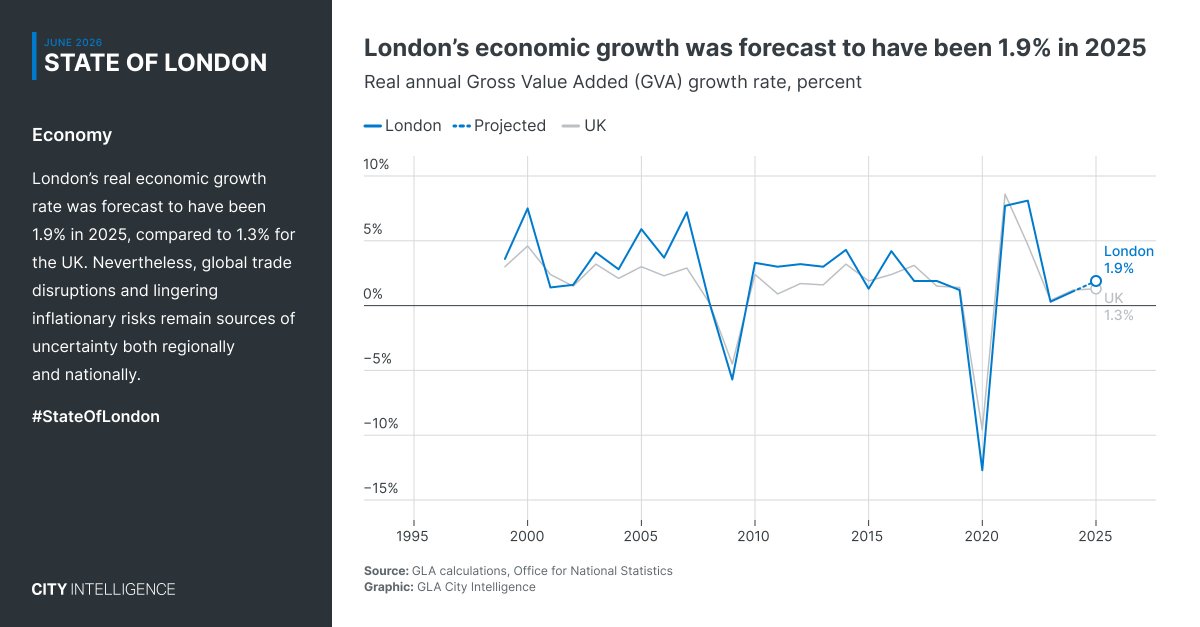
London’s real economic growth rate was forecast to have been 1.9% in 2025, compared to 1.3% for the UK. Nevertheless, global trade disruptions and lingering inflationary risks remain sources of uncertainty both regionally and nationally.
ALT Estimates by GLA Economics suggest a modest strengthening of economic growth in London over the last two years, with real GVA expected to have risen by 1.1% in 2024 and 1.9% in 2025.
Historically, economic growth in London has tended to outperform the UK’s, reflecting its position as the country’s economic engine. In recent years, however, this advantage has narrowed. London’s cumulative recovery from the pandemic has lagged behind that of the UK overall. GVA in 2025 was estimated to be 5.1% above its pre‑pandemic 2019 level, compared with 5.9% for the UK as a whole.
Rising unemployment and widening inequalities
This blog examines how two key consequences of high unemployment, namely rising unemployment duration and falling rates of job-to-job transitions, have affected different groups of Londoners.
data.london.gov.uk/blog/risi…
#StateOfLondonapps.london.gov.uk/state-of-…
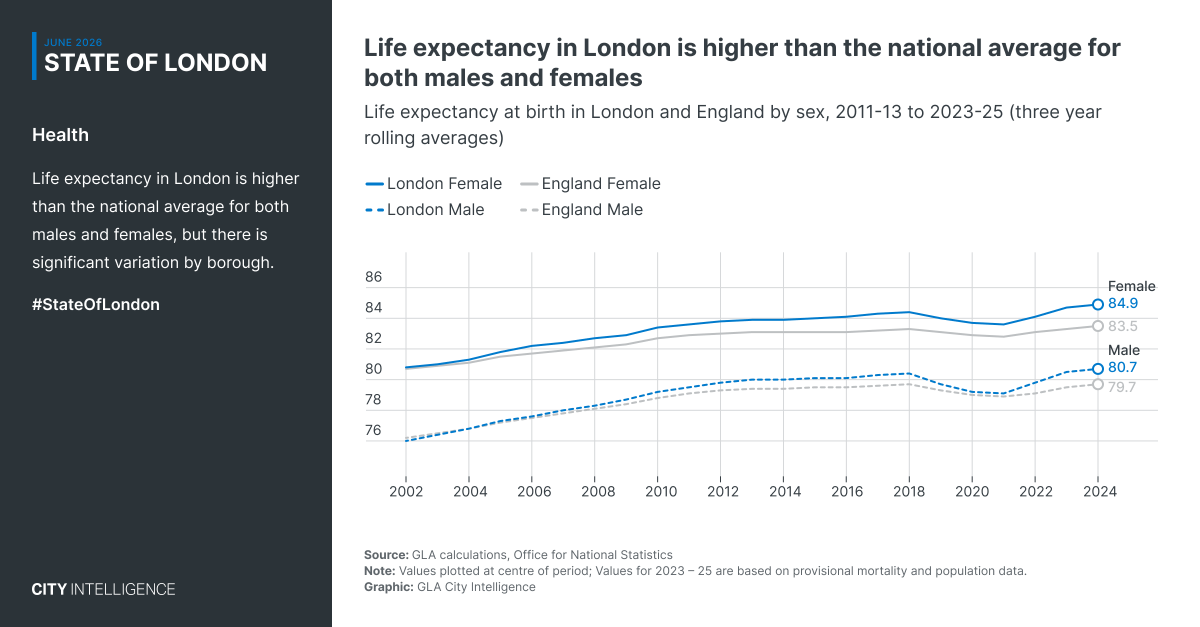
Life expectancy in London is higher than the national average for both males and females, but there is significant variation by borough.
ALT In London, life expectancy at birth in 2023-25 for males stood at 80.7 years, and for females it was 84.9 years, a slight increase on the previous period of 2022-24 (80.5 and 84.7 years, respectively). This increase continued to raise life expectancy to levels higher than those before the pandemic.
Life expectancy in London is higher than that for England which was 79.7 years for males and 83.5 for females in 2023-25. This has been the case for males since 2005-07 and for females since 2001-03.
However, there is significant variation in life expectancy by local authority in London. In 2023-25, life expectancy for males ranged from 78.2 in Barking and Dagenham and Hackney to 83.3 in Kensington and Chelsea. For females it ranged from 82.2 in Barking and Dagenham to 87.2 in Richmond upon Thames. Barking and Dagenham was the only borough for which life expectancy was significantly below the national average for both males and females.
The State of London report 2026 is out today. The GLA’s annual report with over 100 datasets about the capital’s economy, society, environment, all in one place. Published for the first time as a fully digital report: apps.london.gov.uk/state-of-…
London's Economy Today-Issue 285-May 2026.
UK inflation drops in April.
New evidence on UK productivity performance.
Softer house price growth, but persistent rental rises.
Is London’s cost of living pulling away from UK average? Read full newsletter: bit.ly/43ywvvh
London’s workforce exposure to generative artificial intelligence.
This report examines London’s exposure to GenAI across its different occupations, industries & communities. It provides an evidence-based picture of where change is most likely to fall. bit.ly/42XFxlk
ALT Front cover of London’s workforce exposure to generative artificial intelligence report
London's Economy Today - Issue 284 - April 2026.
The economic fallout from the disruption in the Strait of Hormuz continues.
UK inflation picks up in March.
London’s labour market retains weak underlying momentum.
Read the full newsletter:
bit.ly/4taVRtM
📢 London Data Week is BACK! 🎉
Supported by the @MayorofLondon, join us July 6-12 2026, for London’s citywide festival of data. Showcase your organisation's data innovation and connect with 2000 attendees.
Apply to run an event 👉londondataweek.org#LondonDataWeek
ALT Graphic of London Data Week text with DATA in blue, pink and yellow.
Recent studies on Brexit’s economic impacts.
With more comprehensive data to work with, evidence suggests higher negative impacts to UK economic performance in the 5% to 10% range.
This note presents the results of some recent analyses on the subject.
bit.ly/4uVeJir
London's Economy Today - Issue 283 - Mar 2026.
Conflict in the Middle East triggers global commodities shock amid fears for the cost of living.
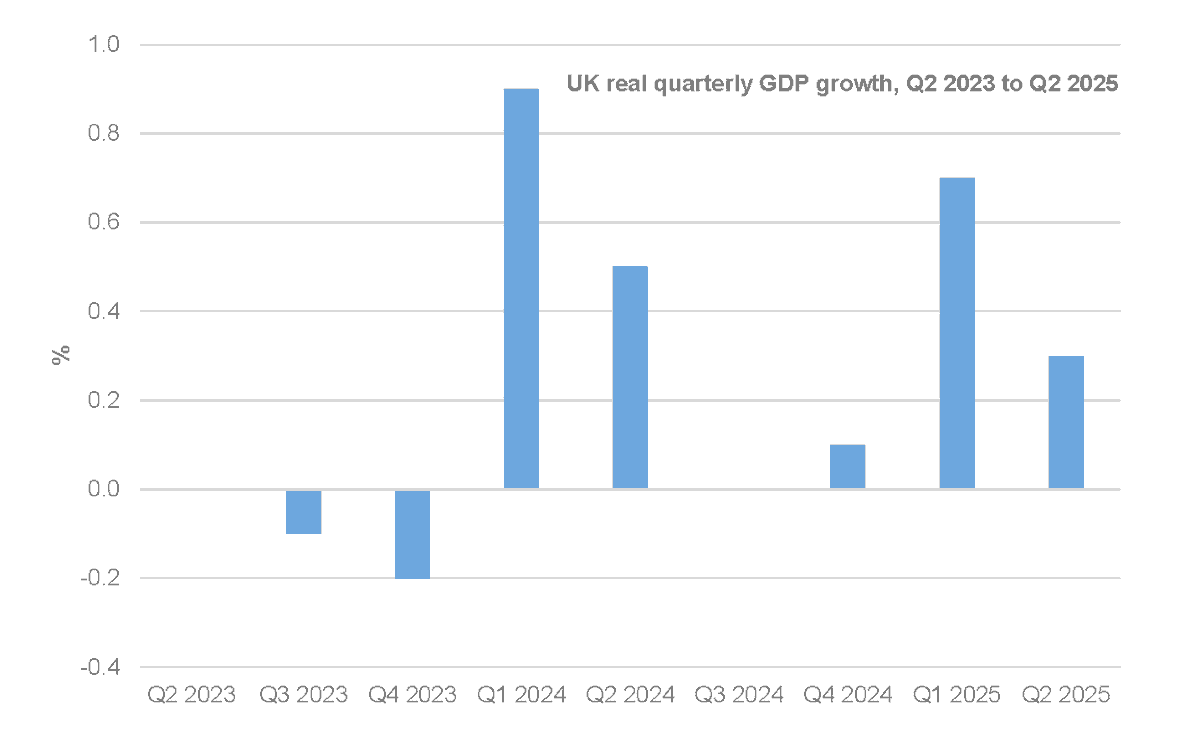
UK GDP growth remains weak.
Devolved mayors could be given control over some tax revenue.
Read the newsletter:
bit.ly/3NOpnH5
London long-term labour market projections - 2024-based update.
GLA Economics look at how London’s labour market is expected to evolve over time.
Workforce jobs are forecast to grow from 6.4m in 2024 to 7.3m in 2050, an increase of 869,000 jobs, (13.6%).
bit.ly/4bR5W8t
London's Economy Today - Feb 2026 - Issue 282.
UK GDP grows sluggishly at the end of the year.
UK inflation falls back sharply in January.
London’s unemployment rate rises.
Read the full newsletter:
bit.ly/3N0whbP
London’s Economy Today-Jan 2026-Issue 281
UK inflation picks up in Dec.
UK GDP returned to growth in Nov.
London’s labour market remains soft.
Read the full newsletter which includes our supplement preview on London employment projections :
bit.ly/4rllRSE
🤔Is it too soon for an end of year blog?
We don't think so!
Read Chief Digital Officer for London Theo Blackwell's blog: 2025 playback and what’s next…
✅bit.ly/2025playback
London's Economy Today: Dec 2025.
UK GDP shrinks in October.
UK inflation slows further in November as Bank reduces interest rates.
Steady growth in London’s output, employment & household finances forecast for the coming years.
Read the full newsletter:
bit.ly/4qloFyO
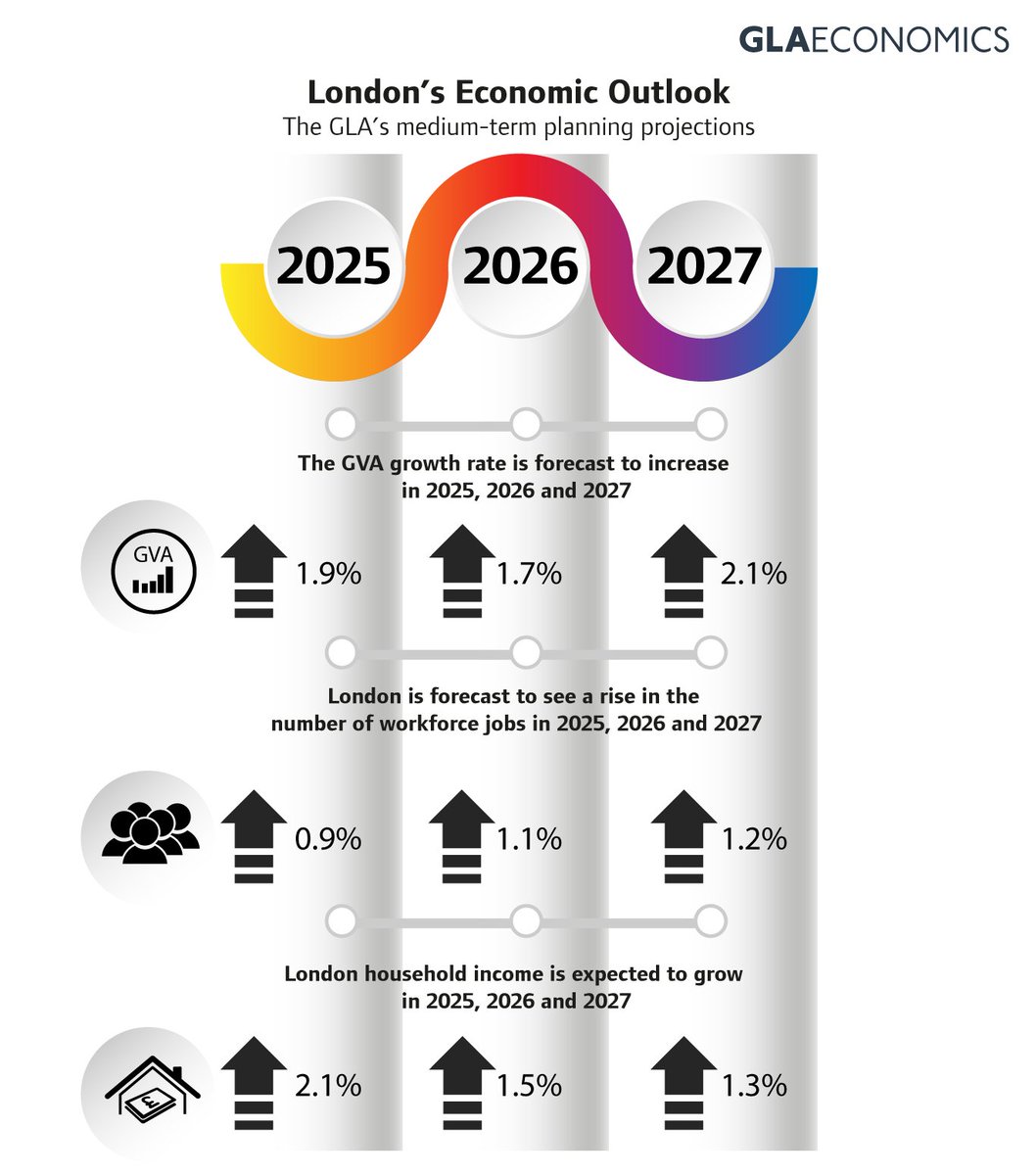
London's Economic Outlook: The GLA's medium-term planning projections.
London’s real GVA is forecast to grow by 1.9% in 2025, 1.7% in 2026, & 2.1% in 2027.
London’s Workforce jobs are projected to increase by 0.9% in 2025, 1.1% in 2026, & 1.2% in 2027.
bit.ly/4j1Gd04
ALT The GLA's medium-term planning projections for GVA, jobs, household income and spending.
London’s real Gross Value Added (GVA) is forecast to grow by 1.9% in 2025, 1.7% in 2026, and 2.1% in 2027.
London’s Workforce jobs (WFJ) are projected to increase by 0.9% in 2025, 1.1% in 2026, and 1.2% in 2027.
Household spending is expected to rise by 0.6% in 2025, 2.0% in 2026, then 1.9% in 2027.
Household income is expected to grow by 2.1% in 2025, 1.5% in 2026, and 1.3% in 2027.
London's Economy Today - Issue 279 - Nov 2025.
Chancellor announces significant revenue raising measures in the Budget.
Brexit impact worse than previously forecast.
Unemployment in London has risen.
Read the full newsletter:
bit.ly/48kmtA9