
Building toward an open, fair, human internet. SM Lead @pala_labs
Joined January 2012
- Tweets 8,139
- Following 1,525
- Followers 3,012
- Likes 39,217
1,999 Photos and videos












We just crossed a line we can’t uncross.
@Polkadot entered its Second Age in 2025.
Smart contracts land on the Polkadot Hub on Jan 27, 2026.
→ A unified network.
→ A defined future for the token DOT.
From here, the Polkadot ecosystem shifts from evolution to direction.
12
15
106
7,774
LV retweeted

Defo no trade-offs.
At Web3 Summit 2026, we’re not here to accept digital life as it is. We’re here to question its defaults, especially when it comes to identity, power, privacy, and who gets to shape the systems we operate within.
Dare to shape future tech? Join us in Berlin: web3summit.com/
9
38
1,398


LV retweeted

Jun 4
In 2010, Steve Jobs argued that privacy means people understand what they're signing up for.
In 2026, that standard feels almost revolutionary.
Most users don't know:
• What data is collected
• How long it's stored
• Who receives it
• How AI systems use it
The internet normalized invisible data collection.
AI risks normalizing invisible data processing.
Transparency isn't created through longer privacy policies.
It comes from giving people clear information and meaningful choices about how their data is used.
Privacy isn't just about protecting data.
It's about enabling informed consent.
10
19
1,008
First night in a Thailand hospital.
Excellent service, super modern facilities, fast attention, and highly professional staff. The only downside was having to pay the bill upfront due to the urgency, but insurance should reimburse it (that's what it's for xd)
Maybe I should stop eating that much junk food on weekends and low the number of coffees? idk xd, I might have a strong coffee addiction but seems my stomach is a bit more delicate than I thought 😤
All good.
1
14
527
LV retweeted
May 10
The original personal computing movement was about one core idea: Giving more power to individuals.
That vision helped shape companies like Apple in their early days and changed how humans interact with technology forever.
Today, as AI rapidly evolves, that principle matters again.
The future should not only be about more intelligent systems. It should be about technology that helps humans stay independent, creative, and in control.
Human agency should remain at the center of technological progress. Because the most important technology is not the one that replaces humans.
It is the one that empowers them.
1
5
14
846
LV retweeted
May 7
Software is eating the world.
But what shapes the software shaping the world?
Every software ecosystem runs on protocols: the rules that determine who can participate, how systems interact, and where value flows.
Over the past decades, software transformed how humanity communicates, learns, builds, and exchanges value.
But the deeper layer has always been the protocols coordinating those systems.
HTTP helped make the web open.
Search algorithms shaped how information was discovered online.
Social graphs shaped how people connected on the internet.
Most only see the apps, but protocols shape the foundation everything else is built on. Apps evolve quickly, while protocols can influence technology and society for decades.
That’s why protocol design and the culture behind it matter.
At Pala Labs, we think in decades. Because the rules being written today will shape what becomes possible tomorrow.
7
16
1,578
LV retweeted
May 5
At the end, there’s always a list of names.
Most people don’t stay to read them.
Not because they don’t matter, but because the experience already feels complete. But nothing is built alone.
Behind every system, there are layers of contribution.
People, processes, coordination. Visible and invisible.
Understanding that changes how you interact with what you use.
You stop seeing products as finished objects and start recognizing them as evolving systems shaped by continuous contributions, dependencies, and iteration.
That’s where agency begins. Your role shifts from just using to understanding what you’re part of.
Not everyone stays for the credits. But the ones who do realize they can shape what comes next.
5
11
457
LV retweeted
May 1
AI is global.
But control over data, infrastructure, and decisions is not.
Today, most AI systems run on infrastructure owned by a handful of companies like Microsoft, Google, and Amazon Web Services.
That creates a structural dependency:
if you don’t control the stack, you don’t control the outcome.
This is why “sovereign AI” is becoming a serious topic across governments and institutions.
At events like London Tech Week (@LDNTechWeek) and in ongoing EU policy debates, the focus is shifting:
Not just how to build AI
But who owns and operates it
Sovereignty in this context means:
> Where your data is stored
> Who can access it
> How decisions are executed
> What rules the system follows
It’s not just about privacy.
It’s about control at every layer of the stack.
Right now, most organizations are effectively renting intelligence.
They rely on external APIs, external compute, and external governance.
That model doesn’t scale for:
> Governments
> Critical infrastructure
> Open ecosystems
Or any system that requires trust minimization.
This is where sovereign tech comes in.
At Pala Labs, the focus is not on building infrastructure directly.
It’s about contributing to the culture, narratives, and coordination around emerging technologies.
Because sovereignty isn’t only a technical problem. It also depends on how people understand, adopt, and organize around these systems.
The shift is already happening.
AI is moving from “model competition”
to “infrastructure competition”
And in that world, the key question becomes:
Who owns the machine that runs the intelligence?
Because sovereignty isn’t about rejecting global technology.
It’s about ensuring you’re not dependent on it.

1
6
14
672
LV retweeted
Apr 26
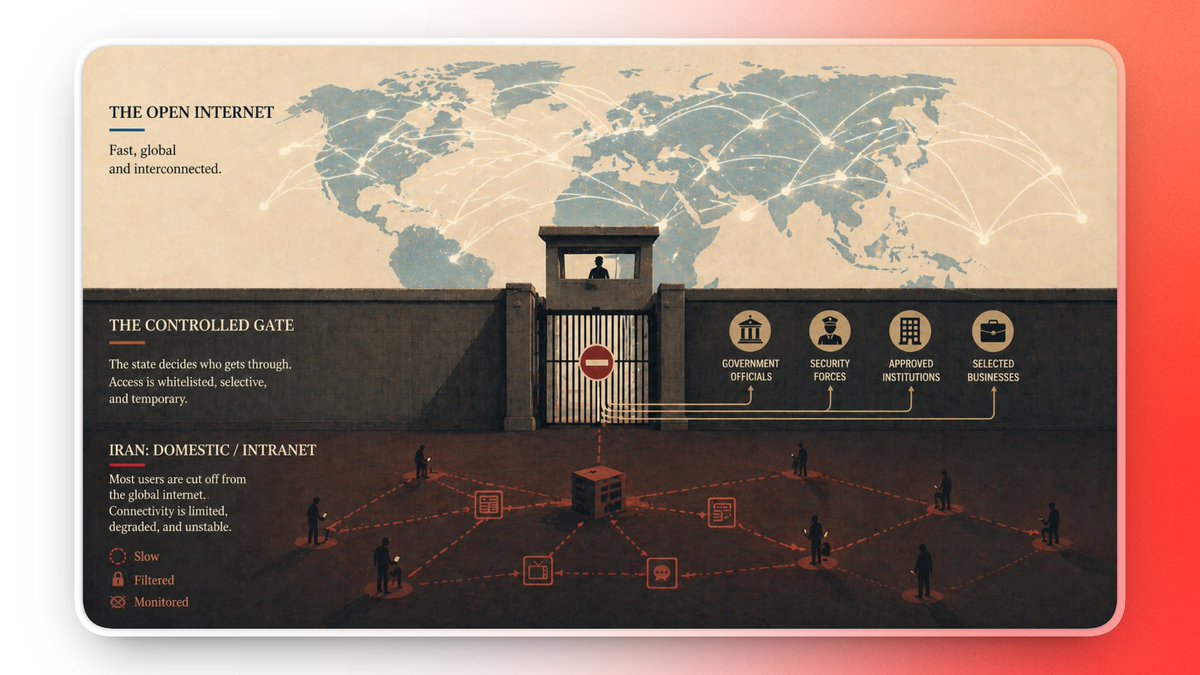
Iran’s internet isn’t just being shut down. It’s being reshaped.
During extended disruptions, connectivity has dropped to a fraction of normal levels and recovered unevenly. It’s not a full blackout for everyone. Some systems remain accessible, while others disappear.
Connectivity becomes conditional.
This isn’t improvised. It reflects years of investment in a more segmented network, where access can be selectively restricted at the network and service level.
People are adapting with what actually works. Tools like Psiphon have reached millions of daily users in Iran during disruptions. Starlink terminals have been smuggled into the country and are used despite being illegal.
These solutions aren’t perfect. They’re slow, unreliable, and actively targeted by authorities. But they work at scale for one reason: they’re harder to shut down uniformly. They introduce alternative paths and reduce reliance on a single control point.
That’s the real lesson. When network infrastructure is highly centralized, access can be restricted at scale. When it’s more distributed, control becomes harder to fully enforce.
The answer isn’t patching centralized models.
It’s building sovereign, human-centric technology where privacy is the default and agency remains with the individual, not a gatekeeper.
Systems designed to reduce single points of failure. Distributed networks. Identities that don’t depend on centralized approval. Infrastructure that remains functional under pressure.
Not ideology.
Just what resilience looks like when control becomes a point of failure.
2
7
27
24,606