
Joined June 2009
- Tweets 3,323
- Following 737
- Followers 761
- Likes 2,377
113 Photos and videos






Lapo Chirici retweeted

Jun 13
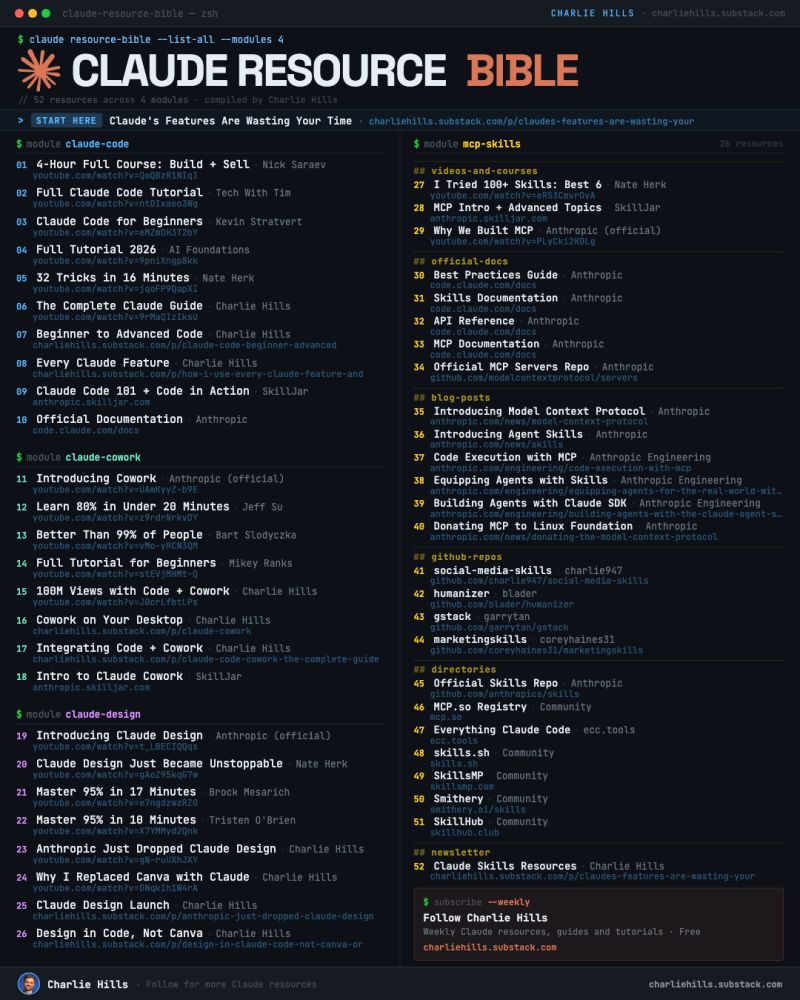
You don't need a $500 Claude course.
52 free resources, sorted into 4 modules:
CLAUDE CODE
1. lnkd.in/e7gUgJFe 4-hour build sell course
2. lnkd.in/eVNQjV66 full Code tutorial
3. lnkd.in/eBBsW3SD Code for beginners
4. lnkd.in/eaHUHfnE full 2026 walkthrough
5. lnkd.in/e6nZb9JZ 32 tricks in 16 mins
6. lnkd.in/ehtPc5Tg complete Claude guide
7. lnkd.in/eX9prA4V beginner to advanced
8. lnkd.in/e-934Yhi Claude features ranked
9. anthropic.skilljar.com the official course
10. code.claude.com/docs official documentation
CLAUDE COWORK
11. lnkd.in/efCGYqNh Anthropic's official intro
12. lnkd.in/eMGATsbn Cowork in 20 mins
13. lnkd.in/eB-8-c7i better than 99% of users
14. lnkd.in/exZCjUbg full beginner walkthrough
15. lnkd.in/epwYqQKA 100M views with Cowork
16. lnkd.in/eeHWHJ49 Cowork on your desktop
17. lnkd.in/eMRDhZYJ Code Cowork combined
18. anthropic.skilljar.com official course
CLAUDE DESIGN
19. lnkd.in/eKsTX-4T Anthropic's official intro
20. lnkd.in/e42_X9hY Design got unstoppable
21. lnkd.in/eFhPrBYp master 95% in 17 mins
22. lnkd.in/eg7b5hmM master 95% in 10 mins
23. lnkd.in/egy4Q4NQ launch reaction video
24. lnkd.in/eWtwB-nJ why I replaced Canva
25. lnkd.in/eZHgXYn7 Design launch breakdown
26. lnkd.in/eZ6wSdJA design in Code, not Canva
Save this for the next time you want to learn Claude.
Join AI Community : whatsapp.com/channel/0029Va…
Repost ♻️ to help someone in your network.
Follow @AIWithAshley for more info
36
86
174
6,675
Lapo Chirici retweeted

Jun 11
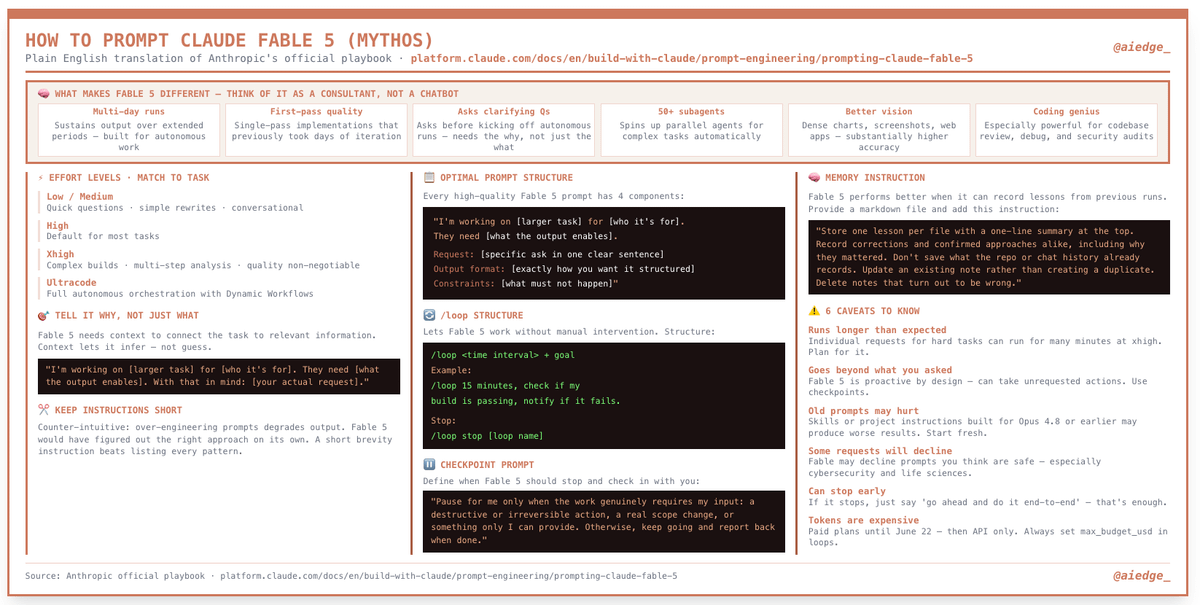
Anthropic just literally spoon-fed you how to use Fable properly.
99% of Claude users missed it.
The way you need to prompt Fable is fundamentally different from all other AI models.
I translated their entire new Fable prompting handbook:

77
328
2,713
695,299

Jun 12
Four vendors in your agent stack = six sealed pairs to model.
Six vendors = fifteen.
Capability grew 50%.
The guessing grew 150%.
This theory is falsifiable: if your verification-and-retry ratio grows linearly with vendor count, coordination debt is wrong.
Pull your traces. Test it.

12
Jun 12
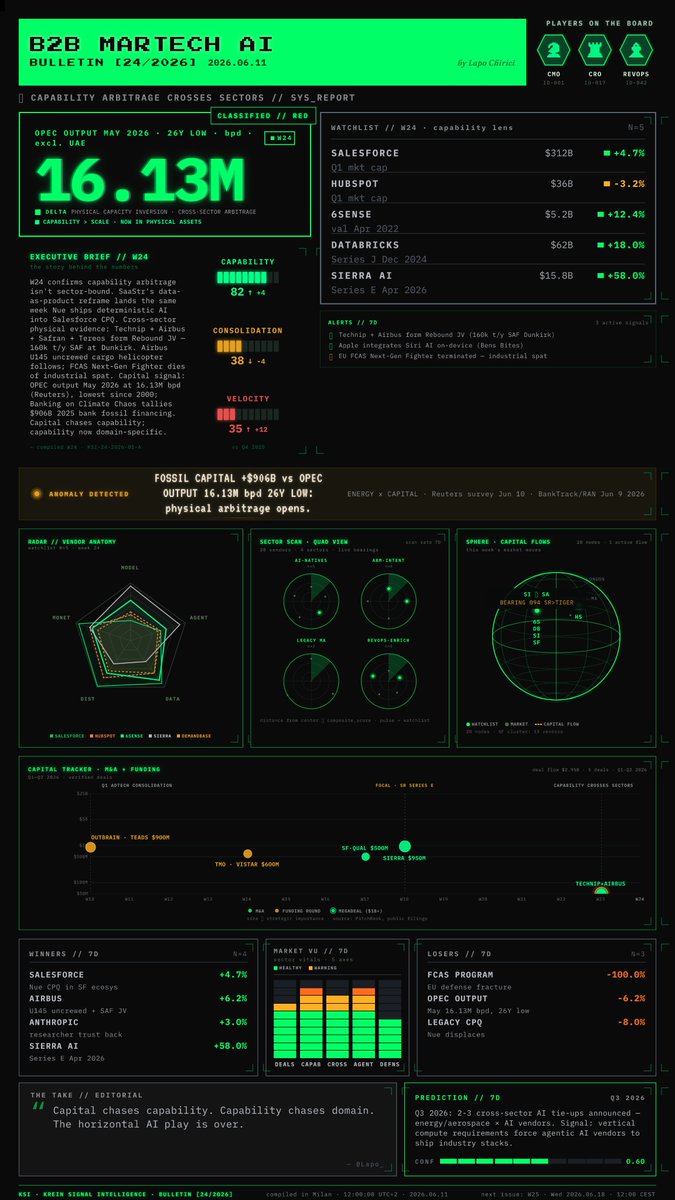
Two numbers from this week that don't belong on the same chart. Except they do.
OPEC output: 16.13M bpd in May — lowest since at least 2000 (Reuters survey). Bank fossil financing: $906B committed in 2025, up 8% (Banking on Climate Chaos).
Capital is accelerating into an asset class whose physical capacity just inverted. There's a word for that spread: arbitrage.
And the same force is moving inside B2B software.
Full W24 board below ↓
1
10
Jun 12
On the board, confidence 0.60: Q3 2026 brings 2-3 cross-sector AI tie-ups — energy/aerospace × AI vendors — because vertical compute requirements force agentic vendors to ship industry stacks.
If Q3 closes with zero, the thesis takes the hit. Publicly.
That's what the bulletin is for.
59

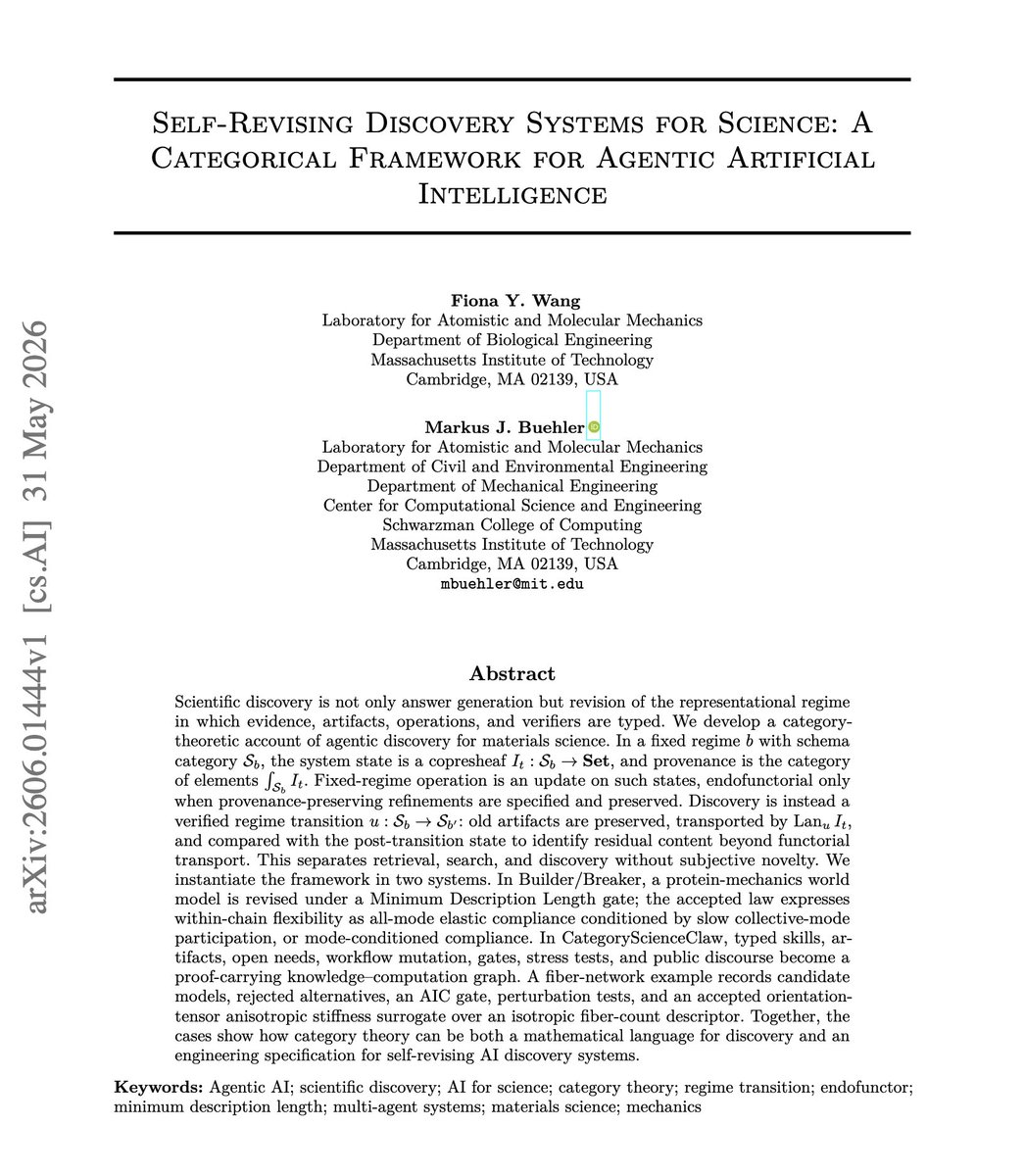
This was one of the standout AI papers of the week.
(bookmark it)
It tackles a question most self-improving AI agents ignore: is the agent actually discovering anything, or just remixing what it already knows?
How can you tell whether the agent is doing real discovery or just confident retrieval?
The authors give three clean buckets:
- Retrieval is looking something up in a notebook you already have.
- Search is combining tools you already own in new ways.
- Discovery is inventing a new concept that wasn't in your toolkit before.
The issue is that most agents stop at the first two.
The math behind their definition (category theory plus a left Kan extension, if you care) is basically a bookkeeping trick to ask: could the old version of me have produced this result? If yes, it's not discovery. If no, something genuinely new showed up.
They build a Builder/Breaker agent that studies protein mechanics. Over four rounds, the model's fit accuracy actually drops (R² goes from 0.48 to 0.68 to 0.54 to 0.41). At first glance, that looks like a failing agent.
It isn't.
The agent kept taking on harder proteins and rewriting its theory to cover them. Data grew almost 10x while the model code grew only 1.3x. A smaller theory covering a bigger world is exactly what good science looks like.
Why does it matter?
If you optimize for accuracy alone, your self-improving agent will just settle into easy benchmarks and stop. This paper offers a cleaner success signal and asks whether the agent is compressing more of the world into less code over time.
Paper: arxiv.org/abs/2606.01444
Learn to build effective AI agents in our academy: academy.dair.ai/
29
68
346
40,400
Jun 7
Everyone Adopted Agents. Half of You Regret It. Here’s the Part Nobody Priced In.
The agentic AI numbers for 2026 read like two different realities, and both are true.
Forrester says 74% of B2B organizations have already deployed AI agents. Adoption isn’t the question anymore. And yet nearly half of enterprises now call AI adoption a massive disappointment, up from 34% a year ago. Only 23% report significant ROI from their agents.
So which is it — transformative, or a let-down?
It’s both. And the gap between them is the most important B2B story of the year, because it isn’t a technology gap. It’s an architecture gap, and most buyers walked straight into it.
The promise was the demo. The problem is the seam.
Single agents work. You connect an agent to your tools, it executes a task, you see value in weeks. The early adopters seeing real ROI are mostly running agents inside one bounded workflow, on clean data, under one vendor’s roof.
The disappointment lives somewhere specific: the moment you need two agents — from two different vendors — to work together.
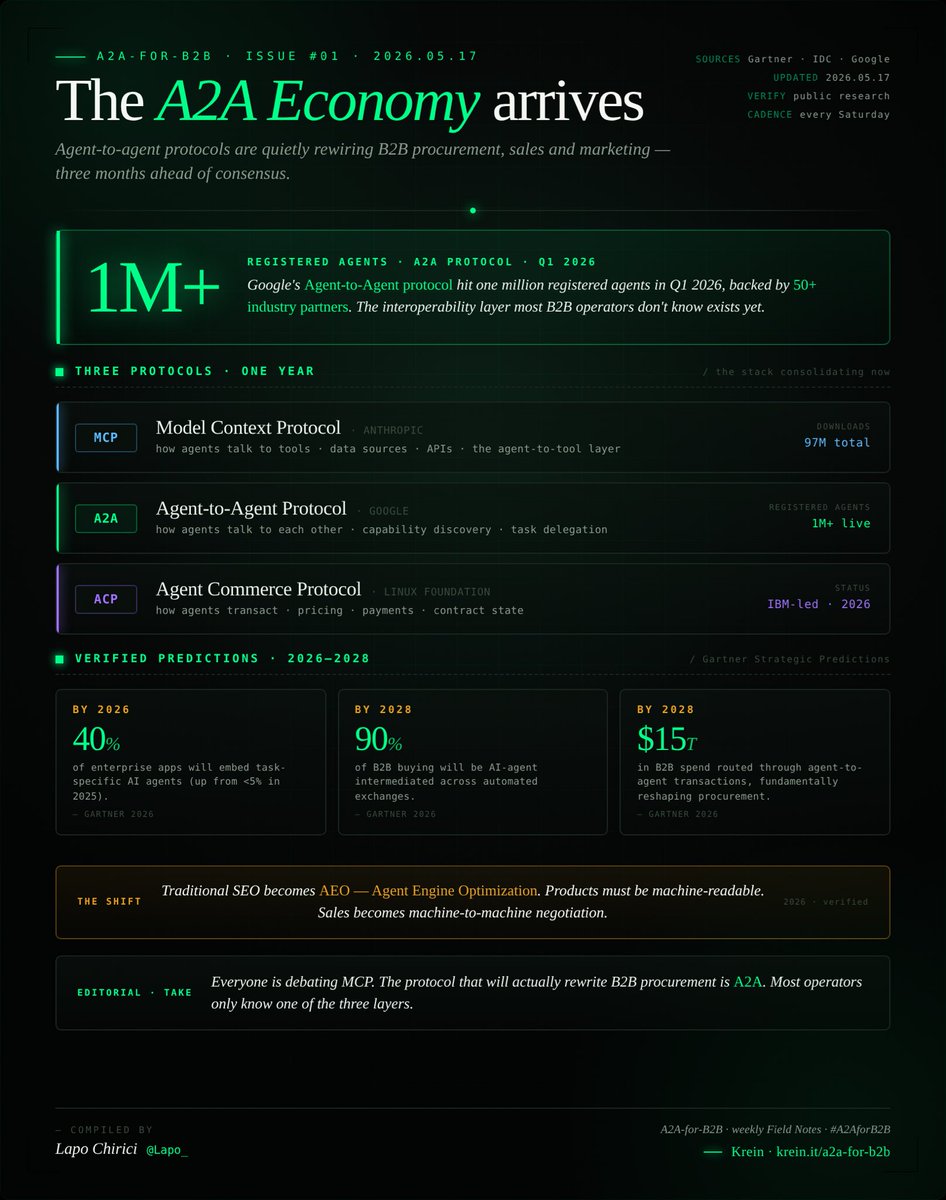
That’s where 2026 breaks. Adoption of multi-agent systems that work across platforms has been far slower than single-agent deployment, and the failures have been loud. The reason isn’t that the technology can’t do it. The standards exist — A2A, the agent-to-agent protocol, is now co-governed by OpenAI, Anthropic, Google, Microsoft, AWS, and Block. The plumbing is there.
The reason is commercial. As IDC’s research lead put it: vendors are hesitant to make their agents interoperable because they’re still figuring out how to monetize the data those agents generate. One vendor’s service agent doesn’t talk to another’s commerce agent — not because it can’t, but because the vendor doesn’t want it to. They’re protecting the data moat.
Your agents aren’t siloed by accident. They’re siloed by someone else’s business model.
Why this is now a buyer problem
For the first time, line-of-business leaders are the largest enterprise AI decision-maker group — 46%, ahead of both CIOs and CTOs. The people buying agents now run revenue, ops, and marketing, not protocol architecture. So the interoperability trap is being walked into by the buyers least equipped to see it — against vendors with an active incentive to keep the answer “no.”
And the stakes are measurable. Accenture found companies with highly interoperable systems grew revenue roughly six times faster than non-interoperable peers. Interoperability isn’t a technical nicety. It’s a growth rate.
What separates the 23% from the 48%
The enterprises getting real ROI aren’t the ones with the smartest agents. They made two decisions early.
They treated data readiness as the deal, not a detail — 58% cite data quality as the number-one blocker, the fifth year running. Features don’t win the deal. Data readiness wins the deal.
And they made interoperability a procurement criterion. The question that matters in 2026 isn’t “what can your agent do.” It’s “which protocols does it speak natively, and will it delegate to an agent you didn’t sell me.” If the honest answer is no, you’re not buying a capability. You’re buying a future migration.
The hype cycle told everyone to adopt agents. Everyone did — and that was the easy phase. The hard phase, the one separating the companies compounding from the ones writing off their AI budgets, is the coordination layer. Whether the agents you bought this year can still talk to the agents you’ll buy next year.
The 48% calling agentic a disappointment aren’t wrong. They’re just early in discovering the demo was never the hard part.
The buyers who win 2026 won’t be the ones who adopted fastest. They’ll be the ones who asked, before signing, the one question the vendor hoped they wouldn’t: will this still work when it’s not just yours?
I publish a weekly B2B MarTech & AI intelligence bulletin (KSI) every Wednesday — where I track the signals separating agentic ROI from agentic regret.
2
1
75
Jun 7
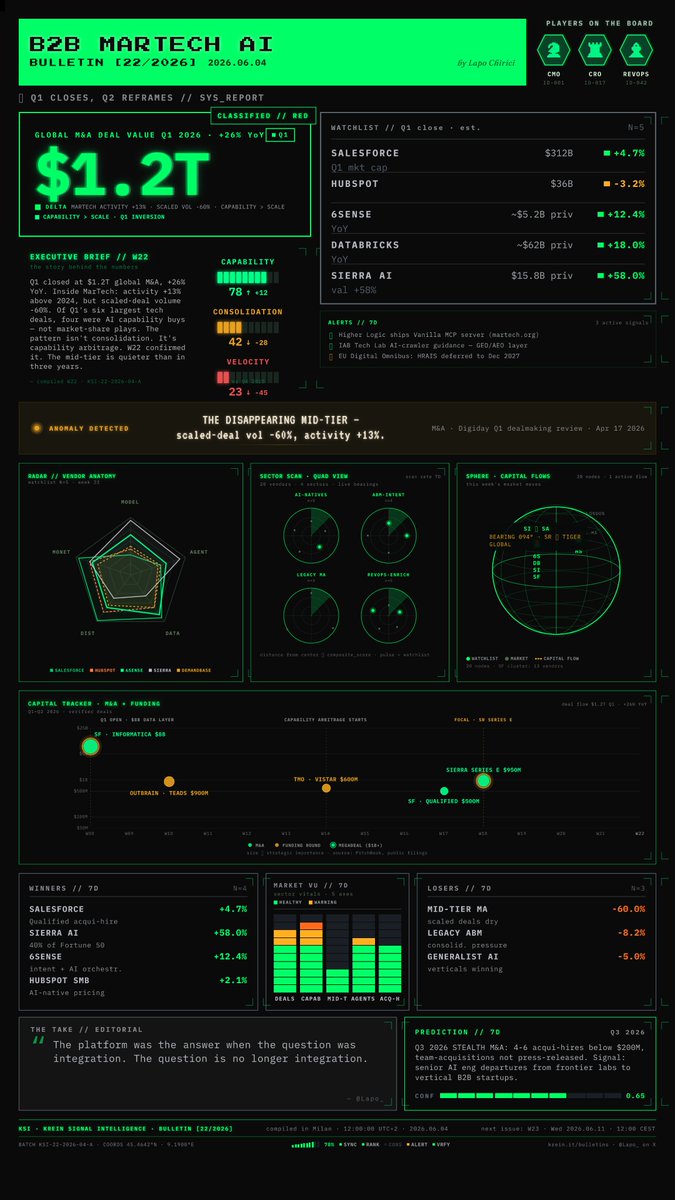
Q1 2026 closed at $1.2T in global M&A, up 26% year over year. Inside MarTech, one number matters more than the headline: deal activity rose 13%, but scaled-deal volume fell 60%.
The market didn’t slow down. It changed what it’s buying.
Of the six largest tech deals in Q1, four were AI capability acquisitions — not market-share plays. Salesforce bought Informatica for $8B. Sierra raised at a $15.8B valuation, up 58%. These aren’t companies buying customers. They’re companies buying the teams that ship.
I call this capability arbitrage, and if you’re making B2B stack decisions in 2026, it should change how you evaluate vendors.
Why the mid-tier is the casualty
For a decade, the winning B2B software play was integration. You bought the platform that connected everything — the suite that promised one login, one dashboard, one throat to choke. The platform was the answer because the question was integration.
The question is no longer integration.
When capability becomes the scarce asset, the mid-tier loses its reason to exist. It was never the cheapest, and it was never the most advanced. It survived by being “good enough and already connected.” But “already connected” stops being a moat when the frontier moves every quarter. In Q1, legacy ABM tools dropped 8.2%. Generalist AI offerings dropped 5%. What gained: vertical AI agents, intent plus orchestration, AI-native pricing models.
What this means for your stack decisions
Three shifts I’d push any CMO or RevOps leader to internalize:
First, stop evaluating vendors on breadth. The “does it do everything” question optimizes for the exact quality that’s now commoditized. Ask instead: what does this vendor do that no one else can, and how fast do they ship it?
Second, treat your stack decisions as quarterly, not annual. The benchmark you bought on in January is stale by April. Capability arbitrage means the gap between the frontier and the mid-tier widens every quarter. Annual procurement cycles are now a structural disadvantage.
Third, watch where the talent goes. The clearest signal for Q3 2026 isn’t a press release — it’s senior AI engineers leaving frontier labs for vertical B2B startups. When the people who built the capability move down-market, the capability follows them within two quarters. That’s your early-warning system.
The uncomfortable part
This is harder for buyers, not easier. Integration was a one-time decision you could defend in a board meeting. Capability is a moving target you have to re-evaluate constantly. The vendors who win your budget in 2026 won’t be the ones with the most features. They’ll be the ones still surprising you in Q4.
The platform was the answer when the question was integration.
The question changed. Make sure your stack decisions did too.
If this was useful, bookmark it — I publish a weekly B2B MarTech intelligence bulletin (KSI) every Wednesday. Next issue covers the Q3 capability-arbitrage signals
14
Jun 5
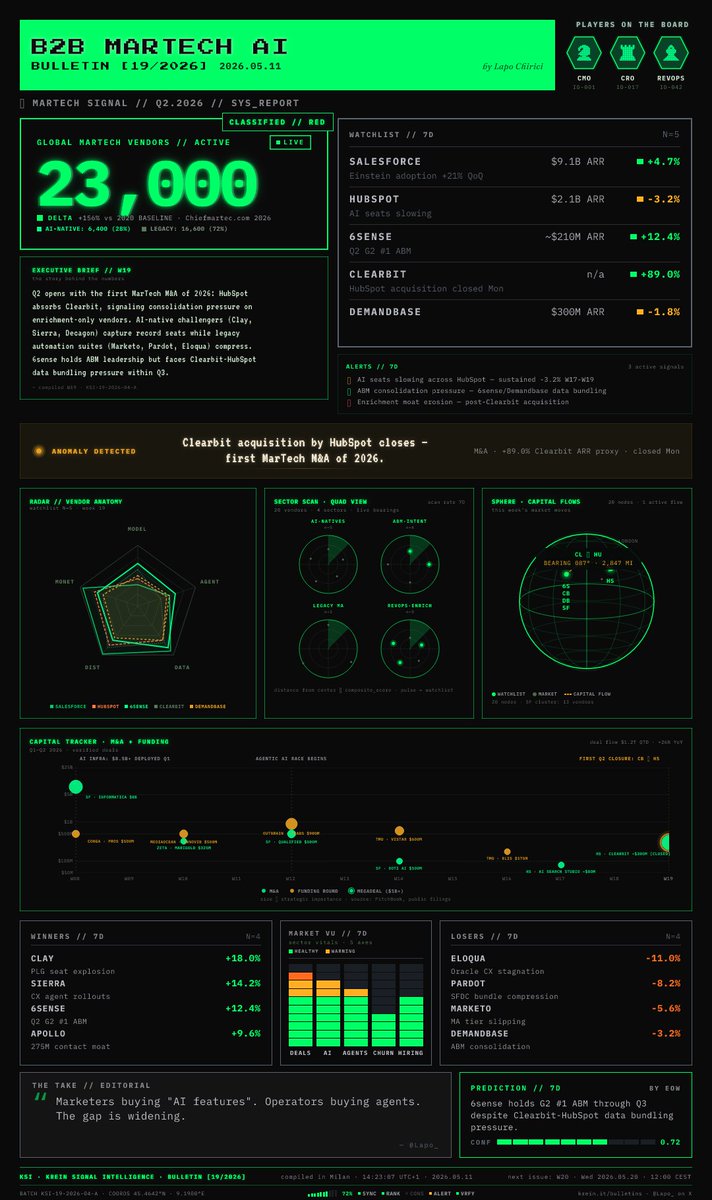
B2B MarTech AI · Bulletin [23/2026]
Q1 closed at $1.2T global M&A, 26% YoY.
Inside MarTech the number that matters isn't the total. It's the split: activity 13%, scaled-deal volume −60%.
The market didn't slow down. It changed what it's buying.
🧵
1
35
Jun 5
The casualty is the mid-tier.
Scaled-deal volume −60%. Legacy ABM −8.2%. Generalist AI −5%.
What's winning: vertical AI agents, intent orchestration, AI-native pricing.
The platform was the answer when the question was integration. The question is no longer integration.
1
16
Jun 5
Q3 2026 prediction: stealth M&A.
4-6 acqui-hires below $200M, team-acquisitions not press-released. Watch senior AI eng departures from frontier labs to vertical B2B startups.
Full bulletin compiled weekly. Next issue W23 · Wed June 11.
What's your read on the mid-tier squeeze?
30
May 30
Forrester just published the debrief from its B2B Summit Women's Leadership Program.
200 leaders, three days, AI as the recurring thread.
The number worth pausing on, half-buried in the post:
Women are 23% less likely than men to receive manager support for using AI at work (McKinsey, 2025).
1
26
May 30
Phyllis Davidson (VP Forrester) lists five takeaways.
One stays: AI adoption accelerates when leaders explicitly remove the "cheating" narrative.
Where AI use still carries a shade of shortcut, the cost falls heaviest on those whose legitimacy was already under closer watch.
1
9
May 30
Heather Cairns-Lee (IMD) closes the piece with a line worth keeping:
AI may become one of the most significant leadership opportunities for women in decades.
The tools are here. What comes next is a leadership question.
🔗 forrester.com/blogs/leading-…
27
Lapo Chirici retweeted

May 30
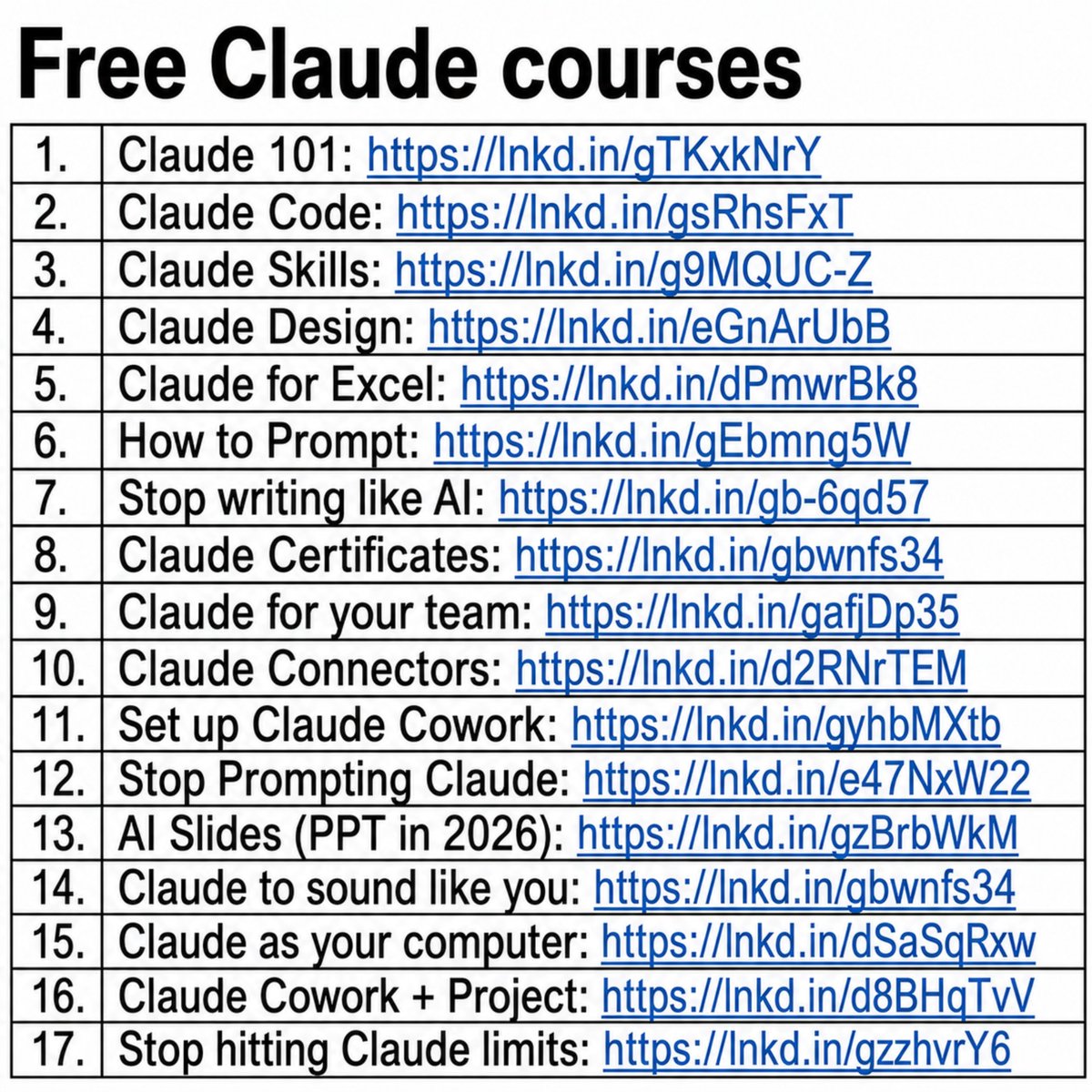
People think learning Claude takes days. It doesn't.
I wrote 17 free guides that teach it in hours:
Claude 101: ruben.substack.com/p/claude-…
Claude Code: ruben.substack.com/p/claude-…
Claude Skills: ruben.substack.com/p/claude-…
Claude Connectors: ruben.substack.com/p/claude-…
Claude for Excel: ruben.substack.com/p/how-to-…
How to Prompt: ruben.substack.com/p/prompt-…
Claude Certificates: ruben.substack.com/p/youre-j…
Claude for your team: ruben.substack.com/p/claude-…
Stop Prompting Claude: ruben.substack.com/p/stop-pr…
AI Slides (PPT in 2026): ruben.substack.com/p/powerpo…
Claude Design: ruben.substack.com/p/claude-…
Set up Claude Cowork: ruben.substack.com/p/claude-…
Claude to sound like you: ruben.substack.com/p/youre-j…
Stop writing like AI: ruben.substack.com/p/its-not…
Claude as your computer: ruben.substack.com/p/claude-…
Claude Cowork Project: ruben.substack.com/p/claude-…
Stop hitting Claude limits: ruben.substack.com/p/how-to-…
___
1. Save this list for later (three dots, top right).
2. Share it with a friend by ♻️ reposting this image.
3. Subscribe to my free newsletter: how-to-ai.guide.

85
1,747
6,676
890,271
May 22
OpenAI just falsified an 80-year Erdős conjecture (planar unit distance). The interesting question isn't whether LLMs do math. It's who now owns counterexample generation—and what happens when falsification is faster than proof.
1
21
May 22

Today, we share a breakthrough on the planar unit distance problem, a famous open question first posed by Paul Erdős in 1946.
For nearly 80 years, mathematicians believed the best possible solutions looked roughly like square grids.
An OpenAI model has now disproved that belief, discovering an entirely new family of constructions that performs better.
This marks the first time AI has autonomously solved a prominent open problem central to a field of mathematics.
12