
𝚆𝚎𝚋𝟹 𝙱𝚞𝚒𝚕𝚍𝚎𝚛 | 𝙲𝚘𝚗𝚝𝚎𝚗𝚝 𝙲𝚛𝚎𝚊𝚝𝚘𝚛 | 𝙲𝚘𝚖𝚖𝚞𝚗𝚒𝚝𝚢 𝙱𝚞𝚒𝚕𝚍𝚎𝚛 | ✉︎ 𝙾𝚙𝚎𝚗 𝚏𝚘𝚛 𝙲𝚘𝚕𝚕𝚊𝚋𝚜 & 𝙱𝚞𝚜𝚒𝚗𝚎𝚜𝚜 ☞ 𝙳𝙼
Joined December 2023
- Tweets 63,290
- Following 2,026
- Followers 3,565
- Likes 74,624
1,721 Photos and videos








Pinned Tweet

May 21
Most NFT collections rely on traditional random generators.
But @quipnetwork took a completely different approach.
They introduced Quantum Echoes a free NFT collection on Ethereum powered by real quantum hardware.
That means every NFT is generated using true quantum randomness, making each mint genuinely unique and impossible to predict.
Not the typical “randomness” we often see in Web3.
This is actual quantum-powered randomness.
What makes the project even more interesting is how multiple technologies come together:
☞ Quantum hardware → generates verifiable randomness.
☞ Ethereum → secures ownership onchain.
☞ Eigen Keys → unlock rare traits and additional features.
It’s a creative example of how advanced technologies can enhance digital ownership and make onchain experiences more dynamic.
Launching soon on @opensea.
Free mint. Ethereum. Quantum-powered uniqueness. 🦋
May 20

Introducing Quantum Echoes, an NFT collection powered by real quantum hardware.
Every mint is unique, seeded by quantum verifiable randomness.
Launching on @opensea.
Free open edition mint on Ethereum. Earn Eigen Keys to unlock rare traits.
Stay tuned for more info 🦋
183
99
354
4,440
Most people assume the crypto they hold today will remain secure forever. The reality is more nuanced.
Experts estimate that roughly 34% of Bitcoin currently in circulation could be vulnerable to future quantum threats. As quantum computing advances toward practical scale, many of the cryptographic assumptions that protect today's digital assets may face unprecedented challenges.
This is where projects like @quipnetwork enter the conversation.
$QUIP is developing a unified base layer designed with post-quantum security in mind, aiming to safeguard wallets, smart contracts, and broader Web3 infrastructure. One of its most ambitious goals is helping quantum-proof Bitcoin without requiring a soft fork.
For years, the crypto industry has focused on narratives around faster transactions, lower fees, and greater scalability. But the next defining conversation may be far more fundamental:
How do we ensure these networks remain secure in the next era of computing?
As discussions around quantum resilience continue to gain momentum, $QUIP is a project worth watching. 🦋

Happy weekend, Quippers 🦋
Classical computing wasn’t designed for the kinds of problems modern industries are running into today.
Not because these problems are unsolvable, but because they’ve simply outgrown the tools we keep forcing them through.
That’s the gap the @quipnetwork is stepping into.
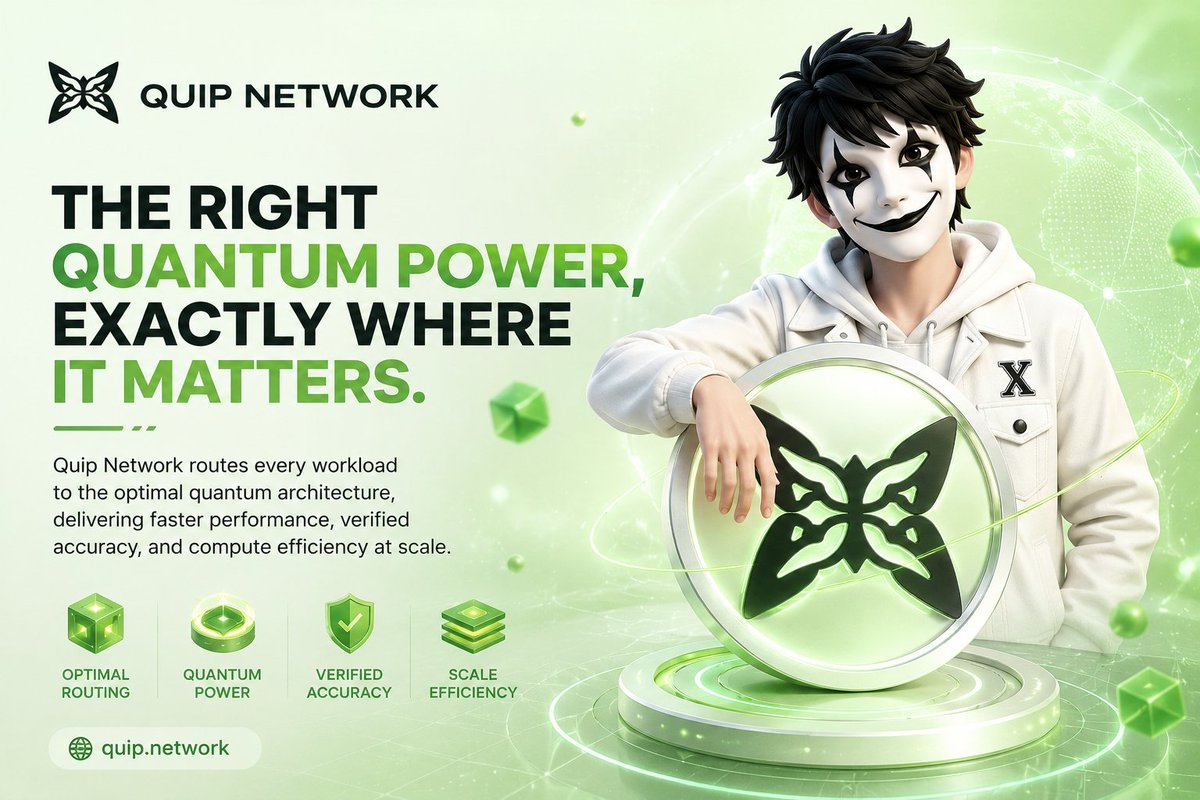
Instead of pushing every workload through a one-size-fits-all pipeline, $QUIP intelligently routes each task to the quantum architecture best suited for it. Right tool, right job with no wasted compute cycles.
And that shift matters for more than just speed.
In real systems, inefficiency isn’t only slow it’s expensive.
What makes it even more compelling is the second layer: every output is verified for correctness. That means you’re not trading reliability for performance you’re getting both.
In industries where a single miscalculation can cascade into millions in losses, that verification layer changes the baseline entirely.
The result is straightforward: better performance, higher accuracy, and compute that scales with actual usage instead of inflated infrastructure.
It stops being "more compute."
It becomes the right intelligence, applied exactly where it’s needed.
100
4
179
600
THE COST OF SELF-INTEREST, HOW NIGERIA CONTINUES TO HOLD ITSELF BACK
About 99% of Nigeria’s problems are self-inflicted we too often prioritize self-interest over collective progress.
Across the country, especially in the North, this mindset is increasingly becoming a silent poison. When combined with a growing "I don’t care" attitude toward national development, it continues to weaken our shared future. In the end, this is one of the major reasons our country’s image keeps declining in the eyes of the world.
Emmanuel: "Tinubu must go!!!"
Mudi: "Tinubu for a second term."
Jatau: "I’ll just keep watching what happens." 👀
Late "Happy Democrazy" 🥲
Since the return of democracy in Nigeria, the story of the average citizen has remained painfully familiar. The poor continue to hope, yet receive very little in return.
Every election season comes wrapped in big promises change, development, prosperity, and a better life. But once leaders are elected, reality rarely changes.
➵ Clean water is still inaccessible for many
➵ Electricity remains unreliable.
➵ Roads continue to deteriorate.
➵ Education lacks adequate resources.
➵ Hospitals struggle to provide the care people deserve.
Yet, election after election, ordinary citizens return to the polls with hope in their hearts.
However, what often follows is not meaningful progress it feels like the same cycle repeating itself, and sometimes even going backward.
At times, it becomes difficult to see when real progress will come, or when this long cycle of hardship will finally be broken.
Still, beneath the frustration, disappointment, and growing skepticism, there remains a stubborn belief that one day Nigeria will rise, transform itself, and surprise the world in ways no one expects.
106
2
210
674
Happy weekend, Quippers 🦋
Classical computing wasn’t designed for the kinds of problems modern industries are running into today.
Not because these problems are unsolvable, but because they’ve simply outgrown the tools we keep forcing them through.
That’s the gap the @quipnetwork is stepping into.
Instead of pushing every workload through a one-size-fits-all pipeline, $QUIP intelligently routes each task to the quantum architecture best suited for it. Right tool, right job with no wasted compute cycles.
And that shift matters for more than just speed.
In real systems, inefficiency isn’t only slow it’s expensive.
What makes it even more compelling is the second layer: every output is verified for correctness. That means you’re not trading reliability for performance you’re getting both.
In industries where a single miscalculation can cascade into millions in losses, that verification layer changes the baseline entirely.
The result is straightforward: better performance, higher accuracy, and compute that scales with actual usage instead of inflated infrastructure.
It stops being "more compute."
It becomes the right intelligence, applied exactly where it’s needed.
Jun 12
TGIF, Homies 📿 🦋
Let me share something that started as a casual garden conversation but ended up shaping how I think about how people actually understand new technology.
A friend asked me a simple question yesterday:
"If someone is new to $QUIP Network, what’s the fastest way to understand it without drowning in threads and docs?"
And honestly, that question points to a real problem.
Most people don’t fail to learn new things they just get lost in the noise before they ever get to clarity.
So I showed him something simple: @quipnetwork recent X article, “What is $QUIP Network? A Primer.”
One clean entry point. No clutter. Just the basics you actually need to get oriented.
After reading it, he said, "Oh… this actually makes sense now."
And that’s the lesson.
Good onboarding isn’t about more information it’s about the right information, placed exactly where people can naturally find it.
But the conversation didn’t stop there.
We drifted into something deeper.
If onboarding is already this messy, what happens when the systems securing today’s crypto economy start facing threats they weren’t originally designed for?
Quantum computing isn’t science fiction anymore it’s a slow-moving reality, getting closer than most timelines suggest.
And while many projects are still optimizing for today’s constraints, @quipnetwork is clearly thinking further ahead toward infrastructure built for shared compute, aligned incentives, and quantum-resistant foundations for what comes next.
At that point, the question shifts.
It’s no longer about whether technology evolves.
It always does.
It’s about who is building early enough, and seriously enough, to matter when it does.
#Quipnetwork $QUIP #PostQuantum #QuantumSecurity
147
1
285
1,724
Jun 13
Morning Sleepers 🦖
Most people think $SLEEP begins when you close your eyes.
But that’s not really where it starts.
It starts earlier at the moment you decide how your day will end.
Saturday mornings make this easier to notice.
No rush. No noise. Just enough space to see what the week usually hides.
Some nights leave you drained. Others quietly set up a better version of you before the day even begins.
That difference isn’t random.
It’s pattern.
And patterns are exactly what we’ve been observing inside @sleepagotchi.
At first, the idea was simple: track sleep, stay consistent, reward the "right" behaviors.
But behavior data always tells a deeper story.
Tracking alone doesn’t change people.
It only creates awareness.
And awareness without direction eventually becomes noise something you glance at, then forget.
So the uncomfortable question emerged:
What if $SLEEP tracking was never the product?
What if it was only the entry point?
That shift changes everything.
@sleepagotchi is moving beyond observation.
Toward systems that connect rest, behavior, and real outcomes.
Not just showing how you slept but helping explain why it happened, and what it leads to next.
✧ Guidance over logging.
✧ Action over awareness.
Because health doesn’t improve by watching yourself.
It improves by responding to what you see.
That’s the transition we’re seeing:
From tracking $SLEEP
To orchestrating better days.
Jun 12
gSleepers Familia 🦖
Last night, I found myself thinking about how most projects behave once momentum kicks in.
They accelerate. They scale.
And somewhere in that speed, the early days quietly fade into the background.
But then I came across something different with @sleepagotchi .
Not a launch. Not a typical hype cycle.
More like a checkpoint.
A quiet signal directed at the people who were there before anything felt "real" those who tested the app when it was still rough around the edges, held the NFT when it carried little narrative weight, and played the Telegram games without an audience watching.
Instead of moving past them, it feels like they’re being brought back into focus.
If you were part of that first wave, the message is subtle but intentional:
☞ You didn’t just participate. You may already be part of the foundation.
☞ But recognition only completes when the loop is closed: connect your SOL wallet and link the same email Telegram ID you used back then.
☞ NFT holders are also being re-anchored through Discord roles, identity verification, and access alignment via the Hub.
hub.sleepagotchi.com
It’s not loud. It’s not chasing attention.
But it carries a different kind of weight.
Because in a space where most systems optimize for what’s next, this feels like something rarer a system remembering what came first.
Not momentum. Not noise. Continuity.
And it leaves you with a simple question:
How many projects actually still see you when it starts to matter?
143
4
162
613
𝐋𝐚𝐲𝐭𝐡 𝐀𝐬𝐟𝐚𝐫 retweeted
Jun 12
TGIF, Homies 📿 🦋
Let me share something that started as a casual garden conversation but ended up shaping how I think about how people actually understand new technology.
A friend asked me a simple question yesterday:
"If someone is new to $QUIP Network, what’s the fastest way to understand it without drowning in threads and docs?"
And honestly, that question points to a real problem.
Most people don’t fail to learn new things they just get lost in the noise before they ever get to clarity.
So I showed him something simple: @quipnetwork recent X article, “What is $QUIP Network? A Primer.”
One clean entry point. No clutter. Just the basics you actually need to get oriented.
After reading it, he said, "Oh… this actually makes sense now."
And that’s the lesson.
Good onboarding isn’t about more information it’s about the right information, placed exactly where people can naturally find it.
But the conversation didn’t stop there.
We drifted into something deeper.
If onboarding is already this messy, what happens when the systems securing today’s crypto economy start facing threats they weren’t originally designed for?
Quantum computing isn’t science fiction anymore it’s a slow-moving reality, getting closer than most timelines suggest.
And while many projects are still optimizing for today’s constraints, @quipnetwork is clearly thinking further ahead toward infrastructure built for shared compute, aligned incentives, and quantum-resistant foundations for what comes next.
At that point, the question shifts.
It’s no longer about whether technology evolves.
It always does.
It’s about who is building early enough, and seriously enough, to matter when it does.
#Quipnetwork $QUIP #PostQuantum #QuantumSecurity
95
4
239
2,146
Jun 12
gSleepers Familia 🦖
Last night, I found myself thinking about how most projects behave once momentum kicks in.
They accelerate. They scale.
And somewhere in that speed, the early days quietly fade into the background.
But then I came across something different with @sleepagotchi .
Not a launch. Not a typical hype cycle.
More like a checkpoint.
A quiet signal directed at the people who were there before anything felt "real" those who tested the app when it was still rough around the edges, held the NFT when it carried little narrative weight, and played the Telegram games without an audience watching.
Instead of moving past them, it feels like they’re being brought back into focus.
If you were part of that first wave, the message is subtle but intentional:
☞ You didn’t just participate. You may already be part of the foundation.
☞ But recognition only completes when the loop is closed: connect your SOL wallet and link the same email Telegram ID you used back then.
☞ NFT holders are also being re-anchored through Discord roles, identity verification, and access alignment via the Hub.
hub.sleepagotchi.com
It’s not loud. It’s not chasing attention.
But it carries a different kind of weight.
Because in a space where most systems optimize for what’s next, this feels like something rarer a system remembering what came first.
Not momentum. Not noise. Continuity.
And it leaves you with a simple question:
How many projects actually still see you when it starts to matter?
Jun 11
Most people think $SLEEP ends when you wake up.
But what if it’s actually the beginning of something more structured and even rewarding?
Morning sleepers, hope you woke up feeling rested. With @sleepagotchi, sleep stops being "just rest" and starts turning into value you can actually see.
You $SLEEP, it tracks. You wake up to something simple but meaningful: proof that your recovery wasn’t wasted it was earned.
I’ve been using it, and what stands out isn’t just the data, but the behavior shift. There’s a quiet motivation that comes from seeing consistency reflected back at you every morning.
@sleepagotchi is building beyond sleep tracking. It’s shaping what you could call an Intelligence Layer for the Wellness Economy where AI, wearables, and health tools connect so your wellness data doesn’t just sit in an app, but starts working for you.
And maybe that’s the real shift: $SLEEP doesn’t have to be passive anymore. It becomes part of a system that recognizes, measures, and rewards recovery.
122
2
250
1,462
Jun 11
Good evening, homies.
Most people don’t fail because they lack talent they fail because they keep waiting.
Waiting for the perfect job, the perfect timing, the perfect opportunity that never really shows up.
But if you look closely, the people who win didn’t start polished. They started messy, uncertain, figuring things out one step at a time.
Waiting feels safe, but it quietly kills momentum. Action is what actually changes your direction.
Sometimes what you dismiss as "not a big break" is really the beginning a small task, an uncomfortable step, or a random opportunity you almost ignored.
Progress doesn’t come from perfect conditions.
It comes from starting anyway.
86
2
166
406
Jun 11
gDac, Familia ⚛
What if the biggest threat to blockchain isn't a hack but a technological shift that's already underway?
For years, quantum computing has been treated as a future problem something the industry would address "when it arrives."
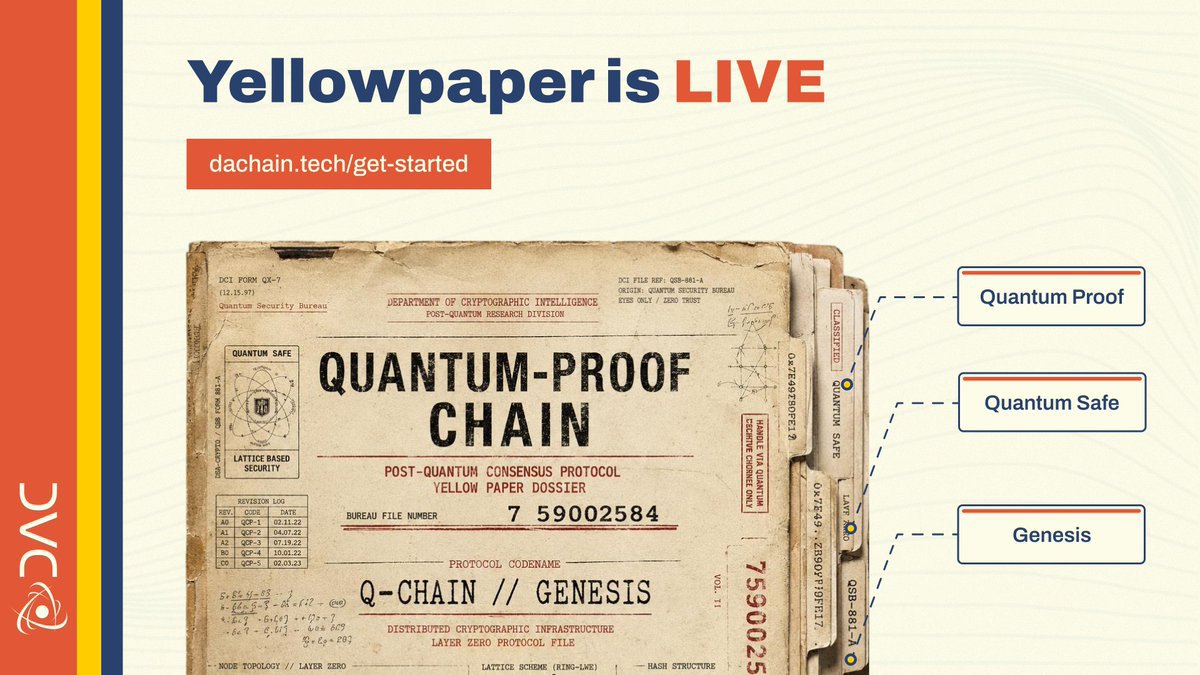
But @dac_chain newly released Yellow Paper opens with a statement that challenges that assumption:
"The threat is no longer theoretical. The transition period has begun."
Most conversations around quantum resistance focus on replacing ECDSA with post-quantum signatures. According to $DAC, that's only part of the solution.
If quantum computing can challenge the foundations of modern cryptographic security, protecting wallets alone won't be enough.
Consensus. Transaction security. Entropy generation. Network architecture.
Every layer matters.
That's why $DAC approaches quantum resilience as a protocol-level design challenge rather than a simple cryptographic upgrade.
Through innovations such as Proof of Quantum Work (PoQW), Quantum Entropy, and a security framework designed for the post-quantum era, $DAC is reimagining what a truly resilient Layer-1 network should look like.
Whether quantum disruption arrives in five years or fifteen, one thing is becoming increasingly clear:
The next generation of blockchain infrastructure won't be defined by who reacts first.
It will be defined by who prepares first.
#DAC Yellow Paper offers an interesting glimpse into what that future may look like.
Read more: dachain.tech/technology
#DAC #Blockchain #QuantumComputing #PostQuantum
Jun 9
They said quantum threats would break everything we’re building.
But @dac_chain wasn’t designed around yesterday’s assumptions.
It’s a layered system that behaves less like a single chain and more like a living structure.
At the base, the Shard Chains handle the heavy lifting. Transactions don’t compete in a single global queue they execute in parallel across segmented states, keeping throughput high even as demand scales.
Above them sits the Master Chain. It isn’t just there to confirm blocks; it defines the system’s rules. Consensus parameters, validator coordination, and overall network integrity all anchor here. It acts as the reference point everything else depends on.
Then there’s the Synchro Chain the layer most people overlook, yet nothing functions properly without it. It keeps state consistent across the system and ensures secure communication between layers, preventing drift and fragmentation.
Each layer solves a distinct scaling challenge on its own.
Together, they create something more deliberate:
☞ Separation without fragmentation
☞ Speed without chaos
☞ Security without centralization
Even in a post-quantum environment, the design doesn’t depend on luck or single points of failure.
It depends on structure.
60
1
226
622
Jun 11
Most people think $SLEEP ends when you wake up.
But what if it’s actually the beginning of something more structured and even rewarding?
Morning sleepers, hope you woke up feeling rested. With @sleepagotchi, sleep stops being "just rest" and starts turning into value you can actually see.
You $SLEEP, it tracks. You wake up to something simple but meaningful: proof that your recovery wasn’t wasted it was earned.
I’ve been using it, and what stands out isn’t just the data, but the behavior shift. There’s a quiet motivation that comes from seeing consistency reflected back at you every morning.
@sleepagotchi is building beyond sleep tracking. It’s shaping what you could call an Intelligence Layer for the Wellness Economy where AI, wearables, and health tools connect so your wellness data doesn’t just sit in an app, but starts working for you.
And maybe that’s the real shift: $SLEEP doesn’t have to be passive anymore. It becomes part of a system that recognizes, measures, and rewards recovery.
Jun 10
Gud night, Sleepers 🦖
I didn’t really notice it at first until it became automatic 🦖.
I’d wake up and instinctively open @sleepagotchi first thing in the morning, almost out of curiosity before Instagram, before WhatsApp, before anything else.
It turns out I’m not alone. 78% of @sleepagotchi users open the app within 10 minutes of waking up.
Before the world starts talking to them, they’re checking in with themselves.
And that’s where it gets interesting.
There’s a quiet shift happening here: $SLEEP doesn’t just end when you wake up it extends into something you can observe, understand, and learn from.
Mornings aren’t just noise anymore.
They’re feedback.
141
1
280
1,885
Jun 11
Happy Timechain Thursday, Quippers 🦋.
Before the timeline gets flooded with charts, hot takes, and market noise, I want to share something that's been on my mind lately.
We're quietly stepping into an era where more compute no longer means simply faster servers. It's about entirely new kinds of machines and who actually gets access to them.
Quantum advantage is no longer just a theory confined to research papers. It's starting to feel tangible, and that changes the game in a fundamental way.
🦋 @quipnetwork is positioning itself as part of that transition.
Because this shift isn't only about raw computational power. It's about access.
And that's where things start to get interesting.
A new kind of system is beginning to take shape.
🦋 @quipnetwork is building something simple in concept but significant in its implications: a decentralized marketplace for quantum computing.
Not just a place to rent compute. Not just infrastructure in the traditional sense.
Instead, it's a coordination layer where quantum workloads can be matched with the right hardware, routed intelligently, and verified for correctness.
Think of it as cloud computing except the machines on the other end are unlike anything most people have ever had access to before.
The real opportunity here isn't just technological progress.
It's the redistribution of access.
If cloud computing helped define the internet era, quantum accessibility may help shape the next generation of intelligence-driven systems.
And @quipnetwork is positioning itself at the center of that shift, transforming rare and expensive compute into something more fluid, usable, and distributed.
Not concentrated in the hands of a few.
But accessible in the way infrastructure should be.
#Quipnetwork $QUIP #PostQuantum
Jun 10
Earlier today at the office, a colleague asked me something I’ve been hearing more often in infra conversations:
"How does anyone survive the quantum threat before it actually happens?"
I laughed and said, "you don’t even know about #QUIP."
He paused. " $QUIP? "
Yeah @quipnetwork 🦋
That’s when the conversation actually got interesting.
Because if quantum computing ever reaches practical scale, a large portion of today’s public-key cryptography starts to look fragile. The systems we rely on for wallets, identities, signatures, transactions everything suddenly stops being something we can take for granted. It becomes something we have to actively rethink.
But the point isn’t fear. It’s design.
So I broke it down like this:
A $QUIP-style approach is essentially about building cryptographic systems that don’t freeze in time. Instead of locking security into a single static model, you design systems that can adapt as the threat landscape evolves:
☞ Hybrid signatures (classical post-quantum together).
☞ Upgradeable cryptographic layers without forcing address or identity changes.
☞ Frequent key rotation to reduce exposure windows.
☞ MPC / threshold signing to eliminate single points of failure.
☞ Automated migration paths into safer vaults when risk signals increase.
The idea is simple almost obvious in hindsight:
Don’t build security like a wall you hope never breaks.
Build it like a system that expects change.
Because in infrastructure, the strongest assumptions are usually the first things to get tested and eventually, the first things to fail.
114
4
341
1,119
Jun 10
Gud night, Sleepers 🦖
I didn’t really notice it at first until it became automatic 🦖.
I’d wake up and instinctively open @sleepagotchi first thing in the morning, almost out of curiosity before Instagram, before WhatsApp, before anything else.
It turns out I’m not alone. 78% of @sleepagotchi users open the app within 10 minutes of waking up.
Before the world starts talking to them, they’re checking in with themselves.
And that’s where it gets interesting.
There’s a quiet shift happening here: $SLEEP doesn’t just end when you wake up it extends into something you can observe, understand, and learn from.
Mornings aren’t just noise anymore.
They’re feedback.
Jun 10

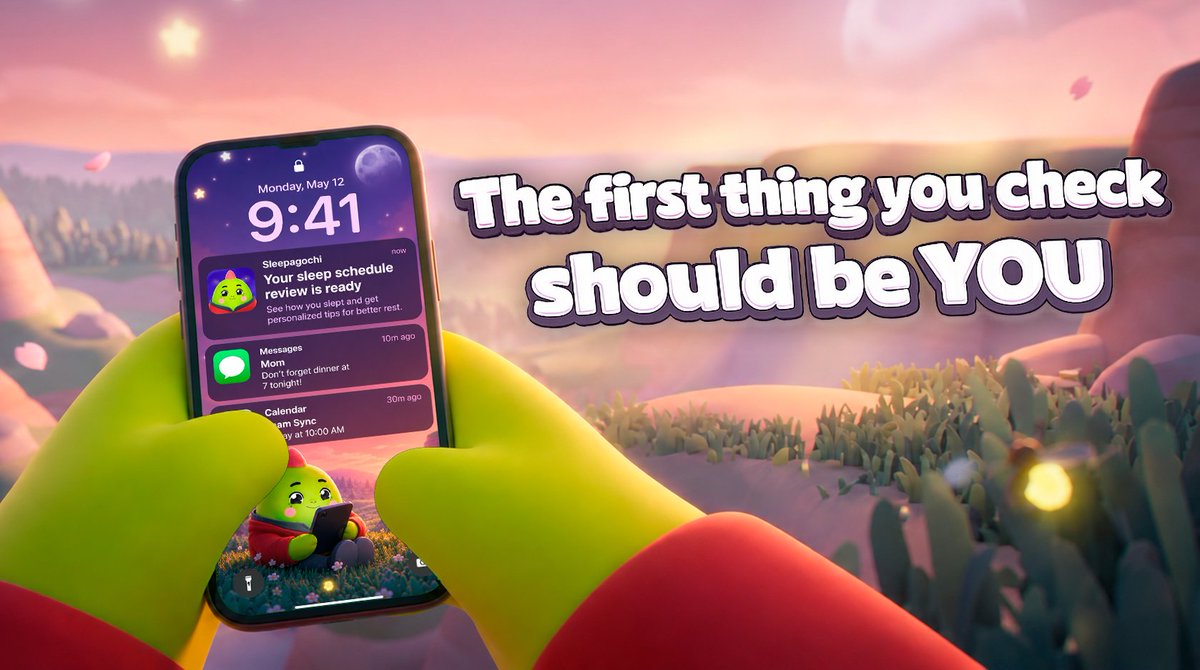
78% of our users open Sleepagotchi within 10 minutes of waking up.
Before Instagram.
Before WhatsApp.
Before emails.
Before you check what's happening in the world, you check what happened to you.
The morning is where sleep becomes intelligence.
68
72
1,667
Jun 10
Earlier today at the office, a colleague asked me something I’ve been hearing more often in infra conversations:
"How does anyone survive the quantum threat before it actually happens?"
I laughed and said, "you don’t even know about #QUIP."
He paused. " $QUIP? "
Yeah @quipnetwork 🦋
That’s when the conversation actually got interesting.
Because if quantum computing ever reaches practical scale, a large portion of today’s public-key cryptography starts to look fragile. The systems we rely on for wallets, identities, signatures, transactions everything suddenly stops being something we can take for granted. It becomes something we have to actively rethink.
But the point isn’t fear. It’s design.
So I broke it down like this:
A $QUIP-style approach is essentially about building cryptographic systems that don’t freeze in time. Instead of locking security into a single static model, you design systems that can adapt as the threat landscape evolves:
☞ Hybrid signatures (classical post-quantum together).
☞ Upgradeable cryptographic layers without forcing address or identity changes.
☞ Frequent key rotation to reduce exposure windows.
☞ MPC / threshold signing to eliminate single points of failure.
☞ Automated migration paths into safer vaults when risk signals increase.
The idea is simple almost obvious in hindsight:
Don’t build security like a wall you hope never breaks.
Build it like a system that expects change.
Because in infrastructure, the strongest assumptions are usually the first things to get tested and eventually, the first things to fail.
Jun 10
Most people will miss $QUIP Network for the same reason many once underestimated cloud computing.
They're focusing on the technology instead of the problem it solves.
When people hear "QUANTUM," they often place it in the same category as every other futuristic idea:
"Interesting, but still too early."
That's where the misunderstanding begins.
Because the real story isn't quantum.
It's compute.
Today, companies spend billions trying to solve problems that traditional systems struggle to handle:
➤ Optimizing global supply chains.
➤ Modeling financial risk.
➤ Accelerating scientific research.
➤ Improving manufacturing efficiency.
➤ Securing critical digital infrastructure.
The demand isn’t theoretical.
The budgets already exist.
The real constraint is access to the right kind of compute for the right kind of workload.
That’s where @quipnetwork becomes interesting.
Rather than betting on a single quantum architecture, #QUIP is building a marketplace where workloads are routed to the most suitable quantum system, while results are verified and performance remains the priority.
Think about it 🤔.
A logistics company doesn't care which quantum architecture finds the solution.
A hedge fund doesn't care which machine produces the result.
They care about outcomes.
☞ Better answers.
☞ Faster execution.
☞ Lower costs.
That's what matters.
And these buyers aren't waiting for some future market to emerge.
They're already looking for competitive advantages today.
Which is why the opportunity extends beyond crypto narratives.
🦋 → Finance: smarter risk modeling and optimization.
🦋 → Logistics: more efficient routing and supply chain management.
🦋 → Manufacturing: improved operational performance.
🦋 → Science and biotech: faster discovery and innovation.
🦋 → Digital assets: stronger security and cryptography.
The real breakthrough isn’t just quantum computing itself.
It's the infrastructure layer that makes advanced compute accessible, practical, and economically viable at scale.
That's the part most people are overlooking.
@quipnetwork isn't simply building a quantum narrative.
It's building a marketplace for compute.
And if compute becomes one of the world's most valuable resources over the next decade, the networks that efficiently allocate it could become just as important as the compute itself.
The question isn't whether quantum computing matters.
The real question is:
Who will own the infrastructure layer when enterprise demand arrives at scale?
$QUIP is positioning itself to be one of those networks.
And that's worth paying attention to.
132
3
291
2,206
Jun 10
gAfternon Sleepers 🦖
For a long time, we treated sleep as optional something to "catch up on later."
Now the data is telling a different story.
Good $SLEEP is becoming the new 10,000 steps.
Today, 1 in 4 adults actively track their sleep. Five years ago, that number was just 1 in 10.
That shift says a lot about where we’re headed: people are starting to measure recovery the same way they measure productivity.
In a way, we’re simply catching up to what nature already figured out long ago.
Dino have been running this system for 66 million years 🦖
No apps. No wearables. Just deep, uninterrupted cycles that kept life going long before step counts ever existed.
We’re only now realizing something simple but powerful:
Performance doesn’t start with output.
It starts with rest.
Jun 9
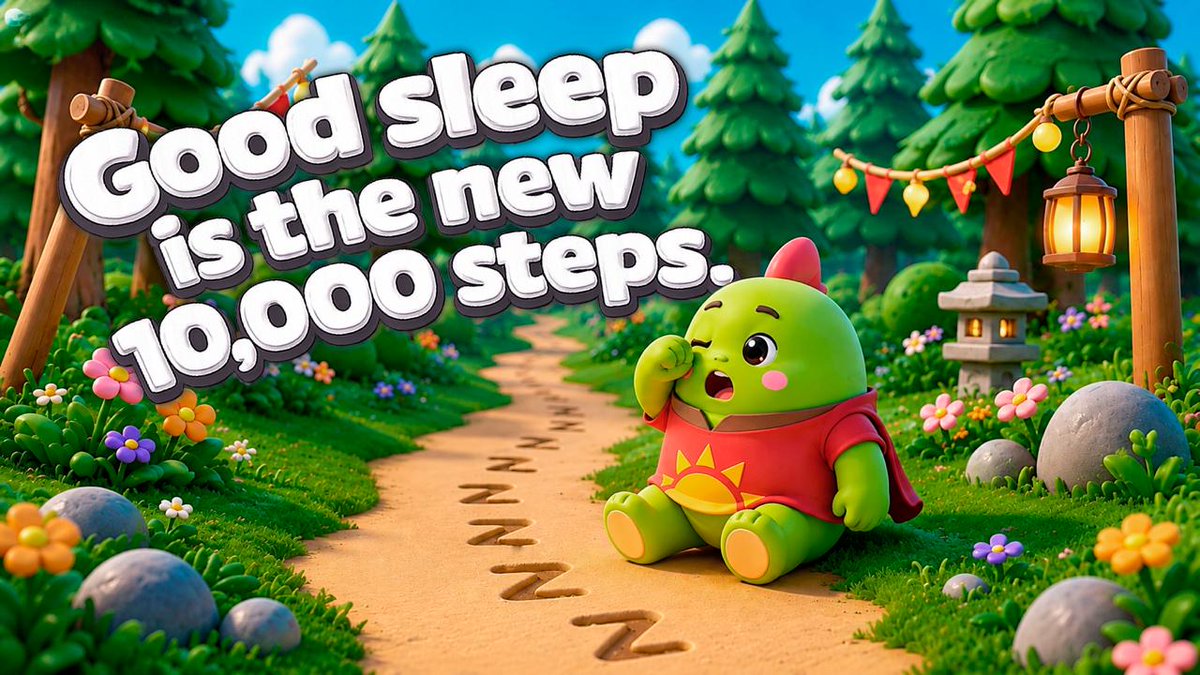
Good sleep is the new 10,000 steps.
1 in 4 adults now track their sleep - that number was 1 in 10 five years ago.
Dino has been on this for 66 million years. He's glad we’re finally catching up 🦖💤
142
1
302
865
Jun 10
Most people will miss $QUIP Network for the same reason many once underestimated cloud computing.
They're focusing on the technology instead of the problem it solves.
When people hear "QUANTUM," they often place it in the same category as every other futuristic idea:
"Interesting, but still too early."
That's where the misunderstanding begins.
Because the real story isn't quantum.
It's compute.
Today, companies spend billions trying to solve problems that traditional systems struggle to handle:
➤ Optimizing global supply chains.
➤ Modeling financial risk.
➤ Accelerating scientific research.
➤ Improving manufacturing efficiency.
➤ Securing critical digital infrastructure.
The demand isn’t theoretical.
The budgets already exist.
The real constraint is access to the right kind of compute for the right kind of workload.
That’s where @quipnetwork becomes interesting.
Rather than betting on a single quantum architecture, #QUIP is building a marketplace where workloads are routed to the most suitable quantum system, while results are verified and performance remains the priority.
Think about it 🤔.
A logistics company doesn't care which quantum architecture finds the solution.
A hedge fund doesn't care which machine produces the result.
They care about outcomes.
☞ Better answers.
☞ Faster execution.
☞ Lower costs.
That's what matters.
And these buyers aren't waiting for some future market to emerge.
They're already looking for competitive advantages today.
Which is why the opportunity extends beyond crypto narratives.
🦋 → Finance: smarter risk modeling and optimization.
🦋 → Logistics: more efficient routing and supply chain management.
🦋 → Manufacturing: improved operational performance.
🦋 → Science and biotech: faster discovery and innovation.
🦋 → Digital assets: stronger security and cryptography.
The real breakthrough isn’t just quantum computing itself.
It's the infrastructure layer that makes advanced compute accessible, practical, and economically viable at scale.
That's the part most people are overlooking.
@quipnetwork isn't simply building a quantum narrative.
It's building a marketplace for compute.
And if compute becomes one of the world's most valuable resources over the next decade, the networks that efficiently allocate it could become just as important as the compute itself.
The question isn't whether quantum computing matters.
The real question is:
Who will own the infrastructure layer when enterprise demand arrives at scale?
$QUIP is positioning itself to be one of those networks.
And that's worth paying attention to.
Jun 9
G to the M, Quippers 🦋
I was reading through recent discussions around Q-Day, and one question kept sticking with me:
What if the biggest security challenge in crypto isn’t years away anymore?
Most Web3 systems are still built on the quiet assumption that today’s cryptography will hold indefinitely. But the reality is, no one really knows when quantum computing crosses the line from theory into a real-world security risk.
That uncertainty is the uncomfortable part.
We’re already securing billions in value on infrastructure designed for a world where quantum threats weren’t practical. Yet every passing year makes post-quantum readiness harder to ignore.
What stands out to me isn’t the noise, but the builders moving early.
One that recently caught my attention is @quipnetwork.
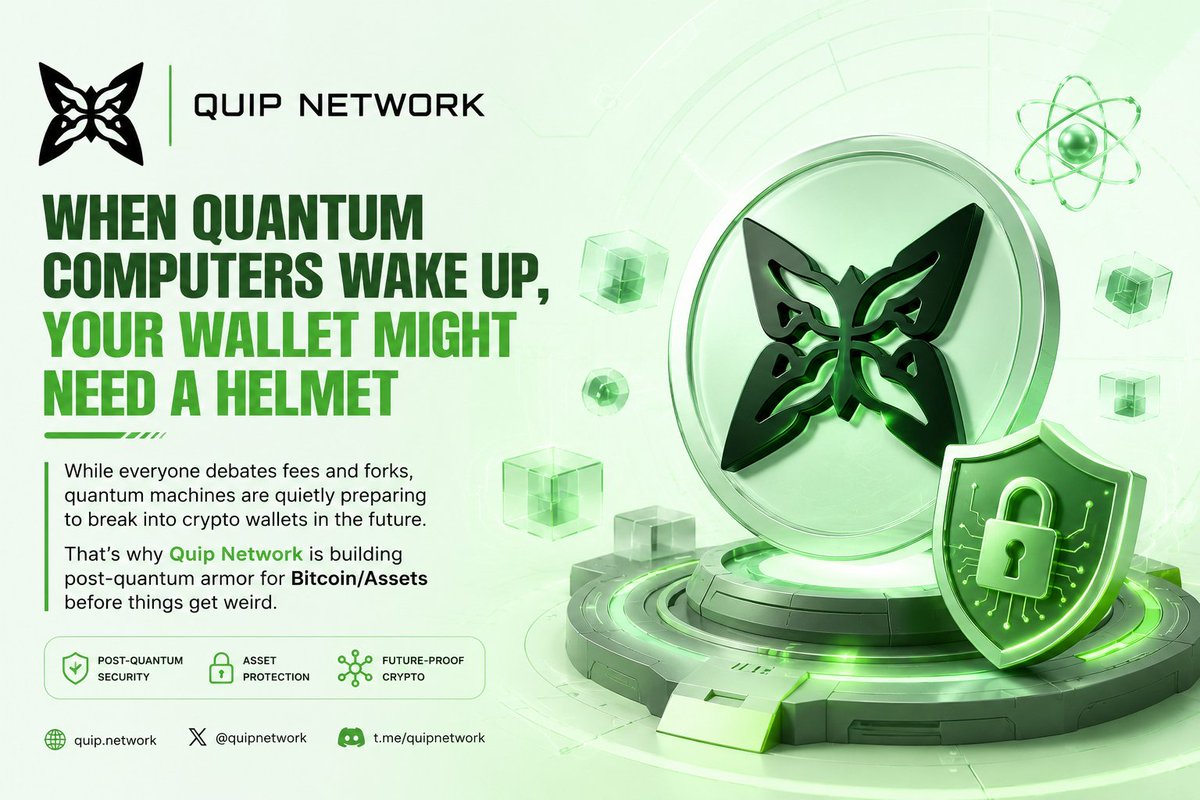
Instead of waiting for protocol upgrades, governance alignment, or slow-moving consensus cycles, they’re already shipping post-quantum protection for Bitcoin today.
No chain drama. No hard fork dependency. No waiting for universal agreement.
Just an additional security layer using WOTS post-quantum signatures designed to help users reduce exposure while the broader ecosystem figures out its long-term direction.
And that detail matters more than it first appears.
A meaningful portion of $BTC is still held in address types that could become vulnerable in a post-quantum future. At scale, even low-probability risks stop being theoretical.
Maybe Q-Day is far off. Maybe it isn’t.
But the signal is becoming harder to ignore: the real edge often belongs to those who prepare before urgency becomes consensus.
And in crypto, timing risk is still risk.
101
3
330
2,221
Jun 9
They said quantum threats would break everything we’re building.
But @dac_chain wasn’t designed around yesterday’s assumptions.
It’s a layered system that behaves less like a single chain and more like a living structure.
At the base, the Shard Chains handle the heavy lifting. Transactions don’t compete in a single global queue they execute in parallel across segmented states, keeping throughput high even as demand scales.
Above them sits the Master Chain. It isn’t just there to confirm blocks; it defines the system’s rules. Consensus parameters, validator coordination, and overall network integrity all anchor here. It acts as the reference point everything else depends on.
Then there’s the Synchro Chain the layer most people overlook, yet nothing functions properly without it. It keeps state consistent across the system and ensures secure communication between layers, preventing drift and fragmentation.
Each layer solves a distinct scaling challenge on its own.
Together, they create something more deliberate:
☞ Separation without fragmentation
☞ Speed without chaos
☞ Security without centralization
Even in a post-quantum environment, the design doesn’t depend on luck or single points of failure.
It depends on structure.
Jun 7
Most people frame the quantum threat as "stealing coins in the future."
That’s the shallow version.
The real risk is more unsettling: a sufficiently capable quantum system may not just break encryption going forward it could potentially re-evaluate past transactions that were assumed to be final.
In that scenario, history stops being fixed. Finality becomes conditional.
That’s the problem space $DAC is built around.
Instead of relying on assumptions that could be reversed later, #DAC enforces settlement with a form of finality designed to resist quantum-level reversals.
So even in a world where computation changes the rules, the ledger doesn’t get rewritten after the fact.
Studying @dac_chain ⚛

84
2
159
1,515
Jun 9
Most $SLEEP apps tell you what happened last night.
@sleepagotchi seems to be aiming for something more interesting.
Not just tracking sleep, but helping people engineer recovery.
It records sleep patterns, interprets recovery signals, connects across devices, and uses AI to transform health data into actionable recommendations instead of endless charts and metrics.
What stands out to me is the shift in perspective.
From:
"Here's how you slept."
To:
"What is your body likely heading toward if nothing changes?"
And that got me thinking about a much bigger opportunity.
What if sleep optimization evolves beyond a personal productivity tool and becomes part of a family's infrastructure?
Not for elite athletes. Not for biohackers.
For exhausted parents navigating fragmented sleep. For newborn feeding schedules. For toddlers who somehow wake up at 3 AM for reasons nobody can explain.
In most households, $SLEEP isn't an individual problem.
It's a shared system.
Maybe the future isn't better $SLEEP tracking.
Maybe it's AI reducing the invisible work of managing rest, recovery, and routines across an entire household.
That's the story I'm watching most closely with @sleepagotchi.
Jun 8
Most wellness apps stop at tracking.
They log your sleep, show you charts, and leave it at that.
But something interesting is happening with @sleepagotchi 🦖.
Every night you sleep stops being just a record it becomes a signal. A reflection of consistency, habits, and how you actually live over time.
Instead of letting that data sit quietly in a dashboard, #Sleepagotchi turns it into something you can interact with.
$SLEEP Points, wearable connections, Dino Gotchis, quests, leaderboards even a profile that slowly evolves to represent more than just "sleep quality."
What stands out isn’t the gamification itself.
It’s the direction: fragmented health data starting to behave like a connected identity layer.
Not just measurement anymore.
More like participation.
And over time, context builds where raw data used to be silent.

145
4
380
1,455
Jun 9
G to the M, Quippers 🦋
I was reading through recent discussions around Q-Day, and one question kept sticking with me:
What if the biggest security challenge in crypto isn’t years away anymore?
Most Web3 systems are still built on the quiet assumption that today’s cryptography will hold indefinitely. But the reality is, no one really knows when quantum computing crosses the line from theory into a real-world security risk.
That uncertainty is the uncomfortable part.
We’re already securing billions in value on infrastructure designed for a world where quantum threats weren’t practical. Yet every passing year makes post-quantum readiness harder to ignore.
What stands out to me isn’t the noise, but the builders moving early.
One that recently caught my attention is @quipnetwork.
Instead of waiting for protocol upgrades, governance alignment, or slow-moving consensus cycles, they’re already shipping post-quantum protection for Bitcoin today.
No chain drama. No hard fork dependency. No waiting for universal agreement.
Just an additional security layer using WOTS post-quantum signatures designed to help users reduce exposure while the broader ecosystem figures out its long-term direction.
And that detail matters more than it first appears.
A meaningful portion of $BTC is still held in address types that could become vulnerable in a post-quantum future. At scale, even low-probability risks stop being theoretical.
Maybe Q-Day is far off. Maybe it isn’t.
But the signal is becoming harder to ignore: the real edge often belongs to those who prepare before urgency becomes consensus.
And in crypto, timing risk is still risk.
Jun 8
Go to the M, Quippers 🦋
A quantum threat doesn’t arrive like a scene from a movie.
There are no alarms. No visible shift. Nothing suddenly breaks.
Instead, something more subtle happens: the cryptography that quietly secures wallets, blockchains, and digital identities gradually becomes insufficient.
That’s the part people understand in theory, but rarely design for in practice.
Quantum risk is no longer a distant "someday" problem. It’s moving steadily closer to real-world systems, and the gap between awareness and readiness is becoming harder to ignore.
With @quipnetwork, the approach shifts. You don’t need to rebuild your entire stack to prepare for what comes next. Their PQS vaults are designed to secure EVM and Solana assets today, while still keeping the door open for quantum computing use cases like research, optimization, and advanced computation.
So the focus isn’t only on defense it’s also on capability.
⚛ Wallet security designed with post-quantum awareness
⚛ Digital assets protected using next-generation safeguards
⚛ Space to explore complex computational problems like Ising models and optimization systems
This is where infrastructure begins to split into two layers: protection and intelligence and builders are already moving in that direction.
The shift is quiet, but it’s already underway.
Builders aren’t waiting for quantum risk to fully arrive. They’re preparing for it now.
161
2
391
2,556
Jun 8
Most wellness apps stop at tracking.
They log your sleep, show you charts, and leave it at that.
But something interesting is happening with @sleepagotchi 🦖.
Every night you sleep stops being just a record it becomes a signal. A reflection of consistency, habits, and how you actually live over time.
Instead of letting that data sit quietly in a dashboard, #Sleepagotchi turns it into something you can interact with.
$SLEEP Points, wearable connections, Dino Gotchis, quests, leaderboards even a profile that slowly evolves to represent more than just "sleep quality."
What stands out isn’t the gamification itself.
It’s the direction: fragmented health data starting to behave like a connected identity layer.
Not just measurement anymore.
More like participation.
And over time, context builds where raw data used to be silent.
Jun 7
Good afternoon, Sleepers 🦖
The @sleepagotchi Creator Leaderboard on @NucleusCodes still is live, with approximately 41 days remaining.
There’s still a $120,000 $SLEEP reward pool available for creators:
→ $100,000 allocated to the top 300 creators
→ $20,000 reserved for high-reputation users
All you need to do is connect your 𝕏 account, check your eligibility, and you're in.
☞ nucleus.codes
But the bigger story isn't the leaderboard itself.
@sleepagotchi is quietly evolving.
What started as a sleep-tracking and gamification experiment is gradually becoming something much broader: an AI-powered wellness intelligence layer.
$SLEEP was never the final destination. It was the entry point.
The vision is becoming clearer: a system that connects sleep, recovery, nutrition, focus, and daily performance into a continuous feedback loop rather than treating them as isolated metrics.
Instead of asking, "How did you sleep last night?", the more meaningful question becomes:
"How is your body performing throughout the day, and what signals is it trying to send you?"
That's the shift.
From sleep rewards to personal health intelligence powered by data and AI.
If successful, #Sleepagotchi won't just track habits. It could build a compounding understanding of human performance over time, learning alongside users rather than simply reporting metrics.
With 41 days remaining, it will be interesting to see how the leaderboard evolves as more attention flows toward the ecosystem.

133
3
328
2,919