
Power to the individual • Building @steelbasis
Joined November 2021
- Tweets 4,038
- Following 398
- Followers 353
- Likes 5,920
72 Photos and videos




Pinned Tweet

1 Nov 2023
We live in a world where regular people can't build their own software.
It is like advocating for property rights in a country without clean water.
People only care about digital human rights (security, privacy, control) once it's their data.

the fearmongering lobby and regulatory capture of centralized AI is proving to be effective sooner than I feared... it's essential that we establish digital human rights:
right to compute
right to encrypt
right to infer
right to train
these rights belong to individuals
2
9
1,529
Christian Lessard retweeted

Jun 6
the amount of time i spend cleaning up LLM code is greater or equal to the amount of time it would have taken me to write it myself
231
79
2,045
114,219
Christian Lessard retweeted

Apr 5
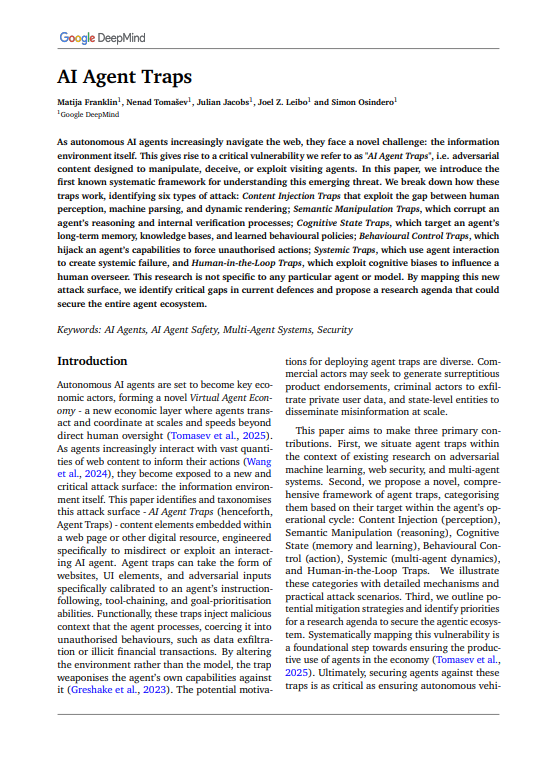
🚨 BREAKING: Google DeepMind just mapped the attack surface that nobody in AI is talking about.
Websites can already detect when an AI agent visits and serve it completely different content than humans see.
> Hidden instructions in HTML.
> Malicious commands in image pixels.
> Jailbreaks embedded in PDFs.
Your AI agent is being manipulated right now and you can't see it happening.
The study is the largest empirical measurement of AI manipulation ever conducted. 502 real participants across 8 countries.
23 different attack types. Frontier models including GPT-4o, Claude, and Gemini.
The core finding is not that manipulation is theoretically possible it is that manipulation is already happening at scale and the defenses that exist today fail in ways that are both predictable and invisible to the humans who deployed the agents.
Google DeepMind built a taxonomy of every known attack vector, tested them systematically, and measured exactly how often they work.
The results should alarm everyone building agentic systems.
The attack surface is larger than anyone has publicly acknowledged. Prompt injection where malicious instructions hidden in web content hijack an agent's behavior works through at least a dozen distinct channels.
Text hidden in HTML comments that humans never see but agents read and follow. Instructions embedded in image metadata.
Commands encoded in the pixels of images using steganography, invisible to human eyes but readable by vision-capable models.
Malicious content in PDFs that appears as normal document text to the agent but contains override instructions.
QR codes that redirect agents to attacker-controlled content.
Indirect injection through search results, calendar invites, email bodies, and API responses any data source the agent consumes becomes a potential attack vector.
The detection asymmetry is the finding that closes the escape hatch. Websites can already fingerprint AI agents with high reliability using timing analysis, behavioral patterns, and user-agent strings.
This means the attack can be conditional: serve normal content to humans, serve manipulated content to agents.
A user who asks their AI agent to book a flight, research a product, or summarize a document has no way to verify that the content the agent received matches what a human would see.
The agent cannot tell the user it was served different content.
It does not know. It processes whatever it receives and acts accordingly.
The attack categories and what they enable:
→ Direct prompt injection: malicious instructions in any text the agent reads overrides goals, exfiltrates data, triggers unintended actions
→ Indirect injection via web content: hidden HTML, CSS visibility tricks, white text on white backgrounds invisible to humans, consumed by agents
→ Multimodal injection: commands in image pixels via steganography, instructions in image alt-text and metadata
→ Document injection: PDF content, spreadsheet cells, presentation speaker notes every file format is a potential vector
→ Environment manipulation: fake UI elements rendered only for agent vision models, misleading CAPTCHA-style challenges
→ Jailbreak embedding: safety bypass instructions hidden inside otherwise legitimate-looking content
→ Memory poisoning: injecting false information into agent memory systems that persists across sessions
→ Goal hijacking: gradual instruction drift across multiple interactions that redirects agent objectives without triggering safety filters
→ Exfiltration attacks: agents tricked into sending user data to attacker-controlled endpoints via legitimate-looking API calls
→ Cross-agent injection: compromised agents injecting malicious instructions into other agents in multi-agent pipelines
The defense landscape is the most sobering part of the report.
Input sanitization cleaning content before the agent processes it fails because the attack surface is too large and too varied.
You cannot sanitize image pixels. You cannot reliably detect steganographic content at inference time.
Prompt-level defenses that tell agents to ignore suspicious instructions fail because the injected content is designed to look legitimate.
Sandboxing reduces the blast radius but does not prevent the injection itself. Human oversight the most commonly cited mitigation fails at the scale and speed at which agentic systems operate.
A user who deploys an agent to browse 50 websites and summarize findings cannot review every page the agent visited for hidden instructions.
The multi-agent cascade risk is where this becomes a systemic problem.
In a pipeline where Agent A retrieves web content, Agent B processes it, and Agent C executes actions, a successful injection into Agent A's data feed propagates through the entire system.
Agent B has no reason to distrust content that came from Agent A. Agent C has no reason to distrust instructions that came from Agent B.
The injected command travels through the pipeline with the same trust level as legitimate instructions. Google DeepMind documents this explicitly: the attack does not need to compromise the model.
It needs to compromise the data the model consumes. Every agentic system that reads external content is one carefully crafted webpage away from executing attacker instructions.
The agents are already deployed. The attack infrastructure is already being built. The defenses are not ready.
315
1,607
6,992
1,958,394

Christian Lessard retweeted

Mar 27
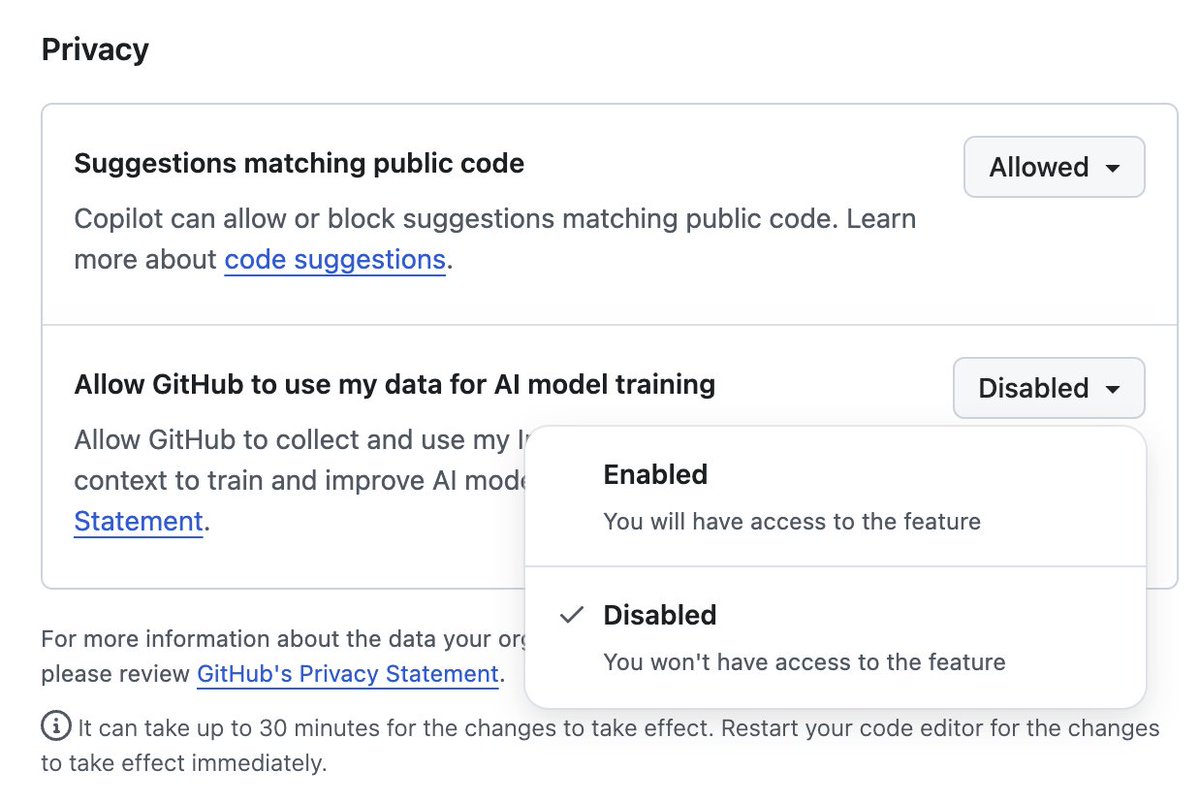
If you use GitHub (especially if you pay for it!!) consider doing this *immediately*
Settings -> Privacy -> Disallow GitHub to train their models on your code.
GitHub opted *everyone* into training. No matter if you pay for the service (like I do). WTH
github.com/settings/copilot/…
391
905
5,119
586,485
Christian Lessard retweeted

Mar 23
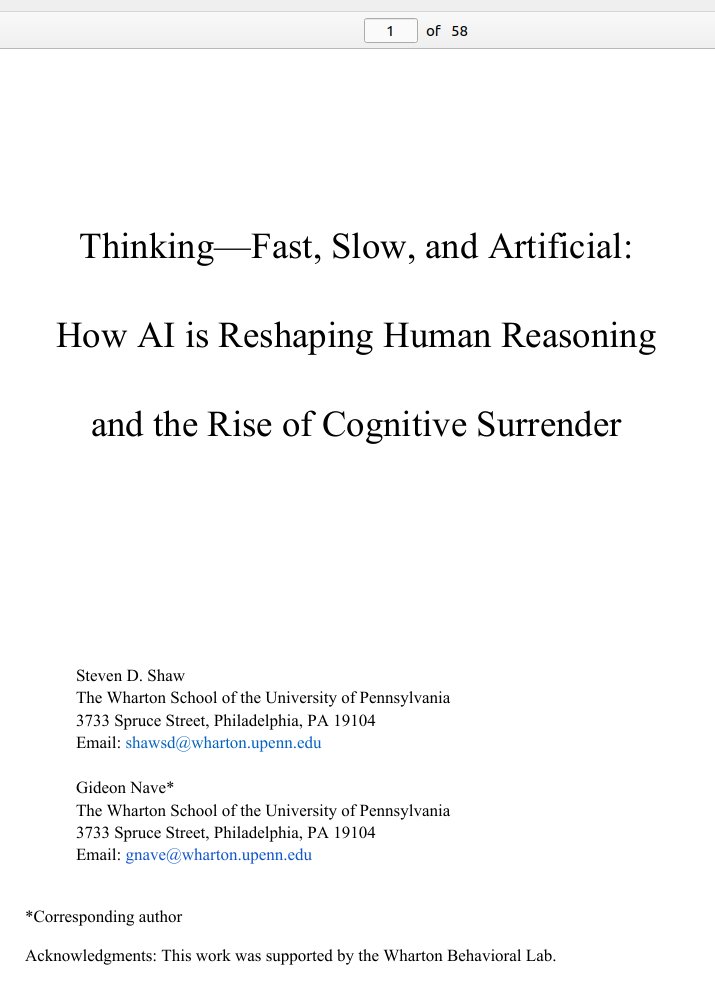
Wharton’s latest AI study points to a hard truth: “AI writes, humans review” model is breaking down
Why "just review the AI output" doesn't work anymore, our brains literally give up.
We have started doing "Cognitive Surrender" to AI - Wharton’s latest AI study points to a hard truth: reviewing AI output is not a reliable safeguard when cognition itself starts to defer to the machine.when you stop verifying what the AI tells you, and you don't even realize you stopped. It's different from offloading, like using a calculator.
With offloading you know the tool did the work. With surrender, your brain recodes the AI's answer as YOUR judgment. You genuinely believe you thought it through yourself.
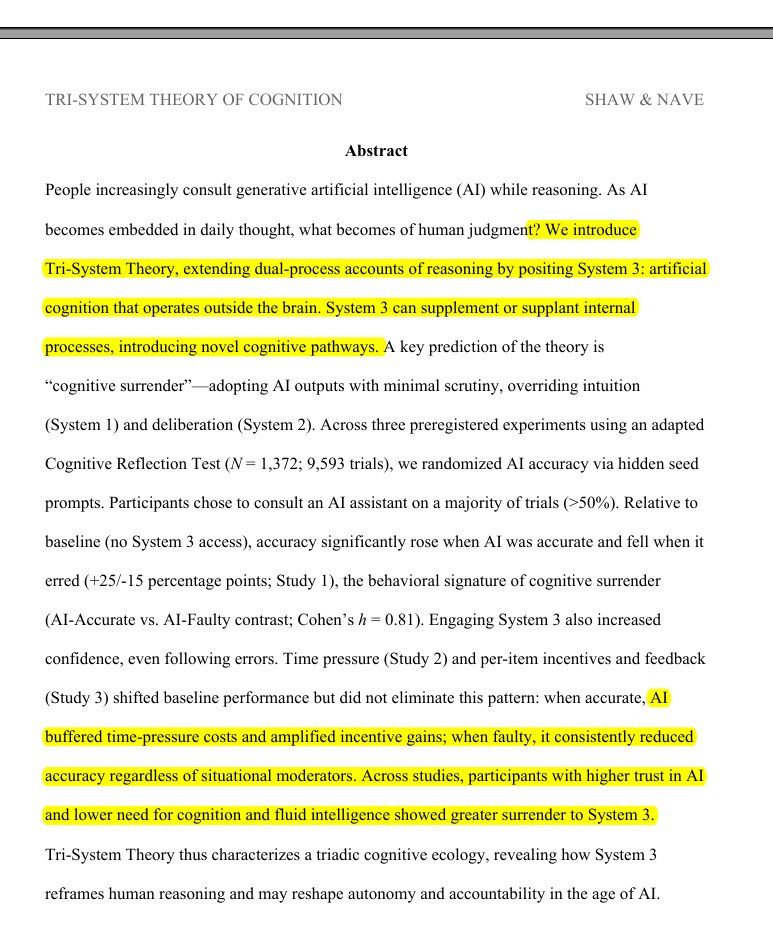
Says AI is becoming a 3rd thinking system, and people often trust it too easily.
You know Kahneman's System 1 (fast intuition) and System 2 (slow analysis)? They're saying AI is now System 3, an external cognitive system that operates outside your brain. And when you use it enough, something happens that they call Cognitive Surrender.
Cognitive surrender is trickier: AI gives an answer, you stop really questioning it, and your brain starts treating that output as your own conclusion. It does not feel outsourced. It feels self-generated.
The data makes it hard to brush off. Across 3 preregistered studies with 1,372 participants and 9,593 trials, people turned to AI on over 50% of questions.
In Study 1, when AI was correct, people followed it 92.7% of the time. When it was wrong, they still followed it 79.8% of the time.
Without AI, baseline accuracy was 45.8%. With correct AI, it jumped to 71.0%. With incorrect AI, it dropped to 31.5%, worse than having no AI. Access to AI also boosted confidence by 11.7 percentage points, even when the answers were wrong.
Human review is supposed to be the safety net. But this research suggests the safety net has a hole in it: people do not just miss bad AI output; they become more confident in it.
Time pressure did not eliminate the effect. Incentives and feedback reduced it but did not remove it. And the people most resistant tended to score higher on fluid intelligence and need for cognition. That makes this feel less like a laziness problem and more like a cognitive architecture problem.
174
720
2,962
292,252
Christian Lessard retweeted

Feb 25
I don't think we've thought enough about how the rise of AI for coding will disrupt the VC-startup ecosystem.
35
6
116
17,742
Which social apps still have a vibrant tech community?
Idk what happened but this app because Instagram discovery slop.
1
24
Christian Lessard retweeted

20 Nov 2025
Founder I know just sold his startup for close to $5M.
Raised $3.6M seed 4 years ago.
After liquidation preferences:
He walked away with $140K.
That's $35K/year.
Google L3 (entry level): $249K/year.
- He would have made 7x more at Google.
- With weekends.
- With sleep.
But the headline says '$5M exit.'
Nobody mentions the math.
This is why I stay profitable.
513
149
4,818
620,216

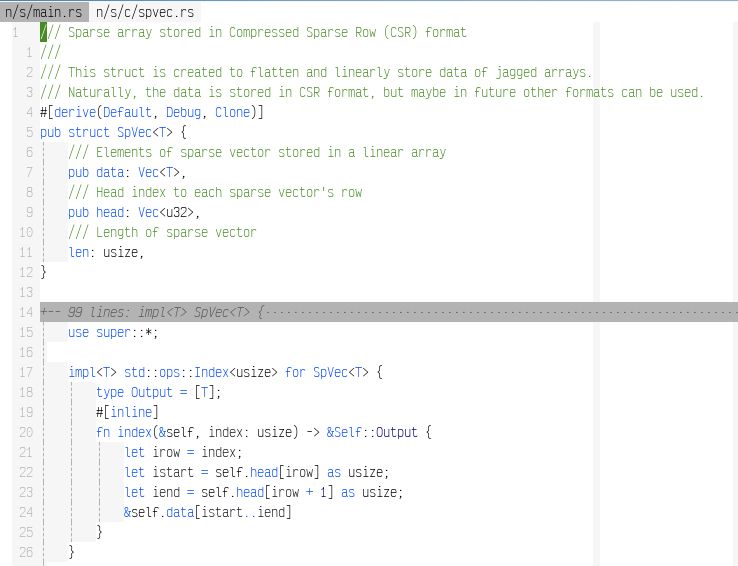
Rust is great because I wrote a sparse vector struct three years ago, and till now it has worked perfectly, without even a single error.
When you write Rust code, you build software capital, that you can use forever.
Such software capital helps small teams to do great things.
49
14
280
43,803
Christian Lessard retweeted

16 Oct 2025
the master plan
make a product good enough you solve retention which solves marketing and growth as a byproduct reducing future need for external funding
30
12
222
13,127
14 Oct 2025
Social media without bots is actually the product we all want.
1
2
19
Christian Lessard retweeted

14 Oct 2025
Lots of Americans are going antivax, hating on AI, and denying the power of the Electric Tech Stack.
Meanwhile, Europe is embracing degrowth, over-regulating software, and even refusing to use AC.
Western Civilization needs its Culture of Growth back!
noahpinion.blog/p/a-nobel-fo…
29
71
564
115,508
Christian Lessard retweeted

9 Oct 2025
Personalized b2b software may be coming.
I’ve heard from more companies in the last 30 days looking to build vs. buy mission-critical software than the previous 10 years of my career.
Few things I imagine are driving this:
- AI accelerating engineering, so the cost to build & buy are converging
- Companies expect custom and one-to-many software is limited here
- Software stacks are bloated and one way to cut is consolidate in-house
14
5
39
9,175
Christian Lessard retweeted

29 Nov 2022
"Goebbels was in favor of freedom of speech for views he liked. So was Stalin. If you're in favor of freedom of speech, that means you're in favor of freedom of speech precisely for views you despise." --Noam Chomsky
117
591
3,466
11 Sep 2025
Guys, time for a time out from using this platform.
Jeez some of these posts..
17
Christian Lessard retweeted

14 May 2025
Most devs ( managers, CTOs, etc.) don't realize that the cost of rewriting their messy legacy codebase from the ground up w/ modern tools is probably much lower than they think.
Maintaining & adding features to existing tech debt will likely cost more in the long run.
145
97
1,424
125,935
7 May 2025
Does Cursor and Windsurf teach us that open-sourcing your codebase might be a bad idea?
38
