
LifeWord | Biblical encouragement for life’s journey in a troubled world.
Joined May 2026
- Tweets 112
- Following 271
- Followers 32
- Likes 105
4 Photos and videos


Jun 11
Pressing Into God: The Path to True Fulfillment
Intimacy with God is the greatest treasure available to man. Connection with God is far superior to personal abilities, achievements, possessions, or influence. Nothing compares to knowing Him and walking closely with Him.
Whatever is lost while pursuing God can be restored. Job’s story is a testimony of this truth. After encountering God more deeply, his losses were restored and his latter days became more blessed than the former. (Job 42:5,10-12)
However, if a person gains everything yet loses God, he has lost all. The rich fool accumulated wealth but neglected his relationship with God, and his earthly treasures could not save him. (Luke 12:16-21)
Therefore, seeking God must take priority over everything else—even above necessary food. Our greatest pursuit should be His presence, His voice, and His pleasure.
Let our desire echo that of David: “One thing have I desired of the Lord… that I may dwell in the house of the Lord all the days of my life, to behold the beauty of the Lord, and to inquire in His temple.” (Psalm 27:4)
Foundational Pillars for Deepening Intimacy with God:
1) Authenticity
Come before God with sincerity. Remove every mask and allow the Holy Spirit to search your heart. Ask Him to uproot every hidden cankerworm—hypocrisy, bitterness, lust, anger, pride, resentment, and every work of the flesh. God draws near to the honest and contrite heart.
2) Consecration
Holiness is essential in our walk with God. Intimacy flourishes where purity is treasured. “Can two walk together, except they be agreed?” (Amos 3:3). God calls His people to be holy because He is holy. (1 Peter 1:15-16)
3) Consistency
A vibrant relationship with God is built daily. Be steadfast in prayer, fellowship, worship, and the study of His Word. Just as the fire on the altar was never to go out, our spiritual fire must be continually maintained. (Leviticus 6:13)
4) Obedience
Love for God is proven through obedience. Jesus said, “If anyone loves Me, he will keep My word.” Obedience opens the door to deeper fellowship and greater revelation of God’s heart. (John 14:23)
Intimacy with God is not an event but a lifelong pursuit. The reward of seeking Him is not merely blessings, power, or answers to prayer—the greatest reward is God Himself.
#IntimacyWithGod #SeekGodFirst #KnowGod #Consecration #Holiness #Prayer #Obedience #ChristianLiving #SpiritualGrowth #Psalm27v4 #WalkWithGod #KingdomLife
1
35
Jun 9
CLOSE AND PERSONAL RELATIONSHIP WITH GOD.
God invites us into a close and personal relationship with Him: “Draw near to God, and He will draw near to you” (James 4:8).
Intimacy with God grows as we deliberately seek Him through prayer, worship, obedience, and His Word.
“As long as he sought the Lord, God made him prosper” (2 Chronicles 26:5), showing that seeking God brings divine guidance and favor.
The deeper our knowledge of God, the greater our sensitivity to His voice, character, and purposes.
Intimate fellowship with God is not merely knowing about Him—it is walking with Him daily and experiencing His transforming presence.
#IntimacyWithGod #DrawNearToGod #KnowledgeOfGod
#SeekTheLord #WalkWithGod #SpiritualGrowth
1
30
Jun 9
The Blessings of Intimate Knowledge of God (Job 22:21 and Jeremiah 9:23-24 )
Job 22:21 and Jeremiah 9:23-24 hold up one great, bright idea. Not wealth, not cleverness pulls weight here. Knowing God rises higher than every other chase. The cosmos brims with targets. Yet this one outshines all. It matters most.
Close to God changes things. Wisdom might impress, yet it falls short. Strength may carry weight, yet fails here. Riches could buy comfort, still they miss the mark. Nothing lines up beside what closeness with the Divine brings
Peace won’t come from them - knowing God is what brings it, according to Job 22:21.
What sticks isn’t found in titles or status. A name that lasts comes from one place alone. According to Jeremiah 9:23–24, real standing grows through connection with God. Boasting makes sense only when it’s about knowing Him.
Nothing follows them past the grave - Ecclesiastes 5:15 made that clear a long time ago.
Deep inside, a longing stays unmet by anything less than the presence of God.
Richness isn’t measured by money piling up in a vault. Instead it shows itself where peace stays full even when pockets are empty. One soul might own little yet carry everything inside. What lasts cannot be stolen or spent. True abundance lives beyond coins and contracts. A heart aligned with something greater lacks nothing. Eternity changes how we count value.
1
32
Jun 9
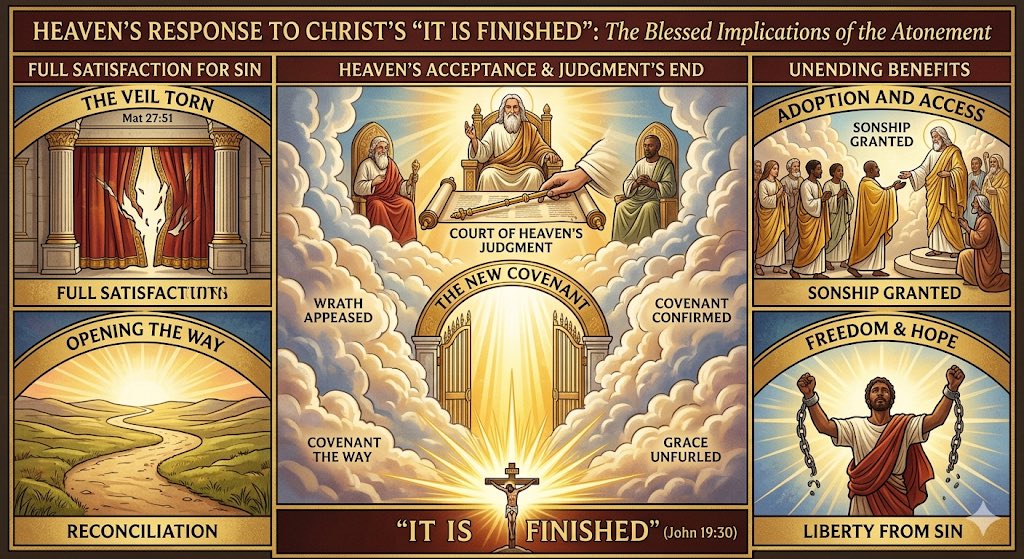
VICTORY AT THE CROSS: Broken Chains, Open Gates.
Below is a colorful chart that explains what happened when Jesus died on the cross. It shows the results of His sacrifice in three main parts:
God's Forgiveness (Left Side): This part shows a heavy curtain ripping in half inside a temple, which means people are no longer separated from God. Below that, a path leading to a bright sunrise shows that the way to God is now open.
The Court of Heaven (Center): This part shows God sitting on a throne surrounded by clouds. A large wooden hammer (a gavel) strikes a scroll to show that humanity's spiritual debt is paid and God's anger is gone. Below the throne, a giant golden gate opens up to let down a bright light of love and grace.
The Gifts for People (Right Side): The top drawing shows a group of different people being welcomed into God's family. The bottom drawing shows a man happily raising his arms as heavy iron chains break off his wrists, showing that people are now liberated from the power of sin.
Accept Jesus as your Lord and Savior, and invite Him into your heart and life.
1
35
Jun 8
Prayer for Intimacy with God:
Lord, I want to truly know You—not just know about You. Like Paul, “that I may know Him.” Like Enoch, help me walk with You daily as my loving Father. Acquaint me with You so I may be at peace (Job 22:21). Let my greatest boast be that I understand and know You (Jeremiah 9:23-24). Draw me closer, Father. Amen.
#IntimacyWithGod #KnowingGod #WalkWithGod #PracticingGodsPresence
1
28
Jun 8
INTIMACY WITH GOD: KNOWING HIM PERSONALLY
Job 22:21 (NKJV)
“Now acquaint yourself with Him, and be at peace; Thereby good will come to you.”
Jeremiah 9:23-24 (NKJV)
“Thus says the Lord: ‘Let not the wise man glory in his wisdom….But let him who glories glory in this, That he understands and knows Me, That I am the Lord, exercising lovingkindness, judgment, and righteousness in the earth. For in these I delight,’ says the Lord.”
Knowing God vs. Knowing About God:
Many possess accurate theological knowledge—facts about His attributes, doctrines, or Bible stories—yet lack a living, relational connection with Him.
Knowing about God is intellectual while knowing God
is intimate, personal, and transformative—an ongoing relationship of love, trust, and communion, like that of a child with a loving Father.
The Apostle Paul expressed this deep longing in Philippians 3:10 (NKJV):
“that I may know Him and the power of His resurrection, and the fellowship of His sufferings, being conformed to His death.”
Paul’s cry was for experiential knowledge of Christ—intimate fellowship that reshapes every part of life.
Anchored in God’s Word:
God invites us into this closeness. Job 22:21 calls us to “acquaint yourself with Him,” implying deep personal connection that brings peace and blessing. Jeremiah 9:23-24 declares that our greatest boast should be in truly understanding and knowing the Lord.
Enoch: A Powerful Example of Intimacy:
Genesis 5:24 (NKJV) says of Enoch: “And Enoch walked with God; and he was not, for God took him.”
Enoch walked with God as a Father for hundreds of years amid a corrupt world. His life was marked by relationship, not religious performance. So deep was his intimacy that God simply took him to heaven. Enoch shows that close fellowship with God is possible in any season and that pleases Him greatly (Hebrews 11:5).
The Challenge of Religion and Spiritual Performance:
Many Christians today chase religion instead of relationship This can produce a form of godliness without power (2 Timothy 3:5), leading to burnout, pride, or emptiness. True intimacy flows from grace, not striving. It is received through surrender, not earned by performance.
Practicing His Presence:
Intimacy grows through practicing the presence of God—moment-by-moment awareness that He is with us (Matthew 28:20). Like Enoch, we can walk with Him daily.
Practical Steps to Cultivate Intimacy with God:
1. Set Apart Daily Time with God
Begin each day with unhurried prayer and Scripture. Read not just to study, but to listen and respond. Psalm 63:1 (NKJV): “O God, You are my God; Early will I seek You…”
2. Practice Continuous Conversation
Turn everyday activities into dialogue with God—thank Him while driving, ask for wisdom in decisions, invite Him into conversations. Brother Lawrence called this “practicing the presence of God.”
3. Worship and Gratitude
Regularly worship through singing, prayer, or quiet adoration. Maintain a gratitude journal, thanking God for who He is and what He has done. This shifts your heart toward Him.
4. Obey Quickly and Listen
Intimacy deepens through obedience. When the Holy Spirit prompts you, respond promptly (John 14:21). Create space to listen—through silence, meditation on Scripture, or journaling what you sense God is saying.
5. Embrace Solitude and Stillness
Regularly withdraw from noise to be alone with God (Mark 1:35). In stillness, we often hear His voice more clearly. Psalm 46:10 (NKJV): “Be still, and know that I am God.”
6. Meditate on God’s Character
Reflect on His names, attributes, and promises. Knowing Him as loving Father, faithful Friend, and sovereign Lord fuels deeper trust.
7. Walk in Fellowship with Others
Share your journey in accountable relationships. The early church grew in intimacy with God together (Acts 2:42).
8. Surrender Daily
Lay down performance, worries, and distractions. Renew your surrender each morning: “Lord, I want to know You more today.”
1
112
Jun 7
Managing God’s Resources: A Biblical Guide to Faithful Financial Stewardship.
The Bible teaches that all resources belong to God, and we are accountable managers (stewards) entrusted to use them faithfully for His glory, our provision, the good of others, and eternal impact.
1. God Owns Everything; We Are Stewards-
• Psalm 24:1 (NKJV): “The earth is the Lord’s, and all its fullness, The world and those who dwell therein.”
• 1 Chronicles 29:11-12 (NKJV): “Yours, O Lord, is the greatness, The power and the glory… Both riches and honor come from You, And You reign over all.”
• 1 Corinthians 4:2 (NKJV): “Moreover it is required in stewards that one be found faithful.”
Everything we have is on loan from God. Our role is faithful management, not ownership.
2. Diligence and Honest Work-
• Proverbs 14:23 (NKJV): “In all labor there is profit, But idle chatter leads only to poverty.”
• Colossians 3:23-24: “And whatever you do, do it heartily, as to the Lord and not to men… for you serve the Lord Christ.”
• Deuteronomy 8:18 (NKJV): “And you shall remember the Lord your God, for it is He who gives you power to get wealth…”
God blesses honest effort. Laziness or unethical practices contradict stewardship.
3. Wisdom, Planning, and Prudence-
• Proverbs 27:23-24: “Be diligent to know the state of your flocks, And attend to your herds; For riches are not forever…”
• Proverbs 21:20 (NKJV): “There is desirable treasure, And oil in the dwelling of the wise, But a foolish man squanders it.”
• Proverbs 21:5 (NKJV): “The plans of the diligent lead surely to plenty, But those of everyone who is hasty, surely to poverty.”
Budgeting, saving, avoiding waste, and seeking wise counsel (Proverbs 15:22) are essential.
4. Generosity and Giving-
• 2 Corinthians 9:6-7 (NKJV): “But this I say: He who sows sparingly will also reap sparingly, and he who sows bountifully will also reap bountifully. So let each one give as he purposes in his heart, not grudgingly or of necessity; for God loves a cheerful giver.”
• Proverbs 3:9-10 (NKJV): “Honor the Lord with your possessions, And with the firstfruits of all your increase.”
• 1 Timothy 6:17-19 (NKJV): Instruct the rich “to do good, to be rich in good works, ready to give, willing to share, storing up for themselves a good foundation for the time to come…”
Give first to God, support the needy, and advance His kingdom cheerfully and proportionally.
5. Contentment and Trust in God-
• 1 Timothy 6:6-8 (NKJV): “Now godliness with contentment is great gain. For we brought nothing into this world, and it is certain we can carry nothing out. And having food and clothing, with these we shall be content.”
• Hebrews 13:5 (NKJV): “Let your conduct be without covetousness; be content with such things as you have. For He Himself has said, ‘I will never leave you nor forsake you.’”
Avoid the love of money (1 Timothy 6:10) and anxiety over provision (Matthew 6:25-34).
6. Caution with Debt and Avoidance of Greed-
• Proverbs 22:7 (NKJV): “The rich rules over the poor, And the borrower is servant to the lender.”
• Romans 13:8 (NKJV): “Owe no one anything except to love one another…”
Minimize debt, repay faithfully, and reject greed (see the Rich Fool, Luke 12:13-21).
7. Eternal Perspective and Accountability-
• Matthew 6:19-21 : “Do not lay up for yourselves treasures on earth… but lay up for yourselves treasures in heaven… For where your treasure is, there your heart will be also.”
• Matthew 25:21 : “Well done, good and faithful servant; you were faithful over a few things, I will make you ruler over many things. Enter into the joy of your lord.”
We will give an account to God. Use wealth to produce eternal fruit through generosity and kingdom investment.
Financial stewardship is holistic and encompasses all the above principles. It is not about achieving riches or embracing poverty, but about faithfulness with whatever God entrusts (Luke 16:10-11).
1
1
104
Jun 7
AVOIDING DEBT’S SLAVERY - BIBLICAL PRINCIPLES FOR FINANCIAL FREEDOM.
The Bible does not explicitly forbid all debt, but it strongly cautions against it, viewing it as a form of bondage that should generally be avoided or minimized through wisdom and faithfulness. The overarching goal is freedom to serve God and others without the enslaving weight of obligations.
Key Biblical Principles on Debt:
1. The Borrower Becomes a Slave to the Lender
Proverbs 22:7 (NJKV): “The rich rules over the poor. And the borrower is slave to the lender.”
Debt creates a master-servant dynamic. It limits freedom, adds ongoing pressure, and can hinder generosity or kingdom priorities.
2. Faithful Repayment
Psalm 37:21 “The wicked borrows and does not repay, But the righteous shows mercy and gives.”
Romans 13:8 (NIV): “Let no debt remain outstanding, except the continuing debt to love one another.”
Failing to repay is condemned as wickedness. Believers must honor obligations promptly as part of their testimony and stewardship. This includes taxes and all legitimate dues (Romans 13:7).
3. Avoid Rash or Unwise Commitments
Proverbs 22:26-27 (NKJV): “Do not be one of those who shakes hands in a pledge , One of those who is surety for debts; if you have nothing with which to pay, Why should he take away your bed from under you?”
Scripture repeatedly cautions against surety (cosigning or guaranteeing another’s debt), viewing it as foolish (Proverbs 6:1-5; 11:15
4. Blessing of Lending, Caution in Borrowing
Deuteronomy 15:6; 28:12: God’s blessing enables His people to lend to others without borrowing, positioning them as the “head and not the tail.” Borrowing is often associated with curses or lack of blessing when it stems from disobedience or poor stewardship.
5. Lending to the Needy
The Bible encourages generous lending to the poor without interest among God’s people (Exodus 22:25; Leviticus 25:35-37; Deuteronomy 23:19-20), but warns against oppressive lending practices. Jesus teaches, “Give to the one who asks you, and do not turn away from the one who wants to borrow from you” (Matthew 5:42).
Debt Is Not Sin, But Often Unwise:
• Borrowing is not labeled a sin outright (e.g., for necessities or productive purposes like business), but Scripture promotes caution, especially consumer debt for wants or luxuries.
• Debt presumes on the future (James 4:13-17) and can distract from trusting God’s provision (Matthew 6:25-34).
• Old Testament provisions like the Year of Jubilee (Leviticus 25) and debt release every seven years (Deuteronomy 15) show God’s heart for freedom from crushing debt.
Practical Biblical Wisdom for Financial Freedom:
• Avoid debt when possible: Save, budget, and live below your means (Proverbs 21:20; 27:23).
• If in debt: Develop a repayment plan, live sacrificially, and seek God’s help (Proverbs 21:5).
• Exceptions: Some view certain debts (e.g., a mortgage ) as more justifiable, but wisdom is still required.
*Contentment: Reduces the desire for debt-fueled lifestyles (1 Timothy 6:6-8).
• Pray for wisdom (James 1:5), seek counsel, and remember the ultimate debt we owe is love—fulfilled in Christ, who canceled our sin-debt on the cross (Colossians 2:14).
In summary, the Bible urges believers to pursue financial freedom so they can serve God wholeheartedly, give generously, and avoid slavery to lenders. Debt should be approached with fear of the Lord, diligence, and an eternal perspective—holding resources loosely while stewarding them faithfully. This leads to greater peace, fruitfulness, and alignment with God’s purposes.
#FinancialFreedom #ChristianFinance #BibleWisdom
• #Contentment #AvoidDebt
1
3
213
Jun 7
WEALTH WISDOM FROM THE BOOK OF PROVERBS.
Biblical wealth is not measured merely by how much money a person has, but by whether it is acquired honestly, managed wisely, shared generously, and enjoyed under God’s blessing.
The Scriptures Teach:
*Avoid the pursuit of quick riches — wealth gained too rapidly is often unstable and short-lived (Proverbs 13:11).
*Build wealth gradually and consistently — steady effort and disciplined stewardship lead to lasting increase (Proverbs 13:11).
*Do not seek shortcuts to prosperity — blessings obtained prematurely or improperly often end badly (Proverbs 20:21).
*Guard against greed — the desire for unjust gain brings trouble to individuals and their families (Proverbs 15:27).
*Reject bribery and corruption — integrity preserves life and invites God’s favor (Proverbs 15:27).
*Never use deception to make money — dishonest gain may seem rewarding at first but ultimately brings regret and loss (Proverbs 20:17).
*Speak truth in all financial dealings — wealth built on lies is temporary and spiritually dangerous (Proverbs 21:6).
*Value character above riches — a good reputation is worth more than financial gain obtained dishonestly.(Proverbs 22.1)
*Recognize that God cares about how wealth is acquired as much as the wealth itself.
*Seek God’s blessing rather than merely seeking money — wealth accompanied by God’s favor brings peace rather than sorrow.(Proverbs 10:22)
Core Biblical Principles on Wealth:
Integrity before prosperity.
Patience before abundance.
Character before capital.
Stewardship before ownership.
Truth before profit.
God’s blessing before personal ambition.
Long-term faithfulness over short-term gain.
Contentment over greed.
Honest labor over dishonest shortcuts.
Eternal values over temporary riches.
1
37
Jun 7
FEAR OF GOD IS FREEDOM.
The fear of God is not bondage—it is freedom from sin, confusion, and destructive choices.
When we honor God above all else, wisdom, peace, and divine direction follow. “The fear of the Lord is the beginning of wisdom.” (Psalm 111:10) 🙏📖
#FearOfGod #Freedom
#Wisdom
#Faith
#ChristianLiving
2
50
Jun 7
Reward for Having Reverential Fear of God.
The fear of God is the foundation of wisdom, protection, and divine guidance. Those who honor God walk in confidence, depart from evil, and enjoy His mercy. “The fear of the Lord is the beginning of wisdom.” (Psalm 111:10) 🙏📖
#FearOfGod #Wisdom #Faith #TrustGod #SpiritualGrowth #BibleTruth #ChristianLiving #GodsFavor #WalkWithGod #KingdomLiving
1
20
Jun 7
FEAR OF GOD, LOVE OF GOD.
A heart that fears God walks in confidence, not terror. Reverence for God unlocks His guidance, protection, and mercy. “In the fear of the Lord there is strong confidence.” (Proverbs 14:26) ✨🕊️
The Bible beautifully balances the fear of God with the love of God—the believer is called to revere God deeply and love Him wholeheartedly. ❤️🙏
1
16
Jun 7
The Paradox: Fear God, Fear Nothing Else:
Here is a profound paradox at the heart of the Christian life:
When God becomes your greatest fear, every other fear loses its power over you.
"The Lord Almighty is the one you are to regard as holy; He is the one you are to fear — He is the one you are to dread." — Isaiah 8:13
When Isaiah said this, the people of Israel were terrified of surrounding nations. God's response was essentially: you are fearing the wrong thing. Fear Me, and the nations lose their power to terrorize you.
"I tell you, my friends, do not be afraid of those who kill the body and after that can do no more. But I will show you whom you should fear: Fear Him who, after your body has been killed, has authority to throw you into hell. Yes, I tell you, fear Him." — Luke 12:4-5
Jesus is not trying to scare us. He is trying to liberate us. He is saying: when you properly orient your fear — when God is at the top of your fear hierarchy — the fear of man, the fear of failure, the fear of loss, the fear of rejection , the fear of the future — all shrink in comparison.
"Fear of man will prove to be a snare, but whoever trusts in the Lord is kept safe." — Proverbs 29:25
How many decisions have you made out of fear of what people would say? How many callings have you delayed because of the fear of man? The fear of God is the cure for the fear of man.
A child who deeply respects their father does not live in terror of the neighborhood bully. Why? Because they know their father is bigger. When God is your Father — and you live with a healthy reverence for Him — who can truly intimidate you?
#FearOfGod #FearOfMan #TrustInGod
1
2
24
Jun 6
WALKING IN THE FEAR OF THE LORD.
Most people associate the fear of God with dread, punishment, and walking on eggshells before an angry deity. That is a misunderstanding — and it has kept many believers from one of the greatest privileges available .
The fear of God is not a burden. It is not bondage. It is a doorway to blessing, protection, wisdom, and a life fully alive:
“Blessed is the man who fears the Lord, who delights greatly in His commandments." — Psalm 112:1
There are two kinds of fear in Scripture:
• Servile fear — the fear of a slave before a master they hate. This produces resentment and rebellion.
• Filial fear — the fear of a child who deeply loves and respects their father. This produces reverence and obedience.
The fear of God the Bible calls us to is filial fear. It is not cowering in terror — it is standing in awe of who God is.
"The fear of the Lord is the beginning of wisdom, and knowledge of the Holy One is understanding." — Proverbs 9:10
This verse tells us that wisdom does not begin with intelligence, education, or experience. It begins with a right posture before God. When you place God where He belongs — at the very top — everything else in your life begins to align.
"Behold, the fear of the Lord — that is wisdom! And to depart from evil is understanding." — Job 28:28
The fear of God has a very practical expression: it makes you depart from evil. Not because you are afraid of hellfire in every moment, but because you love God so much that you do not want to grieve Him. You take His Word seriously. You obey when no one else is watching. You honour Him in private.
Deuteronomy 10:12 says God asks of you to fear the Lord your God, to walk in His ways, to love Him and serve Him with all your heart and soul. Notice that fearing God and loving God appear in the same sentence. They are not opposites — in God's kingdom, they are partners.
In summary , the benefits of the Fear of God—
1). It is the beginning of wisdom
“The fear of the Lord is the beginning of wisdom.” (Psalm 111:10)
Reverence for God helps us make wise decisions and avoid destructive choices.
2). It leads to a longer and more meaningful life
“The fear of the Lord prolongs life.” (Proverbs 10:27)
Living according to God’s principles often promotes healthier and more stable living.
3). It brings divine protection
“The angel of the Lord encamps around those who fear Him, and delivers them.” (Psalm 34:7)
God watches over and protects those who honor Him.
4). It leads to God’s favor and mercy
“His mercy is on those who fear Him from generation to generation.” (Luke 1:50)
Those who reverence God experience His compassion and loving-kindness.
5). It helps believers avoid sin
“By the fear of the Lord one departs from evil.” (Proverbs 16:6)
A healthy fear of God strengthens our resolve to live righteously.
6). It brings confidence and security
“In the fear of the Lord there is strong confidence.” (Proverbs 14:26)
Trusting and honoring God gives inner stability even during difficult times.
7). It attracts God’s guidance
“Who is the man that fears the Lord? Him shall He teach in the way He chooses.” (Psalm 25:12)
God directs and instructs those who seek to honor Him.
How to Cultivate the Fear of God:
Proverbs 2:1-5, Deuteronomy 17:19)
•Meditate on His Word daily — it builds holy reverence
•Practice obedience in private — fear of God shows up when no one else does
•Surround yourself with those who also fear Him — Psalm 34:9 (“Oh fear the Lord, you His saints”)
The Paradox:
When God becomes your greatest fear, every other fear loses its power. The fear of man, failure, and the future — all shrink when God is properly enthroned in your life.
#FearTheLord #Wisdom
#Faith #ChristianLiving
#BibleTruth #TrustGod
#GodlyWisdom #SpiritualGrowth
1
56
Jun 6
OBSTACLES TO RECEIVING SALVATION IN CHRIST.
Salvation is God’s free gift—received by grace through faith in Jesus Christ alone (Ephesians 2:8-9). Yet many people never receive it, or delay it, because of common obstacles. The good news is that every barrier can be overcome by the power of the Holy Spirit and the truth of God’s Word. Read the Gospels, especially John.
Here are some of the major obstacles:
1. Unbelief and Rejection of the Gospel:
Many hear the message of Christ but do not believe it is true or necessary for them. They view the Gospel as a myth, outdated, or irrelevant to modern life : John 3:18; Hebrews 11.6
2. Spiritual Blindness:
Satan, described as the god of this world, works to blind people to the gospel — so they cannot see the light of the glory of Christ (2 Corinthians 4:3–4). Jesus also warned that when anyone hears the Word and does not understand it, the evil one comes and snatches it away from their heart (Matthew 13:19). 
3. Fear of Persecution
The fear of suffering for one’s faith is a major hindrance — 2 Timothy 3:12 and 1 Peter 2:19–23 both speak to this reality, reminding believers that all who live godly in Christ Jesus will suffer persecution. 
4. Love of Comfort and RichesThe deceitfulness of wealth and the desire for material comfort can choke the Word and keep a soul from fully surrendering — 1 Timothy 6:9–10 and Proverbs 10:22 address this directly. 
(See also Matthew 19:24 — “It is easier for a camel to go through the eye of a needle…”)
5. Pride of Intellect and Human Achievement
Relying on human wisdom and intellectual pride can be a barrier — 1 Timothy 6:20–21 warns against false knowledge, while Philippians 3:3–10 shows Paul counting all his achievements as loss compared to knowing Christ. 
6. Shame of the Gospel
“Whoever is ashamed of Me and My words in this adulterous and sinful generation, of him the Son of Man also will be ashamed…” — Mark 8:38
This obstacle is aimed at those who, while partially committed to Christ, keep it quiet to avoid disturbing others or seeming different from the non-dedicated. 
7. Stumbling Blocks from Believers
Acting contrary to God’s will while calling yourself a follower of Christ can discredit the ministry of reconciliation (2 Corinthians 6:3). Jesus Himself said: “Woe to him through whom stumbling blocks come!” (Luke 17:1–2). 
8. Trying to Work for Salvation
Scripture is clear — salvation cannot be earned. It comes solely by grace through faith in Jesus’ finished work, not by our works (Ephesians 2:8–9). Trying to add works or law to grace is a doomed approach that misses the gospel entirely. 
9. Self-Righteousness
Some believe they are “good enough” without needing a Savior. They compare themselves to others and think their good deeds will outweigh their wrongs: Isaiah 64:4; Mark 2.17.
“For all have sinned and fall short of the glory of God” (Romans 3:23).
The Simple Path Forward:
If the Holy Spirit is convicting you, do not harden your heart (Hebrews 3:15). The response God calls for is straightforward:
1. Acknowledge your sin and need for a Savior.
2. Believe that Jesus died for your sins, rose again, and offers forgiveness and new life.
3. Receive Him by faith—calling on His name (Romans 10:9-13).
Pray a simple prayer of faith .
“Lord Jesus, I know I am a sinner. I believe You died for my sins and rose again. I turn from my sins and trust in You alone for salvation. Come into my life and be my Lord and Savior. Thank You for forgiving me and giving me eternal life. Amen.”
If you prayed that and meant it, Scripture says you are now a child of God (John 1:12). Tell someone, get baptized, and begin reading the Bible (start with the Gospel of John) and connecting with a Bible-teaching church.
Today is the day of salvation (2 Corinthians 6:2). Will you receive God’s free gift?
#Salvation #ChristianSalvation #GraceThroughFaith #OvercomeObstacles #RepentAndBelieve #Romans323 #FaithJourney #ComeToJesus #EternalLife
96
Jun 5
Spiritual Warfare and Persistent Prayer: Why God’s Answers Sometimes Take Time.
Daniel 10:12-14 (ESV)
“Then he said to me, ‘Fear not, Daniel, for from the first day that you set your heart to understand and humbled yourself before your God, your words have been heard, and I have come because of your words. The prince of the kingdom of Persia withstood me twenty-one days, but Michael, one of the chief princes, came to help me, for I was left there with the kings of Persia, and came to make you understand what is to happen to your people in the latter days. For the vision is for days yet to come.’”
Context:
This occurs during Daniel’s three-week period of mourning, fasting, and prayer (Daniel 10:2-3). Daniel, an elderly exile, sought understanding about the future of God’s people. The angel’s appearance reassures him that his prayer was effective from day one, despite the delay.
Core Meaning:
God hears and responds to humble, sincere prayer immediately, even when the visible answer is delayed. Behind-the-scenes spiritual opposition can hinder the delivery of answers, but God’s purposes prevail with angelic assistance. The delay serves a greater purpose: deeper revelation about “latter days.”
Key Lessons Learned:
1. God Hears Instantly
From the first day Daniel set his heart to understand and humbled himself, heaven moved. Your prayers are heard the moment you pray with genuine humility and desire for God’s will — not when you finally “feel” the answer.
2. Delays Are Not Denials
Twenty-one days of apparent silence did not mean God was inactive or uninterested. Delays often involve spiritual realities we cannot see. This encourages persistence rather than discouragement.
3. Spiritual Warfare Is Real.
The “prince of Persia” (a demonic power influencing the empire) resisted the angel. This reveals that prayer operates in a contested spiritual realm. Michael (a chief angelic prince) provided backup. Believers should be aware of opposition without being afraid.
4. Humility and Wholehearted Seeking Matter.
Daniel’s posture — humility, fasting, and setting his heart to understand — released divine response. Pride or casual prayer often hinders reception.
5. God’s Timing Serves His Purposes
The delay allowed for a more profound vision about the future. What feels like waiting is often preparation for greater understanding or stronger faith.
6. Fear Not — Reassurance Is Available
The angel’s first words are “Fear not.” God comforts His servants amid spiritual battles and delayed answers.
Broader Biblical Connections:
• Daniel 9 & 10: Consistent pattern of prayer leading to angelic insight.
• Ephesians 6:10-18: Put on the full armor of God because we wrestle against spiritual forces.
• James 4:6-8: God gives grace to the humble; draw near and He draws near.
• Luke 18:1-8: The parable of the persistent widow — keep praying.
• Romans 8:28 & 31: God works all things for good; if He is for us, who can be against us?
Summary:
The main lessons are: God hears immediately, spiritual warfare explains many delays, humility and persistence release answers, and we can trust God’s perfect timing even when we don’t understand our way. This passage brings tremendous encouragement for anyone in a waiting or battling season — your prayers are effective, heaven is moving, and greater revelation is coming.
#HeardFromDayOne #PersistentPrayer #SpiritualWarfare #GodsTiming #HumblePrayer
1
92
Jun 4
When You Can’t Figure Out Your Way: Trusting God’s Hidden Guidance
Proverbs 20:24 (ESV)
“A man’s steps are from the Lord; how then can man understand his way?”
This proverb highlights the tension between divine sovereignty and human limitation.
• God ultimately directs a person’s steps and path in life.
• Because of this, we cannot fully comprehend or control our own way through our limited perspective.
It is a humble acknowledgment that life is not entirely in our hands. Our plans, decisions, and journeys are under God’s guiding providence, even when the road feels confusing, delayed, or different from what we expected.
Key Insights:
1. God’s Sovereign Guidance-
The Lord is actively involved in ordering our lives. “Steps” refers to the everyday decisions and movements of life — not just major milestones. This brings comfort: nothing is random or outside His control.
2. Human Inability to Fully Understand-
The rhetorical question “how then can man understand his way?” exposes our pride and limited vision. We often think we have life figured out, but circumstances (job loss, unexpected detours, delays) reveal how little we actually see. This promotes humility and dependence on God.
3. Mystery and Trust-
The verse does not discourage planning or effort. Instead, it warns against overconfidence in our own understanding. True wisdom involves holding our plans loosely while trusting the Lord’s direction.
Broader Biblical Connections:
• Proverbs 16:9: “The heart of man plans his way, but the Lord establishes his steps.”
• Jeremiah 10:23: “I know, O Lord, that the way of man is not in himself, that it is not in man who walks to direct his steps.”
• Psalm 37:23: “The steps of a man are established by the Lord, when he delights in his way.”
• James 4:13-15: Warns against arrogant planning and calls us to say, “If the Lord wills…”
• Romans 8:28: God works all things for good for those who love Him — even the confusing steps.
Summary:
Proverbs 20:24 calls us to humbly trust in God’s sovereignty. We plan and work diligently, — but we ultimately rest in the truth that He directs our steps. This brings peace in seasons of uncertainty, frustration, or recovery. Instead of demanding full understanding, we walk forward in faith, knowing the One who knows the way is leading us.
#Proverbs2024 #GodOrdersOurSteps #DivineDirection #TrustInTheLord #BiblicalWisdom #SovereigntyOfGod
33
Jun 4
Be Filled with the Spirit, Not Wine:
Ephesians 5:18 (ESV)
“And do not get drunk with wine, for that is debauchery, but be filled with the Spirit.”
Ephesians 5 is part of Paul’s practical instructions on Christian living. It
contrasts between two influences: wine versus the Holy Spirit.
He issues a clear command with a strong contrast:
• Negative command: “Do not get drunk with wine.” Drunkenness is not merely discouraged — it is forbidden for believers. It describes a lifestyle of excess that destroys self-control and leads to ruin.
• Positive command: “But be filled with the Spirit.” This is the God-honoring alternative. Being “filled” means being under the control and influence of the Holy Spirit, not alcohol.
The verse presents two masters: one (wine) leads to loss of control and foolishness; the other (the Spirit) leads to wisdom, power, and godly living.
Key Insights:
1. Drunkenness hands the steering wheel of your life to a substance. Being Spirit-filled means the Holy Spirit directs your thoughts, words, emotions, and action.
2. Grace for Struggle: For those battling addiction, this verse offers hope. The same Spirit who fills us also gives power to overcome (Romans 8:13).
Related Scriptures:
. Proverbs 20:1 & 31:4-7: This New Testament verse brings the Old Testament wisdom into sharper focus — alcohol mocks and fights, especially dangerous for leaders, but the Spirit empowers.
• Galatians 5:16-25: Walk by the Spirit and you will not gratify the desires of the flesh.
• 1 Corinthians 6:19-20: Your body is a temple of the Holy Spirit — treat it accordingly.
Summary:
Ephesians 5:18 is a call to Spirit-controlled living instead of substance-controlled escapism.
#NotDrunkWithWine #BiblicalSobriety #SpiritLedLiving #WisdomInChrist
1
28
Jun 4
True Riches: The Blessing That Adds No Sorrow
Proverbs 10:22 (NKJV):
“The blessing of the Lord makes one rich, And He adds no sorrow with it.
This proverb contrasts two paths to “riches” or prosperity:
• Human striving alone often brings wealth accompanied by stress, anxiety, exhaustion, family strain, moral compromise, or emptiness (the “sorrow” that frequently tags along with self-made success).
• The Lord’s blessing, by contrast, brings true enrichment — material, spiritual, relational — without the accompanying grief or painful toil.
“Rich” here goes beyond mere money. It includes fruitfulness, peace, and well-being. God’s blessing is not a formula for getting rich quick; it is His favor resting on a life aligned with Him, resulting in holistic enrichment that doesn’t destroy the person receiving it.
Key Insights on God’s Blessings:
1. Source Matters: All genuine, lasting blessing originates from God, not solely from hard work, cleverness, or luck. Diligence is important in Proverbs (e.g., 10:4), but the blessing that multiplies and satisfies comes from the Lord.
2. No Added Sorrow: This is the standout promise. Many people gain wealth through:
• Ruthless ambition
• Compromising ethics
• Neglecting family or health
• Chasing success at all costs
These often bring regret, broken relationships, health issues, or inner emptiness. God’s blessing enriches cleanly — with peace, contentment, and joy attached.
3. Holistic Prosperity: “Rich” here isn’t exclusively financial. It can mean:
• Spiritual richness (peace with God, wisdom, fruit of the Spirit)
• Relational richness (strong family, godly community)
• Material provision as God sees fit
The blessing empowers fruitfulness without the curse that often follows worldly gain.
4. Not a Guarantee of Wealth: Godly people may face poverty or trials (see Job, or Jesus Himself), while the wicked sometimes prosper temporarily. This verse highlights the quality of blessing when God chooses to prosper someone.
Practical Application:
• Seek God’s Blessing First: Prioritize righteousness, wisdom, and obedience over chasing money. When God blesses, it comes without the hidden costs.
• Contentment in Any Season: Even without material abundance, God’s blessing brings inner richness and peace that the world cannot give or take away.
• Stewardship: When blessing comes (financial or otherwise), receive it with gratitude and use it generously — free from the sorrow of greed or anxiety.
• Beware of teachings that treat this verse like a prosperity formula. The Bible shows God blesses some with wealth (Abraham, Solomon, Job), but often calls His people to simplicity, sacrifice, or endurance.
In summary, Proverbs 10:22 celebrates the beautiful, sorrow-free nature of God’s blessings. It invites us to trust that when the Lord enriches, He does so as a good Father — fully, freely, and with peace. It’s not “name it and claim it,” but “align with Him and receive what He gives with joy.” [ see James 1:17; Matthew 6:33; Psalm 37:4-5.]
#BlessingOfTheLord #SorrowFreeBlessing #GodsBlessings #TrueRiches #NoAddedSorrow
1
33