
38 Photos and videos










If you're basing your Bitcoin arguments on protecting criminal activity, you are NGMI. 🤷

But if you want to take the other side of that argument @tuftythecat then I will start to question who or what you might be protecting by sewing disagreement. Civilized society has no place for criminals or those who protect them. Miners are not obligated to support criminals.
2
16
665


1
8
46
1,226
Light retweeted

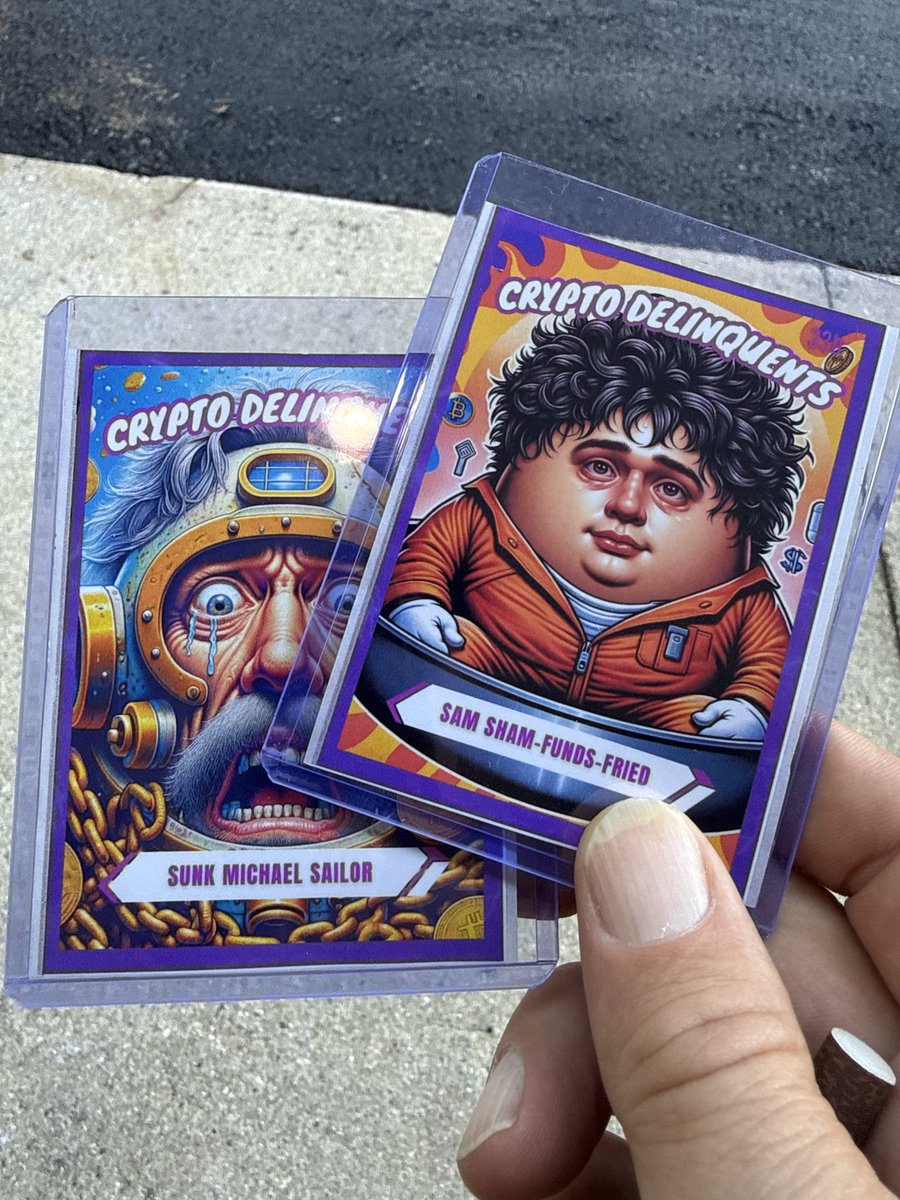
Created an entire Crypto Delinquent series about 2 years ago.. it may be time.
2
4
15
550
Light retweeted

There's a perfectly rational reason companies are quietly testing on BSV without making a song and dance about it.
It's cheap.
If the project goes nowhere, they've spent next to nothing. They can run extensive testing, process large volumes of transactions, experiment with workflows, and collect real data for the price of a few coffees. You can do a hell of a lot of testing for ten dollars.
Try doing that on BTC.
But the bigger problem is that many of the things businesses actually want to do are treated as spam by the BTC crowd. Logistics records? Spam. EDI messages? Spam. Supply-chain data? Spam. Enterprise processes? Spam. Put anything on-chain other than moving coins between speculators and somebody starts screaming that you're abusing the network.
So why would businesses build on a system where their intended use case is already regarded as illegitimate?
They won't.
Businesses don't care about ideological purity tests. They care about whether the system performs the function they need at a price they can justify. If one network lets them test cheaply and process the data they actually need, while another calls their business model spam, the outcome is hardly mysterious.
12
59
244
5,913
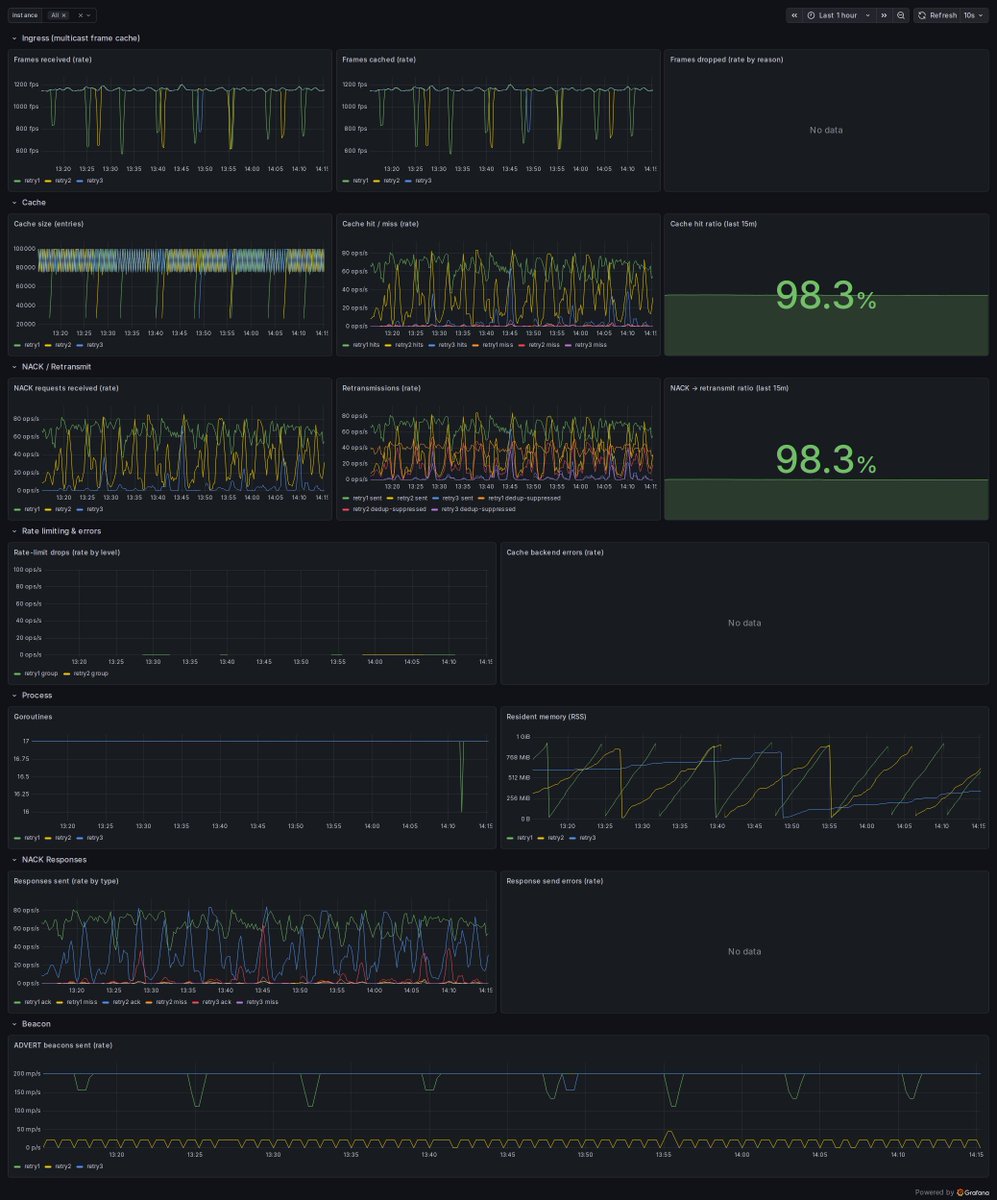
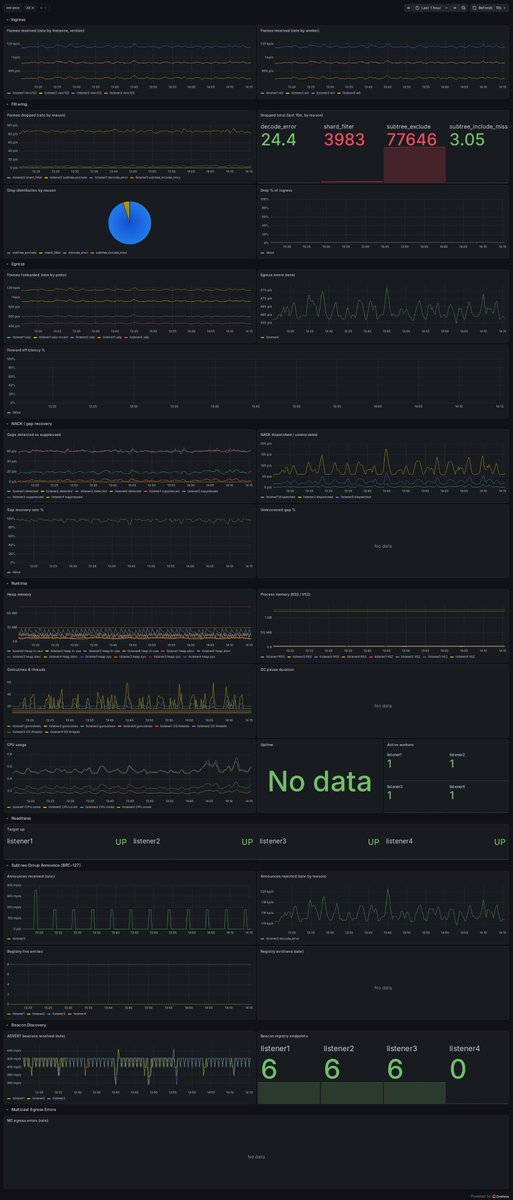
Teranode is already proven to move over a million transactions per second. Submitting a transaction scales easily, but confirming it is the choke point. To know a transaction has been seen, a tracker today must watch the entire network's traffic and sift it for the few transactions it cares about, work that grows with the whole network rather than with one application. Best-effort gossip also sends each update many times over and can drop one silently, leaving a transaction stuck with no warning.
Structured IPv6 multicast changes the math. A transaction's ID maps deterministically to a delivery group, so tracking can be split cleanly across many machines with no central coordinator. The network delivers each update once instead of many times, and every message is sequence-numbered so any gap is caught and repaired automatically. There are no silent losses.
The result: transaction tracking keeps pace with a million-plus-TPS network instead of bottlenecking a single listener, while the application-facing API stays unchanged.
1
13
63
1,411
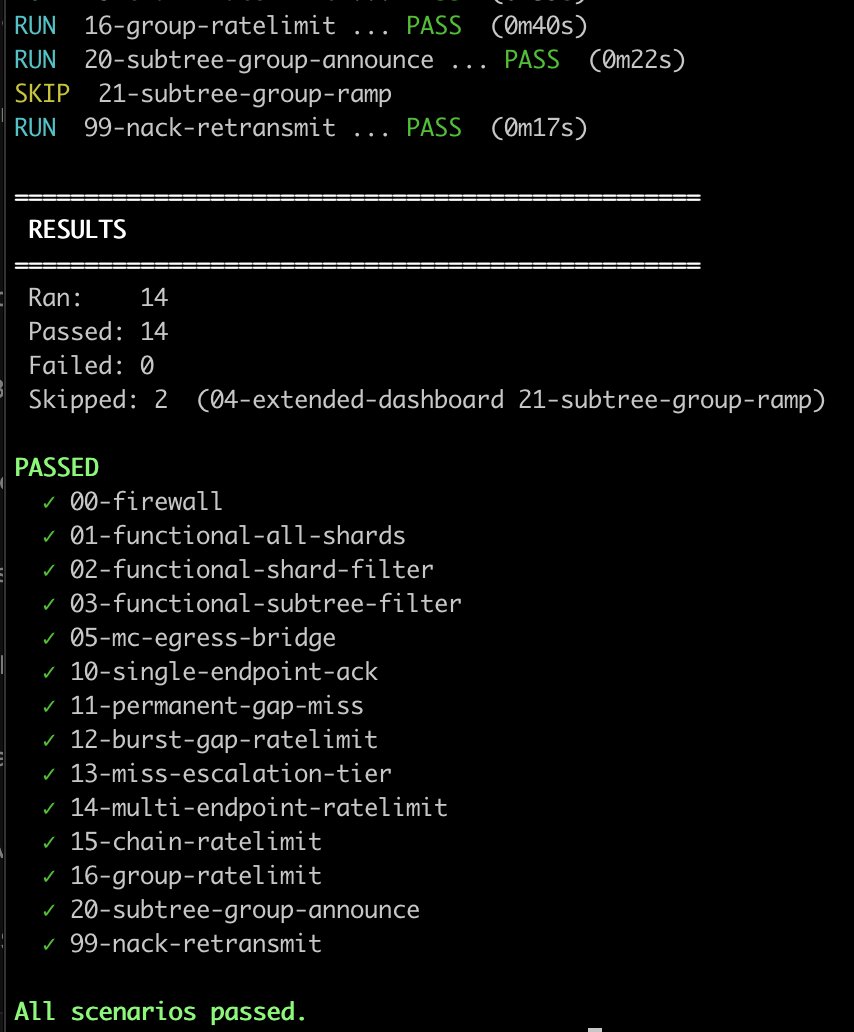
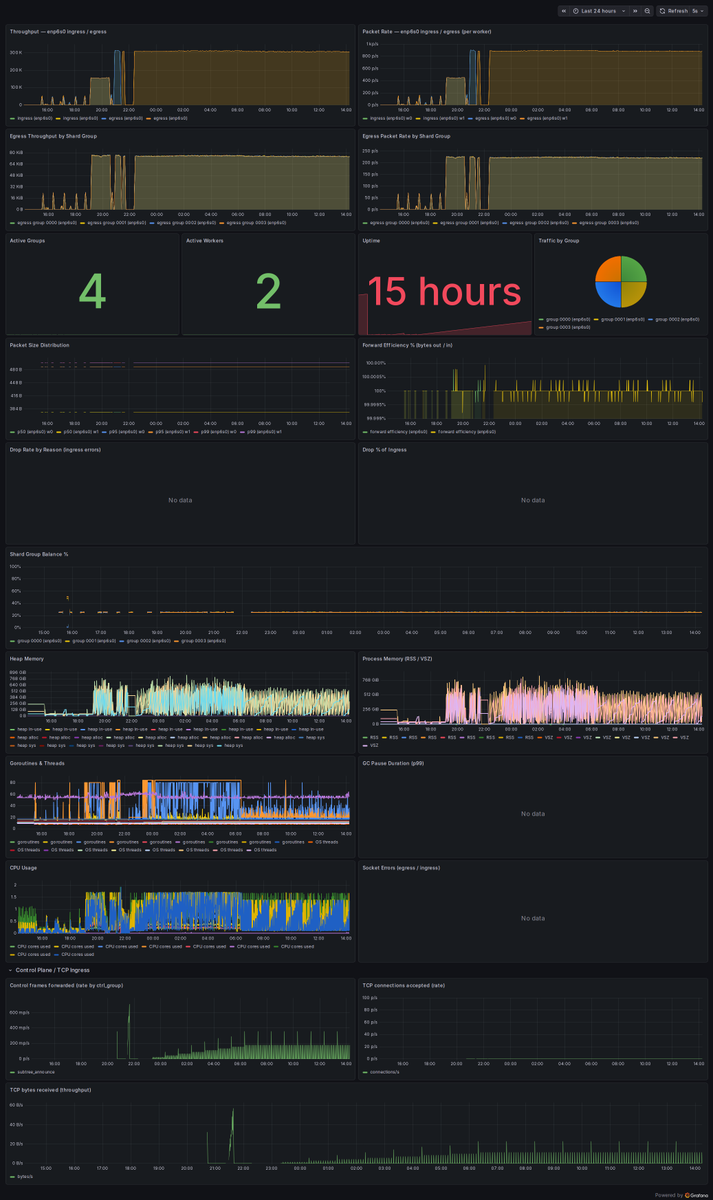
The open source reference solution is capable of at least 600,000 TPS on the same hardware (6-core Intel consumer-class PC hardware with 10/25 Gbit NIC).
The commercial implementation deployed for 1bsv.net is more streamlined and performant.
Testing @1BSVNET throughput reveals at least 3 million ingress transactions per second possible on a single node deployed with efficiency-grade hardware. The multicast network solution scales, just like Teranode and @BSVBlockchain.
3
23
948
Testing @1BSVNET throughput reveals at least 3 million ingress transactions per second possible on a single node deployed with efficiency-grade hardware. The multicast network solution scales, just like Teranode and @BSVBlockchain.
4
18
58
2,691
Light retweeted
Teranode is slowly seeping into the Q1 peer reviewed and tested world:
sciencedirect.com/science/ar…
12
64
277
9,166
So let's bring it back then:
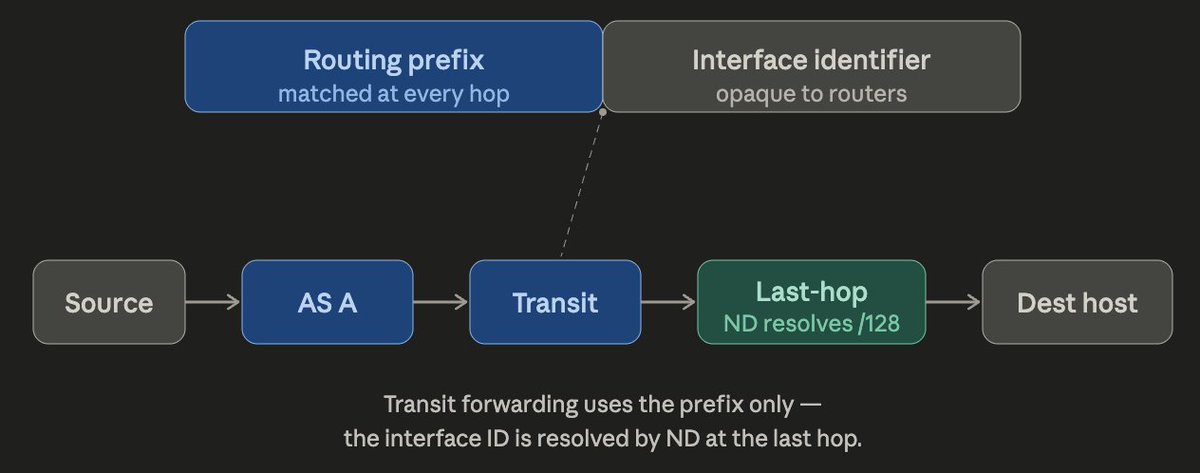
Every internet address is really two parts — where to deliver, and who you are.
Normally the "who you are" part is just a number. This method builds it from your own key instead, so the address itself proves it's really yours. Like a tamper-proof name tag.
Here's the clever bit: routers only ever read the delivery part to move your data along. Your name tag is only checked at the very end, at the front door.
So you get an address that proves who you are, and it changes nothing about how the internet routes traffic.
Drop-in, no new rules.
Let's discuss this a little bit.
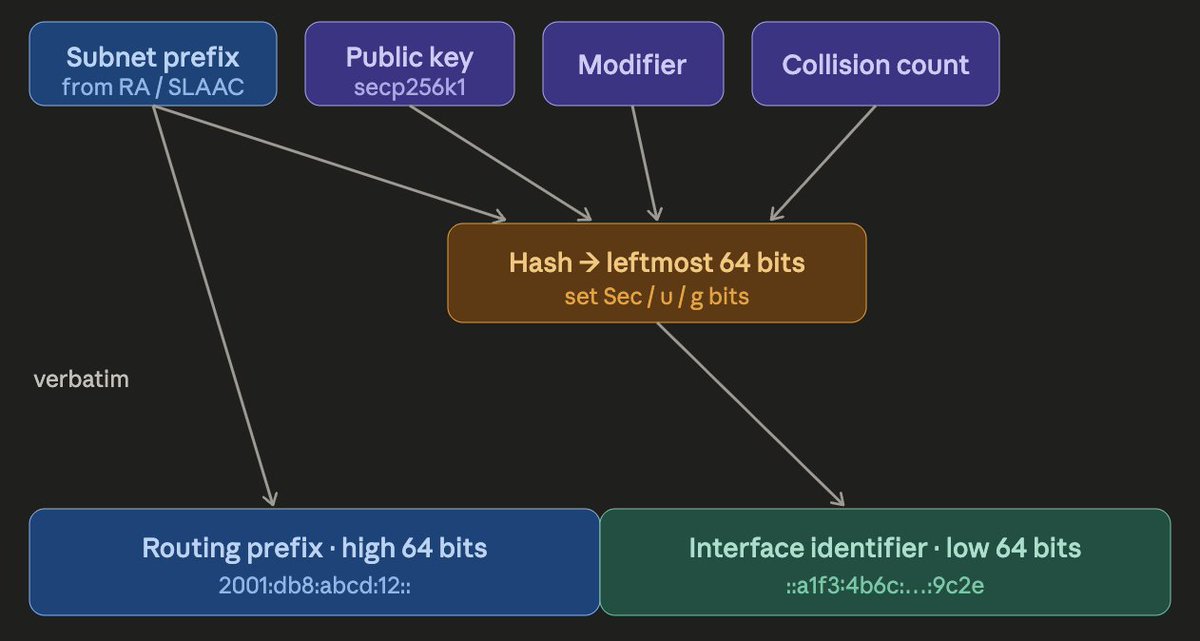
Every IPv6 GUA is two halves: a 64-bit routing prefix (handed to you by the network) and a 64-bit interface ID (your choice). CGA, and the BCA variant from nChain, make that suffix deterministic.
The IID = hash(public key, modifier, collision count, subnet prefix), truncated to 64 bits. The prefix is copied in verbatim. It's an input, never an output of the hash. So the routable half is always exactly what the network advertised.
Routing is longest-prefix-match on the leftmost bits. No router on the path ever reads the IID. It matters once, at the last hop, when ND maps the full /128 on the local link, and ND never leaves the wire.
So it's just a normal address inside an already-advertised prefix. No /128 host routes, no new BGP, DAD collision count handle uniqueness, RFC 7136 already made the IID opaque. A cryptographically generated suffix is invisible to internet routing rules.
3
10
41
1,619