
Joined May 2024
- Tweets 521
- Following 69
- Followers 110
- Likes 120
133 Photos and videos


Apr 30
Your GPU Cluster Is a Financial Instrument with Cooling Fans. Every 5% yield gap on a 1GW campus is $15B/year in unrealized revenue. Most operators don't know how much they're losing.
Find your yield gap.
We'll quantify it in dollars ($/GW)
1
23
Mar 24
Being AI Native - Part Two : Design-First Development: What It Actually Looks Like
Translating from theory to practice can be a challenge. To help others clear this hurdle, we’re going to demonstrate Design-First development by first creating a CI scheduler, and then fixing a bug in it.
Read more 👇
1
45

Hackathon winners drop! 🏆
Congrats to everyone who built in the @LiquidMetalAI hackathon collab.
Here are the Grand Prize projects:
✨ Hakivo: liquidmetal.devpost.com/subm…
✨ AI Compliance Automation: liquidmetal.devpost.com/subm…
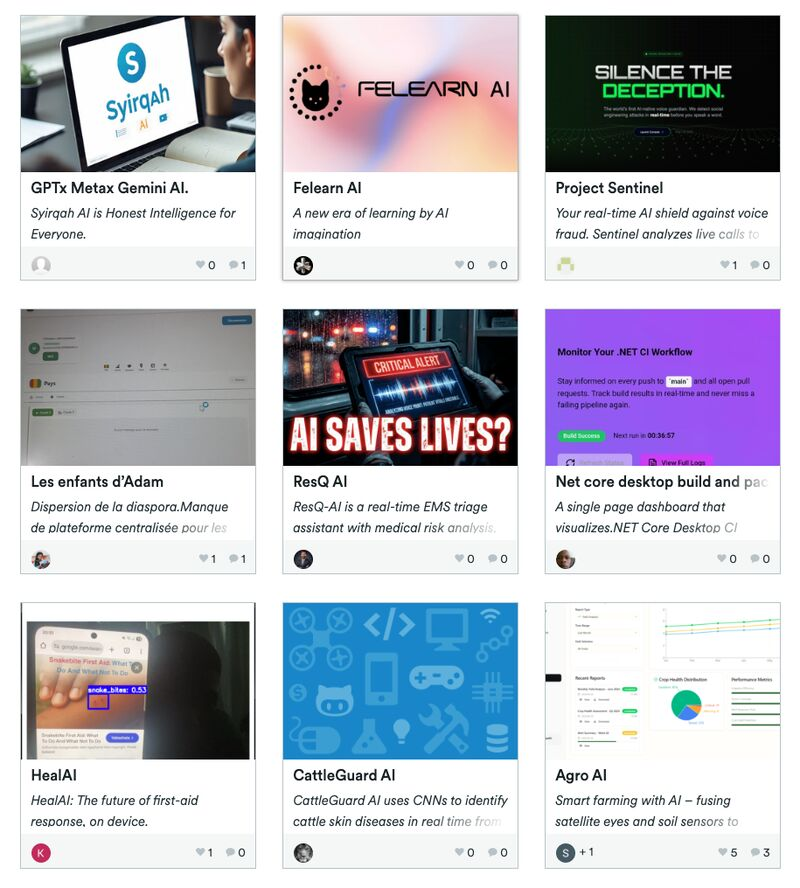
✨ Project Sentinel: liquidmetal.devpost.com/subm…
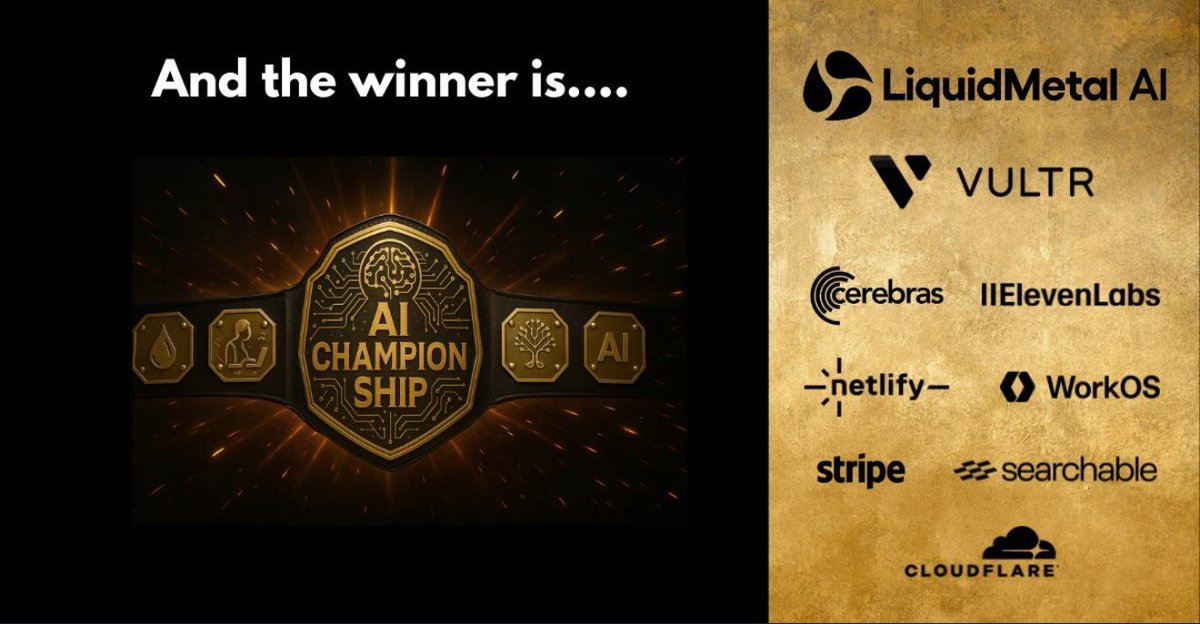
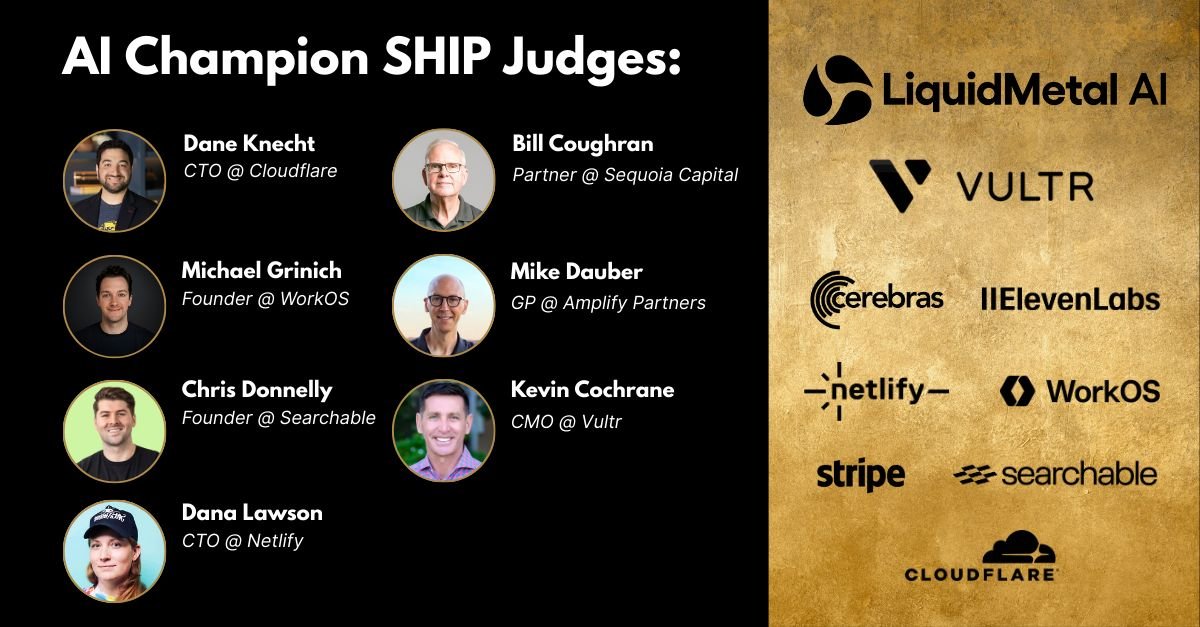
ALT Split graphic. Left side is a black background with the headline “And the winner is….” above a dramatic image of a championship-style belt that reads “AI CHAMPION SHIP,” with sparks/rays behind it. Right side is a textured gold panel listing sponsor logos: LiquidMetal AI, Vultr, Cerebras, ElevenLabs, Netlify, WorkOS, Stripe, Searchable, and Cloudflare.
3
1
9
2,094

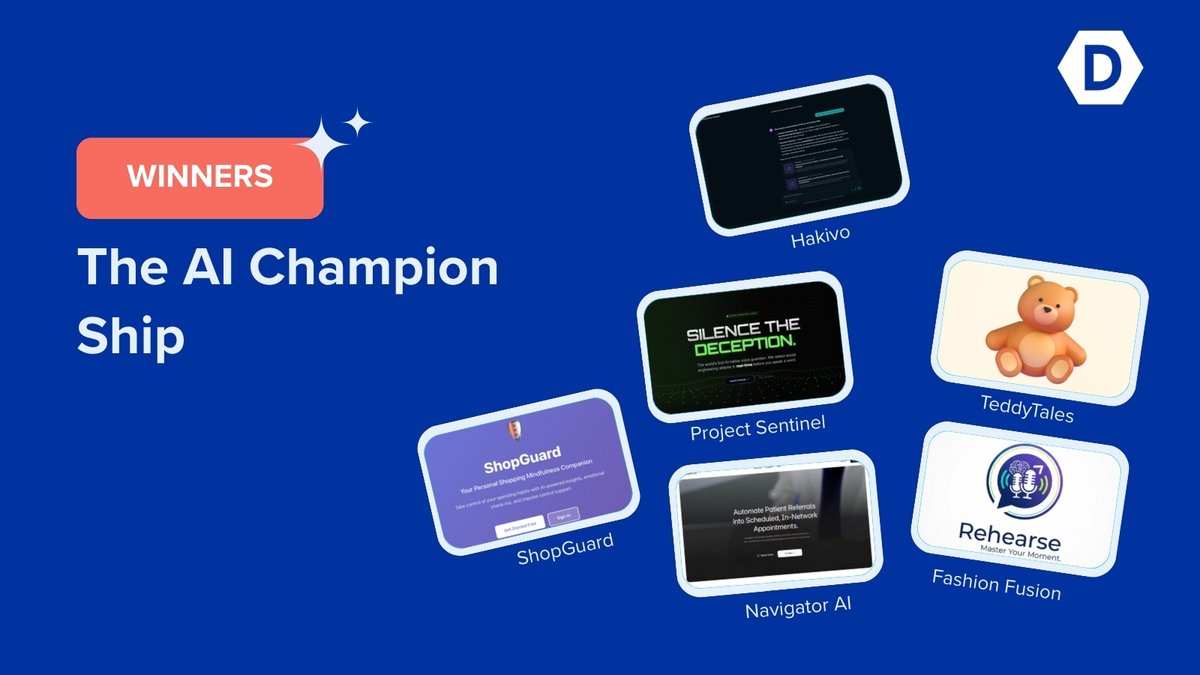
Let's celebrate the winning projects in the @LiquidMetalAI AI Champion Ship! 🚢💨🏆
This mission? Pushing @LiquidMetalAI beyond the ordinary.
The results? Elite execution across the board—from the "Ghost Protocol" defense in Project Sentinel to high-impact literacy tools like TeddyTales.
Check out the full fleet of champions:
🔗liquidmetal.devpost.com/proj…
1
2
5
1,334
Feb 5
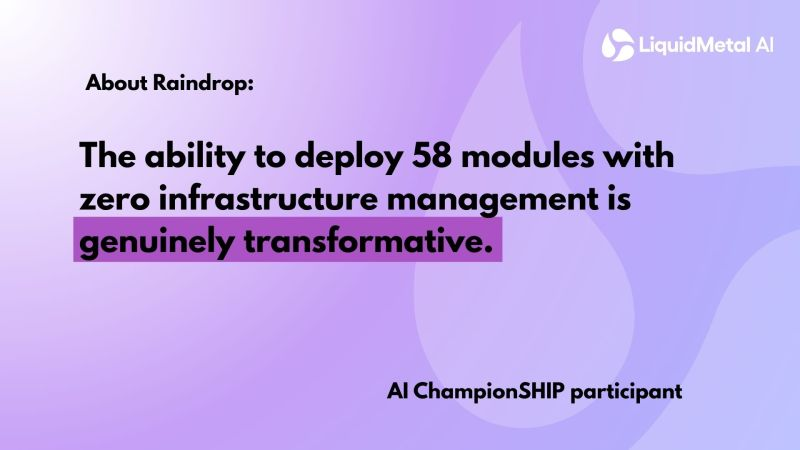
58 modules. Zero infra tickets.
Most stacks can’t say that.
As systems grow, every new agent, job, or workflow usually comes with:
new services, new dashboards, new on-call surface area.
You end up paying a “platform tax” just to keep the thing running.
Raindrop is built to make that trade-off disappear.
In our AI ChampionSHIP program, one team decomposed their system into 58 modules because that’s what the product needed, not what the infra allowed.
They described those modules in Raindrop manifest.
The platform handled:
→ packaging and deployment
→ routing between modules
→ autoscaling and health
→ observability out of the box
No custom Kubernetes setup.
No separate deployment pipelines.
No infra management on their side.
That’s the point of Raindrop:
design the architecture your product deserves,
without turning your team into an infrastructure org.
1
26
Feb 4
Meet AuditGuardX, #2 Grand Prize Winner in AI ChampionSHIP
It turns enterprise compliance into an AI-native workflow.
It reads policies across dozens of frameworks,
spots gaps, and regenerates compliant documents
All that in minutes instead of months
so teams can ship and stay audit-ready at the same time.
Under the hood, AuditGuardX runs as a serverless on Raindrop Vultr: Raindrop’s SmartMemory, SmartBuckets, and SmartInference orchestrate document analysis, voice chat, and semantic search.
AuditGuardX is a sharp example of what happens when one builder treats Raindrop as the backend—and focuses all their energy on real enterprise impact.
Congrats @patsinfotech
devpost.com/software/auditgu…
AI Compliance Automation
Enterprise compliance in minutes, not months at 1% of the cost.
devpost.com 1
22
Feb 2
Meet the first Grand Prize winner of the AI ChampionSHIP: Hakivo.
Hakivo turns Congress into an AI product.
It tracks bills, summarizes them in plain language, and delivers NPR-style audio briefings so anyone can actually follow what’s happening in government.
Under the hood, it runs 58 Raindrop modules:
agents, services, tasks, queues;
without managing a single piece of infrastructure.
SmartBuckets power semantic search over thousands of bills.
SmartMemory keeps long-running conversations grounded.
Hakivo is our kind of winner: ambitious, real-world, and built to go beyond the demo.
Congrats @tarikjmoody
Learn more - Link below !!
@Vultr @cerebras @elevenlabs @CloudflareDev @stripe @WorkOS are the best sponsors of The AI ChampionSHIP.
1
1
1
52
Jan 30
2968 Participants.
3 Grand Prizes:
Congrats to:
#1: Tarik Moody - Hakivo - @tarikjmoody
#2: Patrick Ejelle-Ndille - AI Compliance Automation - @broadcomms
#3: Saicharan Ramineni - Project Sentinel - github.com/GodlyDonuts
Check out the full gallery of all 15 winners selected for 6 categories:
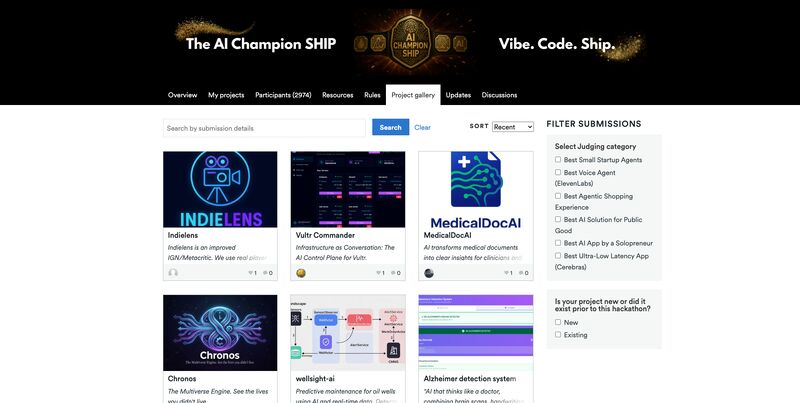
liquidmetal.devpost.com/proj…
1
4
121
Jan 29
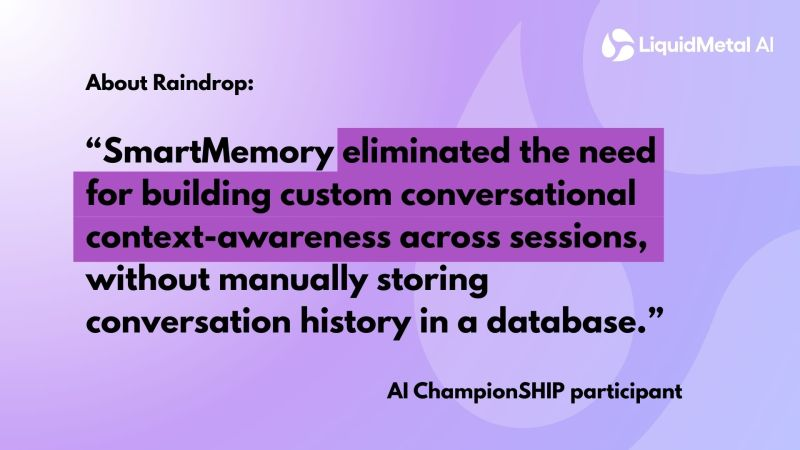
You shouldn’t be reinventing conversational memory.
In the AI ChampionSHIP program, one team took a different route.
They needed an agent that stayed context-aware across sessions. Instead of building custom storage and retrieval for conversation history, they defined a SmartMemory in their Raindrop manifest and plugged it into the agent.
Raindrop handled:
→storing and indexing the right parts of every conversation
→retrieving relevant context on the next interaction
→keeping state consistent across long-lived sessions
No bespoke “memory service.”
No manual history management or one-off databases to keep alive.
SmartMemory turns cross-session context
from an infra project into a configuration decision.
For builders and engineers, that means you spend less time worrying about how to remember, and more time deciding what your agent should remember to actually be useful.
Try it out: liquidmetal.ai/
36
Jan 27
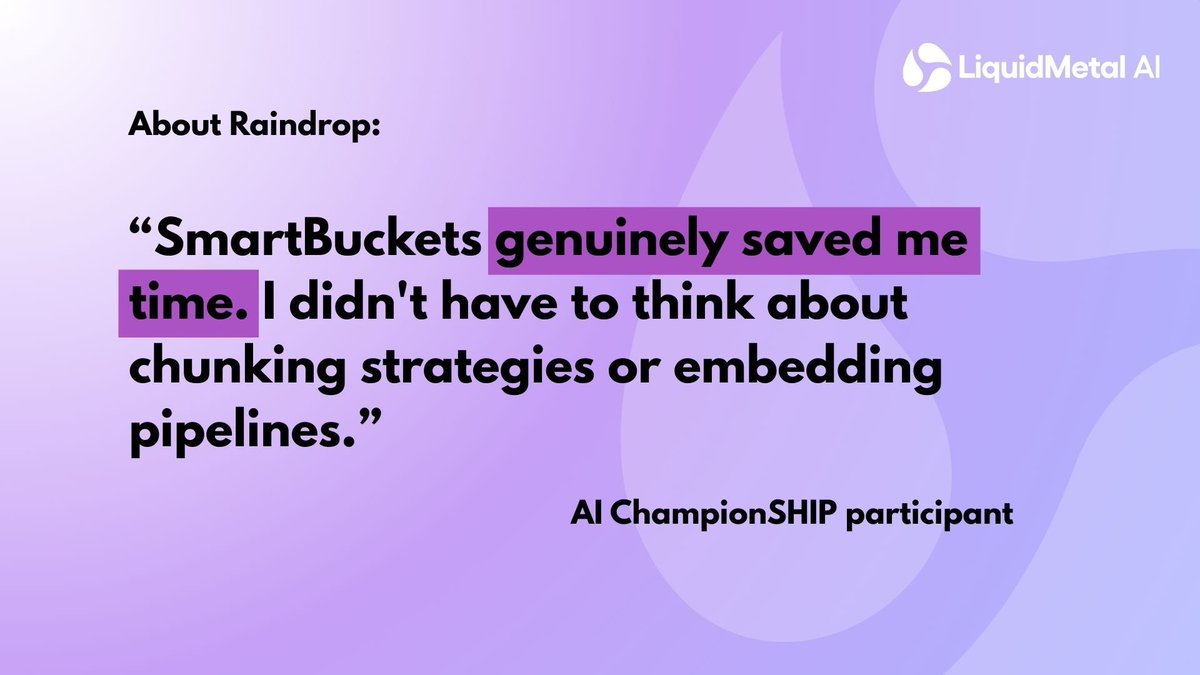
You shouldn’t be designing chunking strategies for a living.
But that’s where a lot of RAG work ends up:
tuning window sizes,
fiddling with overlaps,
wiring embedding pipelines,
then rebuilding it all when the use case changes.
In our AI ChampionSHIP program, one builder dropped that entire layer of work.
They plugged their data into SmartBuckets, and Raindrop handled the rest:
ingest, chunking, embeddings, retrieval - all wired into the agent flow.
Instead of debugging yet another indexing script,
they spent their time on prompts, behaviors,
and what the agent should actually do for users.
That’s what SmartBuckets are for:
a production-grade RAG pipeline out of the box,
so your energy goes into product decisions, not plumbing.
For teams shipping AI features, those hours add up fast.
Try it out: liquidmetal.ai/
1
2
158
Jan 23
Help us select the Audience Favorite!!!
Public voting ends this Monday.
If you haven't yet, leave your vote:
liquidmetal.devpost.com/proj…
The winner gets our flagship WWT style belt !
@Vultr @cerebras @elevenlabs @Netlify @WorkOS @stripe @CloudflareDev
1
2
80
Jan 22
Shipping an AI agent shouldn’t take weeks.
But for most teams, it does.
Not because the idea is complicated,
but because everything around it is:
Tool wiring, state, retries, observability, “just one more” glue service.
Raindrop’s SmartComponents are designed to skip that part.
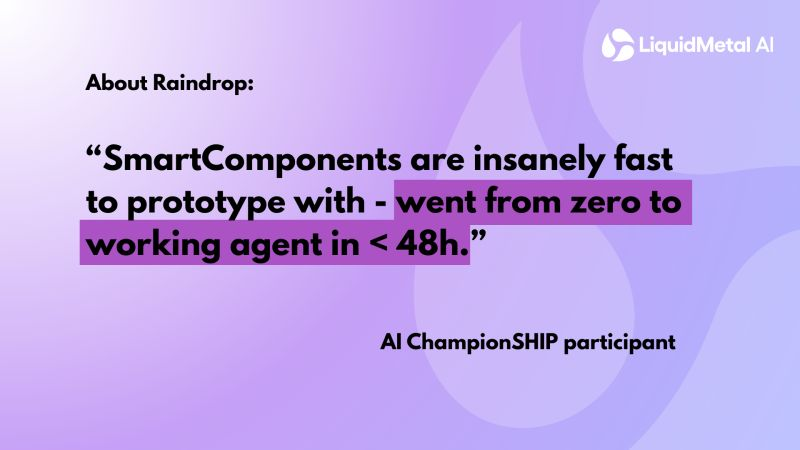
This is what the AI ChampionSHIP Hackathon participant says:
“SmartComponents are insanely fast to prototype with – went from zero to working agent in < 48h.”
SmartComponents give you ready-made pieces for:
→ RAG pipelines
→ model calls and routing
→ memory context handling
→ control flow and monitoring
You’re not reinventing agent architecture every time.
You’re assembling from components that already know how to work together.
The result:
idea → working agent in days, not sprints.
Less time on boilerplate, more time on what the agent actually does for users.
That speed compounds into more experiments, faster learning, and a much shorter path from “we should try this” to “it’s live.”
Try it now: liquidmetal.ai/
1
35
Jan 21
Your AI infra shouldn’t feel like a second product.
Most teams building AI features are juggling:
custom queues, ad-hoc state, manual resource tuning.
Every new feature adds a little more overhead to keep alive.
Raindrop takes a different path.
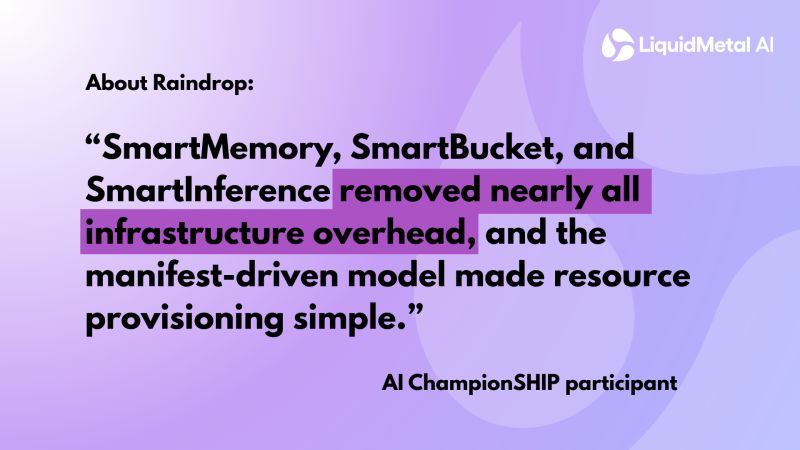
An AI ChampionSHIP participant put it simply:
“SmartMemory, SmartBucket, and SmartInference removed nearly all infrastructure overhead, and the manifest-driven model made resource provisioning simple.”
That’s the goal:
infrastructure you don’t have to think about.
SmartInference → how models are called, chained, and observed.
SmartMemory → how state is stored and reused across interactions.
SmartBuckets → how data is chunked and retrieved.
All described in a manifest, so resource provisioning becomes a config change, not a mini-migration.
Try it now: liquidmetal.ai/
20
Jan 20
Your AI backend shouldn’t take months.
Most AI teams still ship like it’s 2020:
weeks of infra setup, data pipelines, rebuilding RAG over and over.
AI ChampionSHIP Hackathon participants
Went from idea → working backend in days because:
→ The building blocks map to how AI products actually run
→ state, tools, workflows, logging are built-in
→ infra is production-grade without feeling heavy
So instead of:
→ “Can we even support this?”
The question becomes:
→ “How fast can we ship the next thing?”
If you’re a builder who’d rather spend your energy on product, not plumbing, Raindrop is probably the calmest way you’ll ever ship an AI backend.
Give it a try: liquidmetal.ai/
28
Jan 16
Here is what hackathon participants say about Raindrop:
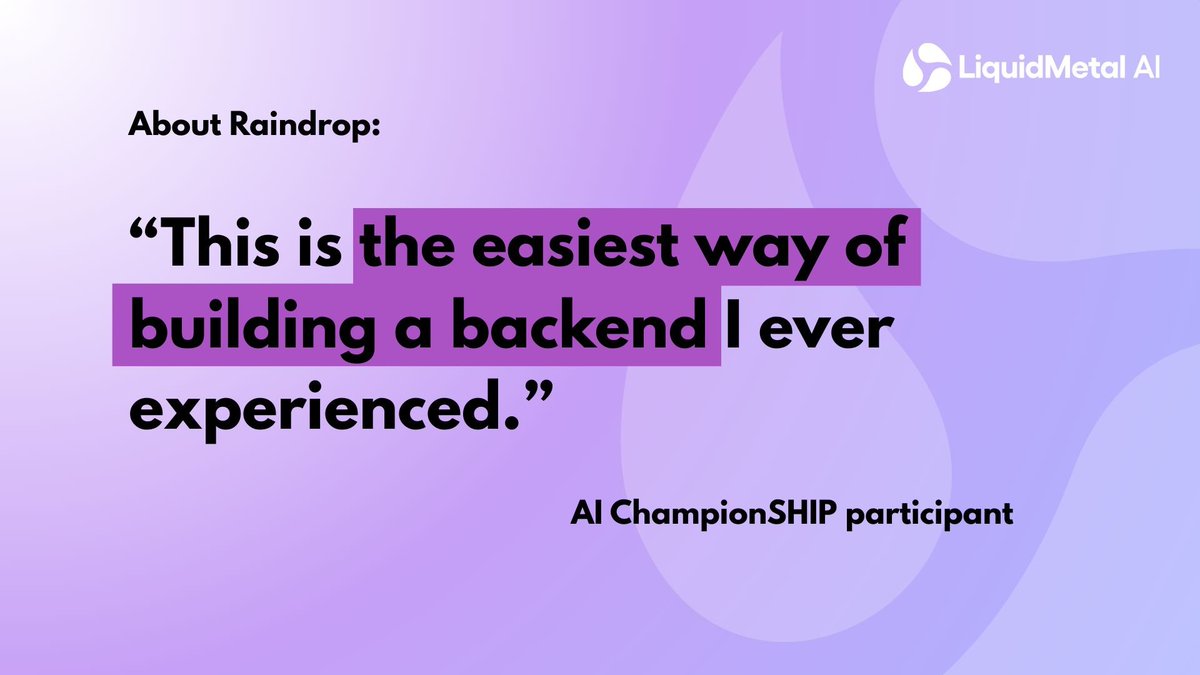
"Raindrop was amazing. All i had to do was build my frontend and ask it to create a backend. It took a bit of time, but it worked the first time. I also only added the AI feature a little later, and it automatically picked the right service, and it worked the first time. This is the easiest way of building a backend I ever experienced."
"The raindrop.manifest file is a game-changer. Being able to define "SmartMemory" or "SmartBucket" in one line and have it provisioned automatically is a fantastic Developer Experience (DevEx). It abstracts away the pain of setting up databases and storage buckets."
"The concept of *Liquid Infrastructure* is a game-changer for the event industry. The ability to define edge infrastructure via code (raindrop.yaml) makes high-end mesh networking accessible to startups who usually only work in the cloud."
Try it for yourself: liquidmetal.ai/
1
44
Jan 15
Over 30% of AI ChampionSHIP submissions
Were AI Solutions for the Public Good
We just wrapped a global hackathon with almost 3,000 people.
Given total freedom, a third of builders chose to work on:
– healthcare access
– digital inclusion
– government services
– climate and sustainability
– education and skills
When you zoom out, that’s wild.
What people build when there are:
– no OKRs
– no quarterly targets
– no stakeholder decks
…is what they wish they were allowed to work on.
1
1
32