
Your private, non-custodial P2P platform to buy or sell crypto.
Joined December 2017
- Tweets 5,384
- Following 77
- Followers 6,855
- Likes 10,094
1,915 Photos and videos

Jun 14
Financial Freedom Means Different Things
What does it mean to you?
5
69
Jun 14
What's The Biggest Risk In Online Trading?
Tell us below.
1
7
136
Jun 14
Trust Is Earned
Not assumed.
That's why reputation matters in P2P.
1
6
120
Jun 13
Who Do You Trust More?
A large institution
OR
Transparent peer-to-peer systems
2
2
12
212
Jun 13
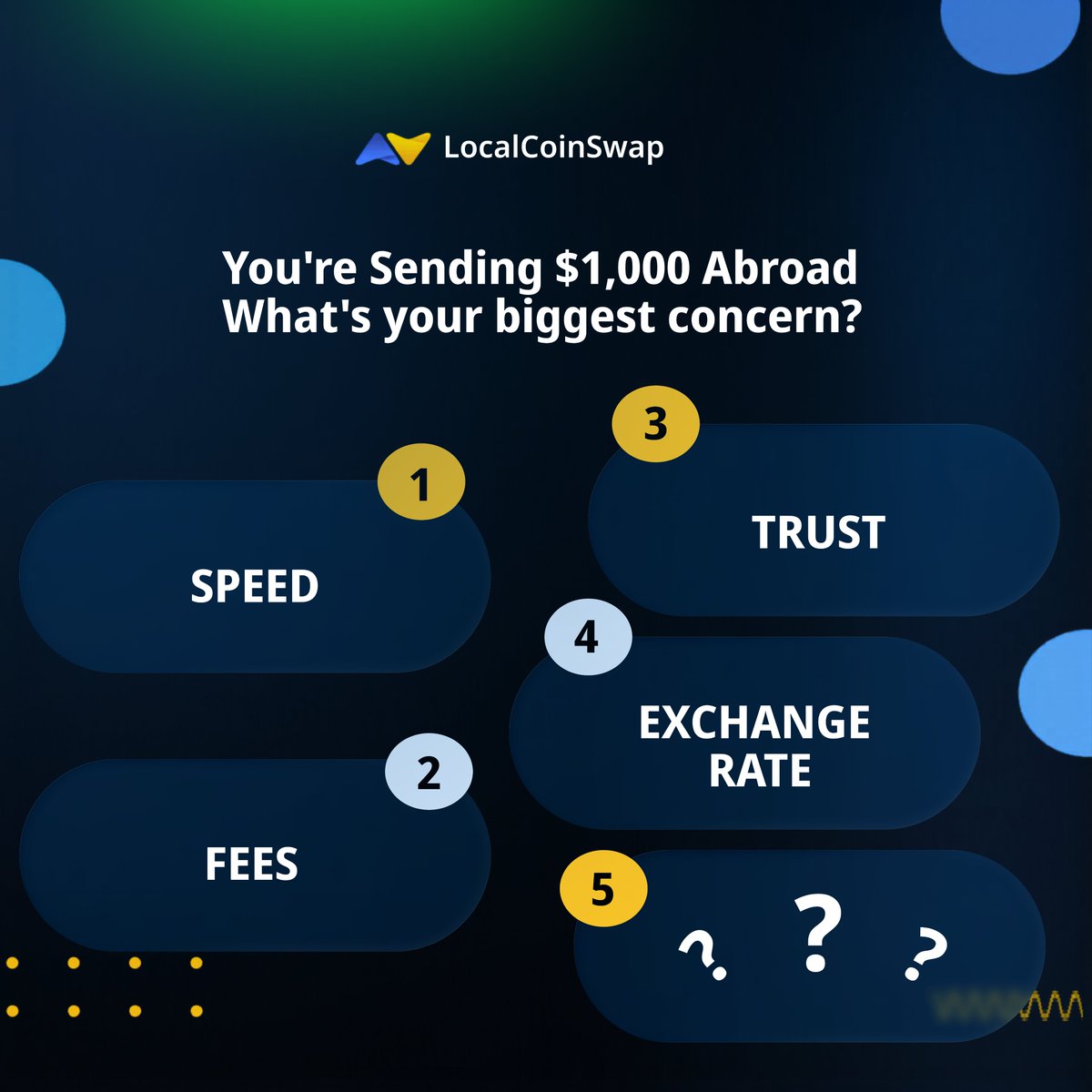
You're Sending $1,000 Abroad
Body: What's your biggest concern?
🔹 Speed 🔹 Fees 🔹 Trust 🔹 Exchange Rate
6
163
Jun 13
Money Shouldn't Stop At Borders
The internet doesn't.
Why should payments?
5
166
Jun 12
Not Your Keys. Not Your Crypto.
Who controls your funds matters.
1
1
7
268
Jun 11
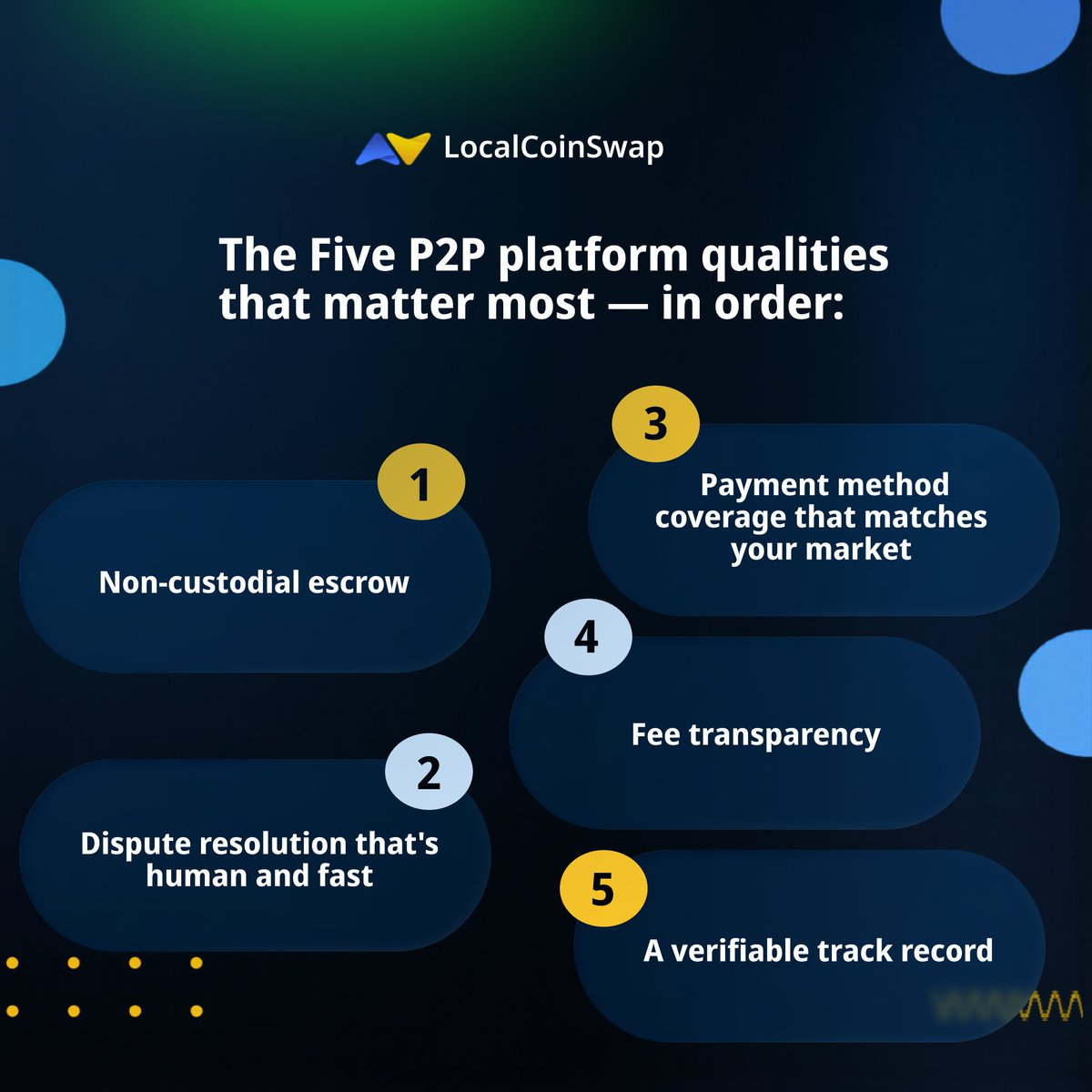
The 5 P2P platform qualities that matter most — in order:
1. Non-custodial escrow. Everything else is secondary. If the platform holds your crypto, the platform holds your risk.
2. Dispute resolution that's human and fast. Under 24 hours. With written rationale. Both parties informed.
3. Payment method coverage that matches your market. Not what works in Europe. What works where you are.
4. Fee transparency. One number. Consistent. The same at listing and at settlement.
5. A verifiable track record. How long have they been running? What's their dispute rate? Have they ever lost user funds? These are not marketing claims — they're operational facts you should be able to verify.
Most platforms hit 1 or 2 of these.
LocalCoinSwap hits all 5.
Come check.
4
77
Jun 11
We're not trying to be the biggest P2P exchange.
We're trying to be the one traders point to when someone asks:
"Which platform do you actually trust?"
Those are different goals.
Biggest: fastest growth, most users, highest processed volume.
Most trusted: slowest to compromise, hardest to exploit, cleanest long-term record.
These goals conflict.
Growth rewards speed. Trust rewards consistency.
We chose trust.
Seven years. $2 billion in volume. Zero fund losses.
Slow and trusted is still here.
Come check the record. Then trade.
1
5
74
Jun 10
⚡️JUST IN: President Trump says the public could become “very rich” from the AI boom.
Trump says he is discussing ways for leading AI companies to give back to Americans and plans to meet with the industry’s top 15 executives shortly
1
80
Jun 9
The vendor trying to get taken seriously as a new platform user:
You join. Clean. Motivated.
You read the platform docs, set your terms carefully, price competitively.
First week: 3 trades. Small. Clean. 5-star reviews.
Second week: 4 trades. Same.
Week 3: a buyer messages. Decent size trade. You check their profile.
Zero trades. Account 2 days old.
You decline.
They message again. "I just registered but I have experience. Please."
Now what?
If you say yes: you're taking on the risk of a completely unknown counterparty.
If you say no: you wait another week for a trade you can actually evaluate safely.
There is no good option.
A platform that doesn't gate new account access is not protecting experienced vendors.
It's using them as a buffer for new user acquisition
2
1
124
Jun 9
The real cost of a bad dispute experience isn't the trade.
It's the week after.
When a dispute takes 5 days:
Your listing drops in visibility while you're in dispute status.
Regular buyers assume you're unavailable and go elsewhere.
Some of them don't come back.
Your response time metric — averaged across the dispute window — takes a hit.
A $500 trade dispute can cost a high-volume vendor $3,000 in indirect impact.
Platforms that treat dispute speed as a cost center are measuring the wrong thing.
Fast, accurate dispute resolution is the retention tool.
It's cheaper to keep a vendor than to replace one.
Most platforms haven't run that math.
1
2
50
Jun 9
The most important thing a P2P platform can do — and the one most platforms skip:
Make trust visible.
Not "we are a trusted platform."
That's a sentence any company can write.
Visible trust means:
Dispute rate published publicly for every vendor.
Response time averages surfaced on every listing.
Trade volume history that can't be gamed with new accounts.
Escrow architecture that any user can verify on-chain.
A resolution process that both parties can read before a problem happens.
Trust is infrastructure.
You can't claim it.
You build it. Slowly. With evidence.
The platforms doing this are smaller and less funded.
They are also the ones that will still be operating in 10 years.
2
106
Jun 8
The CBDC rollout is happening faster than the P2P industry is tracking:
6 countries with live CBDCs.
17 in active pilot.
Combined population affected: over 1.4 billion people.
The design feature most CBDCs share: programmability.
Programmable money means:
Expiry dates can be set on funds.
Spending can be restricted by category.
Balances can be frozen remotely.
This is in the technical specifications — not speculation.
Non-programmable money means neither the platform nor the government controls what you do with it after it's yours.
P2P crypto — especially stablecoins held in non-custodial wallets — is structurally the opposite of programmable CBDC.
When CBDCs go live in more markets, watch what happens to P2P volume.
The eNaira data already shows the pattern.
1
2
5
457
Jun 5
The question that built LocalCoinSwap:
What does a P2P exchange look like when it's designed around the trader — not the growth chart?
The answers are expensive:
Non-custodial escrow: more complex to build, impossible to use as liquidity.
Human dispute resolution: 6x the operational cost of an algorithm.
Transparent fees: less margin per trade.
300 payment methods: more support complexity, more moderation surface area.
We built all of it anyway.
Because the design question was right.
Seven years in, $2 billion in volume, zero platform-level fund losses.
The growth-chart platforms are not all still here.
We are.
The expensive choices were the right ones.
3
222
Jun 4
5 things the best P2P buyers do that most buyers don't:
1. They read the vendor's full trade history — not just the rating. 99% completion on 20 trades means something very different than 99% completion on 800 trades.
2. They test vendors with small trades before bringing volume. Every serious buyer has a "new vendor trial" process.
3. They read the trade terms before messaging, not after. The vendors who write clear terms are usually the ones who have fewer problems.
4. They communicate proactively. "Payment sent. Ref number: XXXX. Screenshot attached." Before the vendor asks.
5. They leave honest reviews. A fast 5-star review that says nothing helps nobody. A specific review helps the next buyer make a real decision.
The best buyers make the best P2P platforms work.
The behavior is learnable.
1
102
Jun 4
The P2P crypto industry is splitting into two very different things.
Track 1: P2P-branded custodial marketplaces.
Big exchanges adding a P2P tab.
Custodial escrow. Centralized dispute resolution. Platform controls the outcome.
Fast. Familiar. The same trust model as the exchange it lives inside.
Track 2: Genuinely non-custodial P2P infrastructure.
Smart contract escrow. No platform control over release. Human dispute resolution.
Slower to build. Less funded. Not as slick.
These two tracks serve different users.
If you're looking for fast and convenient — Track 1 is fine.
If you're looking for a platform that cannot take your funds, cannot freeze your trade, and cannot go bankrupt in a way that affects you —
Track 2 is the only answer.
LocalCoinSwap is Track 2.
We've been Track 2 since 2018.
We're not changing.
2
91
Jun 3
How to start your first trade on LocalCoinSwap:
Step 1: Create an account. Email and password. 2 minutes.
Step 2: Set up your non-custodial wallet. Your keys — not ours.
Step 3: Browse listings. Filter by crypto, country, payment method, price range.
Step 4: Pick a vendor. Read their trade history, completion rate, response time, reviews. Take 60 seconds to do this — it matters.
Step 5: Start the trade. Crypto locks in escrow. You send payment through the agreed method. Crypto releases when seller confirms.
Step 6: Leave a review. It makes the next trader's decision easier.
No document queue.
No minimum deposit.
No premium-tier requirement to access basic features.
Traders. Infrastructure. That's it.
3
99
Jun 3
$23 billion lost to crypto-related fraud in 2023.
The story the industry tells: crypto attracts criminals.
What the data actually shows:
95% of those losses were social engineering. Not technical exploits.
The same manipulation works via wire transfer, Forex, and cash.
The technical vector was often a legitimate, fully verified account.
Crypto doesn't create fraud.
Platforms that optimize for fast acquisition over safe infrastructure create the conditions fraud exploits.
The fix is not slower crypto. It's better platform design.
Behavioral reputation systems.
Escrow that holds until both parties confirm — not until the platform decides.
Human moderation that catches pattern anomalies before they become victims.
These are not new ideas.
They're just expensive to build.
So most platforms don't build them.
2
280
Jun 2
The cross-border freelancer experience trying to get paid:
Client is in the US. You're in Ghana.
Option 1: PayPal — 4.4% fee, not fully available in Ghana, conversion eats another 3%.
Option 2: Wire transfer — $35 flat fee, takes 5–7 days, your bank asks questions.
Option 3: Wise — better, but the "mid-market rate" still has a margin built into it.
Option 4: Client sends crypto directly — they don't own crypto. Now you need to explain crypto to a client.
Option 5: Client sends USDT to a wallet address you share.
You sell the USDT on LocalCoinSwap to a local buyer in Ghana.
Local currency in your mobile money within 40 minutes.
Total cost: under 2%.
The workaround is now the solution.
For millions of cross-border freelancers, it already is.

3
718