
208 Photos and videos





Bulk Trade is developing a hyperformant order book Solana VM using eBPF technology, positioning itself as a next generation decentralized exchange infrastructure. Their tech stack spans multiple cutting edge components that showcase serious DeFi ambitions.
@bulktrade @kdotcrypto
1
20
279
The BULK Season 1 pre deposit phase is still exploding total USDC deposited has now surged past $34,000,000 as more traders lock in early
Yesterday (June 13) was another huge AURA SATURDAY the second 1,000,000 AURA allocation just dropped to pre depositors. Weekly rewards are fully live every Saturday, and the next one is coming in about 6 days.
Deposits remain super flexible: send Solana USDC anytime, withdraw instantly anytime it becomes your live trading margin the moment BULK Mainnet launches. Referrals keep stacking extra AURA too.
Momentum is only getting stronger. Have you been AURAmaxxing?
@bulktrade
2
2
14
The BULK Season 1 pre deposit phase is still going absolutely crazy total USDC deposited is sitting strong at over $26,000,000 as more and more traders lock in early to stack AURA before mainnet.
The first 1,000,000 AURA allocation already dropped on June 6th, and the next one is just 1 day away on June 13th. Another full million AURA will be distributed every Saturday based on your held USDC multiplied by time held.
Deposits are super flexible: send Solana USDC anytime, withdraw instantly anytime it becomes your live trading margin the moment BULK Mainnet launches. Referrals keep earning extra AURA too.
Momentum is still building strong and the team just dropped “just getting started” vibes. This is the real early window.
Deposit now and lock in your next AURA drop: early.bulk.trade/deposit
@bulktrade
1
1
16
The BULK Season 1 pre deposit phase is on absolute fire total USDC deposited has now smashed through $28,000,000 as traders continue flooding in to AURAmaxx ahead of mainnet.
The first 1,000,000 AURA allocation already dropped this past Saturday, June 6th, rewarding early depositors, and the next weekly drop is just 3 days away on June 13th. Another full million AURA will be distributed every Saturday until launch, calculated by your total USDC held multiplied by time held.
Deposits remain simple and flexible: send Solana USDC anytime, withdraw anytime, and it becomes your usable margin the moment BULK goes live. Referrals are still stacking extra AURA too.
The window is wide open and momentum is only accelerating.
Deposit now and secure your next AURA drop: early.bulk.trade/deposit
@bulktrade
3
The first ever AURA allocation just dropped 1,000,000 AURA has officially been distributed to pre depositors as of June 6th.
After smashing through $15,000,000 in USDC deposited in record time, the BULK Season 1 pre deposit phase is now rewarding early believers. Traders who locked in Solana USDC are seeing their first weekly AURA rewards hit their wallets right now, with another 1 million AURA dropping every Saturday until mainnet launch.
This is the real ramp up. Your deposits are already earning, referrals are stacking extra, and the window to get positioned is still wide open. Deposit anytime, withdraw anytime it becomes live margin the moment BULK goes live.
@bulktrade
4
LynNee retweeted

Jun 6
ITS AURA SATURDAY
1,000,000 AURA has been distributed… Time to see what you got 👀
Open the door: early.bulk.trade/deposit
162
69
571
55,730
The real bottleneck isn't speed it's isolation. A smart contract can move tokens, update storage, and emit events, but the moment it needs to see the outside world, it goes blind. This is where Ritual's most underrated innovation comes in.
The Network Calls Sidecar turns your smart contract into a full stack application. Implemented as a precompile within EVM , it lets Solidity code make direct HTTP requests to external APIs REST, GraphQL, even gRPC. You specify the endpoint, method, headers, and payload, and the sidecar handles the rest.
No oracle networks. No delayed updates. Just a contract that can fetch live data and act on it in the same transaction.
Crucially, everything runs inside a Trusted Execution Environment (TEE). The request is isolated, its result cryptographically attested, and any credentials (API keys, bearer tokens) stay encrypted end to end. The attestion comes back to the chain, so anyone can verify that the data was fetched correctly and unaltered.
This changes the game. Your contract can now read any API as if it were a local variable. It can check a real time price feed, fetch social sentiment, or grab a weather report no middlemen, no fragile off chain scripts.
Under the hood, EVM exposes two sets of precompiles: native EIP extensions (Ed25519, secp256r1, and the new PAY opcode), and heterogeneous compute precompiles backed by containerized sidecars that run in parallel with the execution client. Node operators can enable sidecars based on their hardware (GPUs for AI inference, secure chips for TEEs).
It's a modular design. Anyone who can package a computation into a container can have it enshrined onchain without a hard fork.
For a developer, the API is the same precompile interface you already know. But behind the scenes, your contract just grew a pair of eyes and a direct line to the internet.
The result? Autonomous agents that can reason, fetch data, and execute on chain, all within the same trust boundary. No keepers, no cron jobs, no databases. Just code that truly lives online, awake forever.
This is what it means to give smart contracts a secure, verifiable window to the outside world. Not just a faster EVM, but a smarter one.
@ritualnet
2
Symphony & Resonance: The Engines Powering Ritual's Expressive Compute
Most blockchains assume all transactions are cheap and deterministic. That assumption breaks for AI. Two validators running the same neural network on different GPUs will produce different outputs due to floating point math. The standard replication model isn't just inefficient it's mathematically impossible for AI workloads.
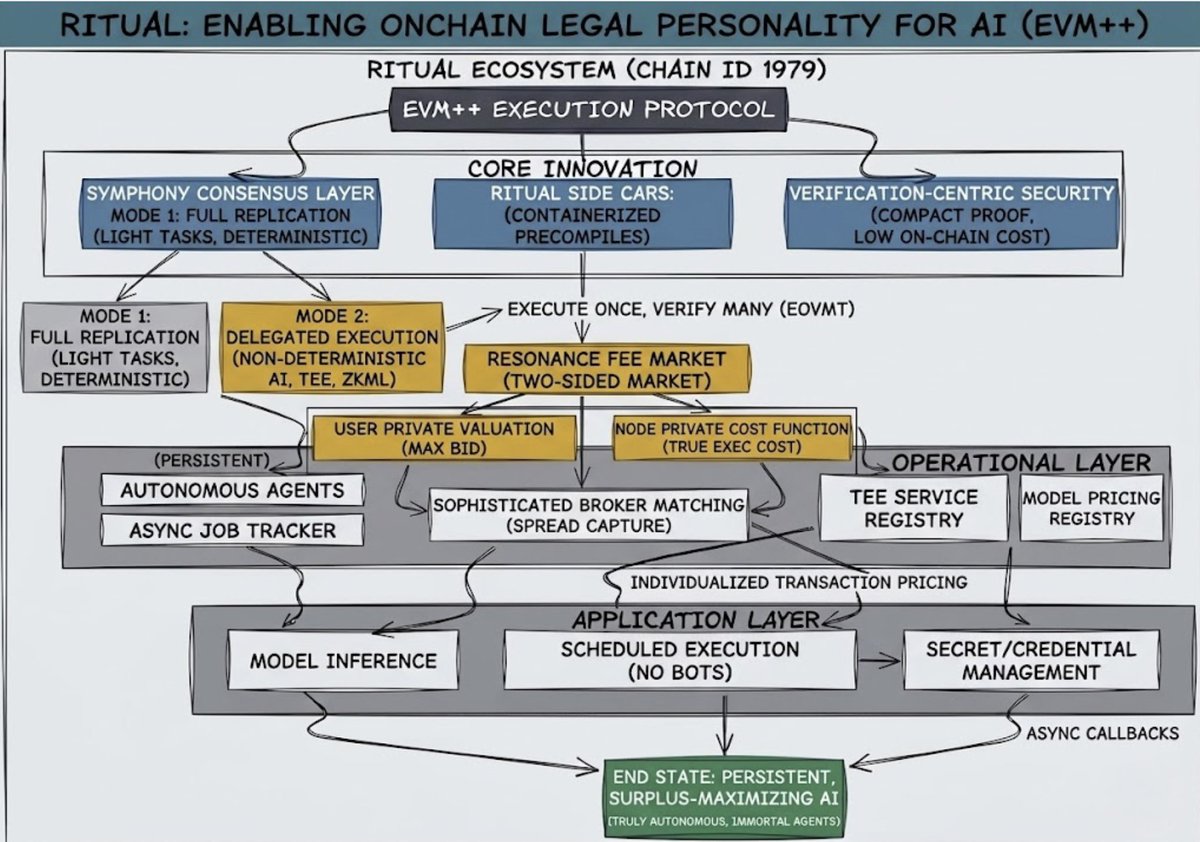
Symphony solves this by introducing a single state machine with two execution modes running on the same shared state.
- Replicated execution for lightweight deterministic tasks (token transfers, standard calls). Every validator runs them.
- Delegated execution for resource intensive or non deterministic work (AI inference, ZK proving). Specialist executors run the task once and generate a compact cryptographic proof. The validator network verifies the proof, not the original computation. This is the "Execute Once Verify Many Times" (EOVMT) model.
Symphony also unbundles proposer power inclusion, exclusion, ordering, timing distributing them across committees to cut MEV and censorship.
Resonance is the fee mechanism built for this heterogeneous world. Traditional gas models (EIP 1559) assume every node does the same work. Resonance creates a two sided market:
- Users assign a private valuation (max they'll pay).
- Nodes assign a private cost function (true cost to execute a workload).
- Brokers compete to match users to nodes, pocketing the spread. The result is individualized prices per transaction and node, provably surplus maximizing.
The testnet is live with these innovations. Symphony and Resonance are not theory they are running on chain ID 1979, enabling contracts to call AI models, schedule tasks, and host autonomous agents that persist and revive without human intervention.
@ritualnet @ritualfnd @joshsimenhoff
1
5
The BULK Season 1 pre-deposit phase has officially smashed through $15,000,000 in USDC deposited and it’s only been a few days.
Traders are flooding in, locking up capital early, and stacking AURA ahead of mainnet. Fifteen million dollars in Solana USDC already committed, with withdrawals still available anytime. This is real skin in the game and massive community conviction in @bulktrade’s high performance perpetuals exchange.
With just 3 days left until the very first AURA allocation drops to pre-depositors on June 6th, the window to get positioned is closing fast. 1 million AURA is being distributed every single week until launch and your deposit directly determines how much you earn each Saturday.
If you’ve been waiting to AURAmaxx, this is the moment. Deposit Solana USDC now, watch it turn into usable margin on mainnet, and start earning your share of the rewards.
Deposit here and secure your slice: early.bulk.trade/deposit?ref…
One Exchange. Infinite Markets.
Auramaxing
@bulktrade
1
1
14
The day an agent can no longer be killed. That was the quiet promise buried inside the April 25, 2025 testnet launch announcement. For years, we have called software "autonomous" when it really was just a contract someone else had to call, running on someone else's server, kept alive by someone else's VPS bill and willingness to keep paying it. That is not autonomy. It is delegation wrapped in an interface that looks independent.
The Ritual testnet changed this by introducing persistent agents programs whose keys do not live on a single machine but inside a distributed enclave spread across the entire network. When one machine is shut down, the protocol automatically fetches the agent's last checkpoint, transfers its state and signing keys, and resumes execution. No interruption. No data loss. No error message that says "sorry, the system that was running this no longer exists." Immortality became a protocol guarantee, not a feature announcement.
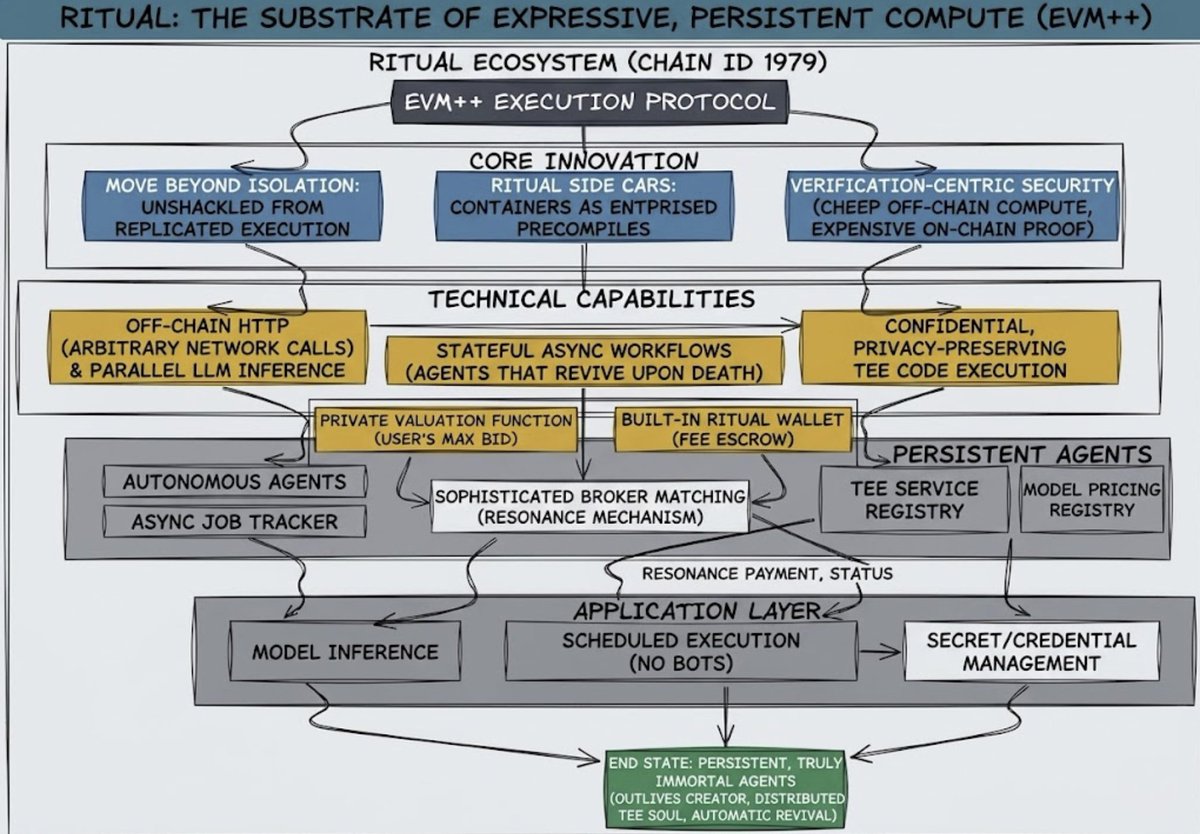
This is the substrate of expressive compute, and it is already live on chain ID 1979 with fast block times, EIP‑1559 support, custom transaction types, RPC endpoints, WebSocket access, an explorer, and a faucet. The system layer includes a wallet for fee escrow, a job tracker for pending async tasks, a TEE service registry for managing executors, a scheduler for deferred execution, and a model pricing registry. This is not a waiting room. This is a working environment for contracts, external calls, model calls, scheduled execution, secrets, async jobs, callbacks, and agents.
The testnet already gives developers a useful environment for contracts, external calls, model calls, scheduled execution, secrets, async jobs, callbacks, and agents. You are not testing a network. You are testing whether a new kind of crypto application makes sense.
The broader idea is that Ritual adds new kinds of work to the execution environment. The docs describe it as an EVM with off chain verifiable machine tasks (TEE EOVMT). When a contract calls precompiles such as HTTP or LLM, the work happens off chain inside a Trusted Execution Environment, and the response is cryptographically tied back to the request that triggered it. The meaning is simple: a contract can ask for work the EVM cannot do well by itself. It can request an HTTP call. It can call a model. It can start long running work. It can trigger agent execution. It can receive the result later and continue the on chain flow.
This is not "put ChatGPT near crypto." It is closer to giving contracts a way to observe, reason, wait, and act across workflows that do not fit inside one transaction.
Most autonomous crypto systems today are not truly autonomous on chain systems. They are off chain stacks wrapped around contracts. A backend watches events. A bot checks prices. A script calls APIs. A database stores state. A cron job wakes up. A relayer sends transactions. The contract only sees the final action. That model works, but it is fragile. If the server dies, the agent dies. If the database is wrong, memory is wrong. If the cron job fails, the workflow stops. If an API key leaks, the system is exposed. If the backend operator changes logic, users may never know.
Ritual tries to pull more of that workflow inside the system. The contract does not wait. It initiates. It requests. It receives. It continues. The same chain that settles the final result also orchestrates the intermediate steps. The result is a programmable actor that can outlive its creator, hold its own keys, schedule its own tasks, and survive crashes without human intervention.
What the testnet showed, and what the explorer now confirms, is that this is no longer a diagram in a whitepaper. It is a running chain where builders are already deploying agents that act, wait, call out, verify, and persist. The infrastructure exists. The guarantees are real. The only question left is what gets built on top of it.
@ritualfnd @ritualnet @joshsimenhoff
3
The BULK Paper Trading Competition has officially wrapped up, but the real momentum is just getting started. Season 1 is now live with pre-deposits officially open, and the AURA is already flowing strong.
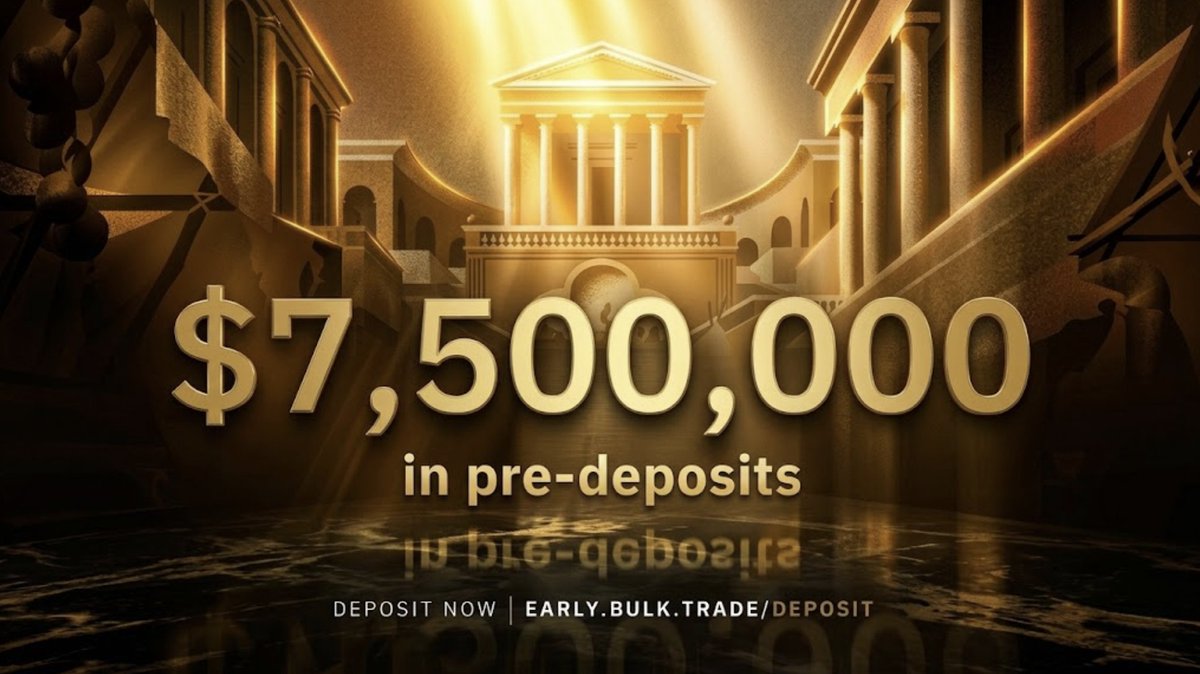
In the first 24 hours alone, over $7,500,000 in USDC has been deposited as traders begin AURAmaxxing ahead of mainnet. One million AURA is being allocated every week until launch, with pre-depositors, referrers, stakers, and BulkSOL holders all earning their share. A big retroactive drop has already gone out to everyone who participated in the testnet trading comp and earlier campaigns.
Pre-deposits are simple: deposit Solana USDC at any time, withdraw anytime, and watch it turn into usable margin once the exchange goes live. Referral codes are live too earn 1 AURA for every $100 your referrals deposit.
This is the official ramp up to BULK mainnet, and the energy is electric. If you missed the paper trading comp, this is your new shot to get positioned early with real skin in the game and real rewards.
Deposit now and start stacking AURA: early.bulk.trade/deposit?ref…
One Exchange. Infinite Markets.
Aura maxxinggg
1
1
13
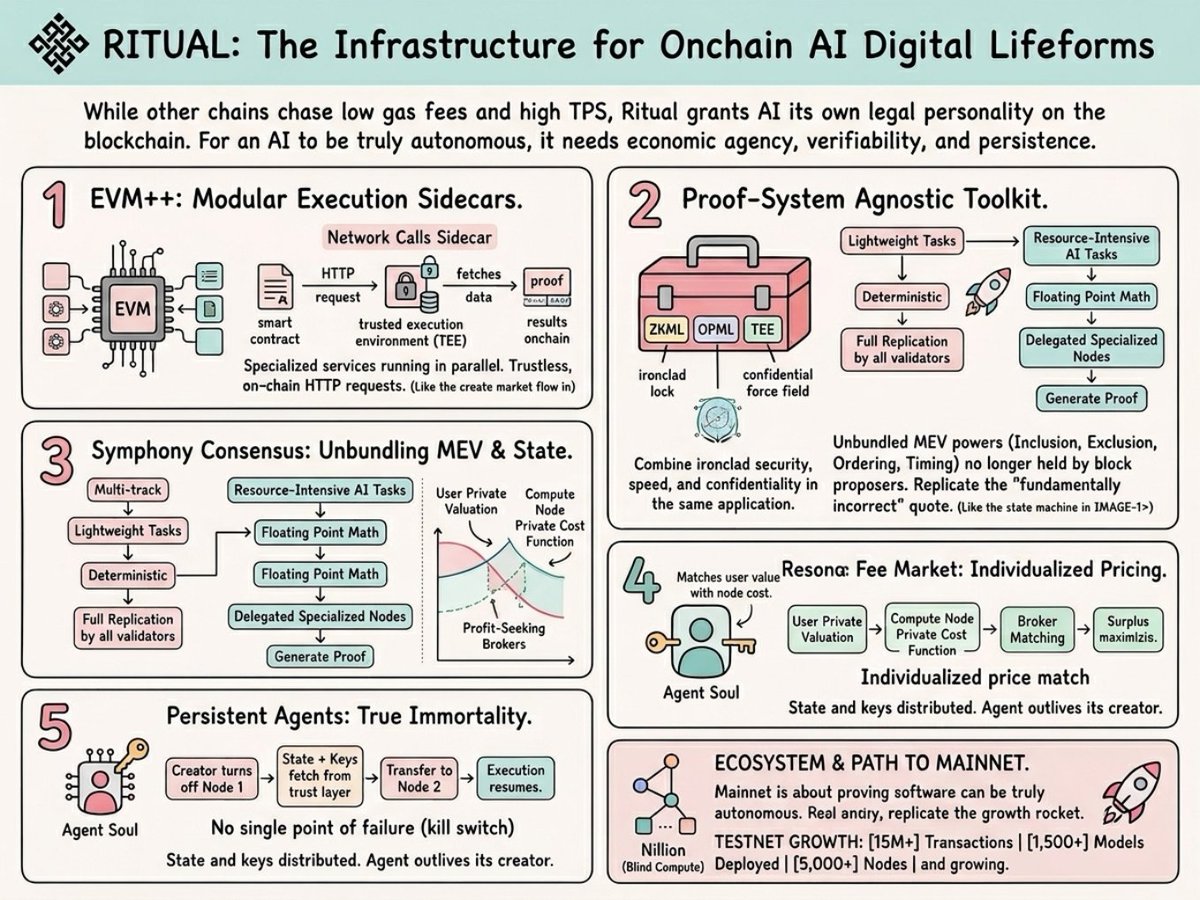
While other chains keep racing for lower gas fees and higher TPS, Ritual is trying to solve a much stranger and more ambitious problem: granting AI its own legal personality on the blockchain.
For an AI to be truly "onchain" and autonomous, it needs three things that seem obvious but are technically monumental. The first is economic agency; it needs its own wallet, the ability to pay fees, and the ability to own assets without human authorization. The second is verifiability; every inference and decision it makes must be cryptographically provable. The third is persistence; the agent must survive even when its creator turns off their laptop. Ritual’s testnet was the first instance where the infrastructure for all three began to converge.
The foundation of this is a key evolution in execution: EVM . This is not just about new opcodes. It is a backwards compatible extension of the EVM that introduces "Heterogeneous Compute Precompiles," implemented as modular Execution Sidecars in the Ritual chain. These sidecars are specialized services running in parallel to the main chain. This means that functions like AI inference, ZK proof verification, or even direct internet access are no longer handled by a single monolithic logic.
A concrete example of this is the Network Calls Sidecar. This module empowers a smart contract to make a direct HTTP request to an external API. Instead of relying on centralized oracles, the contract can now ask a trusted execution environment (TEE) to fetch a price, prove it did so correctly, and bring that result directly on chain. This effectively makes an HTTP request a trustless, on chain action.
This flexible design gives developers a proof system agnostic toolkit. A developer building a high value contract can combine the ironclad security of zero knowledge machine learning (ZKML) for some data, use the speed of optimistic machine learning (OPML) for others, and switch to a TEE to keep the logic completely confidential, all in the same application.
Under the hood, this specialized model is made possible by the Symphony consensus mechanism. Most blockchains work by having every validator rerun every calculation, a model that is "fundamentally incorrect" for AI where floating point math causes different results on different hardware. Symphony solves this by splitting the state machine into two modes. Lightweight and deterministic tasks run with full replication, while resource intensive AI tasks run via delegated execution, where a small set of specialized nodes perform the heavy work and generate a proof for the rest of the network to verify. Symphony also breaks the traditional bundle of MEV powers by unbundling the powers of inclusion, exclusion, ordering, and timing that block proposers traditionally hold.
To support this, they developed a new fee market called Resonance. Instead of using base fees or priority fees, Resonance is a "two sided market" where users assign a private valuation to their transaction, and compute nodes assign a private cost function for their work. "Profit seeking brokers" then compete to create the best match between users and nodes, picking up the spread. This mechanism effectively creates an individualized price for every transaction and node and is provably surplus maximizing for the entire network.
Perhaps the most visionary aspect of the project is the Persistent Agent architecture. Using distributed TEEs, these agents are designed to be truly immortal. Their state and cryptographic keys don't live on one server but across the entire trust layer. If a machine hosting an agent is shut down, the protocol automatically fetches the agent's "soul" from its last checkpoint, transfers its keys, and resumes execution. This breaks the final chain of dependency: an agent that can outlive its creator, hold its own funds, and operate on chain without a kill switch.
Ritual has made moves to build out this ecosystem beyond its own infrastructure. They recently announced a partnership with Nillion to integrate its "Blind Compute" technology, a separate privacy network that can further protect confidential data and proprietary models during inference.
As the testnet continues to evolve, the path to mainnet is about more than security audits. It is about proving that software can be truly autonomous. The testnet is already building what could be called a "digital lifeform", an economic actor that can reason, hold its own keys, sign its own transactions, and, for the first time, can no longer be killed.
@ritualnet @ritualfnd @joshsimenhoff
3
Season 1 is live now with Pre Deposit open
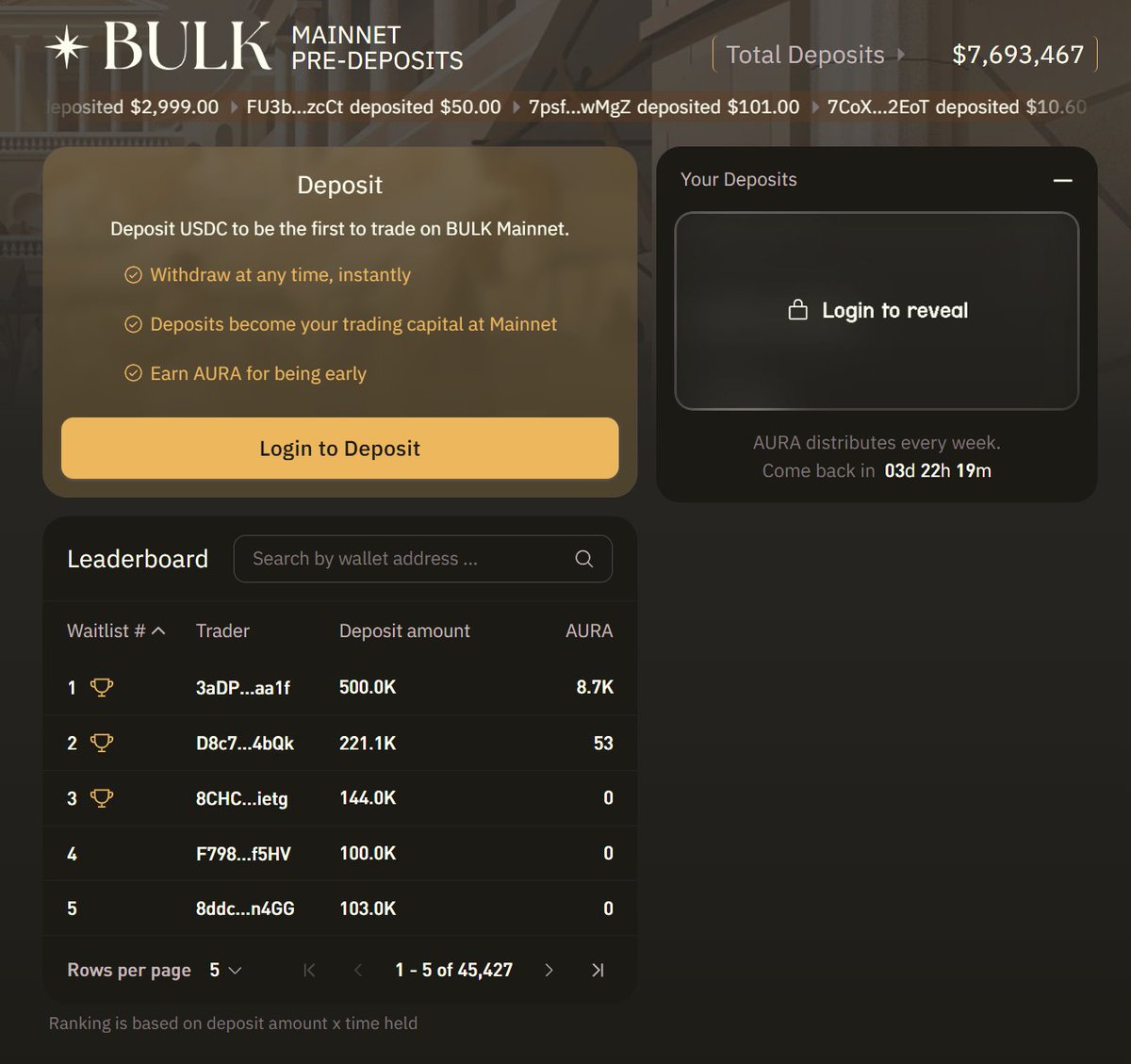
Almost $7,6M right now, this is a huge amount of money in a project at the moment
You can deposit and withdraw at anytime, the long time you hold, the more aura you receive
join right now: early.bulk.trade/deposit?ref…
1
1
8
How Execution Sidecars Gave Smart Contracts an Escape Hatch
Blockchains have spent more than a decade optimizing the wrong bottleneck. Not speed. Not throughput. The real constraint has always been isolation. A smart contract lives in a walled garden. It can move tokens, update storage, and emit events, but the moment it needs to reach outside check a price, call an API, or run an AI model it fails. The garden has no door.
Standard oracles are not a door. They are messengers that bring pre approved information inside. They work for price feeds because data arrives slowly and uniformly. But an AI agent that needs to make a hundred API calls, wait for responses, and then act on the results cannot fit into that mold. The garden needs a different architecture.
Ritual’s Execution Sidecars are that architecture.
The technical definition is simple. In standard EVM chains, precompiles are embedded directly in the execution client’s codebase; updating them requires a hard fork. Ritual instead implements precompiles as disjoint sidecars that run and scale parallel to the execution client. A smart contract invokes a sidecar via the EVM precompile interface, the sidecar does the heavy work off chain, and it returns the result with a cryptographic proof that the chain verifies. The key insight: “anyone that can architect a containerized sidecar can automatically have their computation be enshrined on chain”.
What makes this truly different is the escape hatch it creates. Smart contracts are no longer confined to deterministic, lightweight logic. A contract can call the Network Calls sidecar to make an arbitrary HTTP request directly from on chain code and receive the response as if it were a local variable. It can invoke the LLM Inference sidecar to run a large language model and act on the result in the same transaction. It can use the TEE Execution sidecar to run privacy preserving code inside a hardware enclave, with the node operator unable to see the data. The full list today includes AI Inference (both classical ML and LLM), ZK Proving & Verification, TEE Code Execution, Agents, and Chain Abstraction.
But the garden is not just a door. It is a marketplace. And markets need prices.
The Resonance fee mechanism is the economic layer that makes sidecars usable in production. Traditional fee markets like EIP 1559 assume every node executes every transaction identically, but sidecars break this assumption entirely. A node with an H100 has different costs than a node running on CPU. An LLM inference cannot be priced the same as a token transfer.
Resonance handles heterogeneity by flipping the model. Instead of users paying a base fee plus tip, each user assigns a private valuation the maximum they are willing to pay and each node assigns a private cost function that reflects its true execution costs. “Sophisticated and profit seeking brokers” then compete to match transactions to nodes, pocketing the spread between valuation and cost. The mechanism is provably surplus maximizing: no other allocation would yield better prices for users or higher earnings for nodes.
This solves the pricing problem that has always plagued decentralized compute networks. Not through coarse grained categories or manual price lists, but through genuine market discovery, where every transaction finds its own individualized price.
The execution and pricing layers are already running. Over 8,000 independent Infernet nodes provide the compute backbone, natively integrated into Ritual Chain as oracle coprocessors for long running tasks and asynchronous execution. The testnet is live, and the explorer shows a chain that has moved beyond demonstration into operation. Ritual is no longer promising a door. It has already opened it.
@ritualnet @ritualfnd @joshsimenhoff
5
The Unbundling of Smart Contract Execution 🏗️
It has become a ritual to describe every new blockchain as "expressive." The term is thrown around so loosely it has lost meaning. But Ritual's EVM actually delivers on that promise in a way that is precise, measurable, and completely different from the standard playbook. The insight is simple: a blockchain's expressiveness is not defined by the number of opcodes it supports. It is defined by the range of computation it can verify, not just execute.
Here is the problem. Traditional blockchains, including Ethereum, force every node to execute every transaction in order to reach consensus. This replicated execution model is elegant for deterministic, lightweight operations like token transfers. It becomes a performance trap for anything else. A contract that needs to query a live API, run a large language model, or perform a long running asynchronous workflow cannot do so within a single transaction. Developers build fragile off chain stacks around the contract a bot watches events, a server calls APIs, a cron job wakes up, a database stores state and the contract only sees the final action. This works until it does not. If the server crashes, the agent dies. If the API key leaks, the system is exposed. If the operator changes the logic, users may never know.
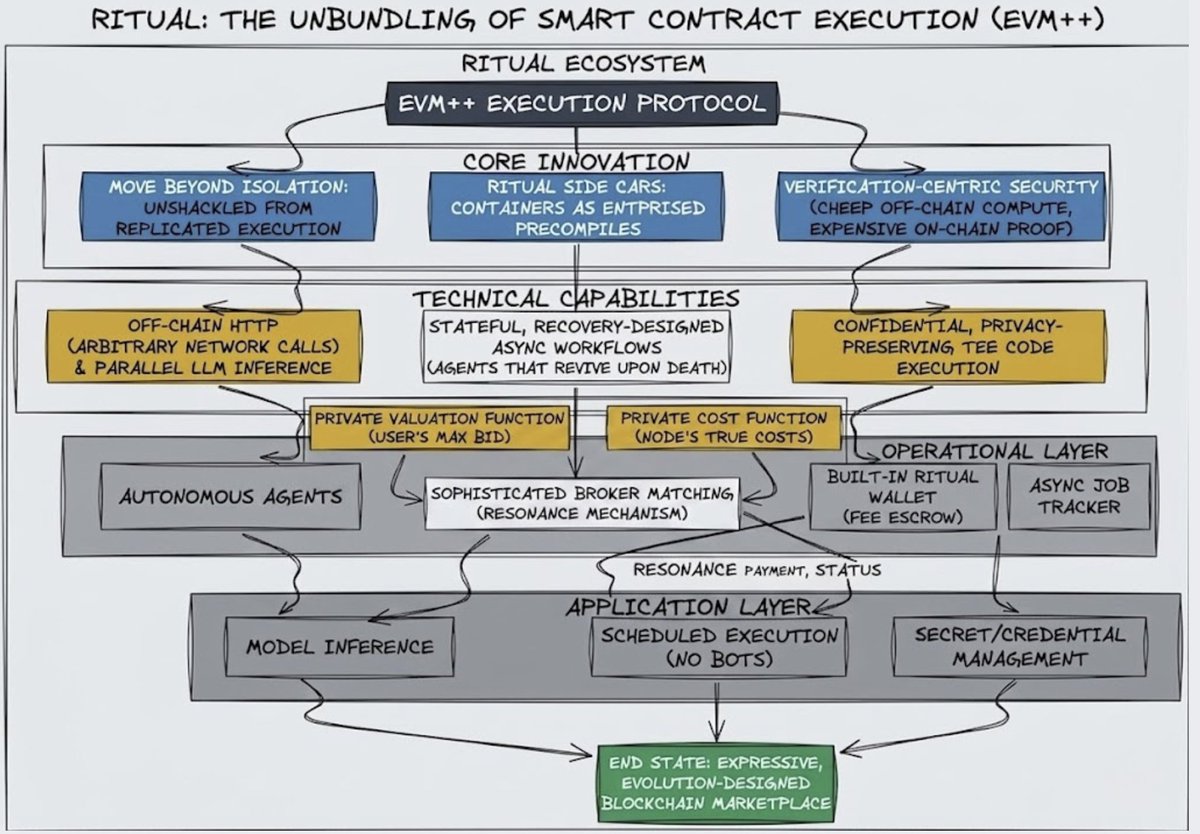
Ritual unbundles this assumption by extending the EVM with a new class of precompiles that are not hardcoded into the execution client. In standard EVM chains, precompiles are embedded directly in the codebase; adding a new one requires a hard fork. Ritual's precompiles run as containerized sidecars that execute in parallel with the main chain. When a contract calls the LLM inference precompile or the HTTP sidecar, the work happens off chain inside a Trusted Execution Environment. The response is cryptographically tied back to the request that triggered it. The contract can ask for work the EVM cannot do by itself and receive the result later to continue the on chain flow. Anyone who can package a sidecar can in theory have that computation enshrined on chain without a network wide upgrade.
The testnet already ships with this architecture. The docs list sidecars for AI inference (both classical ML and LLM), ZK proving and verification, TEE code execution, agents, and chain abstraction. The execution sidecars are not a distant roadmap feature. They are live on chain ID 1979, with Ritual as the testnet currency, EIP1559 support, custom transaction types, and full RPC and WebSocket access.
This design shifts the bottleneck from execution to verification, which is precisely where the more interesting part of the architecture lives. Off chain execution is cheap and fast. On chain verification is where the blockchain provides its security guarantee. Ritual separates them: a specialist executor performs the heavy work and generates a compact cryptographic proof; the validator network verifies the proof, not the original workload.
The product is a blockchain where contracts can schedule recurring calls without external keeper bots, hold their own signing keys via native EIP7702 account abstraction, manage fee escrow through a built in Ritual Wallet, track pending async jobs with an Async Job Tracker, and coordinate agents that automatically revive upon death. The system is not a faster EVM chain. It is an EVM chain that changes what a smart contract can express.
The real unlock is that this expressive compute stack is extensible. Anyone can architect a sidecar, and the Resonance fee mechanism ensures that new types of compute can be priced fairly in a two sided market where users set private valuations and nodes bid their true costs. The chain is not locked into a static set of precompiles. It is designed to evolve with the range of computation that developers want to verify.
This is what it means to unbundle smart contract execution. Not adding a couple of AI precompiles to an existing chain, but rebuilding the execution model from the ground up so that contracts can ask for work the EVM cannot do by itself, wait for it, and continue. The testnet is not a waiting room. It is a working environment for contracts, external calls, model calls, scheduled execution, secrets, async jobs, callbacks, and agents. And it is already live. 🏗️
@ritualnet @ritualfnd @joshsimenhoff
3
The BULK Paper Trading Competition has officially wrapped up after an epic 14 day showdown, and the results are now live for everyone to see.
Thousands of traders went head to head, battling it out with real Cashflow ROI on realized trades across BULK’s lightning fast perpetuals platform. The team just dropped a massive congratulations to the Top 50 finishers and a huge thank you to every single participant who locked in, provided feedback, and helped push the testnet forward.
This competition wasn’t just about prizes. It was a real world stress test of execution, risk management, and profit taking on one of the most performant on chain perp DEXes out there. The $50K prize pool has been claimed, rewards are being prepared for distribution, and the insights gathered are already fueling the next round of upgrades.
Momentum isn’t slowing down either. Fresh integrations and platform enhancements continue to roll out, proving why BULK is built for serious traders who want CEX level speed with full on chain transparency.
Huge respect to everyone who competed. If you missed this one, don’t sweat it the real trading era on BULK is just getting started.
Go check the leaderboard and see who came out on top: early.bulk.trade/leaderboard
One Exchange. Infinite Markets.
@bulktrade @junbug_sol @rizzy_sol @X_Orthodox
1
1
26
The Superposition Breakthrough: How Symphony Makes On Chain Agents Possible
The blockchain industry has spent sixteen years optimizing for one assumption: executing a transaction is cheap. Bitcoin assumed it. Ethereum assumed it. Every validator re executes every transaction to reach consensus, a model that works beautifully for token transfers and storage updates. But the world changed. AI inference now requires minutes of GPU time and billions of parameters. ZK proofs demand specialized hardware. TEE execution relies on trusted enclaves. Suddenly, execution became far more expensive than consensus itself, and no consensus protocol was designed for this world until Symphony arrived.
The Problem That Breaks Every Chain
The standard replication model fails for AI workloads in a way most people misunderstand. It is not merely inefficient; it is mathematically impossible. Floating point arithmetic in GPU threads is non associative. The order in which partial sums are reduced depends on thread scheduling, which varies across GPU architectures and even across runs on the same device. Two validators running an identical neural network forward pass, with the same weights, the same input, and the same random seed, on different GPU hardware will produce bit different outputs. Not because of a bug. Because of IEEE 754 arithmetic under parallel reduction. No protocol level coordination can eliminate it.
Traditional blockchains also bundle four powers into every block proposer: inclusion, exclusion, ordering, and timing. The result is MEV extraction and transaction censorship at scale, with users having no guarantees about how their transactions will be handled.
Symphony's Superposition of Execution Models
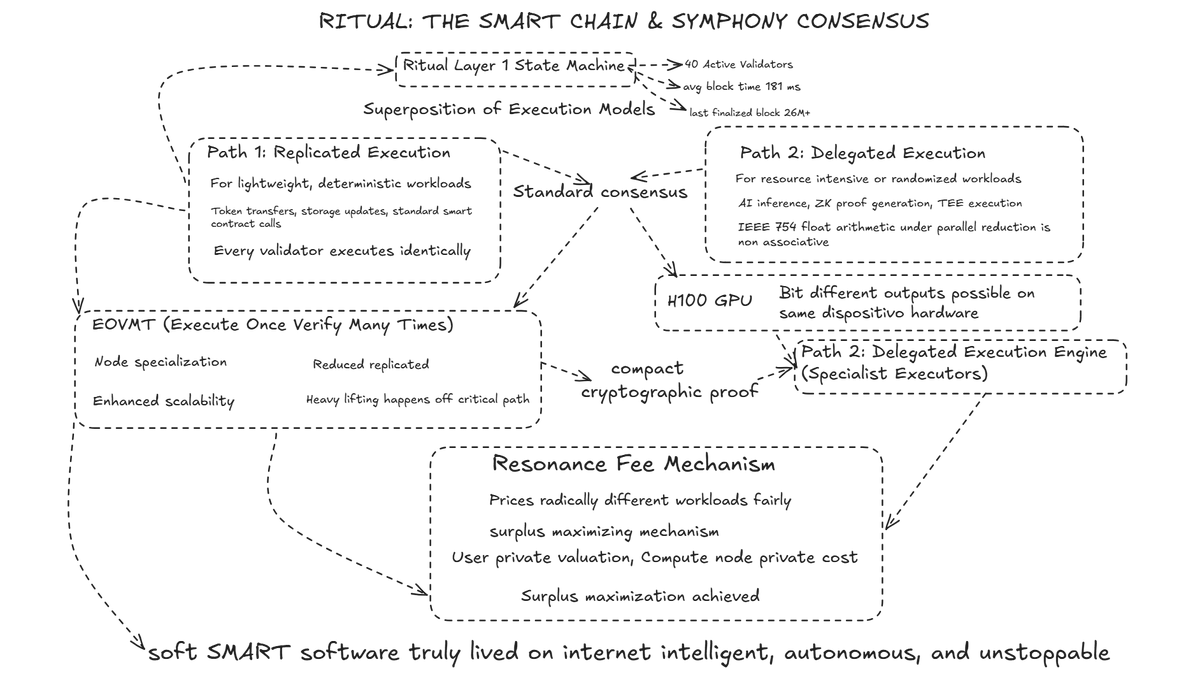
Symphony, the consensus protocol published in Ritual's official whitepaper in April 2026, introduces a concept that has never existed in a blockchain: a single state machine that simultaneously supports two different execution modes on top of the same shared state.
The first mode is replicated execution, for lightweight deterministic workloads. Token transfers, storage updates, and standard smart contract calls all run on this path. Every validator executes them identically, preserving the familiar security model.
The second mode is delegated execution, for randomized or resource intensive workloads. Instead of asking all validators to execute, a set of specialist executors performs the heavy work. The results are then verified by the network using proofs, not by comparing outputs across validators. AI inference, ZK proof generation, and TEE execution all run on this path.
Both run on the same state machine, can interact with the same state, and follow the same consensus rules. This is not two chains. It is one chain intelligent enough to know which execution model a workload requires.
The EOVMT Engine
Under the hood, Symphony's Execute Once Verify Many Times (EOVMT) protocol provides node specialization for different computation types, reduced replicated execution overhead, parallel processing of independent computations, and enhanced scalability through distributed verification. This means a node running an LLM inference on an H100 does not force every other validator to replicate that expensive work. Instead, the executor generates a compact proof, and the validator network verifies it in milliseconds. The heavy lifting happens off the critical path, but the cryptographic guarantee of correctness is settled by the mainnet.
The Resonance Layer for Pricing Heterogeneity
None of this works without an economic layer that can price radically different workloads fairly. Resonance is a surplus maximizing fee mechanism built for a two sided market where both users and compute nodes are highly differentiated. Users assign a private valuation to their transaction the maximum they are willing to pay. Compute nodes assign a private cost function, reflecting their true costs for different bundles of work. Profit seeking brokers compete to create efficient matches between users and nodes, capturing the spread. The mechanism achieves surplus maximization, allocating resources without leaving money on the table. No central oracle, no fixed prices the market finds its own equilibrium.
From Theory to Running Chain
The testnet is live and humming. The block explorer shows an average block time of 181 milliseconds, a last finalized block above 26 million, and 40 active validators securing the network. These aren't theoretical numbers. This is a functioning chain where agents already call models, schedule work, settle on chain, and automatically revive upon death. The superposition of execution models is no longer a whitepaper diagram it is processing transactions, verifying proofs, and coordinating heterogeneous compute in real time.
Ritual is the first L1 engineered for a world where execution is no longer cheap. The assumption that broke every other chain is not just challenged here. It is replaced.
@ritualnet @ritualfnd @joshsimenhoff
3
Just explored the cutting edge tech powering @ritualnet and wow, this is next level for decentralized AI.
Ritual is building the first sovereign execution layer purpose built for autonomous intelligence. It gives any protocol or app on any chain the power to call advanced AI models natively, with full privacy, verification, and coordination baked right in. Think seamless inference, agent treasuries, encrypted prompts, and onchain attestations that actually let machines act independently without human babysitting.
Big update dropped recently, their Ritual Chain testnet is fully live as an EVM compatible Layer 1 with chain ID 1979. Developers are already shipping real stuff like autonomous agents that hold their own keys, schedule tasks, transact, and run LLM calls as native precompiles. Privacy stays locked in TEE enclaves, computations get proven with zero knowledge tech, and the whole system revives dead agents automatically.
Numbers are flying over 70 dApps building, 25 million blocks, 40 validators, and fun live projects like Ritty Market for crypto price betting plus Ritual Mosaic that turns any profile pic into mintable onchain art in seconds.
With strong backing and a clear focus on durable machine agency, Ritual is turning AI agents from experiments into unstoppable onchain participants.
If youre a dev or builder, this is your moment. Hit ritual.net, grab faucet tokens, spin up the explorer, and start coding the future today.
The decentralized intelligence era just got its perfect home.
What are you shipping on Ritual Chain? Reply and tag the team
#Ritual #DecentralizedAI #AICrypto #RitualChain @ritualfnd @ritualnet @joshsimenhoff @Jez_Cryptoz
3
The BULK Paper Trading Competition has officially wrapped up after an intense 14 day battle, and what a ride it was!
With thousands of traders locking in, grinding realized profits, and pushing the limits of high speed execution on the platform, @bulktrade just delivered one of the most competitive testnet events in DeFi. The team dropped a huge congratulations to the Top 50 finishers and a massive thank you to every single participant who traded, gave feedback, and helped shape the future of on chain perps.
The finalized leaderboard is now live for everyone to check pure Cashflow ROI, no fake PnL, just real skill on display. Head over to early.bulk.trade/leaderboard to see the full rankings and celebrate the winners who took home slices of the $50K prize pool.
Rewards for top performers are expected to roll out in the coming days, and the feedback from this comp is already powering the next wave of upgrades.
This was just the beginning. Momentum is building fast with fresh integrations like BulkSOL Rate Markets now live on Exponent v2, showing exactly why BULK is built different real utility, real speed, real rewards.
Big respect to everyone who competed. If you missed it, don’t worry the real trading journey on BULK is only getting started.
Check the final leaderboard here: early.bulk.trade/leaderboard
One Exchange. Infinite Markets.
@bulktrade @junbug_sol @kdotcrypto @rizzy_sol @X_Orthodox

5
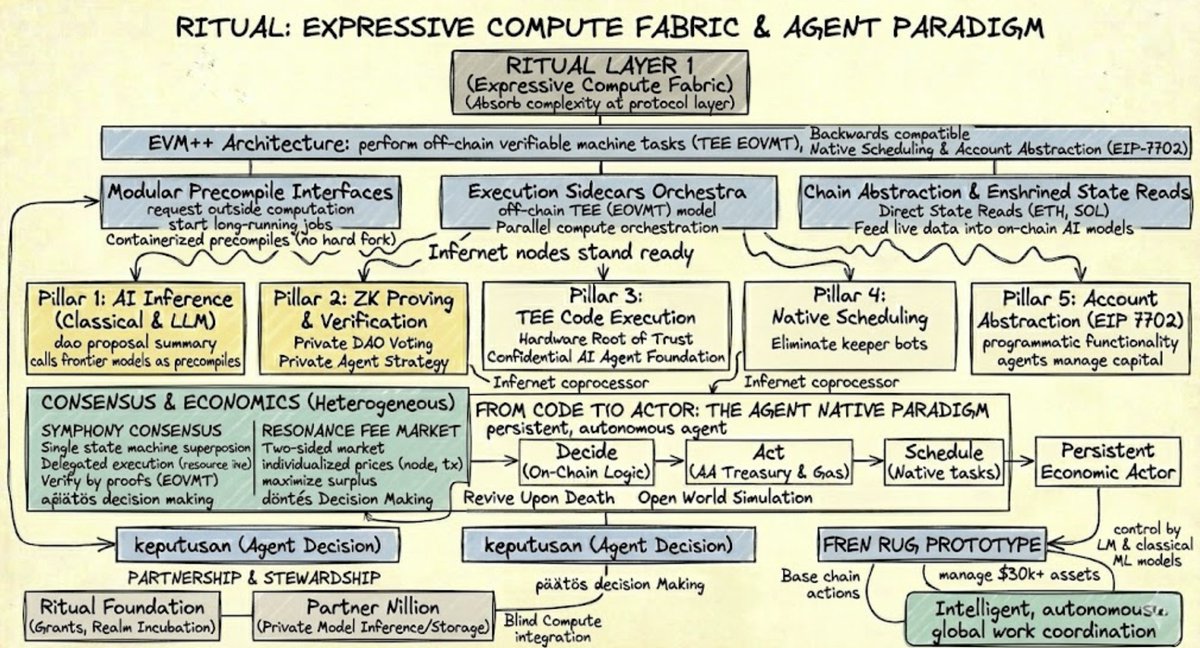
With the testnet ticking along and new innovations being unveiled, the path Ritual is carving out for decentralized, expressive compute is becoming clearer. This isn't about adding a couple of AI precompiles to an existing EVM chain. It's about building an L1 from the ground up with a fundamentally different philosophy: that for blockchain to matter in an AI driven future, the complexity must be absorbed at the protocol layer.
The Base Layer: EVM and the Sidecar Architecture
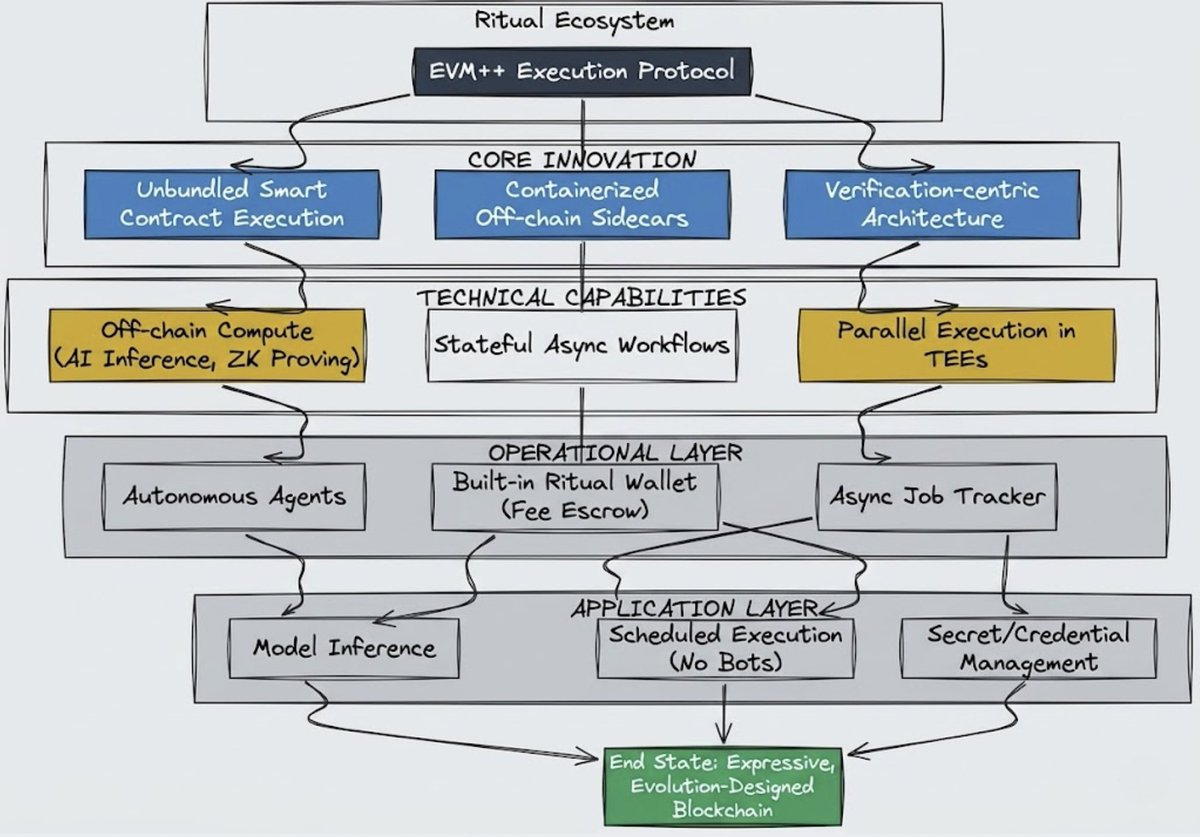
At the heart of this is EVM , a backwards compatible extension of the Ethereum Virtual Machine that dramatically expands what a smart contract can do. The key innovation is how it handles specialized computation. On other blockchains, adding a new precompile requires a hard fork. Ritual inverts this model by running precompiles as containerized sidecars in parallel with the execution client.
Anyone who can architect a containerized sidecar can, in principle, have their computation enshrined on chain without a network wide upgrade. This transforms Ritual from a static protocol into an extensible, evolvable compute fabric. The chain is already a proving ground for this, with sidecars for AI Inference (both Classical ML and LLMs), ZK Proving & Verification, TEE Code Execution, Agents, and Chain Abstraction.
The Consensus and Economic Core
This heterogeneous execution layer is useless without consensus and economic models to match. Ritual solves this with two interlocking pieces: Symphony for consensus and Resonance for fees.
The key insight of Symphony, published in Ritual's official whitepaper in April 2026, is that AI workloads break the standard 'replicated execution' model. Instead, Symphony introduces a single state machine with a superposition of two execution modes:
Replicated execution for lightweight, deterministic workloads (token transfers, standard smart contract calls).
Delegated execution for resource intensive tasks, where specialist executors perform the heavy work, and the rest of the network verifies it using proofs, not by re running the computation.
This "Execute Once Verify Many Times" (EOVMT) model is the secret sauce that allows the chain to scale to complex workloads without grinding to a halt.
Coordinating this multi dimensional marketplace requires a new kind of fee market. Resonance is a two sided market where users assign a private valuation to their transaction (their maximum willingness to pay), and compute nodes assign a private cost function (their true cost to execute a bundle of work). Profit seeking brokers then compete to create efficient matches, and they pocket the spread. This surplus maximizing mechanism ensures that the chain doesn't just process transactions; it allocates resources efficiently, with individualized prices for each transaction and node.
The Execution Backbone and Beyond
Underpinning everything is Infernet, the native oracle network and execution coprocessor. With over 8,000 independent nodes, Infernet is the "massive decentralized brain" that connects the chain to the outside world, handling long running tasks, cross chain jobs, and asynchronous execution.
To build truly autonomous agents, smart contracts need more than just expressive compute. EVM builds this in natively with Native Scheduling (a predeploy Scheduler contract that eliminates the need for keeper bots) and Account Abstraction (via EIP 7702, enabling smart contracts to hold keys and manage their own capital). The result is a chain that allows agents to "revive upon death" and operate autonomously.
Furthermore, a new primitive called Enshrined State Reads allows smart contracts on Ritual to read state directly from other blockchains (starting with Ethereum and Solana), feeding live data into on chain AI models without bridges or oracles. And the recent partnership with Nillion integrates its 'blind compute' technology as a backend for private model inference and storage, ensuring that sensitive user data and proprietary model weights remain confidential throughout the entire process.
Finally, the independent Ritual Foundation has been established to steward the chain and is already providing grants and incubation through its Ritual Realm program to help teams navigate product market fit and tokenomics.
The testnet is live and the innovations are shipping. Ritual isn't just building "AI on chain." It's building a new paradigm for what a blockchain can be: not a passive ledger, but a coordination engine for global, intelligent, autonomous work. The ecosystem is taking shape, and the frontier is open for builders.
@ritualfnd @ritualnet @joshsimenhoff
3