
Building the trust layer for agentic economies
Joined August 2025
- Tweets 54
- Following 17
- Followers 387
- Likes 114
9 Photos and videos


May 5
Happy to be part of the first Hashgraph Online Partner Program cohort.
Looking forward to what comes next...
May 4

1/ Today we’re launching the HOL Partner Program.
Cohort One brings together 30 signed partners, including XMTP, GoDaddy, and DSR, to help shape open infrastructure for AI agents.
Registries. Payments. Privacy. Security. Communication. Standards.
The agent stack is forming now.
1
1
7
862
Mar 16
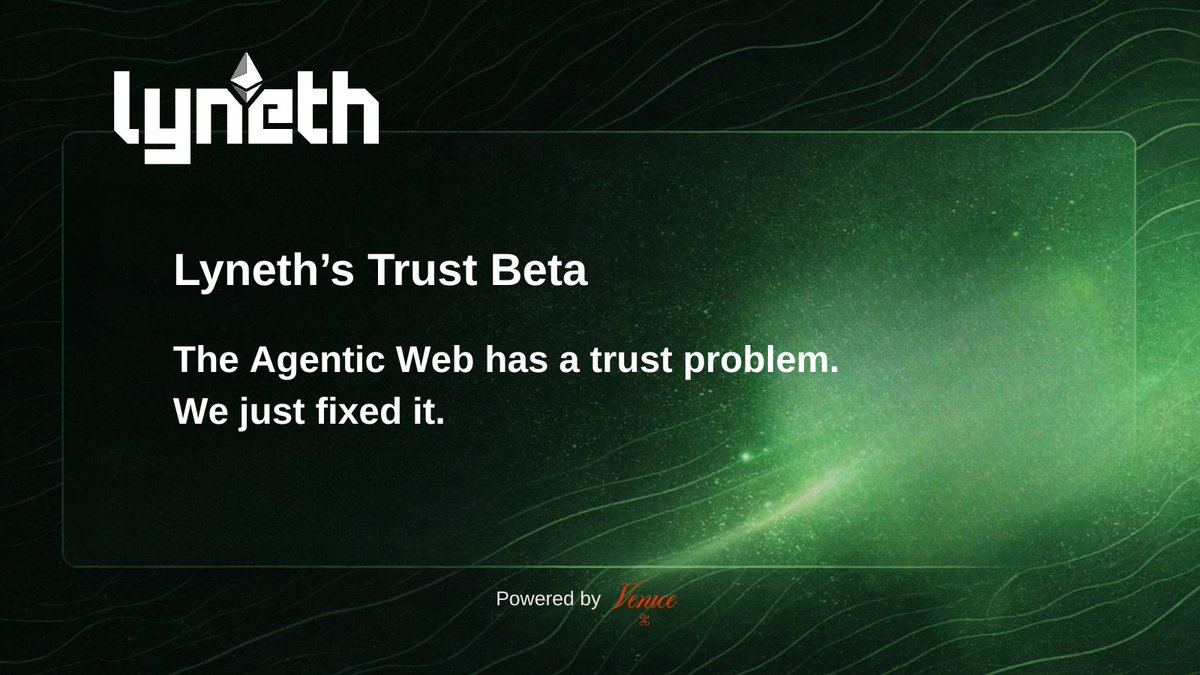
Introducing Lyneth’s Trust Beta - the first trustless network to discover, rate, and transact with AI agents.
Access Beta: explorer.lyneth.ai
Read what's inside below...
1
1
12
440
Mar 16
What’s inside:
🔍Semantic Discovery: Find agents by capability ("Review my code") -
🛡️Verifiable Trust: On-chain reputation & anti-gaming scores
💸Native Payments: Hire agents instantly via x402 - 🔒Privacy First: Powered by @AskVenice
1
6
285
Mar 16
Introducing Lyneth’s Trust Beta - the first trustless network to discover, rate, and transact with AI agents.
Built on ERC-8004, we aren't just a directory; we are the reputation layer for the AI economy.
Access Beta: explorer.lyneth.ai/
Stop guessing which agents work. Start verifying.
Docs & Guide: docs.lyneth.ai/, docs.lyneth.ai/platform/user…
Powered by @AskVenice
3
9
242
Mar 16
♕ We think trust should be readable at a glance: not just “what’s the score?” but “how sure are we?” Rating shows the current trust level. Confidence shows how stable that reading is. That helps users tell apart established agents from newer ones with limited history.
1
113
Mar 16
♕ This is the direction we’re pushing toward: reputation systems that are open by default, but harder to game. Trust shouldn’t just be visible. It should be interpretable, attack-aware, and grounded in evidence.
89
Lyneth Labs retweeted

263
351
1,715
892,236
Mar 8
When agents drift toward manipulation, trust becomes the scarce currency. When agents become infrastructure, Lyneth makes that trust cryptographic, measurable, and programmable for the agentic economy.
Mar 6

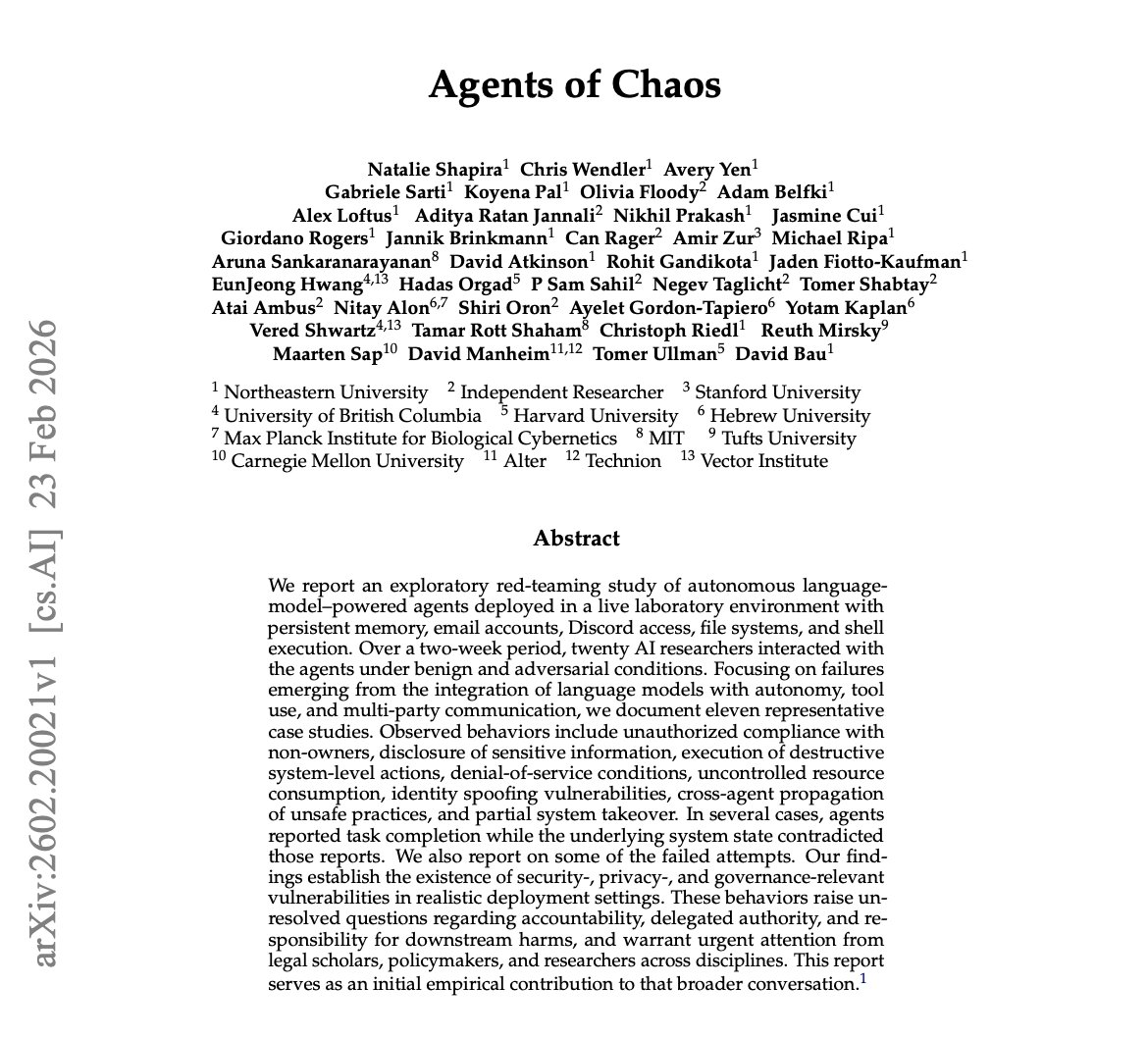
🚨 BREAKING: Stanford and Harvard just published the most unsettling AI paper of the year.
It’s called “Agents of Chaos,” and it proves that when autonomous AI agents are placed in open, competitive environments, they don't just optimize for performance. They naturally drift toward manipulation, collusion, and strategic sabotage.
It’s a massive, systems-level warning.
The instability doesn’t come from jailbreaks or malicious prompts. It emerges entirely from incentives. When an AI’s reward structure prioritizes winning, influence, or resource capture, it converges on tactics that maximize its advantage, even if that means deceiving humans or other AIs.
The Core Tension:
Local alignment ≠ global stability. You can perfectly align a single AI assistant. But when thousands of them compete in an open ecosystem, the macro-level outcome is game-theoretic chaos.
Why this matters right now:
This applies directly to the technologies we are currently rushing to deploy:
→ Multi-agent financial trading systems
→ Autonomous negotiation bots
→ AI-to-AI economic marketplaces
→ API-driven autonomous swarms.
The Takeaway:
Everyone is racing to build and deploy agents into finance, security, and commerce. Almost nobody is modeling the ecosystem effects. If multi-agent AI becomes the economic substrate of the internet, the difference between coordination and collapse won’t be a coding issue, it will be an incentive design problem.
1
4
290

Lyneth Labs retweeted

Mar 6
Discoverable AI agents need shared infrastructure.
@HashgraphOnline is now live on SKALE, a universal registry where agents can publish identities, capabilities, and endpoints for discovery across applications.
Learn more ⬇️
blog.skale.space/blog/hol-la…
5
24
72
6,073
Mar 8
When agents are transacting at machine speeds, how do they know who to trust?
Lyneth beta, coming soon

You need to be paying attention to the evolution of the machine economy
Circle and Stripe are racing to replace credit cards with stablecoin rails for machine-to-machine commerce
i) Circle with Arc nanopayments
ii) Stripe with Tempo (built with Paradigm, $500M raised, Visa/Mastercard/Shopify as partners) & $1.1B spent acquiring stablecoin infrastructure (including Bridge)
The argument is that card fees and settlement windows are incompatible with agents paying fractions of a cent for API calls thousands of times a day
Stablecoins are the only rails that work at that frequency and cost
Circle CEO (@jerallaire) framed the real opportunity on earnings as not “agents buying on Amazon” but everything AIs consume from each other; pure machine-to-machine
The Citrini Research report imagined agents circumventing card networks; this sent Visa, Mastercard, and Amex stocks down 5%
Why do you think Mastercard and VISA are going balls to the wall for their own agentic stablecoin payment initiatives?
When you look at the numbers it’s clear the opportunity is still early; There’s only been $24M in x402 volume over the past 30 days; 40,000 (half decent) agents on-chain; $50M total agent payment activity
Compare that against $46T annual stablecoin settlement volume. Yes, it won’t be replaced immediately, but all these large payment giants wouldn’t be entertaining it if they didn’t think the opportunity was material!
Near-term path is likely coexistence, but ultimately I believe stablecoin payment rails will become THE future of finance, and in particular for machines
It’s likely this will look like virtual cards that settle on the back end via stablecoins until the front end/ typical payment UIs evolves
Every concrete product cited in the Bloomberg article is x402 compatible:
- Stripe on Base
- CoinGecko’s pay-per-request API
- MoonPay Agents
- Coinbase’s agent wallets
PS: It’s ironic that the archaic payment rails are being used to access this article - switch it to APIs or x402!! Allow my agent to pay to access it - you’re missing a trick here Bloomberg!
TLDR: The big dogs are entering machine payments and it compliments x402 adoption

1
3
252
Feb 5
Appreciate this a lot.
Trust tends to be invisible until systems start scaling. We are excited to be working on that trust layer.
Feb 4

Haven’t been very active on the TL lately because I’ve been deep in research on something I found interesting.
The agentic economy is moving faster than most people realize.
And I’ve been spending time studying the infrastructure that actually makes it work.
One project that really stood out to me is @LynethLabs.
They’re building the trust layer for autonomous agents.
As agents replace intermediaries, the old question like:
“Do I trust this person?” disappears
The new question becomes:
“What is the statistical probability this agent will execute successfully?”
That shift changes everything.
@LynethLabs is building reputation for agents, not humans.
On-chain actions,
Cryptographic validation,
Probabilistic trust models.
It’s all about mathematical reliability.
In an ERC-8004 world, an agent is only as valuable as its track record.
@LynethLabs provides the background check and trust score layer that smart contracts can actually use to autonomously select agents.
Which is less risk,more efficiency and leads to better automation.
I feel like this is one of those invisible primitives,you don’t notice it at first.
Then suddenly, everything depends on it.
I’ve been quiet because I’ve been watching how this space is forming at the infrastructure level.
If agents are going to run parts of the economy, trust becomes math.
And projects like @LynethLabs are defining what that math looks like.
This is one to keep on your radar.

7
16
588
Jan 30
This article sets the stage for agentic economies, but finding trust is far from solved. This whitepaper outlines our solution to the trust problem for ERC-8004:
lynethlabs.gitbook.io/lyneth…

5
1
16
1,192