PI in #Epigenetics. Fascinated by how stem cells work and how our genes make us. Can’t wait to find out what #citrullination is all about. Own views. She/her.
Daniel drove and executed this work during his 4-year PhD. It's a bit difficult to convey how impressed I've been! 🚀🚀
So congratulations to him and thank you to our collaborators Eugenia Wong, @stefanschoenfe1, @mikhailspivakov and @simon_andrews.
Many congratulations Chien-Yun and team! Great to see this out.
🚀
Prosit-Cit is an important addition to the community’s toolkit for studying #citrullination
Kicking off the new year strong! 🚀
Prosit-Cit is officially online on MCP! Check it out: mcponline.org/article/S1535-…
Follow us on Bluesky for more exciting research updates! @ msleelab.bsky.social
We are hiring! 3-year BBSRC-funded postdoc position available. TEs, epigenetics, pregnancy: if you love one or more of these keywords, apply through the link below. Please spread the word.
qmul-jobs.tal.net/vx/mobile-…
Fantastic proteins and where to find them – histones, in the nucleus and beyond
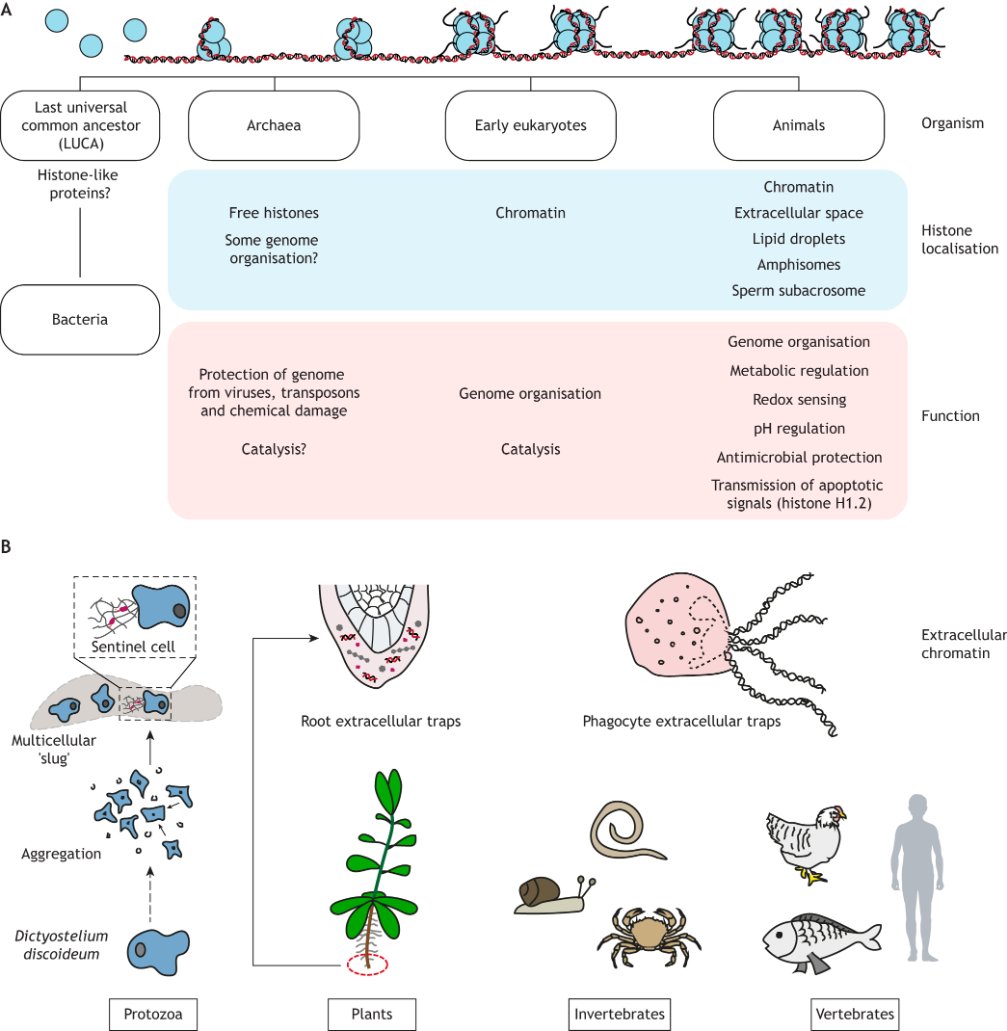
Johanna Grinat, Noah Shriever and @MAChristolab discuss the evolution & mechanisms of chromatin externalisation and (patho)physiological functions of extracellular histones.
journals.biologists.com/jcs/…
ALT Top image - A timeline of the evolution of histones, their complexing with chromatin, and other known or hypothesised functions. Histone proteins are represented as blue spheres. Archaeal histones mostly lack N-terminal tails and form a looser chromatin structure, whereas compaction is increased in simple and higher eukaryotes. Lower image - Modes of chromatin release throughout the tree of life. The slime mould Dictyostelium discoideum releases chromatin via ETosis only while in a multicellular ‘slug’ phase. Plants release chromatin via root extracellular traps for defence against pathogens, whereas animal cells carry out ETosis in many contexts, such as immune or inflammatory responses or tissue repair.
Faculty jobs going in Cambridge Biochemistry!! Assistant Professor/Associate Professor in the area of Bioenergetics or Microbiology @Cambridge_Unijobs.cam.ac.uk/job/49700/
Dear #Epigenetics Friends & Colleagues – Do YOU know where your histones are?
Our Xmas prezzie to the community (and perfect holiday reading): we went hunting for #histones and found them in all sorts of weird and wonderful places.
We report here 👇 journals.biologists.com/jcs/…
This has been one of the most enjoyable pieces of work I have ever undertaken. There is something so wonderful about becoming immersed in academic work – reading, thinking, discussing, writing.
Thank you to @J_Cell_Sci for prompting us to put other things aside and focus on it!