Most organizations struggle to move from AI experimentation to seeing a return on their investments. Here are five common AI mistakes and how you can overcome them. @MIT_CISRbit.ly/4wAhJBB
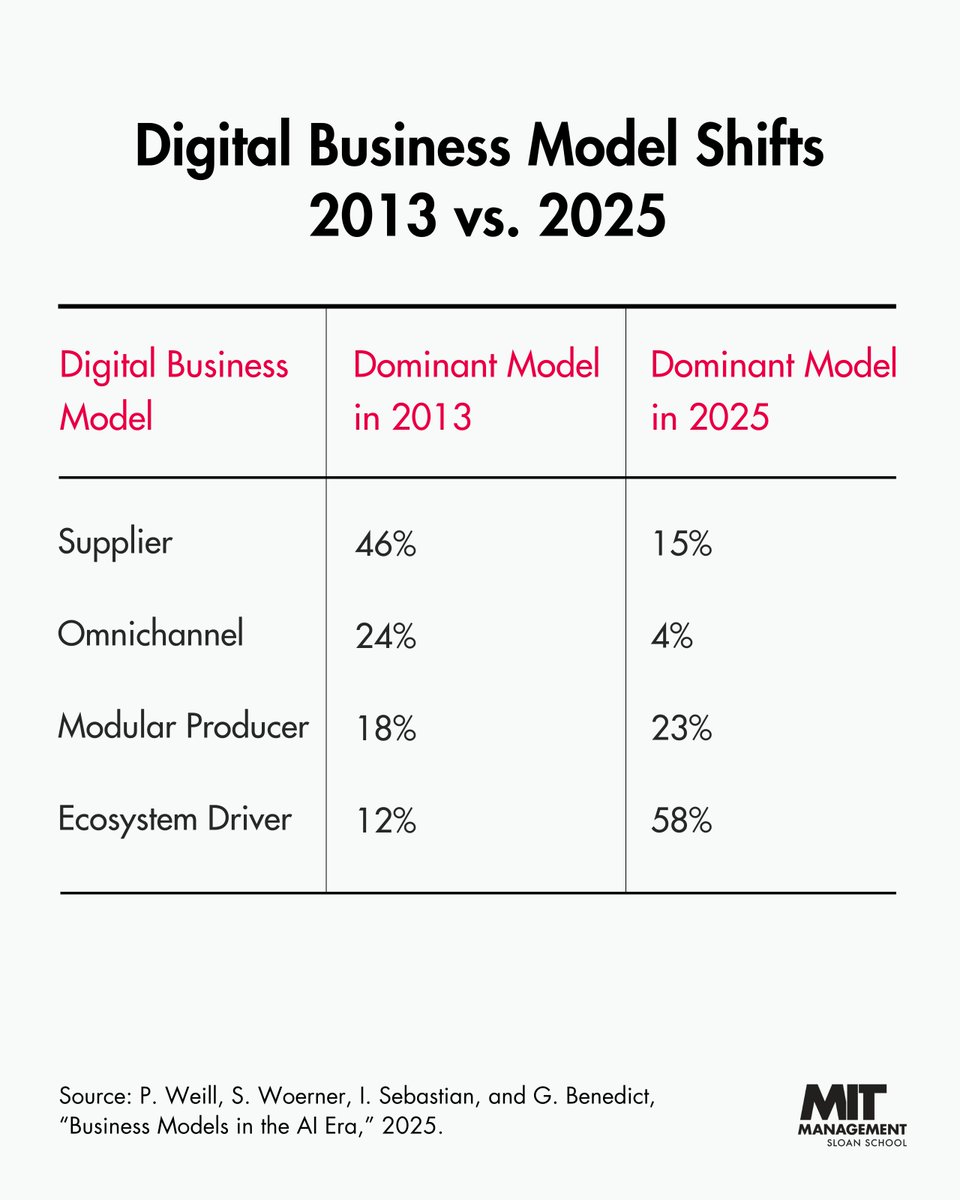
A research brief from @MIT_CISR outlined how business models are evolving to keep pace with advances in AI, and what it takes to successfully navigate change.
Learn more: bit.ly/4aUDML5
ALT Graphic titled 'Digital Business Model Shifts 2013 vs. 2025'. Three columns (from left to right) are labeled 'digital business model', 'dominant model in 2013', and 'dominant model in 2025'. The rows of digital business models are 'supplier', 'omnichannel', 'modular producer', and 'ecosystem driver'. Chart shows that the dominant model in 2013 was 'supplier,' at 46% and in 2025, the dominant model was 'ecosystem driver,' at 58%.
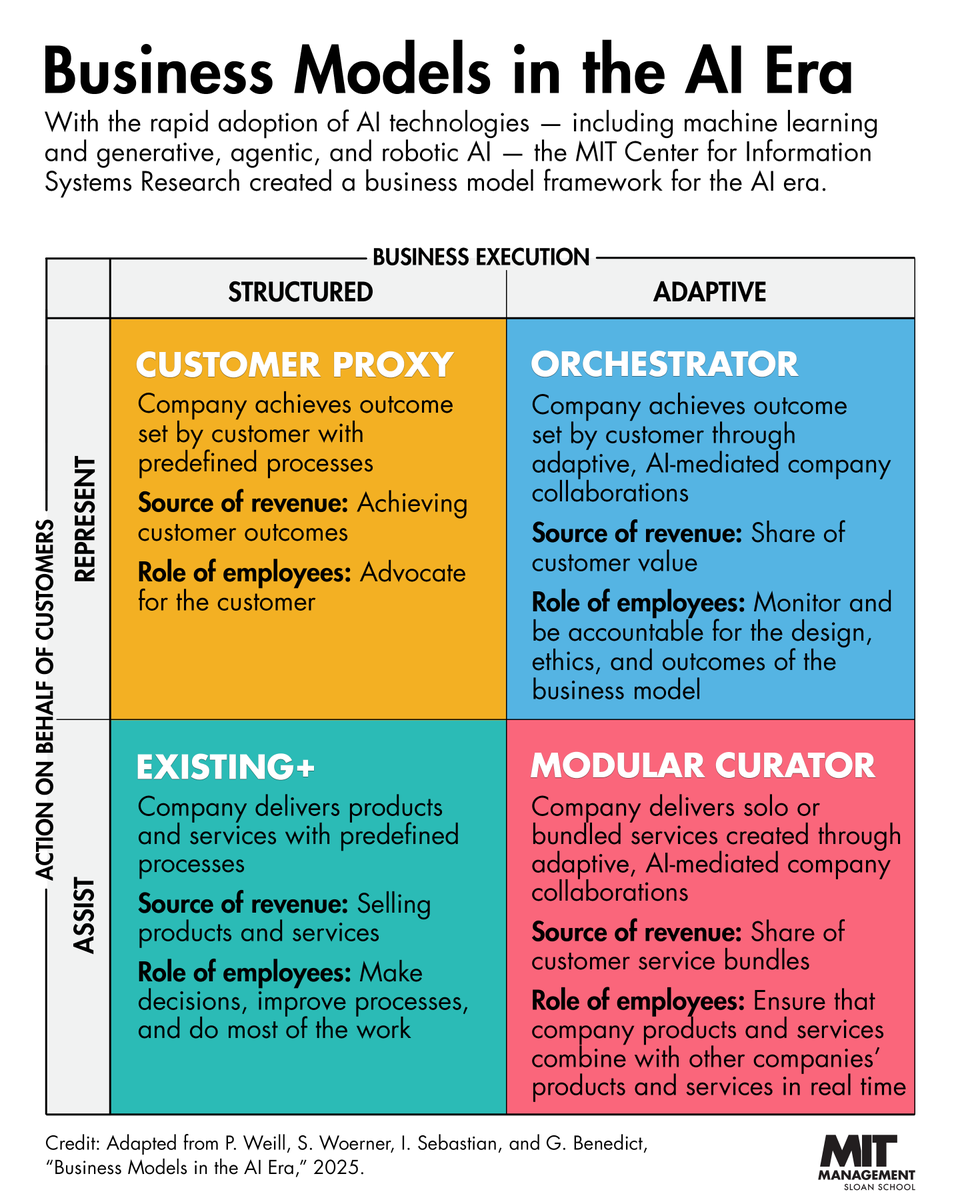
With the rapid adoption of AI technologies, @MIT_CISR created a business model framework for the AI era that shows businesses evolving to become increasingly outcome oriented and enabled by autonomous AI.
Learn more: bit.ly/4qWCWlH
ALT Graphic titled 'Business Models in the AI Era' that is divided into four quadrants (clockwise from top left): Customer proxy, Orchestrator, Existing , and Modular curator. The vertical axis, action on behalf of customers, indicates that companies either assist customers (bottom), playing a supportive role in helping them reach outcomes, or represent them (top), autonomously achieving outcomes for them within guardrails. The horizontal axis, business execution, demonstrates companies taking either a structured (left) or adaptive approach (right). The structured approach starts with a specified business process and builds toward outcomes, with AI executing predefined flows of activity.
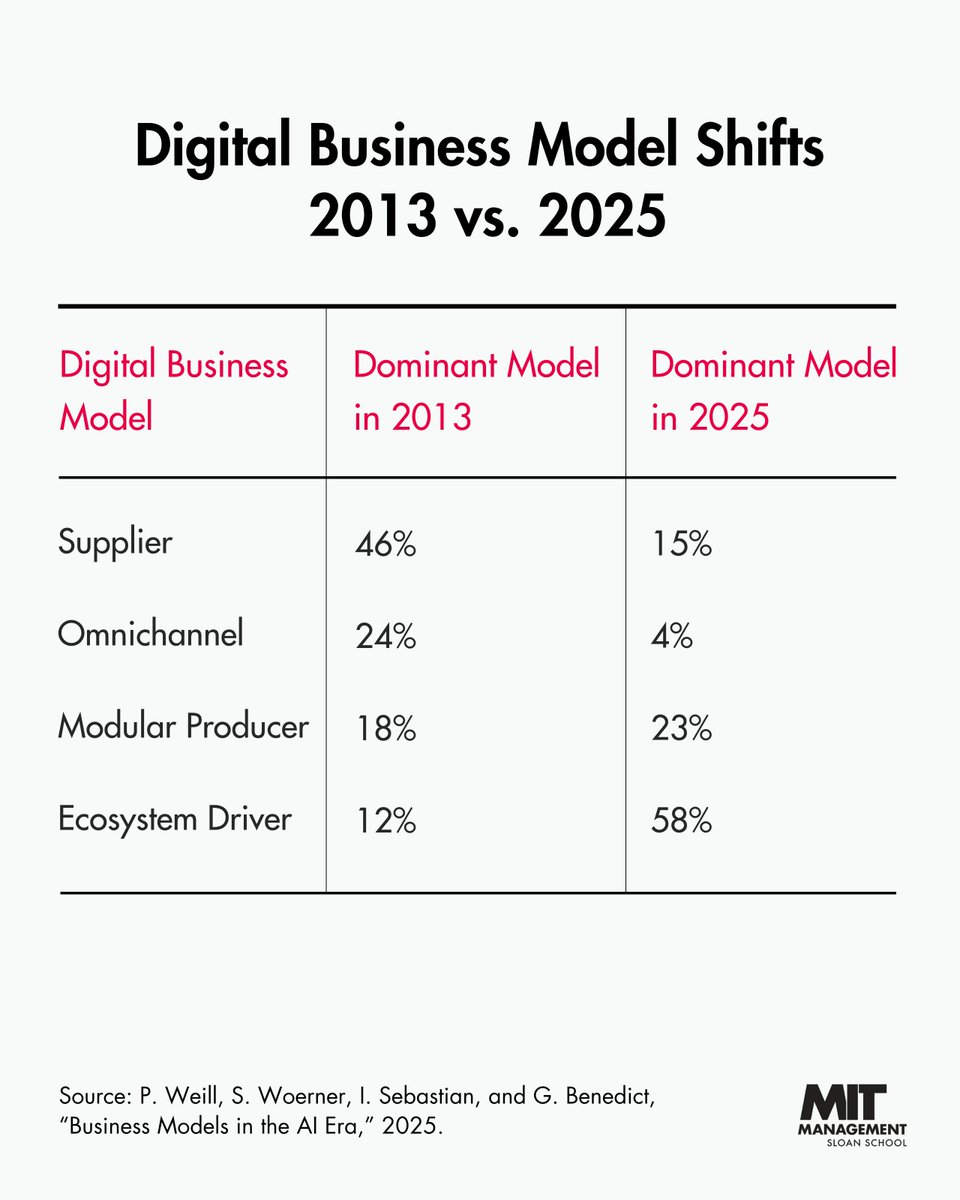
A research brief from @MIT_CISR outlined how business models are evolving to keep pace with advances in AI, and what it takes to successfully navigate change.
Learn more: bit.ly/4aUDML5
ALT Graphic titled 'Digital Business Model Shifts, 2013 vs. 2025'. Chart shows four different digital business models and what percentage of the total each made up in 2013 and in 2025. The four models are supplier, omnichannel, modular producer, and ecosystem driver. The dominant model in 2013 was supplier, at 46%, and the dominant model in 2025 was ecosystem driver, at 58%.
A recent research brief from @MIT_CISR outlined how business models are evolving to keep pace with advances in AI, and what it takes to successfully navigate change. bit.ly/4aUDML5
A data democracy is an organizational state in which employees regularly and universally have access to data assets, along with the skills to exploit them, the motivation to engage with them, and guidance to use them strategically. @MIT_CISRbit.ly/4rsatoN
Transitioning through stages of AI maturity represents a major organizational change, and businesses will likely have to overcome both human resistance and technological complexity. @MIT_CISRbit.ly/4nFe3cV
Generative artificial intelligence solutions are business-case-driven and address a company’s strategic objectives. Companies have three options for acquiring them. @MIT_CISRbit.ly/4gq1u2h
“A future-ready company is one that is ambidextrous, that is innovating and pulling out costs at the same time.” — @SL_Woerner, @MIT_CISRbit.ly/4532ghX
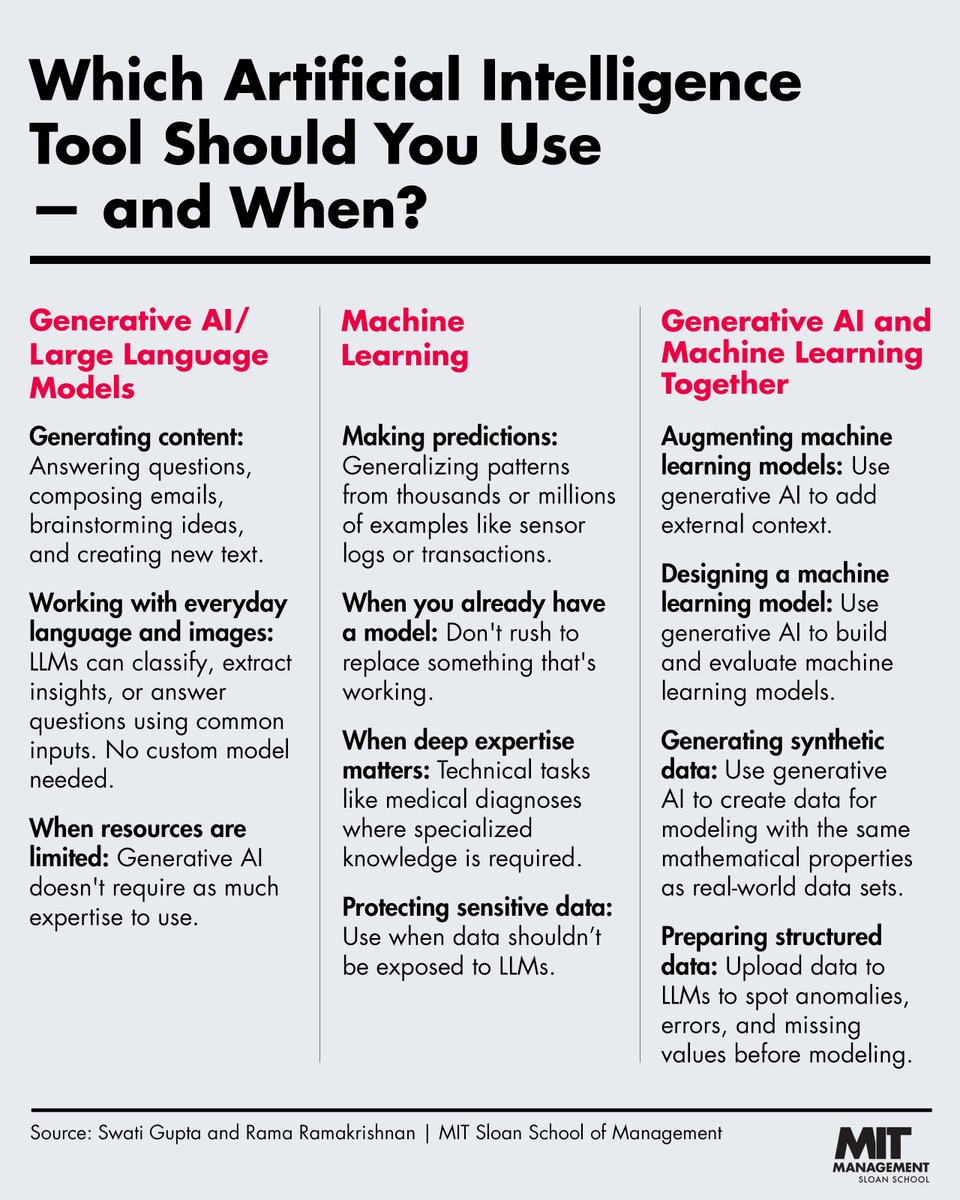
Machine learning and generative AI: Which tool should you use — and when?
Learn more: bit.ly/4mIQEY2
ALT An educational infographic titled "Which Artificial Intelligence Tool Should You Use – and When?" It discusses the distinctions between generative AI, focusing on language and ideas, and machine learning, which focuses on generalizing patterns. The bottom includes sources credited to Swati Gupta and Rama Ramakrishnan, and the MIT Sloan School of Management logo.
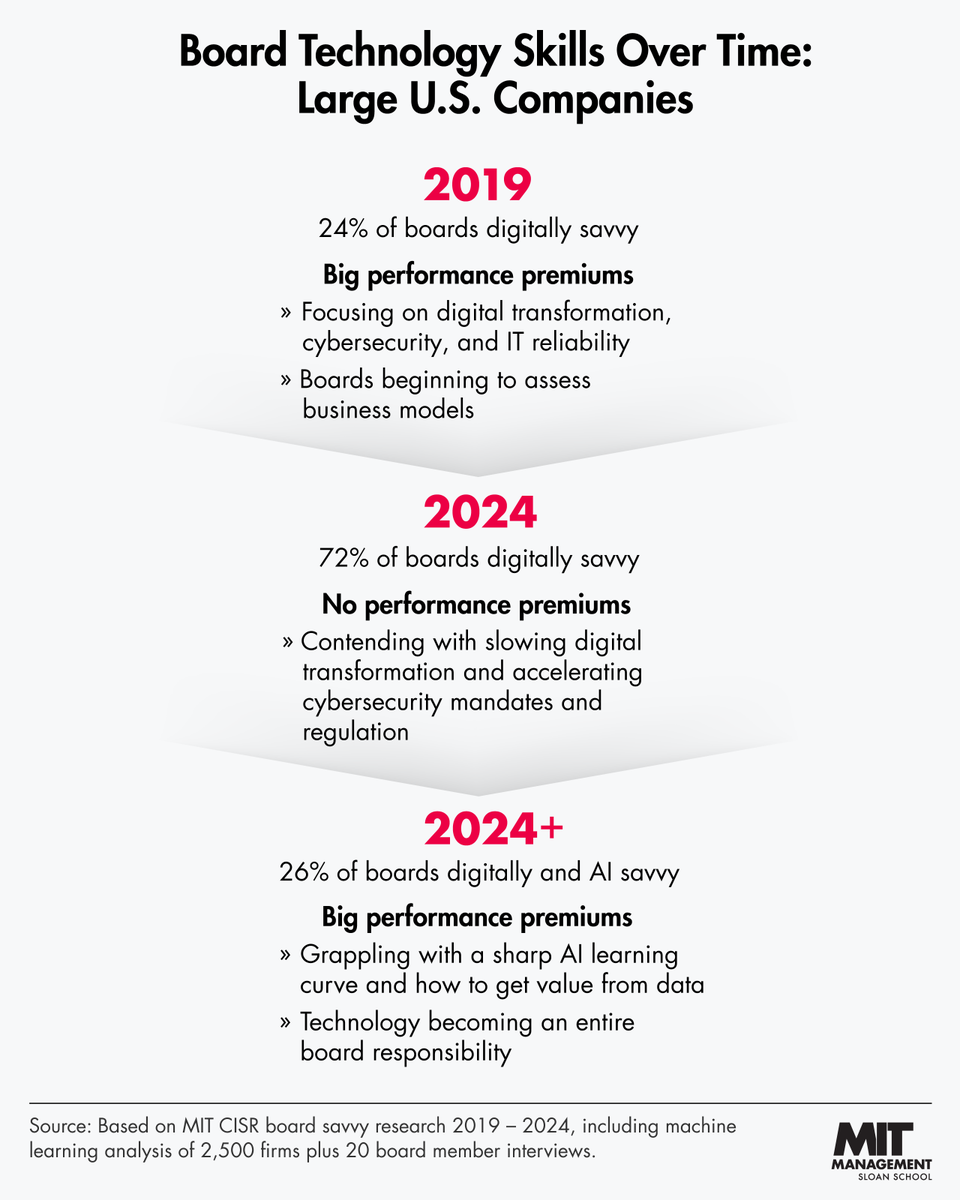
Having a digitally savvy board used to be a competitive differentiator for organizations. Now, it’s corporate boards that are savvy about AI that are helping some companies boost performance, according to @MIT_CISR. Learn more: bit.ly/4k2t1rz
ALT An infographic titled "Board Technology Skills Over Time: Large U.S. Companies," showing increasing focus on digital transformation and cybersecurity from 2019 to 2024 .
Companies need a plan for when employees use unapproved, publicly accessible generative artificial intelligence tools for work-related tasks. @MIT_CISRbit.ly/3DBtOjj
Are you experimenting with artificial intelligence, or are you “AI future-ready”? A new model maps four stages of enterprise AI maturity. @MIT_CISRbit.ly/3DgWiP5
Participate in MIT CISR Research with our new survey on Real-Time Businesses! The right person to answer this survey is familiar with the digital strategy of the enterprise. It will take 20–25 minutes to complete. Respond here! survey.qualtrics.com/jfe/for…
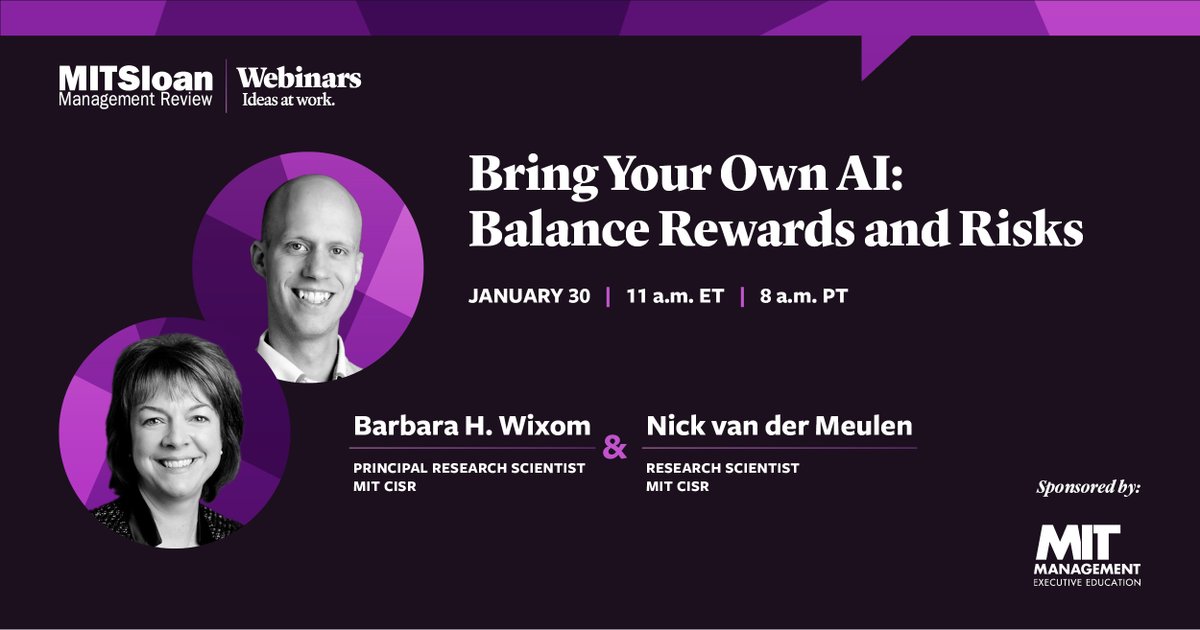
Bring Your Own #AI Balance Rewards and Risks - Free Webinar and Q&A from #MIT Sloan Management Review. New research presented from @NMeulen and @BarbWixom on #BYOAI, the risks, and how leaders can turn them into an asset to drive innovation. REGISTER NOW! mitsmr.com/401DfAU