
ML in PL Association is a non-profit organization devoted to fostering the machine learning community in Poland and promoting a deep understanding of ML methods
Joined April 2018
- Tweets 913
- Following 60
- Followers 1,592
- Likes 26
708 Photos and videos
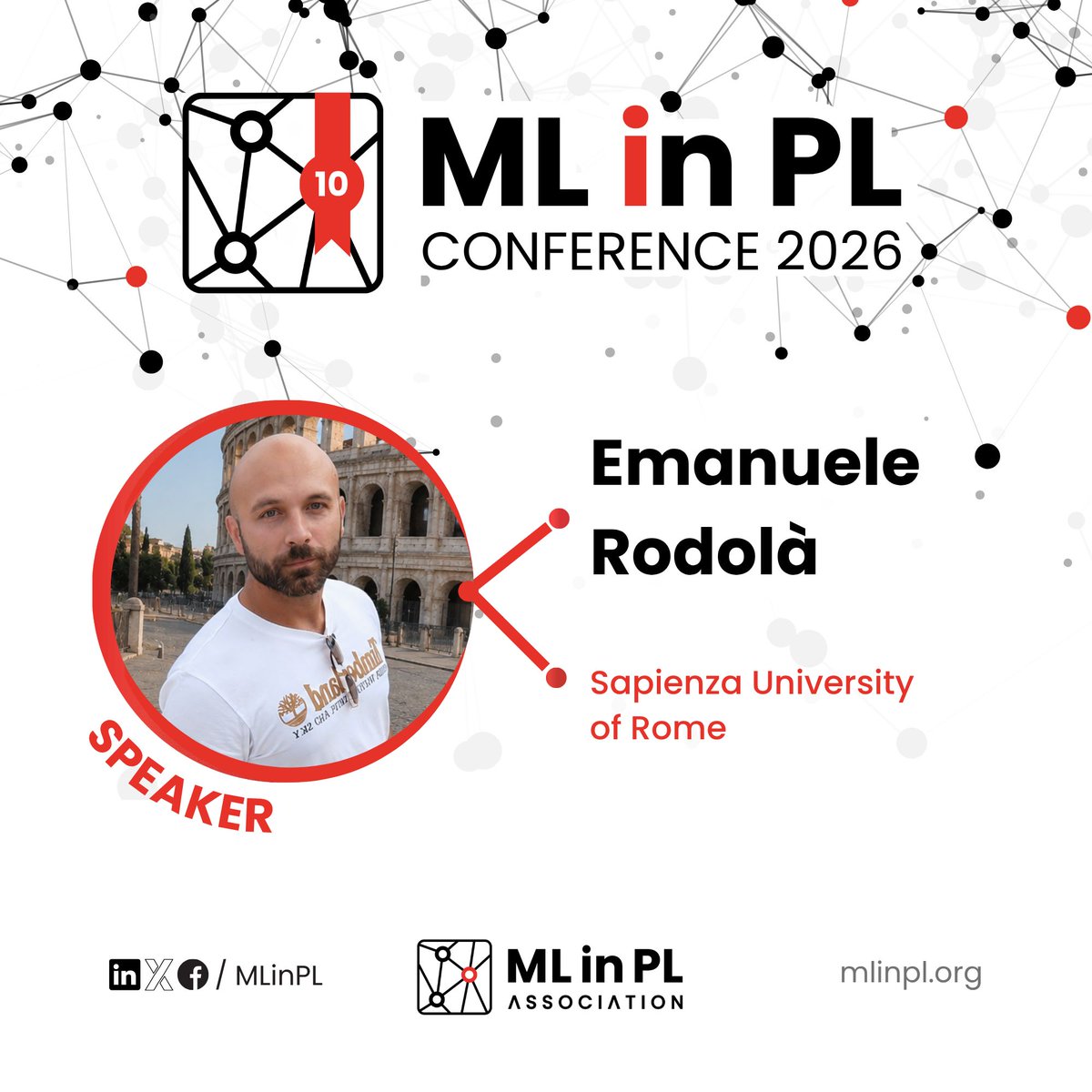
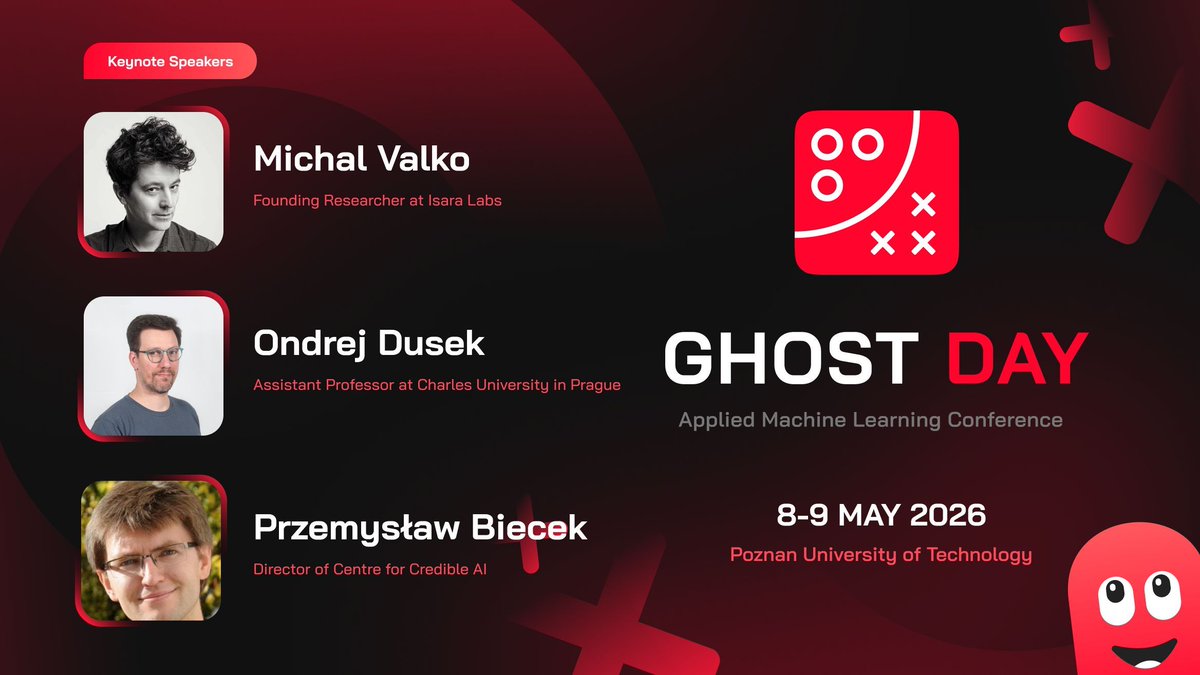

Two models. Trained independently, on different data, different tasks. Average their weights, the result should be garbage. Except sometimes it isn't. Why? That's one of the questions Emanuele Rodolà has been attacking, through geometry. And model fusion is just one corner of it, his work stretches across audio, language models, and multimodal learning.
He's the next name on our 10th edition lineup.
Emanuele Rodolà is a Full Professor of Computer Science at Sapienza University of Rome, where he leads the GLADIA AI group. His work in this field has been supported by an ERC grant, a FIS grant, and a Google Research Award. In the past, he was a postdoctoral researcher at USI Lugano (2016–2017), an Alexander von Humboldt Fellow at TU Munich (2013–2016), and a JSPS Research Fellow at the University of Tokyo (2013), in addition to visiting periods at Tel Aviv University, Technion, École Polytechnique, and Stanford. He is a fellow of ELLIS and a fellow of the Young Academy of Europe. Professor Rodolà has received numerous awards for his research and plays an active role in the academic community, serving on program committees and as Area Chair for major conferences in AI and ML. His current research focuses primarily on neural model fusion, representation learning, language models, ML for audio, and multimodal learning, with around 190 publications in these areas. His work has been featured in media outlets including Fortune, Wired, Italian national broadcast and newspapers.
See you in Warsaw for the 10th edition, October 8–10 at the Copernicus Science Centre.
1
4
190
Talks, posters, and tutorials are open for submission, in case you'd like to be both on the program and in the audience
conference.mlinpl.org/2026/#…
70
Every year, ML in PL is built by organizers who somehow manage to fit community work between research, studies and their actual jobs. Two of them are taking on team coordinator roles this year:
Weronika Piotrowska leads our Special Ops Team. She's been with ML in PL for four years, is finishing her Computer Science Master's at Warsaw University of Technology, and works on problems at the intersection of computer vision and medicine. Outside of research and community work, she runs tabletop RPG campaigns, which feels like useful preparation for a role where contingency planning is part of the job.
Arkadiusz Paterak returns for his second year coordinating the Website Team. He's finishing his Master's at AGH and works as a software engineer at Nivalit, where he's helping build AI systems for mental health. When he's away from code, you'll usually find him reading or travelling with a camera nearby.
3
124
Centrum Nauki Kopernik is, by most definitions, a place for explaining things. That's a mission we recognize.
There's something honest about holding a community ML conference inside an institution built around the idea that complex things are worth understanding and should be accessible. The Copernicus Centre doesn't talk down to its visitors. Neither do we.
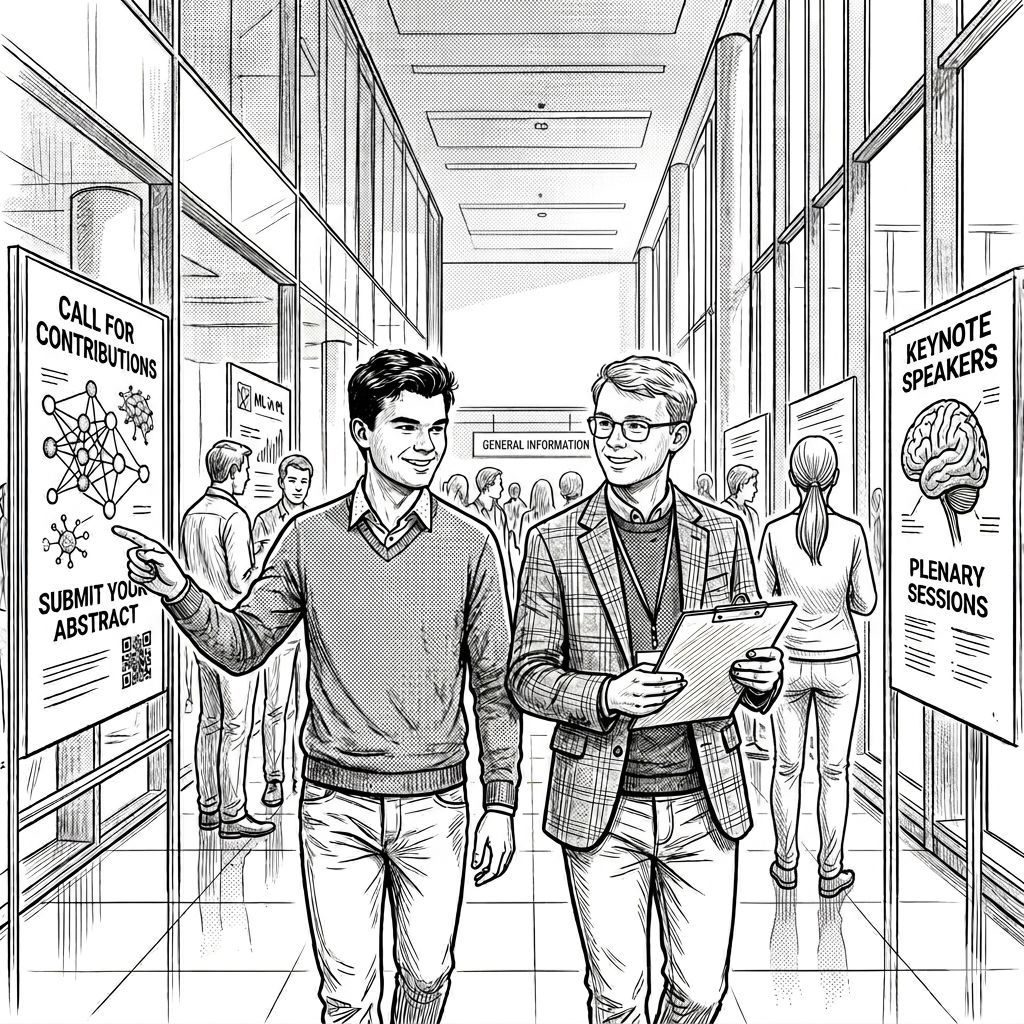
We're honoured to have CNK's honorary patronage again this year. Thank you for continuing to make this possible. And if you have something worth sharing and understanding, our Call for Contributions is open.
1
93
The list is public and definitely missing people. Spot a gap? Reply or DM and we'll fix it.
conference.mlinpl.org/2026/c…
1
61
Early Bird Registration Form: mlinpl2026earlybird.paperfor…
1
129
2/ Johannes Brandstetter — What's the Next Wave of Disruption in Science and Engineering?
From weather modeling to CFD to multi-physics simulation — Johannes connects the dots and makes the case that scientific ML is past the proof-of-concept stage. The focus: what it actually takes to build reference models for whole industry verticals.
Link: youtu.be/Q_m429VVy00
1
149
3/ Herke van Hoof — Modular Learning for Improving AI Assistants
Most AI wins require abundant data. Robotics, real-world infrastructure, scientific domains don't have that. Herke advocates for modular approaches — composing complex behaviour from simpler elements — with three concrete projects on generalisation, data efficiency, and instructability.
Link: youtu.be/uLUAEfg5wOY
51
2/ Alexey Dosovitskiy — From Pixels to Nucleotides
From computer vision through transformers to mRNA-based drug design. Alexey covers "off-the-grid" architectures for visual data and connects them to ML for drug design. A cross-domain talk that earns the framing by actually showing the connections.
Link: youtu.be/ZjROgep6jv0
1
1
83
3/ Gerhard Wunder, Maura Pintor & Jakub Kałużny — Discussion Panel: AI in Security
Inherent vulnerabilities of AI models, adversarial attack vectors, adequacy of traditional security measures, ethical implications of AI in security systems. The kind of conversation that's more useful than a single paper.
Link: youtu.be/LfNhTZ5DB_A
47
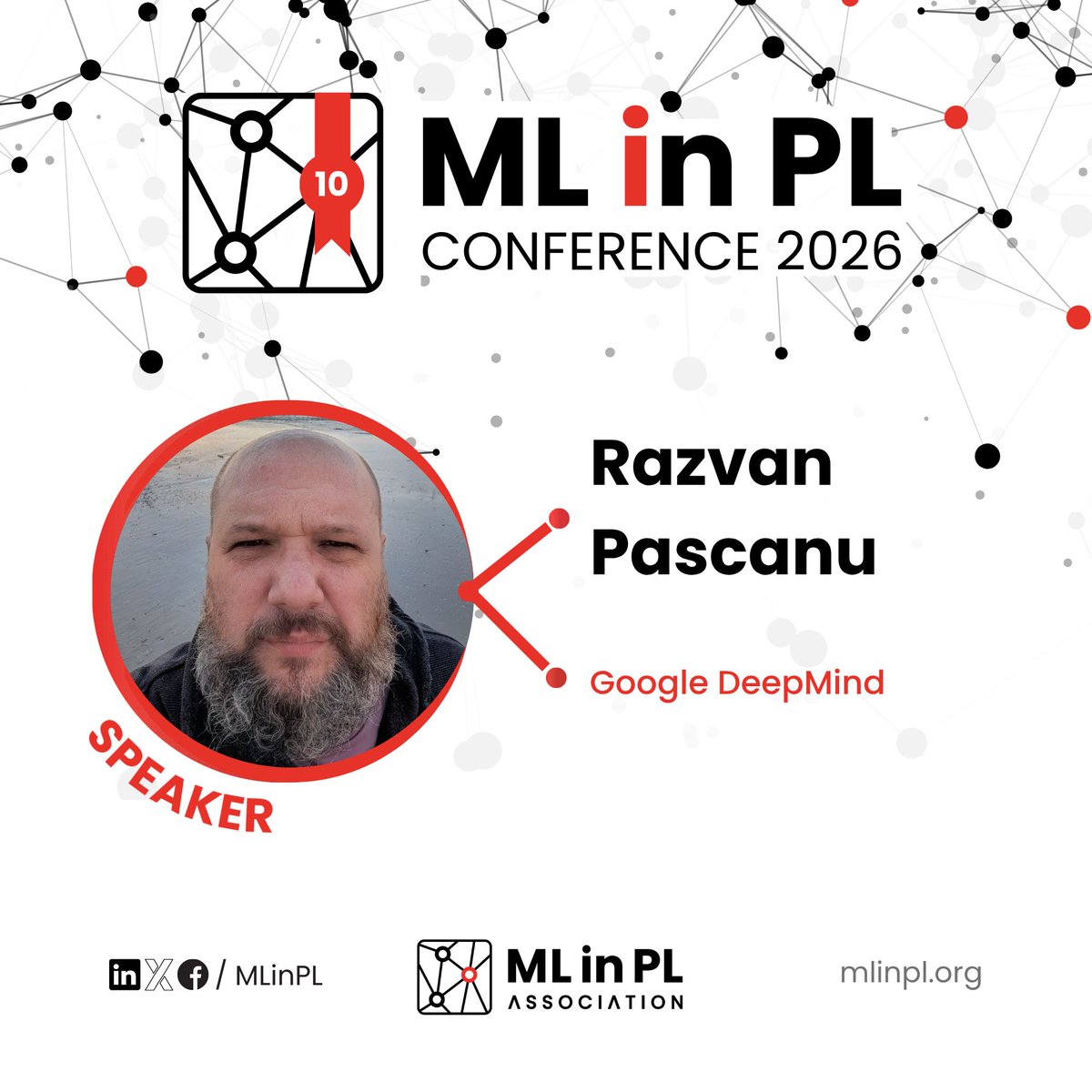
Razvan Pascanu has been a research scientist at Google DeepMind since 2014. Before this, he completed his PhD at Universite de Montréal with prof. Yoshua Bengio, where he worked on understanding deep networks, specifically recurrent neural architectures. During his career he has made significant contributions to theory of deep networks, optimization, recurrent architectures as well as deep reinforcement learning, continual learning, meta-learning and graph neural networks. For details on his work please see razp.info. He has been Program Chair for the Neural Information Processing Systems (NeurIPS) conference and currently acts as General Chair, as well as a Program Chair for the Conference on Life-long Learning Agents (CoLLAs) and the Learning on Graphs Conference (LoG). He has organized various workshops on topics such as continual learning at top-tier conferences. He is also one of the main organizers of the Eastern European Machine Learning Summer School (EEML) and EEML workshop series, as well as an organizer of the Romanian AI Days.
1
3
86