
Joined June 2021
- Tweets 9,698
- Following 911
- Followers 7,810
- Likes 32,996
370 Photos and videos






Pinned Tweet

You must know this, but Melville himself wrote to Hawthorne about Moby-Dick that he wrote "a wicked book and feel spotless as a lamb."
Hawthorne wrote in his journal after spending time with Melville in 1856 in England that, "He can neither believe, nor be comfortable in his unbelief; and he is too honest and courageous not to try to do one or the other."
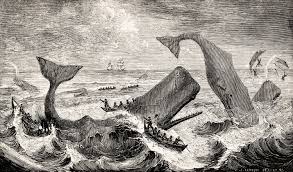
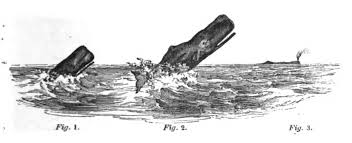
The closing 4 chapters of Moby-Dick offer 4 different possibilities:
Ch. 133: MD surgically targets Ahab (=Ahab was right, God is malicious)
Ch. 134: MD is a chaotic whale who attacks wantonly (God's status unclear)
Ch. 135: MD kills Ahab without realizing it, like a Turk. Okay, so nature (=God) is indifferent and not malicious.
But this points back to when a Turk is mentioned in ch. 41 where Ish thinks that Ahab either has his leg cut by MD as a mower cuts a blade of grass (indifference) OR as a Turk murders (malicious)--so where we might want to settle on indifference, Melville doesn't let us firmly settle here.
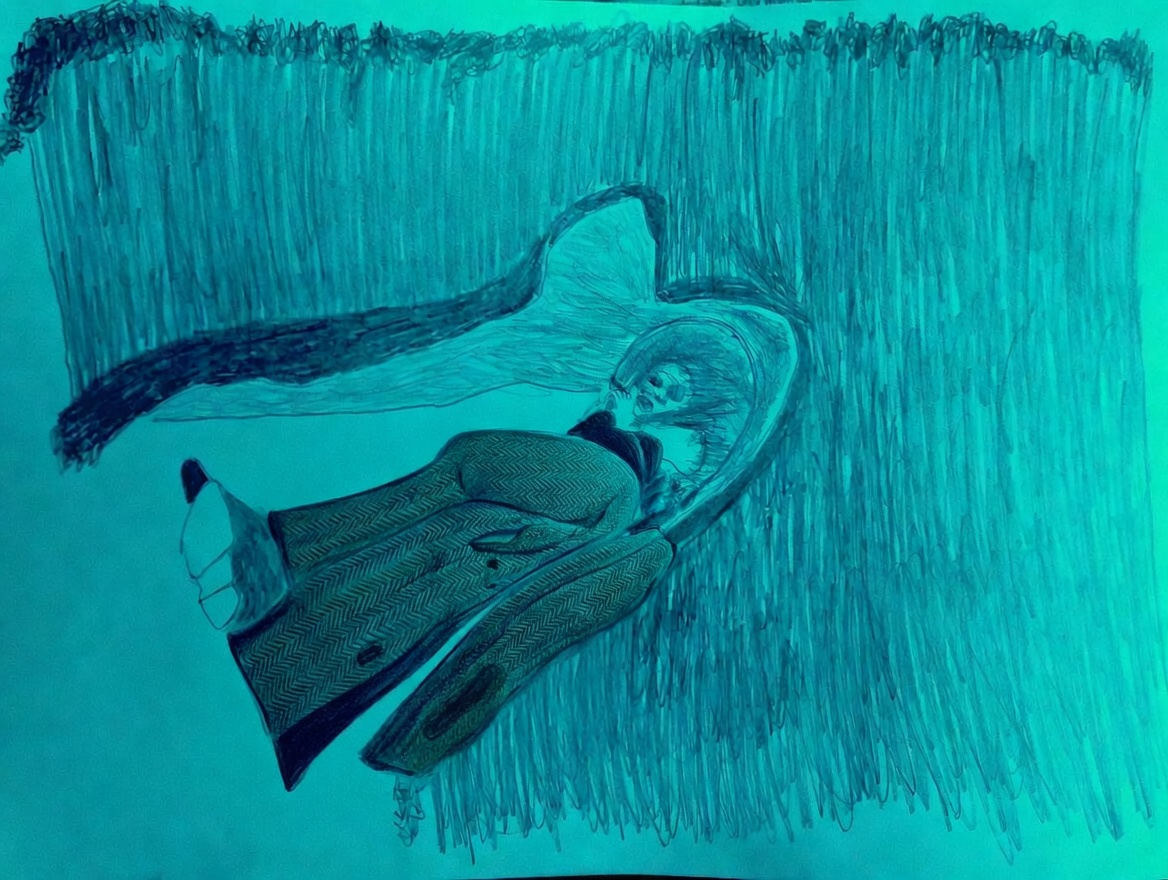
Epilogue: Job quote and it looks like a miracle that Ishmael is saved by his friend's coffin! But Melville doesn't let us settle here either: Ish does not call it a miracle and he says it was "as if" the sharks' mouths were padlocked.
In these 4 chapters, Ish does not comment on his internal emotional state or on physical sensations as he did in ch. 48 when during the "First Lowering" he is shipwrecked. This suggests that he has resigned himself to what he says in ch. 1 about the Fates being the stage managers of the world.
Do you think that Melville was a believer in Christ while writing Moby-Dick or only at some point afterwards?
Jun 10

Melville is great in a way no other American writer is great in that he actually believed in the Christ of the gospels to the degree that he was accused of writing devilish books, as Satan casts out Satan, etc, It took the next century to even begin to understand him, & only in ours are we beginning to truly understand him, that everything he wrote was pure.
2
3
67
8,983
Montana Classical College retweeted

Jun 14
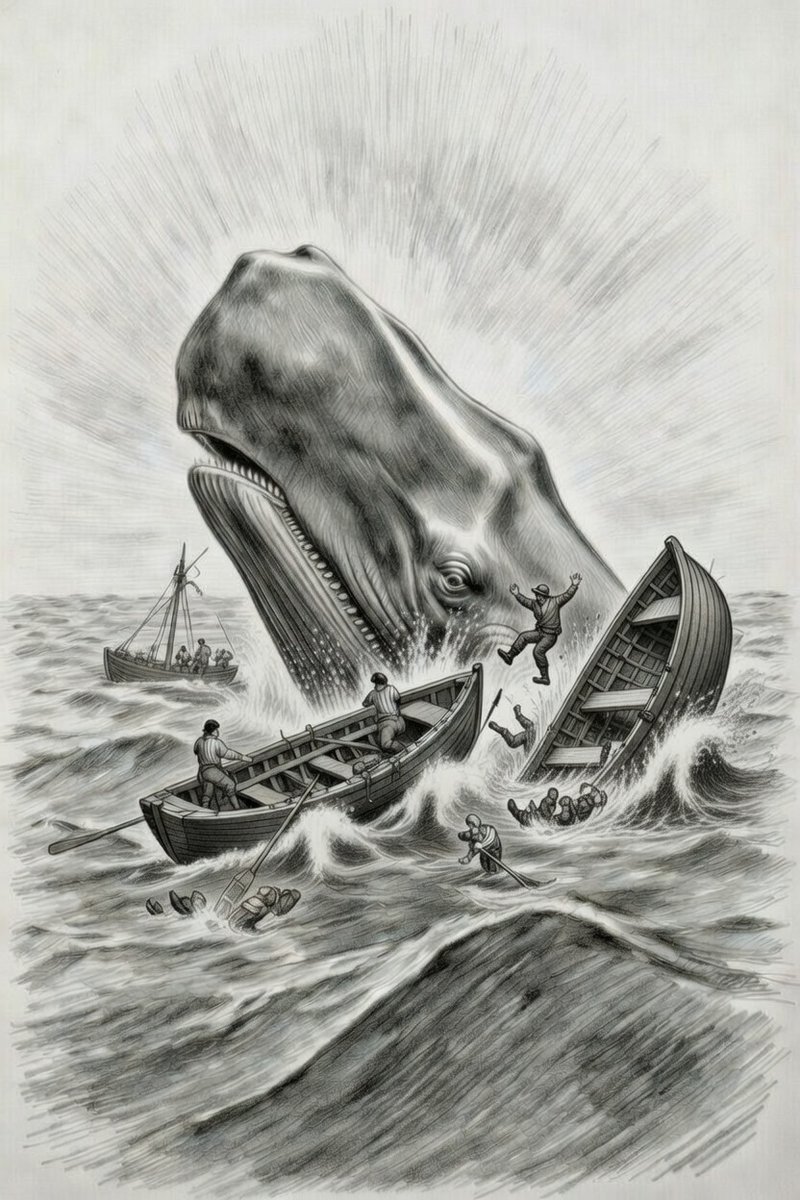
In Moby Dick, Chapter 134, the Chase of the Second Day, Starbuck prays to Jesus in front of the whole crew that Ahab stop this devil's madness, saying that all the good angels are "mobbing thee with warnings." The boat's in shambles, and Ahab hasn't any false legs left. "I'm propped on a lonely foot, but my soul's a centipede!" 2/x
1
1
18
440
Montana Classical College retweeted
Jun 13
Oh my. Definitively neither. Depends on if you want romantic love marinated upon for itself or if you want it defined objectively as a scientist might.
I'm more interested in the latter. And so I choose Vergil.
In the Aeneid Dido rationalizes a kiss as just a kiss, but she has no idea, like a man who tries to casually knife a tractor trailer tire, the immense, primordial forces behind an extremely thin veil, the breach of which is almost a return to cosmic equilibrium.
Vergil describes it also as the gods, Ares and Aphrodite if I recall, although Vergil himself is an Apollonian, conspiring with all the powers of the heavens, to consummate this kiss, and Dido is blissfully unaware, like a sheep.
Well the kiss with Aeneas is shown to destroy Carthage and bring Rome out of a hot dusty valley, the literal death and birth of civilization, and Dido ends up no better than the tire slasher, in a fuge, crawling in a variable pugilist pose, blinded by one hundred times the force it would require to blind, torn open, and dead but for the few lingering nervous actions.
Jun 13

Among classic authors, who's the best writer of (romantic) love?
Jane Austen? Tolstoy?
3
1
10
1,779
This is going to be an exciting World Cup for the US!
We are going to make it to the quarter-finals AT LEAST. But unlike 2002, it won't be a matter of luck and grit, but a matter of grit, talent, and a technical style in possession / almost gegenpressing style out of possession.

I like the World Cup.
The US is playing at an unprecedentedly high level. I have never seen them smother a team, while attacking with patience and aggression and yield no chances at all. (up 3-0 vs. Paraguay at halftime)
It took a while for them to gel under Pochettino (who took Tottenham to the Champions League Final and who coached PSG when they had Mbappe, Neymar, and Messi--and I was worried they never would, but after watching the final warm up game against Germany where they were on the front foot for long periods of time, I became cautiously optimistic.
We are playing football worthy of the pedigree of our coach--and of our players, many who do now play in Europe; we have always looked like a shadow of a European team or as a kick ball team (when Landon Donovan was leading the line we were just huffing it up to him and hoping he would out run people, and that was it).
Paraguay is not the sternest test, and our group is relatively weak, but it is the best start we could hope for.
1
8
498
You can just have a good Saturday morning.
You can take a long walk as the sun rises; you can read New Atlantis out loud in as little as 90 minutes with your wife; you can get ready to have a video call to talk about Xenophon; you could fly later that day to see friends...
12
405
I like the World Cup.
The US is playing at an unprecedentedly high level. I have never seen them smother a team, while attacking with patience and aggression and yield no chances at all. (up 3-0 vs. Paraguay at halftime)
It took a while for them to gel under Pochettino (who took Tottenham to the Champions League Final and who coached PSG when they had Mbappe, Neymar, and Messi--and I was worried they never would, but after watching the final warm up game against Germany where they were on the front foot for long periods of time, I became cautiously optimistic.
We are playing football worthy of the pedigree of our coach--and of our players, many who do now play in Europe; we have always looked like a shadow of a European team or as a kick ball team (when Landon Donovan was leading the line we were just huffing it up to him and hoping he would out run people, and that was it).
Paraguay is not the sternest test, and our group is relatively weak, but it is the best start we could hope for.
1
1
16
1,415


Looking forward to coming out with the structure of Moby-Dick.
Is it a five-act play, as Charles Olson suggests?
I've put together what looks like the structure of the first 36 chapters...but it could easily be unsettled by what comes later.
The structure of Bacon's New Atlantis from a bird's eye view:
I. Opening peril; reception; convalescence (paragraphs 1 - 3)
II. Two questions with the governor of the Stranger's House: how Christianity makes its way to Bensalem? How do you know so much about the world while remaining unknown? (paragraphs 4 - 15)
III. Witnessing the Feast of the Family (paragraph 16)
IV. Joabin's account of their erotic customs (paragraph 17)
V. Meeting with a Father of Salomon's House (paragraphs 18 - 59) who lists the end of their foundations (para. 20), their inventions (para. 21 -45), their employments (para. 46 - 55), and their ordinances and rights (para. 56 - 59)
2
13
528
Below is one of the best great books / philosophy jokes on the platform in recent times.
More people should appreciate it!

If I were Horatio, I would simply have a philosophy coextensive with the things in heaven and earth.
2
2
28
1,670
Montana Classical College retweeted

Jun 11
Nietzsche on EA, AI, and Anthropic:
“What? The ultimate goal of science is to create the most pleasure possible to man, and the least possible pain? But what if pleasure and pain should be so closely connected that he who wants the greatest possible amount of the one must also have the greatest possible amount of the other, that he who wants to experience the ‘heavenly high jubilation,’ must also be ready to be ‘sorrowful unto death’? And it is so, perhaps! The Stoics at least believed it was so, and they were consistent when they wished to have the least possible pleasure, in order to have the least possible pain from life. ... At present also ye have still the choice: either the least possible pain, in short painlessness and after all, socialists and politicians of all parties could not honourably promise more to their people, or the greatest possible amount of pain, as the price of the growth of a fullness of refined delights and enjoyments rarely tasted hitherto! If ye decide for the former, if ye therefore want to depress and minimize man's capacity for pain, well, ye must also depress and minimize his capacity for enjoyment. In fact, one can further the one as well as the other goal by science! Perhaps science is as yet best known by its capacity for depriving man of enjoyment, and making him colder, more statuesque, and more Stoical. But it might also turn out to be the great pain-bringer! And then, perhaps, its counteracting force would be discovered simultaneously, its immense capacity for making new sidereal worlds of enjoyment beam forth!”
–– Joyful Science, I - 12
20
22
171
117,151
The structure of Bacon's New Atlantis from a bird's eye view:
I. Opening peril; reception; convalescence (paragraphs 1 - 3)
II. Two questions with the governor of the Stranger's House: how Christianity makes its way to Bensalem? How do you know so much about the world while remaining unknown? (paragraphs 4 - 15)
III. Witnessing the Feast of the Family (paragraph 16)
IV. Joabin's account of their erotic customs (paragraph 17)
V. Meeting with a Father of Salomon's House (paragraphs 18 - 59) who lists the end of their foundations (para. 20), their inventions (para. 21 -45), their employments (para. 46 - 55), and their ordinances and rights (para. 56 - 59)
4
786
Montana Classical College retweeted

But keep in mind the ending of his New Atlantis — I’m convinced it ends as it does because Bacon knew innovation is inherently imperialistic and will always leak out
1
6
396
Montana Classical College retweeted

Jun 11
The main issue with Bacon's vision is that he underestimates the amount of labor the new science demands, and that's because he didn't invent the mathematical method.
Descartes did, saw the number of experiments, realized the labor and capital required would be through the roof.
The short of it: innovation could never have been kept wholly secret. Much of it must be out in the open.
The effective hybrid is thus between Descartes and Bacon: public research, with a mix of DARPA.
Very little room for the ancients here. But not none.
Francis Bacon's middle ground between the ancients and our contemporary embrace of innovation:
Under supervision, innovate A LOT where no one can see. Only introduce innovations to the public that are politically salutary to good habits.
9
3
62
6,841
Francis Bacon's middle ground between the ancients and our contemporary embrace of innovation:
Under supervision, innovate A LOT where no one can see. Only introduce innovations to the public that are politically salutary to good habits.
Ancient philosophy in a nutshell on technological innovation:
Awareness of human irrationality and insatiability of desire, along with awareness of habit as that which imperfectly curbs these problems, should lead one to wariness of innovation, which inevitably alters habits.
3
27
9,410
People being divided generally, according to the law of nature, into two categories: a lower one, ordinary people, who are, so to speak, material serving solely for the reproduction of their own kind; and people proper--that is, those who have the gift or talent of speaking a new word in their environment.
-Raskolnikov
Jun 10

I think if you’re a truly great prose stylist like Joyce or Faulkner or McCarthy you should be able to commit any crime without being punished. We don’t privilege artistic talent enough in this society. It should be like an entire caste above ordinary man.
3
2
42
2,978
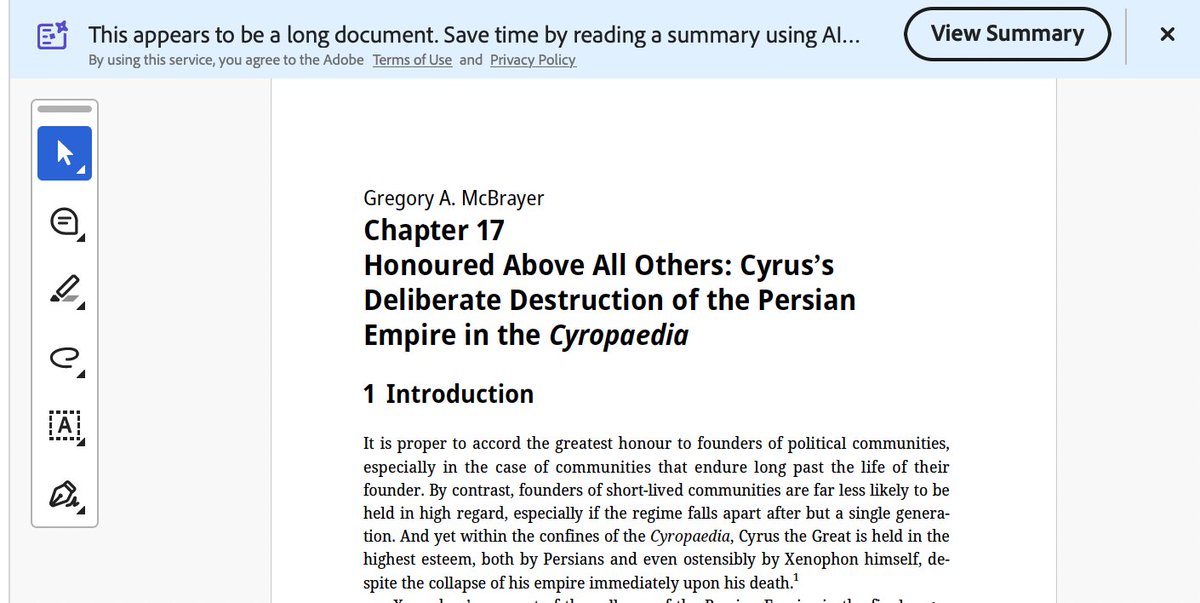
Xenophon is such a careful writer.
Book 2, chapter 2 of his Cyropaedia is structured in the following way:
Cyrus is talking with some of the Peers at dinner. The first section of the chapter features laughter and poking fun at the serious man there.
The central part of the chapters is a serious discussion of how the Peers might meritocratically gain more than others after the army had been democratized (with skirmishers being outfitted in heavy army--at the expense of the Medians!). In this central part, there is also a discussion of expunging men who aren't sufficiently obedient.
Then the third part of the chapters moves back to laughter.
The serious discussion is sandwiched in between moments of laughter.
2
3
24
1,187
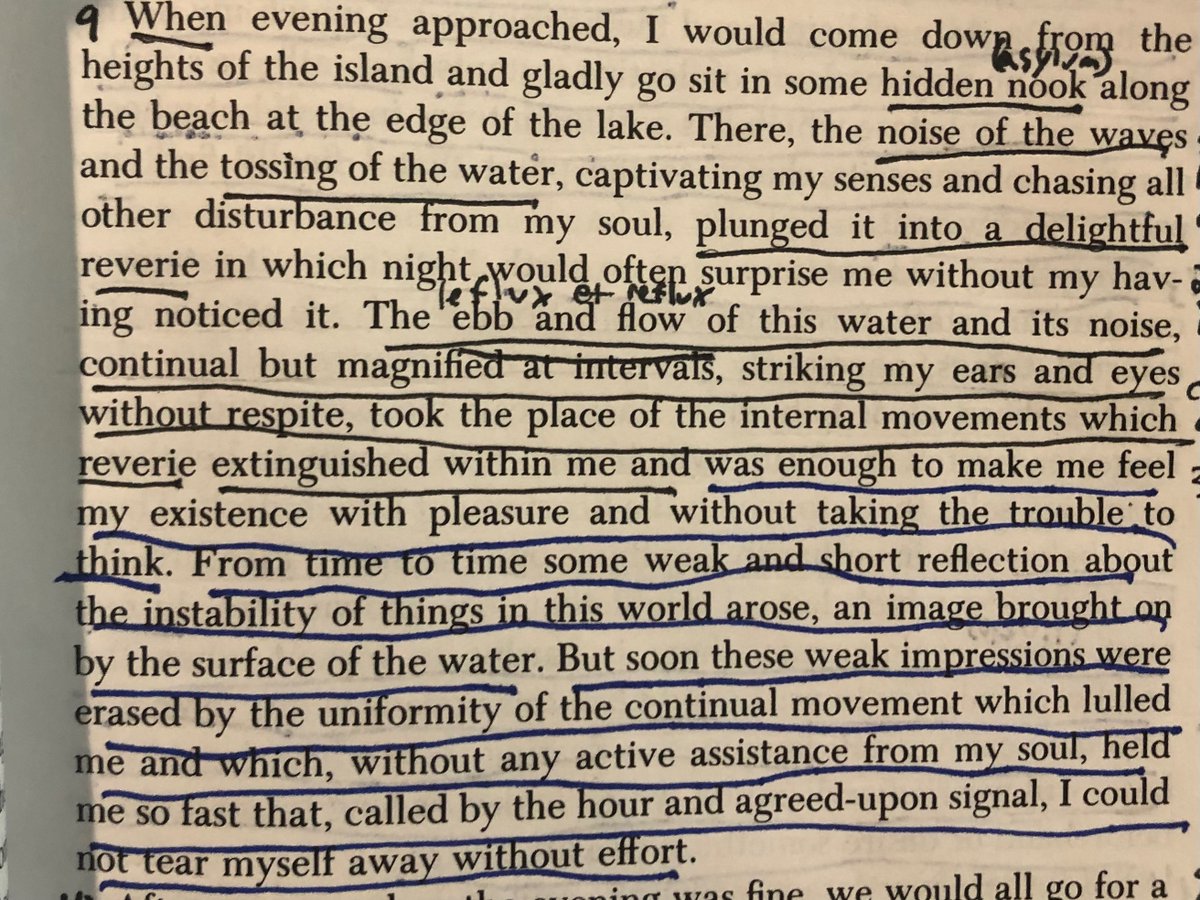
Below was a pretty cool find of Melville paraphrasing Emerson's "Nature," while Ishmael is at the masthead.
A friend pointed out that the passage also might be in conversation with Rousseau's Reveries...
18 Jan 2025
Check out Melville putting Emerson's words into the mouth of Ishmael:
From Emerson's "Nature"
“Standing on the bare ground,--my head bathed by the blithe air and uplifted into infinite space,--all mean egotism vanishes. I become a transparent eyeball; I am nothing; I see all; the currents of the Universal Being circulate through me; I am part or parcel of God” (4).
Now consider chapter 34 of Moby-Dick:
“…lulled into such an opium-like listlessness of vacant, unconscious reverie is this absent minded youth by the blending cadence of waves with thoughts, that at last he loses his identity; takes the mystic ocean at his feet for the visible image of that deep, blue, bottomless soul, pervading mankind and nature…”
In both cases the individual (ego / identity) disappears. Both Emerson and Ishmael blend into currents / waves; and both fall into Universal Being or the image of the deep, blue bottomless soul, pervading mankind and nature.
1
3
48
9,551
I got pulled over, and the officer says, "why didn't you renew your registration?"
To which I replied, "[A]n extraordinary man has the right...that is, not an official right, but his own right, to allow his conscience to...step over certain obstacles..."
3
26
561
Montana Classical College retweeted

Join us tomorrow if you would like to discuss further. lyceum.institute/news-and-an…
1
3
5
959