
AI Product Leader | Enterprise AI governance & portfolio strategy | Former IBM | Writing a series on building AI tools that are useful — and survive governance
Joined October 2025
- Tweets 91
- Following 158
- Followers 16
- Likes 4
15 Photos and videos



Pinned Tweet

Jun 12
Hidden knowledge-work taxes look small alone: context rebuilds, task switches, re-explaining, re-deciding.
Add them up: ~90 min/day. A full workday each week. Nine workweeks a year.
Gone — on an invoice no one totals.
Today’s piece:
linkedin.com/pulse/adding-up… via @LinkedIn
3
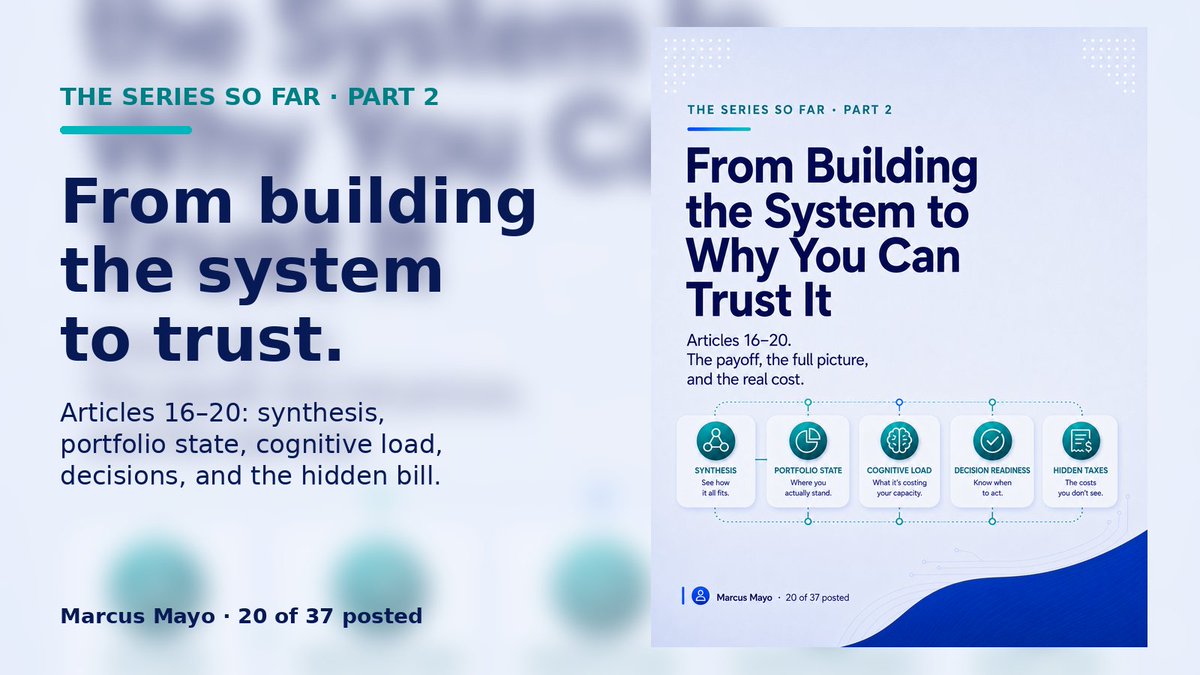
1/ Most AI productivity advice stops at “build the system.”
The harder question is:
Can you trust it?
I just posted Part 2 of my series recap: Articles 16–20, where the system starts proving its value.
🧵
1
1
9/ The next stretch is where the series gets more opinionated:
security, data boundaries, verifiable compliance, and human-in-the-loop design.
Not just what AI can do.
What it can’t.
1
5
10/ Full Part 2 carousel is here:
linkedin.com/posts/marcusmay…
Question:
For an AI tool you’d actually trust, what matters more — what it can do, or what it can’t?
1
5
Jun 11
Complex decisions usually aren’t hard because of the judgment.
They’re hard because the context is scattered.
When the full picture is already assembled, the decision gets easier — and faster.
That’s decision readiness.
Today’s piece:
linkedin.com/pulse/decision-… via @LinkedIn
7
Jun 10
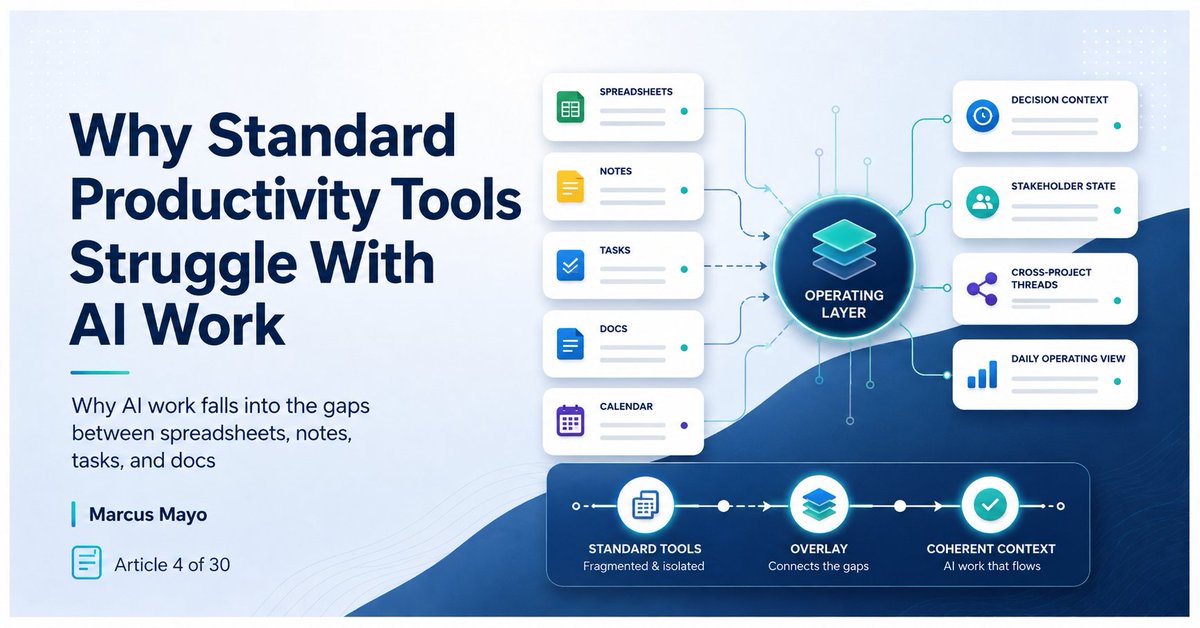
A question most productivity tools avoid:
Does this make your mind quieter or busier?
Capability is easy to judge. It’s the wrong measure.
A system that adds mental load hasn’t helped — it just renamed the burden.
Today’s piece:
linkedin.com/pulse/real-meas… via @LinkedIn
6
Jun 9
Most people hold work as a flat to-do list.
A portfolio is different: workstreams with state — stage, status, blockers, ownership, and priority.
A list tells you what’s next. A portfolio shows the state of everything.
Today’s piece:
linkedin.com/pulse/portfolio… via @LinkedIn
6
Jun 8
A personal system is still a filing system if you’re the one doing the connecting.
The shift: one AI engine reading across every component and returning one answer to a question no single component can answer.
Today’s piece:
linkedin.com/pulse/synthesis… via @LinkedIn
5
Jun 5
Every tool treats people as contacts. Almost none treat them as relationships.
A contact tells you how to reach someone — not how to work with them: what they care about now, what you last discussed.
That state is operational.
linkedin.com/pulse/stakehold… via @LinkedIn
5
Jun 4
Most commitments don't fail because someone forgot them. They fail because the context around them got lost.
A commitment without its context is inert — you defer it again.
The fix isn't "remember harder." It's an action register.
linkedin.com/pulse/action-re… via @LinkedIn
9
Jun 3
Almost every productivity tool tells you the current state of things. Almost none tell you how they got there.
State overwrites itself. History doesn't.
A few structured lines a day is the temporal memory most systems skip.
Today's piece:
linkedin.com/pulse/daily-log… via @LinkedIn
5
Jun 1
Most people treat notes as a place to put things down.
It's also why most people's notes are useless three weeks later. The note captured the words; the meaning lived in your head.
Today's piece: notes as operating memory, not a pile.
linkedin.com/pulse/structure… via @LinkedIn
5
May 29
The first version of my system was embarrassingly simple. Plain text files. No automation. Updated by hand.
That wasn't a limitation. It was the design.
Automate before you understand it and you encode untested assumptions.
Today's piece:
linkedin.com/pulse/why-i-sta… via @LinkedIn
6