
Crypto Market Maker | Liquidity & CEX/DEX Listings Expert | Helping Web3 founders scale | Building global crypto community | DM for collabs
Joined January 2025
- Tweets 11
- Following 26
- Followers 11
- Likes 11
10 Photos and videos

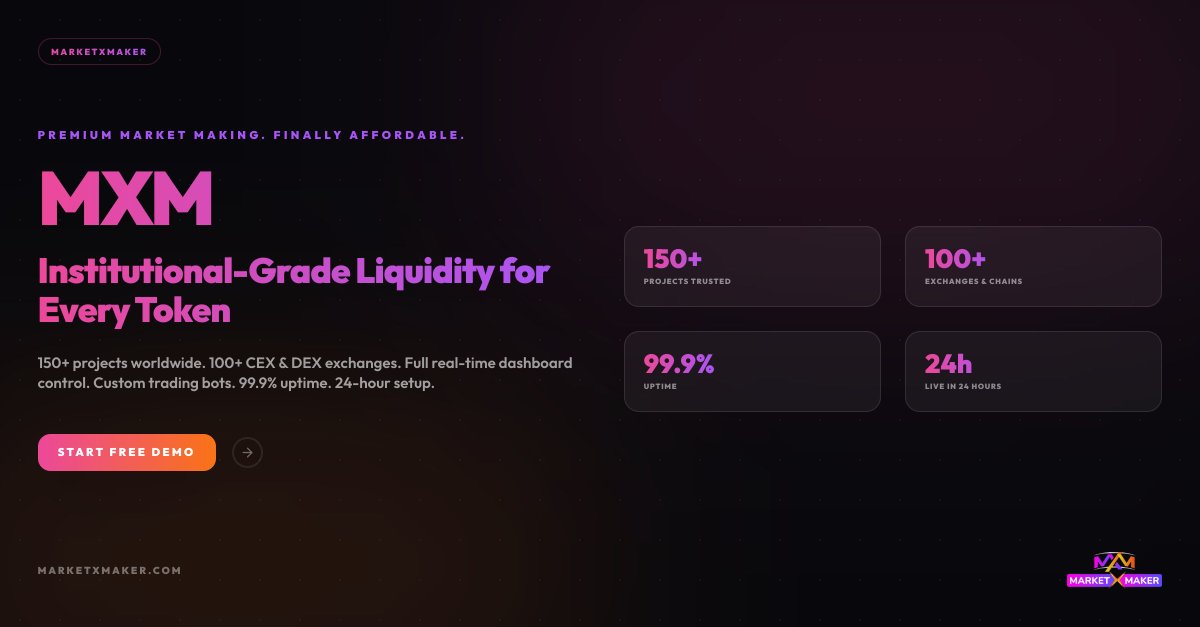

Apr 30
In a launch, seconds matter. ⚡️
You shouldn't have to refresh a dashboard to know if your market is Healthy.
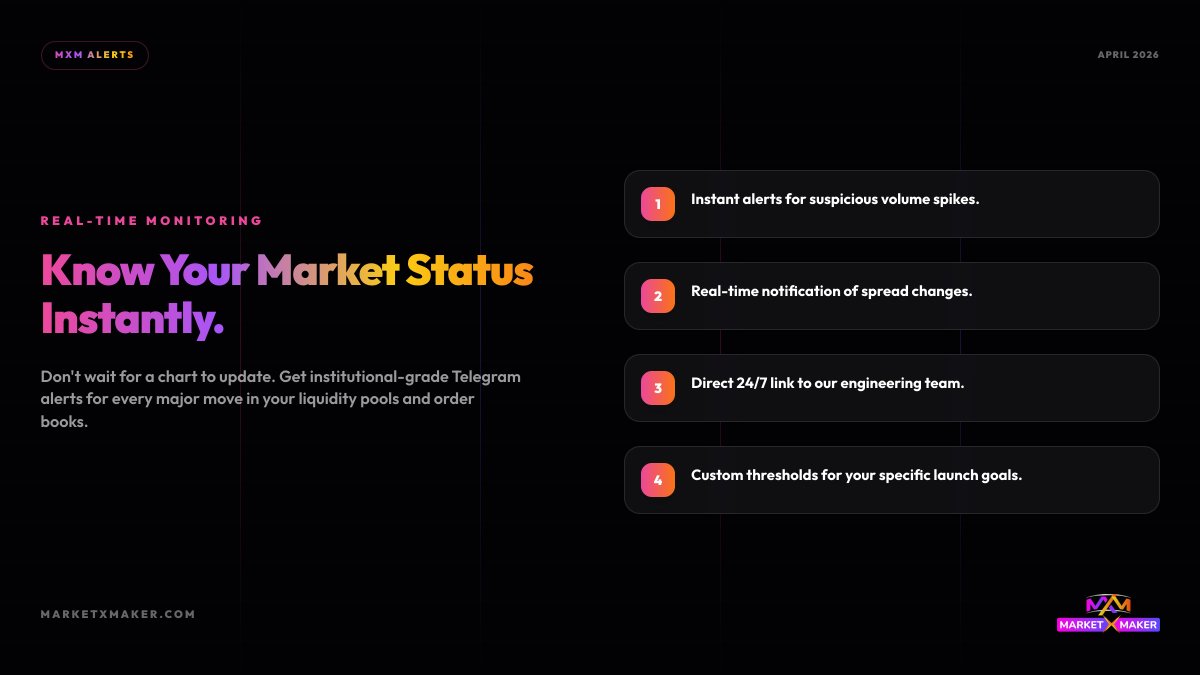
MXM provides Instant Telegram Alerts that keep you in total control:
🚀 Instant pings for volume milestones.
🛡️ Fast warnings for any spread deviations.
📊 Consistent updates on your pool health.
We monitor the technicals so you can celebrate the wins.
Stay Safe. Stay Informed.
DM us for a free audit | marketxmaker.com
#MXM #TokenLaunch #Web3 #CryptoAlerts #Solana #Base #MarketMaking
2
20
Apr 29
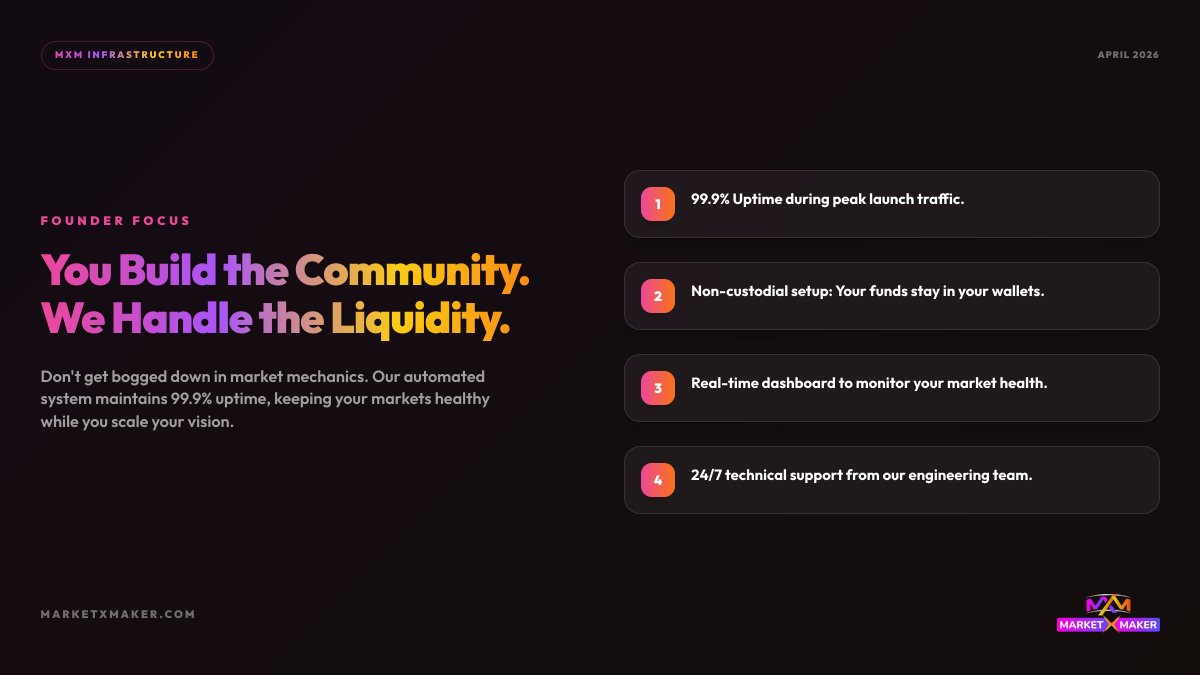
You started your project to build a community, not to watch charts 24/7. 🧘♂️
MXM keeps your markets Healthy and Consistent while you focus on the big picture.
Why 150 founders trust our tech:
🛡️ Safe & Secure: You keep full control of your funds.
⚡️ Fast Setup: Be live and protected in under 24 hours.
📈 Reliable: 99.9% uptime when it matters most.
Stop worrying about the tech. Let us build your liquidity while you build your vision.
DM us for a free audit | marketxmaker.com
#MXM #Web3 #TokenLaunch #MarketMaking #CryptoFounder #Solana #Base
2
18
Apr 28
WE ARE HIRING. 🚨
MXM is opening doors for elite BDEs and Listing Agents.
We’ve built the 5-star infrastructure. Now we need the bridge-builders.
If you have:
• A "black book" of token founders
• CEX/DEX exchange contacts
• Deep knowledge of crypto market mechanics
...this is your opportunity to scale with a market leader (150 projects served).
Unlimited opportunity. Total autonomy. 🛠️
DM to join the team. 📥
#MXM #CryptoJobs #Web3 #MarketMaking #Hiring #SalesAlpha
1
1
25
Apr 28
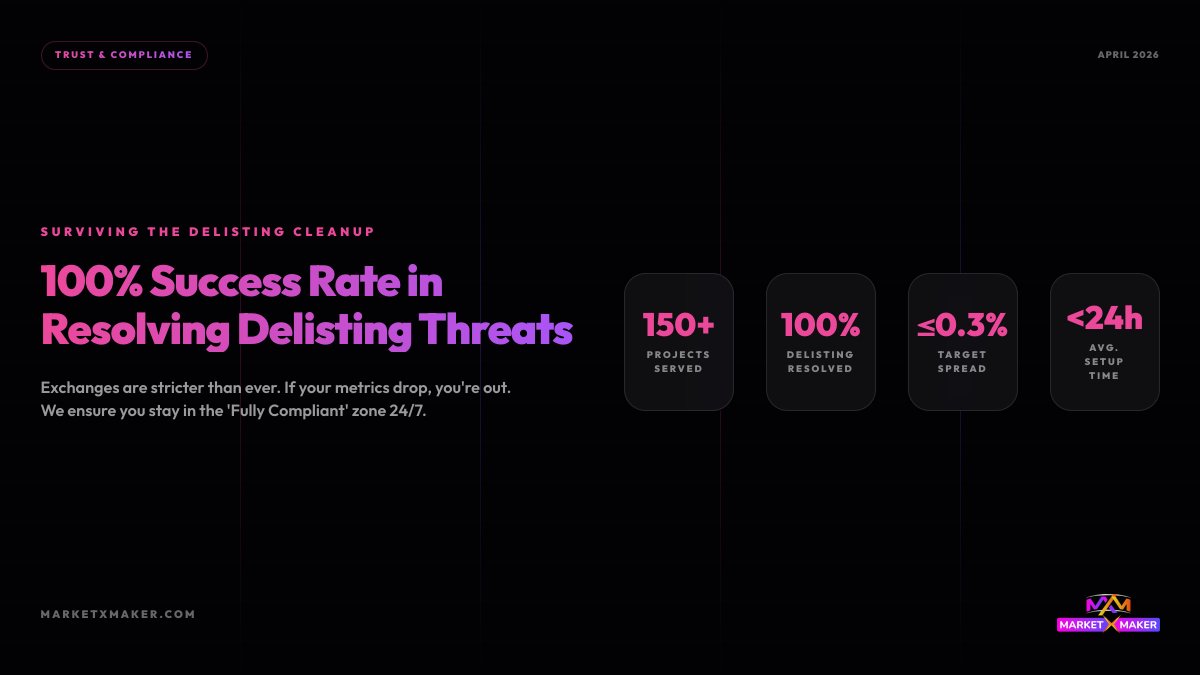
If your volume drops or your spread widens, you're on the fast track to a delisting notice. We’ve helped 150 projects stay in the "Fully Compliant" zone
with institutional-grade market making.
100% success rate in resolving delisting threats for our clients. Don't let your token be the next one cut.
DM us for a free audit | marketxmaker.com
#MarketMaking #CryptoCompliance #Web3Founders #CEX #TokenLiquidity #DeFi #Solana #Ethereum #MarketXMaker #CryptoStartup
2
22
Apr 27
Where should you launch your token first?
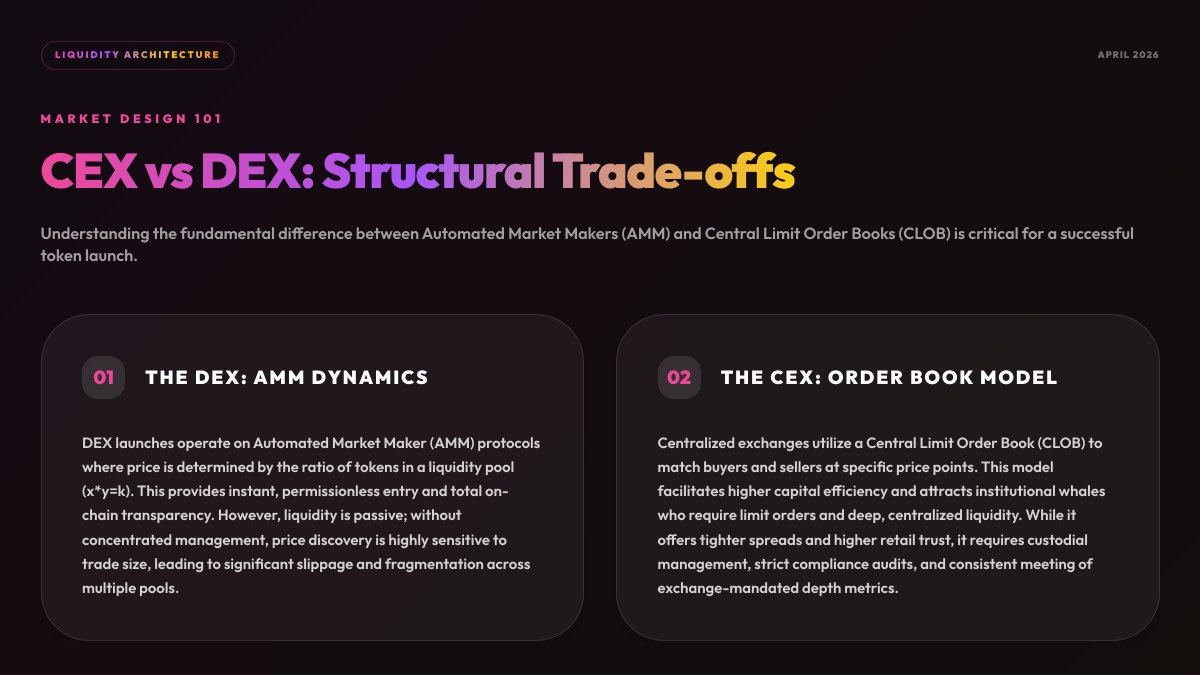
The decision isn't about which venue is "better"—it's about matching your token's specific architecture to the right liquidity model.
The DEX Model (AMM) is built for speed and community ownership. By utilizing protocols like Uniswap or Raydium, you enable anyone to trade instantly without
a middleman. The core challenge is capital efficiency; a large portion of your seed liquidity may sit idle in price ranges that are never traded, making the
"cost of stability" higher for the founder.
The CEX Model (Order Book) is built for scale and institutional flow. It allows for active price discovery through market makers and professional traders.
Because the exchange manages the custody of funds, it can offer high-speed execution that on-chain environments can't yet match. However, the barrier to
entry is higher, requiring professional reporting and verified volume history.
The Strategy: Most successful institutional-grade tokens now use a "DEX-to-CEX" pipeline—building a transparent, on-chain floor to prove market demand before
migrating to the deep liquidity to top exchange.
DM us for a technical liquidity audit | marketxmaker.com
#LiquidityArchitecture #AMM #CLOB #Tokenomics #CEX #DEX #CryptoStrategy #MXM #Tokenlaunch
1
20
Apr 26
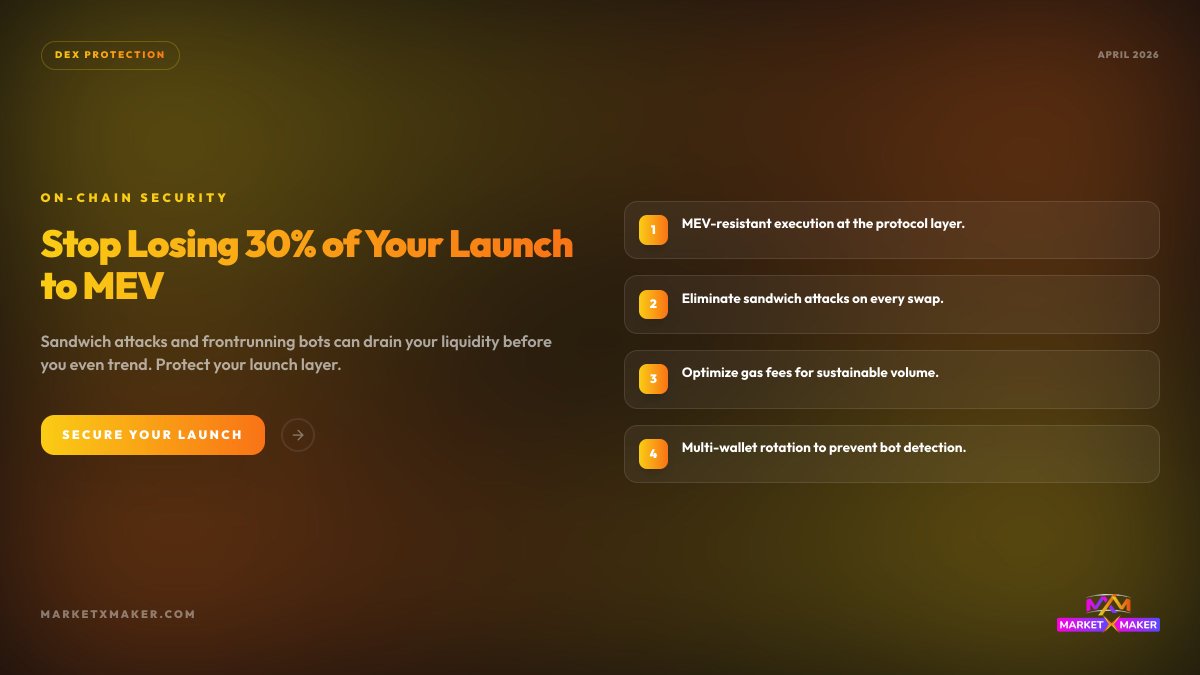
On-chain launches are a battlefield. 🛡️
If you're not using MEV-resistant execution, sandwich bots are taking a 30% "tax" on your liquidity. We eliminate frontrunning at the layer that matters.
Secure your chart. Protect your holders.
DM for a DEX audit | marketxmaker.com
#DEXLiquidity #MEVProtection #Solana #Base #TokenLaunch #MXM #DEX #meme
1
22
Apr 24
Why are whales ignoring your project? Check your Order Book. 🐋
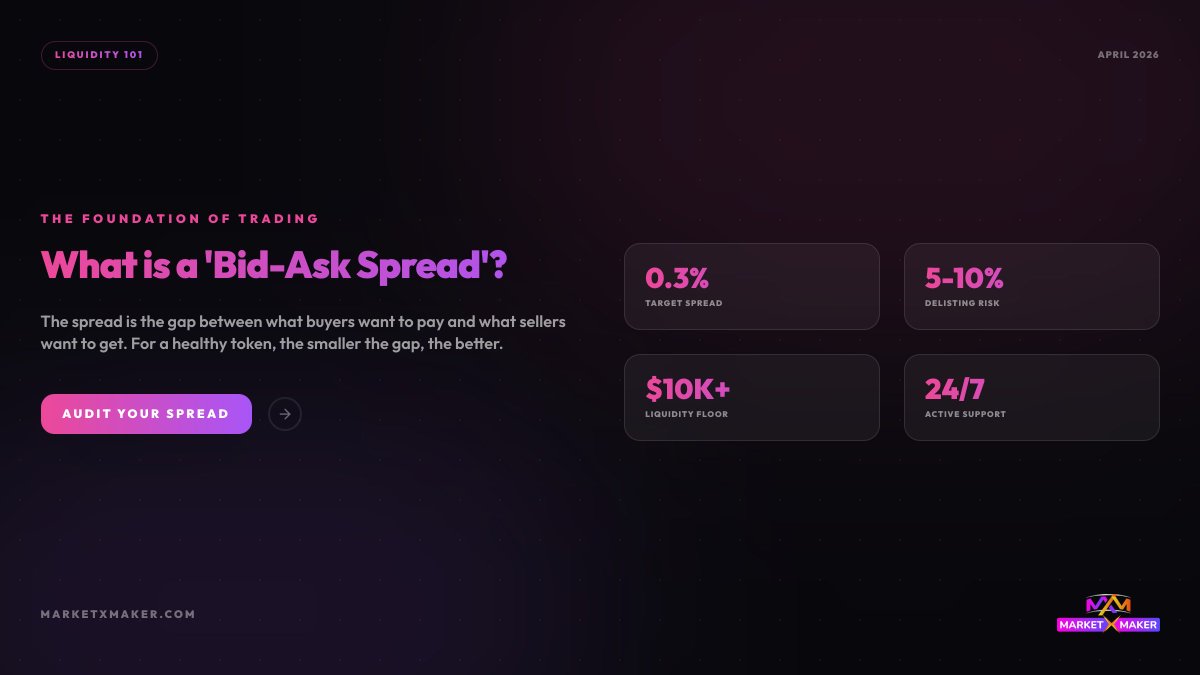
An investor looking to buy $2,000 worth of your token won't do it if your Bid-Ask Spread is 8%. Why? Because they’d lose $160 instantly to slippage.
Low liquidity is a "Keep Out" sign for serious capital. Professional Market Making builds a $10K floor and keeps the spread tight, so big players can enter (and exit) with confidence.
Don't just chase volume. Build a market that institutions can actually trade in.
DM for a free audit | marketxmaker.com
#MXM #CryptoMarket #CEX #TokenGrowth #MarketMaking #Web3Founders #Liquidity #MarketXMaker #LiquidityManagement #CEXListing #Web3
1
39
Apr 23
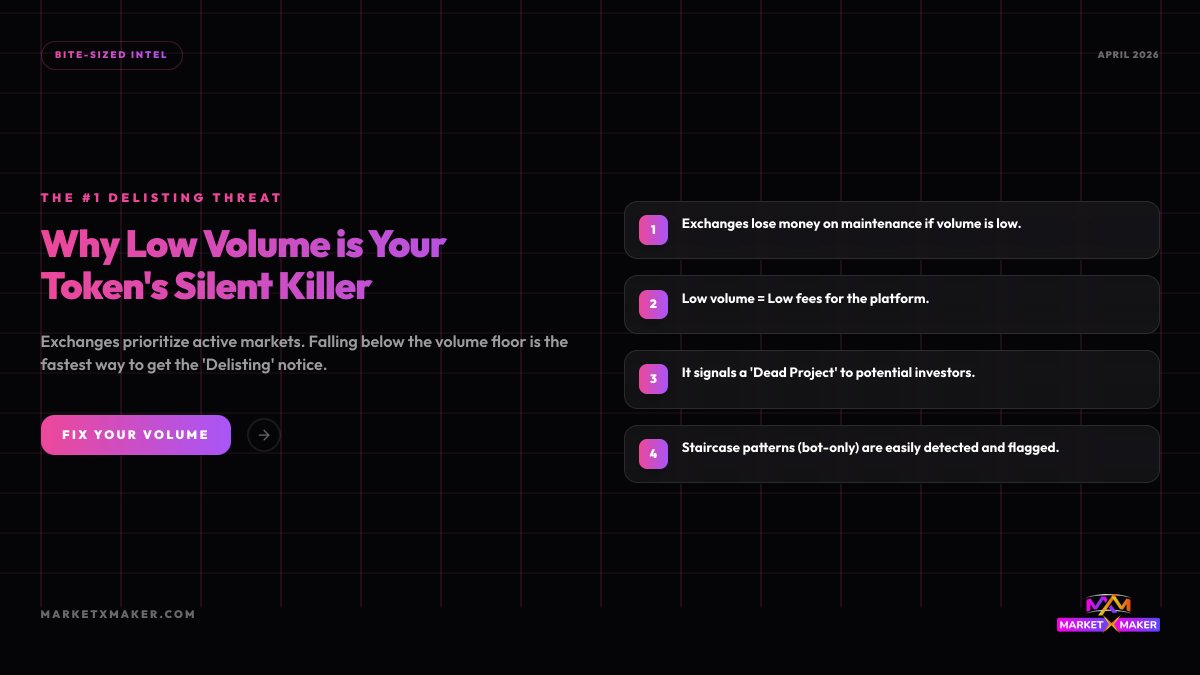
The #1 reason tokens get delisted in 2026 isn't the tech—it's the floor. 📉
If your daily volume consistently dips below exchange maintenance costs, you are already on the radar for the next cleanup. Platforms aren't just looking at the number; they're looking at the
sustainability of the fees you generate.
3 signs your volume is a delisting threat:
• Fees don't cover platform server costs.
• "Staircase" patterns flag bot-only activity.
• Zero organic order book depth.
Don't wait for the 48-hour notice.
DM for a liquidity audit | marketxmaker.com
#MarketMaking #CEX #Liquidity #Web3Founders
2
28
Apr 22
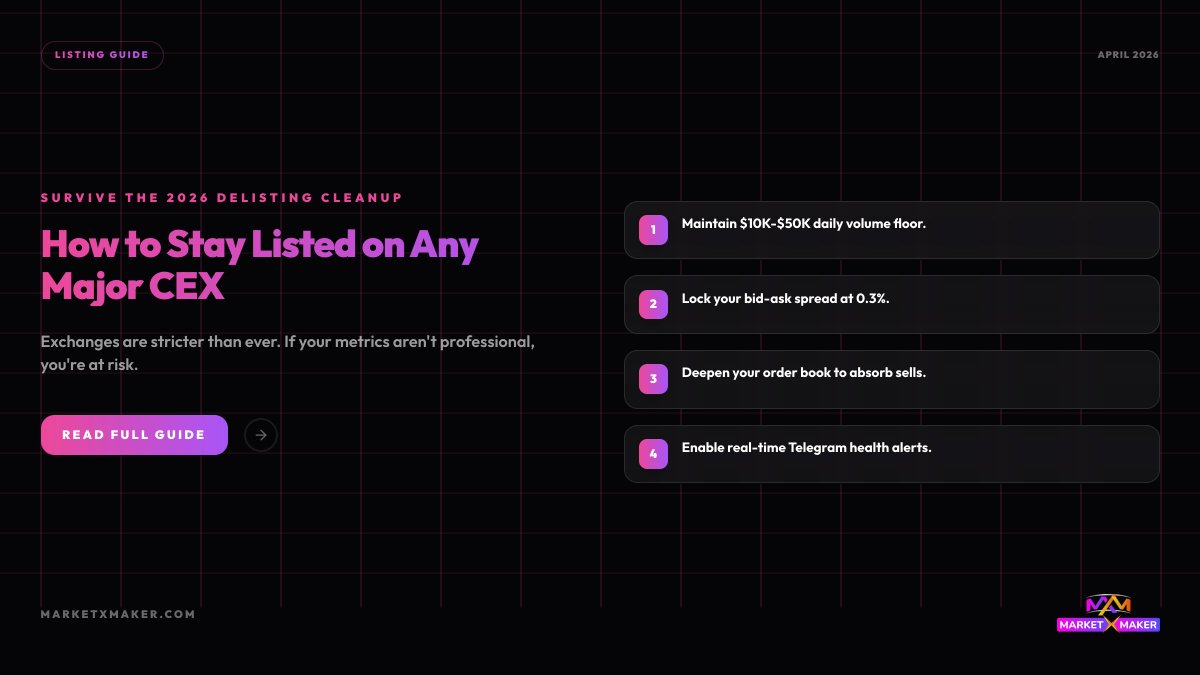
In 2026, major exchanges aren't just listing tokens—they’re cleaning house. 🛡️
If your volume is spiky or your spread is over 0.3%, you’re in the "Delisting Zone."
We just published the ultimate survival guide to keep your metrics in the green.
Read it here: marketxmaker.com/blog/how-to…
#CryptoFounder #MarketMaker #Liquidity #MXM #CEX #TokenGrowth #TradingVolume #Blockchain #CryptoStartups #ListingGuide
2
45
Apr 19
🚀 Welcome to MarketXMaker (@Marketxmaker)
Premium market making, finally affordable.Healthy order books. Tight spreads. Real control. Custom bots. 24/7 support.150 projects already scaling with us across 100 exchanges.Your token deserves institutional-grade liquidity — without the institutional price tag.
Start your free 24-hour demo today 👇
marketxmaker.com
#MarketMaking #CryptoLiquidity #CEX #DEX #TokenLaunch"
21
1
25
614