
The Matrix AI Network was founded in 2017. In 2023, we enter Matrix 3.0 blending neuroscience with our previous work to realize the vision of the Matrix films.
Joined November 2017
- Tweets 6,792
- Following 532
- Followers 79,299
- Likes 4,148
1,792 Photos and videos


Pinned Tweet

2 Dec 2025
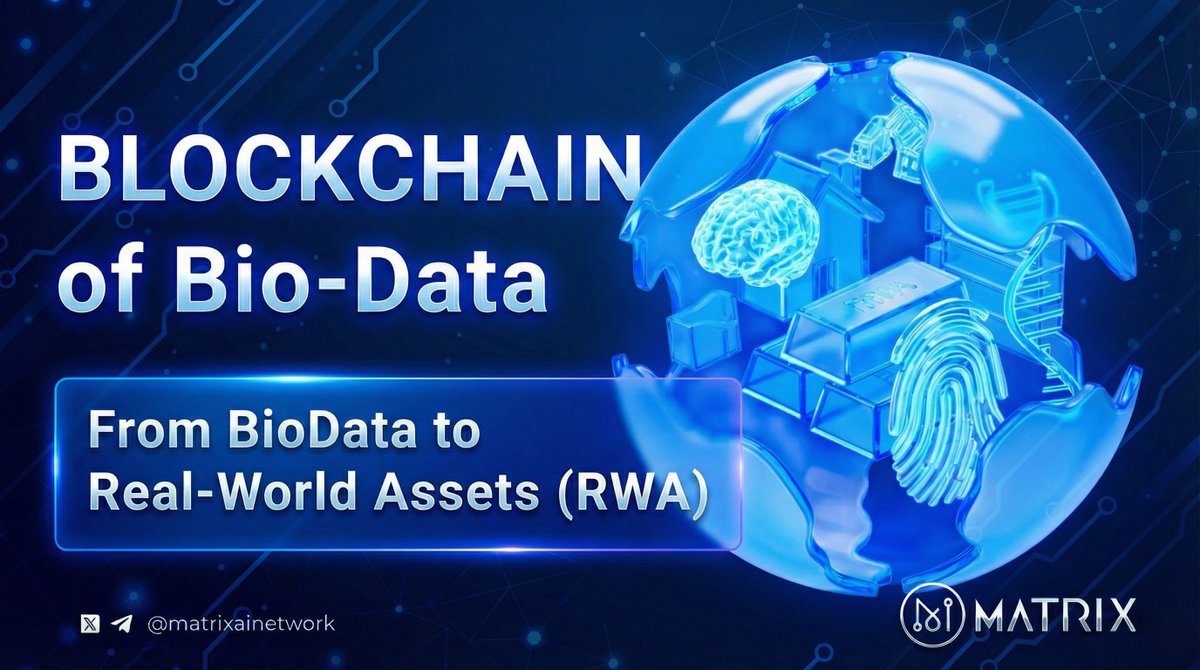
🔥 From BioData to Real-World Assets (#RWA)
Get ready to witness The Infrastructure Blueprint of Matrix AI Network! 🚀
docs.matrix.io/hong-kong-sta…
✅ Chapter 1: Why Biodata Becomes RWA Capital Now is LIVE!
Stay Tuned...
20
40
133
16,547
The business model insight hidden in this:
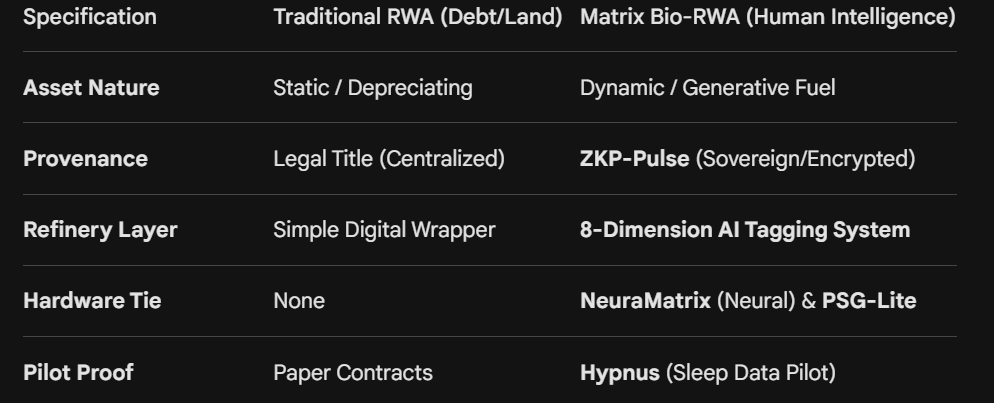
The hospital owns your PSG data.
Always has. Always will.
You consented when you signed the forms.
PSG Lite inverts this:
The data goes to YOUR wallet.
On-chain. Verified. Yours.
The hospital charges you for the test
AND keeps the data as its asset.
Matrix/Hypnus gives you the test
AND you keep the data as your asset.
Different infrastructure.
Different ownership.
This is the position issue Owen described.
Not technical. A choice.

What if your personal data became an asset you actually owned?
In this May 2026 AMA, Matrix AI Network explores one of the most important questions facing AI, Web3, and the future digital economy:
Who owns the data that powers artificial intelligence?
As AI models continue to improve, the next major bottleneck is no longer computing power—it is access to high-quality, verified human data. The discussion covers how personal biodata can become a valuable digital asset, how data quality is measured, and why future AI companies may depend directly on users as data providers.
Topics include:
✅ Biodata as a new asset class
✅ AI-grade data quality scoring
✅ Wearable devices for raw data
✅ Data ownership and monetization models
✅ Preventing fake data and device spoofing
✅ Real-world applications in healthcare, sports science and mental wellness
✅ Hypnus and the future biodata ecosystem
✅ Project direction
The future may not belong to companies that own data. It belongs to the people who create it.
Watch now 👇
#AI #Web3 #DataOwnership
1
70
The PSG vs PSG Lite comparison in full:
FULL PSG:
Location: sleep clinic / hospital
Booking: months of waiting
Comfort: wires on head, chest, legs
Results: 3 weeks
Cost: $1,000–$5,000
Data ownership: hospital
Frequency: once (maybe)
PSG LITE (Hypnus / Matrix):
Location: your own bed
Booking: none
Comfort: lightweight headband
Results: available quickly
Cost: consumer accessible
Data ownership: you, on-chain
Frequency: every night
What if your personal data became an asset you actually owned?
In this May 2026 AMA, Matrix AI Network explores one of the most important questions facing AI, Web3, and the future digital economy:
Who owns the data that powers artificial intelligence?
As AI models continue to improve, the next major bottleneck is no longer computing power—it is access to high-quality, verified human data. The discussion covers how personal biodata can become a valuable digital asset, how data quality is measured, and why future AI companies may depend directly on users as data providers.
Topics include:
✅ Biodata as a new asset class
✅ AI-grade data quality scoring
✅ Wearable devices for raw data
✅ Data ownership and monetization models
✅ Preventing fake data and device spoofing
✅ Real-world applications in healthcare, sports science and mental wellness
✅ Hypnus and the future biodata ecosystem
✅ Project direction
The future may not belong to companies that own data. It belongs to the people who create it.
Watch now 👇
#AI #Web3 #DataOwnership
5
9
17
510
Why 70% of sleep disorder sufferers go undiagnosed:
PSG (polysomnography) requires:
→ Booking a specialist clinic
→ Months of waiting for an appointment
→ Sleeping in a hospital bed
→ Wires attached to your head, chest, legs
→ Weeks more waiting for the results
→ Hundreds to thousands of dollars
For a one-night snapshot.
Most people with mild-to-moderate sleep issues never bother.
The friction is too high.
PSG Lite addresses every one of these:
Own bed. Headband. Fast results.
Clinical-grade data captured every night.
Goes on-chain as your asset.
May AMA below:
What if your personal data became an asset you actually owned?
In this May 2026 AMA, Matrix AI Network explores one of the most important questions facing AI, Web3, and the future digital economy:
Who owns the data that powers artificial intelligence?
As AI models continue to improve, the next major bottleneck is no longer computing power—it is access to high-quality, verified human data. The discussion covers how personal biodata can become a valuable digital asset, how data quality is measured, and why future AI companies may depend directly on users as data providers.
Topics include:
✅ Biodata as a new asset class
✅ AI-grade data quality scoring
✅ Wearable devices for raw data
✅ Data ownership and monetization models
✅ Preventing fake data and device spoofing
✅ Real-world applications in healthcare, sports science and mental wellness
✅ Hypnus and the future biodata ecosystem
✅ Project direction
The future may not belong to companies that own data. It belongs to the people who create it.
Watch now 👇
#AI #Web3 #DataOwnership
4
8
20
659
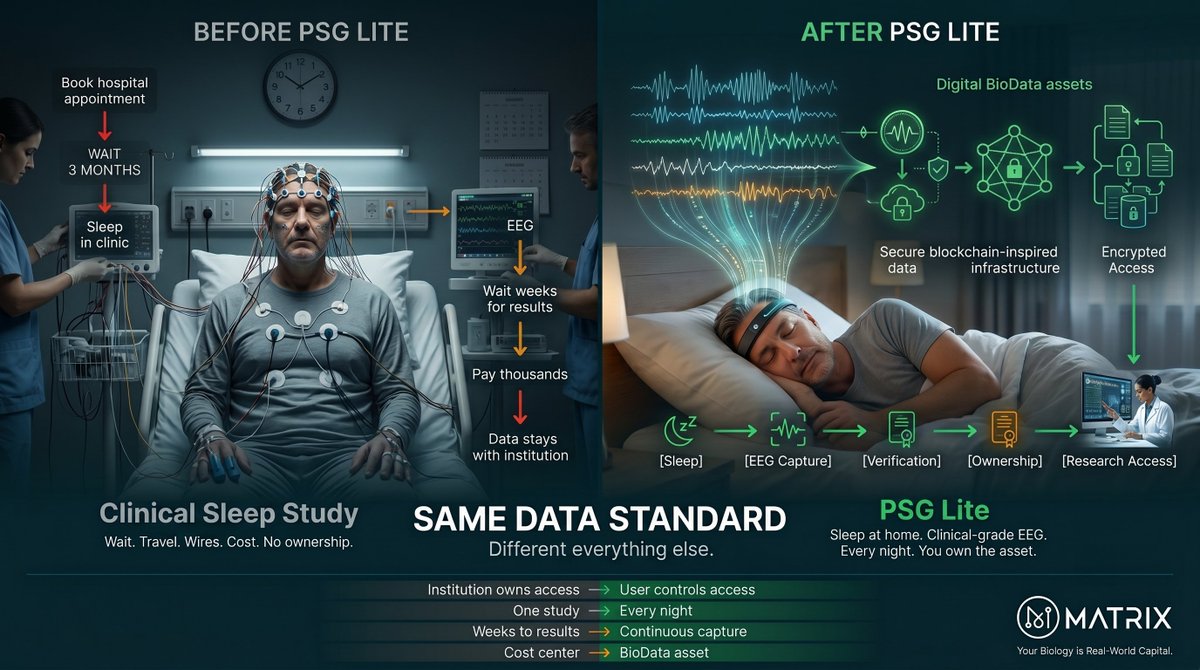
Before PSG Lite:
Want clinical-grade sleep data?
Book a hospital.
Wait 3 months or more.
Sleep in a clinic bed wired up.
Wait 3 more weeks for results.
Pay thousands.
Own nothing.
After PSG Lite:
Put on a headband.
Sleep in your own bed.
Get clinical-grade EEG data.
Every night.
Goes on-chain as your asset.
You own it.
AI labs pay to use it.
Same data standard.
Different everything else.
Name the other protocol that built this. 👇
$MAN #BioData
What if your personal data became an asset you actually owned?
In this May 2026 AMA, Matrix AI Network explores one of the most important questions facing AI, Web3, and the future digital economy:
Who owns the data that powers artificial intelligence?
As AI models continue to improve, the next major bottleneck is no longer computing power—it is access to high-quality, verified human data. The discussion covers how personal biodata can become a valuable digital asset, how data quality is measured, and why future AI companies may depend directly on users as data providers.
Topics include:
✅ Biodata as a new asset class
✅ AI-grade data quality scoring
✅ Wearable devices for raw data
✅ Data ownership and monetization models
✅ Preventing fake data and device spoofing
✅ Real-world applications in healthcare, sports science and mental wellness
✅ Hypnus and the future biodata ecosystem
✅ Project direction
The future may not belong to companies that own data. It belongs to the people who create it.
Watch now 👇
#AI #Web3 #DataOwnership
7
9
27
682
To get a clinical sleep test,
you book a hospital.
Wait months for an appointment.
Sleep in a clinic bed.
Covered in wires.
Wait weeks for results.
70% of people with sleep disorders never get diagnosed.
The test is too inconvenient.
PSG Lite is what Matrix built.
Same clinical-grade data standard.
Your own bed.
Tonight.
Data owned by you.
The hospital never made this accessible.
That's not an accident either. 👇
$MAN #BioData #Hypnus
What if your personal data became an asset you actually owned?
In this May 2026 AMA, Matrix AI Network explores one of the most important questions facing AI, Web3, and the future digital economy:
Who owns the data that powers artificial intelligence?
As AI models continue to improve, the next major bottleneck is no longer computing power—it is access to high-quality, verified human data. The discussion covers how personal biodata can become a valuable digital asset, how data quality is measured, and why future AI companies may depend directly on users as data providers.
Topics include:
✅ Biodata as a new asset class
✅ AI-grade data quality scoring
✅ Wearable devices for raw data
✅ Data ownership and monetization models
✅ Preventing fake data and device spoofing
✅ Real-world applications in healthcare, sports science and mental wellness
✅ Hypnus and the future biodata ecosystem
✅ Project direction
The future may not belong to companies that own data. It belongs to the people who create it.
Watch now 👇
#AI #Web3 #DataOwnership
9
9
20
601
When you die, you can leave your house to your children.
You can leave your car.
Your bank account.
Your investment portfolio.
You cannot leave your Fitbit data.
It belongs to Fitbit.
It always has.
The terms you agreed to transfer it permanently on collection.
Your entire health history.
Every night's sleep.
Every heart rate spike.
Every stress pattern.
Worth something to someone.
Just not to your estate.
Has anyone thought about this? 👇
What if your personal data became an asset you actually owned?
In this May 2026 AMA, Matrix AI Network explores one of the most important questions facing AI, Web3, and the future digital economy:
Who owns the data that powers artificial intelligence?
As AI models continue to improve, the next major bottleneck is no longer computing power—it is access to high-quality, verified human data. The discussion covers how personal biodata can become a valuable digital asset, how data quality is measured, and why future AI companies may depend directly on users as data providers.
Topics include:
✅ Biodata as a new asset class
✅ AI-grade data quality scoring
✅ Wearable devices for raw data
✅ Data ownership and monetization models
✅ Preventing fake data and device spoofing
✅ Real-world applications in healthcare, sports science and mental wellness
✅ Hypnus and the future biodata ecosystem
✅ Project direction
The future may not belong to companies that own data. It belongs to the people who create it.
Watch now 👇
#AI #Web3 #DataOwnership
4
8
21
822
Every durable thing in crypto ran on network effects.
More people made it more valuable, not less. The rest was zero sum dressed as alpha.
The purest version of that is biodata.
One dataset is a data point.
Ten thousand is a market.
The friends are not sentimental here, they are the math.
So which of your bags is actually worth more because other people showed up? Check AMA: x.com/MatrixAINetwork/status…
$MAN #MatrixAINetwork #RWA

Happy National Best Frens Day.
The real alpha is the friends we made along the way. 🫡
7
8
25
733
The internet created the information economy.
AI is creating the data economy.
The central question is no longer:
"Can AI improve?"
It's:
"Who owns the data that makes AI possible?"
That's what the May AMA is really about.
Watch the full discussion 👇
#AI #Web3 #FutureOfData
What if your personal data became an asset you actually owned?
In this May 2026 AMA, Matrix AI Network explores one of the most important questions facing AI, Web3, and the future digital economy:
Who owns the data that powers artificial intelligence?
As AI models continue to improve, the next major bottleneck is no longer computing power—it is access to high-quality, verified human data. The discussion covers how personal biodata can become a valuable digital asset, how data quality is measured, and why future AI companies may depend directly on users as data providers.
Topics include:
✅ Biodata as a new asset class
✅ AI-grade data quality scoring
✅ Wearable devices for raw data
✅ Data ownership and monetization models
✅ Preventing fake data and device spoofing
✅ Real-world applications in healthcare, sports science and mental wellness
✅ Hypnus and the future biodata ecosystem
✅ Project direction
The future may not belong to companies that own data. It belongs to the people who create it.
Watch now 👇
#AI #Web3 #DataOwnership
7
11
25
728
Owen picked the most innovative question from the May AMA.
It was this:
'If biological data becomes economically valuable at scale, does the relationship between individuals and AI companies fundamentally change?'
Reply with a letter:
A) Yes — individuals become suppliers, AI companies become dependent on us
B) No — platforms will find ways to retain control regardless
C) Partially — some people benefit, most won't know it's happening
Drop your thoughts in reply.
$MAN #BioData #AI
What if your personal data became an asset you actually owned?
In this May 2026 AMA, Matrix AI Network explores one of the most important questions facing AI, Web3, and the future digital economy:
Who owns the data that powers artificial intelligence?
As AI models continue to improve, the next major bottleneck is no longer computing power—it is access to high-quality, verified human data. The discussion covers how personal biodata can become a valuable digital asset, how data quality is measured, and why future AI companies may depend directly on users as data providers.
Topics include:
✅ Biodata as a new asset class
✅ AI-grade data quality scoring
✅ Wearable devices for raw data
✅ Data ownership and monetization models
✅ Preventing fake data and device spoofing
✅ Real-world applications in healthcare, sports science and mental wellness
✅ Hypnus and the future biodata ecosystem
✅ Project direction
The future may not belong to companies that own data. It belongs to the people who create it.
Watch now 👇
#AI #Web3 #DataOwnership
6
10
27
801
Wisdom, much like valuable signal data, is not about accumulating more information,
but relentlessly stripping away the negative noise until only the essential truth remains.
"The higher the purity, the higher the quality of the data, and the higher the weight it gets." (Owen Tao, CEO, May 2026 AMA)
What if your personal data became an asset you actually owned?
In this May 2026 AMA, Matrix AI Network explores one of the most important questions facing AI, Web3, and the future digital economy:
Who owns the data that powers artificial intelligence?
As AI models continue to improve, the next major bottleneck is no longer computing power—it is access to high-quality, verified human data. The discussion covers how personal biodata can become a valuable digital asset, how data quality is measured, and why future AI companies may depend directly on users as data providers.
Topics include:
✅ Biodata as a new asset class
✅ AI-grade data quality scoring
✅ Wearable devices for raw data
✅ Data ownership and monetization models
✅ Preventing fake data and device spoofing
✅ Real-world applications in healthcare, sports science and mental wellness
✅ Hypnus and the future biodata ecosystem
✅ Project direction
The future may not belong to companies that own data. It belongs to the people who create it.
Watch now 👇
#AI #Web3 #DataOwnership
8
13
25
721
There's a new CAPTCHA being built.
Except instead of clicking traffic lights, it reads your brain.
The CEO of Matrix explained in the AMA how to prevent fake biological data from polluting the ecosystem.
Level one: hardware unique codes.
Level two: live brain verification.
Level three: cross-data consistency.
The third one is the most interesting.
$MAN #BioData #AI
What if your personal data became an asset you actually owned?
In this May 2026 AMA, Matrix AI Network explores one of the most important questions facing AI, Web3, and the future digital economy:
Who owns the data that powers artificial intelligence?
As AI models continue to improve, the next major bottleneck is no longer computing power—it is access to high-quality, verified human data. The discussion covers how personal biodata can become a valuable digital asset, how data quality is measured, and why future AI companies may depend directly on users as data providers.
Topics include:
✅ Biodata as a new asset class
✅ AI-grade data quality scoring
✅ Wearable devices for raw data
✅ Data ownership and monetization models
✅ Preventing fake data and device spoofing
✅ Real-world applications in healthcare, sports science and mental wellness
✅ Hypnus and the future biodata ecosystem
✅ Project direction
The future may not belong to companies that own data. It belongs to the people who create it.
Watch now 👇
#AI #Web3 #DataOwnership
9
12
31
1,116
Level 3 — cross-data consistency:
When sleeping, two things must correlate:
Beta waves go UP (memory consolidation).
Heart rate goes DOWN (rest).
If your EEG and heart rate don't match what a sleeping human actually looks like — the data is flagged.
Three layers. Almost impossible to fake.
11
235
Nobody has clipped this from the May AMA.
Matrix has a user.
A real one.
Right now.
It's not a sleep tracker.
It's a boxing team.
30 seconds. 👇
What if your personal data became an asset you actually owned?
In this May 2026 AMA, Matrix AI Network explores one of the most important questions facing AI, Web3, and the future digital economy:
Who owns the data that powers artificial intelligence?
As AI models continue to improve, the next major bottleneck is no longer computing power—it is access to high-quality, verified human data. The discussion covers how personal biodata can become a valuable digital asset, how data quality is measured, and why future AI companies may depend directly on users as data providers.
Topics include:
✅ Biodata as a new asset class
✅ AI-grade data quality scoring
✅ Wearable devices for raw data
✅ Data ownership and monetization models
✅ Preventing fake data and device spoofing
✅ Real-world applications in healthcare, sports science and mental wellness
✅ Hypnus and the future biodata ecosystem
✅ Project direction
The future may not belong to companies that own data. It belongs to the people who create it.
Watch now 👇
#AI #Web3 #DataOwnership
7
19
40
1,061
Owen's words on the boxing team:
'Some of the results of our EMG are helping Chinese boxing teams to train.'
The two things EMG tracks during boxing:
① The order of muscle activation
(is the sequence correct?)
② The proportion of each muscle activated
(is the distribution right?)
By collecting this data, coaches can precisely diagnose and correct technique.
This is biosignal data being used right now.
The sleep application is ONE use case.
Owen listed: sport, pilots, train drivers, ADHD treatment, depression monitoring.
Same infrastructure. Multiple markets.
15
278
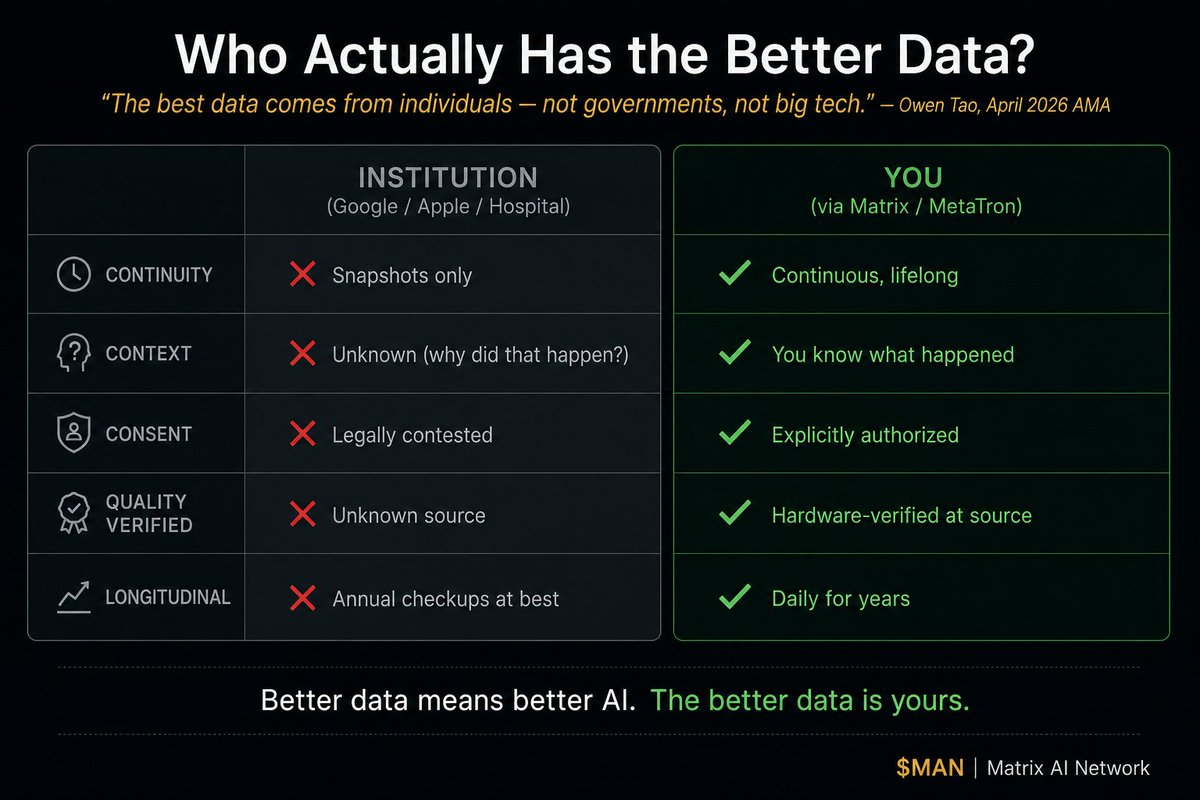
The CEO of Matrix said something in the May AMA that floored me.
Kriptoburak asked why wearable companies don't pay users for their data.
His answer:
'It's not a technical issue.
It's a position issue.'
They could pay you.
They choose not to.
That's not a technology problem.
That's a business model problem.
Those have different solutions.
Tell me I'm wrong. 👇
$MAN #BioData
What if your personal data became an asset you actually owned?
In this May 2026 AMA, Matrix AI Network explores one of the most important questions facing AI, Web3, and the future digital economy:
Who owns the data that powers artificial intelligence?
As AI models continue to improve, the next major bottleneck is no longer computing power—it is access to high-quality, verified human data. The discussion covers how personal biodata can become a valuable digital asset, how data quality is measured, and why future AI companies may depend directly on users as data providers.
Topics include:
✅ Biodata as a new asset class
✅ AI-grade data quality scoring
✅ Wearable devices for raw data
✅ Data ownership and monetization models
✅ Preventing fake data and device spoofing
✅ Real-world applications in healthcare, sports science and mental wellness
✅ Hypnus and the future biodata ecosystem
✅ Project direction
The future may not belong to companies that own data. It belongs to the people who create it.
Watch now 👇
#AI #Web3 #DataOwnership
4
8
33
1,768
What if your personal data became an asset you actually owned?
In this May 2026 AMA, Matrix AI Network explores one of the most important questions facing AI, Web3, and the future digital economy:
Who owns the data that powers artificial intelligence?
As AI models continue to improve, the next major bottleneck is no longer computing power—it is access to high-quality, verified human data. The discussion covers how personal biodata can become a valuable digital asset, how data quality is measured, and why future AI companies may depend directly on users as data providers.
Topics include:
✅ Biodata as a new asset class
✅ AI-grade data quality scoring
✅ Wearable devices for raw data
✅ Data ownership and monetization models
✅ Preventing fake data and device spoofing
✅ Real-world applications in healthcare, sports science and mental wellness
✅ Hypnus and the future biodata ecosystem
✅ Project direction
The future may not belong to companies that own data. It belongs to the people who create it.
Watch now 👇
#AI #Web3 #DataOwnership
11
17
46
53,176
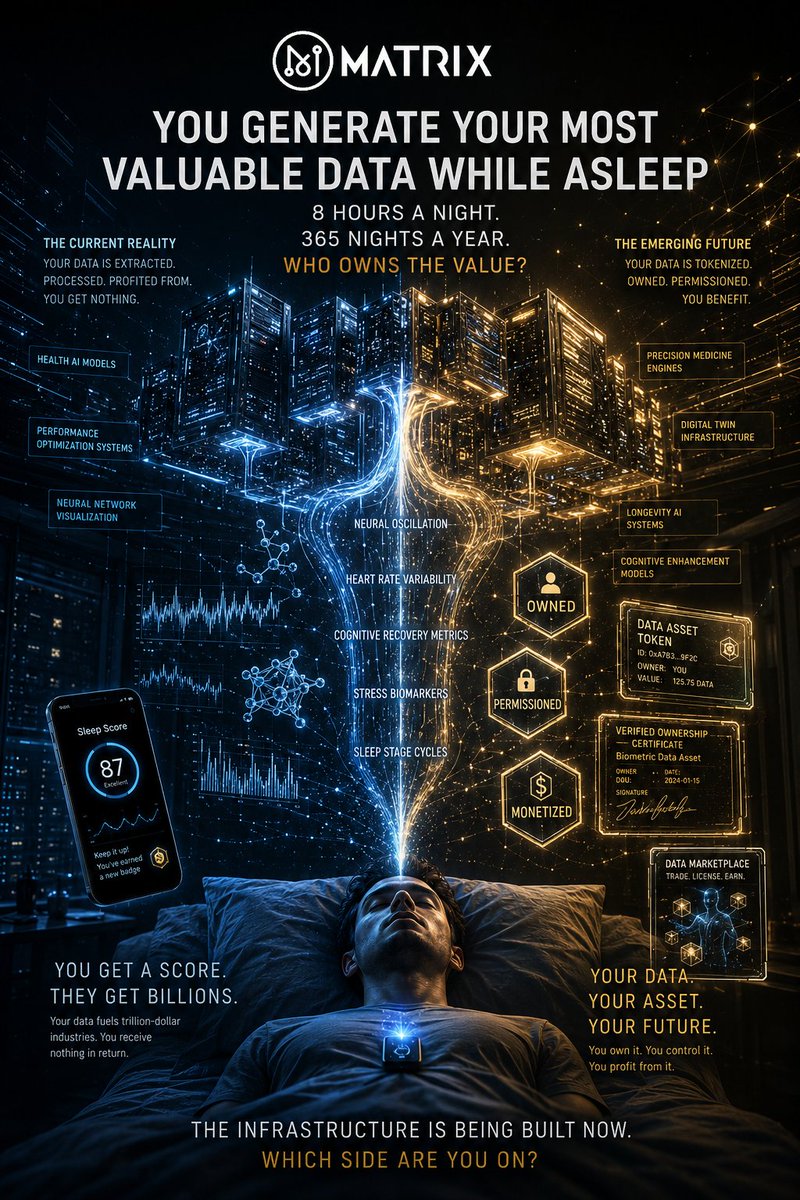
You generate your most valuable data while unconscious.
During sleep:
Neural oscillation patterns.
Heart rate variability cycles.
Stress biomarker baselines.
Cognitive recovery metrics.
AI labs training the next generation of health, cognition, and performance models need exactly this data.
You produce it automatically.
Eight hours a night.
365 nights a year.
Current payment for this:
A free app and a sleep score.
The infrastructure that changes this is being built right now.
Which side of that are you on? 👇
$MAN #BioData #AI #RWA
9
15
34
930
Why sleep data specifically:
Sleep is when the brain consolidates memory, repairs cellular damage, regulates hormones, and processes emotional experiences.
The biological signals during sleep are richer in diagnostic information than any waking measurement.
Clinical EEG during sleep:
Used to diagnose epilepsy, sleep disorders, early cognitive decline, PTSD markers.
AI models trained on high-quality sleep EEG:
Could enable earlier disease detection,
personalised cognitive enhancement,
non-invasive mental health monitoring.
The data is generating itself.
Every night.
In your bedroom.
Currently going to Fitbit.
1
1
13
326
The FICO parallel is exact:
Pre-FICO (pre-1989):
Banks decided creditworthiness subjectively.
Good borrowers couldn't prove it.
Rates were arbitrary.
The market was closed to most people.
Post-FICO:
Your score is objective. Portable.
Good credit history = lower rates.
The market opened to hundreds of millions.
Pre-Matrix data scoring:
AI labs can't price biological data reliably.
Good data producers can't prove quality.
The market is thin and inefficient.
Post-Matrix data scoring:
Your score is objective. On-chain.
High quality sleep = higher price.
The market opens for everyone.
Bi-weekly report see below.
Second Bi-Weekly Report of May from #MatrixAINetwork just dropped.
The biggest takeaway?
The project is moving deeper into infrastructure most people won’t understand until much later:
🧠 EEG preprocessing
⏱ millisecond-level synchronization
📊 biological metadata standards
🔐 anti-fraud device credibility systems
Why does this matter?
Because AI becomes dangerous when it cannot distinguish real human-origin data from synthetic noise.
The next AI race may not be about bigger models.
It may be about better data.
#AI #DePIN #BioData
Check:
docs.matrix.io/bi-weekly-rep…
docs.matrix.io/bi-weekly-rep…
5
9
32
1,150
Every technology consolidation creates a shared infrastructure dependency among the survivors.
Dot-com bust: survivors all needed cloud.
Social consolidation: survivors all needed ad targeting infrastructure.
Health AI consolidation: survivors will all need verified biosignal training data that cannot be fabricated — sleep, EEG, cardiac, biochemical across eight domains.
$MAN builds that layer. What does AI consolidation create demand for?
#MatrixAINetwork #AI #RWA
May 29

AI will stay and grow exponentially.
But most AI companies will go bust. There are just too many.
Even survivors will see huge price fluctuations.
There will be new survivor entrants too.
Same as any other new industry, really.
8
12
32
1,043