
Joined February 2010
- Tweets 13
- Following 72
- Followers 67
- Likes 152
Photos and videos
Max Eisele retweeted

18 Sep 2024
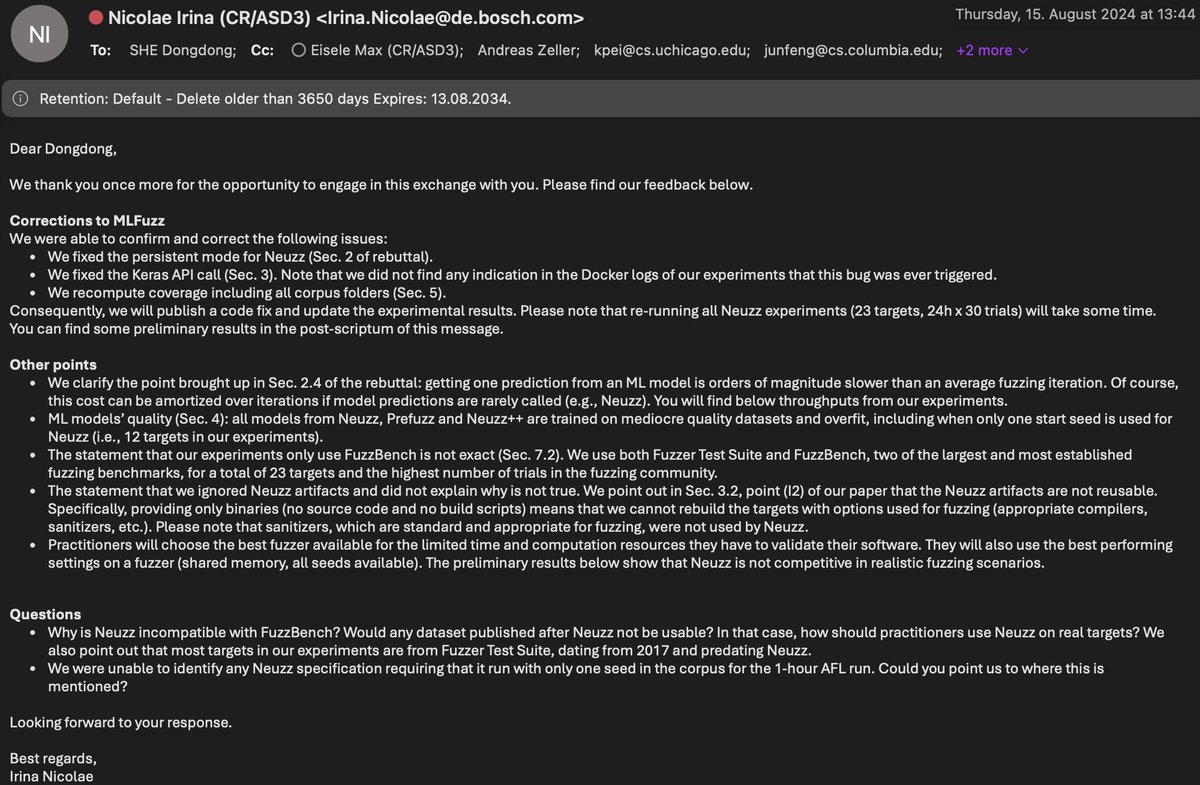
@DongdongShe You seem happy enough to communicate in the public channel: you’re the one who took this to Twitter and shared private conversations.
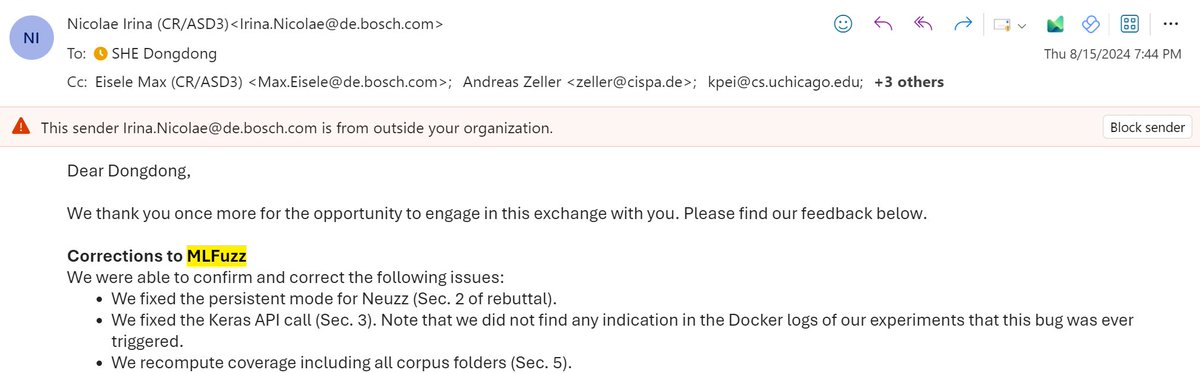
If you’re going to share emails, might as well do so in full and not cherry-pick:
17 Sep 2024

Ep5. Rebuttal MLFuzz
Thanks Irina’s response. We never heard back from you and @AndreasZeller since last month when we sent the last email to ask if you guys were willing to write an errata of MLFuzz to acknowledge the bugs and wrong conclusion. So I am happy to communicate with you in the public channel about this issue and clarify the misleading conclusions in your paper MLFuzz in front of the fuzzing community.
Our first email pointed out 4 bugs in MLFuzz and we showed that if you fixed the 4 bugs you can successfully reproduce our results. We also provide a fixed version of your code and preliminary results on 4 FuzzBench programs. Your first response confirmed 3 bugs but refused to acknowledge the most severe one – an error in training data collection. For any ML model, garbage in, garbage out. If you manipulate the training data distribution, you can cook any arbitrary poor results for an ML model.
Why are you reluctant to fix the training data collection error? Instead, you insist on running NEUZZ with the WRONG training data and cooking invalid results even though we already notified you of this issue. We suspect maybe that’s the only way to keep reproducing your wrong experiment results and avoid acknowledging your error in MLFuzz.
Your research conduct raised a serious issue about how to properly reproduce fuzzing performance in the Fuzzing community. Devil’s advice: blindly, deliberately or stealthily run it with WRONG settings or patch it with a few bugs and claim its performance does not hold? Only an ill-configured fuzzer is a good baseline fuzzer.
We think a fair and scientific way to reproduce/revisit a fuzzer should ensure running a fuzzer properly as the original paper did, rather than free-style wrong settings and bug injections.
The fact is you guys wrote buggy code (you confirmed in the email) and cooked invalid results and wrong conclusions published in a top-tier conference @FSEconf 2023. We wrote a rebuttal to point out 4 fatal bugs in your code and wrong conclusions.
A responsible and professional response should directly address our questions about the 4 fatal bugs and wrong conclusions. But your response discussed the inconsistent performance number issue of NEUZZ (due to a different metric choice), the benchmark, seed corpus, IID issue of MLFuzz. They are research questions about NEUZZ and MLFuzz, but they are not the topic of this post: MLFuzz rebuttal.
They can only shift the audience's attention but cannot fix the bugs and errors in MLFuzz. I promise I will address every question in your response in a separate post on X, but not in this one. Stay tuned! @is_eqv @moyix @thorstenholz @mboehme_
1
3
12
2,571
Max Eisele retweeted
16 Sep 2024
Recently, @DongdongShe et al. raised issues regarding our paper “Revisiting Neural Program Smoothing for Fuzzing”.
Tldr: they highlight two bugs in our code, make inaccurate statements, and ignore all the core issues we raised 🧵: 1/
1
10
35
17,969
Max Eisele retweeted

17 Jan 2024
Congratulations to my PhD student Max Eisele for winning the @sigsoft/@AcmSigbed Frank Anger Award!
@MaxCamillo works on testing and analyzing embedded systems at Bosch. He is best known so far for GDBFuzz, a GDB-based fuzzer for embedded systems medium.com/security-garten/g…
17 Jan 2024

Excited to announce ACM SIGSOFT Awards 2024!!! Congratulations to all winners for their significant contributions! Here is the blog post by the Awards chair @davidlo2015 and @sigsoft chair
@tomzimmermann 👋👋👋
medium.com/@sigsoft/sigsoft-…
A serious of posts to follow!
2
76
5,267
Max Eisele retweeted
20 Dec 2023
Missed our @FSEconf talk debunking neural program smoothing for fuzzing? Discover key insights in our latest Security Garden blog post. medium.com/security-garten/c…
2
6
695
Max Eisele retweeted
5 Dec 2023
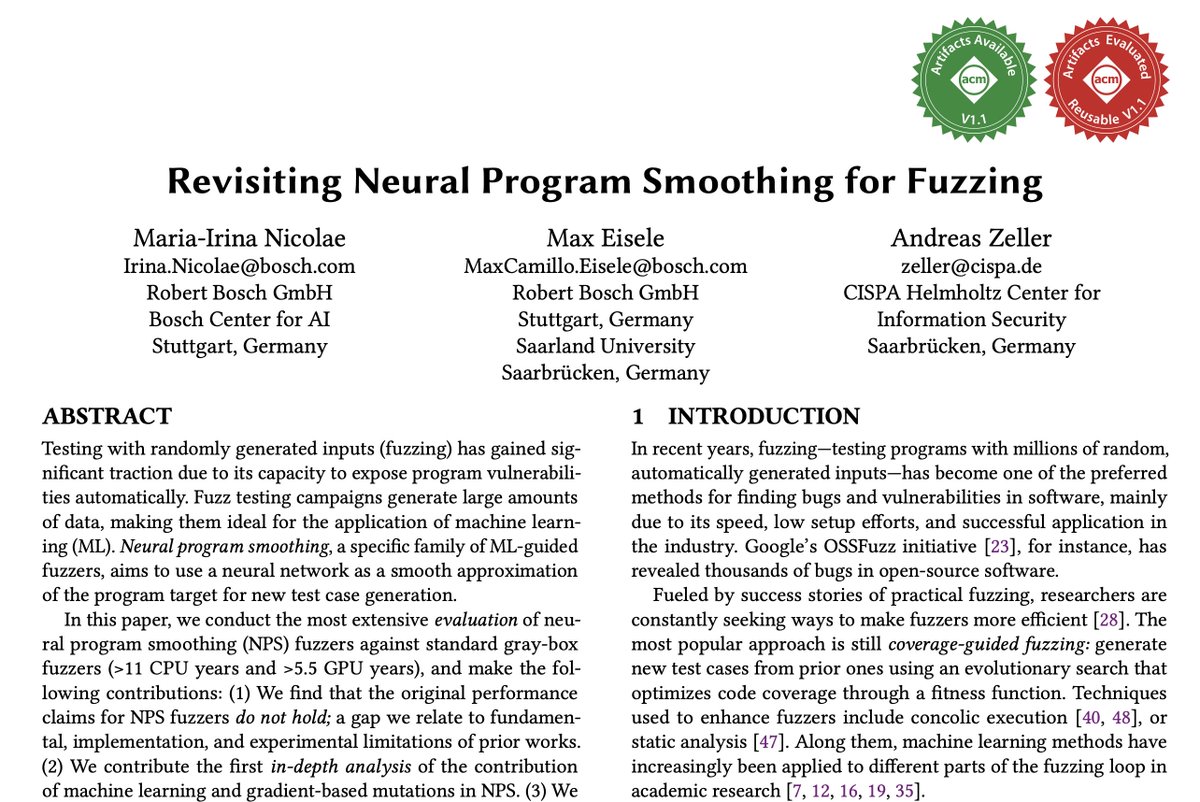
In one year of work, @ririnicolae, @MaxCamillo, and I have deconstructed the controversial NEUZZ ML-based fuzzer and found that its original performance claims do not hold. Looking forward to lively discussions today 12:15 at @FSEconf! dl.acm.org/doi/10.1145/36116…
10 Apr 2022

She's right: I have seen _not a single_ ML-based approach that outperforms traditional fuzzing - and many have tried.
Can't we just call all fuzzers AI and get the funding anyway?
2
13
123
50,226
Max Eisele retweeted
19 Jul 2023
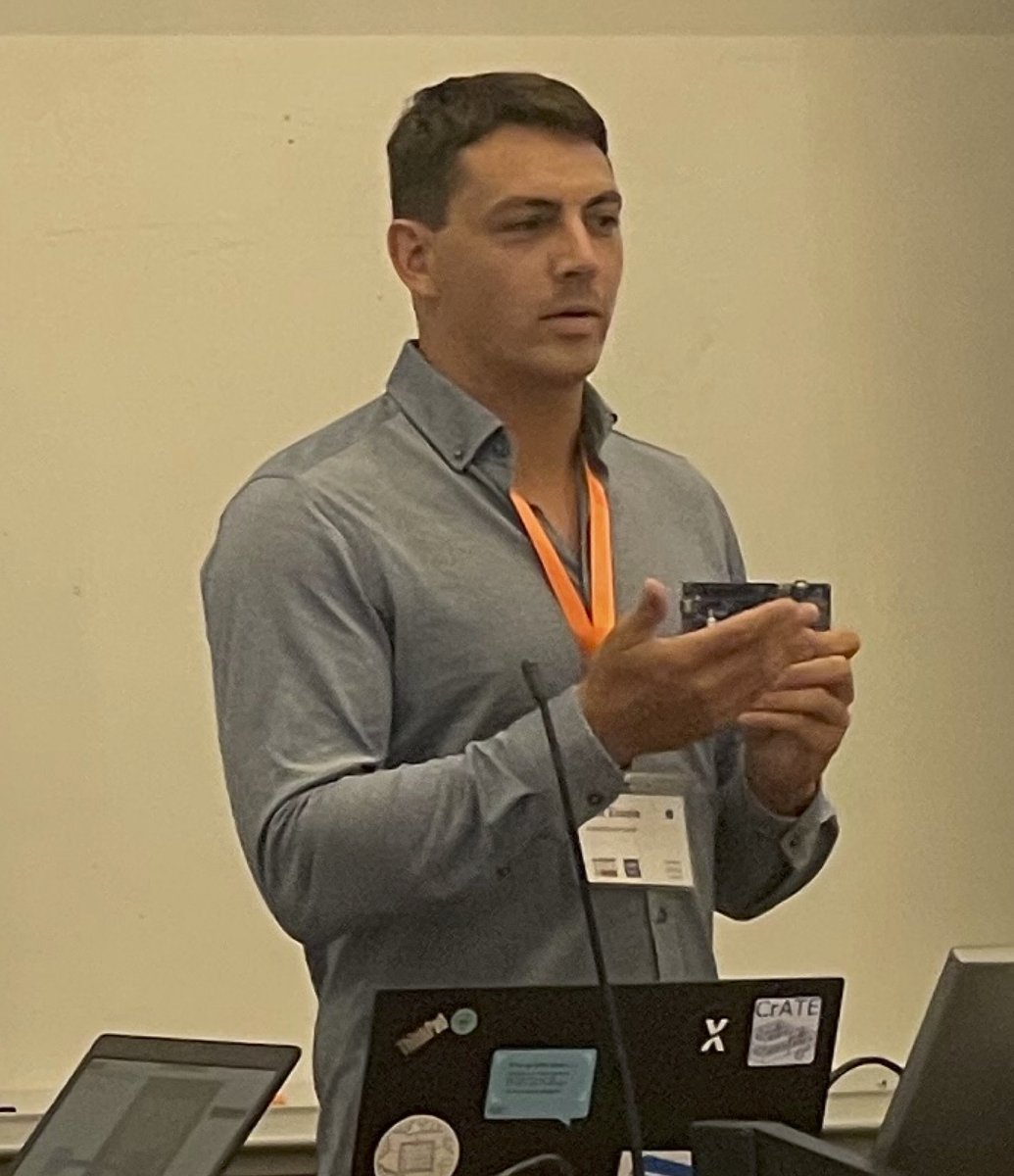
Here’s @MaxCamillo in his talk, presenting actual hardware boards (shudder!) to software engineers
19 Jul 2023

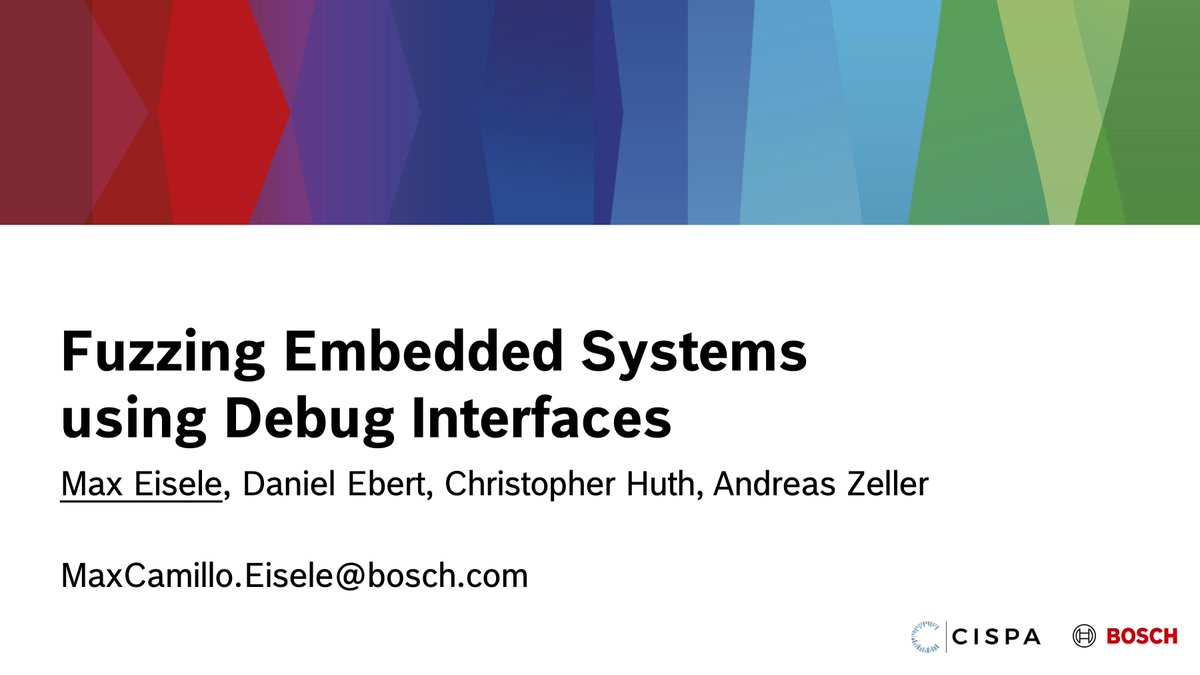
Fuzzing embedded systems! If you’re at @issta_conf or @ECOOPconf today, drop in at 2:15pm at G01 and see how we use GDB (yes, the GNU debugger) to fuzz test software running on embedded systems hardware: 2023.issta.org/details/issta…
1
2
12
1,999
Max Eisele retweeted
19 Jul 2023
Fuzzing embedded systems! If you’re at @issta_conf or @ECOOPconf today, drop in at 2:15pm at G01 and see how we use GDB (yes, the GNU debugger) to fuzz test software running on embedded systems hardware: 2023.issta.org/details/issta…
1
2
23
4,535

5 Jun 2023
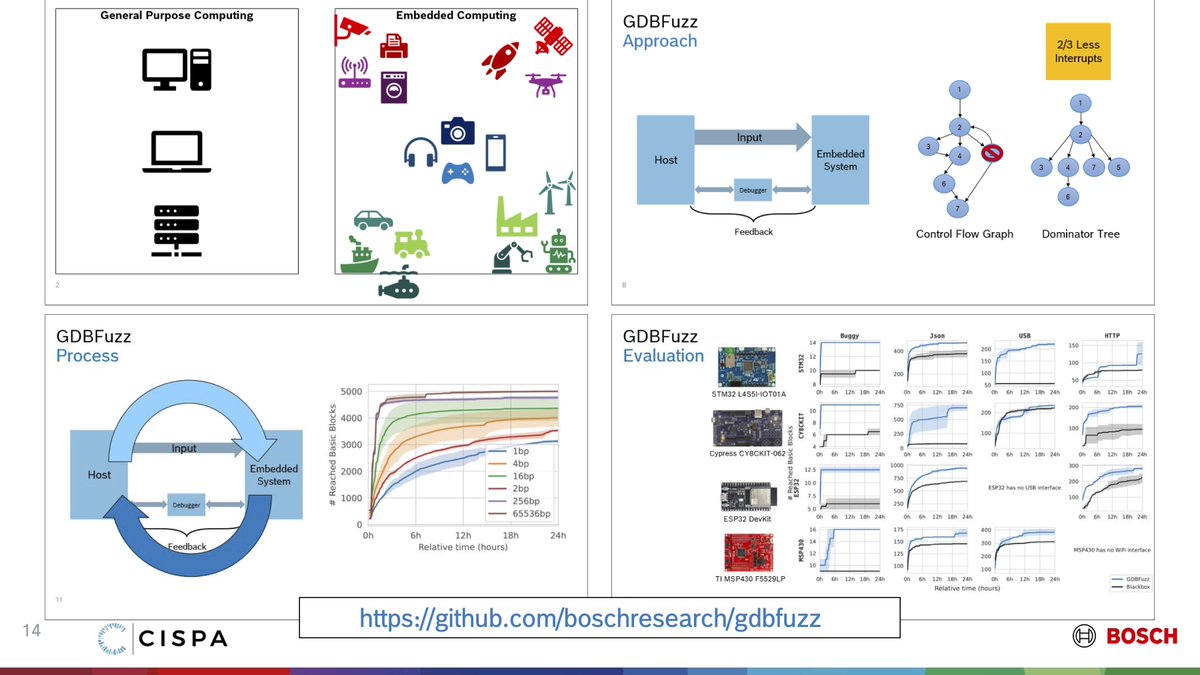
I just published a summary of our tool "GDBFuzz", which enables fuzzing of embedded systems on a scale using the standard GDB remote protocol and hardware breakpoints: link.medium.com/8DZ2zmSInAb
1
20
57
6,380
23 May 2023
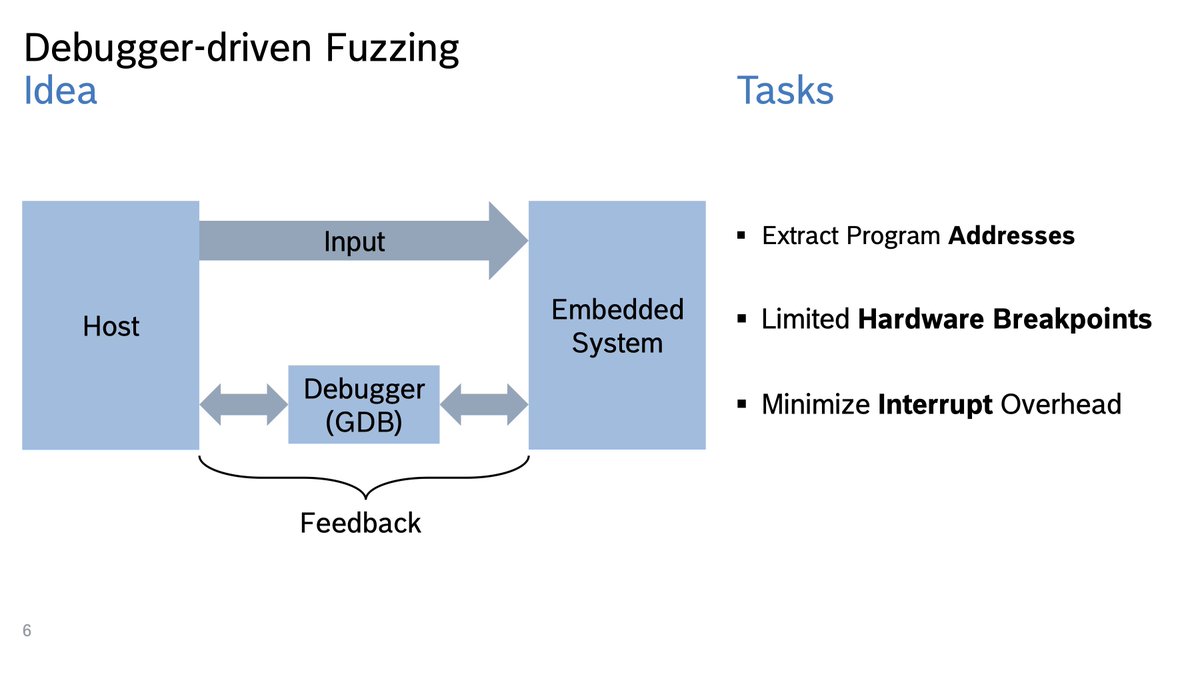
Happy to announce that our paper "Fuzzing Embedded Systems using Debug Interfaces" is accepted at #ISSTA2023 ! In the paper, we present our debugger-driven fuzzer GDBFuzz , which leverages hardware breakpoints to gain coverage feedback.
@AndreasZeller
1
3
18
21,368
23 May 2023
Essentially, we show that the limited amount of hardware breakpoints typically present in microcontrollers suffice to perform coverage-guided fuzzing independent from processor architecture.
1
2
294
23 May 2023
Based on this observation, we implemented GDBFuzz, which orchestrates the fuzzing process and controls debug units via the standard GDB remote serial protocol. A preprint is already available at publications.cispa.saarland/…
5
266