
Primum non nocere
Joined August 2019
- Tweets 36,412
- Following 0
- Followers 613
- Likes 54
13,340 Photos and videos


Pinned Tweet

𝙸𝚂𝚁𝙰𝙴𝙻 𝙸𝚂 𝙰𝙽 𝙸𝙽𝚂𝚄𝙻𝚃 𝚃𝙾 𝙷𝚄𝙼𝙰𝙽𝙸𝚃𝚈
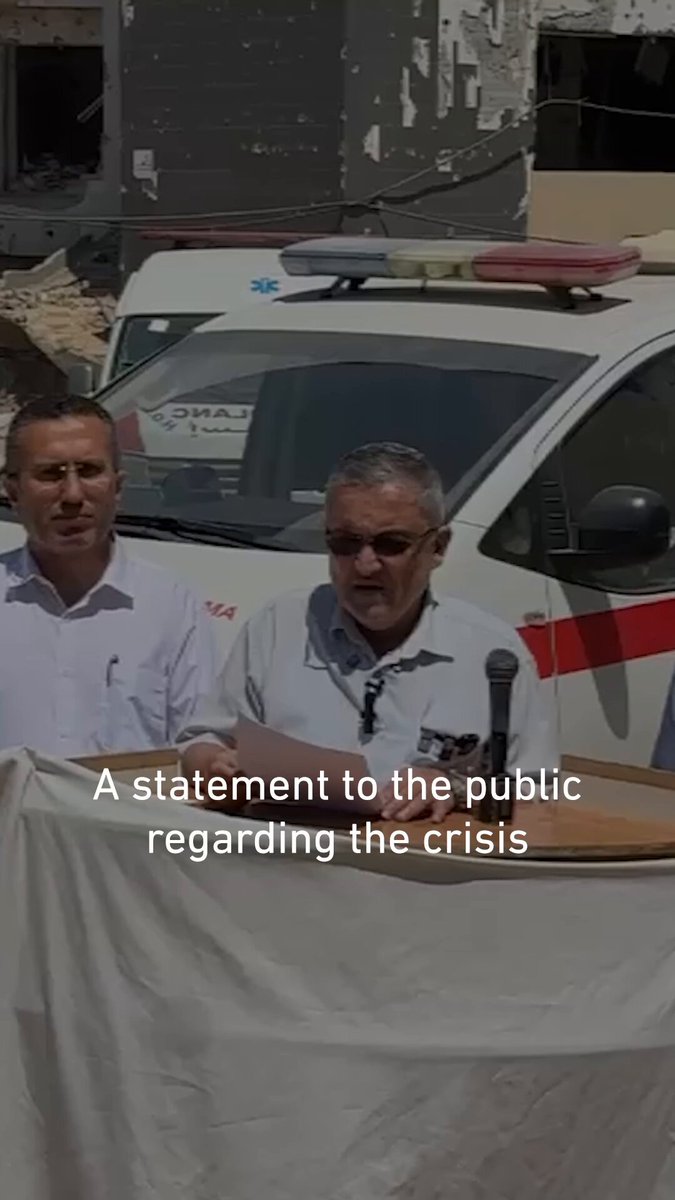
More than 500 days after his arrest by Israeli forces, Dr Hussam Abu Safiya—the director of Kamal Adwan Hospital and one of Gaza’s most respected pediatricians—has finally appeared before Israel’s Supreme Court. His appearance on 10 June was not a sign of justice finally being served. Rather, it exposed the profound injustice of a detention system that has imprisoned a physician for over a year and a half without charge, without trial, and without presenting credible evidence of wrongdoing.
The image of Dr Abu Safiya emerging after months of disappearance shocked observers. Once known as the determined doctor who remained beside his patients while northern Gaza's healthcare system collapsed under bombardment, he appeared visibly weakened, having suffered dramatic weight loss and deteriorating health. His lawyers reported ongoing medical problems and appealed for his immediate release, arguing that his continued detention is arbitrary, unlawful, and unsupported by any formal accusation.
His own words, conveyed through lawyer Nasser Abu Odeh, stand as a devastating indictment of his imprisonment:
"I am a paediatrician. I provide medical services and care to patients, the injured, and the vulnerable in the Strip. I carried out my work in accordance with international law and humanitarian standards. My detention is arbitrary and unjust. I demand that the court release me immediately."
That statement should never have needed to be made.
Dr Abu Safiya's alleged crime was not violence, incitement, or participation in military activity. His defining act was refusing to abandon sick and wounded patients while Gaza's hospitals came under relentless attack. In any society claiming respect for humanitarian principles, such conduct would be honoured. Instead, it has apparently become grounds for indefinite imprisonment.
His case represents something larger than the fate of one individual. According to human rights organisations, he is one of at least fourteen Palestinian doctors from Gaza who have been detained for more than a year without charge. Physicians for Human Rights Israel has raised concerns that these detainees have been denied adequate medical treatment and nutrition while facing physical abuse and degrading conditions.
The implications are grave. International Humanitarian Law (IHL) provides explicit protections for medical personnel operating in conflict zones. Doctors, nurses, paramedics, and hospital administrators are not combatants. Their duty is to preserve life regardless of nationality, religion, or political affiliation. When physicians are arrested for carrying out that mission, the boundary separating warfare from persecution begins to disappear.
The detention of Dr Abu Safiya also raises troubling questions about the broader treatment of Gaza's healthcare sector. Since the beginning of the Israeli genocidal war, almost all of Gaza's 36 hospitals have suffered damage, destruction, or forced closures, with only a fraction remaining even partially functional. Medical facilities have been rendered inoperable, healthcare workers killed, displaced, or detained, and access to essential treatment severely restricted. The imprisonment of a pediatrician who remained at his post until the very end has become emblematic of a wider assault on the institutions responsible for keeping civilians alive.
What makes the situation particularly alarming is the apparent normalization of prolonged detention without charge. Holding a person for more than 500 days while failing to bring a case against them strikes at the core principles of due process, judicial accountability, and the rule of law. If a state possesses evidence, it must present it before an independent court. If it does not, continued imprisonment becomes punishment without conviction.
The case of Dr Hussam Abu Safiya therefore transcends individual injustice. It has become a test of whether humanitarian service still carries legal protection, whether medical neutrality still means anything in modern warfare, and whether international law remains more than a collection of unenforced principles.
A physician who chose his patients over his own safety now stands before a court asking for the most basic right any human being should possess: freedom from arbitrary detention. The fact that such a request must be made after more than 500 days behind bars is itself a condemnation. The continued imprisonment of Dr Abu Safiya is not merely a legal controversy; it is a moral failure whose consequences extend far beyond the walls of a prison cell, reaching into the very foundations of humanitarian law and human dignity.
Epiphonema (Informative Note)
In recent history, the UN Human Rights Commission, on three occasions, defined the actions of the Israeli army in Palestine as “war crimes and an insult to humanity” (12/1977 - 02/1985 - 10/2000). Israel has been led by leaders convicted of terrorism by the British Mandate in Palestine, by the United Nations, and finally by its own investigative bodies, among whom are the names of Abraham Stern, Menachem Begin, and Ariel Sharon. The latter was judged by the Israeli Kahan inquiry commission as "personally responsible" for the massacre of 1,700 Arab civilians in September 1982, after already being condemned for terrorism by the UN Security Council in Resolution 101 of 1953.

𝙸𝚂𝚁𝙰𝙴𝙻 𝙸𝚂 𝙰𝙽 𝙸𝙽𝚂𝚄𝙻𝚃 𝚃𝙾 𝙷𝚄𝙼𝙰𝙽𝙸𝚃𝚈
The footage emerging from Masafer Yatta is not simply disturbing; it is profoundly degrading. Illegal Israeli settlers tied a dead dog to a military vehicle, dragged it through the streets, and dumped it near Palestinian homes. This was not an act of necessity, security, or even random vandalism. It was an act designed to humiliate, intimidate, and dehumanize.
Cruelty has always been about more than physical harm. Throughout history, occupying powers, colonial projects, and systems of domination have often relied on symbolic acts intended to send a message: that one community possesses power while another is expected to endure humiliation. The desecration of animals, the destruction of property, the uprooting of olive trees, the theft of livestock, and the intimidation of families occur repeatedly within the same environment, becoming part of a broader language of domination.
What makes this episode particularly shocking is its apparent pointlessness. No military objective was achieved. No security threat was addressed. No public interest was served. The act appears to have had only one purpose: to inflict psychological distress on a vulnerable civilian population already living under immense pressure.
Masafer Yatta has for years become synonymous with mounting tensions over land, displacement, demolitions, and illegal settler violence. Human rights organizations, journalists, and international observers have repeatedly documented allegations of harassment, attacks on residents, restrictions on movement, destruction of homes, and attempts to make daily life unbearable for Palestinian communities. Against this backdrop, the dragging and dumping of a dead animal near people's homes acquires a significance that extends beyond the act itself. It becomes another Mafia-style signal to residents that they are expected to live under constant intimidation.
Equally troubling is the recurring perception that such incidents occur within a climate of near-total impunity. The most dangerous consequence of impunity is not merely the absence of punishment after an abuse has occurred. It is the encouragement it provides for future abuses. When individuals believe that their actions will carry no legal, political, or moral consequences, boundaries that once seemed unthinkable can rapidly disappear.
A society should be judged by how it treats the vulnerable, whether human or animal. The deliberate mistreatment of an animal as a tool of humiliation reflects a profound erosion of ethical restraint. When that act is directed toward a civilian population already living under occupation and uncertainty, the moral implications become even more severe.
No nation that claims adherence to democratic values, human rights, and the rule of law should tolerate such conduct. No government should dismiss it as trivial. No international actor should look away simply because the victims belong to a politically inconvenient population.
The images from Masafer Yatta should provoke outrage not because they involve a dead dog alone, but because they reveal something deeper: the normalization of degradation as a method of exerting power. When humiliation becomes routine, when intimidation becomes commonplace, and when accountability remains absent, the damage extends far beyond a single village. It corrodes the very principles of human dignity upon which any just society must rest.
The residents of Masafer Yatta, like all civilians, are entitled to live free from fear, harassment, and humiliation. Any act designed to deny them that basic dignity deserves unequivocal condemnation. Silence in the face of such behaviour does not preserve peace; it merely signals that those responsible can continue without consequence. And that is precisely how cycles of abuse become entrenched.
Epiphonema (Informative Note)
In recent history, the UN Human Rights Commission, on three occasions, defined the actions of the Israeli army in Palestine as “war crimes and an insult to humanity” (12/1977 - 02/1985 - 10/2000). Israel has been led by leaders convicted of terrorism by the British Mandate in Palestine, by the United Nations, and finally by its own investigative bodies, among whom are the names of Abraham Stern, Menachem Begin, and Ariel Sharon. The latter was judged by the Israeli Kahan inquiry commission as "personally responsible" for the massacre of 1,700 Arab civilians in September 1982, after already being condemned for terrorism by the UN Security Council in Resolution 101 of 1953.
1
3
314
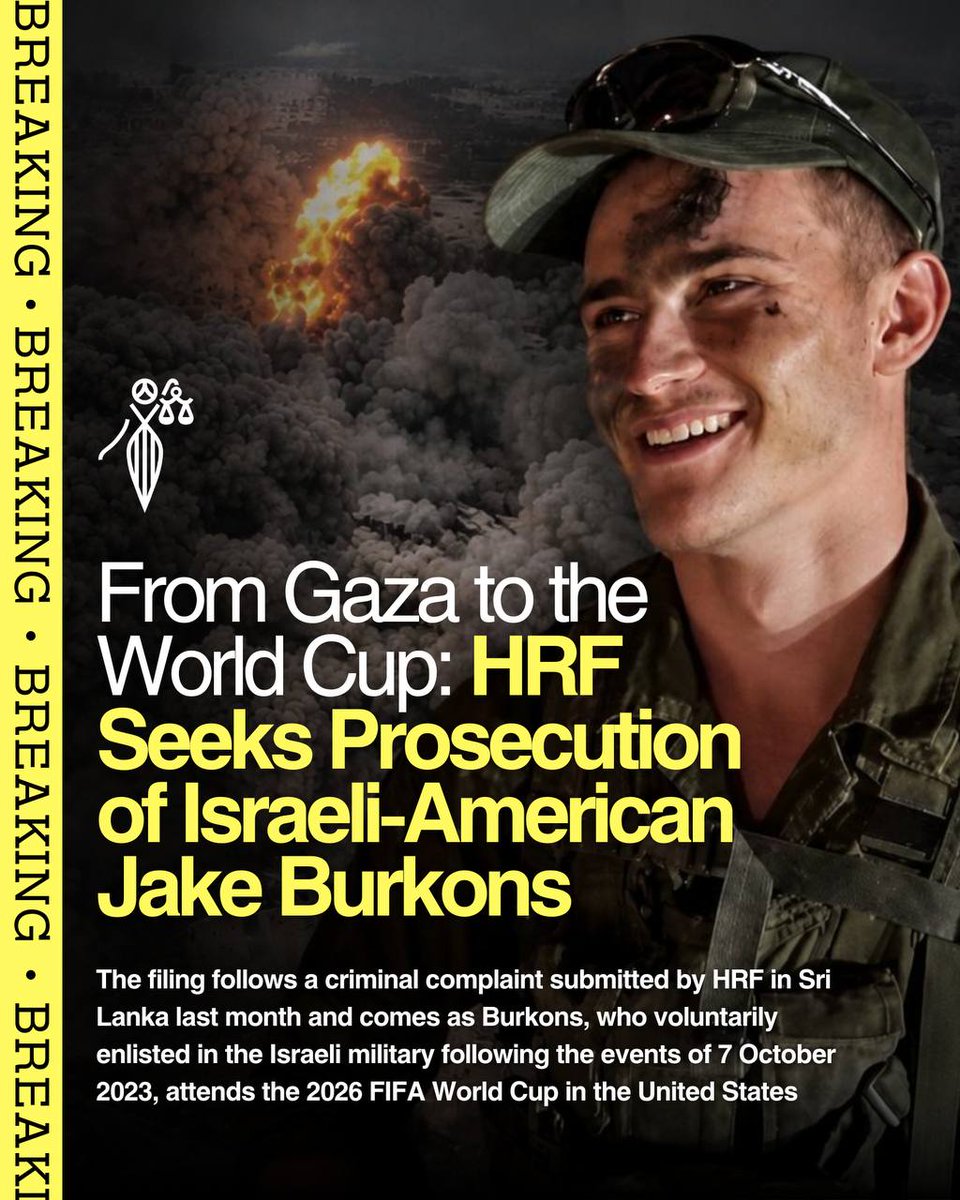
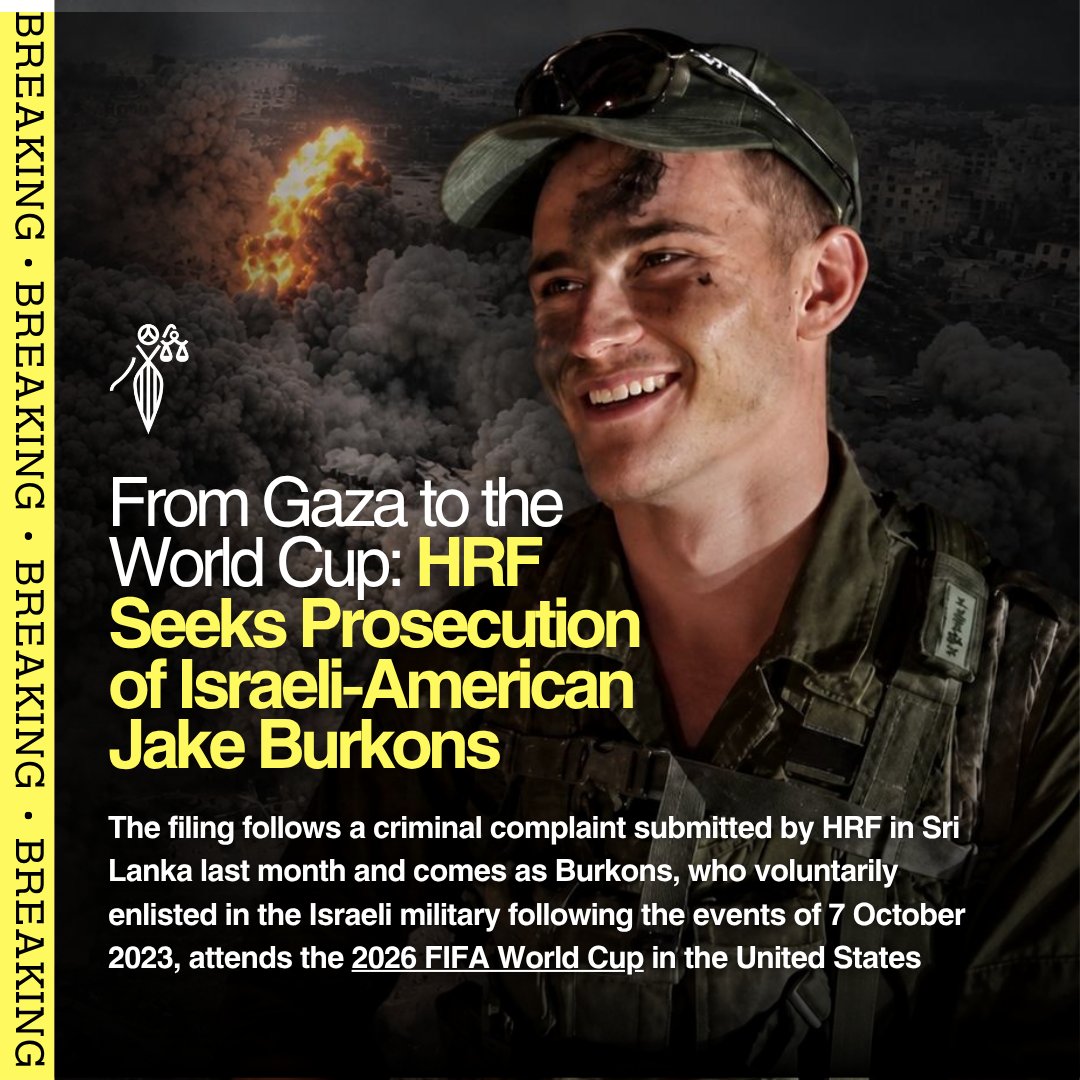
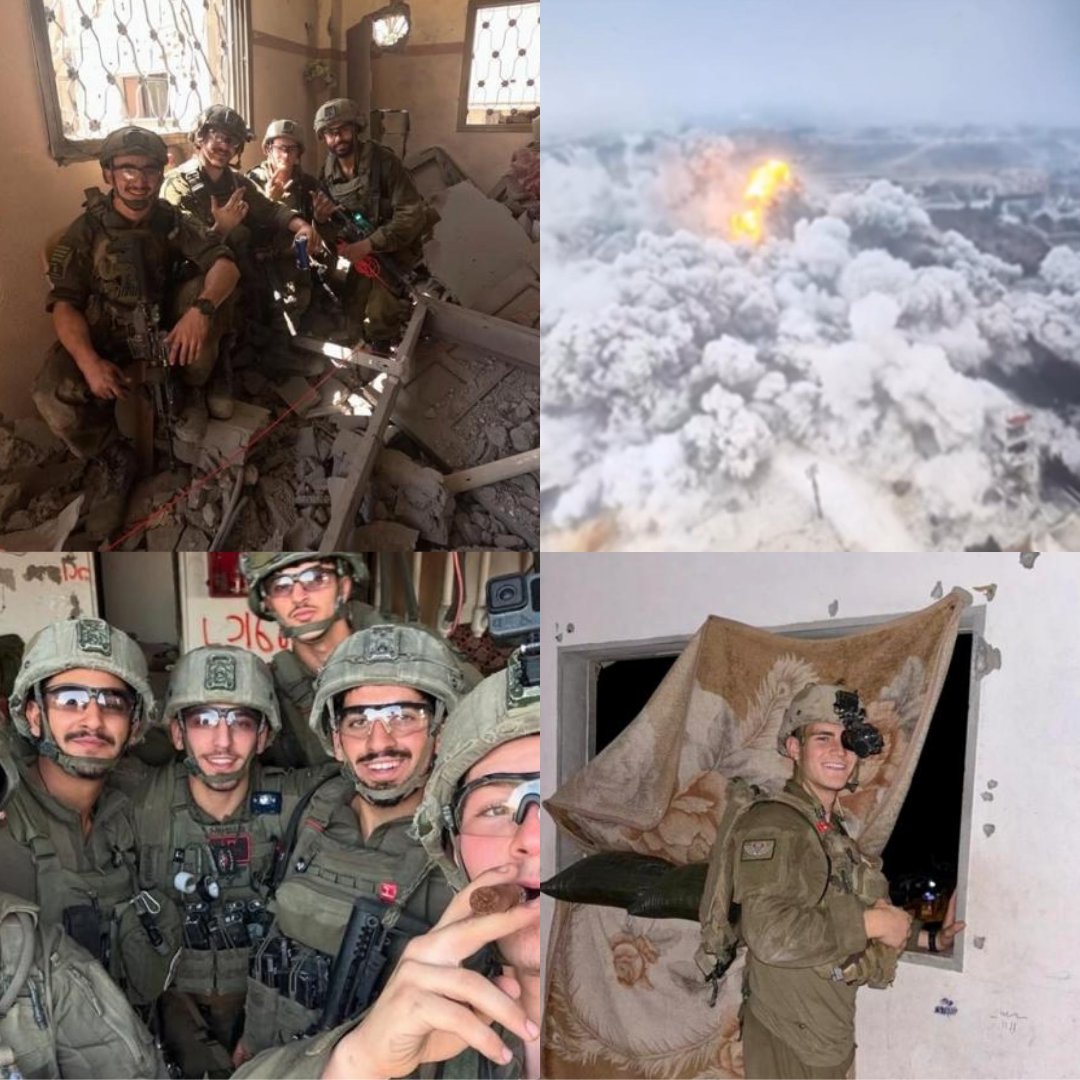
🚨 The Hind Rajab Foundation (HRF) has filed a request for prosecution with the 🇺🇸 #UnitedStates Department of Justice (DOJ) against Jake Burkons, an Israeli-American dual national, based on evidence of his alleged involvement in 𝚠𝚊𝚛 𝚌𝚛𝚒𝚖𝚎𝚜 and acts of 𝚐𝚎𝚗𝚘𝚌𝚒𝚍𝚎 committed in the 𝙶𝚊𝚣𝚊 Strip. Burkons is currently in the United States, where he is attending the 2026 FIFA World Cup.
This filing follows a criminal complaint submitted by HRF in 🇱🇰 #SriLanka last month while Burkons was holidaying in the country.
Burkons served in Company D of the 603rd Combat Engineering Battalion, part of the Israeli army's 7th Armoured Brigade. He voluntarily enlisted following the events of 7 October 2023 and was subsequently deployed to 𝙶𝚊𝚣𝚊, where he took part in military operations.
As Burkons is currently present in the United States and holds U.S. citizenship, HRF is calling on U.S. authorities to investigate, arrest, and prosecute Jake Burkons, prevent his departure from the country, and ensure accountability for alleged crimes committed in 𝙶𝚊𝚣𝚊.
Full details → bit.ly/4euoBZa
▬▬▬▬▬▬
Join the Hind Rajab Foundation’s legal mission to fight impunity. Become a monthly sponsor or make a one-time gift. Every contribution comes from individuals like you—who care. → bit.ly/hrf-support

🚨🇺🇸 The #HindRajabFoundation has filed a request for prosecution in the United States against Israeli-American Jake Burkons for alleged involvement in crimes committed in the Gaza Strip. Burkons is currently in the U.S. attending the 2026 FIFA World Cup.
HRF is calling on U.S. authorities to investigate, arrest, and prosecute Burkons, prevent his departure from the country, and ensure accountability.
➡️ More → bit.ly/4euoBZa
26
Medical Science and Technology #earlytreatments retweeted

🚨🇺🇸 The #HindRajabFoundation has filed a request for prosecution in the United States against Israeli-American Jake Burkons for alleged involvement in crimes committed in the Gaza Strip. Burkons is currently in the U.S. attending the 2026 FIFA World Cup.
HRF is calling on U.S. authorities to investigate, arrest, and prosecute Burkons, prevent his departure from the country, and ensure accountability.
➡️ More → bit.ly/4euoBZa
16
744
1,256
13,903
Hebron, Road 60, and the Unmaking of Oslo: Israel’s Accelerating Drive Toward Annexation
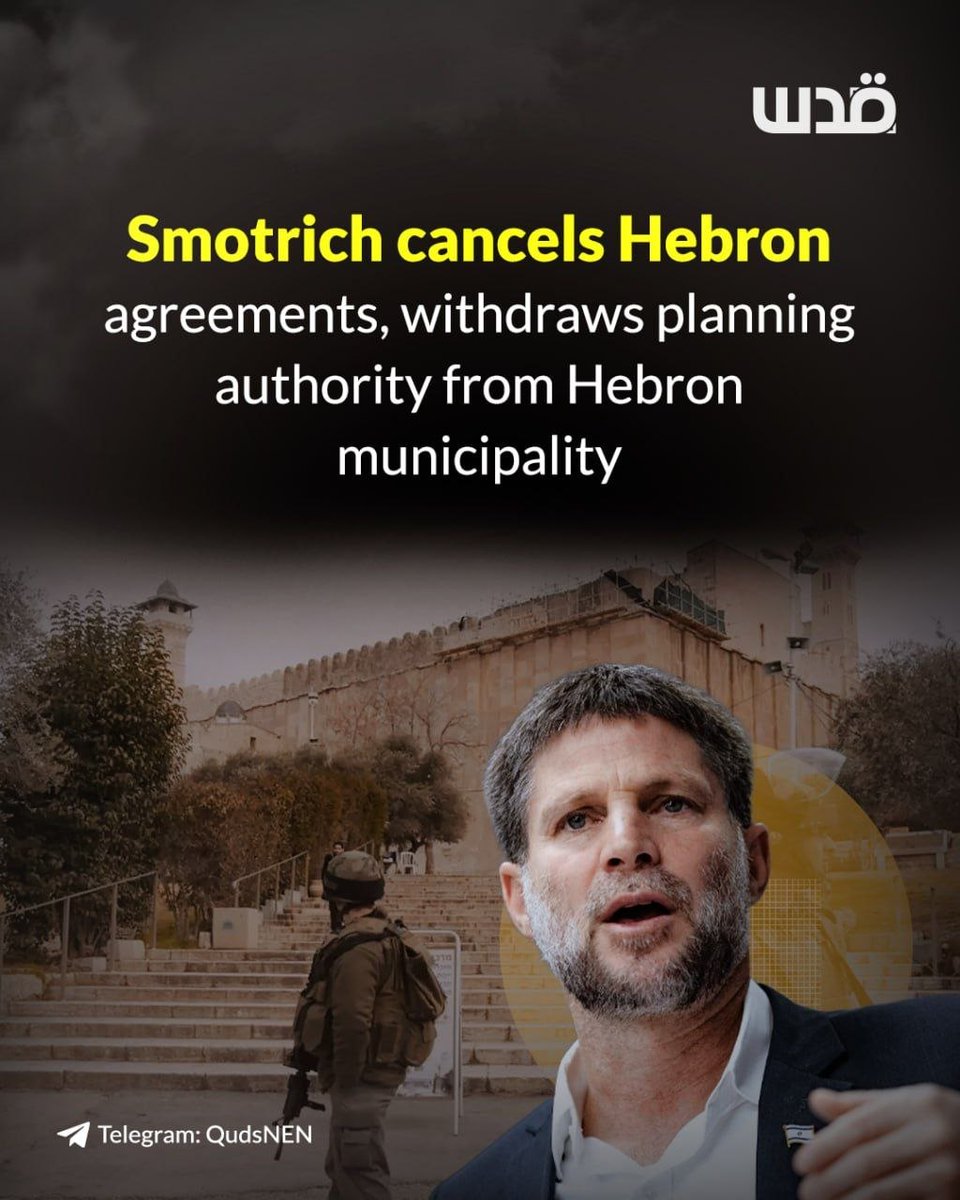
Israeli Finance Minister Bezalel Smotrich’s decision to revoke key provisions of the 1997 Hebron Protocol marks another significant step in the erosion of the Oslo framework that has governed relations between Israel and the Palestinians for nearly three decades. By transferring planning, construction and administrative powers from the Hebron Municipality to Israeli authorities, the move places even greater portions of the occupied city under direct Israeli control.
The Hebron Protocol divided the city into H1 and H2 sectors, establishing a fragile arrangement intended to balance Palestinian self-administration with Israeli security concerns. Smotrich’s announcement effectively dismantles parts of that arrangement, including authorities linked to urban planning and the area surrounding the Ibrahimi Mosque, one of the most sensitive religious sites in the occupied West Bank.
The decision comes amid a broader transformation of the territory. Parallel to the changes in Hebron, Israel continues expanding Highway 60, the strategic north-south artery connecting settlements throughout the West Bank. Palestinian officials and rights groups argue that the project is not merely a transportation initiative but a territorial re-engineering programme designed to integrate settlements, fragment Palestinian communities and facilitate future annexation.
The expansion involves extensive land confiscations, demolition orders, bypass roads and new infrastructure linking settlement blocs around Jerusalem, Hebron, Ramallah, Nablus and Salfit. Palestinian villages face the loss of agricultural land, increased restrictions on movement and growing geographic isolation as settlement corridors expand.
Taken together, the cancellation of elements of the Hebron Protocol and the continued development of Highway 60 point toward a wider strategy aimed at replacing temporary occupation arrangements with a more permanent system of control. What was once presented as an interim framework pending a negotiated settlement increasingly appears to be giving way to facts created on the ground.
These measures represent not isolated administrative decisions but part of a long-term project to consolidate Israeli authority across large parts of the occupied West Bank, reducing the space available for Palestinian self-governance while further undermining the prospects for a viable and contiguous Palestinian state.
Epiphonema (Informative Note)
On 18 September 2024, the @UN General Assembly overwhelmingly adopted a resolution (news.un.org/en/story/2024/09…) demanding that @Israel “brings to an end without delay its unlawful presence” in the Occupied Palestinian Territory within 12 months. The resolution—grounded in the International Court of Justice’s (ICJ) advisory opinion of July 2024—declares Israel’s occupation, the proliferation of settlements, and resource exploitation illegal under international law and calls for reparations. It commands not just Israel but also obliges all UN member states to refrain from sustaining this illegal status quo.
That deadline has now passed. Israel has defied the General Assembly, ignored the Court, and intensified its crimes. The Independent International Commission of Inquiry on the Occupied Palestinian Territory, including East Jerusalem, and Israel has now concluded that Israel’s actions constitute a genocide. In the face of this grave reality, the international community must commit — not to rhetoric, but to action.
Al-Aqsa Under Siege: The Assault on Custodianship, Identity, and International Law
The reported emptying of four Islamic Waqf facilities inside the Al-Aqsa Mosque compound marks far more than an administrative dispute over office space. It represents another step in a broader campaign aimed at weakening the institutional structures that have safeguarded one of Islam’s holiest sites for generations. According to Palestinian monitors, Israeli authorities targeted facilities located across different sections of the compound, citing security justifications while preventing their normal use and administration.
Viewed in isolation, the closure of offices may appear minor. Viewed within the wider context of developments in occupied East Jerusalem, however, it assumes a far more troubling significance. Over recent years, Palestinians, Jordanian officials, religious authorities, and numerous international observers have repeatedly warned that measures once considered exceptional are increasingly becoming permanent features of governance around Al-Aqsa. Restrictions on worshippers, repeated incursions by settlers and political figures, proposals to alter access arrangements, challenges to the authority of the Islamic Waqf, and discussions regarding alternative administrative structures have combined to create the perception of a sustained effort to transform the status quo governing the compound.
The Islamic Waqf is not merely a bureaucratic institution. It is the custodian of centuries of religious, cultural, and historical continuity in Jerusalem. The Jordanian-backed body administers one of the most sensitive religious sites on earth and plays a central role in maintaining the delicate arrangements that have helped prevent the city’s competing national and religious claims from descending into even greater confrontation. Undermining its authority therefore carries consequences extending far beyond the walls of the mosque compound itself.
What makes the latest developments particularly alarming is their apparent connection to broader political discussions concerning the future administration of Al-Aqsa. Reports indicating that alternative governance structures are being explored have intensified fears that the gradual erosion of Waqf authority is not accidental but strategic. Whether such plans ultimately materialise or not, the perception among Palestinians that their religious institutions are being systematically sidelined is itself profoundly destabilising: trust, once lost in a place as sensitive as Jerusalem, is extraordinarily difficult to restore.
The issue is not only political but also legal and diplomatic. East Jerusalem remains occupied territory under international law, and the status of its holy places has long been regarded as a matter of international concern. Any unilateral attempt to alter established arrangements risks deepening tensions not only between Israelis and Palestinians but across the wider region. Al-Aqsa is not a local shrine. It is a site revered by hundreds of millions of Muslims worldwide. Actions perceived as threatening its identity or administration inevitably resonate far beyond Jerusalem.
The repeated invocation of security concerns has also become increasingly controversial: when security arguments are used to justify measures that consistently weaken one side’s religious, cultural, or institutional presence, critics inevitably question whether security is the true objective or merely the language through which broader political goals are pursued. The closure of Waqf facilities, the restriction of administrative functions, and the targeting of longstanding religious institutions risk reinforcing precisely those suspicions.
History offers numerous warnings about attempts to reshape sacred spaces through unilateral power. Holy sites derive their significance not only from stone and architecture but from the communities, traditions, and institutions that sustain them. When those institutions are weakened or displaced, the result is often not stability but deeper conflict. Jerusalem’s history is filled with examples demonstrating that efforts to impose exclusive control over shared sacred spaces rarely produce peace; they instead generate resistance, resentment, and enduring instability.
For this reason, the sidelining of Waqf facilities should be viewed as more than a local administrative measure. It is part of a larger struggle over sovereignty, identity, memory, and legitimacy in one of the most contested cities on earth. If the current trajectory continues, the world may soon witness not merely a dispute over offices within Al-Aqsa, but a fundamental challenge to the religious and historical framework that has governed the compound for decades. Such a course would carry consequences extending far beyond Jerusalem, threatening to transform one of humanity’s most sacred sites into yet another arena of escalating political confrontation.
1
1
48

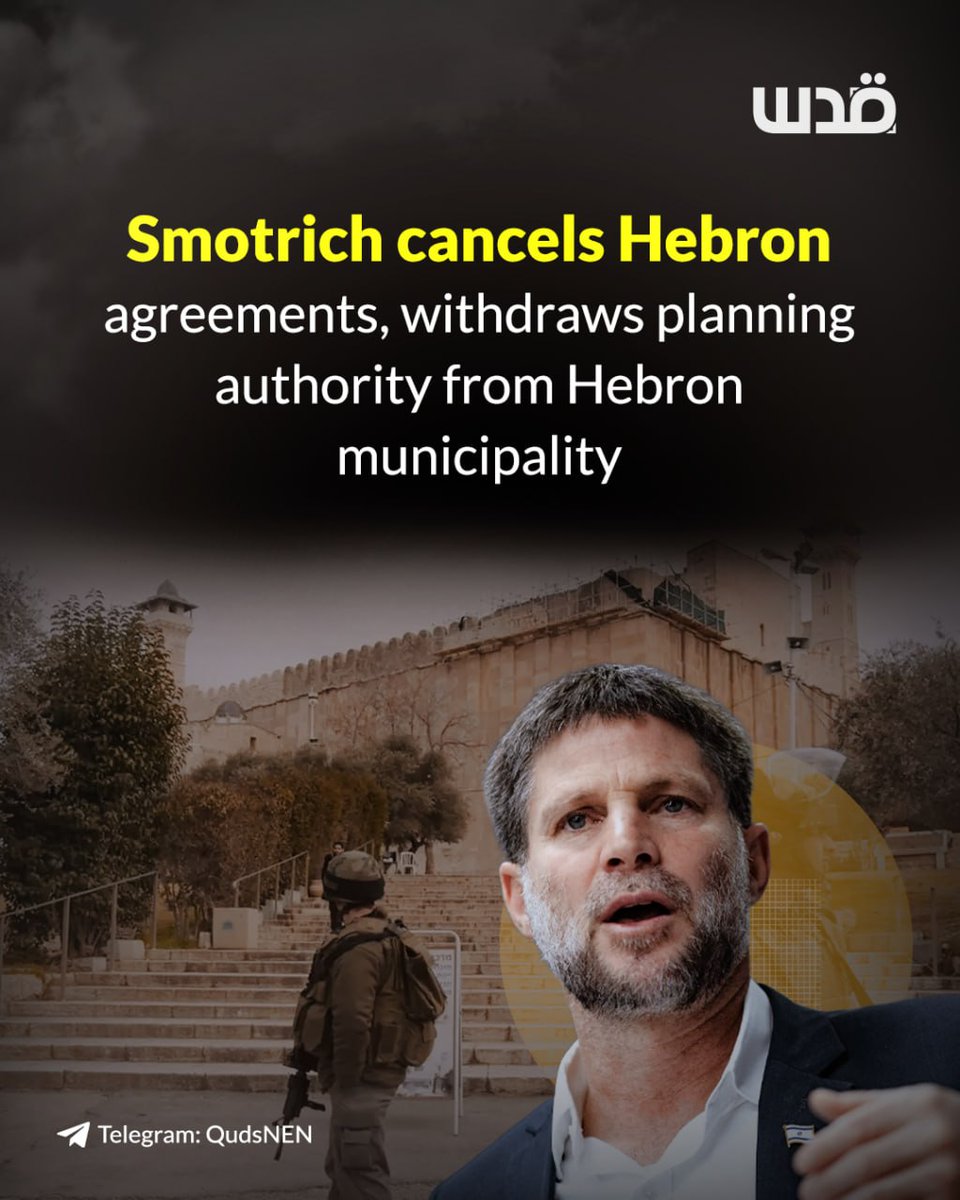
Hardcore Israeli Finance Minister Bezalel Smotrich announced today a decision to cancel provisions of the Hebron Protocol in the southern occupied West Bank and transfer related authorities to the occupation.
Speaking during the announcement of a new settlement project in Hebron, Smotrich said that all planning and construction powers previously granted to the Hebron Municipality under the Hebron Protocol had been revoked.
The decision effectively removes planning and building authority, as well as responsibilities related to the Ibrahimi Mosque, from the Hebron Municipality and places them under full Israeli control.
The Hebron Protocol, signed in 1997 as part of the Oslo process, divided the city of Hebron into two sectors: H1, administered by the Palestinian Authority, and H2, which remains under Israeli military control and includes the Ibrahimi Mosque and Israeli settlements established in the city.
1
17
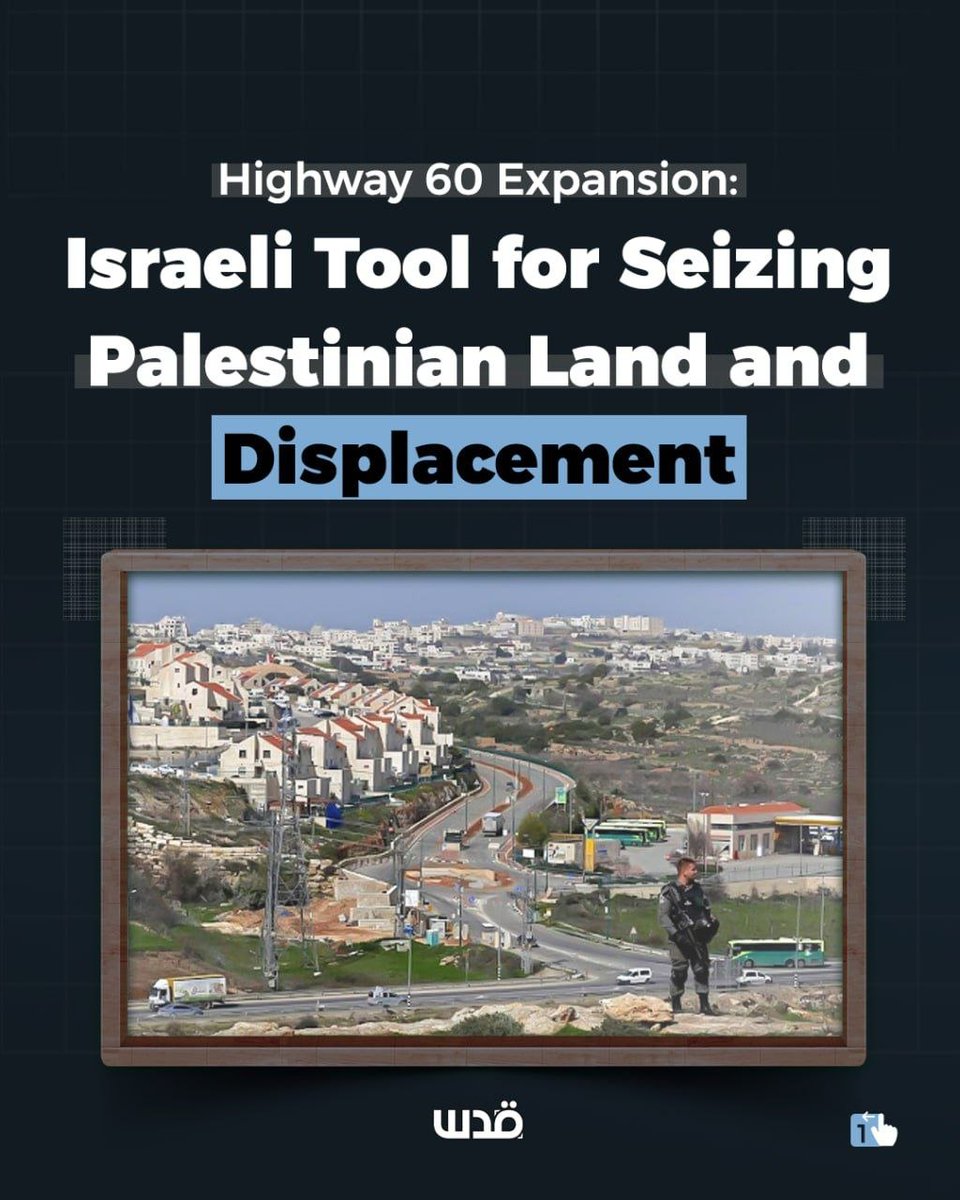
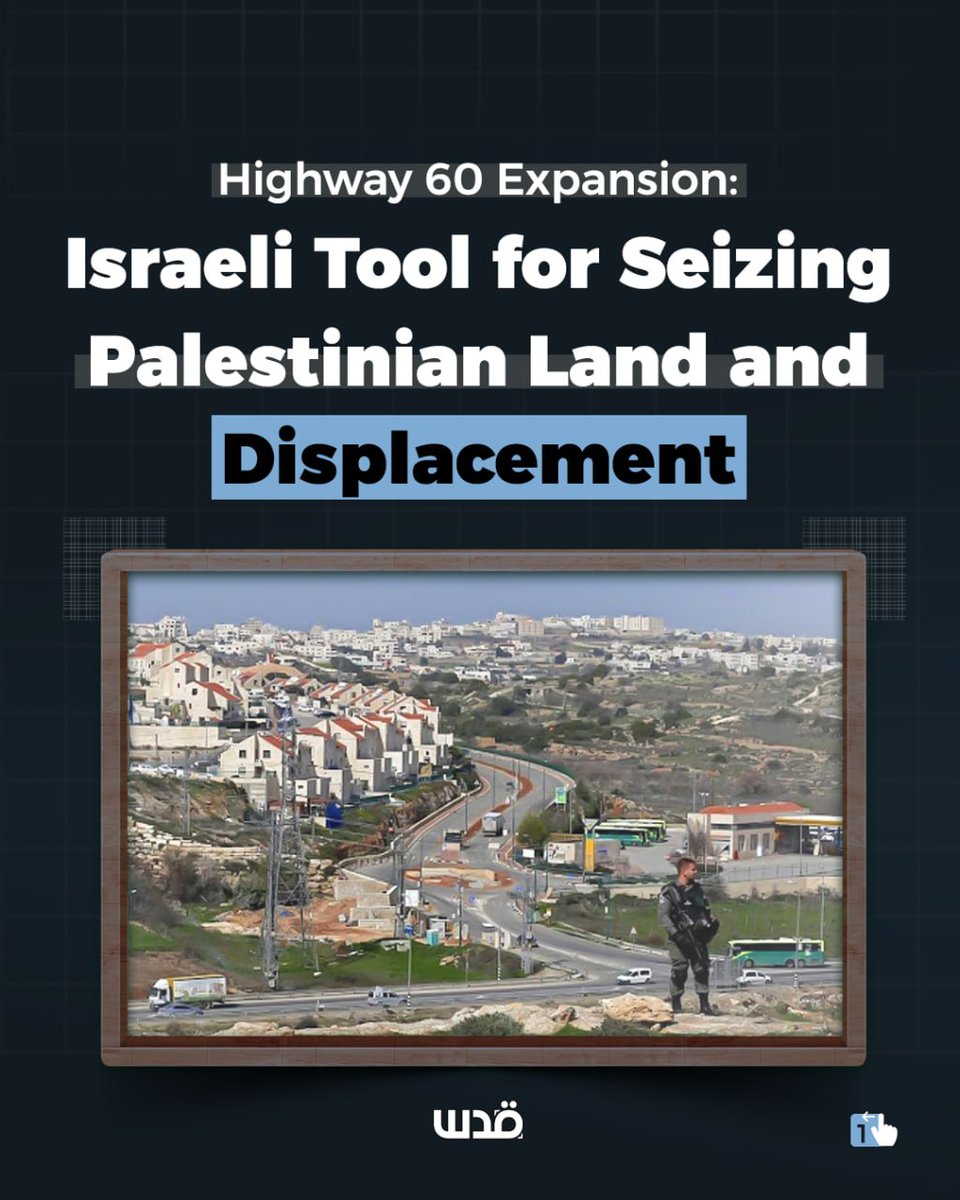
The Israeli occupation's plan to expand Road 60 is considered one of the most dangerous schemes, as it involves seizing large areas of Palestinian land from villages in several provinces of the occupied West Bank.
It includes the demolition of Palestinian homes, the displacement of villages, and plans for new vehicle roads as well as railway links.
This road has become an Israeli tool to facilitate the connection of settlements with one another and to ease the movement of Israeli settlers. It also imposes a new cordon on Palestinian towns, in addition to changes in routes and roads between Palestinian towns and villages.
5
Medical Science and Technology #earlytreatments retweeted
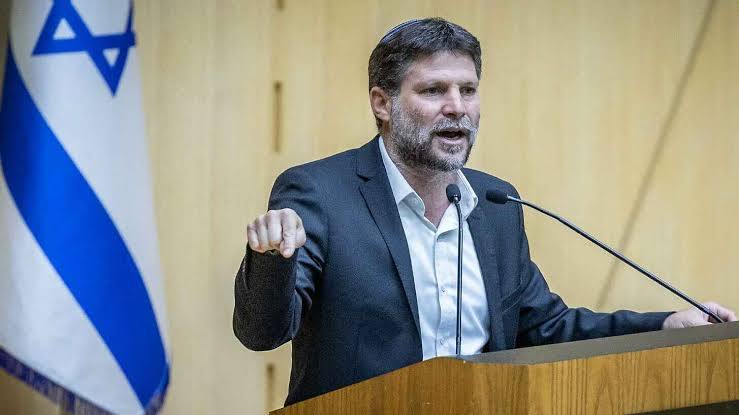
Breaking | Hard-right Israeli Finance Minister Bezalel Smotrich announces the cancellation of the Hebron Agreement and the withdrawal of planning and construction powers from the Hebron Municipality, transferring them to Israeli authorities.
The Hebron Agreement (Hebron Protocol) was signed in 1997 between Israel and the Palestine Liberation Organization (PLO). It divided the city of Hebron in the occupied West Bank into two areas: H1, placed under Palestinian Authority control, and H2, remaining under Israeli military control, including areas where Israeli settlers reside.
The agreement also set arrangements for security coordination and the redeployment of Israeli forces from parts of the city.
3
52
73
13,283
Al-Aqsa Under Siege: The Assault on Custodianship, Identity, and International Law
The reported emptying of four Islamic Waqf facilities inside the Al-Aqsa Mosque compound marks far more than an administrative dispute over office space. It represents another step in a broader campaign aimed at weakening the institutional structures that have safeguarded one of Islam’s holiest sites for generations. According to Palestinian monitors, Israeli authorities targeted facilities located across different sections of the compound, citing security justifications while preventing their normal use and administration.
Viewed in isolation, the closure of offices may appear minor. Viewed within the wider context of developments in occupied East Jerusalem, however, it assumes a far more troubling significance. Over recent years, Palestinians, Jordanian officials, religious authorities, and numerous international observers have repeatedly warned that measures once considered exceptional are increasingly becoming permanent features of governance around Al-Aqsa. Restrictions on worshippers, repeated incursions by settlers and political figures, proposals to alter access arrangements, challenges to the authority of the Islamic Waqf, and discussions regarding alternative administrative structures have combined to create the perception of a sustained effort to transform the status quo governing the compound.
The Islamic Waqf is not merely a bureaucratic institution. It is the custodian of centuries of religious, cultural, and historical continuity in Jerusalem. The Jordanian-backed body administers one of the most sensitive religious sites on earth and plays a central role in maintaining the delicate arrangements that have helped prevent the city’s competing national and religious claims from descending into even greater confrontation. Undermining its authority therefore carries consequences extending far beyond the walls of the mosque compound itself.
What makes the latest developments particularly alarming is their apparent connection to broader political discussions concerning the future administration of Al-Aqsa. Reports indicating that alternative governance structures are being explored have intensified fears that the gradual erosion of Waqf authority is not accidental but strategic. Whether such plans ultimately materialise or not, the perception among Palestinians that their religious institutions are being systematically sidelined is itself profoundly destabilising: trust, once lost in a place as sensitive as Jerusalem, is extraordinarily difficult to restore.
The issue is not only political but also legal and diplomatic. East Jerusalem remains occupied territory under international law, and the status of its holy places has long been regarded as a matter of international concern. Any unilateral attempt to alter established arrangements risks deepening tensions not only between Israelis and Palestinians but across the wider region. Al-Aqsa is not a local shrine. It is a site revered by hundreds of millions of Muslims worldwide. Actions perceived as threatening its identity or administration inevitably resonate far beyond Jerusalem.
The repeated invocation of security concerns has also become increasingly controversial: when security arguments are used to justify measures that consistently weaken one side’s religious, cultural, or institutional presence, critics inevitably question whether security is the true objective or merely the language through which broader political goals are pursued. The closure of Waqf facilities, the restriction of administrative functions, and the targeting of longstanding religious institutions risk reinforcing precisely those suspicions.
History offers numerous warnings about attempts to reshape sacred spaces through unilateral power. Holy sites derive their significance not only from stone and architecture but from the communities, traditions, and institutions that sustain them. When those institutions are weakened or displaced, the result is often not stability but deeper conflict. Jerusalem’s history is filled with examples demonstrating that efforts to impose exclusive control over shared sacred spaces rarely produce peace; they instead generate resistance, resentment, and enduring instability.
For this reason, the sidelining of Waqf facilities should be viewed as more than a local administrative measure. It is part of a larger struggle over sovereignty, identity, memory, and legitimacy in one of the most contested cities on earth. If the current trajectory continues, the world may soon witness not merely a dispute over offices within Al-Aqsa, but a fundamental challenge to the religious and historical framework that has governed the compound for decades. Such a course would carry consequences extending far beyond Jerusalem, threatening to transform one of humanity’s most sacred sites into yet another arena of escalating political confrontation.
Al-Aqsa at a Crossroads: Custodianship, Control, and the Battle for Jerusalem’s Islamic Identity
The struggle over Al-Aqsa Mosque is increasingly moving beyond periodic confrontations at its gates and courtyards into a broader contest over authority, identity, and control. Recent reports concerning proposals to alter Jordan's historic custodianship of the site, efforts to regulate Islamic religious practices, and changes in the personnel responsible for policing the compound have intensified concerns among Palestinians and Muslim institutions that the long-standing status quo governing Jerusalem's holy places is facing its most serious challenge in decades.
At the centre of these concerns are claims that political and religious actors in Israel, supported by influential voices in Washington, seek to transform the framework under which Al-Aqsa Mosque has been administered since 1967. According to Ismail Patel, chair of Friends of Al-Aqsa, proposals under discussion would remove the authority of the Jordanian-backed Islamic Waqf and replace it with a new structure more closely aligned with Israeli oversight. Such plans would fundamentally alter the character of the site by redefining it as a so-called "multi-faith centre" rather than a Muslim sanctuary administered according to established Islamic custodianship arrangements.
The issue extends far beyond institutional management. Such proposals are viewed as part of a wider effort to reshape the political and cultural identity of occupied East Jerusalem itself. Under this interpretation, changes to the governance of Al-Aqsa would not merely affect religious administration but would represent a significant shift in sovereignty claims over one of the most symbolically charged sites in the Israeli-Palestinian conflict.
These concerns have been reinforced by a separate controversy surrounding a proposed Israeli bill that would allow authorities to impose restrictions on the Muslim call to prayer. Sheikh Ekrima Sabri, the imam of Al-Aqsa Mosque and one of the most prominent religious figures in Jerusalem, warned that the legislation represents a dangerous escalation following years of unsuccessful attempts to limit the adhan. He argued that previous efforts focused on reducing the volume or frequency of the call to prayer, whereas the current proposal seeks to establish legal mechanisms enabling direct state intervention in a central element of Islamic religious life.
Supporters of the legislation have framed it in terms of noise regulation and public order. Opponents, however, see it as part of a broader pattern of measures targeting Palestinian and Islamic presence in Jerusalem. For many Palestinians, the adhan is not only a religious practice but also an audible expression of the city's historical and cultural identity. Any attempt to restrict it is therefore perceived as carrying significance beyond the purely administrative.
At the same time, reports published by Israeli media have raised additional questions about developments inside the Al-Aqsa compound itself. According to Haaretz, Israeli police have been actively recruiting religious Jewish and far-right officers to serve in and around the site. Recruitment efforts reportedly targeted networks associated with organisations that advocate expanded Jewish access to the compound and support changes to current restrictions governing prayer and visitation.
Palestinian officials and the Jerusalem Governorate have described the initiative as a particularly alarming development. In their view, placing officers with strong ideological commitments in positions responsible for managing one of the region's most sensitive religious spaces risks further eroding the neutrality expected of security forces operating at the site. Such measures could accelerate a gradual transfer of practical authority away from the Islamic Waqf and toward Israeli institutions.
Taken together, these developments have deepened fears that the future of Al-Aqsa Mosque is becoming intertwined with larger efforts to redefine the political, religious, and legal landscape of occupied Jerusalem. Whether these initiatives ultimately succeed or remain contested proposals, they highlight the central role that holy sites continue to play in the broader struggle over sovereignty, identity, and the future of the city. For Palestinians, Jordanians, and Muslims around the world, the debate is increasingly seen not simply as a dispute over administration but as a contest over the preservation of a historic status quo that has shaped Jerusalem for generations. middleeasteye.net/news/al-aq…
1
1
183

From blocked maintenance crews to revoked permits to emptied landmarks, Israel is systematically sidelining the Waqf at Al-Aqsa.
Sources tell us the plan goes much further than anyone has officially admitted.
4
The Architecture of Displacement: How Demolitions Are Reshaping the Occupied West Bank
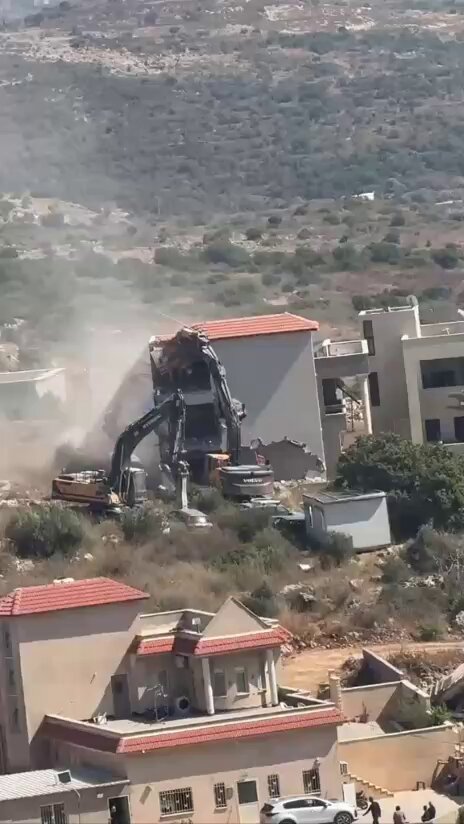
The demolition campaign unfolding in the town of Barta'a in the northern occupied West Bank has become emblematic of a broader reality facing many Palestinian communities under occupation. Under the pretext of lacking Israeli-issued building permits, occupation authorities have intensified the destruction of homes, apartment buildings and commercial structures, leaving families displaced and entire neighbourhoods under constant threat.
Israeli forces, accompanied by bulldozers and heavily armed units, entered the town to carry out a new wave of demolitions, including the destruction of a multi-storey residential building. These operations follow a series of demolitions conducted only days earlier, during which at least fifteen homes were reportedly razed. Residents and local officials describe the campaign as unprecedented in scale, arguing that it forms part of a systematic effort to reshape the demographic and physical landscape of the occupied territory.
At the centre of the controversy lies the permit system itself. Palestinians living in areas under Israeli control face immense obstacles in obtaining building permits, with applications frequently delayed, rejected or left unresolved for years.
The events in Barta'a are taking place amid growing concerns over wider Israeli policies in the occupied West Bank, including land registration initiatives, settlement expansion, restrictions on Palestinian development and increasing displacement from refugee camps and rural communities. These measures are not isolated administrative actions but components of a broader strategy that gradually alters realities on the ground while weakening the territorial continuity of Palestinian communities.
For the families watching their homes reduced to rubble, the consequences are immediate and devastating. Years of labour, savings and personal history can disappear within hours. Beyond the physical destruction, the repeated demolitions send a stark message about power, control and permanence in a territory whose future remains one of the most contested issues in modern international politics.
Khan Al-Ahmar: “We Will Stay Here” as Bedouin Community Defies Expulsion Order
The Palestinian Bedouin community of Khan Al-Ahmar, east of Jerusalem in the occupied West Bank, has once again become the focal point of a long-running struggle over land, displacement and settlement expansion after Israeli Finance Minister Bezalel Smotrich reportedly ordered the immediate expulsion of the village’s residents. The move has reignited fears that one of the most symbolically important Palestinian communities in the West Bank could soon face forced removal after years of legal, political and military pressure.
Residents have responded with open defiance, insisting they will not abandon their land despite repeated threats of demolition and displacement. “How much longer will the Palestinian people be displaced? We are refugees and they keep evicting us,” said Mohammed Ibrahim, a resident of Khan Al-Ahmar. “After everything that has happened to us, we won’t leave, we will stay here.” His words reflect not only local resistance, but a broader Palestinian fear that repeated expulsions are becoming a central mechanism of territorial transformation across the occupied West Bank.
Khan Al-Ahmar, home to a Bedouin community largely descended from families displaced from the Negev in the 1950s, has long occupied strategic significance far beyond its modest size. The village lies in the highly contested E1 corridor between occupied East Jerusalem and the Israeli settlement of Maale Adumim. For years, Israeli authorities and settler groups have sought its removal, arguing that the community was built without permits—permits that Palestinians say are almost impossible to obtain under Israeli planning systems in Area C.
Clearing Khan Al-Ahmar would do more than displace a vulnerable Bedouin population. It would strengthen territorial continuity between Israeli settlements east of Jerusalem, deepen fragmentation of Palestinian land, and further undermine the geographic viability of a future contiguous Palestinian state. For this reason, the village has become one of the most internationally watched symbols of resistance against displacement and annexation policies.
Human rights organisations and international observers have repeatedly warned that any forced transfer of protected civilian populations in occupied territory could raise serious concerns under International Humanitarian Law (IHL). Yet for the families of Khan Al-Ahmar, the issue remains immediate and deeply personal: whether they will once again be uprooted—or whether this small desert community can remain standing amid one of the most contested land struggles in the occupied West Bank.
1
1
77
Last night, Israeli settler militias set fire to a mosque while worshippers were inside and torched several vehicles during a large-scale attack on the town of Deir Dibwan, east of Ramallah in the occupied West Bank.
According to eyewitnesses, one elderly worshipper was doused with gasoline by attackers, who attempted to set him on fire, but he escaped without being burned.
1
8
Sayel Kanaan, the mayor of Burqa village, east of Ramallah in the occupied West Bank, speaks about the pogrom carried out by Israeli settlers in the village, where they torched a Palestinian vehicle near Al-Nour Mosque, broke down doors, and set the entrance of the mosque on fire.
6
𝗔 𝗨𝗦–𝗜𝗿𝗮𝗻–𝗣𝗮𝗸𝗶𝘀𝘁𝗮𝗻 𝘁𝗿𝗶𝗹𝗮𝘁𝗲𝗿𝗮𝗹, 𝘂𝗻𝗱𝗲𝗿𝗽𝗶𝗻𝗻𝗲𝗱 𝗯𝘆 𝗮 𝗨𝗦 𝘀𝘁𝗿𝗮𝘁𝗲𝗴𝘆 𝗰𝗹𝗼𝘀𝗲𝗹𝘆 𝗮𝗹𝗶𝗴𝗻𝗲𝗱 𝘄𝗶𝘁𝗵 𝗜𝘀𝗿𝗮𝗲𝗹𝗶 𝗶𝗻𝘁𝗲𝗿𝗲𝘀𝘁𝘀
Iranian and US delegations met Pakistan’s Prime Minister Shehbaz Sharif in Islamabad ahead of expected peace talks.
Iran’s delegation included parliamentary speaker Mohammad Bagher Ghalibaf and Foreign Minister Abbas Araghchi, while the US side included Vice President JD Vance and special envoys Steve Witkoff and Jared Kushner.
1
1
430
Jun 14

Following intensive talks, we are pleased to announce that the Peace Deal between the United States of America and Islamic Republic of Iran has been REACHED. Both sides have declared the immediate and permanent termination of military operations on all fronts, including in Lebanon.
The official signing ceremony will be on Friday, 19 June in Switzerland.
We would like to thank the United States of America and the Islamic Republic of Iran for their commitment to finding a diplomatic solution to the conflict. We would also like to extend our sincere appreciation to our brothers in this mediation effort, the great leadership of State of Qatar, for their support in reaching this agreement. I would also especially thank the visionary leadership of Kingdom of Saudi Arabia and Republic of Türkiye for their immense contributions in this regard.
With the agreement now in place, mediators will facilitate a series of meetings this week. These pre-implementation discussions will lay the foundation for the technical talks and the official signing ceremony.
@realDonaldTrump
@JDVance
@SecRubio
@SteveWitkoff
@SEPeaceMissions
@drpezeshkian
@mb_ghalibaf
@araghchi
1
16
From War to Framework: The US–Iran Agreement That Could Redraw the Middle East
After months of military confrontation, missile exchanges, maritime disruption and fears of a wider regional war, the United States and Iran have reached a framework agreement intended to halt hostilities and establish a path toward a broader political settlement. The announcement, first made by Pakistani Prime Minister Shehbaz Sharif and later echoed by US President Donald Trump, marks the most significant diplomatic development since the outbreak of the conflict and could signal the beginning of a new phase in Middle Eastern politics.
According to Sharif, both sides have agreed to the “immediate and permanent termination of military operations on all fronts, including in Lebanon,” while a formal signing ceremony is scheduled to take place in Switzerland on 19 June. The agreement follows intensive mediation efforts led by Pakistan, with support from Qatar, Saudi Arabia and Türkiye, all of which played increasingly visible diplomatic roles throughout the crisis.
The framework appears to address several of the issues that drove the escalation. Foremost among them is the cessation of direct military operations between Washington and Tehran after months of attacks on military infrastructure, maritime assets and strategic facilities across the region. The announcement also suggests a broader de-escalation extending beyond the bilateral conflict to include Lebanon, where repeated Israeli strikes and Iranian warnings had raised fears of a return to full-scale regional warfare.
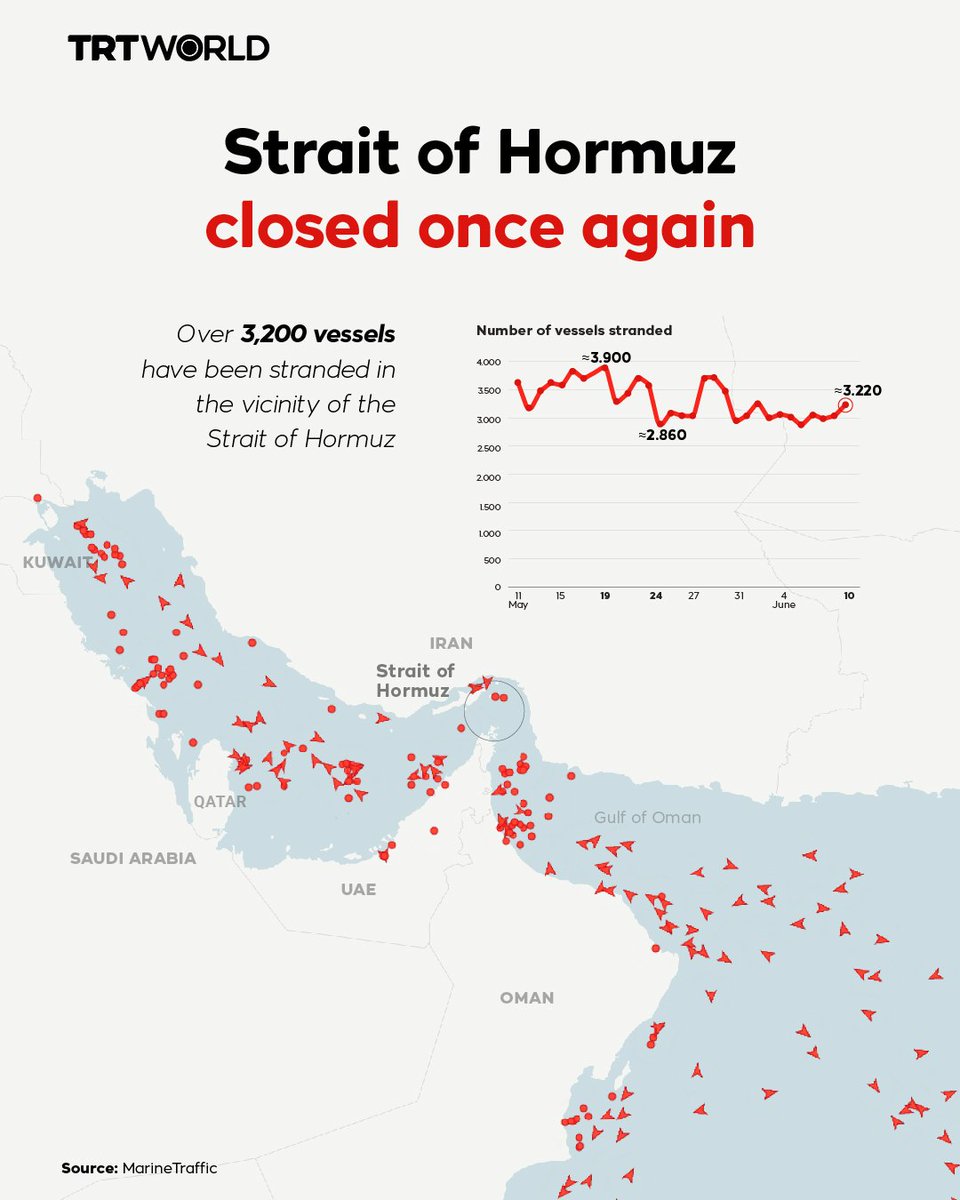
Another key component concerns the Strait of Hormuz, whose closure triggered major disruptions in global shipping and energy markets. The preliminary understanding includes the reopening of the strategic waterway and the removal of restrictions that had effectively paralysed a significant portion of global oil transport. Given that roughly one-fifth of the world's traded oil passes through the strait, restoring maritime traffic could ease pressure on international markets and reduce fears of a prolonged energy shock.
The agreement is also said to contain provisions for sanctions relief and a renewed negotiating process focused on Iran's nuclear programme. However, many of the most sensitive details remain unresolved. Officials have indicated that a sixty-day period of technical and political negotiations will follow, during which mechanisms for implementation, verification, maritime security and future regional arrangements will be discussed.
The international response has been largely positive. Leaders from Europe, Asia and the broader international community have welcomed the breakthrough, describing it as an opportunity to prevent a wider war and restore stability to a region that has spent months on the edge of a broader confrontation. Turkish President Recep Tayyip Erdoğan publicly praised the agreement and urged all parties to avoid provocations that could undermine the process before the formal signing.
Yet significant uncertainty remains. The agreement is currently a framework rather than a finalized treaty, and the coming days will determine whether all parties can translate political commitments into practical implementation. Questions persist regarding the future of sanctions, the status of Iran's nuclear activities, maritime security arrangements, regional proxy conflicts and the long-term role of external powers in the Gulf.
Nevertheless, the announcement represents a remarkable shift from the atmosphere that prevailed only days earlier, when missile exchanges, attacks on strategic infrastructure and threats to close critical maritime chokepoints appeared to be pushing the region toward a much larger conflict. Whether the framework evolves into a durable peace remains uncertain, but for the first time in months, diplomacy rather than military escalation appears to be setting the agenda.
The significance of the moment extends beyond Washington and Tehran. If successfully implemented, the agreement could reshape regional security dynamics, restore confidence in diplomatic mediation, reopen critical trade routes and reduce the risk of a conflict that many feared could engulf much of the Middle East. The coming week, culminating in the planned Swiss signing ceremony, may therefore prove to be one of the most consequential diplomatic periods the region has witnessed in years.
86
Medical Science and Technology #earlytreatments retweeted

Jun 14
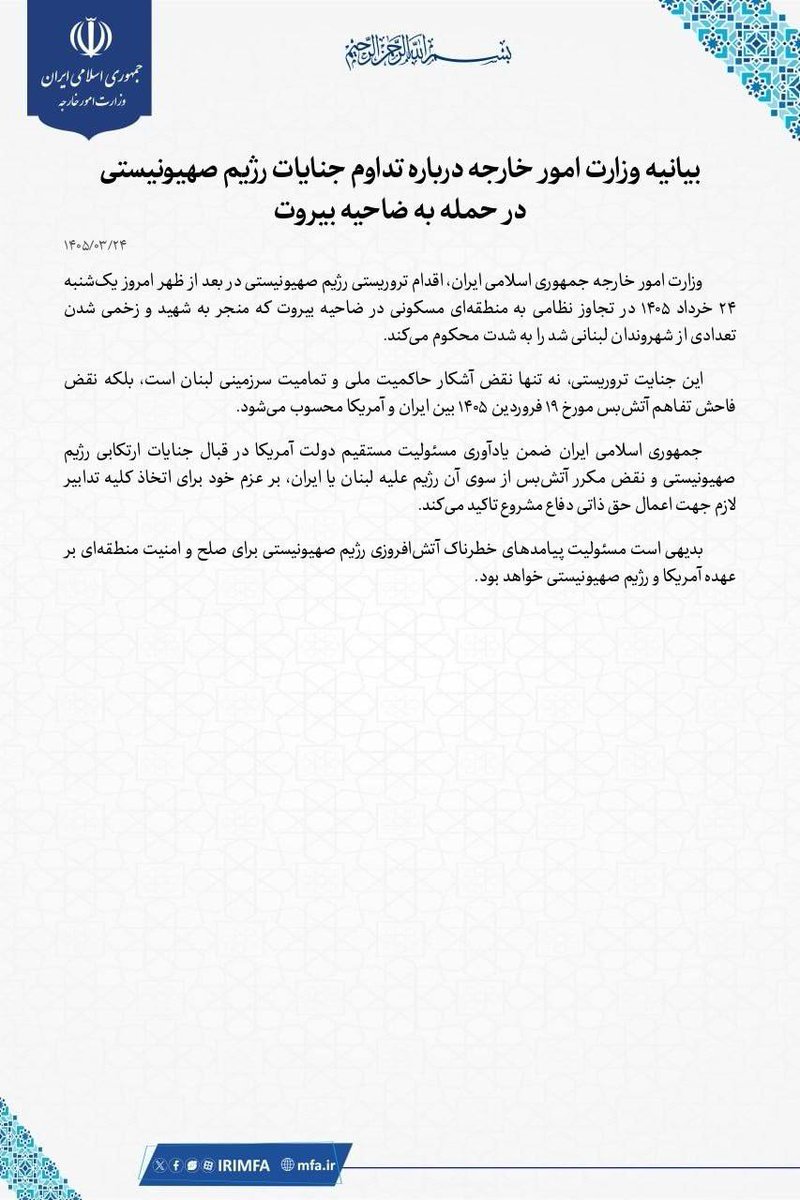
Breaking | Iran says it reserves the right to self-defense, holds the U.S. directly responsible for Israeli violations
Iran's Foreign Ministry said the Islamic Republic remains determined to take all necessary measures to exercise its legitimate right to self-defense, while holding the United States directly responsible for the crimes committed by the Israeli occupation and its repeated violations of ceasefire agreements involving Lebanon and Iran.
The ministry added that the United States and Israel bear responsibility for the serious consequences of war-driven policies that threaten regional peace and security.
2
43
72
2,763
Iranians form human chain on Ahvaz’s White Bridge amid fears of strikes on critical infrastructure
Residents in southwestern Ahvaz gathered in large numbers to form a human chain across the city’s iconic White Bridge, in a striking display of civilian mobilisation as tensions escalate between Iran and the United States.
The demonstration comes amid growing fears that key civilian infrastructure—including bridges, power plants, and transport networks—could be targeted following increasingly aggressive rhetoric from Washington. Participants stood shoulder to shoulder along the historic bridge, some holding flags, others linking hands in silence, in what observers described as both a symbolic and protective act.
The White Bridge, one of Ahvaz’s most recognisable landmarks, spans the Karun River and serves as a vital transport artery connecting different parts of the city. Its selection as a site for the human chain underscores both its practical importance and its symbolic value as a piece of national heritage.
The gathering in Ahvaz is part of a broader mobilisation effort across the country. Iranian officials and affiliated organisations have called on civilians—particularly youth, students, and professionals—to assemble around strategic infrastructure sites. These include power generation facilities, bridges, and industrial hubs considered essential to daily life.
Reports and social media footage indicate that similar human chains have formed in multiple cities, including near power plants and key transport links.
Officials presenting the initiative have framed it as a defensive, nonviolent response aimed at deterring attacks by placing civilians directly in harm’s way—a controversial tactic that reflects the severity of current fears. The campaign has reportedly been promoted as a show of unity, with organisers urging participants to demonstrate that such infrastructure “belongs to the people” and should not be targeted.
The mobilisation follows a sharp escalation in rhetoric from Donald Trump, who has issued warnings suggesting that Iran’s infrastructure could be severely damaged. According to reports, threats have included references to the destruction of bridges and power facilities—statements that have heightened anxiety among civilians.
In response, Iranian authorities have sought to channel public sentiment into visible acts of resistance, presenting the human chains as both a moral statement and a form of deterrence.
While the gatherings have been widely portrayed domestically as acts of patriotism and solidarity, analysts note that they also highlight the vulnerability of civilian infrastructure in modern warfare. By placing themselves at potential target sites, participants are attempting to raise the political and ethical cost of any attack.
However, such actions also carry significant risks. International Humanitarian Law (IHL) prohibits the targeting of civilian infrastructure unless it is used for military purposes, but the presence of civilians at strategic sites complicates the situation further.
For many participants, the human chain represents more than a defensive measure—it is also an expression of national unity during a period of uncertainty. Images from Ahvaz show families, students, and elderly residents standing together, suggesting a broad cross-section of society responding to the call.
As tensions continue to rise, the scenes on the White Bridge reflect a wider national mood: one marked by defiance, concern, and a determination among civilians to assert their presence in the face of potential escalation.
Whether such demonstrations will influence military calculations remains unclear. But for now, they stand as a powerful visual symbol of a population seeking to protect not only its infrastructure, but also its sense of collective identity and resilience.
US-Israeli strikes hit Iran’s top university, raising alarm over attacks on academic infrastructure
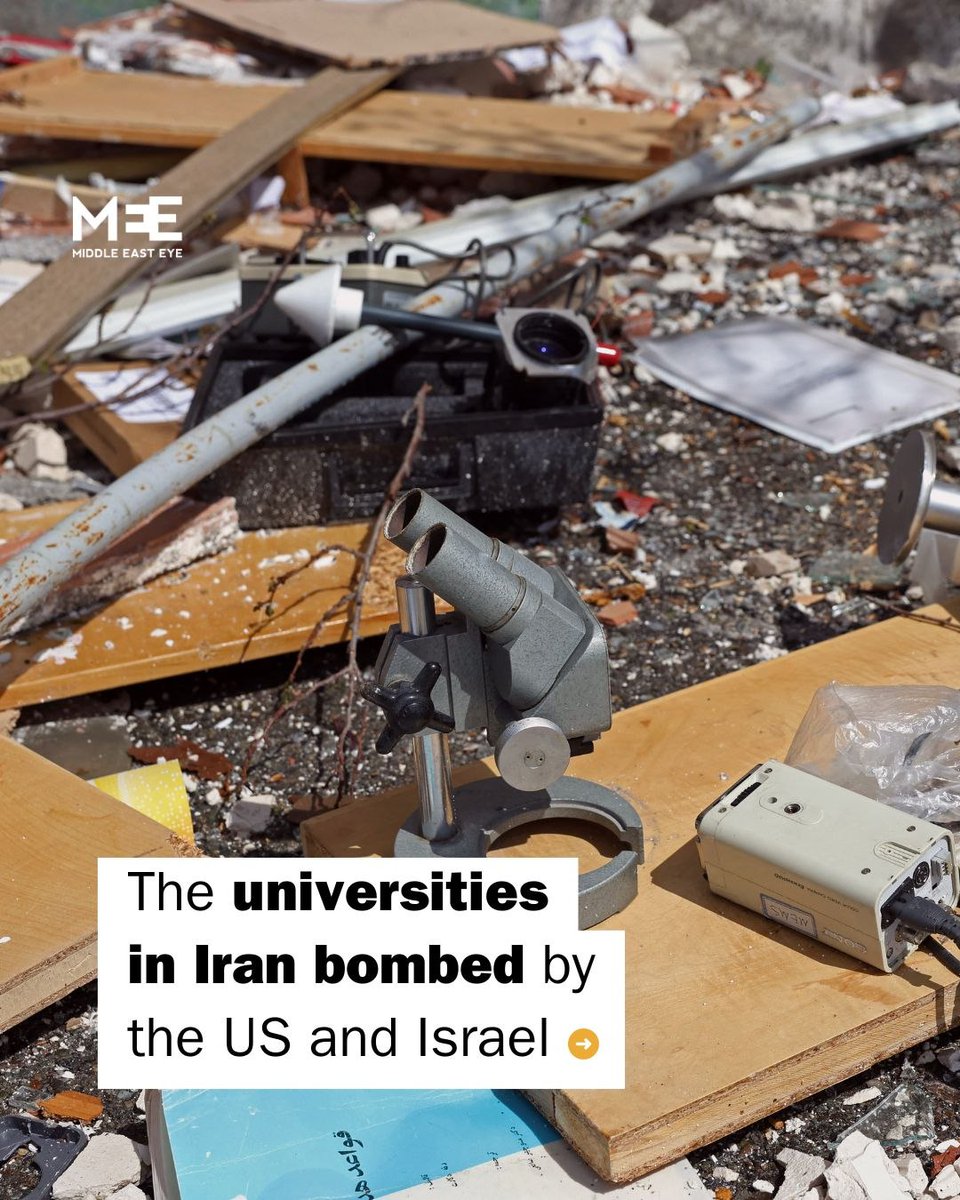
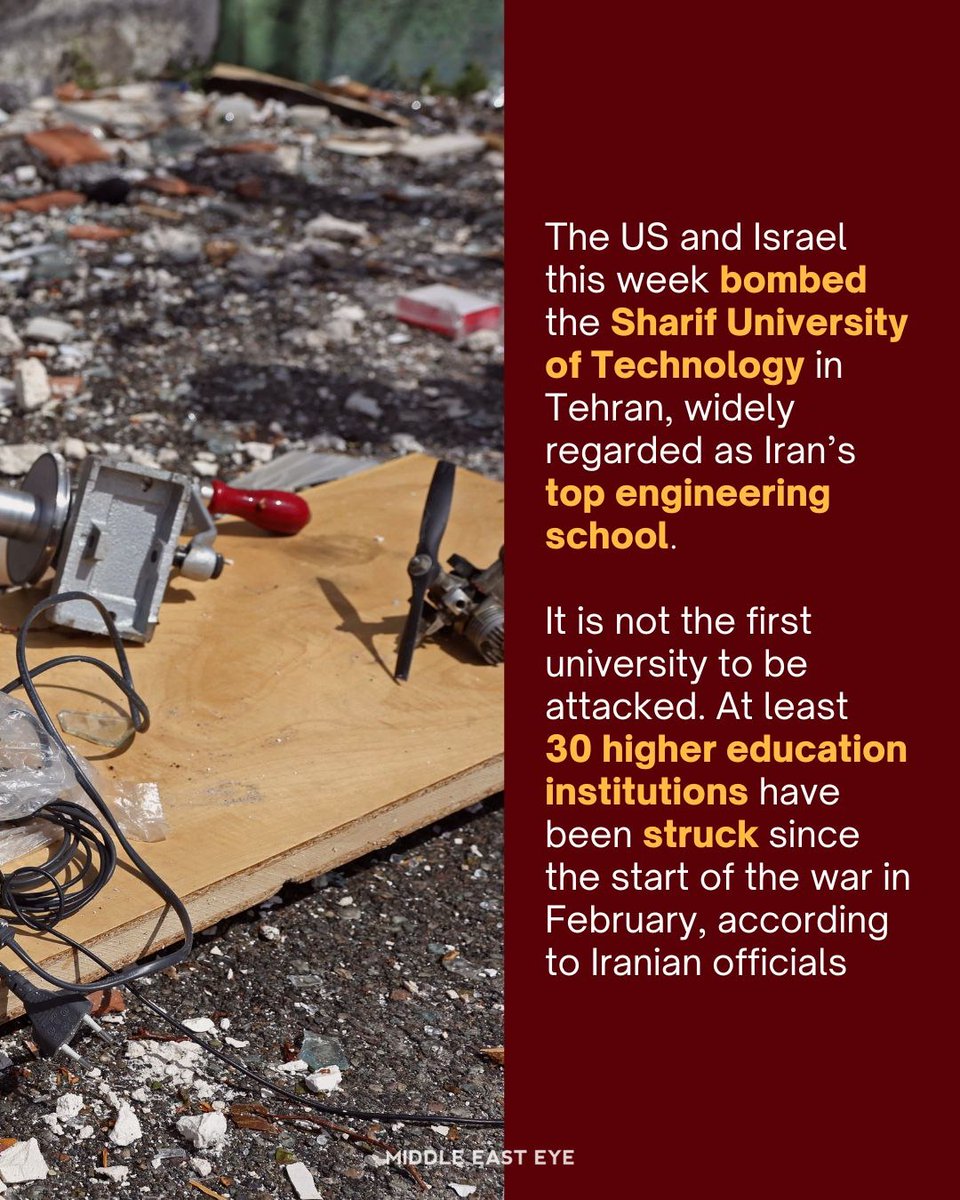
Air strikes attributed to the United States and Israel struck Sharif University of Technology in Tehran on 6 April, causing extensive damage to laboratories, research facilities, and parts of the campus, including a mosque. The attack marks one of the most high-profile hits on Iran’s academic sector since the escalation of hostilities.
Widely regarded as Iran’s premier engineering institution, Sharif University is often compared to Massachusetts Institute of Technology for its role in producing leading scientists, engineers, and innovators. The university has long been a cornerstone of Iran’s scientific development, with alumni contributing to both civilian and advanced technological sectors.
Growing pattern of strikes on academic institutions
The attack on Sharif is not an isolated incident. Since the beginning of the war involving Iran, dozens of universities, libraries, and research centres across the country have reportedly been struck. Iranian officials say the pattern suggests a deliberate campaign targeting the country’s intellectual and scientific infrastructure.
Among the earlier incidents was a strike on Shahid Beheshti University in northern Tehran on 4 April, where parts of a research institute — including facilities linked to laser and plasma studies — were reduced to rubble. Although classes had reportedly been moved online, limiting casualties, nearby dormitories sustained damage.
Iran’s Science Minister, Hossein Simaee Sarraf, strongly condemned the attacks. Speaking outside the damaged buildings, he accused the US and Israel of deliberately targeting centres of knowledge.
“A civilised country, a civilised government never targets institutions of knowledge, laboratories or research centres,” he said, adding that such actions reflected a “Stone Age mentality.”
Impact on research and public services
Beyond universities, other research and health-related institutions have also been affected. The historic Pasteur Institute of Iran — a key centre for vaccine production and infectious disease research — reportedly sustained significant damage, disrupting critical medical services.
Iranian officials also report that dozens of public libraries have been damaged, with some completely destroyed, further affecting access to education and knowledge resources.
Analysts warn that such attacks could have long-term consequences, not only for Iran’s scientific output but also for regional stability, as the destruction of academic infrastructure undermines future capacity in healthcare, engineering, and technology.
Broader regional context
The targeting of educational infrastructure is not limited to Iran. Similar patterns have been reported in Lebanon and Gaza Strip, where schools and universities have been damaged or destroyed during military operations.
In Gaza in particular, large-scale destruction of educational institutions, alongside the reported killing of academics and students, has led some experts to describe the situation as a “scholasticide” — the systematic dismantling of a society’s educational foundation.
Legal and ethical concerns
Under International Humanitarian Law (IHL), civilian infrastructure — including schools, universities, and hospitals — is protected and cannot be targeted unless being used for military purposes. The reported strikes have therefore raised serious legal and ethical questions among international observers and human rights groups.
As the conflict continues, the repeated targeting of academic institutions is drawing increasing scrutiny, with critics warning that the erosion of educational systems may have consequences that last far beyond the battlefield.
1
1
112
𝗔 𝗨𝗦–𝗜𝗿𝗮𝗻–𝗣𝗮𝗸𝗶𝘀𝘁𝗮𝗻 𝘁𝗿𝗶𝗹𝗮𝘁𝗲𝗿𝗮𝗹, 𝘂𝗻𝗱𝗲𝗿𝗽𝗶𝗻𝗻𝗲𝗱 𝗯𝘆 𝗮 𝗨𝗦 𝘀𝘁𝗿𝗮𝘁𝗲𝗴𝘆 𝗰𝗹𝗼𝘀𝗲𝗹𝘆 𝗮𝗹𝗶𝗴𝗻𝗲𝗱 𝘄𝗶𝘁𝗵 𝗜𝘀𝗿𝗮𝗲𝗹𝗶 𝗶𝗻𝘁𝗲𝗿𝗲𝘀𝘁𝘀
Iranian and US delegations met Pakistan’s Prime Minister Shehbaz Sharif in Islamabad ahead of expected peace talks.
Iran’s delegation included parliamentary speaker Mohammad Bagher Ghalibaf and Foreign Minister Abbas Araghchi, while the US side included Vice President JD Vance and special envoys Steve Witkoff and Jared Kushner.
7

Footage shows a Lebanese journalist lying injured on the street after being caught in Israeli shelling near the town of Kfar Tebnit in southern Lebanon.
The attacks come after the announcement of a Pakistan-mediated agreement between the US and Iran and despite an ongoing ceasefire in Lebanon that has been in effect since April 17
1
38
40
1,669
Profiting from Occupation: The Controversy Surrounding London’s Israeli Property Exhibition
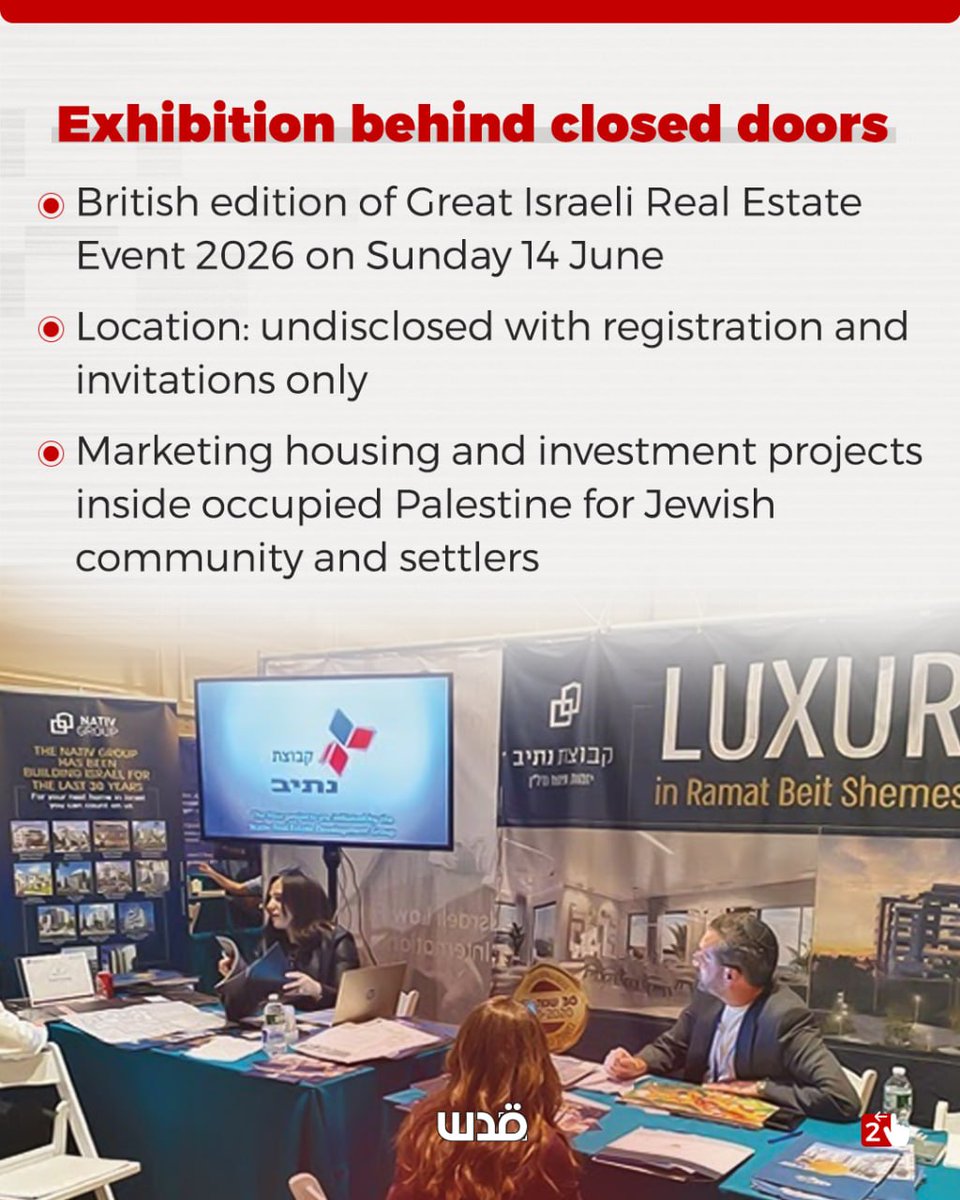
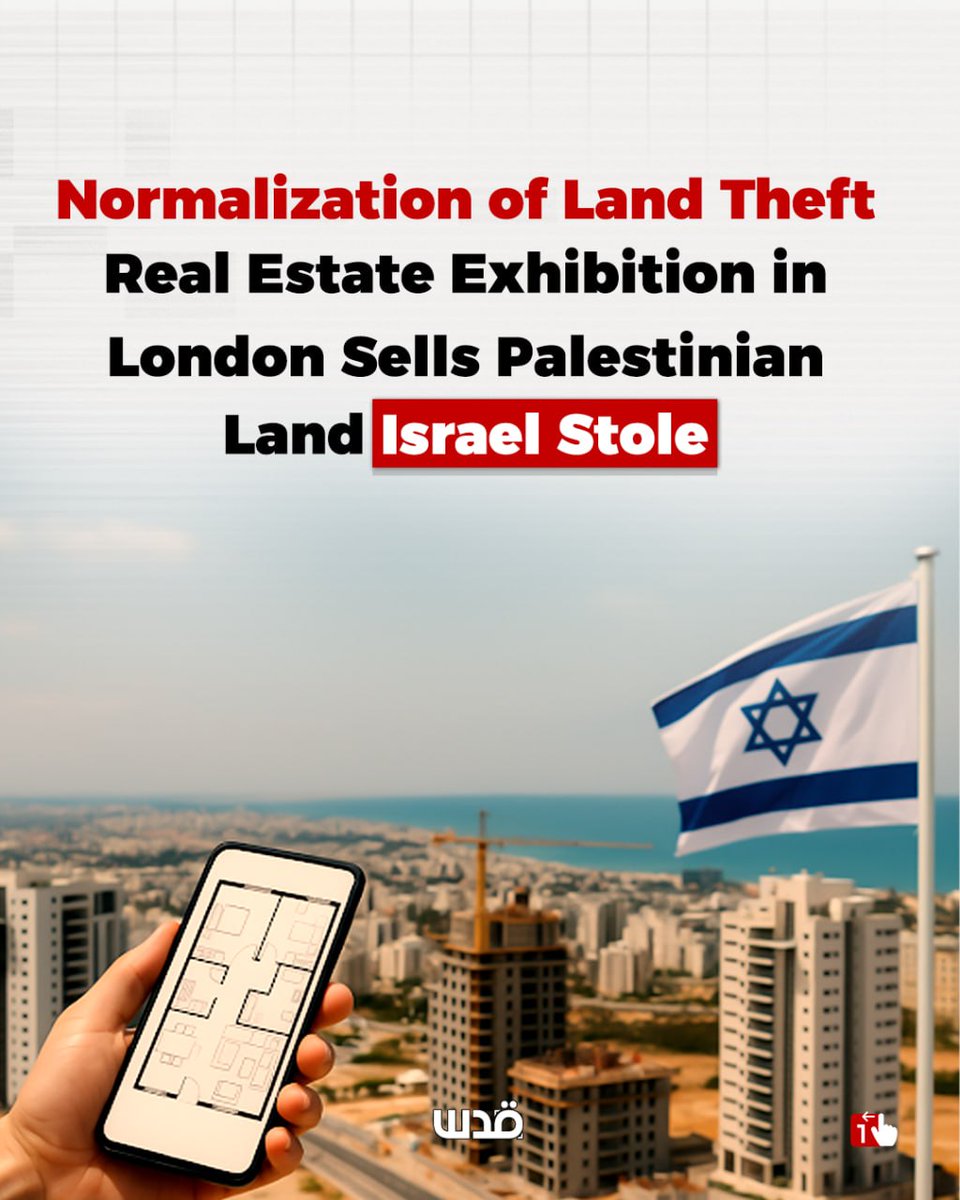
The “Great Israeli Property Exhibition 2026,” held at a secret location in London, has sparked intense political and public criticism over its promotion of properties in Israeli settlements built on occupied Palestinian land. Marketing real-estate projects in the occupied West Bank normalises and profits from a settlement enterprise widely considered illegal under international law.
More than 130 Labour Party members, alongside around 100 MPs and peers, have reportedly warned that the event could risk implicating the United Kingdom in activities linked to potential violations of international law, supporting “potential war crimes.”. For Palestinians and human rights advocates, the issue extends beyond property sales: it concerns the commercialisation of land acquired through occupation, displacement and settlement expansion. The controversy highlights growing scrutiny of whether international businesses and investors should be permitted to profit from territories whose legal status remains internationally contested.
From the perspective of international law, the controversy is not simply about real-estate transactions but about the commercial exploitation of territory under occupation. The transfer of an occupying power’s civilian population into occupied territory and the acquisition or marketing of property linked to settlements have been repeatedly condemned by the United Nations and international legal bodies. Turning disputed land into an investment opportunity risks normalising a situation that international law was specifically designed to prevent: the permanent acquisition of territory and property rights through occupation and coercive control.
Epiphonema (Informative Note)
On 18 September 2024, the @UN General Assembly overwhelmingly adopted a resolution (news.un.org/en/story/2024/09…) demanding that @Israel “brings to an end without delay its unlawful presence” in the Occupied Palestinian Territory within 12 months. The resolution—grounded in the International Court of Justice’s (ICJ) advisory opinion of July 2024—declares Israel’s occupation, the proliferation of settlements, and resource exploitation illegal under international law and calls for reparations. It commands not just Israel but also obliges all UN member states to refrain from sustaining this illegal status quo.
That deadline has now passed. Israel has defied the General Assembly, ignored the Court, and intensified its crimes. The Independent International Commission of Inquiry on the Occupied Palestinian Territory, including East Jerusalem, and Israel has now concluded that Israel’s actions constitute a genocide. In the face of this grave reality, the international community must commit — not to rhetoric, but to action.
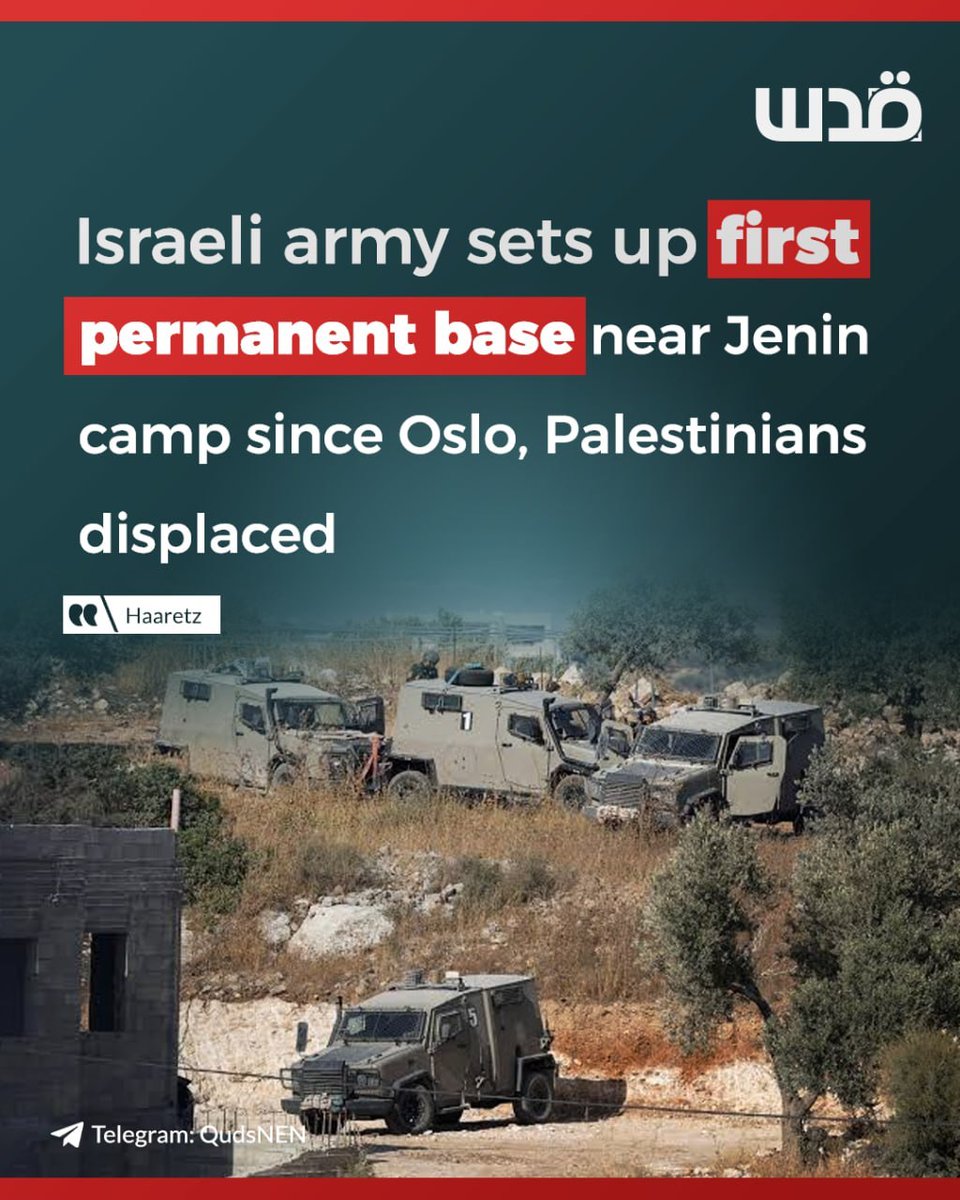
Jenin After Oslo: Israel’s First Permanent Military Base in Area A and the Future of the Occupied West Bank.
The construction of a permanent Israeli military base near Jenin refugee camp marks a potentially historic turning point in the occupied West Bank. According to reports cited by Haaretz, the installation is being built on land seized in Area A, territory that under the Oslo Accords was designated for full Palestinian civil and security control. If completed, it would constitute the first permanent Israeli military presence of its kind in such an area since the accords were signed more than three decades ago.
The development comes amid an ongoing Israeli military campaign across the northern West Bank that has already displaced more than 33,000 Palestinians from the refugee camps of Jenin, Tulkarm and Nur Shams. Entire neighbourhoods have been emptied, access roads restricted, and residents prevented from returning to their homes as military operations continue. The revelation emerged through court documents responding to legal challenges against the prolonged displacement of civilians.
The base is seen not as a temporary security measure but as evidence of a deeper transformation of realities on the ground. The establishment of permanent military infrastructure inside territory intended for Palestinian self-governance raises profound questions about the future of the Oslo framework itself. What was once presented as a temporary occupation is increasingly taking on the characteristics of enduring territorial control, with military installations, land seizures and long-term restrictions becoming embedded features of daily life.
Against this backdrop, the planned base near Jenin is another indication that the geography of the occupied West Bank is being reshaped in ways that could have lasting political, legal and humanitarian consequences for years to come.
1
96
Jun 14
Watch | British activists interrupted the 'Great Israeli Real Estate Event' in London, which was promoting and selling property in illegal settlements built on stolen Palestinian land in the occupied West Bank.
1
16
Jun 14
Police arrested peaceful Jewish protesters outside Edgware Synagogue during a demonstration against the illegal sale of Palestinian land, including properties linked to West Bank settlements.
9