
Sharing our weather and climate stories for teachers, parents and students. Monitored Mon-Fri 9am-5pm (@metoffice for customer services)
Joined May 2019
- Tweets 2,515
- Following 121
- Followers 1,036
- Likes 52
1,078 Photos and videos
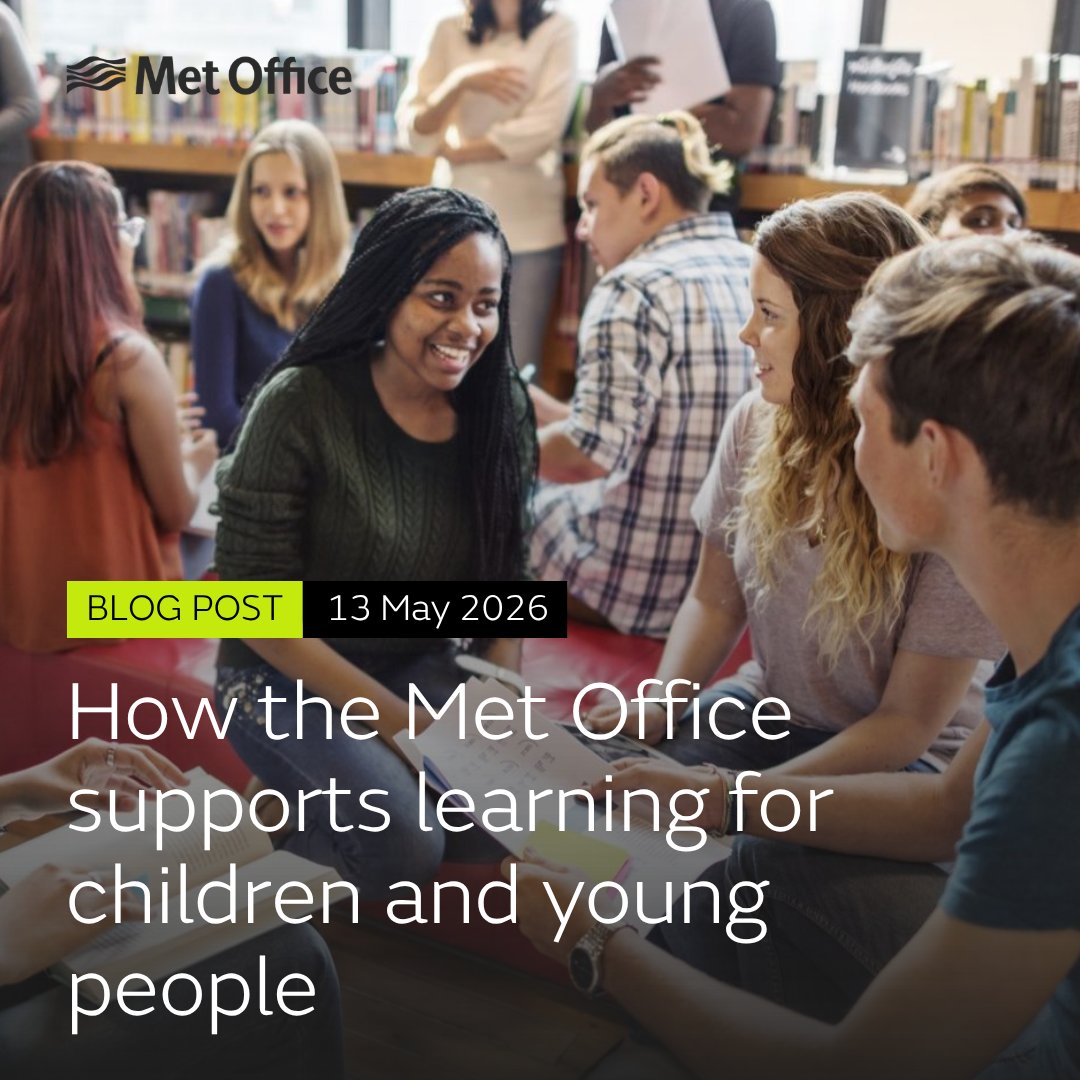

Helping young people understand weather, climate, and the science behind them, is a core part of the Met Office’s public service role.
Find out more about how we support learning for children and young people in our blog post 👇
metoffice.gov.uk/blog/2026/h…
ALT Group of young people seated together in a library, reading and talking; overlay text: “Met Office – Blog Post, 13 May 2026, How the Met Office supports learning for children and young people.”
1
52
How do communities recover after a devastating cyclone?
Explore our new case study on Tropical Cyclone Freddy in Malawi and Mozambique, perfect for GCSE Geography or equivalent bit.ly/4nPujsk
#ClimateEducation #GeographyTeacher #CycloneFreddy
41
Jet streams are fast-flowing currents of air that meander around the world at around 8 to 15 kilometres above sea level. We know that these high-altitude winds affect the weather at the surface, but how?
youtube.com/watch?v=5wCq2Y9C…
1
1
154
Can you distinguish fact from fiction in the media? How do we tell weather stories from different angles?
These activities look at weather reporting and how to distinguish between ‘real and ‘exaggerated’ headlines in the media
bit.ly/4hbUe9S
bit.ly/4jC9oGX
31
When it comes to meteorology there's a lot of mis-information with many headlines these days that are are pure clickbait. So how can you tell the forecast from the fiction?
Let us guide you through what you should look for in any weather story.
youtube.com/watch?v=8qdeUM_H…
1
63
What do you think weather data is? What different types of weather data can you think of and why is telling people about it important?
Explore the different types of data and look at how it can be presented in these activities bit.ly/3hWSy7p
bit.ly/3CxIAmh
23
You might have heard 'weather fronts' mentioned in a weather forecast but what are they and how do they affect our weather? bit.ly/304V5Ep
Find out more on our website bit.ly/3xu4402

1
88
What can a historic storm teach us about extreme weather today?
Explore the story of Storm Ulysses in 1903 with our expert-led GCSE Geography resource. Perfect for classroom use or independent study.
bit.ly/3JqiSrO
#GCSEGeography #ExtremeWeather #ClimateEducation
39
Have you ever wondered what the lines, arrows & letters mean on a weather chart?
In this video you can dive into the fascinating world of synoptic weather charts, revealing the science behind isobars, pressure systems, weather fronts, and more!
youtube.com/watch?v=RVBhb1ca…
79
What effects can the weather have on the lives and jobs of people in your community?
Through this activity you will think about how data and weather forecasting can be used to support and benefit your local area bit.ly/3daLRKk
26
Have you ever stopped to wonder how that weather forecast on your phone, you hear on radio or watch on TV actually gets made?
There’s a lot more to it than looking out of the window find out more with Alex
youtube.com/watch?v=YKW9H2ck…
1
44
Learn about what makes weather events ‘extreme’ and reflect on the impacts they can have on the local community.
In these activities you’ll come up with a guide to help others prepare for extreme weather
bit.ly/3t1rEkO
bit.ly/3tRUOlA
28
Although you can't see it, atmospheric pressure has a huge influence on our weather.
In this video you can find out how the force exerted by the weight of air above us, affects the weather we experience bit.ly/2NWnXaL
Find out more bit.ly/3eyNTYK
33
Imagine you are working for a local radio or TV station.
In this activity you are going to put yourself in the shoes of a meteorologist and create a weather forecast of your own to present.
First explorations👉bit.ly/42TT5Qc
Deeper discovery👇bit.ly/42N5i9a
29
Did you know that there are different ways rain can form?
This video looks at frontal, orographic and convective rain👉bit.ly/2Y7OCYH
Find out more about rain on our website bit.ly/2M1MWt2
1
70
We're all familiar with weather on planet earth but what about weather we get from beyond our atmosphere?
What causes the beautiful northern lights and could extra terrestrial meteorology damage the communication systems we all rely on.
youtube.com/watch?v=19pcpcqQ…
68
Parts of the UK saw the aurora last night.
You can explore the aurora through the eyes of different cultures in these resources, using their folklore to create your own stories about space weather & its impacts:
7-11👉bit.ly/3dBUsHx
11-14 👉bit.ly/3m65mbD
Jan 19

A fast moving coronal mass ejection (CME) means the northern lights may be visible overnight, and perhaps on Tuesday night too
The arrival time of the CME is uncertain, but aurora sightings are possible in northern Britain and perhaps in southern areas depending on cloud cover.
103
Can you detect a magnetic storm from your classroom?
Build your own magnetometer and explore how space weather affects Earth’s magnetic field!
Hands-on, curriculum-linked, and perfect for curious minds bit.ly/4nROc1L
#SpaceWeather #STEMeducation #Magnetism #KS3Science
51
We all see clouds every day but what are they made of? How do they form? How do they stay afloat? This video answers some of these questions. bit.ly/2Nt58f3
Find out more about clouds on our website bit.ly/2p8eXXe
23
Have you heard the wind whistle past your ears? Have you ever thought what makes the wind blow?
In this video we explain the science behind wind
bit.ly/3sjQYAt
You could also try our windy days activity and create your own windmill bit.ly/40ZkuML
34