
AI runs on compute. We make it decentralized.
Joined February 2026
- Tweets 122
- Following 100
- Followers 465
- Likes 261
16 Photos and videos






Pinned Tweet

Feb 27
Meta Pulse - Decentralized Compute Layer.
AI depends on reliable processing power.
We coordinate distributed GPU resources
for AI workloads.
⚙️ Deterministic inference
🔗 On-chain verification
🧩 Provider bonding
🏗 Long-term protocol design
Public presale model.
🌐 Website: mpulse.network
📄 Whitepaper: mpulse.network/whitepaper
📢 Telegram: t.me/mpulse_net
Follow the build.
64
1
45
3,049
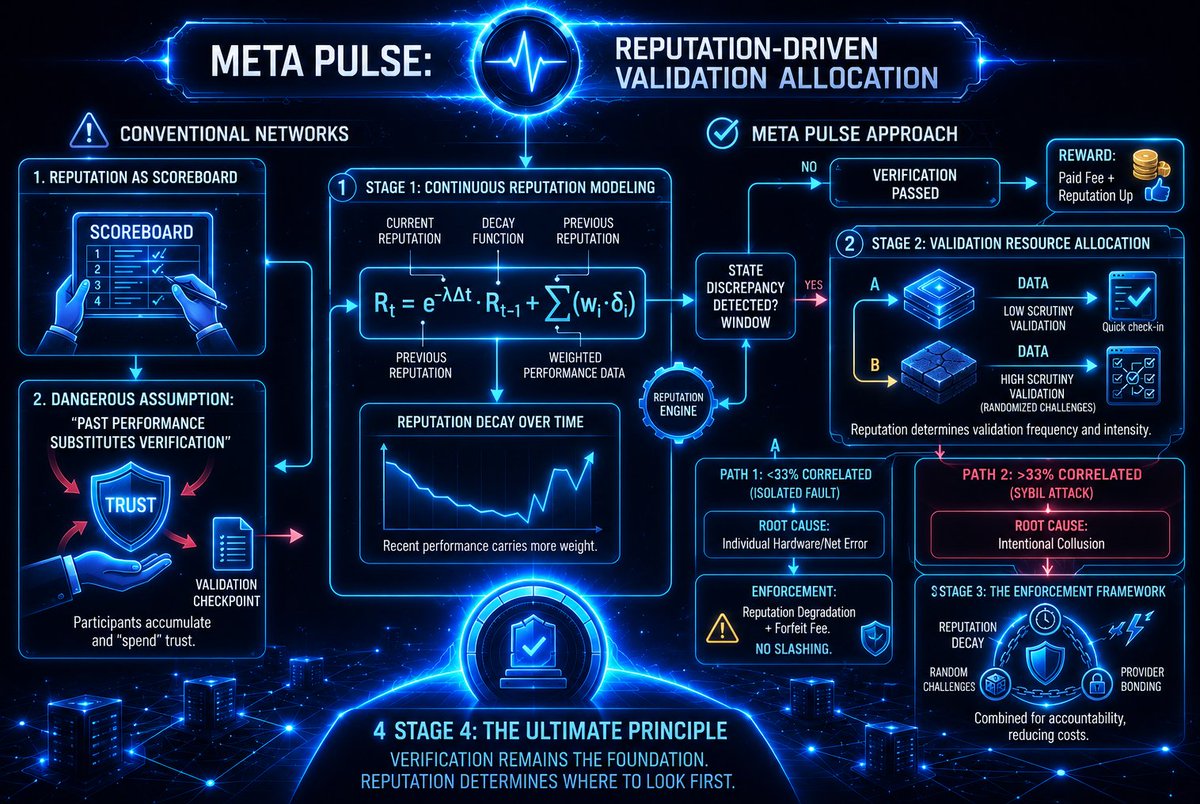
Protocol Insight: Reputation Is Not Trust
In distributed systems, reputation is often misunderstood as a substitute for verification. It is not.
Constantly verifying every participant at the same intensity is economically inefficient and does not scale. The purpose of reputation is therefore not to create trust, but to allocate verification resources more efficiently.
In the MetaPulse Network, provider reliability is modeled as a time-weighted process:
Rₜ = e^(-λΔt) · Rₜ₋₁ Σ(wᵢ · δᵢ)
This ensures that historical performance decays over time, preventing participants from accumulating reputation indefinitely and later exploiting it.
Reputation does not determine who is trusted.
It determines where verification effort is spent.
Reliable providers may require less frequent validation, while new or degraded nodes receive increased scrutiny through challenge jobs and enforcement mechanisms.
The objective is not blind trust.
The objective is minimizing verification cost while preserving accountability.
Unlike systems that replace verification with reputation, the Meta Pulse Network uses reputation as a routing signal within a broader verification framework.
Verification remains the foundation. Reputation only determines where the protocol looks first.
More details:
mpulse.network
1,978
May 21
Drafting a new architecture for decentralized compute: The MetaPulse
Most DeCi systems make a fatal mistake: forcing every workload through the same consensus layer. Full global verification is an economic and performance killer.
We are building around Workload-Dependent Validation. The goal isn’t constant global verification - it is bounded risk under economically enforceable constraints. Here is the blueprint:
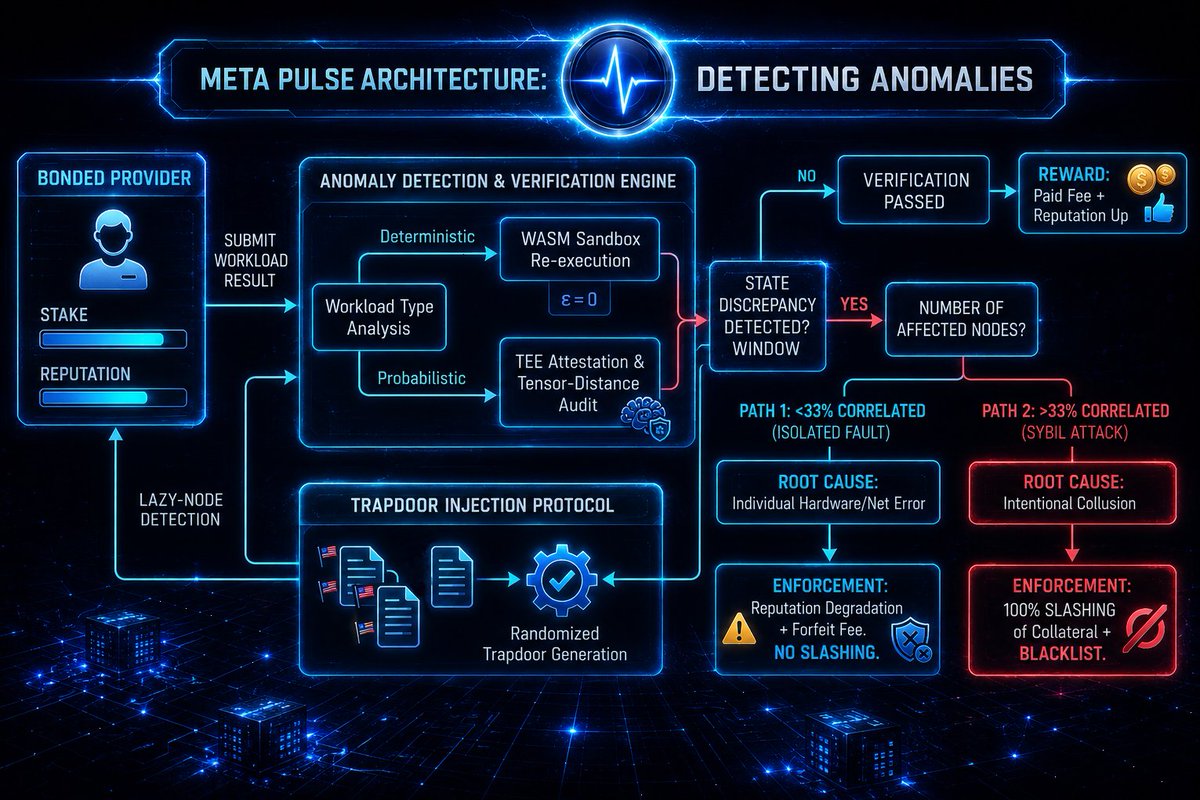
1/ The Validation Split
Pathway A (Deterministic): Low-risk CPU tasks run in isolated WASM sandboxes. Fixed gas, fixed memory. Discrepancy tolerance is absolute ($\epsilon = 0$). Easy to verify via quick re-execution.
Pathway B (Probabilistic): GPU AI inference isn’t naturally deterministic due to floating-point drift. We route these through TEEs (Intel SGX/Confidential GPUs) and validate via Tensor-Distance Alignment (MSE/Cosine Similarity) instead of raw byte hashes.
2/ Proportional Enforcement (No False Positives)
We separate infra bugs from actual attacks:
- Isolated Fault: One node fails due to overheating/network drops. Penalty: Minor reputation dip, loss of fee. No slashing.
- Coordinated Anomaly: $>33\%$ of nodes return the exact same invalid output. That’s a Sybil attack. Penalty: 100% Slashing of collateral permanent blacklist.
3/ Optimistic ZK-ML (Dispute-Only)
Generating ZK proofs for billions of ML parameters on every block is a financial suicide. The MetaPulse uses an optimistic model. Compute is assumed valid. ZK-SNARK proofs are generated only during unresolved disputes —and the losing party pays the massive proof-generation fee.
4/ Keeping Nodes Honest (Trapdoors)
To stop validators from blindly signing off on results to farm fees, the protocol randomly injects intentionally flawed workloads. If a node signs off on a trapdoor, its reputation is instantly nuked, and its collateral requirements skyrocket.
The Web3 compute race won't be won by the most secure network, but by the most economically rational one.
More details:
mpulse.network
2
2,304
May 13
Development Update
This week focused on execution reliability scoring and dispute escalation behavior under constrained verification conditions.
Completed:
• initial reputation-weighted routing logic connected to provider selection flow
• execution timeout handling integrated into the settlement validation pipeline
• escalation paths added for repeated challenge failures and inconsistent outputs
• preliminary cooldown logic introduced for providers failing deterministic validation thresholds
• verification window behavior tested for delayed dispute submission scenarios
In progress:
• adaptive challenge frequency scaling based on provider reputation decay
• refinement of provider scoring weights across latency, uptime, and verification success
• benchmarking consistency validation across identical GPU tiers under sustained load
• optimization of redundant re-execution logic for disputed inference jobs
Network update:
• presale participation has now surpassed $130,000
• total staked: 142,921 MPULSE
Current testing remains intentionally constrained to controlled execution environments.
The protocol is being optimized for reproducibility and verification integrity before broader scaling assumptions are introduced.
Still early.
But the goal remains the same:
Build a compute network where results can be verified — not simply trusted.
mpulse.network/
2
1,422
Protocol Insight:
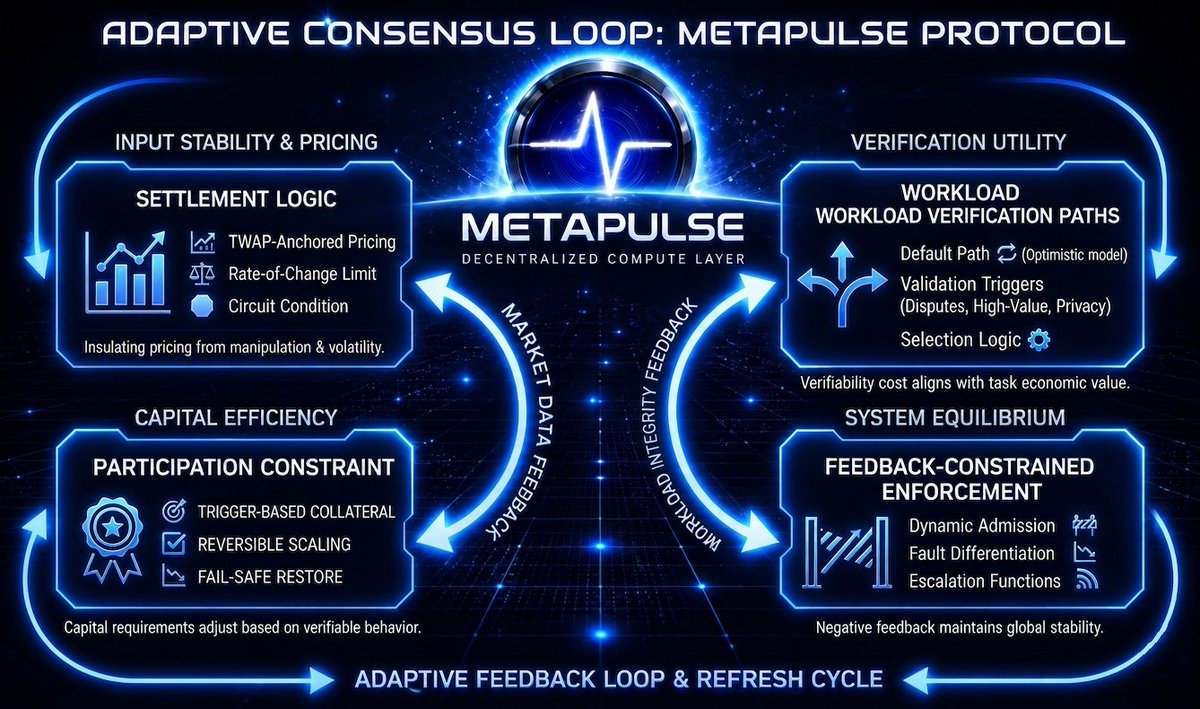
Implementation Framework for the Meta Pulse Network
1. Settlement Logic: TWAP-Anchored Pricing with Volatility Bounds
Workload pricing must be insulated from short-term market manipulation while remaining responsive to longer-term trends.
Mechanism:
The protocol derives conversion rates from a time-weighted price feed aggregated across multiple sources. This reduces exposure to transient price spikes and oracle manipulation.
Bounded Update:
The conversion function applies a rate-of-change limit per epoch, ensuring that the required token amount cannot adjust beyond predefined bounds within a single update interval.
Circuit Condition:
If price variance exceeds defined thresholds, the protocol temporarily anchors settlement to the last stable reference window until volatility normalizes.
This prevents sudden cost spikes or forced collateral imbalance during extreme market conditions.
2. Participation Constraint: Trigger-Based Collateral Scaling
Collateral requirements evolve based on verifiable behavior rather than fixed thresholds.
Trigger Model:
State transitions are gated by objective conditions such as sustained uptime, successful execution under challenge conditions, and absence of verified faults over a rolling window.
State Transition:
Upon reaching defined reliability checkpoints, nodes may operate under progressively reduced collateral requirements within safety bounds enforced by the protocol.
Constraint:
Collateral scaling is reversible. Repeated faults or failed challenges restore stricter requirements.
This ensures that capital efficiency is earned, not assumed.
3. Verification Integrity: Workload-Dependent Validation Paths
A uniform verification model is inefficient across heterogeneous workloads.
Default Path:
Execution operates under an optimistic model with a bounded challenge window. Results are accepted provisionally until the dispute period expires.
Validation Triggers:
Disputes initiate verification via:
deterministic re-execution (for reproducible workloads), or
proof-based validation (for high-integrity or privacy-sensitive tasks), or
environment-constrained execution (e.g., attested environments)
Selection Logic:
The validation path is determined by workload characteristics and required assurance level.
This aligns verification cost with the economic value and risk profile of the task.
4. System Equilibrium: Feedback-Constrained Enforcement
Network stability is maintained through negative feedback mechanisms applied at the scheduling and enforcement layers.
Dynamic Admission:
Task allocation thresholds adjust based on network utilization and observed reliability, increasing entry requirements under congestion or degraded conditions.
Fault Differentiation:
The protocol distinguishes between isolated faults and correlated failures.
Isolated faults degrade reputation and participation capacity.
Correlated discrepancies (e.g., across multiple nodes assigned to the same workload) increase enforcement severity.
Escalation:
Penalty functions scale with repeated or correlated violations, ensuring that coordinated or persistent misbehavior becomes economically prohibitive.
Engineering Implication
Security in this architecture is not derived from constant global verification, but from bounded risk, verifiable triggers, and adaptive constraints.
By combining asynchronous validation with feedback-driven enforcement, the system maintains execution integrity while limiting the overhead associated with continuous consensus.
5
8
2,204
Apr 28
Protocol Insight: Utility Requires Constraint
The viability of decentralized compute depends on the structural coupling of the economic layer and the workload layer.
In many networks, token velocity becomes a liability when the asset functions as a detached financial layer. To reduce value leakage, protocol design shifts from speculative turnover toward enforceable constraints.
- Deterministic Sinks: Linking fee-burn functions directly to compute consumption ties economic activity to workload demand and reinforces utility at the settlement layer.
- Stake-Weighted Capacity: Provider participation is not defined by availability alone. Execution rights scale with bonded collateral, ensuring that slashable stake backs every workload admitted into the network.
- Native Unit of Account: Denominating compute credits in the native asset causes demand to scale with resource utilization rather than external market sentiment.
Unlike systems where token utility is layered on after network design, the MetaPulse Network integrates settlement, provider incentives, and compute access into a single coordinated model, where utility emerges from protocol constraints rather than token narratives.
Utility is not a story. It emerges from how access to scarce compute is constrained by protocol rules.
12
13
1,783
Apr 22
Protocol Insight: Reliability vs. Compliance
Why is slashing alone not sufficient in distributed compute networks?
Because protocol compliance is not the same as reliability. A node can follow the rules and still produce inconsistent or degraded performance, which introduces variance the system must account for over time.
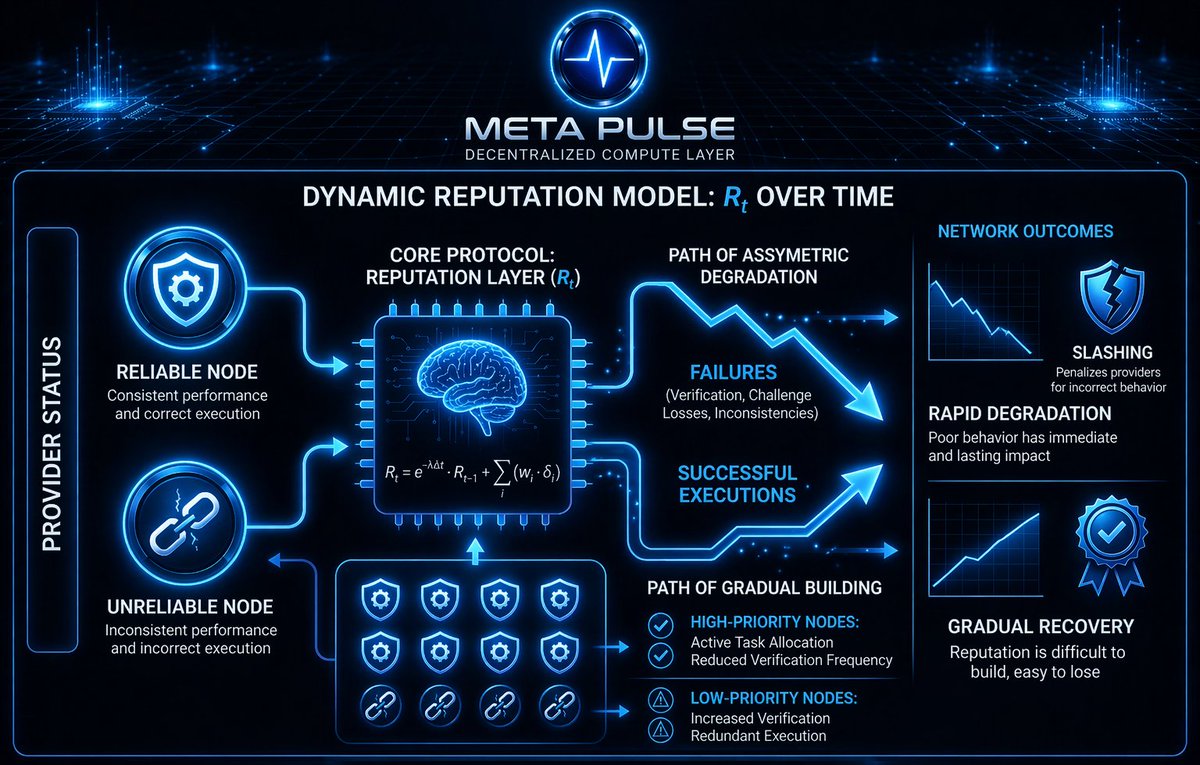
To address this, provider reliability is modeled as a time-weighted process. In practice, this is implemented as a rolling update function:
R_t = e^(-λΔt) * R_{t-1} Σ(w_i * δ_i)
where the exponential decay term reduces the influence of past performance over time, while each new execution outcome contributes proportionally based on its weight and result.
________________________________________
Key takeaways from this model:
•Anti-Stagnation: Prevents nodes from relying on accumulated reputation; they must maintain performance to stay relevant.
•Asymmetric Degradation: Poor behavior (failed challenges, inconsistencies) reduces the score faster than good behavior builds it.
•Active Orchestration: Reputation directly influences task allocation and verification frequency, optimizing network resources.
Reliability must be continuously measured, not assumed.
This is part of the core protocol architecture being built and validated step by step.
8
10
3,274
Apr 15
Weekly Development Update
This week focused on implementing deterministic execution constraints and validating enforcement logic at the protocol level.
Completed:
• fixed runtime containers defined with pinned CUDA and cuDNN versions to ensure reproducible inference behavior
• deterministic execution flags applied where supported to reduce variability across identical workloads
• initial handling of floating point inconsistencies under controlled hardware conditions (same GPU class, identical runtime)
• provider bond logic connected to execution flow, including failure-triggered slashing paths at the protocol level
• basic challenge jobs implemented using known inputs to validate execution correctness through re-run scenarios
In progress:
• stricter environment validation (GPU class, driver, runtime consistency checks before execution)
• refinement of tolerance thresholds for output comparison under deterministic constraints
• expansion of challenge scenarios to cover edge cases and failure modes
All testing remains limited to controlled environments and constrained workloads to ensure reproducibility before introducing heterogeneous hardware conditions.
9
10
1,356
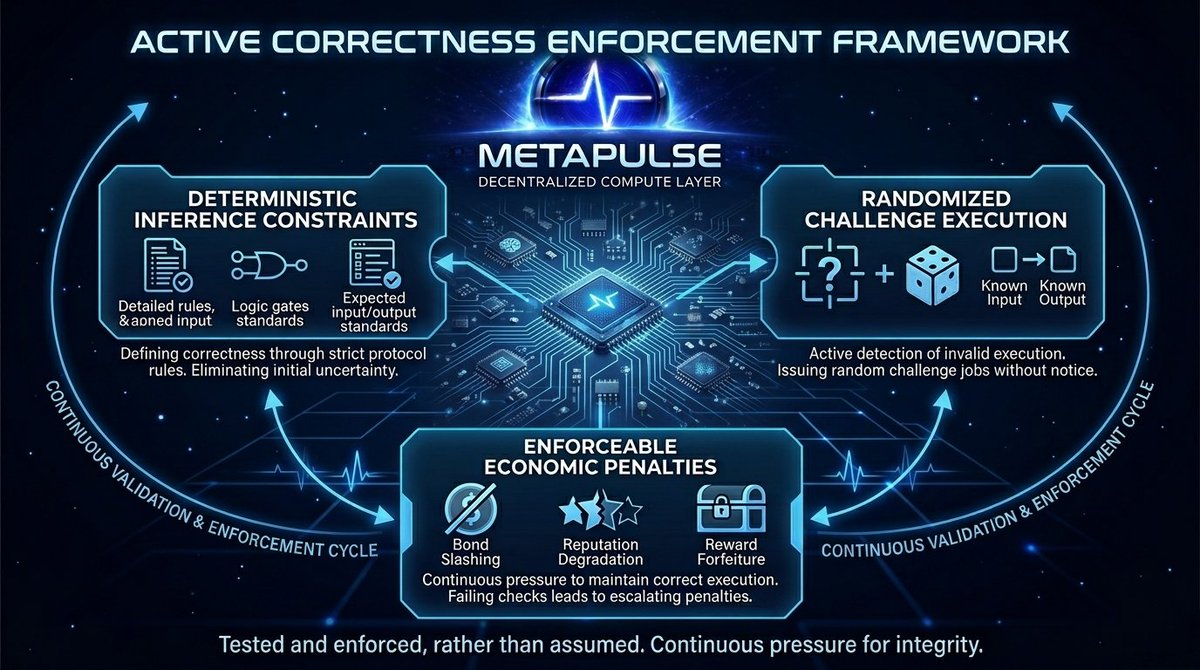
Verification and slashing define how correctness is measured and enforced, but they do not eliminate uncertainty on their own. In a distributed environment, there must be a mechanism to actively detect invalid execution and resolve disputes when results are contested.
For this reason, the protocol introduces a verification window during which submitted results can be challenged. Instead of assuming correctness, the system allows independent validation through dispute mechanisms that re-execute or test the output under controlled conditions.
To strengthen this process, randomized challenge jobs can be issued to providers without prior notice. These tasks use known inputs and expected outputs, allowing the network to directly measure execution integrity and detect dishonest behavior.
Providers that fail these checks face escalating penalties, including reward forfeiture, bond slashing, and reputation degradation. This creates continuous pressure to maintain correct execution rather than only behaving honestly when directly observed.
Unlike systems that rely purely on passive verification or reputation, the MetaPulse Network integrates deterministic inference constraints, randomized challenge execution, and enforceable economic penalties into a single coordinated framework. This allows correctness to be actively tested and enforced at the protocol level, rather than assumed.
9
12
1,175
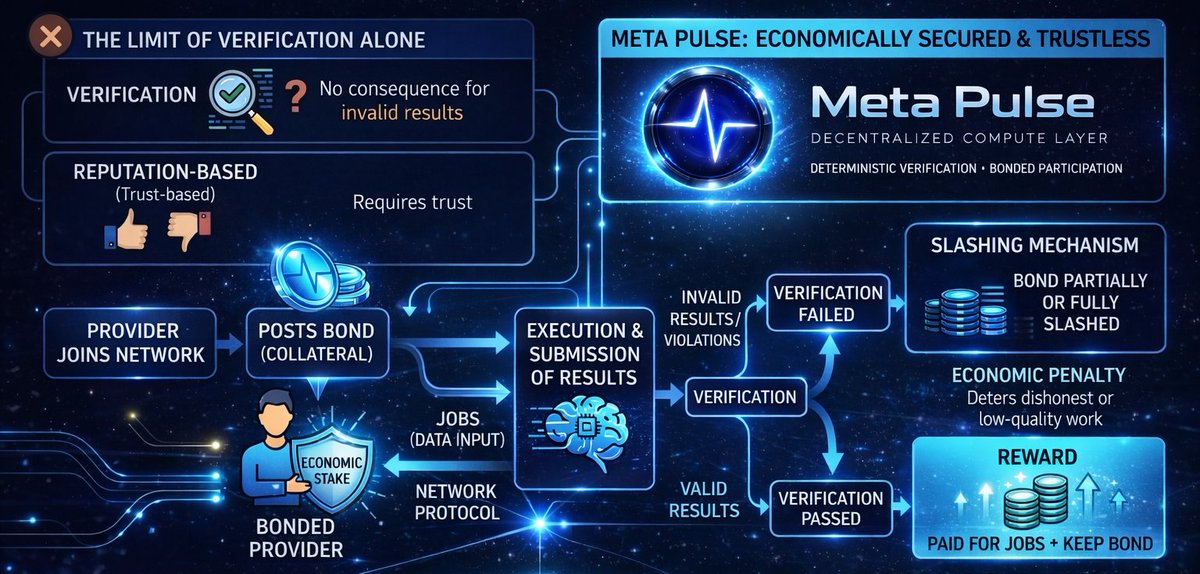
Verification defines what is correct, but correctness alone is not enough to enforce behavior within a distributed compute network. Without economic exposure, providers have no real incentive to consistently produce valid results, and incorrect execution carries little to no consequence beyond detection.
For this reason, participation in the network requires providers to post a bond before accepting jobs, creating a direct financial stake in their performance. This bond acts as collateral, ensuring that execution is not only verifiable, but also accountable at the protocol level.
If a provider returns invalid results, fails verification, or violates protocol rules, the bonded collateral can be partially or fully slashed, introducing a tangible economic penalty for dishonest or low-quality execution. Over time, this mechanism aligns incentives across the network, making correct computation the most profitable and sustainable path.
Systems built without enforceable economic guarantees remain inherently dependent on trust, regardless of their verification model.
By combining deterministic verification with bonded participation and slashing, the MetaPulse Network transforms compute into an economically enforced system rather than a reputation-based one.
9
11
1,298
Mar 28
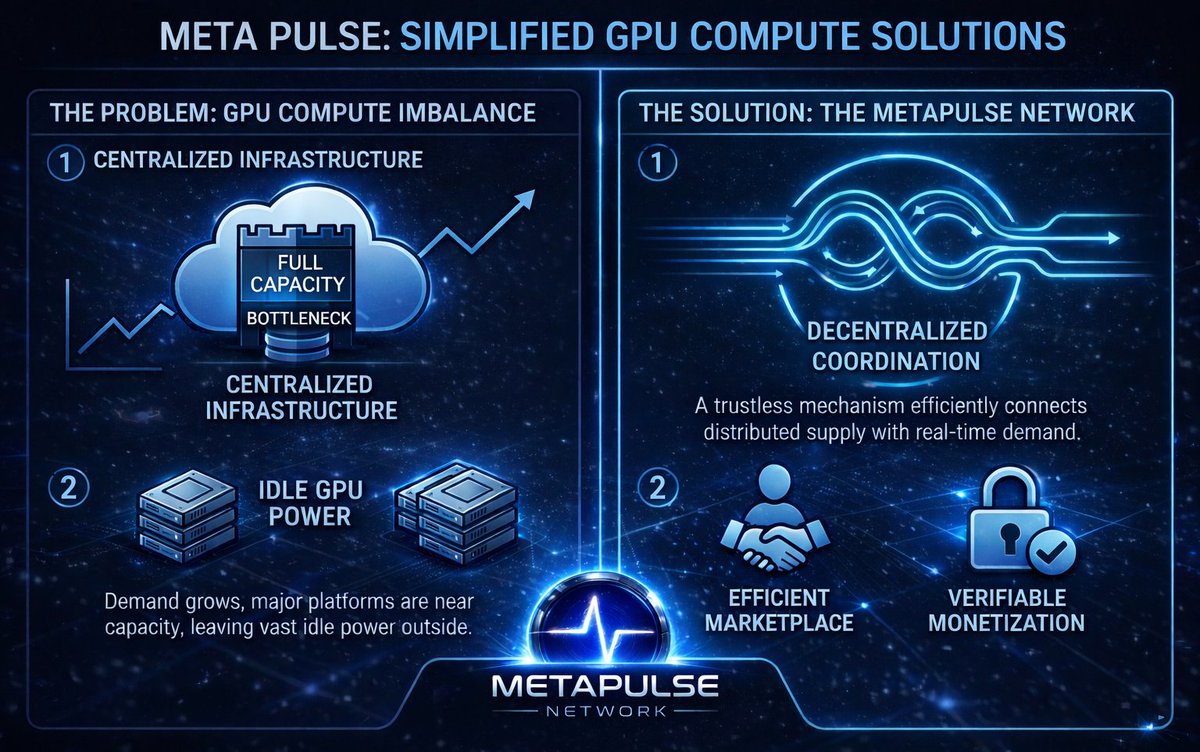
GPU compute demand continues to grow faster than centralized infrastructure can absorb, creating persistent bottlenecks across the AI stack.
While large data centers operate near full capacity, a significant amount of GPU power remains idle outside major cloud platforms.
This imbalance is not caused by a lack of hardware, but by limited access to it.
Current systems fail to efficiently connect distributed supply with real-time demand.
Centralized providers control pricing, allocation, and availability, which leads to higher costs and reduced flexibility for smaller teams.
At the same time, independent GPU owners lack a reliable way to monetize unused capacity in a consistent and verifiable manner.
The missing layer is not additional infrastructure, but a coordination mechanism that can align providers and users without relying on trust.
Creating an open, verifiable market for compute is what allows supply and demand to meet efficiently at scale.
This is where the MetaPulse Network introduces a more efficient and transparent alternative.
4
1
102
2,123
Mar 23
In an open compute network, verification cannot rely on trust.
If execution results cannot be reproduced or validated, the system becomes dependent on the honesty of the provider, which breaks the premise of decentralized infrastructure.
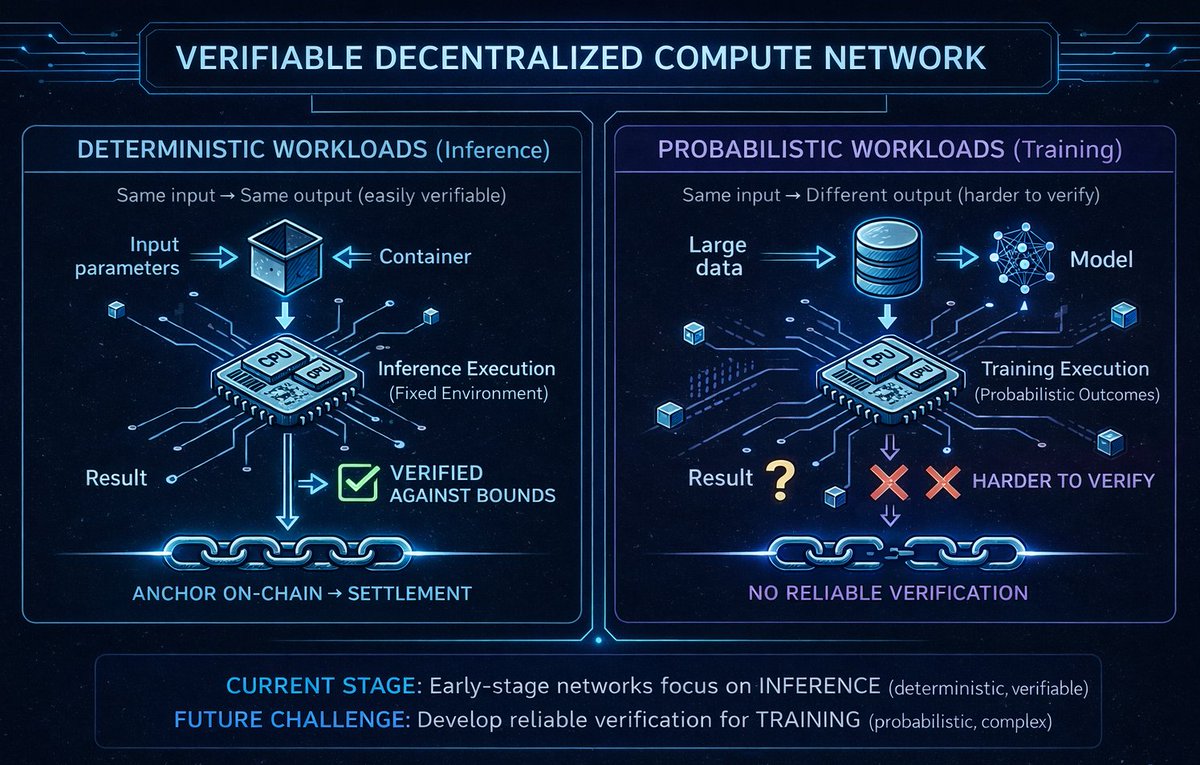
This is why early-stage distributed compute systems focus on deterministic workloads.
Inference tasks can be executed in controlled environments where model version, runtime container, and input parameters are fixed, allowing the output to be verified against expected bounds.
By anchoring execution results on-chain, the protocol can confirm that the job was completed under the agreed conditions before settlement is released.
This removes the need for manual arbitration and reduces the attack surface as the network grows.
Training workloads introduce additional complexity because results are probabilistic and harder to verify.
For that reason, many systems prioritize inference-first architectures until verification methods for non-deterministic compute become reliable.
Correctness at the execution layer is a prerequisite for scaling the network safely.
Without verifiable results, higher throughput only increases the probability of undetected failures.
Verification defines validity. Enforcement defines trust.
6
23
1,974
Mar 16
Weekly Development Update
Work continues on the core protocol architecture.
Current focus:
• compute verification model
• deterministic inference rules
• provider bonding logic
• token utility parameters
Inference outputs must be reproducible.
Results are hashed and anchored on-chain
to allow independent verification.
Foundation layer in progress.
More updates soon.
6
9
1,184
Mar 16
Decentralized compute is not only about hardware availability, but also about how execution and settlement are handled.
In a distributed compute market, it is not enough to simply connect users with GPU providers. The system must also ensure that jobs are executed correctly, results are valid, and payments are released under clear and verifiable conditions.
Traditional cloud infrastructure solves this through centralized control. The provider tracks execution, verifies results, and manages billing internally. This works, but it also creates opacity, higher costs, and dependence on a single operator.
In an open compute network, these guarantees cannot rely on trust alone. Job commitments, execution proofs, and payments must be recorded in a way that anyone can verify.
On-chain settlement provides a mechanism for this. Work agreements can be committed on-chain, execution results can be hashed and anchored, and payments can be released automatically once conditions are met.
This removes the need for manual reconciliation and reduces the risk of disputes between users and providers. It also allows independent participants to coordinate without relying on a centralized authority.
Transparent settlement is one of the key requirements for compute markets to become truly open, efficient, and scalable.
This is a requirement for the next generation of compute networks.
3
6
1,114
Mar 13
One of the biggest limitations in AI development today is the cost and availability of compute.
Most projects rely on centralized cloud providers, where GPU capacity is limited, pricing is controlled by the provider rather than an open market, and costs often rise far above the actual hardware value.
At the same time, a significant amount of compute power remains idle around the world, because there is no efficient system capable of coordinating supply and demand.
As long as compute infrastructure depends on closed systems, the growth of AI will remain constrained.
This is the problem decentralized compute networks — including the MetaPulse — aim to solve.
This is what we are working.
51
48
1,391
Mar 10
Wave 1 has successfully launched!
Thank you to everyone who participated and supported the start of the MetaPulse journey.
This marks the first step of the project.
While the presale begins, the broader context remains clear: - AI demand is growing at an unprecedented pace, while GPU supply continues to lag behind.
Major data centers operate at full capacity,
yet thousands of GPUs around the world remain underutilized because there is no efficient marketplace coordinating supply and demand.
The challenge is not simply a lack of hardware,
but a coordination problem within
the AI infrastructure market.
Decentralized infrastructure aims to create this missing coordination layer and connect available compute capacity with AI workloads more efficiently.
We will continue sharing updates
as the protocol evolves.
23
25
1,525
After months of preparation, Genesis begins today.
Wave 1 opens 20:00 UTC.
mpulse.network
Public allocation - Equal terms.
42
1
13
1,720
Almost everything is ready.
The infrastructure has been prepared.
The mechanics are in place.
Genesis phase is about to begin.
Soon the Network moves from preparation to participation.
mpulse.network
8
11
1,278
In most token launches, the focus is entirely on the moment of launch.
But in protocol design, the real question is what happens immediately after.
Once a network goes live, distribution becomes economics, and economics becomes behavior.
How participants interact with the system — whether they hold, use, build, or provide infrastructure — determines the direction of the ecosystem.
That’s why Genesis is not treated as a marketing event.
It is the moment where the first layer of incentives becomes active.
From that point forward, the system begins to evolve through participation.
MetaPulse Network
mpulse.network
Genesis begins tomorrow. ⚡️
1
3
1,911