
Asia/US Tech Analysis, Founder Interviews, and Intelligent Daily Signals on AI, FinTech, and Infrastructure
Joined May 2013
- Tweets 161
- Following 299
- Followers 756
- Likes 2,103
13 Photos and videos

Pinned Tweet

Jun 12
Is @SpaceX Really Worth $1.77T?
SpaceX has priced the largest IPO on record, raising $75 billion by selling 555.56 million shares at $135 each, giving the company a valuation of about $1.77 trillion.
That puts SpaceX among the most valuable listed companies in the U.S., despite the company reporting losses and still depending heavily on future execution across Starlink, launch, AI infrastructure, and long-horizon space ambitions.
I am not giving investment advice, but I do not think so.
Let me know what you think...
I am also curios to know what people think about its inclusion in Nasdaq 100, FTSE-Russel and MSCI.
On today's agenda:
03:59 - SpaceX Completes Largest IPO Ever, Ugh.
43:40 - Aman Arora, CO-Founder & CEO at Heizen
youtube.com/live/eHmdMuNoXUw…
Jun 12

On today's agenda:
1. SpaceX Completes Largest IPO Ever, Ugh.
2. Xiaomi Drops Open Source AI Coding Assistant, MiMo Code
3. Aman Arora, CO-Founder & CEO at Heizen x.com/i/broadcasts/1nxnRRnPY…
125
Jun 12
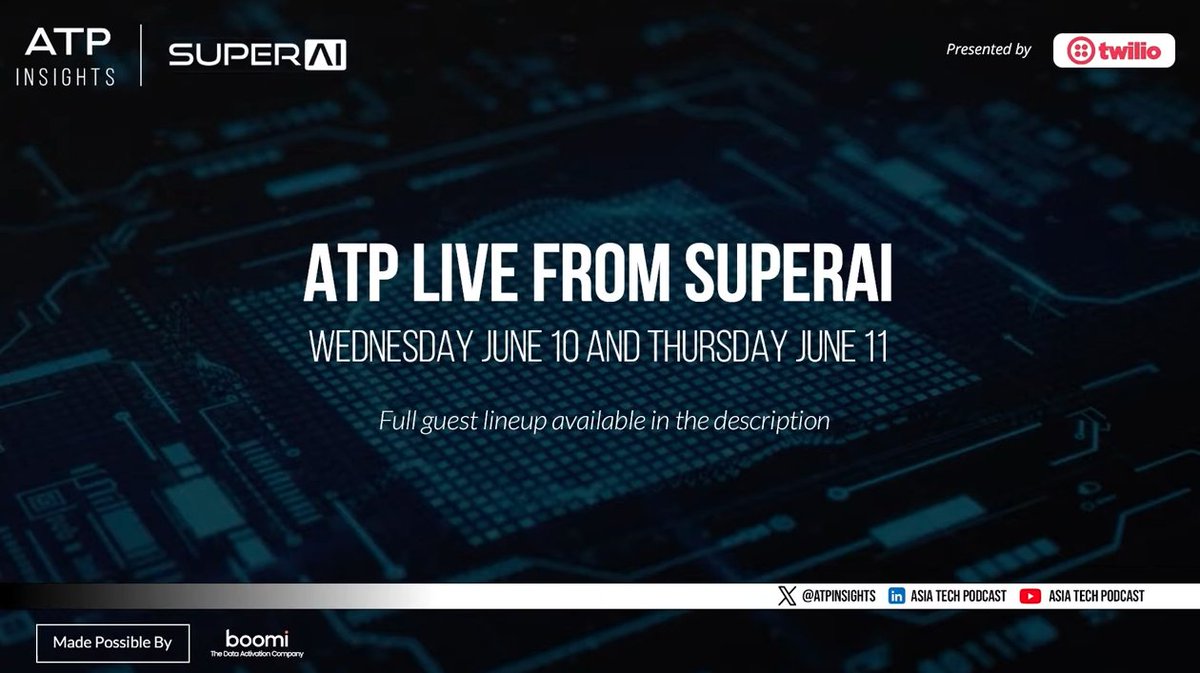
A great back and forth conversation with Jonathan Yip from @HSBCInnovation on @ATPinsights at @superai_conf at @marinabaysands in Singapore.
Jun 10

Category leadership in AI won't be decided by benchmark performance. That's the argument Jonathan Yip of @HSBC makes, pointing to where investor capital is actually flowing.
Jonathan says investors are currently underwriting three things. Compute, compliance, and commercial. The companies gaining the most ground are those embedding themselves into regulated workflows and partnering with institutions to solve real problems.
The benchmark question is secondary. What matters is whether a company can bring the right compute in a compliant way to the right customer or partner. That combination is what produces category winners.
Two factors make regulated markets particularly important. First, navigating compliance is difficult, but companies that get it right unlock substantial productivity gains. Second, regulated markets are sticky. Once a firm like Goldman Sachs buys your technology, they are unlikely to switch. That lock-in is where durable commercial value gets built.
23
Jun 12
At @superai_conf in Singapore, Carmen Lee, the Founder of @computeexchange told @ATPinsights that GPU access and compute were no longer new just infrastructure.
They are becoming an asset class, with reserve contracts, forward contracts, indices, and hedging.
Are companies ready to manage compute like financial risk?
Watch the full ATP Insights episode here:
youtube.com/live/F_y03ibb5_E…
1
36
Jun 9
On today's episode of AGTP Daily, we discussed how @Apple is rebuilding Apple Intelligence around a more open, layered AI architecture. The core pieces are the Foundation Models framework, App Intents, Private Cloud Compute, Core AI, and expanded multimodal capabilities.
Apple clearly wants AI to sit inside the operating system, inside apps, and inside Siri, rather than behave only like a standalone chatbot.
Developers can now access Apple’s on-device foundation model and connect app content and actions to Siri through App Intents schemas.
youtube.com/live/D4jD8Oz-zPc…
Jun 9
On today's agenda:
1. Apple Bets on AI on Device
2. OpenAI Says Everyone Should Have Personal AGI x.com/i/broadcasts/1dGYllVBP…
53
Jun 8
On today's episode of AGTP Daily, we discussed how @Meta is looking at a much more aggressive financing model for AI infrastructure.
It is not only the case that AI capex is rising. It is that even the largest cash-generating technology companies may now need outside capital to keep building data centers, securing power, and funding inference capacity at the scale the market expects.
Meta is reportedly considering a stock offering that could raise tens of billions of dollars for AI infrastructure. No banks have been hired, no final decision has been made, and other financing options remain open...but this does not seem out of the realm of possibility.
We also talked about whether @OpenAI is going to try to rebuild @ChatGPTapp as a superapp.
On today's agenda:
04:30 Meta Considers Selling Equity to Finance AI
48:49 Is ChatGPT Dead?
youtube.com/live/EUXZrUNApQ4…
Jun 8
On Today's agenda:
1. Meta Considers Selling Equity to Finance AI
2. Is ChatGPT Dead? x.com/i/broadcasts/1nGnRRzrq…
73
Jun 8
On today's episode of ATP Insights, we discussed how China’s humanoid robot push has moved to its industrial output phase. The country now has the manufacturing base, supplier network, government backing, and aggressive robotics companies needed to build humanoids at scale.
The most important fact is that China reportedly accounted for about 85% of global humanoid robot output in 2025. @UnitreeRobotics is one of the clearest examples: it has made humanoids visually compelling, relatively affordable by robotics standards, and easy to understand as a symbol of China’s hardware strength.
We also talked about how @nvidia's move with Unitree and Singapore-based Sharpa turns this into a bigger platform story. Nvidia’s Isaac GR00T reference humanoid robot combines a Unitree robot body, Sharpa’s dexterous hands, and Nvidia compute and software.
Nvidia is trying to create a common development platform for humanoid robotics research all the way out to deployment.
Jun 8
On Today's agenda:
1. Is Nvidia Part of China’s Robot Boom?
2. Wei-Chuan Chew, Co-Founder at @kitalulus
3. Ganesh Kumar Ramachandran, Head of Engineering & Product at @gopando
4. Olivier Too, Co-Founder at Auptimate
5. Ankit Upadhyay, Founder & General Partner at A2D Ventures
6. Isabella Suarez, Head of Engagement for Southeast Asia at TransitionZero
7. Muhammad Furqan Karim Kidwai, Co-Founder & CEO at Plouton AI
48
Jun 5
On today's episode of AGTP Daily, we discussed how frontier AI development is beginning to change the way frontier AI itself gets built.
The central issue is not that AI systems have already escaped human control, but that they are becoming increasingly important participants in the research and engineering loop that produces the next generation of models.
Today’s advanced AI systems are already being used to write production code, debug software, and run experiments.
In some leading AI labs, AI-generated code now accounts for a large share of merged production code, and engineers are reportedly shipping far more code per day than they did only a few years ago.
That does not mean human researchers are obsolete, but it does mean the division of labor is shifting.
On Today's Agenda:
04:46 - Anthropic Says Slow Down AI Development
29:52 - Cloudflare Says the Majority of Online Traffic is Bots
48:56 - Adam Robinson, CEO and Co-Founder at Hireology
01:04:48 - Sachit Kamat, Chief Product Officer at Eightfold
youtube.com/live/jFRDQsUptuI…
Jun 5
On today's agenda:
1. Anthropic Says Slow Down AI Development
2. Cloudflare Says the Majority of Online Traffic is Bots
3. @adrobins, CEO and Co-Founder at @Hireology
5. Sachit Kamat, Chief Product Officer at @eightfoldai
92
Jun 4
This conversation with @jeffseibert was so informed and insightful. Thank you Jeff!
Jun 3
LLMs are poorly suited for accounting,@jeffseibert, Co-founder and CEO at @digits argues, because the discipline is fundamentally deterministic rather than generative. Accounting requires that six times seven always equals 42.
There is no room for probabilistic outputs where the answer might be 43 this time.
Because of this, Digits built its platform around custom trained deterministic predictive models as the core engine.
LLMs are used only in limited areas as a fallback. Jeff points out that even as language models have grown more capable, their probabilistic nature makes them a poor fit for financial calculations that must produce exact, consistent results every time.
1
3
555
Jun 4
On today's episode of AGTP Daily, we discussed how @Apple's MacBook Neo appears to be turning into one of the most important Mac launches in years because it attacks a price band where Apple has historically had limited direct presence: affordable consumer, student, and first-time-buyer laptops.
Apple’s 2026 MacBook Neo shipment forecast has been raised from about 5 million units to 10 million units, implying Apple and its suppliers badly underestimated demand.
On Today's Agenda:
02:55 - Apple’s MacBook Neo Popularity and Apple Glasses
57:36 - @Uber Imposed a $1,500/month AI Limit
youtube.com/live/6u7hcVPTKSc…
Jun 4
On today's agenda:
1. Apple’s MacBook Neo Popularity and Apple Glasses
2. Uber Imposed a $1,500/month AI Limit x.com/i/broadcasts/1dGYllbRd…
126
Jun 4
On today's episode of ATP Insights, we discussed how and why Vietnam is emerging as Southeast Asia’s new test bed for platform businesses, where companies are not only expanding existing operations but also experimenting with new business lines across mobility automation, fintech, logistics infrastructure, AI-enabled services, and broader digital-economy partnerships.
On Today's Agenda:
04:55 - Is Vietnam the Next Super-App Battleground?
22:54 - Gary Ng, CEO at viAct
42:18 - Felix Liao, APAC Product Management Director at Denodo
01:05:19 - Matt Smith, CEO at MyPass Global
01:23:30 - Alon Kaufman, CEO and Co-Founder at Duality Technologies
01:44:50 - Darren Wang, CEO at OwlTing Group
02:06:23 - Nanda Ivens, CMO & Co-Founder at MWX AI
youtube.com/live/l3Qc3W_r9PQ…
Jun 4
On Today's agenda:
1. Is Vietnam the Next Super-App Battleground?
2. Gary Ng, CEO at @aiviact
3. Felix Liao, APAC Product Management Director at @denodo
4. Matthew Smith, CEO at MyPass Global
5. Alon Kaufman, CEO and Co-Founder at @DualityTech
6. @owltingdarren, CEO at @owlting
7. @NandaIvens, CMO & Co-Founder at @mwx_ai
1
106
Jun 3
On today's episode of AGTP Daily, we discussed @Microsoft's launch of Scout, an always-on agentic assistant built on the open-source @openclaw framework and designed for the Microsoft 365 environment.
Unlike a conventional Copilot-style chat interface, Scout is intended to operate persistently across work systems, with a user-defined identity, memory, preferences, and task patterns that improve through ongoing feedback.
This is being framed it as Microsoft’s attempt to bring OpenClaw’s flexible, autonomous-agent model into enterprise productivity workflows...and it feels like nobody is better positioned to do this than Microsoft.
On today's agenda:
03:19 Microsoft Built Scout, Inspired by OpenClaw
50:01 DeepSeek To Raise $7BN
01:02:30 Jeff Seibert, Co-Founder & CEO at Digits
youtube.com/live/LIP5EEaIXLY…
Jun 3
On Today's Agenda:
1. Microsoft Built Scout, Inspired by OpenClaw
2. DeepSeek To Raise $7BN
3. Jeff Seibert, Co-Founder & CEO at Digits x.com/i/broadcasts/1lJQRRgMo…
99
Jun 2
On today's episode of AGTP Daily, we discussed the significance of Alphabet announcing an $80 billion equity capital raise to fund a major expansion of AI infrastructure and compute capacity.
@Google says customer demand for AI solutions and services is exceeding available supply, and that the new capital is intended to help scale its global compute base.
On today's agenda:
04:45 Alphabet Is Raising $80B for AI Investment
46:53 Pre-ChatGPT Startups Face a Reckonin
youtube.com/live/_F8MdrfCiWo…
Jun 2
On today's agenda:
1. Alphabet Is Raising $80B for AI Investment
2. Pre-ChatGPT Startups Face a Reckoning
3. Salesforce Has a Stake in Anthropic x.com/i/broadcasts/1yxBeemVo…
34
Jun 1
On today's episode of AGTP Daily, we discussed Nvidia and Microsoft announcing RTX Spark, a Windows-on-Arm PC platform built around an Nvidia “superchip” combining an Arm CPU, Blackwell RTX GPU, large unified memory, and Nvidia’s AI/graphics software stack.
The idea here is that the PC is being repositioned as a local agentic AI machine, not just a productivity endpoint. Nvidia says RTX Spark systems can run on-device agents, large local models, creative workloads, and RTX gaming in thin laptops and compact desktops.
Time Stamps:
04:00 - @Microsoft Next PC Bet Runs on @nvidia Silicon
47:15 - @Meta Launches Subscription Plans
01:02:24 - William Bao Bean (@williambaobean), Managing General Partner at Orbit Ventures (@OrbitVenturesVC)
youtube.com/live/Oe9mmHRLNOY…
Jun 1
On today's agenda:
1. Microsoft’s Next PC Bet Runs on Nvidia Silicon
2. Meta Launches Subscription Plans
3. William Bao Bean, Managing General Partner at Orbit Ventures x.com/i/broadcasts/1pKkOOPdL…
1
94
Jun 1
On today's episode of ATP Insights, we discussed how Huawei is trying to reframe China’s AI-chip constraint as a systems-engineering problem, not merely a lithography problem. Its “Tau Scaling Law” argues that performance can be improved by reducing signal/data-movement delay across devices and larger systems, rather than depending primarily on transistor nanometer shrinkage.
Huawei says related techniques such as LogicFolding can improve density, power efficiency, and speed by stacking and reorganizing chip components more tightly.
This is also feels like a very strategic sanctions workaround, because China remains restricted from accessing the most advanced EUV lithography tools used by TSMC and others.
Separately, China has added AI chips to its official “secure and reliable” procurement assessment system for the first time. The new category covers AI training and inference chips, and certifications are valid for three years. This gives government agencies, central SOEs, and state-linked buyers a formal procurement channel for domestic AI accelerators.
youtube.com/live/G7NxDDatESs…
Jun 1
Today's agenda:
1. China Rewrites AI Chip Design Strategy
2. Rubens Peculis, CTO at Otivo
3. Mark Keough, Executive Director at SkillsAware
4. Snir Levi, Founder & CEO at Nominis x.com/i/broadcasts/1qKDzzmaj…
111
May 28
On today's episode of AGTP Daily, we discussed how @nvidia CEO Jensen Huang told CNA that blaming layoffs on AI is a “lazy” explanation and often does not match the timing or reality of corporate restructuring. His point was not that AI has no labor impact, but that CEOs should not use AI as a convenient public-relations wrapper for layoffs already driven by cost pressure, restructuring, margin targets, or management choices.
Huang argued that the better framing is skills displacement rather than job extinction. His line was: people are less likely to lose jobs directly “to AI” than to people who learn to use AI better.
He also emphasized the need for a more balanced narrative around AI adoption, including training, regulation, and industry readiness.
youtube.com/live/DC7tNKH28TQ…
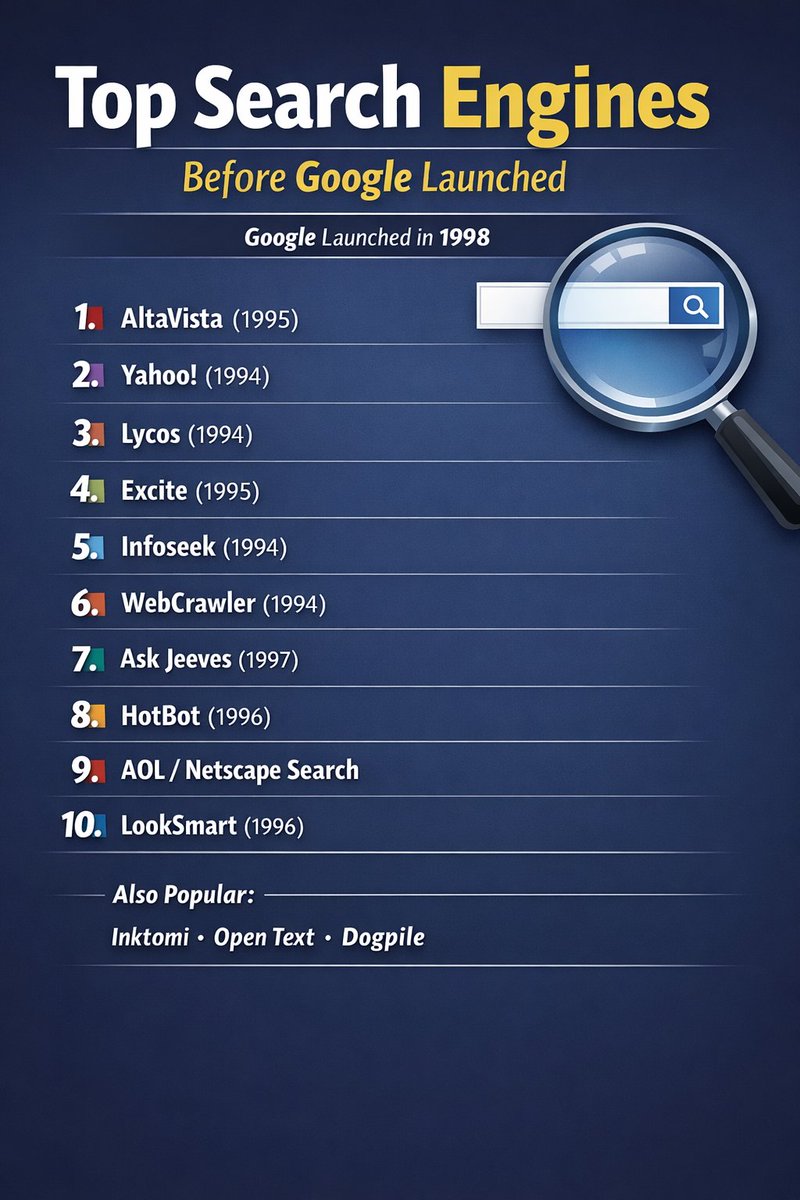
@OpenAI @DuckDuckGo
May 28
1. Jensen Huang Says CEOs Are Just Too Lazy
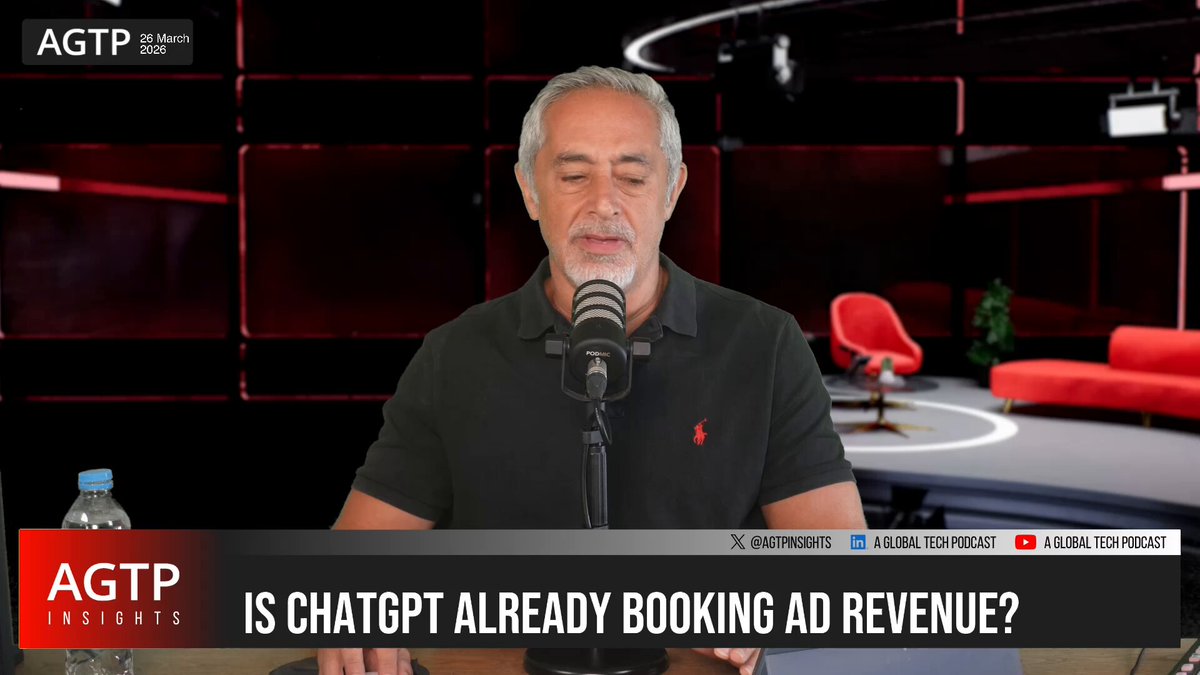
2. OpenAi Commits $250MM to Help AI Disruption
3. DuckDuckGo Sees Spike In Search
4. Bob Blakley, CPO at Mimic
5. Sam Kaplan, Founder at Remix x.com/i/broadcasts/1nxeLLqRd…
51
May 28
On today's episode of ATP Insights we discussed how Singapore’s 2026 growth story is being pulled in two directions.
The upside is the AI capex cycle: stronger demand for memory chips, servers, semiconductor components, disk media and related electronics is lifting manufacturing, wholesale trade, exports, and investment expectations.
The downside is geopolitical and energy risk from the Middle East conflict. MTI and analysts warn that a prolonged conflict could raise energy costs, disrupt supply chains, hurt petrochemicals and energy-intensive industries, and create input shortages for semiconductor production.
Singapore is still benefiting from AI demand, but the growth forecast is not a clean “AI boom” story; it is an AI boom sitting on top of energy, trade, and supply-chain fragility.
We also had some amazing guests on the show including @Gavriel_Cohen the team behind @NanoClaw_AI.
youtube.com/live/WYq2kfV0doU…
May 28
On today's agenda:
1. Singapore Rides the Global AI Boom
2. Ilya Kravtsov, co-Founder at Ringkas
3. Gilbert Leung, CEO & co-Founder at Novo AI
4. Robin Lee, Chief Growth Officer at Confide Platform
5. Michael Gladishev, co-Founder and VP R&D at Legion Security
6. Michael Davies, Founder at Nextvestment
7. Gavriel Cohen, co-Founder and CEO at Nanoco
1
46
May 27
On today's episode of AGTP Daily, we discussed how Sundar Pichai, CEO of Alphabet and Google did a Q&A about Google’s AI strategy with Nilay Patel (@reckless) at @verge .
This strategy has led to a company-wide restructuring around Search, YouTube, Google Cloud, Gemini models, and AI infrastructure. Pichai says Google reorganized after the ChatGPT shock by combining Brain and DeepMind, centralizing AI infrastructure, creating more direct AI product reviews, and pushing Search to move faster.
He describes Google as now operating from a shared Gemini infrastructure layer across products, rather than treating AI as separate product experiments.
We also talked about the hiring of @colinjfleming as the new CMO at @OpenAI and why it matters!
youtube.com/live/AK_TNv7vl4A…
May 27
On today's agenda:
1. Q&A With Sundar Pichai - CEO of Google and Alphabet
2. Colin Fleming - New OpenAI CMO, Business
3. @veradittakit, Managing Partner at @panteracapital x.com/i/broadcasts/1MJgNNVjv…
84
May 27
This feels like it should be VERY true.
May 27

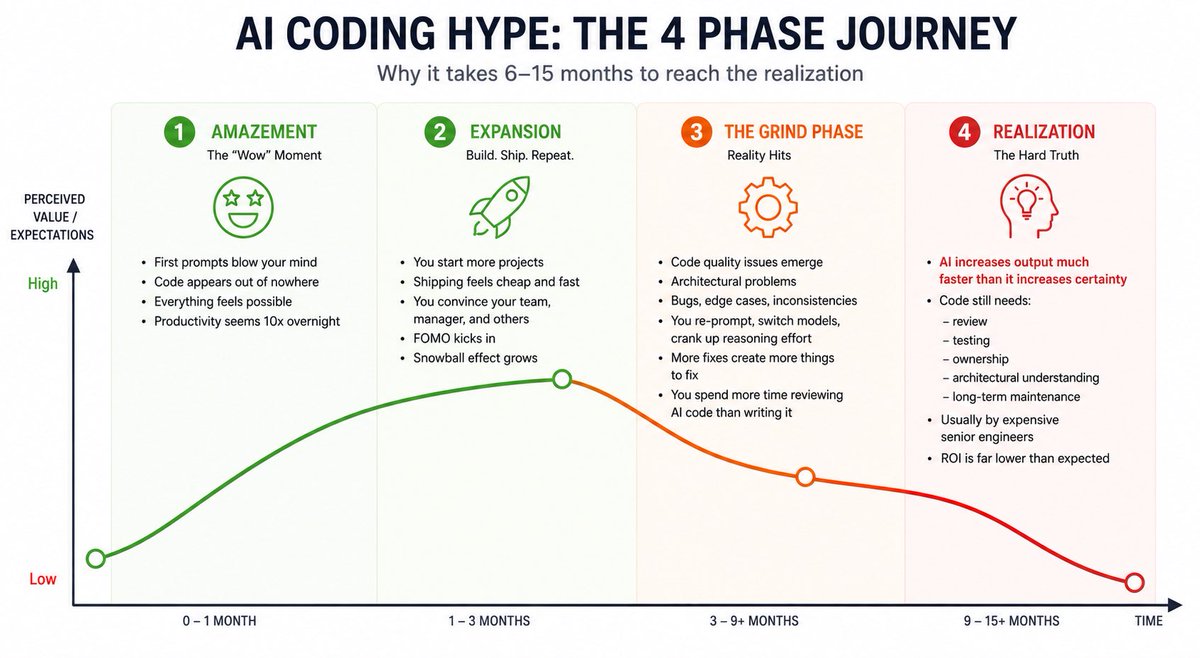
I think AI coding hype follows roughly four stages:
1. Amazement
You try it and can’t believe how much code it generates from a few prompts.
2. Expansion
You start more and more projects because shipping suddenly feels cheap and fast.
This is also the phase where people start convincing everyone around them:
- coworkers
- management
- friends in other companies
because nobody wants to “fall behind” in 6–12 months.
That creates a massive snowball/FOMO effect.
3. The grind phase
You realize the generated code has architectural issues, sloppy mistakes, weird abstractions, duplicated logic, broken edge cases, etc.
So you start:
- re-prompting
- switching models
- increasing reasoning effort
- reviewing fixes
- generating fixes for previous fixes
And suddenly you spend your days reviewing AI-generated pull requests instead of building software.
4. Realization
You realize AI coding increases output much faster than it increases certainty.
The code still needs:
- review
- testing
- ownership
- architectural understanding
- long-term maintenance
Usually by expensive senior engineers.
And the interesting thing is:
this whole cycle can take many months or even more than a year because people become socially and professionally invested in the narrative themselves.
Once teams, managers, and entire companies have been convinced that this is the future, it becomes psychologically and politically very hard to later say:
“Actually, the ROI is much lower than we expected.”
15