
Tech policy wonk. Former Tech Strategy @Georgetown/@Cloudflare/Senate/White House/FCC/IBM/@BGOV/MSFT. Accelerating the future of the Net & the Cloud
Joined June 2007
- Tweets 90,641
- Following 9,254
- Followers 8,856
- Likes 82,805
1,040 Photos and videos

Michael Nelson retweeted

Jun 13
The monster inevitably eats its own.
Jun 13

Wow.
Russia Confiscates $7.6Bln in Assets in Largest Nationalization Yet themoscowtimes.com/2026/06/1…
54
926
4,859
210,965
Michael Nelson retweeted

ZELENSKYY: Russia is trying to bribe European politicians, and some are playing along — but they will lose, as Orbán did.
“They (Russians) are trying to bribe certain politicians with certain benefits. Not for peace, but so those politicians simply sell their nations' interests and Europe's common interests to Russia. In the end, they will lose, like Orbán did. But many still try to make friends with Putin's wallets and turn a blind eye to the fact, what is really happening”.
Ukrainian president on Saturday, June 13, 2026.
176
724
2,946
47,296
Michael Nelson retweeted

🚨 Due to national security concerns, the U.S. government issued an export control directive to SUSPEND all foreign access to Anthropic's Fable 5 and Mythos 5 (including access by foreign nationals inside the U.S.).
As I wrote in my newsletter this week, Mythos has triggered a massive AI policy shift in the U.S., which is already echoing globally.
We've entered what I've called the 'adolescence of AI policy,' and there is no coming back.
For countries, it means the "wait and see" approach is no longer an option, as there could be immediate geopolitical consequences, including from a cybersecurity perspective.
Read David Sacks'(a key Trump advisor and previously "AI czar") full account below.
I'm also adding a link to my article "Mythos and the Adolescence of AI Policy." (link below).

I’ve had a number of conversations with folks inside and outside government about the current situation with Anthropic, and here is what I believe to be true:
— As we know, Anthropic publicly released its Mythos class models earlier this week under the commercial name Fable.
— Fable is Mythos with guardrails. But if those guardrails fail, then you’ve exposed Mythos and its advanced cyber capabilities to people who shouldn’t have them. (Keep in mind that Anthropic itself widely promoted the idea that Mythos was a cyberweapon and needed to be regulated as such. They asked for government regulation of Mythos and championed the guardrails on Fable. If there is a vulnerability — big or small — it is Anthropic’s responsibility to patch.)
— A highly credible trusted partner of both Anthropic and the USG who was testing Fable came forward with a jailbreak of those guardrails. The Admin asked Dario to fix the jailbreak or de-deploy the model. Dario refused.
— In their blog post, Anthropic defended its decision by saying the jailbreak isn’t serious. That is not what the trusted partner and the USG believe; nor is that kind of minimizing language consistent with Anthropic’s brand as the AI safety company. It’s difficult to fathom how they could claim a jailbreak allowing operability of a cyber weapon could be defined as not “serious.”
— In the past, Anthropic has always said that safety must be top priority and taken super seriously. In this case, Anthropic prioritized the continued offering of the consumer model over safety.
— In reaction, the Admin issued the export control. The Admin did this reluctantly. It’s been very surprised that Anthropic hasn’t wanted to cooperate with a reasonable safety request (ie fixing the jailbreak issue). Anthropic’s reaction is very much at odds with their branding and ethos as a safe AI research community.
— The Admin’s hope now is that Anthropic remediates the safety issue, the export control is lifted, and Fable goes back into general release. The Admin wants all of this to happen as soon as possible. It is frankly bewildered that Anthropic hasn’t wanted to comply with safety requests that it previously said were its highest priority.
— Those trying to misdirect and tie this action to the prior DoW/Anthropic issues are wrong. The Admin values Anthropic’s technical capabilities and feels that this issue, while serious, should be easily resolved. The ball is in Anthropic’s court.
7
6
26
2,880
Michael Nelson retweeted

Looks a lot like a centrally planned economy
theguardian.com/commentisfre…
18
201
522
38,178
Michael Nelson retweeted

I’ve seen the paper. It’s not a jailbreak. It was Defense Oriented Prompting (DOP), capabilities defenders need. My thoughts on the hasty Export Controls that made Anthropic pull Fable. If Nat defense is the goal, this just scored an own goal against us
wsj.com/tech/ai/anthropic-ha…
15
63
293
37,830
Michael Nelson retweeted

Lately, Russian propagandists started openly mocking President Trump. The shift has been rather abrupt, as Russian television had not allowed itself such rhetoric before. Clearly, the Kremlin gave the order to start criticizing Trump.
At first, Russian propagandists referred to him as "our guy." Now they describe him as a "Bidenized loser," a destroyer of the American empire, and a helpless manager. It is not Trump who has changed, but the tasks of the Russian propaganda machine. So, by taking his figure as a case study, we can see how propaganda works.
▪️ The first law: the object is not evaluated - it is used.
On Russian television, Trump can be both a hero and a fool, a genius and a weakling on the very same day. One day, Solovyev praises the man who "destroyed the world order," and the next day he mocks his inability to reach a deal on Iran. Not because propagandists are confused, but because propaganda and lies do not require consistency. The more confusing and absurd, the better.
▪️ The second law: Russian television says only what the Kremlin allows it to say, and only when it allows it.
Once the command was given, the hosts immediately began tearing Trump apart.
▪️ The third law: every audience gets its own dish.
The domestic audience hears contempt. Foreign audiences hear doubt. Russian-language broadcasts feed viewers mockery, while RT in English carefully cultivates skepticism and asks questions.
▪️ The fourth law: ridicule is a political weapon.
In reality, propaganda attacks not the individual but the institution through the individual. Trump is merely a convenient conduit. If he appears weak, manipulable, or incompetent, then American leadership itself begins to look the same.
▪️ The fifth law: propaganda hates inventing anything new. It prefers clichés.
Need to explain Trump? Bring out "Biden." Need to explain Ukraine? Bring out "Afghanistan." Need to discredit future evidence? Bring out "Powell's vial." New events are simply stretched over old templates.
▪️ The sixth law is one of the most sophisticated.
The most effective Russian propaganda does not sound Russian. It speaks with an American voice. If the desired message can be put into the mouth of an American journalist, blogger, or politician, its impact multiplies. People are more willing to trust their own.
And finally, the most important thing.
The ultimate goal of the machine is not to convince you that it is right. That is too difficult. It is much easier to convince you that truth itself does not exist. That everyone lies. That everyone manipulates. That everyone is equally ridiculous and equally absurd.
Once people stop searching for the truth, they become much easier to control.
The key question is why Russian propaganda has changed its rhetoric toward Trump precisely now.
73
651
2,004
134,784
Michael Nelson retweeted

Among all the European nations that have already joined the European Union or see such a prospect for themselves, Ukraine is the one making the greatest sacrifices for Europe. We are not simply carrying out internal reforms, nor are we simply going through a transformation. We are fighting for our state, for our independence, and for our right to choose our own path and to be Europe.
And this right of ours is at the same time the right of every nation in our region. We are fighting for our freedom and theirs, for Europe for ourselves and for them – for the Baltic states and for Poland, for Hungary and Slovakia, for Romania and Moldova, and for the peoples of the Caucasus.
That is why the fate of Europe is being decided here – it is being decided in Ukraine, in this war, and in how this war ends – and whether Russia will still have the strength and the desire after this war to threaten the existence of Ukraine and its other neighbors, and the entirety of Europe.
That is why we must end this war with dignity and with guaranteed security. And this is what we will discuss with our partners during the G7 Summit in France, and later at the European Council Summit and at the NATO Summit in Ankara.
1,050
2,674
13,090
265,650
Michael Nelson retweeted

Jun 13
Snyder: The U.S. is not just unreliable, it is behaving strangely.
Allies like Romania, Poland, Taiwan and South Korea expect America to save resources for serious moments, not waste munitions, reputation and focus on wars it cannot explain. 1/
15
869
3,263
105,286

A GOP revolt over AI is taking shape dlvr.it/TT1xFL
12
66
154
34,039
Michael Nelson retweeted

Jun 13
The most interesting thing in tech: Commerce bans foreign nationals—including Anthropic's own staff!—from using Fable. So the company shuts it down for all. Anthropic keeps warning AI is existentially dangerous but then keeps shipping. The government wants AI built here but incoherent regulations just derailed a leading product. It's not going well, folks.
10
28
193
12,041
Michael Nelson retweeted

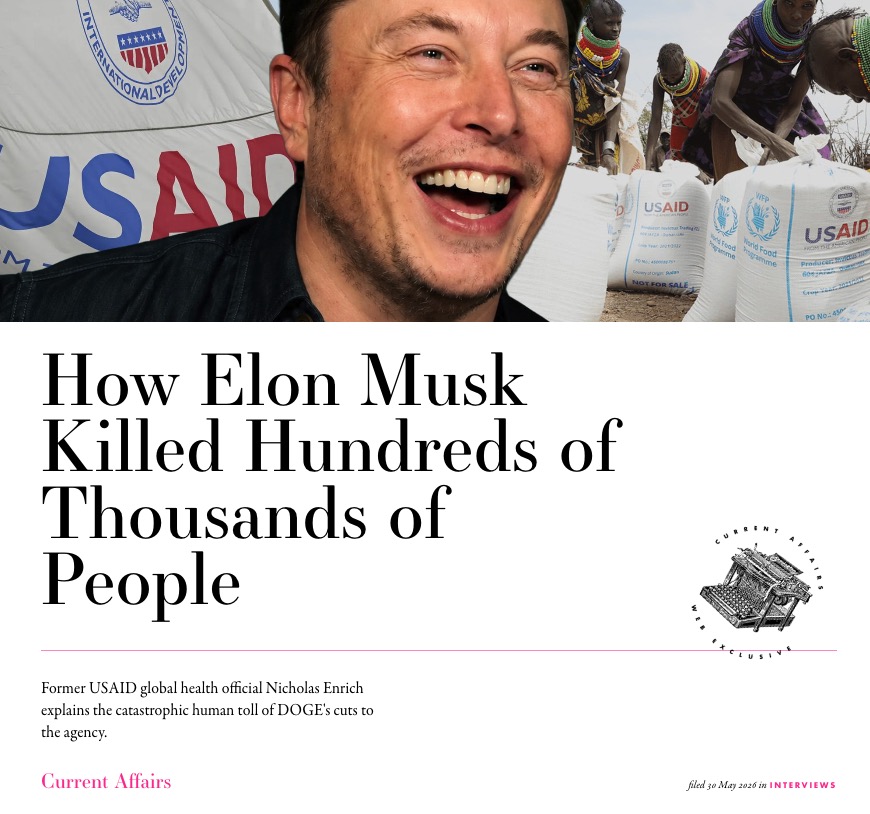
Instead of discussing how Elon Musk is now the world's first trillionaire, we should talk about how he killed hundreds of thousands of people through his dismantling of food and medical aid to poor countries
currentaffairs.org/news/how-…
4,753
18,492
44,996
1,598,949
Michael Nelson retweeted

Jun 13
From nonexistent studies in White House reports to hallucinated sources in EU cybersecurity briefs, AI tools are increasingly slipping "fake facts" into official government records restofworld.org/2026/governm…
6
8
1,104
Michael Nelson retweeted
Jun 12
Applebaum: The Trump administration often seems uninterested in human beings, not Americans facing inflation, not Iranians under bombing, not Epstein victims.
It is focused on clips, engagement, visuals and what the online world will say. 1/
5
191
665
16,112
Michael Nelson retweeted

Jun 13
❗️ Commerce’s shocking decree this afternoon – which effectively shuts down Anthropic by cutting off access to Mythos 5 and Fable 5 for many of their own employees — seems both wildly overdramatic and also counterproductive for the US AI industry.
I concur with @deanwball that the decision feels heavy-handed.
Perhaps it does China a favor, though. Certainly every Chinese person working in a US AI company (and there are many) will consider returning to the competition in China ASAP.
And investors will start to wonder whether American AI companies can thrive in this atmosphere.
If you want an example of an AI regulation that can stifle innovation, this is it.
Jun 13

I can’t tell if this is lawfare against Anthropic in particular or extreme national-security hawkery. Regardless, it is simply cartoonish.
44
52
256
26,974

Michael Nelson retweeted

La Maison-Blanche vient de forcer Anthropic à couper ses modèles avancés à tous les étrangers—qu’il soient ou non sur le sol américain.
Les effets géopolitiques de cette décision historique sont massifs.
Analyse à chaud @victorstorchan, très conseillée.
legrandcontinent.eu/fr/2026/…
15
238
366
64,920
Michael Nelson retweeted
Jun 12
Fiona Hill: Autocracies see the state as strong and society as irrelevant. Individuals have no real role.
The fundamental difference with democracies is that societies still matter and in Ukraine, society has shown extraordinary resilience. 1/
5
210
740
15,815
Michael Nelson retweeted

Jun 13
I actually think targeted export controls on model access are prudent. But across the board controls on all countries on a single model, without any warning, is highly questionable. Imposing equally broad deemed export controls, which also restrict access to foreign nationals, is just absurd—and obviously will result in the model being pulled from distribution, as just happened.
Export controls are a critical tool, and an extremely powerful one. Used correctly, they have the potential to massively extend the US lead in AI. Used incorrectly, they will stifle AI development. The Department of Commerce’s export control strategy has been completely incoherent and sabotaging. It is sending powerful AI chips to China, not enforcing controls that would prevent Chinese smuggling, creating massive loopholes that allow AI chips to be sent to China, and preventing US AI companies from releasing their own models.
This has to stop. We urgently need a smart export control strategy that applies robust export controls to deny our adversaries access to advanced technology, while advantaging US companies. Commerce and BIS are consistently doing the opposite. If BIS doesn’t understand how to use its authorities or what the implications are of its actions, then it needs to find some new personnel who can actually execute a competent export control strategy. The current one is incoherent and self-defeating.
Jun 13

The US government, citing national security authorities, has issued an export control directive to suspend all access to Fable 5 and Mythos 5 by any foreign national, whether inside or outside the United States, including foreign national Anthropic employees.
The net effect of this order is that we must abruptly disable Fable 5 and Mythos 5 for all our customers to ensure compliance.
Access to all other Claude models is not affected.
We apologize for this disruption to our customers. We believe this is a misunderstanding and are working to restore access as soon as possible.
Read our full statement: anthropic.com/news/fable-myt…
19
25
194
32,073
Michael Nelson retweeted

Jun 12
A promised 4–5 week war that's still dragging on three months later tells you something important: the forecast was wildly wrong.
And bad forecasts have consequences. Businesses make plans around them. Allies make plans around them. Families do too.
12
147
738
28,490
Michael Nelson retweeted

Jun 13
This is really dangerous: an FBI raid on voter registration group ms.now/news/ohio-pro-democra…
28
728
1,325
30,024