
Joined February 2024
- Tweets 1,419
- Following 249
- Followers 763
- Likes 97
120 Photos and videos








Pinned Tweet

Apr 24
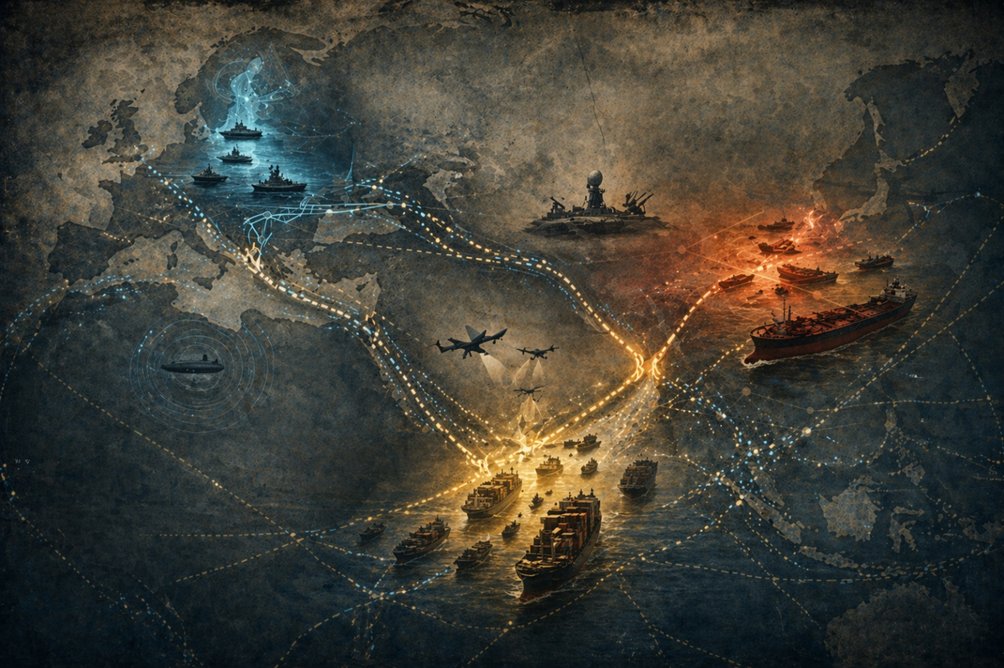
New issue: Mission Grey Guild Newsletter #2 is published!
Maritime chokepoints are now a business risk issue, not just geopolitics.
Friction in global shipping is driving costs, delays, and planning uncertainty.
We outline practical strategies firms can use to adapt.
Subscribe:
missiongrey.com/insights
2
1
219
AI’S NEXT BOTTLENECK IS NOT THE GPU
A more consequential AI risk is moving upstream. China’s export controls on indium phosphide, a critical material for high-speed optical chips used in AI data centers, are now delaying supply and lifting average 6-inch wafer prices by 250% to about $5,000. China also accounted for roughly 70% of global indium output in 2024, underscoring how concentrated this node already is. [cite:5SQh] [cite:bAYk]
This matters because AI infrastructure depends on more than advanced processors. Optical interconnects are essential as hyperscalers push faster, more power-efficient data centers, and alternative capacity outside China will take time to scale. At the same time, the G7 is preparing to focus on critical minerals coordination, including stockpiles and joint sourcing, as dependence on Chinese-controlled supply chains becomes harder to ignore. [cite:5SQh] [cite:fixT] [cite:ZM8O]
Implication: executives should stop treating AI supply risk as a chip-only issue. The next delay, cost overrun, or margin squeeze may come from specialty materials and photonics, not semiconductors alone.
22
Jun 13
ENERGY SHOCKS ARE NOW CENTRAL-BANK SHOCKS
The biggest signal for business today is not only the US-Iran escalation, but how fast it is spilling into prices, shipping and monetary policy. Brent has traded near $95 a barrel in recent days, while the Strait of Hormuz still carries about 20 million barrels a day, roughly 25% of global seaborne oil trade. With only limited pipeline bypass capacity, even partial disruption keeps freight, insurance and input costs elevated. [cite:LvDR] [cite:6kDJ]
That pressure is no longer staying in energy markets. It is feeding directly into inflation expectations and financing conditions across major economies. The implication is clear: firms exposed to Gulf transit, energy-intensive production or thin margins should plan for a longer period of higher volatility, higher working-capital needs and more expensive hedging. In this environment, geopolitics is not a background risk. It is a cost driver. [cite:S1A8] [cite:qgWJ]
59
Jun 12
SOUTH CHINA SEA RISK IS RISING BY INCREMENTS
A 6-by-6 meter Chinese floating platform with an apparent antenna at Scarborough Shoal may look minor, but that is precisely why markets should pay attention. Philippine authorities say the structure was detected in late May, later moved deeper into the shoal, and was accompanied by Chinese vessels and personnel. Manila has filed diplomatic protests, while US intelligence is now monitoring the site closely. [cite:W7k8] [cite:s65x]
This matters because Scarborough sits on one of the world’s most commercially vital maritime corridors. The South China Sea carries more than $3 trillion in annual shipborne trade, and past Chinese moves in disputed waters have often begun with small, deniable installations before becoming harder facts on the water. [cite:TfYD] [cite:ZwGO]
Implication: companies should not treat this as a local fisheries dispute. It is a reminder that Indo-Pacific supply chains face persistent gray-zone coercion risk, with potential consequences for shipping confidence, insurance costs, offshore investment, and long-term assumptions about regional stability.
34
Jun 11
EU SANCTIONS ARE SPREADING RISK FAR BEYOND RUSSIA
The EU’s proposed 21st sanctions package is not just another Russia measure. It would hit 31 additional Russian banks, add 30 more shadow-fleet vessels, restrict LNG tanker sales, tighten crypto rules, and impose new import bans worth around €60 million, including on some Russian fish products. [cite:mtgu] [cite:HRjy]
The bigger shift is geographic. Brussels also wants measures on 20 entities in third countries and export controls on 50 companies in jurisdictions including China, India, Türkiye, Kazakhstan, Kyrgyzstan and the UAE that it says are helping sanctions evasion or supporting Russia’s military supply chains. [cite:mtgu] [cite:m4xL]
Implication: for international business, compliance risk is moving from direct Russia exposure to ecosystem exposure. Shipping, trade finance, procurement and distributor networks across Eurasia now face a higher probability of disruption, delayed payments, and intensified beneficial-ownership scrutiny. [cite:Ei0Y]
40
Jun 10
AI CHIP CONTROLS ARE BECOMING A BOARDROOM ISSUE
Taiwan is considering much stricter AI chip export controls to China, including expanding limits beyond blacklisted firms to potentially all Chinese customers above a performance threshold, and making chip smuggling a criminal offense. That would tighten one of the most important enforcement gaps in the global semiconductor system. [cite:knbI] [cite:A6tV]
At the same time, bipartisan US senators are pushing Washington to close loopholes that could let Chinese firms use offshore subsidiaries or shell companies to order advanced chips from foundries such as TSMC. US regulators have already said sales to Chinese subsidiaries in third countries like Malaysia require licenses. [cite:ofPL] [cite:KeJ7]
The implication for business is clear: AI supply chains are moving deeper into the national security domain. For multinationals, compliance exposure is widening from direct sales to customer structure, routing, and end-use. This raises legal, operational and concentration risk across semiconductors, cloud, servers and advanced manufacturing. [cite:kGac]
15
Jun 9
EUROPE’S RATE TURN IS A WARNING FOR GLOBAL BUSINESS
The most important shift in today’s brief may be in Europe: the ECB is now widely expected to raise rates by 25 basis points to 2.25% this week, its first increase in more than 2.5 years, after eurozone inflation accelerated to 3.2% in May. At the same time, euro area GDP was revised to a 0.2% contraction in Q1, while the EU cut its 2026 growth forecast to 0.9%. [cite:XhhY] [cite:N3wM] [cite:Pn7s]
That combination matters. Europe is not tightening because demand is booming, but because imported energy pressure is forcing policymakers into a harder inflation-versus-growth trade-off. For companies, the implication is clear: financing conditions may stay tighter, consumer demand more uneven, and margin pressure sharper for sectors exposed to energy, transport and discretionary spending.
In short, the Middle East shock is no longer just an oil story. It is now a Europe demand, rates and investment story too.
22
Jun 8
ENERGY MARKETS ARE NO LONGER WAITING FOR WAR TO END
The biggest signal in today’s risk environment is not just higher oil. It is the breakdown of “normal” trade assumptions around the Strait of Hormuz. Recent reporting shows traffic remains far below typical levels, with only a handful of ships transiting on some days versus roughly 100-125 vessels a day under normal conditions, while more than 300 non-Iranian vessels have reportedly applied for passage permits. OPEC has responded with another July quota increase of 188,000 barrels per day, but markets remain skeptical that paper supply can offset physical disruption. Brent recently touched nearly $98 intraday. [cite:2jQV] [cite:kDbC] [cite:MuZc] [cite:FGO5]
The implication for business is broader than fuel costs. Higher marine insurance, rerouting, inventory buffers and working-capital pressure are now feeding directly into margins. With the IMF still projecting 3.1% global growth in 2026 under a limited-conflict baseline, any prolonged shipping disruption would make that outlook harder to sustain. This is now an operating model issue for importers, manufacturers and logistics-heavy sectors. [cite:YxGg]
1
35
Jun 7
EUROPE’S SECURITY BILL IS NOW A BUSINESS STORY
Washington is no longer just pressuring Europe on burden-sharing. It is cutting real capabilities from NATO planning. Reuters reports the US wants European allies and Canada to replace reduced American air and naval contributions, with US fighter jets available to NATO set to fall by a third to 99 and MQ-4/MQ-9 drones cut by half to 12. Other reports say one carrier strike group and all cruise-missile submarines assigned to NATO’s crisis pool could also be removed. [cite:jL73] [cite:L82h] [cite:wFGa]
This shifts defense from a policy debate into a fiscal and industrial repricing. Europe is already discussing mobilization on a far larger scale, with plans around up to €800 billion for rearmament. [cite:4AUJ] [cite:w4Tm]
Implication: for business, this points to stronger demand in aerospace, drones, shipbuilding, secure communications, cyber and logistics infrastructure, but also tougher competition for public spending. In Europe, defense is becoming a macro allocation choice, not a niche sector.
48
Jun 6
FORCED-LABOR TARIFFS JUST TURNED INTO A GLOBAL SUPPLY-CHAIN TEST
Washington’s proposed new tariffs of 10% to 12.5% on imports from 60 economies are not just another US-China trade salvo. They would reach allies and major manufacturing hubs across Europe, Asia and the Americas, with public comments open until July 6 and hearings starting July 7. Exemptions for rare earths, energy, pharmaceuticals and aircraft parts show the US is trying to apply pressure without fully disrupting critical inputs. [cite:ETnv] [cite:oofU] [cite:iPyT]
The bigger signal for business is that labor-rights enforcement is becoming a harder trade instrument. Sectors with complex upstream sourcing, especially textiles, electronics and solar, now face a higher risk of tariff exposure, customs scrutiny and reputational damage if supplier visibility is weak. [cite:EHxW] [cite:DMYE]
Implication: boards should treat traceability as a margin issue, not just a compliance issue. In this environment, opaque tier-2 and tier-3 sourcing can become a pricing, market-access and brand risk very quickly.
19
Jun 5
TAIWAN RISK IS GETTING HARDER FOR GLOBAL BUSINESS TO IGNORE
Taiwan reported 32 Chinese aircraft, 10 naval vessels and 5 official ships around the island in the latest 24-hour window, with 25 aircraft crossing the Taiwan Strait median line. That is the highest daily aircraft count in roughly two and a half months and another sign that military pressure is becoming more routine, not less. [cite:qZj9] [cite:PoN3]
At the same time, Washington says a proposed $14 billion arms package for Taiwan is still under review, not paused, adding another layer of uncertainty around regional deterrence and defense planning. The package reportedly includes Patriot interceptors, NASAMS and counter-drone systems. [cite:Yfyb] [cite:impX]
The implication for business is clear: this is no longer only a security story. Companies exposed to semiconductors, advanced electronics, regional shipping and just-in-time manufacturing should treat Taiwan Strait disruption as a live board-level scenario. The immediate risk is not necessarily conflict tomorrow, but a higher baseline of volatility that can quickly spill into freight costs, inventory strategy and customer delivery assumptions.
42
Jun 4
RUSSIA’S “DAVOS” JUST GOT A WAR-RISK DISCOUNT
Ukraine’s latest drone strike on St. Petersburg hit the city’s oil terminal and targets in Kronstadt just as Russia opened its flagship economic forum, a showcase meant to project business normality despite the war. Ukrainian officials say the oil terminal has 10 million tons of annual throughput capacity; Russia says it intercepted 354 drones overnight, but infrastructure was still damaged and flights were disrupted. [cite:MGmC] [cite:D6Bc]
The signal for business is bigger than the physical damage. St. Petersburg is Russia’s commercial window to the world, and an attack timed to its premier investment event undermines the narrative that the war is contained far from core economic assets. It also reinforces that energy, logistics and investor confidence are now part of the battlefield. [cite:TqfV] [cite:kpao]
Implication: companies exposed to Russian trade, Baltic shipping, marine insurance or commodity flows should assume a higher risk premium on infrastructure once seen as politically insulated. In this phase of the war, symbolism is becoming an operating cost.
57
Jun 3
OIL SHOCKS ARE BACK ON THE BOARDROOM AGENDA
Brent closed at $94.98 and WTI at $92.16 after renewed tension around Iran and the Strait of Hormuz, with Brent briefly nearing $98 intraday. Ship-tracking data showed only 10 vessel crossings through Hormuz over the weekend, underlining how fragile Gulf transit confidence remains. Even with OPEC still expected to raise July output by about 188,000 barrels per day, the market is telling executives that supply risk is outrunning policy reassurance. [cite:Hyxw] [cite:Sg2A]
This is no longer just an energy story. Euro area inflation rose to 3.2% in May, with core at 2.5%, driven in part by a 10.9% jump in energy costs and stronger services inflation. That is reinforcing expectations of an ECB rate hike just as firms hoped for easier financing conditions. [cite:XRs6]
Implication: if oil volatility persists, transport, chemicals, aviation and food sectors face a renewed squeeze from input costs, hedging pressure and weaker demand. The real risk is not only higher prices, but a world where a single headline can reprice costs across entire supply chains in hours.
62
Jun 2
CHIP CONTROLS ARE NO LONGER JUST ABOUT CHINA
Washington’s latest move to close the AI-chip loophole may be one of the most important business signals this week. The US Commerce Department is now applying licensing rules to advanced chips shipped to China-headquartered firms even when those entities are based abroad, including in hubs such as Malaysia. Industry estimates suggest hundreds of thousands of high-end chips may have moved through this gap, including Nvidia Blackwell and Rubin and AMD MI350x. [cite:tbfs] [cite:HLnd]
This is bigger than semiconductors. It shows export controls are becoming more extraterritorial, more aggressive, and harder for multinationals to ringfence through overseas subsidiaries. For data centers, cloud providers, distributors and Southeast Asian manufacturing hubs, ownership structure now matters as much as shipment destination. [cite:o7Bq] [cite:4efT]
Implication: “China plus one” is not disappearing, but it is becoming less politically neutral. Compliance, partner screening and beneficial ownership checks are moving from legal back office work to board-level risk management.
22
Jun 1
WAR RISK IS NOW HITTING NATO TERRITORY
The sharpest signal from today’s brief may be on Europe’s eastern flank. A Russian Geran-2 drone struck a residential building in Galati, Romania, injuring two people and forcing around 70 residents to evacuate. Romanian authorities say this was the most serious incident on their territory since the war began, and Bucharest has already asked allies to accelerate anti-drone transfers. [cite:fvzP] [cite:rNsZ]
At the same time, President Zelensky says Ukraine wants to push peace talks before winter, arguing Russia has been losing battlefield initiative since December 2025. But U.S.-brokered talks have stalled as Washington’s attention shifts to Iran, underscoring how diplomacy and escalation are now moving in parallel. [cite:MFpR] [cite:Dj8e]
Implication: for business, Eastern Europe remains a live operational risk zone. Black Sea logistics, border manufacturing, energy assets and insurance assumptions all need closer review, even as defense and anti-drone procurement create new demand across the region.
28
May 31
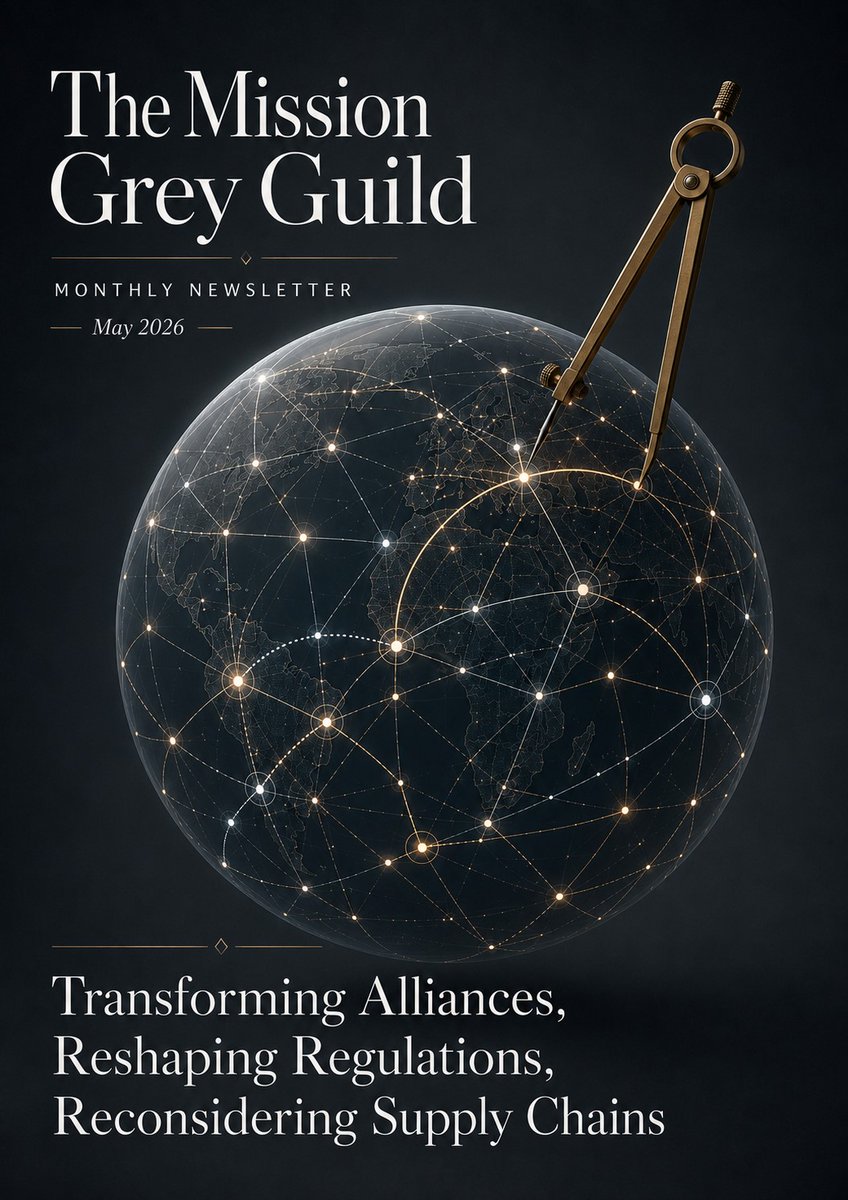
The third issue of the Mission Grey Guild Newsletter has been published!
Theme: Transforming Alliances, Reshaping Regulations, Reconsidering Supply Chains
The global economy is not simply fragmenting or integrating. Rather, it is being reorganized. As geopolitical competition, regulatory divergence, and supply chain transformation accelerate, organizations face a new reality: success increasingly depends on understanding the architecture of dependencies that shape markets, technologies, and investments.
In this issue, we explore:
• The New Global Operating System
• The Loop of Managed Interdependence
• The growing interaction between alliances, regulations, and sourcing decisions
• The rise of political admissibility as a business consideration
• Practical actions organizations can take to prepare for the "Great Rewiring"
The newsletter also includes a framework for leaders and decision-makers, including guidance on supply chain segmentation, carbon traceability, geopolitical risk assessment, and strategic investment planning.
"The winners will not necessarily be those with the largest scale, the lowest costs, or even the most advanced technologies. They will be those who understand the architecture of dependencies before it becomes visible to everyone else."
Read and subscribe:
missiongrey.com/insights
Please feel free to share with colleagues and others interested in international business, strategy, supply chain resilience, and geopolitics!
2
2
333
May 31
TRADE LAW IS NOW A BALANCE-SHEET RISK
One of the most important business stories today is not a new tariff, but the legal uncertainty around reversing old ones. The Trump administration is appealing a court order that would let all eligible importers seek refunds on tariffs the Supreme Court ruled unlawful. U.S. Customs has already accepted $85 billion in claims and directed $20.6 billion in refunds, out of an estimated $166 billion potentially owed across roughly 330,000 importers. A June 9 hearing could determine whether payments accelerate or stall. [cite:WP5A] [cite:NDBd] [cite:YBCn]
Why it matters: this is now a live variable for working capital, pricing and investor guidance. Some retailers say refunds could support price cuts, while smaller firms need the cash for debt reduction and operations. The implication is broader than tariffs alone: U.S. trade policy is becoming harder to model, even after courts rule. For companies exposed to imports, legal remedy risk now sits alongside supply-chain and inflation risk. [cite:WP5A] [cite:g2Zm]
17
May 30
EUROPE’S REARMAMENT IS NOW AN INDUSTRIAL STORY
Europe’s defence pivot is no longer just politics. EU defence spending has risen from €218 billion in 2021 to an estimated €381 billion in 2025, a 75% jump in four years, while the ReArm Europe agenda aims to mobilise up to €800 billion, including €150 billion through SAFE. This week, SAFE moved from plan to execution, with first contracts signed and Poland alone set to access €43.7 billion. [cite:gYUE] [cite:B6pK] [cite:zxU1]
The business impact runs well beyond prime contractors. EU ammunition capacity has expanded from roughly 300,000 shells in 2022 to around 2 million by end-2025. Cybersecurity revenue in Europe rose 10% year on year in April 2026, with identity and access management up 18%, while Goldman estimates rearmament could lift regional industrial metals demand by 6% by 2027. [cite:gYUE]
Implication: for manufacturers, metals, electronics and cyber firms, Europe’s security shift is becoming a multi-year demand cycle. But procurement, localisation and supply-chain sovereignty will matter as much as price.
24
May 29
EU’S CHINA TURN IS GETTING HARDER
Brussels is moving beyond “de-risking” language toward active industrial defense. Ahead of today’s China debate, five EU countries pushed for faster emergency tariffs, broader safeguards and new resilience tools to curb dependence on concentrated suppliers, while Beijing has already warned of retaliation. [cite:sWYG] [cite:xZaX]
The numbers explain the shift. EU goods exports to China were €199.6 billion in 2025, versus €559.4 billion of imports, leaving a €359.8 billion deficit. In the first four months of 2026 alone, China’s surplus with the EU reached about €98 billion, up from €78 billion a year earlier. One joint paper also says Europe lost 1 million industrial jobs between 2019 and 2025. [cite:zILv] [cite:J2Vw] [cite:sWYG]
Implication: companies should prepare for a more political EU market, where supplier concentration, subsidy exposure, ownership structure and local-content expectations matter more. For firms with Chinese sourcing, investment or clean-tech exposure, market access in Europe may become more conditional and less predictable.
25
May 28
MANAGED TRADE, HARDER RIVALRY
Washington and Beijing are moving toward tariff relief on roughly $30 billion of non-strategic goods, with the US set to seek public comment on which Chinese products qualify. But the strategic core of the relationship remains unchanged: US tariffs on China are still expected to stay structurally above those on other partners, while chips, rare earths and technology controls remain outside the thaw. [cite:NGen] [cite:Yjb5]
That distinction matters for business. This is not a return to normal trade. It is a narrower effort to stabilize low-sensitivity commerce while competition intensifies in the technologies that matter most for industrial power and national security. Nvidia’s latest quarter shows why: revenue reached $81.6 billion, up 85% year on year, with data center revenue up 92%, underscoring how fast AI demand is accelerating even as governments tighten controls. [cite:pHv4] [cite:rnbG]
Implication: near-term tariff shock risk may ease, but medium-term exposure to export controls, licensing, origin tracing and critical-mineral dependencies is still rising. For multinationals, “China plus one” is no longer enough without deeper compliance and supplier visibility.
17
May 27
SANCTIONS ARE MOVING INTO THE PAYMENT SYSTEM
The most important shift in today’s risk picture is not another trade ban, but a deeper attack on Russia’s financial plumbing. The UK has imposed 18 new sanctions targeting the Kremlin-linked A7 network, crypto channels, and entities in jurisdictions such as Kyrgyzstan and Georgia that London says helped route more than $1.5 billion back to Russia. British officials also say A7 may have processed over $90 billion in 2025, an extraordinary sign of how sanctions evasion has scaled. [cite:6s8i] [cite:l8gg] [cite:tTsN]
This matters well beyond Russia exposure. The EU has already tightened restrictions on Russian crypto platforms, the digital ruble, and the A7A5 ruble-backed stablecoin, showing that enforcement is moving from goods to payment rails. [cite:g9Rq] [cite:AZqU]
Implication: counterparty risk is becoming harder to see. For firms in commodities, shipping, trade finance, fintech and crypto, the danger is increasingly indirect exposure through intermediaries, not just direct Russia ties. Compliance is becoming a core operating capability, not a legal back office task.
26